‘A’ Level Philosophy and Ethics
                                  Notes
                       Aristotle - Causality

Aristotle's Metaphysics

Metaphysics:- Any enquiry that raises questions about reality
                that lie beyond or behind those capable of being
                tackled by the methods of science.
                                 (Oxford Dictionary of Philosophy)

                Literally, it means "Beyond Physics". The Metaphysical
                includes matters of Spirituality, Religion, Emotion and
                Love. It is essentially non-empirical and non-materialist,
                and empiricists have a deep mistrust of the metaphysical
                because talk of it cannot be supported by any sense
                experience. Note that David Hume argued against the
                Metaphysical, writing:

                Aristotle rejected Plato's idea of The Form. He felt that
                Plato's claim of "innate" knowledge was wrong, and that
                the idea of "Form" was built up through contact with the
                material world. The Form exists in our experience.

    Form and Aristotle proposed a system of categories, by which
       Matter objects in the material world were to be known:
              § I see a thing which I believe to be a man.
              § It conforms to my knowledge of "The Form of Man".
              § But it could be an ape, a statue or even a robot. How
                     do I know?
                §    There must be a concept of "Man" over and above the
                     form. I refer to this when I make my claim that the
                     object is a man.
                §    However, I still cannot be sure - I refer to another
                     concept of "man", and another......

                Because the Forms are "immanent" (indwelling) in the
                "particulars", we have true knowledge through our senses.

                Aristotle believed that all that we know is based closely on
                our experience. He established methods for acquiring this
                experience, and his methods form the foundations of
                modern science.
Aristotle - Causality


Causality
   Plato believed that a thing can be identified by its “Form”, an abstract
           idea that existed independently of the physical world.

Aristotle disagreed with his teacher. He believed that the identity of a thing is
a part of its physical existence. He distinguished between the substance of a
thing, and its form.

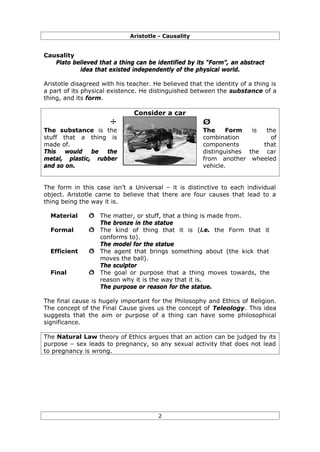
                               Consider a car
                      ÷                                ø
The substance is the                                   The     Form   is  the
stuff that a thing is                                  combination         of
made of.                                               components        that
This   would   be  the                                 distinguishes the car
metal, plastic, rubber                                 from another wheeled
and so on.                                             vehicle.


The form in this case isn’t a Universal – it is distinctive to each individual
object. Aristotle came to believe that there are four causes that lead to a
thing being the way it is.

  Material     ð The matter, or stuff, that a thing is made from.
                   The bronze in the statue
  Formal       ð The kind of thing that it is (i.e. the Form that it
                 conforms to).
                 The model for the statue
  Efficient    ð The agent that brings something about (the kick that
                 moves the ball).
                 The sculptor
  Final        ð The goal or purpose that a thing moves towards, the
                 reason why it is the way that it is.
                 The purpose or reason for the statue.

The final cause is hugely important for the Philosophy and Ethics of Religion.
The concept of the Final Cause gives us the concept of Teleology. This idea
suggests that the aim or purpose of a thing can have some philosophical
significance.

The Natural Law theory of Ethics argues that an action can be judged by its
purpose – sex leads to pregnancy, so any sexual activity that does not lead
to pregnancy is wrong.


                                       2

Aristotle Causality

  • 1.
    ‘A’ Level Philosophyand Ethics Notes Aristotle - Causality Aristotle's Metaphysics Metaphysics:- Any enquiry that raises questions about reality that lie beyond or behind those capable of being tackled by the methods of science. (Oxford Dictionary of Philosophy) Literally, it means "Beyond Physics". The Metaphysical includes matters of Spirituality, Religion, Emotion and Love. It is essentially non-empirical and non-materialist, and empiricists have a deep mistrust of the metaphysical because talk of it cannot be supported by any sense experience. Note that David Hume argued against the Metaphysical, writing: Aristotle rejected Plato's idea of The Form. He felt that Plato's claim of "innate" knowledge was wrong, and that the idea of "Form" was built up through contact with the material world. The Form exists in our experience. Form and Aristotle proposed a system of categories, by which Matter objects in the material world were to be known: § I see a thing which I believe to be a man. § It conforms to my knowledge of "The Form of Man". § But it could be an ape, a statue or even a robot. How do I know? § There must be a concept of "Man" over and above the form. I refer to this when I make my claim that the object is a man. § However, I still cannot be sure - I refer to another concept of "man", and another...... Because the Forms are "immanent" (indwelling) in the "particulars", we have true knowledge through our senses. Aristotle believed that all that we know is based closely on our experience. He established methods for acquiring this experience, and his methods form the foundations of modern science.
  • 2.
    Aristotle - Causality Causality Plato believed that a thing can be identified by its “Form”, an abstract idea that existed independently of the physical world. Aristotle disagreed with his teacher. He believed that the identity of a thing is a part of its physical existence. He distinguished between the substance of a thing, and its form. Consider a car ÷ ø The substance is the The Form is the stuff that a thing is combination of made of. components that This would be the distinguishes the car metal, plastic, rubber from another wheeled and so on. vehicle. The form in this case isn’t a Universal – it is distinctive to each individual object. Aristotle came to believe that there are four causes that lead to a thing being the way it is. Material ð The matter, or stuff, that a thing is made from. The bronze in the statue Formal ð The kind of thing that it is (i.e. the Form that it conforms to). The model for the statue Efficient ð The agent that brings something about (the kick that moves the ball). The sculptor Final ð The goal or purpose that a thing moves towards, the reason why it is the way that it is. The purpose or reason for the statue. The final cause is hugely important for the Philosophy and Ethics of Religion. The concept of the Final Cause gives us the concept of Teleology. This idea suggests that the aim or purpose of a thing can have some philosophical significance. The Natural Law theory of Ethics argues that an action can be judged by its purpose – sex leads to pregnancy, so any sexual activity that does not lead to pregnancy is wrong. 2