TELECOMMUTING By group 8 Ajith S Dipu  V L Krishnakumaran Thampi Ratheesh Susan Jacob
 
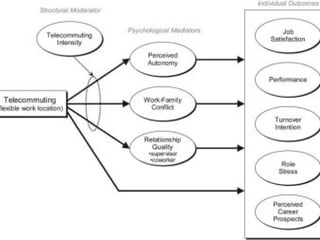
Introduction Telecommuting, the practice of working at home with the aid of computers, modems, and fax machines linked to the office, is becoming more prevalent in the modern business environment for a number of reasons. Environmental standards  are being imposed on many businesses across the country. Economic factors are causing many employers to consider alternatives to an office facility-based staff. There is also an increasing number of parents who wish to remain at home to care for young children while maintaining their positions at work.
Definition Telecommuting is an alternative work arrangement allowing to work at home or in some other location other than the employer’s physical premises    H John Bernardin
 
Types Of Telecommuting Working at home Satellite Offices Neighborhood work centers  Virtual office mobile workers
Benefits Greater Productivity Improved information turnaround Better Communication New mothers,physically challenged, individuals taking care of housebound persons Reduce time and flexibility in working hours
Challenges Feeling of isolation exploitation of workers  Workers less protected May not work without supervision Not remembered during promotions
Selection of Personnel Post job listings View resumes and telecommuter offices Identify the best  telecommuter Team worker
Equipment Procurement Equipments are needed in two main areas Communication Information
Conclusion As our global economy in the Information Age evolves, telecommuting will increasingly become a popular work style. Many companies are turning to telecommuting to solve the dilemma of recruiting and retaining quality employees, controlling costs of office space, and meeting environmental standards. The major national advantages for telecommuting include savings in gasoline, a reduction in pollution, a decrease in traffic congestion, and lower highway accident rates. For a successful telecommuting program, top-down support is vital, employee support is necessary, screening is important, training is essential, and guidelines are required. Major capital investments are not necessary. Telecommuting should be customized for each agency, each employee, and each task. Peter Drucker sums up telecommuting in the following quotation: "Commuting to office work is obsolete. It is now infinitely easier, cheaper, and faster … to move information … to where the people are."
Bibliography www.answers.com Human Resource Management  by H.John Bernardin www.knowledgetree.com
 

Telecommuting 8

  • 1.
    TELECOMMUTING By group8 Ajith S Dipu V L Krishnakumaran Thampi Ratheesh Susan Jacob
  • 2.
  • 3.
    Introduction Telecommuting, thepractice of working at home with the aid of computers, modems, and fax machines linked to the office, is becoming more prevalent in the modern business environment for a number of reasons. Environmental standards are being imposed on many businesses across the country. Economic factors are causing many employers to consider alternatives to an office facility-based staff. There is also an increasing number of parents who wish to remain at home to care for young children while maintaining their positions at work.
  • 4.
    Definition Telecommuting isan alternative work arrangement allowing to work at home or in some other location other than the employer’s physical premises H John Bernardin
  • 5.
  • 6.
    Types Of TelecommutingWorking at home Satellite Offices Neighborhood work centers Virtual office mobile workers
  • 7.
    Benefits Greater ProductivityImproved information turnaround Better Communication New mothers,physically challenged, individuals taking care of housebound persons Reduce time and flexibility in working hours
  • 8.
    Challenges Feeling ofisolation exploitation of workers Workers less protected May not work without supervision Not remembered during promotions
  • 9.
    Selection of PersonnelPost job listings View resumes and telecommuter offices Identify the best telecommuter Team worker
  • 10.
    Equipment Procurement Equipmentsare needed in two main areas Communication Information
  • 11.
    Conclusion As ourglobal economy in the Information Age evolves, telecommuting will increasingly become a popular work style. Many companies are turning to telecommuting to solve the dilemma of recruiting and retaining quality employees, controlling costs of office space, and meeting environmental standards. The major national advantages for telecommuting include savings in gasoline, a reduction in pollution, a decrease in traffic congestion, and lower highway accident rates. For a successful telecommuting program, top-down support is vital, employee support is necessary, screening is important, training is essential, and guidelines are required. Major capital investments are not necessary. Telecommuting should be customized for each agency, each employee, and each task. Peter Drucker sums up telecommuting in the following quotation: "Commuting to office work is obsolete. It is now infinitely easier, cheaper, and faster … to move information … to where the people are."
  • 12.
    Bibliography www.answers.com HumanResource Management by H.John Bernardin www.knowledgetree.com
  • 13.