Telecom Product Development:
Business Cases and Cost Modelling
PITA AGM 2016
Workshop Session
Igor Glavanic
Managing Director
Parcus Group
Agenda
1. Telecom product development: Business case & product cost models
a) Why are new products required
b) Product development issues
c) End-to-end process overview
d) Importance of framework and market focus
e) Steps in product cost model development
f) Key data required
g) Modelling approach
h) Next steps post modelling
i) Product development process improvements
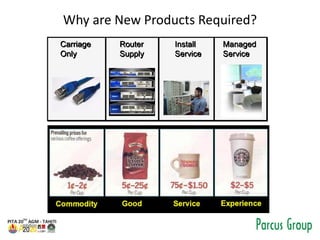
Why are New Products Required?
Carriage
Only
Router
Supply
Install
Service
Managed
Service
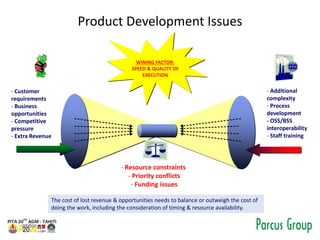
Product Development Issues
- Customer
requirements
- Business
opportunities
- Competitive
pressure
- Extra Revenue
- Resource constraints
- Priority conflicts
- Funding issues
The cost of lost revenue & opportunities needs to balance or outweigh the cost of
doing the work, including the consideration of timing & resource availability.
- Additional
complexity
- Process
development
- OSS/BSS
interoperability
- Staff training
WINING FACTOR:
SPEED & QUALITY OF
EXECUTION
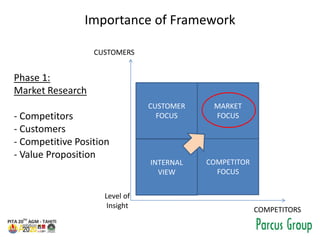
Importance of Framework
Phase 1:
Market Research
- Competitors
- Customers
- Competitive Position
- Value Proposition
COMPETITORS
CUSTOMERS
INTERNAL
VIEW
CUSTOMER
FOCUS
COMPETITOR
FOCUS
MARKET
FOCUS
Level of
Insight
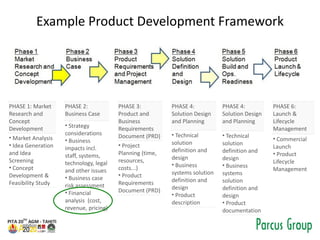
Example Product Development Framework
PHASE 1: Market
Research and
Concept
Development
• Market Analysis
• Idea Generation
and Idea
Screening
• Concept
Development &
Feasibility Study
PHASE 2:
Business Case
• Strategy
considerations
• Business
impacts incl.
staff, systems,
technology, legal
and other issues
• Business case
risk assessment
• Financial
analysis (cost,
revenue, pricing)
PHASE 3:
Product and
Business
Requirements
Document (PRD)
• Project
Planning (time,
resources,
costs...)
• Product
Requirements
Document (PRD)
PHASE 4:
Solution Design
and Planning
• Technical
solution
definition and
design
• Business
systems solution
definition and
design
• Product
description
PHASE 4:
Solution Design
and Planning
• Technical
solution
definition and
design
• Business
systems
solution
definition and
design
• Product
documentation
PHASE 6:
Launch &
Lifecycle
Management
• Commercial
Launch
• Product
Lifecycle
Management
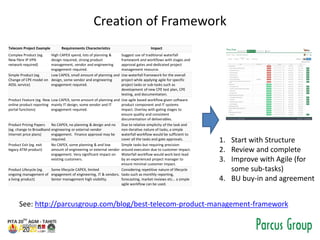
Creation of Framework
See: http://parcusgroup.com/blog/best-telecom-product-management-framework
Telecom Project Example Requirements Characteristics Impact
Complex Product (eg.
New fibre IP VPN
network required)
High CAPEX spend, lots of planning &
design required, strong product
management, vendor and engineering
engagement required.
Suggest use of traditional waterfall
framework and workflows with stages and
approval gates and dedicated project
management resource.
Simple Product (eg.
Change of CPE model on
ADSL service)
Low CAPEX, small amount of planning and
design, some vendor and engineering
engagement required.
Use waterfall framework for the overall
project while applying agile for specific
project tasks or sub-tasks such as
development of new CPE test plan, CPE
testing, and documentation.
Product Feature (eg. New
online product reporting
portal functions)
Low CAPEX, some amount of planning and
mainly IT design, some vendor and IT
engagement required.
Use agile based workflow given software
product component and IT systems
impact. Overlay with gating stages to
ensure quality and consistent
documentation of deliverables.
Product Pricing Papers
(eg. change to Broadband
Internet price plans)
No CAPEX, no planning & design and no
engineering or external vendor
engagement. Finance approval may be
required.
Due to relative simplicity of the task and
non-iterative nature of tasks, a simple
waterfall workflow would be sufficient to
cover all the tasks and gate approvals.
Product Exit (eg. exit
legacy ATM product)
No CAPEX, some planning & and low
amount of engineering or external vendor
engagement. Very significant impact on
existing customers.
Simple tasks but requiring precision
around execution due to customer impact.
Waterfall workflow would work best lead
by an experienced project manager to
ensure minimal customer impact.
Product Lifecycle (eg.
ongoing management of
a living product)
Some lifecycle CAPEX, limited
engagement of engineering, IT & vendors.
Senior management high visibility.
Considering repetitive nature of lifecycle
tasks such as monthly reporting,
forecasting, market reviews etc… a simple
agile workflow can be used.
1. Start with Structure
2. Review and complete
3. Improve with Agile (for
some sub-tasks)
4. BU buy-in and agreement
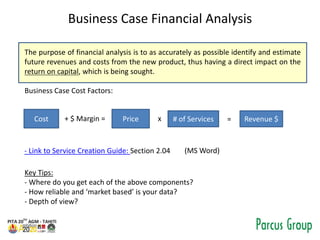
Business Case Financial Analysis
The purpose of financial analysis is to as accurately as possible identify and estimate
future revenues and costs from the new product, thus having a direct impact on the
return on capital, which is being sought.
Business Case Cost Factors:
PriceCost # of Services+ $ Margin = x Revenue $=
Key Tips:
- Where do you get each of the above components?
- How reliable and ‘market based’ is your data?
- Depth of view?
- Link to Service Creation Guide: Section 2.04 (MS Word)
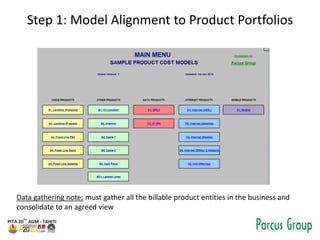
Step 1: Model Alignment to Product Portfolios
Data gathering note: must gather all the billable product entities in the business and
consolidate to an agreed view
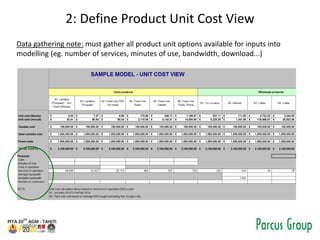
2: Define Product Unit Cost View
Data gathering note: must gather all product unit options available for inputs into
modelling (eg. number of services, minutes of use, bandwidth, download...)
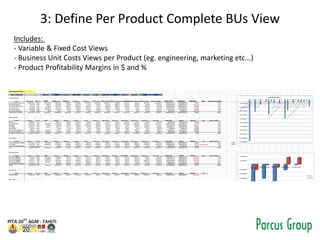
3: Define Per Product Complete BUs View
Includes:
- Variable & Fixed Cost Views
- Business Unit Costs Views per Product (eg. engineering, marketing etc...)
- Product Profitability Margins in $ and %
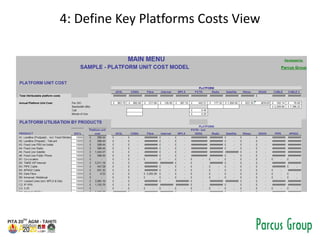
4: Define Key Platforms Costs View
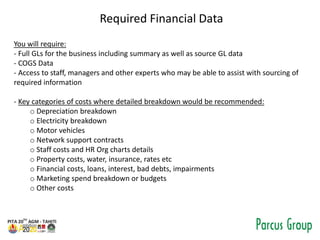
Required Financial Data
You will require:
- Full GLs for the business including summary as well as source GL data
- COGS Data
- Access to staff, managers and other experts who may be able to assist with sourcing of
required information
- Key categories of costs where detailed breakdown would be recommended:
o Depreciation breakdown
o Electricity breakdown
o Motor vehicles
o Network support contracts
o Staff costs and HR Org charts details
o Property costs, water, insurance, rates etc
o Financial costs, loans, interest, bad debts, impairments
o Marketing spend breakdown or budgets
o Other costs
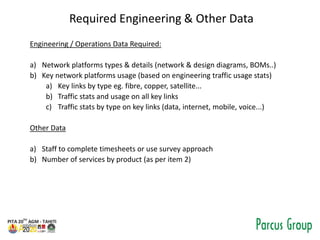
Required Engineering & Other Data
Engineering / Operations Data Required:
a) Network platforms types & details (network & design diagrams, BOMs..)
b) Key network platforms usage (based on engineering traffic usage stats)
a) Key links by type eg. fibre, copper, satellite...
b) Traffic stats and usage on all key links
c) Traffic stats by type on key links (data, internet, mobile, voice...)
Other Data
a) Staff to complete timesheets or use survey approach
b) Number of services by product (as per item 2)
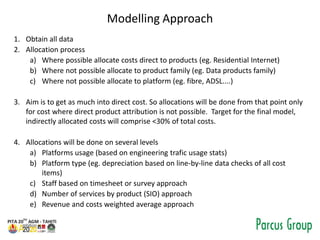
Modelling Approach
1. Obtain all data
2. Allocation process
a) Where possible allocate costs direct to products (eg. Residential Internet)
b) Where not possible allocate to product family (eg. Data products family)
c) Where not possible allocate to platform (eg. fibre, ADSL....)
3. Aim is to get as much into direct cost. So allocations will be done from that point only
for cost where direct product attribution is not possible. Target for the final model,
indirectly allocated costs will comprise <30% of total costs.
4. Allocations will be done on several levels
a) Platforms usage (based on engineering trafic usage stats)
b) Platform type (eg. depreciation based on line-by-line data checks of all cost
items)
c) Staff based on timesheet or survey approach
d) Number of services by product (SIO) approach
e) Revenue and costs weighted average approach
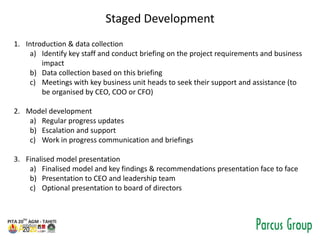
Staged Development
1. Introduction & data collection
a) Identify key staff and conduct briefing on the project requirements and business
impact
b) Data collection based on this briefing
c) Meetings with key business unit heads to seek their support and assistance (to
be organised by CEO, COO or CFO)
2. Model development
a) Regular progress updates
b) Escalation and support
c) Work in progress communication and briefings
3. Finalised model presentation
a) Finalised model and key findings & recommendations presentation face to face
b) Presentation to CEO and leadership team
c) Optional presentation to board of directors
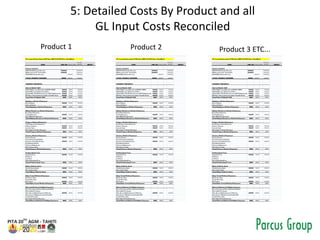
5: Detailed Costs By Product and all
GL Input Costs Reconciled
Product 1 Product 2 Product 3 ETC...
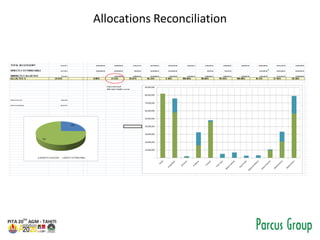
Allocations Reconciliation
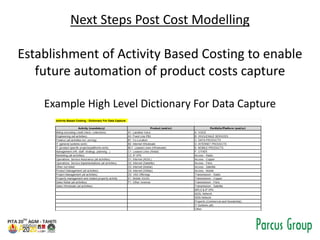
Next Steps Post Cost Modelling
Establishment of Activity Based Costing to enable
future automation of product costs capture
Example High Level Dictionary For Data Capture
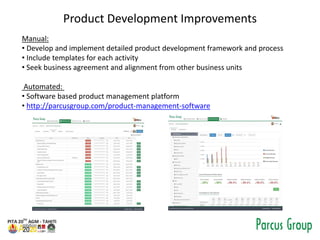
Product Development Improvements
Manual:
• Develop and implement detailed product development framework and process
• Include templates for each activity
• Seek business agreement and alignment from other business units
Automated:
• Software based product management platform
• http://parcusgroup.com/product-management-software
Thank You
For more information contact:
Parcus Group
Igor Glavanic
www.parcusgroup.com
And visit:
http://parcusgroup.com/product-management-training

Telecom product cost models development approach

  • 1.
    Telecom Product Development: BusinessCases and Cost Modelling PITA AGM 2016 Workshop Session Igor Glavanic Managing Director Parcus Group
  • 2.
    Agenda 1. Telecom productdevelopment: Business case & product cost models a) Why are new products required b) Product development issues c) End-to-end process overview d) Importance of framework and market focus e) Steps in product cost model development f) Key data required g) Modelling approach h) Next steps post modelling i) Product development process improvements
  • 3.
    Why are NewProducts Required? Carriage Only Router Supply Install Service Managed Service
  • 4.
    Product Development Issues -Customer requirements - Business opportunities - Competitive pressure - Extra Revenue - Resource constraints - Priority conflicts - Funding issues The cost of lost revenue & opportunities needs to balance or outweigh the cost of doing the work, including the consideration of timing & resource availability. - Additional complexity - Process development - OSS/BSS interoperability - Staff training WINING FACTOR: SPEED & QUALITY OF EXECUTION
  • 5.
    Importance of Framework Phase1: Market Research - Competitors - Customers - Competitive Position - Value Proposition COMPETITORS CUSTOMERS INTERNAL VIEW CUSTOMER FOCUS COMPETITOR FOCUS MARKET FOCUS Level of Insight
  • 6.
    Example Product DevelopmentFramework PHASE 1: Market Research and Concept Development • Market Analysis • Idea Generation and Idea Screening • Concept Development & Feasibility Study PHASE 2: Business Case • Strategy considerations • Business impacts incl. staff, systems, technology, legal and other issues • Business case risk assessment • Financial analysis (cost, revenue, pricing) PHASE 3: Product and Business Requirements Document (PRD) • Project Planning (time, resources, costs...) • Product Requirements Document (PRD) PHASE 4: Solution Design and Planning • Technical solution definition and design • Business systems solution definition and design • Product description PHASE 4: Solution Design and Planning • Technical solution definition and design • Business systems solution definition and design • Product documentation PHASE 6: Launch & Lifecycle Management • Commercial Launch • Product Lifecycle Management
  • 7.
    Creation of Framework See:http://parcusgroup.com/blog/best-telecom-product-management-framework Telecom Project Example Requirements Characteristics Impact Complex Product (eg. New fibre IP VPN network required) High CAPEX spend, lots of planning & design required, strong product management, vendor and engineering engagement required. Suggest use of traditional waterfall framework and workflows with stages and approval gates and dedicated project management resource. Simple Product (eg. Change of CPE model on ADSL service) Low CAPEX, small amount of planning and design, some vendor and engineering engagement required. Use waterfall framework for the overall project while applying agile for specific project tasks or sub-tasks such as development of new CPE test plan, CPE testing, and documentation. Product Feature (eg. New online product reporting portal functions) Low CAPEX, some amount of planning and mainly IT design, some vendor and IT engagement required. Use agile based workflow given software product component and IT systems impact. Overlay with gating stages to ensure quality and consistent documentation of deliverables. Product Pricing Papers (eg. change to Broadband Internet price plans) No CAPEX, no planning & design and no engineering or external vendor engagement. Finance approval may be required. Due to relative simplicity of the task and non-iterative nature of tasks, a simple waterfall workflow would be sufficient to cover all the tasks and gate approvals. Product Exit (eg. exit legacy ATM product) No CAPEX, some planning & and low amount of engineering or external vendor engagement. Very significant impact on existing customers. Simple tasks but requiring precision around execution due to customer impact. Waterfall workflow would work best lead by an experienced project manager to ensure minimal customer impact. Product Lifecycle (eg. ongoing management of a living product) Some lifecycle CAPEX, limited engagement of engineering, IT & vendors. Senior management high visibility. Considering repetitive nature of lifecycle tasks such as monthly reporting, forecasting, market reviews etc… a simple agile workflow can be used. 1. Start with Structure 2. Review and complete 3. Improve with Agile (for some sub-tasks) 4. BU buy-in and agreement
  • 8.
    Business Case FinancialAnalysis The purpose of financial analysis is to as accurately as possible identify and estimate future revenues and costs from the new product, thus having a direct impact on the return on capital, which is being sought. Business Case Cost Factors: PriceCost # of Services+ $ Margin = x Revenue $= Key Tips: - Where do you get each of the above components? - How reliable and ‘market based’ is your data? - Depth of view? - Link to Service Creation Guide: Section 2.04 (MS Word)
  • 9.
    Step 1: ModelAlignment to Product Portfolios Data gathering note: must gather all the billable product entities in the business and consolidate to an agreed view
  • 10.
    2: Define ProductUnit Cost View Data gathering note: must gather all product unit options available for inputs into modelling (eg. number of services, minutes of use, bandwidth, download...)
  • 11.
    3: Define PerProduct Complete BUs View Includes: - Variable & Fixed Cost Views - Business Unit Costs Views per Product (eg. engineering, marketing etc...) - Product Profitability Margins in $ and %
  • 12.
    4: Define KeyPlatforms Costs View
  • 13.
    Required Financial Data Youwill require: - Full GLs for the business including summary as well as source GL data - COGS Data - Access to staff, managers and other experts who may be able to assist with sourcing of required information - Key categories of costs where detailed breakdown would be recommended: o Depreciation breakdown o Electricity breakdown o Motor vehicles o Network support contracts o Staff costs and HR Org charts details o Property costs, water, insurance, rates etc o Financial costs, loans, interest, bad debts, impairments o Marketing spend breakdown or budgets o Other costs
  • 14.
    Required Engineering &Other Data Engineering / Operations Data Required: a) Network platforms types & details (network & design diagrams, BOMs..) b) Key network platforms usage (based on engineering traffic usage stats) a) Key links by type eg. fibre, copper, satellite... b) Traffic stats and usage on all key links c) Traffic stats by type on key links (data, internet, mobile, voice...) Other Data a) Staff to complete timesheets or use survey approach b) Number of services by product (as per item 2)
  • 15.
    Modelling Approach 1. Obtainall data 2. Allocation process a) Where possible allocate costs direct to products (eg. Residential Internet) b) Where not possible allocate to product family (eg. Data products family) c) Where not possible allocate to platform (eg. fibre, ADSL....) 3. Aim is to get as much into direct cost. So allocations will be done from that point only for cost where direct product attribution is not possible. Target for the final model, indirectly allocated costs will comprise <30% of total costs. 4. Allocations will be done on several levels a) Platforms usage (based on engineering trafic usage stats) b) Platform type (eg. depreciation based on line-by-line data checks of all cost items) c) Staff based on timesheet or survey approach d) Number of services by product (SIO) approach e) Revenue and costs weighted average approach
  • 16.
    Staged Development 1. Introduction& data collection a) Identify key staff and conduct briefing on the project requirements and business impact b) Data collection based on this briefing c) Meetings with key business unit heads to seek their support and assistance (to be organised by CEO, COO or CFO) 2. Model development a) Regular progress updates b) Escalation and support c) Work in progress communication and briefings 3. Finalised model presentation a) Finalised model and key findings & recommendations presentation face to face b) Presentation to CEO and leadership team c) Optional presentation to board of directors
  • 17.
    5: Detailed CostsBy Product and all GL Input Costs Reconciled Product 1 Product 2 Product 3 ETC...
  • 18.
  • 19.
    Next Steps PostCost Modelling Establishment of Activity Based Costing to enable future automation of product costs capture Example High Level Dictionary For Data Capture
  • 20.
    Product Development Improvements Manual: •Develop and implement detailed product development framework and process • Include templates for each activity • Seek business agreement and alignment from other business units Automated: • Software based product management platform • http://parcusgroup.com/product-management-software
  • 21.
    Thank You For moreinformation contact: Parcus Group Igor Glavanic www.parcusgroup.com And visit: http://parcusgroup.com/product-management-training