NEXT GEN BILLING- a look at the evolving role of billing Ehtisham Rao Asia Pacific Billing and RA 2011
Billing has changed
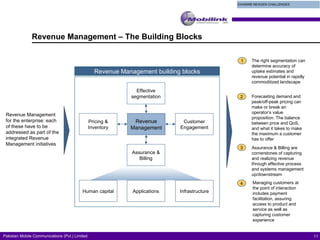
Revenue Management – The Building Blocks Revenue Management for the enterprise: each of these have to be addressed as part of the integrated Revenue Management initiatives The right segmentation can determine accuracy of uptake estimates and revenue potential in rapidly commoditized landscape Managing customers at the point of interaction includes payment facilitation, assuring access to product and service as well as capturing customer experience Assurance & Billing are cornerstones of capturing and realizing revenue through effective process and systems management up/downstream Forecasting demand and peak/off-peak pricing can make or break an operator’s value proposition. The balance between price and QoS, and what it takes to make the maximum a customer has to offer 1 2 3 4 Revenue Management building blocks Revenue Management Effective segmentation Assurance & Billing Customer Engagement Pricing & Inventory Human capital Applications Infrastructure
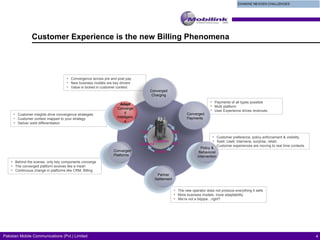
Customer Experience is the new Billing Phenomena Convergence across pre and post pay New business models are key drivers Value is locked in customer context Payments of all types possible Multi platform User Experience drives revenues Customer insights drive convergence strategies Customer context mapped to your strategy Deliver solid differentiation Customer preference, policy enforcement & visibility Xsell, Usell, intervene, surprise, retain Customer experiences are moving to real time contexts The new operator does not produce everything it sells More business models, more adaptability We’re not a bitpipe…right? Behind the scenes, only key components converge The converged platform evolves like a mesh Continuous change in platforms like CRM, Billing Converged Payments Converged Charging Policy & Behavioral Intervention Partner Settlement Customer Adapt  Converged Intelligence Converged Platforms Opt Pay Consume Test Switch
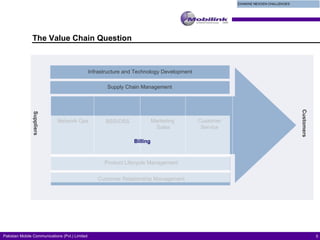
Infrastructure and Technology Development Supply Chain Management Product Lifecycle Management Network Ops BSS/OSS Marketing  Sales Customer Service Customer Relationship Management Customers Suppliers The Value Chain Question Billing
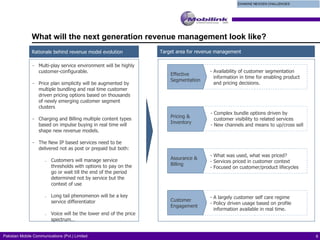
What will the next generation revenue management look like? Rationale behind revenue model evolution Multi-play service environment will be highly customer-configurable. Price plan simplicity will be augmented by multiple bundling and real time customer driven pricing options based on thousands of newly emerging customer segment clusters Charging and Billing multiple content types based on impulse buying in real time will shape new revenue models. The New IP based services need to be delivered not as post or prepaid but both: Customers will manage service thresholds with options to pay on the go or wait till the end of the period determined not by service but the context of use Long tail phenomenon will be a key service differentiator Voice will be the lower end of the price spectrum… Target area for revenue management Availability of customer segmentation information in time for enabling product and pricing decisions.  Complex bundle options driven by customer visibility to related services New channels and means to up/cross sell What was used, what was priced? Services priced in customer context Focused on customer/product lifecycles A largely customer self care regime Policy driven usage based on profile information available in real time. Effective Segmentation Pricing & Inventory Assurance & Billing Customer Engagement
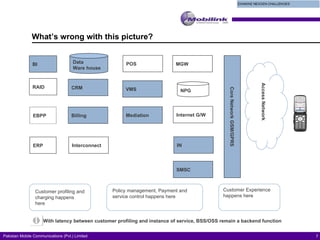
What’s wrong with this picture? Data  Ware house ERP BI RAID EBPP Billing Interconnect CRM Core Network GSM/GPRS Internet G/W MGW IN SMSC POS Mediation NPG VMS Access Network Customer profiling and charging happens here Policy management, Payment and service control happens here Customer Experience  happens here With latency between customer profiling and instance of service, BSS/OSS remain a backend function
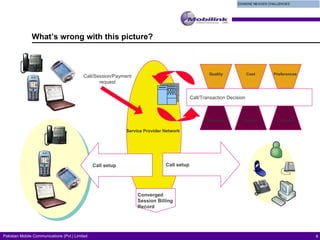
What’s wrong with this picture? Call setup Call/Session/Payment request Call/Transaction Decision Quality Cost Preferences Presence Status Location Call setup Service Provider Network Converged  Session Billing Record
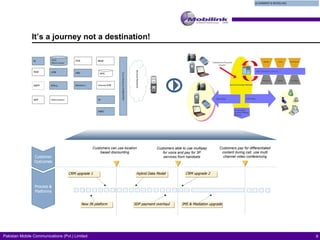
It’s a journey not a destination! New IN platform CRM upgrade 1 Hybrid Data Model SDP payment overhaul CRM upgrade 2 Customers can use location based discounting Customers able to use multipay for voice and pay for 3P services from handsets IMS & Mediation upgrade Customers pay for differentiated content during call, use multi channel video conferencing Process & Platforms Customer Outcomes
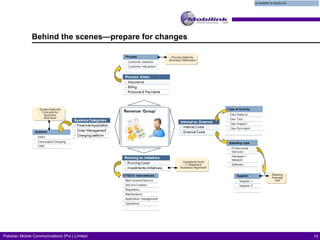
Behind the scenes—prepare for changes
Revenue Management – The Building Blocks Revenue Management for the enterprise: each of these have to be addressed as part of the integrated Revenue Management initiatives The right segmentation can determine accuracy of uptake estimates and revenue potential in rapidly commoditized landscape Managing customers at the point of interaction includes payment facilitation, assuring access to product and service as well as capturing customer experience Assurance & Billing are cornerstones of capturing and realizing revenue through effective process and systems management up/downstream Forecasting demand and peak/off-peak pricing can make or break an operator’s value proposition. The balance between price and QoS, and what it takes to make the maximum a customer has to offer 1 2 3 4 Revenue Management building blocks Revenue Management Effective segmentation Assurance & Billing Customer Engagement Pricing & Inventory Human capital Applications Infrastructure
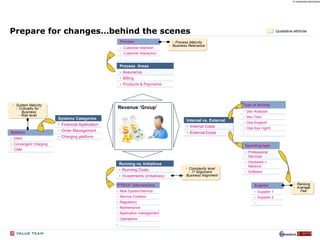
Prepare for changes…behind the scenes Revenue ‘Group’ Process Maturity Business Relevance Qualitative attribute Ranking Average Fee Complexity level IT Alignment Business Alignment System Maturity Criticality for Business Risk level Spending type Professional Services Hardware + Network Software IT/TECH  Interventions New System/Service Service Creation Regulatory Maintenance Application management Operations … . Process  Areas Assurance Billing Products & Payments Type of Activity Dev-Analysis Dev-Test Ops-Support Ops-Sys mgmt … Process Customer retention Customer Interaction … Systems Categories Financial Application Order Management Charging platform Systems DWH Convergent Charging CRM Running vs. Initiatives Running Costs Investments (initiatives) Internal vs. External Internal Costs External Costs Supplier Supplier 1 Supplier 2 …
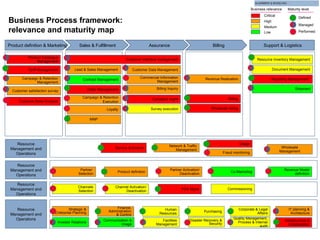
Business Process framework: relevance and maturity map Partner  Selection Partner Activation/ Deactivation Product definition Co-Marketing Revenue Model definition Channels Selection Channel Activation/ Deactivation Service Activation Usage Wholesale Management Fraud monitoring Investor Relations Communication & Image Strategic & Enterprise Planning Human Resources Purchasing Corporate & Legal Affairs Disaster Recovery & Security Finance, Administration & Control Quality Management, Process & Internal audit IT planning & Architecture Facilities Management Infrastructure & Collaboration Network & Traffic Management POS Mgmt Commissioning Resource Management and Operations Resource Management and Operations Resource Management and Operations Resource Management and Operations Defined Performed Business relevance Critical High Medium Low Maturity level Managed Support & Logistics Product definition & Marketing Sales & Fulfillment Assurance Product Catalogue Management Tariff Management Campaign & Retention Management Commercial Information Management Complaint mgmt Customer satisfaction survey Resource Inventory Management Document Management Billing Inquiry Customer Data Management Order Management Lead & Sales Management Contract Management Reporting Management* Customer interface management Survey execution Loyalty Campaign & Retention Execution Shipment Billing Billing Revenue Realization Wholesale billing Customer Base Analysis MNP
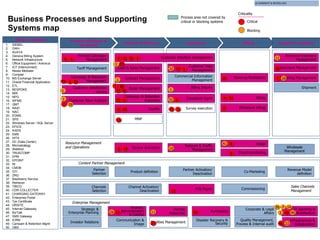
Business Processes and Supporting Systems map Support & Logistics Product definition & Marketing Sales & Fulfillment Assurance Product Catalogue Management Tariff Management Campaign & Retention Management Commercial Information Management Complaint mgmt Customer satisfaction survey Partner  Selection Partner Activation/ Deactivation Product definition Co-Marketing Revenue Model definition Content Partner Management Resource Inventory Management Channels Selection Channel Activation/ Deactivation Document Management Billing Inquiry Customer Data Management Order Management Lead & Sales Management Contract Management Reporting Management Customer interface management Survey execution Loyalty Campaign & Retention Execution Shipment Billing Billing Revenue Realization Resource Management and Operations Service Activation Usage Enterprise Management Wholesale Management Fraud monitoring Investor Relations Communication & Image Strategic & Enterprise Planning Human Resources Purchasing Corporate & Legal Affairs Disaster Recovery & Security Finance, Administration & Control Quality Management, Process & Internal audit IT planning & Architecture Facilities Management SIEBEL DWH AVAYA Geneva Billing System Network Infrastructure Office Equipment / Antivirus ICT (Interconnect) Nexes Mediater Comptel MS Exchange Server Oracle Financial Application ETL BESPOKE MW NPG WFMS QMT RAID  NAC EDMS SPS Windows Server / SQL Server EFICS KXEN EMS HITS DC (Data Center) Microstrategy WeMind TRUECOMP EPM EPOINT IN CMDB GTI ZRG Blackberry Service Retriever TIBCO CDR COLLECTER CHARGING GATEWAY Enterprise Portal  Tax Certificate DRSITE Internet Gatewaty BizTalk SMS Gateway ICRM Campain & Retention Mgmt OBS Wholesale billing Main IT Systems 3 46 40 49 Infrastructure & Collaboration Process area not covered by critical or blocking systems Network & Traffic Management Customer Base Analysis MNP Sales Channels Management POS Mgmt Commissioning Critical Blocking Criticality 3 46 46 41 9 27 2 2 2 2 20 23 23 23 32 32 32 32 32 32 12 4 4 26 48 7 7 33 24 28 28 10 22 14 14 8 15 8 50 11 11 11 11 18 39 29 1 1 1 1 1 1 1 1 1 1 1 1
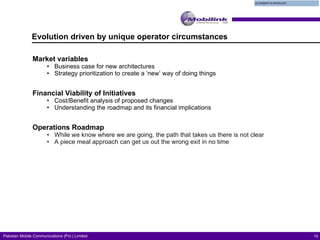
Evolution driven by unique operator circumstances Market variables Business case for new architectures Strategy prioritization to create a ‘new’ way of doing things Financial Viability of Initiatives Cost/Benefit analysis of proposed changes Understanding the roadmap and its financial implications Operations Roadmap While we know where we are going, the path that takes us there is not clear A piece meal approach can get us out the wrong exit in no time
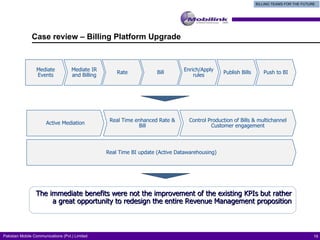
Case review – Billing Platform Upgrade Mediate Events Mediate IR and Billing Rate Bill Enrich/Apply rules Publish Bills Push to BI Active Mediation Real Time enhanced Rate & Bill Control Production of Bills & multichannel Customer engagement Real Time BI update (Active Datawarehousing) The immediate benefits were not the improvement of the existing KPIs but rather a great opportunity to redesign the entire Revenue Management proposition BILLING TEAMS FOR THE FUTURE
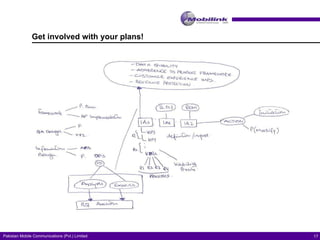
Get involved with your plans!
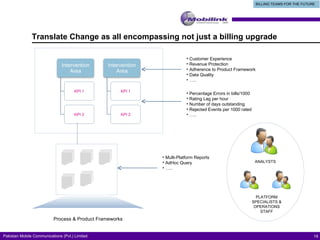
Translate Change as all encompassing not just a billing upgrade Customer Experience Revenue Protection Adherence to Product Framework Data Quality … .. Percentage Errors in bills/1000 Rating Lag per hour Number of days outstanding Rejected Events per 1000 rated … .. Multi-Platform Reports AdHoc Query … .. Process & Product Frameworks BILLING TEAMS FOR THE FUTURE ANALYSTS PLATFORM SPECIALISTS & OPERATIONS STAFF
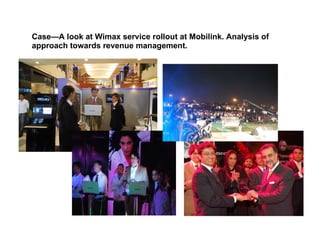
Case—A look at Wimax service rollout at Mobilink. Analysis of approach towards revenue management.
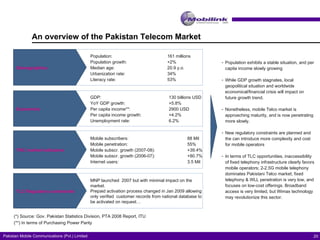
An overview of the Pakistan Telecom Market (*) Source: Gov. Pakistan Statistics Division, PTA 2008 Report, ITU (**) In terms of Purchasing Power Parity Population:  161 millions Population growth: +2% Median age: 20.9 y.o. Urbanization rate: 34% Literacy rate: 53% Demographics GDP:  130 billions USD YoY GDP growth: +5.8% Per capita income**: 2900 USD Per capita income growth:  +4.2% Unemployment rate: 6.2% Economics Mobile subscribers: 88 Mil Mobile penetration: 55% Mobile subscr. growth (2007-08): +39.4% Mobile subscr. growth (2006-07): +80.7% Internet users: 3.5 Mil TKC market indicators Population exhibits a stable situation, and per capita income slowly growing While GDP growth stagnates, local geopolitical situation and worldwide economical/financial crisis will impact on future growth trend. Nonetheless, mobile Telco market is approaching maturity, and is now penetrating more slowly. New regulatory constraints are planned and the can introduce more complexity and cost for mobile operators In terms of TLC opportunities, inaccessibility of fixed telephony infrastructure clearly favors mobile operators; 2-2.5G mobile telephony dominates Pakistani Telco market; fixed telephony & WLL penetration is very low, and focuses on low-cost offerings. Broadband access is very limited, but Wimax technology may revolutionize this sector. MNP launched  2007 but with minimal impact on the market. Prepaid activation process changed in Jan 2009 allowing only verified  customer records from national database to be activated on request… TLC Regulatory constraints
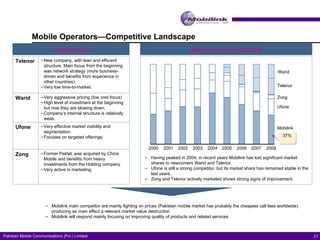
Mobile Operators—Competitive Landscape Market share dynamics 2000-2008 Competitor focus Mobilink main competitor are mainly fighting on prices (Pakistan mobile market has probably the cheapest call fees worldwide) producing as main effect a relevant market value destruction Mobilink will respond mainly focusing on improving quality of products and related services Having peaked in 2004, in recent years Mobilink has lost significant market shares to newcomers Warid and Telenor. Ufone is still a strong competitor, but its market share has remained stable in the last years. Zong and Telenor actively marketed shows strong signs of improvement. 37% Telenor New company, with lean and efficient structure. Main focus from the beginning was network strategy (more business-driven and benefits from experience in other countries). Very low time-to-market. Warid Very aggressive pricing (low cost focus) High level of investment at the beginning but now they are slowing down. Company’s internal structure is relatively weak. Ufone Very effective market visibility and segmentation.  Focuses on targeted offerings. Zong Former  Paktel , was acquired by China Mobile and benefits from heavy investments from the Holding company Very active in marketing. 2000 2001 2002 2003 2004 2005 2006 2007 2008 Warid  Telenor  Zong  Ufone  Mobilink
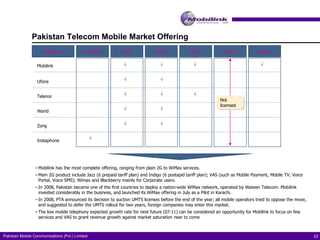
Pakistan Telecom Mobile Market Offering Mobilink has the most complete offering, ranging from plain 2G to WiMax services.  Main 2G product include Jazz (6 prepaid tariff plan) and Indigo (6 postapid tariff plan); VAS (such as Mobile Payment, Mobile TV, Voice Portal, Voice SMS); Wimax and Blackberry mainly for Corporate users. In 2008, Pakistan became one of the first countries to deploy a nation-wide WiMax network, operated by Wateen Telecom. Mobilink invested considerably in the business, and launched its WiMax offering in July as a Pilot in Karachi. In 2008, PTA announced its decision to auction UMTS licenses before the end of the year; all mobile operators tried to oppose the move, and suggested to defer the UMTS rollout for two years, foreign companies may enter this market. The low mobile telephony expected growth rate for next future (07-11) can be considered an opportunity for Mobilink to focus on few services and VAS to grant revenue growth against market saturation near to come  US-TDMA GSM GPRS EDGE UMTS WiMax Mobilink Ufone Telenor Warid Zong Instaphone               Operator Not licensed
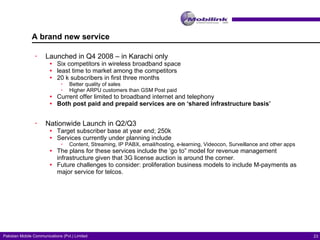
A brand new service Launched in Q4 2008 – in Karachi only Six competitors in wireless broadband space least time to market among the competitors 20 k subscribers in first three months Better quality of sales Higher ARPU customers than GSM Post paid Current offer limited to broadband internet and telephony Both post paid and prepaid services are on ‘shared infrastructure basis’ Nationwide Launch in Q2/Q3  Target subscriber base at year end; 250k Services currently under planning include Content, Streaming, IP PABX, email/hosting, e-learning, Videocon, Surveillance and other apps  The plans for these services include the ‘go to” model for revenue management infrastructure given that 3G license auction is around the corner. Future challenges to consider: proliferation business models to include M-payments as major service for telcos.
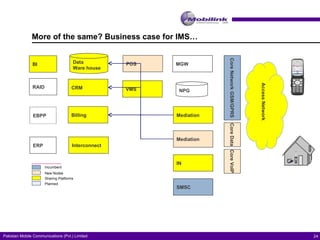
More of the same? Business case for IMS… Data  Ware house ERP BI RAID EBPP Billing Interconnect CRM Core Network GSM/GPRS MGW IN SMSC POS Mediation NPG VMS Access Network Core Data Core VoIP Incumbent New Nodes Sharing Platforms Planned Mediation


Thank you—any questions? Ehtisham Rao Director Business Intelligence & Billing, Mobilink +00923008499114 [email_address]

Telecom Billing's evolving role in post pc era

  • 1.
    NEXT GEN BILLING-a look at the evolving role of billing Ehtisham Rao Asia Pacific Billing and RA 2011
  • 2.
  • 3.
    Revenue Management –The Building Blocks Revenue Management for the enterprise: each of these have to be addressed as part of the integrated Revenue Management initiatives The right segmentation can determine accuracy of uptake estimates and revenue potential in rapidly commoditized landscape Managing customers at the point of interaction includes payment facilitation, assuring access to product and service as well as capturing customer experience Assurance & Billing are cornerstones of capturing and realizing revenue through effective process and systems management up/downstream Forecasting demand and peak/off-peak pricing can make or break an operator’s value proposition. The balance between price and QoS, and what it takes to make the maximum a customer has to offer 1 2 3 4 Revenue Management building blocks Revenue Management Effective segmentation Assurance & Billing Customer Engagement Pricing & Inventory Human capital Applications Infrastructure
  • 4.
    Customer Experience isthe new Billing Phenomena Convergence across pre and post pay New business models are key drivers Value is locked in customer context Payments of all types possible Multi platform User Experience drives revenues Customer insights drive convergence strategies Customer context mapped to your strategy Deliver solid differentiation Customer preference, policy enforcement & visibility Xsell, Usell, intervene, surprise, retain Customer experiences are moving to real time contexts The new operator does not produce everything it sells More business models, more adaptability We’re not a bitpipe…right? Behind the scenes, only key components converge The converged platform evolves like a mesh Continuous change in platforms like CRM, Billing Converged Payments Converged Charging Policy & Behavioral Intervention Partner Settlement Customer Adapt Converged Intelligence Converged Platforms Opt Pay Consume Test Switch
  • 5.
    Infrastructure and TechnologyDevelopment Supply Chain Management Product Lifecycle Management Network Ops BSS/OSS Marketing Sales Customer Service Customer Relationship Management Customers Suppliers The Value Chain Question Billing
  • 6.
    What will thenext generation revenue management look like? Rationale behind revenue model evolution Multi-play service environment will be highly customer-configurable. Price plan simplicity will be augmented by multiple bundling and real time customer driven pricing options based on thousands of newly emerging customer segment clusters Charging and Billing multiple content types based on impulse buying in real time will shape new revenue models. The New IP based services need to be delivered not as post or prepaid but both: Customers will manage service thresholds with options to pay on the go or wait till the end of the period determined not by service but the context of use Long tail phenomenon will be a key service differentiator Voice will be the lower end of the price spectrum… Target area for revenue management Availability of customer segmentation information in time for enabling product and pricing decisions. Complex bundle options driven by customer visibility to related services New channels and means to up/cross sell What was used, what was priced? Services priced in customer context Focused on customer/product lifecycles A largely customer self care regime Policy driven usage based on profile information available in real time. Effective Segmentation Pricing & Inventory Assurance & Billing Customer Engagement
  • 7.
    What’s wrong withthis picture? Data Ware house ERP BI RAID EBPP Billing Interconnect CRM Core Network GSM/GPRS Internet G/W MGW IN SMSC POS Mediation NPG VMS Access Network Customer profiling and charging happens here Policy management, Payment and service control happens here Customer Experience happens here With latency between customer profiling and instance of service, BSS/OSS remain a backend function
  • 8.
    What’s wrong withthis picture? Call setup Call/Session/Payment request Call/Transaction Decision Quality Cost Preferences Presence Status Location Call setup Service Provider Network Converged Session Billing Record
  • 9.
    It’s a journeynot a destination! New IN platform CRM upgrade 1 Hybrid Data Model SDP payment overhaul CRM upgrade 2 Customers can use location based discounting Customers able to use multipay for voice and pay for 3P services from handsets IMS & Mediation upgrade Customers pay for differentiated content during call, use multi channel video conferencing Process & Platforms Customer Outcomes
  • 10.
  • 11.
    Revenue Management –The Building Blocks Revenue Management for the enterprise: each of these have to be addressed as part of the integrated Revenue Management initiatives The right segmentation can determine accuracy of uptake estimates and revenue potential in rapidly commoditized landscape Managing customers at the point of interaction includes payment facilitation, assuring access to product and service as well as capturing customer experience Assurance & Billing are cornerstones of capturing and realizing revenue through effective process and systems management up/downstream Forecasting demand and peak/off-peak pricing can make or break an operator’s value proposition. The balance between price and QoS, and what it takes to make the maximum a customer has to offer 1 2 3 4 Revenue Management building blocks Revenue Management Effective segmentation Assurance & Billing Customer Engagement Pricing & Inventory Human capital Applications Infrastructure
  • 12.
    Prepare for changes…behindthe scenes Revenue ‘Group’ Process Maturity Business Relevance Qualitative attribute Ranking Average Fee Complexity level IT Alignment Business Alignment System Maturity Criticality for Business Risk level Spending type Professional Services Hardware + Network Software IT/TECH Interventions New System/Service Service Creation Regulatory Maintenance Application management Operations … . Process Areas Assurance Billing Products & Payments Type of Activity Dev-Analysis Dev-Test Ops-Support Ops-Sys mgmt … Process Customer retention Customer Interaction … Systems Categories Financial Application Order Management Charging platform Systems DWH Convergent Charging CRM Running vs. Initiatives Running Costs Investments (initiatives) Internal vs. External Internal Costs External Costs Supplier Supplier 1 Supplier 2 …
  • 13.
    Business Process framework:relevance and maturity map Partner Selection Partner Activation/ Deactivation Product definition Co-Marketing Revenue Model definition Channels Selection Channel Activation/ Deactivation Service Activation Usage Wholesale Management Fraud monitoring Investor Relations Communication & Image Strategic & Enterprise Planning Human Resources Purchasing Corporate & Legal Affairs Disaster Recovery & Security Finance, Administration & Control Quality Management, Process & Internal audit IT planning & Architecture Facilities Management Infrastructure & Collaboration Network & Traffic Management POS Mgmt Commissioning Resource Management and Operations Resource Management and Operations Resource Management and Operations Resource Management and Operations Defined Performed Business relevance Critical High Medium Low Maturity level Managed Support & Logistics Product definition & Marketing Sales & Fulfillment Assurance Product Catalogue Management Tariff Management Campaign & Retention Management Commercial Information Management Complaint mgmt Customer satisfaction survey Resource Inventory Management Document Management Billing Inquiry Customer Data Management Order Management Lead & Sales Management Contract Management Reporting Management* Customer interface management Survey execution Loyalty Campaign & Retention Execution Shipment Billing Billing Revenue Realization Wholesale billing Customer Base Analysis MNP
  • 14.
    Business Processes andSupporting Systems map Support & Logistics Product definition & Marketing Sales & Fulfillment Assurance Product Catalogue Management Tariff Management Campaign & Retention Management Commercial Information Management Complaint mgmt Customer satisfaction survey Partner Selection Partner Activation/ Deactivation Product definition Co-Marketing Revenue Model definition Content Partner Management Resource Inventory Management Channels Selection Channel Activation/ Deactivation Document Management Billing Inquiry Customer Data Management Order Management Lead & Sales Management Contract Management Reporting Management Customer interface management Survey execution Loyalty Campaign & Retention Execution Shipment Billing Billing Revenue Realization Resource Management and Operations Service Activation Usage Enterprise Management Wholesale Management Fraud monitoring Investor Relations Communication & Image Strategic & Enterprise Planning Human Resources Purchasing Corporate & Legal Affairs Disaster Recovery & Security Finance, Administration & Control Quality Management, Process & Internal audit IT planning & Architecture Facilities Management SIEBEL DWH AVAYA Geneva Billing System Network Infrastructure Office Equipment / Antivirus ICT (Interconnect) Nexes Mediater Comptel MS Exchange Server Oracle Financial Application ETL BESPOKE MW NPG WFMS QMT RAID NAC EDMS SPS Windows Server / SQL Server EFICS KXEN EMS HITS DC (Data Center) Microstrategy WeMind TRUECOMP EPM EPOINT IN CMDB GTI ZRG Blackberry Service Retriever TIBCO CDR COLLECTER CHARGING GATEWAY Enterprise Portal Tax Certificate DRSITE Internet Gatewaty BizTalk SMS Gateway ICRM Campain & Retention Mgmt OBS Wholesale billing Main IT Systems 3 46 40 49 Infrastructure & Collaboration Process area not covered by critical or blocking systems Network & Traffic Management Customer Base Analysis MNP Sales Channels Management POS Mgmt Commissioning Critical Blocking Criticality 3 46 46 41 9 27 2 2 2 2 20 23 23 23 32 32 32 32 32 32 12 4 4 26 48 7 7 33 24 28 28 10 22 14 14 8 15 8 50 11 11 11 11 18 39 29 1 1 1 1 1 1 1 1 1 1 1 1
  • 15.
    Evolution driven byunique operator circumstances Market variables Business case for new architectures Strategy prioritization to create a ‘new’ way of doing things Financial Viability of Initiatives Cost/Benefit analysis of proposed changes Understanding the roadmap and its financial implications Operations Roadmap While we know where we are going, the path that takes us there is not clear A piece meal approach can get us out the wrong exit in no time
  • 16.
    Case review –Billing Platform Upgrade Mediate Events Mediate IR and Billing Rate Bill Enrich/Apply rules Publish Bills Push to BI Active Mediation Real Time enhanced Rate & Bill Control Production of Bills & multichannel Customer engagement Real Time BI update (Active Datawarehousing) The immediate benefits were not the improvement of the existing KPIs but rather a great opportunity to redesign the entire Revenue Management proposition BILLING TEAMS FOR THE FUTURE
  • 17.
    Get involved withyour plans!
  • 18.
    Translate Change asall encompassing not just a billing upgrade Customer Experience Revenue Protection Adherence to Product Framework Data Quality … .. Percentage Errors in bills/1000 Rating Lag per hour Number of days outstanding Rejected Events per 1000 rated … .. Multi-Platform Reports AdHoc Query … .. Process & Product Frameworks BILLING TEAMS FOR THE FUTURE ANALYSTS PLATFORM SPECIALISTS & OPERATIONS STAFF
  • 19.
    Case—A look atWimax service rollout at Mobilink. Analysis of approach towards revenue management.
  • 20.
    An overview ofthe Pakistan Telecom Market (*) Source: Gov. Pakistan Statistics Division, PTA 2008 Report, ITU (**) In terms of Purchasing Power Parity Population: 161 millions Population growth: +2% Median age: 20.9 y.o. Urbanization rate: 34% Literacy rate: 53% Demographics GDP: 130 billions USD YoY GDP growth: +5.8% Per capita income**: 2900 USD Per capita income growth: +4.2% Unemployment rate: 6.2% Economics Mobile subscribers: 88 Mil Mobile penetration: 55% Mobile subscr. growth (2007-08): +39.4% Mobile subscr. growth (2006-07): +80.7% Internet users: 3.5 Mil TKC market indicators Population exhibits a stable situation, and per capita income slowly growing While GDP growth stagnates, local geopolitical situation and worldwide economical/financial crisis will impact on future growth trend. Nonetheless, mobile Telco market is approaching maturity, and is now penetrating more slowly. New regulatory constraints are planned and the can introduce more complexity and cost for mobile operators In terms of TLC opportunities, inaccessibility of fixed telephony infrastructure clearly favors mobile operators; 2-2.5G mobile telephony dominates Pakistani Telco market; fixed telephony & WLL penetration is very low, and focuses on low-cost offerings. Broadband access is very limited, but Wimax technology may revolutionize this sector. MNP launched 2007 but with minimal impact on the market. Prepaid activation process changed in Jan 2009 allowing only verified customer records from national database to be activated on request… TLC Regulatory constraints
  • 21.
    Mobile Operators—Competitive LandscapeMarket share dynamics 2000-2008 Competitor focus Mobilink main competitor are mainly fighting on prices (Pakistan mobile market has probably the cheapest call fees worldwide) producing as main effect a relevant market value destruction Mobilink will respond mainly focusing on improving quality of products and related services Having peaked in 2004, in recent years Mobilink has lost significant market shares to newcomers Warid and Telenor. Ufone is still a strong competitor, but its market share has remained stable in the last years. Zong and Telenor actively marketed shows strong signs of improvement. 37% Telenor New company, with lean and efficient structure. Main focus from the beginning was network strategy (more business-driven and benefits from experience in other countries). Very low time-to-market. Warid Very aggressive pricing (low cost focus) High level of investment at the beginning but now they are slowing down. Company’s internal structure is relatively weak. Ufone Very effective market visibility and segmentation. Focuses on targeted offerings. Zong Former Paktel , was acquired by China Mobile and benefits from heavy investments from the Holding company Very active in marketing. 2000 2001 2002 2003 2004 2005 2006 2007 2008 Warid Telenor Zong Ufone Mobilink
  • 22.
    Pakistan Telecom MobileMarket Offering Mobilink has the most complete offering, ranging from plain 2G to WiMax services. Main 2G product include Jazz (6 prepaid tariff plan) and Indigo (6 postapid tariff plan); VAS (such as Mobile Payment, Mobile TV, Voice Portal, Voice SMS); Wimax and Blackberry mainly for Corporate users. In 2008, Pakistan became one of the first countries to deploy a nation-wide WiMax network, operated by Wateen Telecom. Mobilink invested considerably in the business, and launched its WiMax offering in July as a Pilot in Karachi. In 2008, PTA announced its decision to auction UMTS licenses before the end of the year; all mobile operators tried to oppose the move, and suggested to defer the UMTS rollout for two years, foreign companies may enter this market. The low mobile telephony expected growth rate for next future (07-11) can be considered an opportunity for Mobilink to focus on few services and VAS to grant revenue growth against market saturation near to come US-TDMA GSM GPRS EDGE UMTS WiMax Mobilink Ufone Telenor Warid Zong Instaphone               Operator Not licensed
  • 23.
    A brand newservice Launched in Q4 2008 – in Karachi only Six competitors in wireless broadband space least time to market among the competitors 20 k subscribers in first three months Better quality of sales Higher ARPU customers than GSM Post paid Current offer limited to broadband internet and telephony Both post paid and prepaid services are on ‘shared infrastructure basis’ Nationwide Launch in Q2/Q3 Target subscriber base at year end; 250k Services currently under planning include Content, Streaming, IP PABX, email/hosting, e-learning, Videocon, Surveillance and other apps The plans for these services include the ‘go to” model for revenue management infrastructure given that 3G license auction is around the corner. Future challenges to consider: proliferation business models to include M-payments as major service for telcos.
  • 24.
    More of thesame? Business case for IMS… Data Ware house ERP BI RAID EBPP Billing Interconnect CRM Core Network GSM/GPRS MGW IN SMSC POS Mediation NPG VMS Access Network Core Data Core VoIP Incumbent New Nodes Sharing Platforms Planned Mediation
  • 25.
  • 26.
  • 27.
  • 28.
  • 29.
    Thank you—any questions?Ehtisham Rao Director Business Intelligence & Billing, Mobilink +00923008499114 [email_address]

Editor's Notes

  • #3 The idea behind revenue management is to not sell an additional unit of capacity for less than you expect to receive from another customer!
  • #4 Its not about the buzzwords-Convergence, Service oriented Architecture (SOA).The forces that drive change and the forces that resist change will in all likelihood do it for the same reason again and again. Marketing will blame idea to market time as unacceptably long. Sales and channel management will ask for processes to remain the same as the world transforms around them, IT and technical will want the world to be explained with technical constraints….revenue management suffers the most from silo-ed organizational structures. Revenue assurance and new revenue realization sit at the center of an organization’s survival strategy and yet do not drive the cohesion that is required for it to work in the first place…
  • #5 Its not about the buzzwords-Convergence, Service oriented Architecture (SOA).The forces that drive change and the forces that resist change will in all likelihood do it for the same reason again and again. Marketing will blame idea to market time as unacceptably long. Sales and channel management will ask for processes to remain the same as the world transforms around them, IT and technical will want the world to be explained with technical constraints….revenue management suffers the most from silo-ed organizational structures. Revenue assurance and new revenue realization sit at the center of an organization’s survival strategy and yet do not drive the cohesion that is required for it to work in the first place…
  • #12 Its not about the buzzwords-Convergence, Service oriented Architecture (SOA).The forces that drive change and the forces that resist change will in all likelihood do it for the same reason again and again. Marketing will blame idea to market time as unacceptably long. Sales and channel management will ask for processes to remain the same as the world transforms around them, IT and technical will want the world to be explained with technical constraints….revenue management suffers the most from silo-ed organizational structures. Revenue assurance and new revenue realization sit at the center of an organization’s survival strategy and yet do not drive the cohesion that is required for it to work in the first place…