Teeth
Rihaab
10 F
Teeth
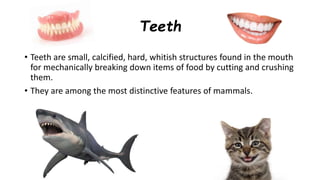
• Teeth are small, calcified, hard, whitish structures found in the mouth
for mechanically breaking down items of food by cutting and crushing
them.
• They are among the most distinctive features of mammals.
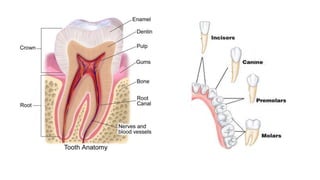
Teeth are made of:
• The hard material of the tooth is composed of calcium, phosphorus,
and other mineral salts
• The material in the majority of the tooth is called the dentine
• The hard, shiny layer that you brush is called the enamel
• The pulp or pulp chamber is the soft area within the center of the
tooth and contains the nerve, blood vessels, and connective tissue
• The roots are normally buried in bone, and they serve to anchor the
tooth in position. The roots are covered with a thin layer of bone,
and they are inserted into sockets in the bone of the jaw
Types of teeth and their function:
There are 4 types of teeth in the oral cavity:
• Incisors - The four front teeth in both the upper and lower jaws are called incisors. Their primary
function is to cut food. The two incisors on either side of the midline are known as central
incisors. The two adjacent teeth to the central incisors are known as the lateral incisors. Incisors
have a single root and a sharp incisal edge
• Canines - There are four canines in the oral cavity. Two in the upper jaw and two in the lower jaw.
They are behind and adjacent to the lateral incisors. Their main function is to tear food. They
have a single root.They have the longest root of any tooth. They also serve to form the corners of
the mouth
• Premolars (Bicuspids) - These teeth are located behind and adjacent to the canines and are
designed to crush food. There are eight premolars in the oral cavity. The one closest to the
midline is the first premolar and the one farthest from the midline is the second premolar. The
maxillary first premolar has two roots, and the remaining premolars have a single root
• Molars - The most posterior teeth in the mouth are the molars. They are designed to grind
food. Molars typically have two roots, although the maxillary first molar (behind the second
premolar) has three roots. There are 12 molars in the permanent dentition. They are named
starting with closest to the midline as first molars, second molars and third molars. Although,
some people do not fully develop the third molars. Third molars are often referred to as wisdom
teeth
Oh no! Tooth Decay…
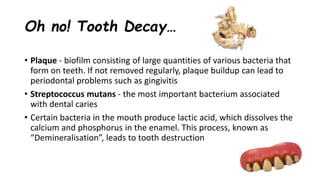
• Plaque - biofilm consisting of large quantities of various bacteria that
form on teeth. If not removed regularly, plaque buildup can lead to
periodontal problems such as gingivitis
• Streptococcus mutans - the most important bacterium associated
with dental caries
• Certain bacteria in the mouth produce lactic acid, which dissolves the
calcium and phosphorus in the enamel. This process, known as
“Demineralisation”, leads to tooth destruction
Tooth Care:
• Oral hygiene is the practice of keeping the mouth clean and
is a means of preventing dental caries, gingivitis, periodontal
disease, bad breath and other dental disorders
• Brush your teeth twice in a day
• Regular dental check up is also recommended
HAVE A GOOD DAY!!!!

TEETH

  • 1.
  • 2.
    Teeth • Teeth aresmall, calcified, hard, whitish structures found in the mouth for mechanically breaking down items of food by cutting and crushing them. • They are among the most distinctive features of mammals.
  • 3.
    Teeth are madeof: • The hard material of the tooth is composed of calcium, phosphorus, and other mineral salts • The material in the majority of the tooth is called the dentine • The hard, shiny layer that you brush is called the enamel • The pulp or pulp chamber is the soft area within the center of the tooth and contains the nerve, blood vessels, and connective tissue • The roots are normally buried in bone, and they serve to anchor the tooth in position. The roots are covered with a thin layer of bone, and they are inserted into sockets in the bone of the jaw
  • 4.
    Types of teethand their function: There are 4 types of teeth in the oral cavity: • Incisors - The four front teeth in both the upper and lower jaws are called incisors. Their primary function is to cut food. The two incisors on either side of the midline are known as central incisors. The two adjacent teeth to the central incisors are known as the lateral incisors. Incisors have a single root and a sharp incisal edge • Canines - There are four canines in the oral cavity. Two in the upper jaw and two in the lower jaw. They are behind and adjacent to the lateral incisors. Their main function is to tear food. They have a single root.They have the longest root of any tooth. They also serve to form the corners of the mouth • Premolars (Bicuspids) - These teeth are located behind and adjacent to the canines and are designed to crush food. There are eight premolars in the oral cavity. The one closest to the midline is the first premolar and the one farthest from the midline is the second premolar. The maxillary first premolar has two roots, and the remaining premolars have a single root • Molars - The most posterior teeth in the mouth are the molars. They are designed to grind food. Molars typically have two roots, although the maxillary first molar (behind the second premolar) has three roots. There are 12 molars in the permanent dentition. They are named starting with closest to the midline as first molars, second molars and third molars. Although, some people do not fully develop the third molars. Third molars are often referred to as wisdom teeth
  • 6.
    Oh no! ToothDecay… • Plaque - biofilm consisting of large quantities of various bacteria that form on teeth. If not removed regularly, plaque buildup can lead to periodontal problems such as gingivitis • Streptococcus mutans - the most important bacterium associated with dental caries • Certain bacteria in the mouth produce lactic acid, which dissolves the calcium and phosphorus in the enamel. This process, known as “Demineralisation”, leads to tooth destruction
  • 7.
    Tooth Care: • Oralhygiene is the practice of keeping the mouth clean and is a means of preventing dental caries, gingivitis, periodontal disease, bad breath and other dental disorders • Brush your teeth twice in a day • Regular dental check up is also recommended HAVE A GOOD DAY!!!!