BY
OLATOMIWA AYODELE
INTRODUCTION
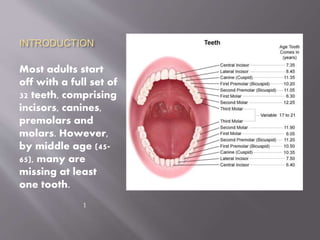
Most adults start
off with a full set of
32 teeth, comprising
incisors, canines,
premolars and
molars. However,
by middle age (45-
65), many are
missing at least
one tooth.
1
COMMON CAUSES OF TOOTH LOSS
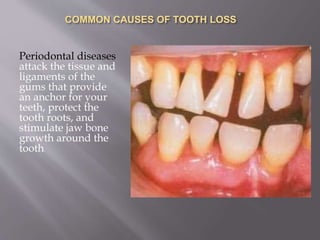
Periodontal diseases
attack the tissue and
ligaments of the
gums that provide
an anchor for your
teeth, protect the
tooth roots, and
stimulate jaw bone
growth around the
tooth.
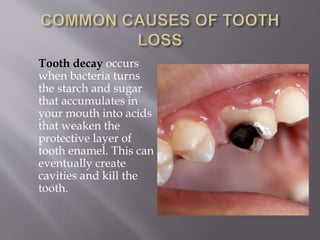
Tooth decay occurs
when bacteria turns
the starch and sugar
that accumulates in
your mouth into acids
that weaken the
protective layer of
tooth enamel. This can
eventually create
cavities and kill the
tooth.
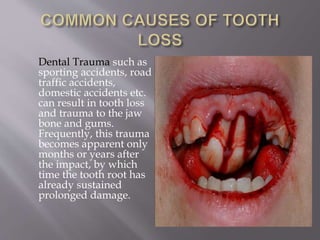
Dental Trauma such as
sporting accidents, road
traffic accidents,
domestic accidents etc.
can result in tooth loss
and trauma to the jaw
bone and gums.
Frequently, this trauma
becomes apparent only
months or years after
the impact, by which
time the tooth root has
already sustained
prolonged damage.
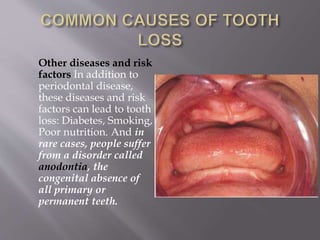
Other diseases and risk
factors In addition to
periodontal disease,
these diseases and risk
factors can lead to tooth
loss: Diabetes, Smoking,
Poor nutrition. And in
rare cases, people suffer
from a disorder called
anodontia, the
congenital absence of
all primary or
permanent teeth.
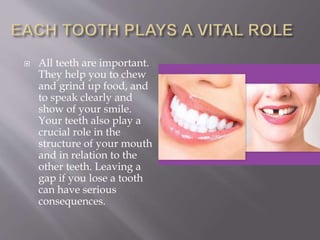
 All teeth are important.
They help you to chew
and grind up food, and
to speak clearly and
show of your smile.
Your teeth also play a
crucial role in the
structure of your mouth
and in relation to the
other teeth. Leaving a
gap if you lose a tooth
can have serious
consequences.
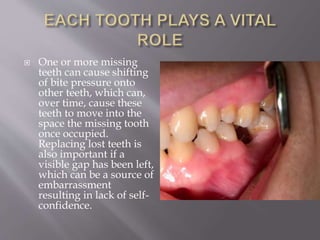
 One or more missing
teeth can cause shifting
of bite pressure onto
other teeth, which can,
over time, cause these
teeth to move into the
space the missing tooth
once occupied.
Replacing lost teeth is
also important if a
visible gap has been left,
which can be a source of
embarrassment
resulting in lack of self-
confidence.
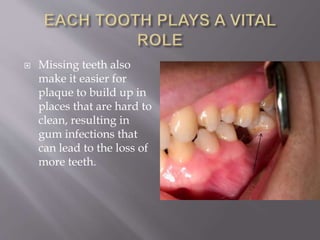
 Missing teeth also
make it easier for
plaque to build up in
places that are hard to
clean, resulting in
gum infections that
can lead to the loss of
more teeth.
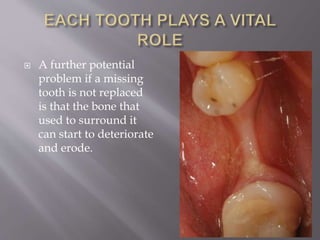
 A further potential
problem if a missing
tooth is not replaced
is that the bone that
used to surround it
can start to deteriorate
and erode.
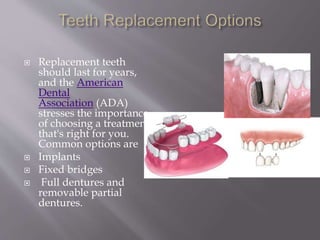
 Replacement teeth
should last for years,
and the American
Dental
Association (ADA)
stresses the importance
of choosing a treatment
that's right for you.
Common options are
 Implants
 Fixed bridges
 Full dentures and
removable partial
dentures.
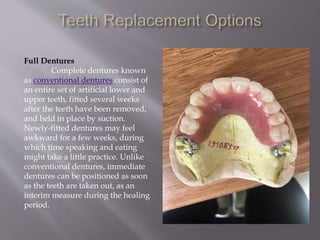
Full Dentures
Complete dentures known
as conventional dentures consist of
an entire set of artificial lower and
upper teeth, fitted several weeks
after the teeth have been removed,
and held in place by suction.
Newly-fitted dentures may feel
awkward for a few weeks, during
which time speaking and eating
might take a little practice. Unlike
conventional dentures, immediate
dentures can be positioned as soon
as the teeth are taken out, as an
interim measure during the healing
period.
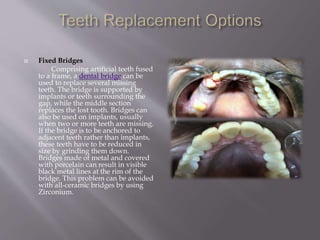
 Fixed Bridges
Comprising artificial teeth fused
to a frame, a dental bridge can be
used to replace several missing
teeth. The bridge is supported by
implants or teeth surrounding the
gap, while the middle section
replaces the lost tooth. Bridges can
also be used on implants, usually
when two or more teeth are missing.
If the bridge is to be anchored to
adjacent teeth rather than implants,
these teeth have to be reduced in
size by grinding them down.
Bridges made of metal and covered
with porcelain can result in visible
black metal lines at the rim of the
bridge. This problem can be avoided
with all-ceramic bridges by using
Zirconium.
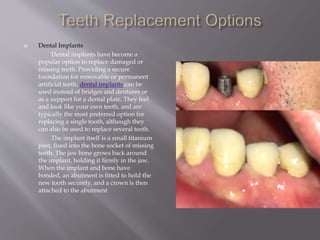
 Dental Implants
Dental implants have become a
popular option to replace damaged or
missing teeth. Providing a secure
foundation for removable or permanent
artificial teeth, dental implants can be
used instead of bridges and dentures or
as a support for a dental plate. They feel
and look like your own teeth, and are
typically the most preferred option for
replacing a single tooth, although they
can also be used to replace several teeth.
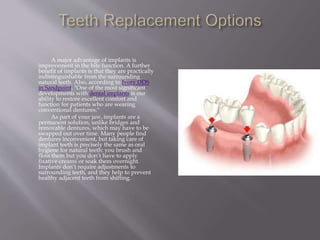
The implant itself is a small titanium
post, fixed into the bone socket of missing
teeth. The jaw bone grows back around
the implant, holding it firmly in the jaw.
When the implant and bone have
bonded, an abutment is fitted to hold the
new tooth securely, and a crown is then
attached to the abutment.
A major advantage of implants is
improvement in the bite function. A further
benefit of implants is that they are practically
indistinguishable from the surrounding
natural teeth. Also, according to Ivory DDS
in Sandpoint, "One of the most significant
developments with dental implants is our
ability to restore excellent comfort and
function for patients who are wearing
conventional dentures."
As part of your jaw, implants are a
permanent solution, unlike bridges and
removable dentures, which may have to be
swapped out over time. Many people find
dentures inconvenient, but taking care of
implant teeth is precisely the same as oral
hygiene for natural teeth: you brush and
floss them but you don’t have to apply
fixative creams or soak them overnight.
Implants don’t require adjustments to
surrounding teeth, and they help to prevent
healthy adjacent teeth from shifting.

Importance of replacing lost teeth

  • 1.
  • 2.
    INTRODUCTION Most adults start offwith a full set of 32 teeth, comprising incisors, canines, premolars and molars. However, by middle age (45- 65), many are missing at least one tooth. 1
  • 3.
    COMMON CAUSES OFTOOTH LOSS Periodontal diseases attack the tissue and ligaments of the gums that provide an anchor for your teeth, protect the tooth roots, and stimulate jaw bone growth around the tooth.
  • 4.
    Tooth decay occurs whenbacteria turns the starch and sugar that accumulates in your mouth into acids that weaken the protective layer of tooth enamel. This can eventually create cavities and kill the tooth.
  • 5.
    Dental Trauma suchas sporting accidents, road traffic accidents, domestic accidents etc. can result in tooth loss and trauma to the jaw bone and gums. Frequently, this trauma becomes apparent only months or years after the impact, by which time the tooth root has already sustained prolonged damage.
  • 6.
    Other diseases andrisk factors In addition to periodontal disease, these diseases and risk factors can lead to tooth loss: Diabetes, Smoking, Poor nutrition. And in rare cases, people suffer from a disorder called anodontia, the congenital absence of all primary or permanent teeth.
  • 7.
     All teethare important. They help you to chew and grind up food, and to speak clearly and show of your smile. Your teeth also play a crucial role in the structure of your mouth and in relation to the other teeth. Leaving a gap if you lose a tooth can have serious consequences.
  • 8.
     One ormore missing teeth can cause shifting of bite pressure onto other teeth, which can, over time, cause these teeth to move into the space the missing tooth once occupied. Replacing lost teeth is also important if a visible gap has been left, which can be a source of embarrassment resulting in lack of self- confidence.
  • 9.
     Missing teethalso make it easier for plaque to build up in places that are hard to clean, resulting in gum infections that can lead to the loss of more teeth.
  • 10.
     A furtherpotential problem if a missing tooth is not replaced is that the bone that used to surround it can start to deteriorate and erode.
  • 11.
     Replacement teeth shouldlast for years, and the American Dental Association (ADA) stresses the importance of choosing a treatment that's right for you. Common options are  Implants  Fixed bridges  Full dentures and removable partial dentures.
  • 12.
    Full Dentures Complete denturesknown as conventional dentures consist of an entire set of artificial lower and upper teeth, fitted several weeks after the teeth have been removed, and held in place by suction. Newly-fitted dentures may feel awkward for a few weeks, during which time speaking and eating might take a little practice. Unlike conventional dentures, immediate dentures can be positioned as soon as the teeth are taken out, as an interim measure during the healing period.
  • 13.
     Fixed Bridges Comprisingartificial teeth fused to a frame, a dental bridge can be used to replace several missing teeth. The bridge is supported by implants or teeth surrounding the gap, while the middle section replaces the lost tooth. Bridges can also be used on implants, usually when two or more teeth are missing. If the bridge is to be anchored to adjacent teeth rather than implants, these teeth have to be reduced in size by grinding them down. Bridges made of metal and covered with porcelain can result in visible black metal lines at the rim of the bridge. This problem can be avoided with all-ceramic bridges by using Zirconium.
  • 14.
     Dental Implants Dentalimplants have become a popular option to replace damaged or missing teeth. Providing a secure foundation for removable or permanent artificial teeth, dental implants can be used instead of bridges and dentures or as a support for a dental plate. They feel and look like your own teeth, and are typically the most preferred option for replacing a single tooth, although they can also be used to replace several teeth. The implant itself is a small titanium post, fixed into the bone socket of missing teeth. The jaw bone grows back around the implant, holding it firmly in the jaw. When the implant and bone have bonded, an abutment is fitted to hold the new tooth securely, and a crown is then attached to the abutment.
  • 15.
    A major advantageof implants is improvement in the bite function. A further benefit of implants is that they are practically indistinguishable from the surrounding natural teeth. Also, according to Ivory DDS in Sandpoint, "One of the most significant developments with dental implants is our ability to restore excellent comfort and function for patients who are wearing conventional dentures." As part of your jaw, implants are a permanent solution, unlike bridges and removable dentures, which may have to be swapped out over time. Many people find dentures inconvenient, but taking care of implant teeth is precisely the same as oral hygiene for natural teeth: you brush and floss them but you don’t have to apply fixative creams or soak them overnight. Implants don’t require adjustments to surrounding teeth, and they help to prevent healthy adjacent teeth from shifting.