Workshop 4 – The Minimum Viable Product
Mario Reyes
Research Manager P3 Ventures S.A.
Objectives of the Workshop
•  Understand the function of a prototype and of a
Minimum Viable Product, in each stage of
resolution.
•  Bring the solution to its essential features.
•  Explore if the solution works in the customer’s
context.
•  Prepare the testing of an early prototype of the
solution (Minimum Viable Product). Include in the
plan the objectives and indicators to be measured.
Activity 1
•  Individually, list the 5 main features of the product
or solution, from the 1st to the 5th, in order of
importance.
•  Then, 2 people in each group should present their
exercise.
15 minutes
Returning to the Loop of Validated
Learning…
Definition of Minimum Viable
Product
“Is that version of a new product which allows a
team to collect the maximum amount of
validated learning about the customers with the
least effort”.	
  
(Eric Ries)
Minimum Viable Product Product
Focus on the 20% of the funcionality that
will be used the 80% of the time.
Do many iterations and pivots
•  Iterations: small changes in features specific to
the product.
•  Pivot: a big change based on the testing of a
basic assumption of the value propostion.
Role of the prototype in a Design
Thinking Process
UNDERSTAND	
   OBSERVE	
   DEFINE	
   IDEATE	
   PROTOTYPE	
   TEST	
  
Prototype Definition
•  A prototype is an integrative tool,
which allows to learn, communicate
and persuade.
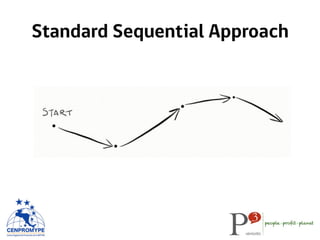
Traditional Lineal Approach
Standard Sequential Approach
Suggested Approach
Prototyping multiple Minimum Viable
Products
Tools for making the Minimum
Viable Product
•  Physical prototypes of low and high resolution
(3D printing):
– Develop tests: split test, A/B test, etc.
•  Storyboard (low resolution).
•  Low resolution service prototypes.
•  “Wizard of Oz” Prototypes (higher resolution).
•  Crowdsourcing Test.
Visual Thinking
•  “Use of visual tools such as pictures, sketches,
diagrams and post-it notes, to construct and
discuss meaning.”
(“Business Model Generation” Alex Osterwalder)
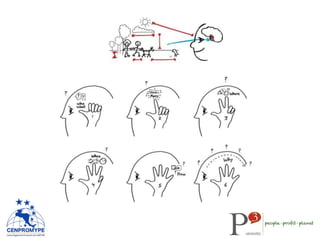
The Four Steps of Visual Thinking
Look See Imagine Show
What is it there?
What am I looking?
What are the limits?
What do I see?
Have I seen these
before?
What patterns
emerge?
Which is the most
outstanding?
What is missing?
How can I
manipulate the
patterns?
How can I close the
breaches?
Have I seen enough?
Or do I need to come
back?
This is what I saw
and this is what I
believe it means.
Is this what I
expected or not?
When you see this
Do you see the
same things?
An image is worth a thousand words
6 Ways of Seeing
•  Why?
•  How?
•  When?
•  Where?
•  How many?
•  Who/what?
To Look vs. To See
•  To see is the opposite side of looking. To look is to
recollect visual information; to see is to select and
identify patterns, is to identify the problem.
Looking at a problem is the way to begin, but
doesn’t add to the solution. For knowing what to
fix, we need to be capable of seeing what is
damaged.
How to Show the Problem
Different Levels of Resolution:
Lo-fi vs Hi-fi
Different Levels of Resolution
Low Resolution Medium Resolution High Resolution
How to do quick prototypes?
Learn from low cost and quick tests.
Diverse tools: drawings, storyboards,
videos, etc.
•  Technique originated in
cinematography. Walt Disney
pioneered it, discovering a
technique that allowed him to
follow up the progress and
improve the story.
•  It is a useful exercise to imagine
and create new possibilities.
•  The relevant thing is the story
that is being told, the images
just support the story.
Storyboard
Storyboard Example
•  Offer: Molecular
marker test of marine
species. Certification
of the trazability of
marine products, by
the application of an
aunthenticity test.
This test allows to
know if what is being
sold is authentic.
Storyboard Premium: Ipad
app
Storyboard 6 keyframes
Keyframe 1 Keyframe 2 Keyframe 3
Keyframe 4 Keyframe 5 Keyframe 6
Activity 2: Draw an Storyboard of
the Solution
•  Individually, create a storyboard of the solution,
explaining how it fits in the context of the
problem.
•  Following that, two persons in each group
should present their storyboard to the rest of
the group and receive feedback from them.
15 minutes
Early Prototype: Dropbox
Publish or launch a web site of a inexistent product. When
they access the site, they are offered to be the first ones
in trying the beta prototype if they provide contact
information or answer questions.
It applies to web and physical projects.
Early Prototype: Groupon
•  They started as a collective activism platform
named El Punto, but they got weak results.
•  They promoted themselves using a wordpress
blog and sending pdf coupons.
•  They started with the announcement of a 2x1
discount in pizza.
•  During the first announcement 20 people bought.
•  How much is this company worth today? 12 billion
dollars.
Pain Test: Ekidsmovies.com
•  Value the quaintity of annoyances they confront
with the problem.
•  The web site ekidsmovies.com sent an
announcement in Google, about online movies,
that gave access to the testing web site. Frome
the people who entered, 50% gave their email.
•  They were asked to describe the annoyances they
experienced in relation to classifications for
movies directed to kids and the lack of access to
them.
The Concierge MVP: Food on the
Table
•  The Concierge MVP is a learning process with the
first customers..
•  A service that offers the elaboration of a weekly
meal plan, where you can budget expenses in
different stores based on recipes and ingredients.
•  At the moment, the sites allows to review
thousands of stores, but they started just with one
store for one client.
•  It was the first “concierge” client, who received the
shopping list at home.
Wizard of Oz: Carsdirect, Zappos
The intention of purchasing was validated,
without having the whole logistics.
Wizard of Oz: Berkeley Pizza
•  They started without a physical space..
•  They assured themselves there was enough
demand. Only when they showed that there
was enought people intending to pay, the
invested in a location for a restaurant.
Crowdfunding Test: Pebble
•  Pebble is a digital watch that was funded
exclusively by Kickstarter. The funding of
people is proof that you have potential
customers.
Split Test
•  A version is tested with one group of
customers, and the other version with the
other group.
•  You compare the results with one and the other
version: with or without the feature.
Refining	
  the	
  Features:	
  The	
  100	
  dollar	
  
test	
  
•  Ask the customer to point, between a list of
features, how he will distribute 100 dollar.
•  This test allow to understand what features are
the most important for customers. It helps to
focus when you have many features.
Ranking System
•  Ask the customers to qualify the features that
are more important to them.
•  They have to be the feature that better
respond to a problem faced by a customer
segment.
“Choice, happiness and Spaghetti
Sauce”
Malcolm Gladwell
(www.ted.com)
Apps for Prototyping
•  Mobile Prototypes
Physical Prototypes
•  Quick Prototyping: Physical model of the
project.
•  3D Printing.
Levels of Resolution in a Porsche
Prototype
Prototype of the First
Mouse
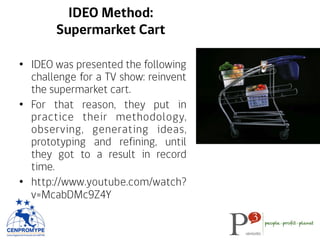
IDEO Method:
Supermarket Cart
•  IDEO was presented the following
challenge for a TV show: reinvent
the supermarket cart.
•  For that reason, they put in
practice their methodology,
observing, generating ideas,
prototyping and refining, until
they got to a result in record
time.
•  http://www.youtube.com/watch?
v=McabDMc9Z4Y
3D Printing
Prototypes(D. School Stanford)
“The only way to do it is
to DO IT.”
“Nothing is a mistake. There’s
no win or fail. There’s only
MAKE”
Role Playing
The experience of a product or service, with all
their emotional and sensorial components, it is
better expressed by acting and performing the
role of the customer.
Activity: Physical Prototype
•  Choose any project from the group that its closer
to a physical product.
•  Individually, look for objects you may have in your
sorrouding (any object).
•  Build a prototype that represents this product.
•  Then simulate that you are introducing the
product to the customer. Simulate an introduction
of the product to your customer.
15 minutes
Business Opportunities!...
•  They emerge when you there are barriers to
consumption.
– A barrier to consumption means that persons or
companies posses barriers that stops them from doing
certain activities or to consume certain products or
services.
Business Opportunities!...
•  Also when markets are saturated.
– A market is saturated when the available solutions
don’t add value and the companies are not able to
offer better solutions.
•  The objective should be to identify the
quantity of non consumption in a market
space.
•  You have 4 types of barriers to consumption:
Which are the main Barriers to
Consumption?
Barriers to Consumption
You find barriers in:
• Skills
• Resources
• Access
• Time
Barriers to Consumption: Skills
•  Frequent problems when a new
technology is introduced.
•  Heart Start Home Defibrilator
from Phillips, to be used by
people without medical
training.
Barriers to Consumption: Resources
•  M o t o f o n e b y
Motorola (2006): the
first cel phone for
customer of lower
incomes in developing
nations.
Barriers to Consumption: Access
•  Online Retailers like
A m a z o n a l l o w
customers to access
to a broad range of
products form every
location.
Barriers to Consumption:
Time
•  Metro: newspapers
for people without
enough time, that
can be read in the
public transport.
Summarizing…	
  
•  Barriers	
  from	
  skills:	
  a	
  simpler	
  solu>on.	
  	
  
•  Barriers	
  from	
  resources:	
  less	
  costly	
  solu>on.	
  	
  
•  Barriers	
  from	
  access:	
  more	
  accessible	
  solu>on.	
  
•  Barriers	
  from	
  >me:	
  quickest	
  solu>on.	


Workshop 4 belize minimum viable product

  • 1.
    Workshop 4 –The Minimum Viable Product Mario Reyes Research Manager P3 Ventures S.A.
  • 2.
    Objectives of theWorkshop •  Understand the function of a prototype and of a Minimum Viable Product, in each stage of resolution. •  Bring the solution to its essential features. •  Explore if the solution works in the customer’s context. •  Prepare the testing of an early prototype of the solution (Minimum Viable Product). Include in the plan the objectives and indicators to be measured.
  • 3.
    Activity 1 •  Individually,list the 5 main features of the product or solution, from the 1st to the 5th, in order of importance. •  Then, 2 people in each group should present their exercise. 15 minutes
  • 4.
    Returning to theLoop of Validated Learning…
  • 5.
    Definition of MinimumViable Product “Is that version of a new product which allows a team to collect the maximum amount of validated learning about the customers with the least effort”.   (Eric Ries)
  • 6.
  • 7.
    Focus on the20% of the funcionality that will be used the 80% of the time.
  • 8.
    Do many iterationsand pivots •  Iterations: small changes in features specific to the product. •  Pivot: a big change based on the testing of a basic assumption of the value propostion.
  • 9.
    Role of theprototype in a Design Thinking Process UNDERSTAND   OBSERVE   DEFINE   IDEATE   PROTOTYPE   TEST  
  • 10.
    Prototype Definition •  Aprototype is an integrative tool, which allows to learn, communicate and persuade.
  • 11.
  • 12.
  • 13.
  • 14.
    Tools for makingthe Minimum Viable Product •  Physical prototypes of low and high resolution (3D printing): – Develop tests: split test, A/B test, etc. •  Storyboard (low resolution). •  Low resolution service prototypes. •  “Wizard of Oz” Prototypes (higher resolution). •  Crowdsourcing Test.
  • 15.
    Visual Thinking •  “Useof visual tools such as pictures, sketches, diagrams and post-it notes, to construct and discuss meaning.” (“Business Model Generation” Alex Osterwalder)
  • 16.
    The Four Stepsof Visual Thinking Look See Imagine Show What is it there? What am I looking? What are the limits? What do I see? Have I seen these before? What patterns emerge? Which is the most outstanding? What is missing? How can I manipulate the patterns? How can I close the breaches? Have I seen enough? Or do I need to come back? This is what I saw and this is what I believe it means. Is this what I expected or not? When you see this Do you see the same things?
  • 17.
    An image isworth a thousand words
  • 18.
    6 Ways ofSeeing •  Why? •  How? •  When? •  Where? •  How many? •  Who/what?
  • 20.
    To Look vs.To See •  To see is the opposite side of looking. To look is to recollect visual information; to see is to select and identify patterns, is to identify the problem.
  • 21.
    Looking at aproblem is the way to begin, but doesn’t add to the solution. For knowing what to fix, we need to be capable of seeing what is damaged.
  • 22.
    How to Showthe Problem
  • 23.
    Different Levels ofResolution: Lo-fi vs Hi-fi
  • 24.
    Different Levels ofResolution Low Resolution Medium Resolution High Resolution
  • 25.
    How to doquick prototypes? Learn from low cost and quick tests.
  • 26.
    Diverse tools: drawings,storyboards, videos, etc.
  • 27.
    •  Technique originatedin cinematography. Walt Disney pioneered it, discovering a technique that allowed him to follow up the progress and improve the story. •  It is a useful exercise to imagine and create new possibilities. •  The relevant thing is the story that is being told, the images just support the story. Storyboard
  • 28.
    Storyboard Example •  Offer:Molecular marker test of marine species. Certification of the trazability of marine products, by the application of an aunthenticity test. This test allows to know if what is being sold is authentic.
  • 29.
  • 30.
    Storyboard 6 keyframes Keyframe1 Keyframe 2 Keyframe 3 Keyframe 4 Keyframe 5 Keyframe 6
  • 31.
    Activity 2: Drawan Storyboard of the Solution •  Individually, create a storyboard of the solution, explaining how it fits in the context of the problem. •  Following that, two persons in each group should present their storyboard to the rest of the group and receive feedback from them. 15 minutes
  • 32.
    Early Prototype: Dropbox Publishor launch a web site of a inexistent product. When they access the site, they are offered to be the first ones in trying the beta prototype if they provide contact information or answer questions. It applies to web and physical projects.
  • 33.
    Early Prototype: Groupon • They started as a collective activism platform named El Punto, but they got weak results. •  They promoted themselves using a wordpress blog and sending pdf coupons. •  They started with the announcement of a 2x1 discount in pizza. •  During the first announcement 20 people bought. •  How much is this company worth today? 12 billion dollars.
  • 34.
    Pain Test: Ekidsmovies.com • Value the quaintity of annoyances they confront with the problem. •  The web site ekidsmovies.com sent an announcement in Google, about online movies, that gave access to the testing web site. Frome the people who entered, 50% gave their email. •  They were asked to describe the annoyances they experienced in relation to classifications for movies directed to kids and the lack of access to them.
  • 35.
    The Concierge MVP:Food on the Table •  The Concierge MVP is a learning process with the first customers.. •  A service that offers the elaboration of a weekly meal plan, where you can budget expenses in different stores based on recipes and ingredients. •  At the moment, the sites allows to review thousands of stores, but they started just with one store for one client. •  It was the first “concierge” client, who received the shopping list at home.
  • 36.
    Wizard of Oz:Carsdirect, Zappos The intention of purchasing was validated, without having the whole logistics.
  • 37.
    Wizard of Oz:Berkeley Pizza •  They started without a physical space.. •  They assured themselves there was enough demand. Only when they showed that there was enought people intending to pay, the invested in a location for a restaurant.
  • 38.
    Crowdfunding Test: Pebble • Pebble is a digital watch that was funded exclusively by Kickstarter. The funding of people is proof that you have potential customers.
  • 39.
    Split Test •  Aversion is tested with one group of customers, and the other version with the other group. •  You compare the results with one and the other version: with or without the feature.
  • 40.
    Refining  the  Features:  The  100  dollar   test   •  Ask the customer to point, between a list of features, how he will distribute 100 dollar. •  This test allow to understand what features are the most important for customers. It helps to focus when you have many features.
  • 41.
    Ranking System •  Askthe customers to qualify the features that are more important to them. •  They have to be the feature that better respond to a problem faced by a customer segment.
  • 42.
    “Choice, happiness andSpaghetti Sauce” Malcolm Gladwell (www.ted.com)
  • 43.
    Apps for Prototyping • Mobile Prototypes
  • 44.
    Physical Prototypes •  QuickPrototyping: Physical model of the project. •  3D Printing.
  • 45.
    Levels of Resolutionin a Porsche Prototype
  • 46.
    Prototype of theFirst Mouse
  • 51.
    IDEO Method: Supermarket Cart • IDEO was presented the following challenge for a TV show: reinvent the supermarket cart. •  For that reason, they put in practice their methodology, observing, generating ideas, prototyping and refining, until they got to a result in record time. •  http://www.youtube.com/watch? v=McabDMc9Z4Y
  • 52.
  • 53.
    Prototypes(D. School Stanford) “Theonly way to do it is to DO IT.” “Nothing is a mistake. There’s no win or fail. There’s only MAKE”
  • 54.
    Role Playing The experienceof a product or service, with all their emotional and sensorial components, it is better expressed by acting and performing the role of the customer.
  • 55.
    Activity: Physical Prototype • Choose any project from the group that its closer to a physical product. •  Individually, look for objects you may have in your sorrouding (any object). •  Build a prototype that represents this product. •  Then simulate that you are introducing the product to the customer. Simulate an introduction of the product to your customer. 15 minutes
  • 56.
    Business Opportunities!... •  Theyemerge when you there are barriers to consumption. – A barrier to consumption means that persons or companies posses barriers that stops them from doing certain activities or to consume certain products or services.
  • 57.
    Business Opportunities!... •  Alsowhen markets are saturated. – A market is saturated when the available solutions don’t add value and the companies are not able to offer better solutions.
  • 58.
    •  The objectiveshould be to identify the quantity of non consumption in a market space. •  You have 4 types of barriers to consumption: Which are the main Barriers to Consumption?
  • 59.
    Barriers to Consumption Youfind barriers in: • Skills • Resources • Access • Time
  • 60.
    Barriers to Consumption:Skills •  Frequent problems when a new technology is introduced. •  Heart Start Home Defibrilator from Phillips, to be used by people without medical training.
  • 61.
    Barriers to Consumption:Resources •  M o t o f o n e b y Motorola (2006): the first cel phone for customer of lower incomes in developing nations.
  • 62.
    Barriers to Consumption:Access •  Online Retailers like A m a z o n a l l o w customers to access to a broad range of products form every location.
  • 63.
    Barriers to Consumption: Time • Metro: newspapers for people without enough time, that can be read in the public transport.
  • 64.
    Summarizing…   •  Barriers  from  skills:  a  simpler  solu>on.     •  Barriers  from  resources:  less  costly  solu>on.     •  Barriers  from  access:  more  accessible  solu>on.   •  Barriers  from  >me:  quickest  solu>on.