ELECTRONIC
MEDIA
HA R A M HA BIB
ROLL # 9044
MASS COMMINICATION
SEMESTER 2 n d (EVENING)
BS A PPLIED PSYCHOLOGY
SUBMITTED TO MA M FA RWA BA TOOL
HISTORY OF ELECTRONIC
MEDIA
Historically speaking, Marconi started radio broadcasting in
1896 with the invention of first wireless telegraph link. It took
ten years since then for the first demonstration of radio
broadcasting to establish but it was hard to distinguish words
from music. Another successful demonstration took place
from the Eiffel Tower in Paris in 1908. First radio news
bulletin in 1916 on the occasion of the election of US
President. By 1927, broadcasting services were started as a
major medium of information.
HISTORY OF ELECTRONIC
MEDIA
 Transmission
 Wire and transmission lines
• Telegraph 1795–1832
• Facsimile 1843–1861
• Telephone 1849–1877
• Coaxial cable 1880
• Fiber Optics not known
 Wireless
• Radio 1897–1920
• Satellite 1958–1972
• Free Space Optics 1960s
HISTORY OF ELECTRONIC
MEDIA
 Display and Output
• CRT 1922
• Speaker/Headphones 1876–1928/1930s
• LED/LCD 1955–1962/1968
• Computer Monitor 1950s/19
 Electronic information storage
• Compact Disc/DVD 1982/1993–current
• Magnetic storage 1898–2003
• RAM 1941–current
• Film 1876–1889
WHAT IS ELECTRONIC MEDIA
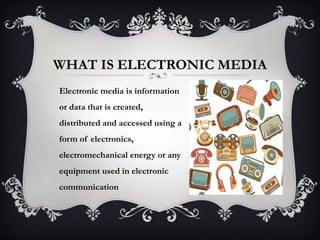
Electronic media is information
or data that is created,
distributed and accessed using a
form of electronics,
electromechanical energy or any
equipment used in electronic
communication
EXAMPLES OF ELECTRONIC
MEDIA
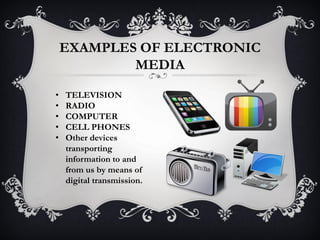
• TELEVISION
• RADIO
• COMPUTER
• CELL PHONES
• Other devices
transporting
information to and
from us by means of
digital transmission.
TYPES OF ELECTRONIC
MEDIA
 There are three traditional types of Electronic Media and a
few Hybrids:
1) Television
2) Radio
3) Internet
4) Smart phones may have created
a new media type
TYPES OF ELECTRONIC
MEDIA
5) Electronic display advertising, electronic streaming
billboards may aslo be a new hybrid
 Internet, TV, Radio, arguably electronic
Bill boards might qualify. Smart Phones are
a play between Phone & internet so might
pass for electronic media
USES OF ELECTRONIC MEDIA
 Uses of electronic media are as follow:
Journalism News
Commerce Marketing
Advertising Barker Channel
Digital signage Graphic design
Education Professional training
USES OF ELECTRONIC MEDIA
 Uses of electronic media are as follow:
Science Engineering
Digital art Digital photography
Virtual reality Business presentations
Telecommuting Computer simulations
Videos Software interfaces
ADVANTAGES OF
ELECTRONIC MEDIA
 Many areas people get educated through the media were they get
to learn many things form media about the politics, outside
environment, etc.
 Media like television is a good source for the people to get updated
through the electronic media.
 Electronic media makes people aware of world-wide things.
 Greater opportunities you get through this media sitting at your
place, this is an advantage of media.
ADVANTAGES OF
ELECTRONIC MEDIA
 Firstly people used to use radio for the news but as the generation
changes the media generation also changes to television and other
electronic devices.
 Also through this electronic media you can get to see many
cultural events going in world.
 Elder citizen and children get more knowledge through this media.
 Many people get a chance to do their courier
DISADVANTAGES OF
ELECTRONIC MEDIA
 It leads to individualism. People spend too much time on the
internet and watching television. As a result, socialization with friends,
family and neighbors is affected.
 Some media contents are not suitable for children. Limiting
children’s access to such content can be difficult.
 Newspaper is geographically selective.
 Increase in advertisements in television and radio is making them
less attractive.
DISADVANTAGES OF
ELECTRONIC MEDIA
 Health problems (eyesight problems, hearing problems)
 It glamorize drugs and alcohol. Some programs make the use of
these things appear cool’.
 It can lead to personal injury. Some people decide to follow the
stunts that are showcased in the media. This can lead to injuries.
 Internet as a form of media opens up possibilities of imposters,
fraud and hacking.
THE END

ELECTRONIC MEDIA

  • 1.
    ELECTRONIC MEDIA HA R AM HA BIB ROLL # 9044 MASS COMMINICATION SEMESTER 2 n d (EVENING) BS A PPLIED PSYCHOLOGY SUBMITTED TO MA M FA RWA BA TOOL
  • 2.
    HISTORY OF ELECTRONIC MEDIA Historicallyspeaking, Marconi started radio broadcasting in 1896 with the invention of first wireless telegraph link. It took ten years since then for the first demonstration of radio broadcasting to establish but it was hard to distinguish words from music. Another successful demonstration took place from the Eiffel Tower in Paris in 1908. First radio news bulletin in 1916 on the occasion of the election of US President. By 1927, broadcasting services were started as a major medium of information.
  • 3.
    HISTORY OF ELECTRONIC MEDIA Transmission  Wire and transmission lines • Telegraph 1795–1832 • Facsimile 1843–1861 • Telephone 1849–1877 • Coaxial cable 1880 • Fiber Optics not known  Wireless • Radio 1897–1920 • Satellite 1958–1972 • Free Space Optics 1960s
  • 4.
    HISTORY OF ELECTRONIC MEDIA Display and Output • CRT 1922 • Speaker/Headphones 1876–1928/1930s • LED/LCD 1955–1962/1968 • Computer Monitor 1950s/19  Electronic information storage • Compact Disc/DVD 1982/1993–current • Magnetic storage 1898–2003 • RAM 1941–current • Film 1876–1889
  • 5.
    WHAT IS ELECTRONICMEDIA Electronic media is information or data that is created, distributed and accessed using a form of electronics, electromechanical energy or any equipment used in electronic communication
  • 6.
    EXAMPLES OF ELECTRONIC MEDIA •TELEVISION • RADIO • COMPUTER • CELL PHONES • Other devices transporting information to and from us by means of digital transmission.
  • 7.
    TYPES OF ELECTRONIC MEDIA There are three traditional types of Electronic Media and a few Hybrids: 1) Television 2) Radio 3) Internet 4) Smart phones may have created a new media type
  • 8.
    TYPES OF ELECTRONIC MEDIA 5)Electronic display advertising, electronic streaming billboards may aslo be a new hybrid  Internet, TV, Radio, arguably electronic Bill boards might qualify. Smart Phones are a play between Phone & internet so might pass for electronic media
  • 9.
    USES OF ELECTRONICMEDIA  Uses of electronic media are as follow: Journalism News Commerce Marketing Advertising Barker Channel Digital signage Graphic design Education Professional training
  • 10.
    USES OF ELECTRONICMEDIA  Uses of electronic media are as follow: Science Engineering Digital art Digital photography Virtual reality Business presentations Telecommuting Computer simulations Videos Software interfaces
  • 11.
    ADVANTAGES OF ELECTRONIC MEDIA Many areas people get educated through the media were they get to learn many things form media about the politics, outside environment, etc.  Media like television is a good source for the people to get updated through the electronic media.  Electronic media makes people aware of world-wide things.  Greater opportunities you get through this media sitting at your place, this is an advantage of media.
  • 12.
    ADVANTAGES OF ELECTRONIC MEDIA Firstly people used to use radio for the news but as the generation changes the media generation also changes to television and other electronic devices.  Also through this electronic media you can get to see many cultural events going in world.  Elder citizen and children get more knowledge through this media.  Many people get a chance to do their courier
  • 13.
    DISADVANTAGES OF ELECTRONIC MEDIA It leads to individualism. People spend too much time on the internet and watching television. As a result, socialization with friends, family and neighbors is affected.  Some media contents are not suitable for children. Limiting children’s access to such content can be difficult.  Newspaper is geographically selective.  Increase in advertisements in television and radio is making them less attractive.
  • 14.
    DISADVANTAGES OF ELECTRONIC MEDIA Health problems (eyesight problems, hearing problems)  It glamorize drugs and alcohol. Some programs make the use of these things appear cool’.  It can lead to personal injury. Some people decide to follow the stunts that are showcased in the media. This can lead to injuries.  Internet as a form of media opens up possibilities of imposters, fraud and hacking.
  • 15.