DOING YOUR RESEARCH:
THE COMPETITIVE LANDSCAPE
WORKSHOP
NICK SOLOMON
IP Solutions Consultant
DECEMBER 2016
TODAY’S AGENDA
• Intellectual Property Overview
• Australian Innovation
• Why Intellectual Property is Important
• Determining the Competitive Landscape
• Real World Example
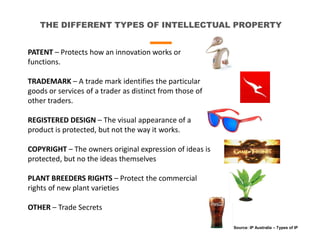
THE DIFFERENT TYPES OF INTELLECTUAL PROPERTY
PATENT – Protects how an innovation works or
functions.
TRADEMARK – A trade mark identifies the particular
goods or services of a trader as distinct from those of
other traders.
REGISTERED DESIGN – The visual appearance of a
product is protected, but not the way it works.
COPYRIGHT – The owners original expression of ideas is
protected, but no the ideas themselves
PLANT BREEDERS RIGHTS – Protect the commercial
rights of new plant varieties
OTHER – Trade Secrets
Source: IP Australia – Types of IP
WHAT IS A PATENT?
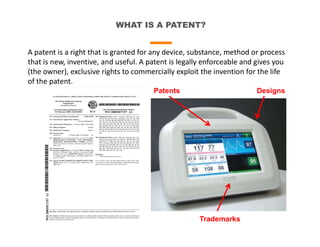
A patent is a right that is granted for any device, substance, method or process
that is new, inventive, and useful. A patent is legally enforceable and gives you
(the owner), exclusive rights to commercially exploit the invention for the life
of the patent.
Trademarks
Patents Designs
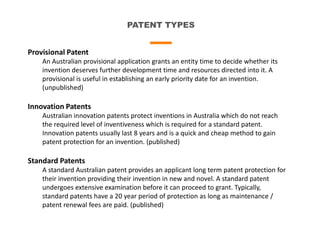
PATENT TYPES
Provisional Patent
An Australian provisional application grants an entity time to decide whether its
invention deserves further development time and resources directed into it. A
provisional is useful in establishing an early priority date for an invention.
(unpublished)
Innovation Patents
Australian innovation patents protect inventions in Australia which do not reach
the required level of inventiveness which is required for a standard patent.
Innovation patents usually last 8 years and is a quick and cheap method to gain
patent protection for an invention. (published)
Standard Patents
A standard Australian patent provides an applicant long term patent protection for
their invention providing their invention in new and novel. A standard patent
undergoes extensive examination before it can proceed to grant. Typically,
standard patents have a 20 year period of protection as long as maintenance /
patent renewal fees are paid. (published)
WHAT CAN I PATENT
• Any device, substance, method or process that is new, inventive, and useful
• An invention can have multiple patents (also multiple trademarks and
designs)
• Many chemical or life science related innovation has multiple patents
associated. e.g.
– Method Patents
– Use Patents
– Delivery System Patents
• Why don't we put everything in one patent instead of having multiple
patents?
– Litigation
– Easier to protect your innovation separately.
– Cost!
IS MY PATENT VALID IN EVERY COUNTRY?
In short…. No!
Patents are territorial rights. In general, the
exclusive rights are only applicable in the country or
region in which a patent has been filed and granted,
in accordance with the law of that country or region.
Therefore, it is important to know the competitive
landscape (or the IP Landscape) to know where to
seek patent protection and why.
AUSTRALIAN INNOVATION
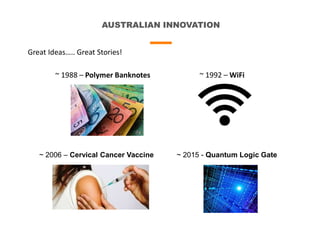
Great Ideas….. Great Stories!
~ 1988 – Polymer Banknotes ~ 1992 – WiFi
~ 2015 - Quantum Logic Gate~ 2006 – Cervical Cancer Vaccine
AUSTRALIAN INNOVATION
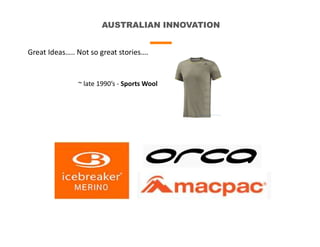
Great Ideas….. Not so great stories….
~ late 1990’s - Sports Wool
AUSTRALIAN INNOVATION
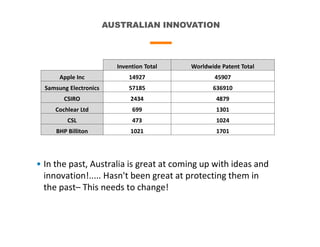
Invention Total Worldwide Patent Total
Apple Inc 14927 45907
Samsung Electronics 57185 636910
CSIRO 2434 4879
Cochlear Ltd 699 1301
CSL 473 1024
BHP Billiton 1021 1701
• In the past, Australia is great at coming up with ideas and
innovation!..... Hasn't been great at protecting them in
the past– This needs to change!
ONE MORE THING……..
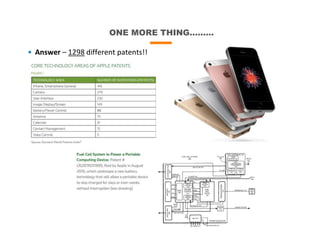
• Question – How many patents (individual inventions) do you think are
associated with the Apple iPhone?
ONE MORE THING………
• Answer – 1298 different patents!!
ONE FINAL THING…………….
IMPORTANT!!
If you intend to seek patent protection, DO
NOT publically disclose your innovation i.e.
publish a paper or journal article, as once
the innovation is in the public domain you
cannot gain patent protection on it.
DETERMINING THE COMPETITIVE LANDSCAPE
Key Questions To Consider…..
1. Is my idea Innovative? Is there a need for my
technology?
2. What do I want to do with my technology?
3. Who else is operating in my technology space?
4. Where are they operating around the world?
5. What worldwide markets are important to me?
DETERMINING THE COMPETITIVE LANDSCAPE
1. Is my idea innovative? Is there a need for my
Technology?
• Conduct a patent and non-patent literature
search for what you are attempting to undertake.
• Use keywords and technology classifications to
get an idea if your idea is patentable or not.
DETERMINING THE COMPETITIVE LANDSCAPE
2. What do I want to do with my Technology?
• Do you want to commercialise your innovation?
• Do you want to find a partner to help develop
your innovation?
• Do you want to find an organisations or entities
to potentially licence your innovation?
Note: The above will determine what type of applicant / assignee you
can focus on.
DETERMINING THE COMPETITIVE LANDSCAPE
3. Who else is operating in my technology
space?
• Use the applicant / assignee details to
determine who else is operating within your
general technology space.
DETERMINING THE COMPETITIVE LANDSCAPE
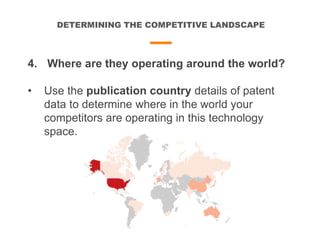
4. Where are they operating around the world?
• Use the publication country details of patent
data to determine where in the world your
competitors are operating in this technology
space.
DETERMINING THE COMPETITIVE LANDSCAPE
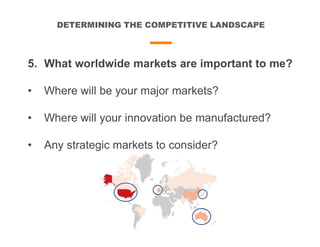
5. What worldwide markets are important to me?
• Where will be your major markets?
• Where will your innovation be manufactured?
• Any strategic markets to consider?
WHY IS THIS IMPORTANT TO ME
• Having knowledge about your target market, competition / other players, potential
other uses of the technology will help you tell a persuasive story in attracting
partners, funding, support and potential licensees.
• Can help you stay nimble and proactive (not reactive)
• Nearly every career that you have the potential to work in involves Intellectual
Property in some form.
– Research
– Law
– Marketing
– Advertising
– Consultancy
– Venture Capitalist
• Can help you stand out from the crowd!
• A patent owner has the right to decide who may – or may not – use the patented
invention for the period in which the invention is protected. In other words, patent
protection means that the invention cannot be commercially made, used,
distributed, imported, or sold by others without the patent owner's consent.
REAL WORLD EXAMPLE
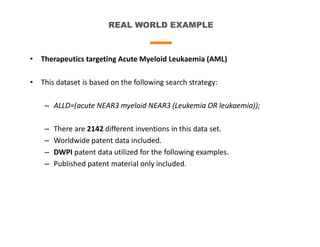
• Therapeutics targeting Acute Myeloid Leukaemia (AML)
• This dataset is based on the following search strategy:
– ALLD=(acute NEAR3 myeloid NEAR3 (Leukemia OR leukaemia));
– There are 2142 different inventions in this data set.
– Worldwide patent data included.
– DWPI patent data utilized for the following examples.
– Published patent material only included.
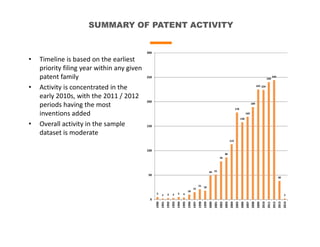
SUMMARY OF PATENT ACTIVITY
• Timeline is based on the earliest
priority filing year within any given
patent family
• Activity is concentrated in the
early 2010s, with the 2011 / 2012
periods having the most
inventions added
• Overall activity in the sample
dataset is moderate
5
2 3 3 5 4
10
15
21
18
49 51
78
86
113
178
158
169
189
225 224
240
244
38
2
0
50
100
150
200
250
300
1990
1991
1992
1993
1994
1995
1996
1997
1998
1999
2000
2001
2002
2003
2004
2005
2006
2007
2008
2009
2010
2011
2012
2013
2014
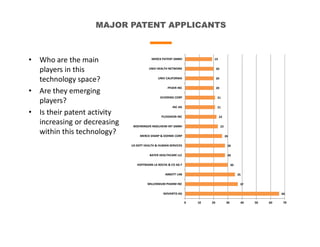
MAJOR PATENT APPLICANTS
• Who are the main
players in this
technology space?
• Are they emerging
players?
• Is their patent activity
increasing or decreasing
within this technology?
66
37
35
30
28
28
26
23
22
21
21
20
20
20
19
0 10 20 30 40 50 60 70
NOVARTIS AG
MILLENNIUM PHARM INC
ABBOTT LAB
HOFFMANN LA ROCHE & CO AG F
BAYER HEALTHCARE LLC
US DEPT HEALTH & HUMAN SERVICES
MERCK SHARP & DOHME CORP
BOEHRINGER INGELHEIM INT GMBH
PLEXXIKON INC
4SC AG
SCHERING CORP
PFIZER INC
UNIV CALIFORNIA
UNIV HEALTH NETWORK
MERCK PATENT GMBH
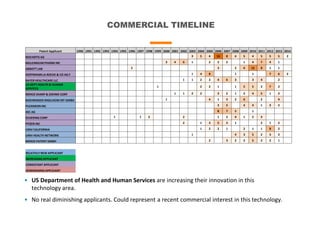
COMMERCIAL TIMELINE
Patent Applicant 1990 1991 1992 1993 1994 1995 1996 1997 1998 1999 2000 2001 2002 2003 2004 2005 2006 2007 2008 2009 2010 2011 2012 2013 2014
NOVARTIS AG 3 5 4 16 8 4 5 4 5 5 5 2
MILLENNIUM PHARM INC 3 4 6 1 2 2 2 1 4 7 4 1
ABBOTT LAB 2 3 2 6 12 8 1 1
HOFFMANN LA ROCHE & CO AG F 1 4 8 1 1 7 6 2
BAYER HEALTHCARE LLC 1 1 2 2 4 6 3 3 4 2
US DEPT HEALTH & HUMAN
SERVICES
1 2 2 1 1 5 5 2 7 2
MERCK SHARP & DOHME CORP 1 1 2 2 3 2 1 2 4 5 1 2
BOEHRINGER INGELHEIM INT GMBH 1 4 1 3 2 6 2 4
PLEXXIKON INC 3 5 4 4 1 3 2
4SC AG 8 7 5 1
SCHERING CORP 1 1 2 2 1 2 4 1 2 3
PFIZER INC 2 1 3 5 3 1 2 1 2
UNIV CALIFORNIA 1 2 2 1 2 1 1 8 2
UNIV HEALTH NETWORK 1 4 3 5 2 3 2
MERCK PATENT GMBH 2 3 2 2 5 2 2 1
RELATIVLY NEW APPLICANT
INCREASING APPLICANT
CONSISTANT APPLICANT
DEMINISHING APPLICANT
• US Department of Health and Human Services are increasing their innovation in this
technology area.
• No real diminishing applicants. Could represent a recent commercial interest in this technology.
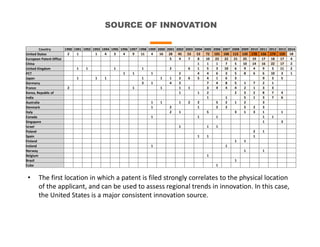
SOURCE OF INNOVATION
Country 1990 1991 1992 1993 1994 1995 1996 1997 1998 1999 2000 2001 2002 2003 2004 2005 2006 2007 2008 2009 2010 2011 2012 2013 2014
United States 2 1 1 4 3 4 9 11 4 16 28 45 53 53 72 101 106 115 120 178 156 174 159 18
European Patent Office 5 4 7 8 10 22 22 21 25 19 17 18 17 4
China 1 1 1 7 5 10 14 16 22 17 2
United Kingdom 1 1 1 1 2 6 1 5 3 10 6 9 4 9 3 11 2
PCT 1 1 1 2 4 4 6 3 5 8 6 6 10 3 1
Japan 1 1 1 1 1 1 2 6 5 4 1 6 3 9 3 5
Germany 3 1 4 2 7 4 8 5 1 7 2 1
France 2 1 1 1 1 3 4 4 4 2 1 3 3
Korea, Republic of 1 1 2 2 3 2 8 7 4
India 1 1 5 1 3 7 6
Australia 1 1 1 2 2 5 2 1 2 3
Denmark 1 2 1 2 2 5 2 3
Italy 2 1 5 3 1 3 1 1
Canada 1 1 1 1 1
Singapore 1 3
Israel 1 1 1
Poland 2 1
Spain 1 1 1
Finland 1 1
Ireland 1 1
Norway 1 1
Belgium 1
Brazil 1
Cuba 1
• The first location in which a patent is filed strongly correlates to the physical location
of the applicant, and can be used to assess regional trends in innovation. In this case,
the United States is a major consistent innovation source.
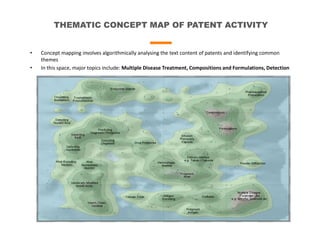
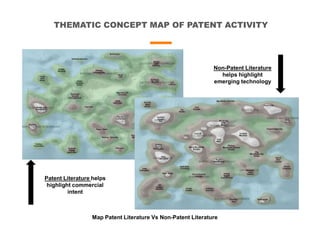
THEMATIC CONCEPT MAP OF PATENT ACTIVITY
• Concept mapping involves algorithmically analysing the text content of patents and identifying common
themes
• In this space, major topics include: Multiple Disease Treatment, Compositions and Formulations, Detection
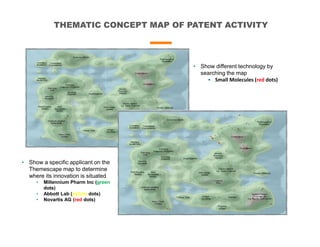
THEMATIC CONCEPT MAP OF PATENT ACTIVITY
• Show different technology by
searching the map
• Small Molecules (red dots)
• Show a specific applicant on the
Themescape map to determine
where its innovation is situated
• Millennium Pharm Inc (green
dots)
• Abbott Lab (yellow dots)
• Novartis AG (red dots)
THEMATIC CONCEPT MAP OF PATENT ACTIVITY
Map Patent Literature Vs Non-Patent Literature
Non-Patent Literature
helps highlight
emerging technology
Patent Literature helps
highlight commercial
intent
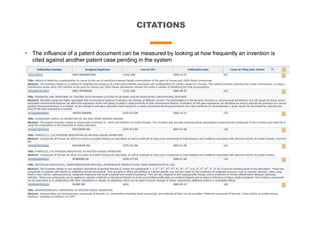
CITATIONS
• The influence of a patent document can be measured by looking at how frequently an invention is
cited against another patent case pending in the system
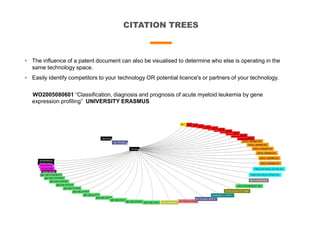
CITATION TREES
• The influence of a patent document can also be visualised to determine who else is operating in the
same technology space.
• Easily identify competitors to your technology OR potential licence's or partners of your technology.
WO2005080601 “Classification, diagnosis and prognosis of acute myeloid leukemia by gene
expression profiling” UNIVERSITY ERASMUS
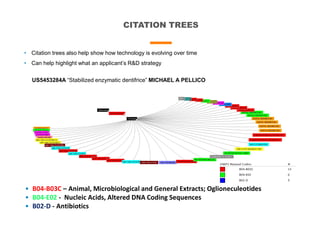
CITATION TREES
• Citation trees also help show how technology is evolving over time
• Can help highlight what an applicant’s R&D strategy
US5453284A “Stabilized enzymatic dentifrice” MICHAEL A PELLICO
• B04-B03C – Animal, Microbiological and General Extracts; Oglioneculeotides
• B04-E02 - Nucleic Acids, Altered DNA Coding Sequences
• B02-D - Antibiotics
WHERE TO ACCESS PATENT INFORMATION
Thomson Innovation – http://info.thomsoninnovation.com/
Publically Available Patent Websites
IP Australia -
http://pericles.ipaustralia.gov.au/ols/auspat/
European Patent Office - Espacenet
https://worldwide.espacenet.com/advancedSearch?locale=en_EP
WIPO – PatentScope
https://patentscope.wipo.int/search/en/advancedSearch.jsf
Thank you!
Nick Solomon
IP Solutions Consultant
Email: Nicholas.Solomon@tr.com

Competitive landsape by Clarivate Analytics

  • 1.
    DOING YOUR RESEARCH: THECOMPETITIVE LANDSCAPE WORKSHOP NICK SOLOMON IP Solutions Consultant DECEMBER 2016
  • 2.
    TODAY’S AGENDA • IntellectualProperty Overview • Australian Innovation • Why Intellectual Property is Important • Determining the Competitive Landscape • Real World Example
  • 3.
    THE DIFFERENT TYPESOF INTELLECTUAL PROPERTY PATENT – Protects how an innovation works or functions. TRADEMARK – A trade mark identifies the particular goods or services of a trader as distinct from those of other traders. REGISTERED DESIGN – The visual appearance of a product is protected, but not the way it works. COPYRIGHT – The owners original expression of ideas is protected, but no the ideas themselves PLANT BREEDERS RIGHTS – Protect the commercial rights of new plant varieties OTHER – Trade Secrets Source: IP Australia – Types of IP
  • 4.
    WHAT IS APATENT? A patent is a right that is granted for any device, substance, method or process that is new, inventive, and useful. A patent is legally enforceable and gives you (the owner), exclusive rights to commercially exploit the invention for the life of the patent. Trademarks Patents Designs
  • 5.
    PATENT TYPES Provisional Patent AnAustralian provisional application grants an entity time to decide whether its invention deserves further development time and resources directed into it. A provisional is useful in establishing an early priority date for an invention. (unpublished) Innovation Patents Australian innovation patents protect inventions in Australia which do not reach the required level of inventiveness which is required for a standard patent. Innovation patents usually last 8 years and is a quick and cheap method to gain patent protection for an invention. (published) Standard Patents A standard Australian patent provides an applicant long term patent protection for their invention providing their invention in new and novel. A standard patent undergoes extensive examination before it can proceed to grant. Typically, standard patents have a 20 year period of protection as long as maintenance / patent renewal fees are paid. (published)
  • 6.
    WHAT CAN IPATENT • Any device, substance, method or process that is new, inventive, and useful • An invention can have multiple patents (also multiple trademarks and designs) • Many chemical or life science related innovation has multiple patents associated. e.g. – Method Patents – Use Patents – Delivery System Patents • Why don't we put everything in one patent instead of having multiple patents? – Litigation – Easier to protect your innovation separately. – Cost!
  • 7.
    IS MY PATENTVALID IN EVERY COUNTRY? In short…. No! Patents are territorial rights. In general, the exclusive rights are only applicable in the country or region in which a patent has been filed and granted, in accordance with the law of that country or region. Therefore, it is important to know the competitive landscape (or the IP Landscape) to know where to seek patent protection and why.
  • 8.
    AUSTRALIAN INNOVATION Great Ideas…..Great Stories! ~ 1988 – Polymer Banknotes ~ 1992 – WiFi ~ 2015 - Quantum Logic Gate~ 2006 – Cervical Cancer Vaccine
  • 9.
    AUSTRALIAN INNOVATION Great Ideas…..Not so great stories…. ~ late 1990’s - Sports Wool
  • 10.
    AUSTRALIAN INNOVATION Invention TotalWorldwide Patent Total Apple Inc 14927 45907 Samsung Electronics 57185 636910 CSIRO 2434 4879 Cochlear Ltd 699 1301 CSL 473 1024 BHP Billiton 1021 1701 • In the past, Australia is great at coming up with ideas and innovation!..... Hasn't been great at protecting them in the past– This needs to change!
  • 11.
    ONE MORE THING…….. •Question – How many patents (individual inventions) do you think are associated with the Apple iPhone?
  • 12.
    ONE MORE THING……… •Answer – 1298 different patents!!
  • 13.
    ONE FINAL THING……………. IMPORTANT!! Ifyou intend to seek patent protection, DO NOT publically disclose your innovation i.e. publish a paper or journal article, as once the innovation is in the public domain you cannot gain patent protection on it.
  • 14.
    DETERMINING THE COMPETITIVELANDSCAPE Key Questions To Consider….. 1. Is my idea Innovative? Is there a need for my technology? 2. What do I want to do with my technology? 3. Who else is operating in my technology space? 4. Where are they operating around the world? 5. What worldwide markets are important to me?
  • 15.
    DETERMINING THE COMPETITIVELANDSCAPE 1. Is my idea innovative? Is there a need for my Technology? • Conduct a patent and non-patent literature search for what you are attempting to undertake. • Use keywords and technology classifications to get an idea if your idea is patentable or not.
  • 16.
    DETERMINING THE COMPETITIVELANDSCAPE 2. What do I want to do with my Technology? • Do you want to commercialise your innovation? • Do you want to find a partner to help develop your innovation? • Do you want to find an organisations or entities to potentially licence your innovation? Note: The above will determine what type of applicant / assignee you can focus on.
  • 17.
    DETERMINING THE COMPETITIVELANDSCAPE 3. Who else is operating in my technology space? • Use the applicant / assignee details to determine who else is operating within your general technology space.
  • 18.
    DETERMINING THE COMPETITIVELANDSCAPE 4. Where are they operating around the world? • Use the publication country details of patent data to determine where in the world your competitors are operating in this technology space.
  • 19.
    DETERMINING THE COMPETITIVELANDSCAPE 5. What worldwide markets are important to me? • Where will be your major markets? • Where will your innovation be manufactured? • Any strategic markets to consider?
  • 20.
    WHY IS THISIMPORTANT TO ME • Having knowledge about your target market, competition / other players, potential other uses of the technology will help you tell a persuasive story in attracting partners, funding, support and potential licensees. • Can help you stay nimble and proactive (not reactive) • Nearly every career that you have the potential to work in involves Intellectual Property in some form. – Research – Law – Marketing – Advertising – Consultancy – Venture Capitalist • Can help you stand out from the crowd! • A patent owner has the right to decide who may – or may not – use the patented invention for the period in which the invention is protected. In other words, patent protection means that the invention cannot be commercially made, used, distributed, imported, or sold by others without the patent owner's consent.
  • 21.
    REAL WORLD EXAMPLE •Therapeutics targeting Acute Myeloid Leukaemia (AML) • This dataset is based on the following search strategy: – ALLD=(acute NEAR3 myeloid NEAR3 (Leukemia OR leukaemia)); – There are 2142 different inventions in this data set. – Worldwide patent data included. – DWPI patent data utilized for the following examples. – Published patent material only included.
  • 22.
    SUMMARY OF PATENTACTIVITY • Timeline is based on the earliest priority filing year within any given patent family • Activity is concentrated in the early 2010s, with the 2011 / 2012 periods having the most inventions added • Overall activity in the sample dataset is moderate 5 2 3 3 5 4 10 15 21 18 49 51 78 86 113 178 158 169 189 225 224 240 244 38 2 0 50 100 150 200 250 300 1990 1991 1992 1993 1994 1995 1996 1997 1998 1999 2000 2001 2002 2003 2004 2005 2006 2007 2008 2009 2010 2011 2012 2013 2014
  • 23.
    MAJOR PATENT APPLICANTS •Who are the main players in this technology space? • Are they emerging players? • Is their patent activity increasing or decreasing within this technology? 66 37 35 30 28 28 26 23 22 21 21 20 20 20 19 0 10 20 30 40 50 60 70 NOVARTIS AG MILLENNIUM PHARM INC ABBOTT LAB HOFFMANN LA ROCHE & CO AG F BAYER HEALTHCARE LLC US DEPT HEALTH & HUMAN SERVICES MERCK SHARP & DOHME CORP BOEHRINGER INGELHEIM INT GMBH PLEXXIKON INC 4SC AG SCHERING CORP PFIZER INC UNIV CALIFORNIA UNIV HEALTH NETWORK MERCK PATENT GMBH
  • 24.
    COMMERCIAL TIMELINE Patent Applicant1990 1991 1992 1993 1994 1995 1996 1997 1998 1999 2000 2001 2002 2003 2004 2005 2006 2007 2008 2009 2010 2011 2012 2013 2014 NOVARTIS AG 3 5 4 16 8 4 5 4 5 5 5 2 MILLENNIUM PHARM INC 3 4 6 1 2 2 2 1 4 7 4 1 ABBOTT LAB 2 3 2 6 12 8 1 1 HOFFMANN LA ROCHE & CO AG F 1 4 8 1 1 7 6 2 BAYER HEALTHCARE LLC 1 1 2 2 4 6 3 3 4 2 US DEPT HEALTH & HUMAN SERVICES 1 2 2 1 1 5 5 2 7 2 MERCK SHARP & DOHME CORP 1 1 2 2 3 2 1 2 4 5 1 2 BOEHRINGER INGELHEIM INT GMBH 1 4 1 3 2 6 2 4 PLEXXIKON INC 3 5 4 4 1 3 2 4SC AG 8 7 5 1 SCHERING CORP 1 1 2 2 1 2 4 1 2 3 PFIZER INC 2 1 3 5 3 1 2 1 2 UNIV CALIFORNIA 1 2 2 1 2 1 1 8 2 UNIV HEALTH NETWORK 1 4 3 5 2 3 2 MERCK PATENT GMBH 2 3 2 2 5 2 2 1 RELATIVLY NEW APPLICANT INCREASING APPLICANT CONSISTANT APPLICANT DEMINISHING APPLICANT • US Department of Health and Human Services are increasing their innovation in this technology area. • No real diminishing applicants. Could represent a recent commercial interest in this technology.
  • 25.
    SOURCE OF INNOVATION Country1990 1991 1992 1993 1994 1995 1996 1997 1998 1999 2000 2001 2002 2003 2004 2005 2006 2007 2008 2009 2010 2011 2012 2013 2014 United States 2 1 1 4 3 4 9 11 4 16 28 45 53 53 72 101 106 115 120 178 156 174 159 18 European Patent Office 5 4 7 8 10 22 22 21 25 19 17 18 17 4 China 1 1 1 7 5 10 14 16 22 17 2 United Kingdom 1 1 1 1 2 6 1 5 3 10 6 9 4 9 3 11 2 PCT 1 1 1 2 4 4 6 3 5 8 6 6 10 3 1 Japan 1 1 1 1 1 1 2 6 5 4 1 6 3 9 3 5 Germany 3 1 4 2 7 4 8 5 1 7 2 1 France 2 1 1 1 1 3 4 4 4 2 1 3 3 Korea, Republic of 1 1 2 2 3 2 8 7 4 India 1 1 5 1 3 7 6 Australia 1 1 1 2 2 5 2 1 2 3 Denmark 1 2 1 2 2 5 2 3 Italy 2 1 5 3 1 3 1 1 Canada 1 1 1 1 1 Singapore 1 3 Israel 1 1 1 Poland 2 1 Spain 1 1 1 Finland 1 1 Ireland 1 1 Norway 1 1 Belgium 1 Brazil 1 Cuba 1 • The first location in which a patent is filed strongly correlates to the physical location of the applicant, and can be used to assess regional trends in innovation. In this case, the United States is a major consistent innovation source.
  • 26.
    THEMATIC CONCEPT MAPOF PATENT ACTIVITY • Concept mapping involves algorithmically analysing the text content of patents and identifying common themes • In this space, major topics include: Multiple Disease Treatment, Compositions and Formulations, Detection
  • 27.
    THEMATIC CONCEPT MAPOF PATENT ACTIVITY • Show different technology by searching the map • Small Molecules (red dots) • Show a specific applicant on the Themescape map to determine where its innovation is situated • Millennium Pharm Inc (green dots) • Abbott Lab (yellow dots) • Novartis AG (red dots)
  • 28.
    THEMATIC CONCEPT MAPOF PATENT ACTIVITY Map Patent Literature Vs Non-Patent Literature Non-Patent Literature helps highlight emerging technology Patent Literature helps highlight commercial intent
  • 29.
    CITATIONS • The influenceof a patent document can be measured by looking at how frequently an invention is cited against another patent case pending in the system
  • 30.
    CITATION TREES • Theinfluence of a patent document can also be visualised to determine who else is operating in the same technology space. • Easily identify competitors to your technology OR potential licence's or partners of your technology. WO2005080601 “Classification, diagnosis and prognosis of acute myeloid leukemia by gene expression profiling” UNIVERSITY ERASMUS
  • 31.
    CITATION TREES • Citationtrees also help show how technology is evolving over time • Can help highlight what an applicant’s R&D strategy US5453284A “Stabilized enzymatic dentifrice” MICHAEL A PELLICO • B04-B03C – Animal, Microbiological and General Extracts; Oglioneculeotides • B04-E02 - Nucleic Acids, Altered DNA Coding Sequences • B02-D - Antibiotics
  • 32.
    WHERE TO ACCESSPATENT INFORMATION Thomson Innovation – http://info.thomsoninnovation.com/ Publically Available Patent Websites IP Australia - http://pericles.ipaustralia.gov.au/ols/auspat/ European Patent Office - Espacenet https://worldwide.espacenet.com/advancedSearch?locale=en_EP WIPO – PatentScope https://patentscope.wipo.int/search/en/advancedSearch.jsf
  • 33.
    Thank you! Nick Solomon IPSolutions Consultant Email: Nicholas.Solomon@tr.com