Patent Strategy for Startups
Peter Miller
17 September 2015
VORKSHOP
VAREHARDV
V
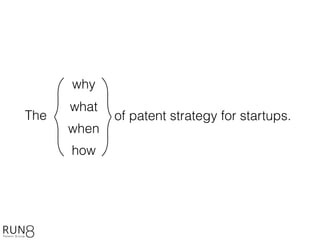
why
what
when
how
of patent strategy for startups.The
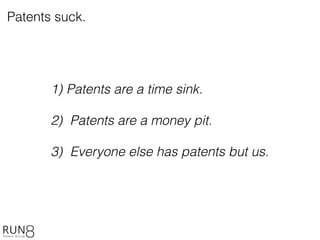
1) Patents are a time sink.
2) Patents are a money pit.
3) Everyone else has patents but us.
Patents suck.
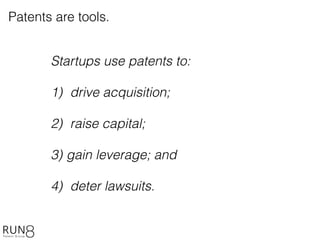
Startups use patents to:
1) drive acquisition;
2) raise capital;
3) gain leverage; and
4) deter lawsuits.
Patents are tools.
Can startups also use patents to:
1) generate licensing revenue?
2) stop competitors?
Did I miss anything?
The two faces of patent law.
patentability
infringement
1)
2)
of a new concept
of another patent
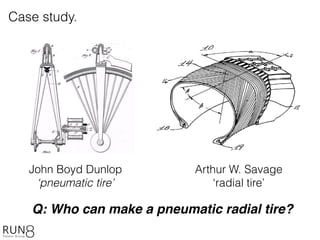
Case study.
Arthur W. Savage
‘radial tire’
John Boyd Dunlop
‘pneumatic tire’
Q: Who can make a pneumatic radial tire?
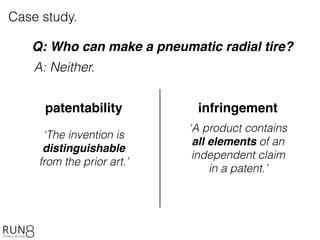
Case study.
A: Neither.
Q: Who can make a pneumatic radial tire?
patentability infringement
‘The invention is
distinguishable
from the prior art.’
‘A product contains
all elements of an
independent claim
in a patent.’
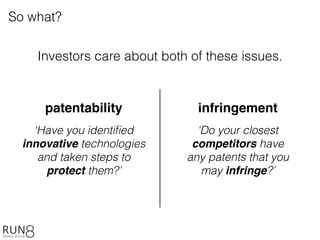
So what?
‘Have you identified
innovative technologies
and taken steps to
protect them?’
‘Do your closest
competitors have
any patents that you
may infringe?’
patentability infringement
Investors care about both of these issues.
How to handle the question.infringement
Don’t.
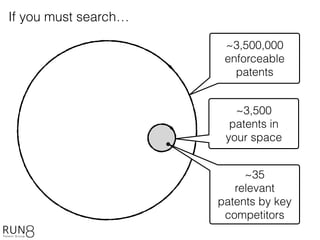
~3,500,000
enforceable
patents
~3,500
patents in
your space
~35
relevant
patents by key
competitors
If you must search…
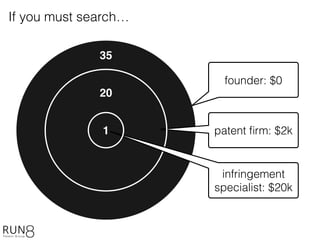
35
20
1
founder: $0
patent firm: $2k
If you must search…
infringement
specialist: $20k
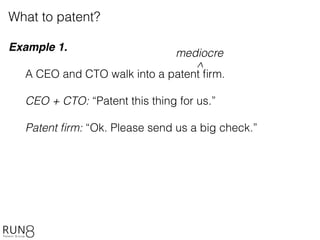
Example 1.
A CEO and CTO walk into a patent firm.
CEO + CTO: “Patent this thing for us.”
Patent firm: “Ok. Please send us a big check.”
What to patent?
mediocre
^
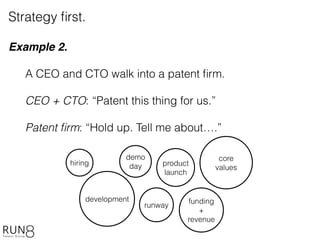
Example 2.
A CEO and CTO walk into a patent firm.
CEO + CTO: “Patent this thing for us.”
Patent firm: “Hold up. Tell me about….”
Strategy first.
hiring
demo
day
runway
development
product
launch
core
values
funding
+
revenue
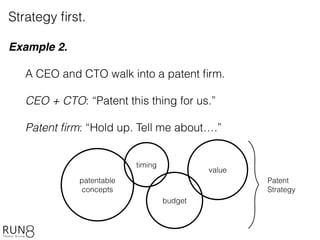
patentable
concepts
timing
budget
value
Patent
Strategy
Strategy first.
Example 2.
A CEO and CTO walk into a patent firm.
CEO + CTO: “Patent this thing for us.”
Patent firm: “Hold up. Tell me about….”
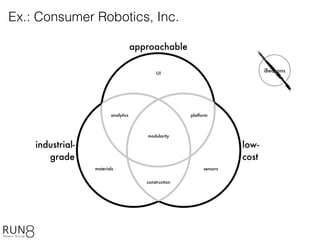
low-
cost
industrial-
grade
approachable
platform
UI
sensors
analytics
modularity
materials
construction
Ex.: Consumer Robotics, Inc.
iBeacons
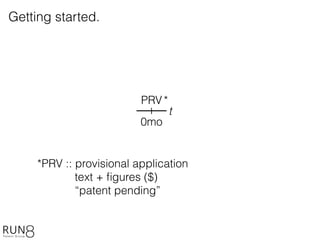
*PRV :: provisional application
text + figures ($)
“patent pending”
t
0mo
PRV*
Getting started.
t
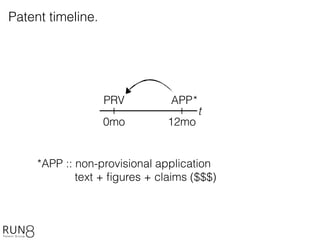
0mo 12mo
PRV APP
*APP :: non-provisional application
text + figures + claims ($$$)
*
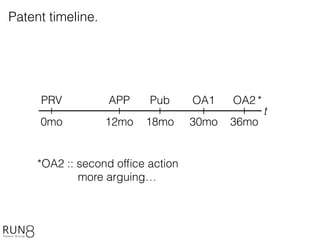
Patent timeline.
t
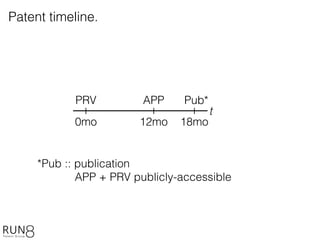
0mo 12mo
PRV APP
18mo
Pub
*Pub :: publication
APP + PRV publicly-accessible
*
Patent timeline.
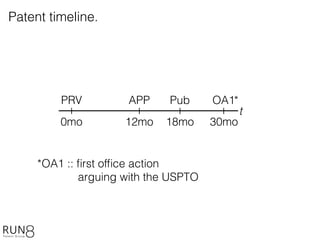
t
0mo 12mo
PRV APP
18mo
Pub
30mo
OA1
*OA1 :: first office action
arguing with the USPTO
*
Patent timeline.
t
0mo 12mo
PRV APP
18mo
Pub
30mo
OA1
36mo
OA2
*OA2 :: second office action
more arguing…
*
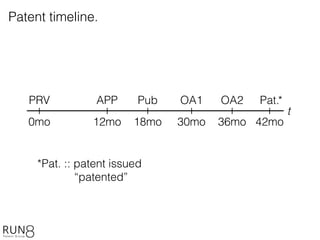
Patent timeline.
t
0mo 12mo
PRV APP
18mo
Pub
30mo
OA1
36mo
OA2
42mo
Pat.
*Pat. :: patent issued
“patented”
*
Patent timeline.
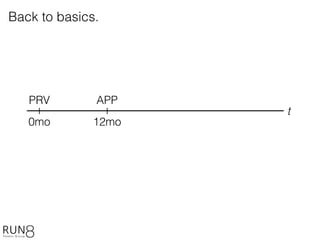
Back to basics.
t
0mo
PRV
12mo
APP
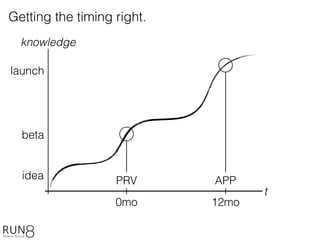
knowledge
t
idea
beta
launch
0mo 12mo
PRV APP
Getting the timing right.
t
0mo 12mo
APP
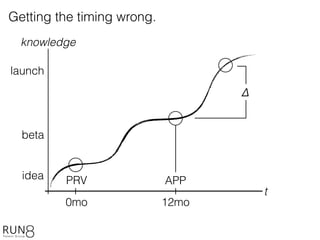
Getting the timing wrong.
Δ
PRVidea
beta
launch
knowledge
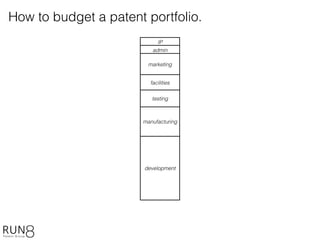
development
marketing
testing
manufacturing
facilities
admin
IP
$
How to budget a patent portfolio.
development
marketing
testing
manufacturing
facilities
admin
IP
How to budget a patent portfolio.
development
marketing
testing
manufacturing
facilities
admin
IP
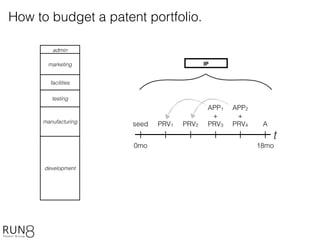
How to budget a patent portfolio.
t
PRV1 PRV2seed
0mo 18mo
A
APP1
+
PRV3
APP2
+
PRV4
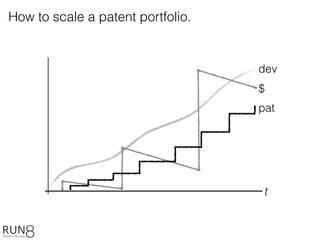
dev
t
How to scale a patent portfolio.
$
pat
Recap.
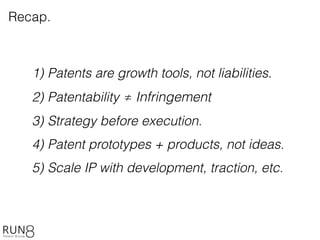
1) Patents are growth tools, not liabilities.
2) Patentability ≠ Infringement
3) Strategy before execution.
4) Patent prototypes + products, not ideas.
5) Scale IP with development, traction, etc.
Peter Miller
peter@r8pg.com
@Run8PG

Patent Strategy for Startups, Hardware Workshop SF 2015