E-Business Innovation & Entrepreneurship The Technology Assessment Process November 5 & 7, 2001 © 2001  William J. Brown
What We’ve Covered to Date Defined Emerging Technologies Defined Discontinuous Technologies Defined Evolutionary Technologies Challenges for Incumbents The 4 Traps 4 Strategies for avoiding Pitfalls
Early detection of emerging technologies is crucial As Professor Doering argues in  Wharton , competitive advantage now often goes to the companies that are most adept at choosing among the vast number of technological options and not necessarily to the companies that create them. Example of the U.S. semiconductor industry in the 1980s and 1990s winning out over Japan and Korea
Best Practices for R&D Decision Making Technology identification and assessment, as the first step in the R&D process, lays the foundation Assess the portfolio of options Hedge against technical uncertainty Create frameworks of learning Insist on alternatives Evaluate projects quantitatively
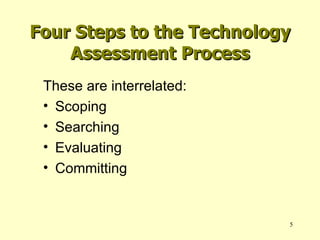
Four Steps to the Technology Assessment Process These are interrelated: Scoping Searching Evaluating Committing
Scoping “ If you don’t have a target, you’ll miss it every time.” The scope of the technology assessment must be clearly limited. Where the firm looks for technologies depends upon what it is looking for. Will be shaped by firm’s strategic intent & capabilities.
Scoping –  Strategic Intent Technology assessment is only meaningful when performed in the context of the firm’s strategic intent. Strategic intent  is a “sense of direction, discovery, or destiny.” British Airways’ goal of becoming  “The World’s Favourite Airline.” Meet this year’s goal of launching a new $200 MM business unit. Increase product shelf life. Lower production costs.
Technology cannot be considered in the abstract. It should be used to answer a question or to address a challenge. The strategic intent of the company is this challenge. If the company is going after a new market or seeking a new level of performance, what technology will take it there? Scoping –  Strategic Intent
Example: What new information systems could help British Airways become the world’s favorite airline? If the technology does not respond to the challenge of strategic intent, then there is no clear strategic purpose for pursuing it. The firm’s strategic intent must be foremost in focus for the technology assessment team. Scoping –  Strategic Intent
Core competence could be: Special technical capabilities leading to the development of unique products. The ability to provide a superior service. Capabilities for rapid product innovation and development Particular capabilities which yield enduring cost advantages First-rate technology assessment can itself be a crucial core competence in today’s economy. Scoping –  Firm Capabilities
Codifying the firm’s technical capabilities is the starting point for the technology assessment. The key questions: Does the firm possess sufficient capabilities? Will it have to  acquire ,  develop , or  create  partnerships to attain specific capabilities for tech development & commercialization? NOTE:  This may also require divesting some existing capabilities. What is the firm’s capacity for such change? Scoping –  Firm Capabilities
Managing a creative technology process requires balancing the capabilities & constraints of the firm with its intellectual openness to new technologies & ambitions for growth. Scoping –  Firm Capabilities
Scoping -  The Scope of Technology Assessment Includes the target market & target customer, and the perceived need that will be served by the new technology. Technical field must be given some boundaries to eliminate certain approaches & to understand risk between alternatives. Boundaries may include: Market & customer definition Technology standards Intellectual property Technical expertise of the firm Cost of R&D
A multifunctional team approach to defining scope best accomplishes task. Both technology & market knowledge Effective teams should include scientists & engineers, as well as those with production, marketing and customer service in the target market. Can be a great asset in integrating technological assessment with market needs. Scoping -  The Scope of Technology Assessment
To determine scope, teams might address such questions as: Does our team carry technical limitations that may prejudice the process? Is there a new discovery that can be the basis for a viable commercial opportunity? What is the best new technology to meet my target market’s current & future needs? What technologies are being developed outside my firm or industry? What existing & future markets can we apply the firm’s technology? Scoping -  The Scope of Technology Assessment
Sometimes a firm must expand its scope to meet it’s strategic intent Barnes & Noble’s decision to compete on the Internet Required directions in technology development that were entirely new to the industry Sometimes a firm must expand its scope because of the new tech itself: Such as chemical photography firms did in moving to digital technologies (such as Kodak) Scoping -  The Scope of Technology Assessment
Sometimes the identification of market needs also requires an expanded scope. In other cases, the scope of the firm may be narrowed, because technologies become obsolete or no longer provide competitive advantage. Scoping -  The Scope of Technology Assessment
As new information is gained, the scope may naturally be redefined. If a promising new technology is discovered, the scope may be narrowed to focus more intently on this area. Alternatively, if a promising technology is identified on the outer edges of the original scope, tit might be expanded to look more broadly at related technologies. Scoping -  The Scope of Technology Assessment
Searching Once the firm knows what it is looking for, it needs to determine how and where to look for new technologies. Managers need to systematically survey a variety of sources, including: Inside the firm (3M, DuPont, IBM, etc.) Public licensors of technology (universities, government, etc.) Technical & trade literature (Lexis Nexis, MedLine, etc.)
Searching –  Sensing Technological Emergence Every day, 1000’s of scientific discoveries are made public through conferences, patents, and publications. How can the technology manager detect the signal of a potentially transformative discovery? The challenge is to recognize some momentum beginning to form around a given technology. Leading technologies can be recognized as  emergent  for their technological “following”.
Technology forecasting occurs by looking carefully into the recent past for signals of a momentum building behind a technology toward filling a market need. Searching –  Sensing Technological Emergence
Searching –  Strong Signals These clearly reveal commercial investment in the candidate technology and signal its technical feasibility to serve target market needs. Two examples: Patent & literature citation Competitor’s actions
Searching –  Weak Signals Are more subtle indicators that a scientific discovery has commercial potential and that independent analysis has recognized this potential – and a following has then formed. Examples include: Confirmation within knowledge networks Competitive intelligence
Searching –  Knowledge & Information Capture As the picture becomes more complex, the company needs a system for keeping track of all the information & progress along the various research streams. Why?
Information gathered at the start may only be understood fully later on. Technologies continue to progress & develop. As the team grows or changes, compiled information can rapidly bring team members up-to-date. The knowledge of the team and its rationale for selecting decisions should be explicitly described to monitor progress and earn support from the firm’s leadership for new initiatives. The role of the Internet & corporate intranets creates extraordinary opportunities.
Evaluating The next challenge is to sort through the set of possibilities your team has defined.
Managers need to rank candidate technologies according to a set of common financial & organizational criteria. Position in a ranking may be established by weighted scores of these different criteria, financial analysis, or measures of risk. It’s important to limit the technology choice – also important to preserve a record of those technologies that did not make the grade for tomorrow’s possible breakthroughs. Evaluating
To assess technologies in the context of corporate strategy, managers need to develop technology plans that approximate the paths to: Technology commercialization Required investment Organizational implications Potential financial rewards Evaluating
A draft plan will reveal the outstanding questions that must be answered to reduce the uncertainties. An effective plan describes the technical & market uncertainties and the timing of investments & steps toward resolving each area of uncertainty. Evaluating
The Development of the Fax Machine Illustrates the importance of identifying & continuously evaluating these uncertainties. Xerox had developed the underlying technologies in the late 1960s but could not create a profitable business. Within 10 years, technological advances in component technologies enabled higher speed transmission, improved image quality, automation, cost reduction, and ease of use. During this same period, increased mail costs & unreliability, and lower phone rates changed the market for fax acceptance.
Lessons from the Fax Machine If Xerox had better identified & tracked the technical and market hurdles for the fax machine, it may have recognized more quickly its opportunities for product development & commercialization.
Committing Four general forms of strategic commitment reflect four increasingly aggressive strategic postures or intention. These depend upon the: Risk-reward relationship of the technology & its market Competitive imperative to take action Signals of technology emergence of the new technology
Committing –  Watch & Wait Posture applied when the uncertainty associated with a new technology is too great to begin its R&D. The technology has enough potential that activities for monitoring its emergence and the development of its market merits an active process.
Committing –  Position & Learn When there is less uncertainty associated with a technology, or if the risk of inaction is greater, a firm may choose to take a posture that positions the company to develop the technology and to defer or exclude a competitive threat. This is more aggressive – it engages the company actively in the new technology and thus creates a more active learning process.
Committing –  Sense & Follow When a company chooses to invest in an emerging technology, the strategic posture may be described as one of “sense and follow.” The firm is satisfied that there are sufficient signals of technological emergence to proceed with an active commercialization strategy.
Committing –  Believe & Lead When the technology opportunity is very promising, the company may fully commit its resources to commercialization of an emerging technology. Sometimes the firm is convinced a technology choice in the absence of broader external validation. Often, the firm truly believes in the technology and leads the technical field and the market application.

UM MBA Program: Technology Assessment Process

  • 1.
    E-Business Innovation &Entrepreneurship The Technology Assessment Process November 5 & 7, 2001 © 2001 William J. Brown
  • 2.
    What We’ve Coveredto Date Defined Emerging Technologies Defined Discontinuous Technologies Defined Evolutionary Technologies Challenges for Incumbents The 4 Traps 4 Strategies for avoiding Pitfalls
  • 3.
    Early detection ofemerging technologies is crucial As Professor Doering argues in Wharton , competitive advantage now often goes to the companies that are most adept at choosing among the vast number of technological options and not necessarily to the companies that create them. Example of the U.S. semiconductor industry in the 1980s and 1990s winning out over Japan and Korea
  • 4.
    Best Practices forR&D Decision Making Technology identification and assessment, as the first step in the R&D process, lays the foundation Assess the portfolio of options Hedge against technical uncertainty Create frameworks of learning Insist on alternatives Evaluate projects quantitatively
  • 5.
    Four Steps tothe Technology Assessment Process These are interrelated: Scoping Searching Evaluating Committing
  • 6.
    Scoping “ Ifyou don’t have a target, you’ll miss it every time.” The scope of the technology assessment must be clearly limited. Where the firm looks for technologies depends upon what it is looking for. Will be shaped by firm’s strategic intent & capabilities.
  • 7.
    Scoping – Strategic Intent Technology assessment is only meaningful when performed in the context of the firm’s strategic intent. Strategic intent is a “sense of direction, discovery, or destiny.” British Airways’ goal of becoming “The World’s Favourite Airline.” Meet this year’s goal of launching a new $200 MM business unit. Increase product shelf life. Lower production costs.
  • 8.
    Technology cannot beconsidered in the abstract. It should be used to answer a question or to address a challenge. The strategic intent of the company is this challenge. If the company is going after a new market or seeking a new level of performance, what technology will take it there? Scoping – Strategic Intent
  • 9.
    Example: What newinformation systems could help British Airways become the world’s favorite airline? If the technology does not respond to the challenge of strategic intent, then there is no clear strategic purpose for pursuing it. The firm’s strategic intent must be foremost in focus for the technology assessment team. Scoping – Strategic Intent
  • 10.
    Core competence couldbe: Special technical capabilities leading to the development of unique products. The ability to provide a superior service. Capabilities for rapid product innovation and development Particular capabilities which yield enduring cost advantages First-rate technology assessment can itself be a crucial core competence in today’s economy. Scoping – Firm Capabilities
  • 11.
    Codifying the firm’stechnical capabilities is the starting point for the technology assessment. The key questions: Does the firm possess sufficient capabilities? Will it have to acquire , develop , or create partnerships to attain specific capabilities for tech development & commercialization? NOTE: This may also require divesting some existing capabilities. What is the firm’s capacity for such change? Scoping – Firm Capabilities
  • 12.
    Managing a creativetechnology process requires balancing the capabilities & constraints of the firm with its intellectual openness to new technologies & ambitions for growth. Scoping – Firm Capabilities
  • 13.
    Scoping - The Scope of Technology Assessment Includes the target market & target customer, and the perceived need that will be served by the new technology. Technical field must be given some boundaries to eliminate certain approaches & to understand risk between alternatives. Boundaries may include: Market & customer definition Technology standards Intellectual property Technical expertise of the firm Cost of R&D
  • 14.
    A multifunctional teamapproach to defining scope best accomplishes task. Both technology & market knowledge Effective teams should include scientists & engineers, as well as those with production, marketing and customer service in the target market. Can be a great asset in integrating technological assessment with market needs. Scoping - The Scope of Technology Assessment
  • 15.
    To determine scope,teams might address such questions as: Does our team carry technical limitations that may prejudice the process? Is there a new discovery that can be the basis for a viable commercial opportunity? What is the best new technology to meet my target market’s current & future needs? What technologies are being developed outside my firm or industry? What existing & future markets can we apply the firm’s technology? Scoping - The Scope of Technology Assessment
  • 16.
    Sometimes a firmmust expand its scope to meet it’s strategic intent Barnes & Noble’s decision to compete on the Internet Required directions in technology development that were entirely new to the industry Sometimes a firm must expand its scope because of the new tech itself: Such as chemical photography firms did in moving to digital technologies (such as Kodak) Scoping - The Scope of Technology Assessment
  • 17.
    Sometimes the identificationof market needs also requires an expanded scope. In other cases, the scope of the firm may be narrowed, because technologies become obsolete or no longer provide competitive advantage. Scoping - The Scope of Technology Assessment
  • 18.
    As new informationis gained, the scope may naturally be redefined. If a promising new technology is discovered, the scope may be narrowed to focus more intently on this area. Alternatively, if a promising technology is identified on the outer edges of the original scope, tit might be expanded to look more broadly at related technologies. Scoping - The Scope of Technology Assessment
  • 19.
    Searching Once thefirm knows what it is looking for, it needs to determine how and where to look for new technologies. Managers need to systematically survey a variety of sources, including: Inside the firm (3M, DuPont, IBM, etc.) Public licensors of technology (universities, government, etc.) Technical & trade literature (Lexis Nexis, MedLine, etc.)
  • 20.
    Searching – Sensing Technological Emergence Every day, 1000’s of scientific discoveries are made public through conferences, patents, and publications. How can the technology manager detect the signal of a potentially transformative discovery? The challenge is to recognize some momentum beginning to form around a given technology. Leading technologies can be recognized as emergent for their technological “following”.
  • 21.
    Technology forecasting occursby looking carefully into the recent past for signals of a momentum building behind a technology toward filling a market need. Searching – Sensing Technological Emergence
  • 22.
    Searching – Strong Signals These clearly reveal commercial investment in the candidate technology and signal its technical feasibility to serve target market needs. Two examples: Patent & literature citation Competitor’s actions
  • 23.
    Searching – Weak Signals Are more subtle indicators that a scientific discovery has commercial potential and that independent analysis has recognized this potential – and a following has then formed. Examples include: Confirmation within knowledge networks Competitive intelligence
  • 24.
    Searching – Knowledge & Information Capture As the picture becomes more complex, the company needs a system for keeping track of all the information & progress along the various research streams. Why?
  • 25.
    Information gathered atthe start may only be understood fully later on. Technologies continue to progress & develop. As the team grows or changes, compiled information can rapidly bring team members up-to-date. The knowledge of the team and its rationale for selecting decisions should be explicitly described to monitor progress and earn support from the firm’s leadership for new initiatives. The role of the Internet & corporate intranets creates extraordinary opportunities.
  • 26.
    Evaluating The nextchallenge is to sort through the set of possibilities your team has defined.
  • 27.
    Managers need torank candidate technologies according to a set of common financial & organizational criteria. Position in a ranking may be established by weighted scores of these different criteria, financial analysis, or measures of risk. It’s important to limit the technology choice – also important to preserve a record of those technologies that did not make the grade for tomorrow’s possible breakthroughs. Evaluating
  • 28.
    To assess technologiesin the context of corporate strategy, managers need to develop technology plans that approximate the paths to: Technology commercialization Required investment Organizational implications Potential financial rewards Evaluating
  • 29.
    A draft planwill reveal the outstanding questions that must be answered to reduce the uncertainties. An effective plan describes the technical & market uncertainties and the timing of investments & steps toward resolving each area of uncertainty. Evaluating
  • 30.
    The Development ofthe Fax Machine Illustrates the importance of identifying & continuously evaluating these uncertainties. Xerox had developed the underlying technologies in the late 1960s but could not create a profitable business. Within 10 years, technological advances in component technologies enabled higher speed transmission, improved image quality, automation, cost reduction, and ease of use. During this same period, increased mail costs & unreliability, and lower phone rates changed the market for fax acceptance.
  • 31.
    Lessons from theFax Machine If Xerox had better identified & tracked the technical and market hurdles for the fax machine, it may have recognized more quickly its opportunities for product development & commercialization.
  • 32.
    Committing Four generalforms of strategic commitment reflect four increasingly aggressive strategic postures or intention. These depend upon the: Risk-reward relationship of the technology & its market Competitive imperative to take action Signals of technology emergence of the new technology
  • 33.
    Committing – Watch & Wait Posture applied when the uncertainty associated with a new technology is too great to begin its R&D. The technology has enough potential that activities for monitoring its emergence and the development of its market merits an active process.
  • 34.
    Committing – Position & Learn When there is less uncertainty associated with a technology, or if the risk of inaction is greater, a firm may choose to take a posture that positions the company to develop the technology and to defer or exclude a competitive threat. This is more aggressive – it engages the company actively in the new technology and thus creates a more active learning process.
  • 35.
    Committing – Sense & Follow When a company chooses to invest in an emerging technology, the strategic posture may be described as one of “sense and follow.” The firm is satisfied that there are sufficient signals of technological emergence to proceed with an active commercialization strategy.
  • 36.
    Committing – Believe & Lead When the technology opportunity is very promising, the company may fully commit its resources to commercialization of an emerging technology. Sometimes the firm is convinced a technology choice in the absence of broader external validation. Often, the firm truly believes in the technology and leads the technical field and the market application.