TOPIC: WILDLIFE ECOLOGY AND
ENVIRONMENT
SUBMITTED BY: SUMBAL MASOOD
Lahore College For Women University
INTRODUCTION
Wildlife ecology is the science behind
the practice of wildlife management
that seeks to manage wildlife
populations for the benefit of humans.
Wildlife ecology is
concerned principally with
the biology of birds and
mammals
including,
threatened,
endangered.
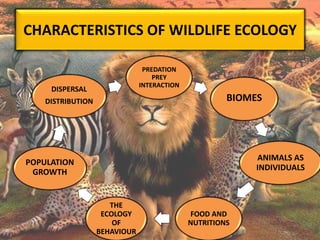
CHARACTERISTICS OF WILDLIFE ECOLOGY
PREDATION
PREY
INTERACTION
BIOMES
ANIMALS AS
INDIVIDUALS
FOOD AND
NUTRITIONS
THE
ECOLOGY
OF
BEHAVIOUR
POPULATION
GROWTH
DISPERSAL
DISTRIBUTION
A. PREDATION PREY INTERACTION
Predation can be
defined as occurring
when individuals eat all
or part of other live
individuals. This
excludes detritivores
and scavengers which
eat dead material.
There are four types of
predation:
1. HERBIVORY
2. PARASITISM
3. CARNIVORY
4. CANNIBALISM
• MAIN
CHARACTERISTICS
INCLUDES:
 The effect of
predators on prey
density.
 The behavior of
predators
 Behavior of the
prey
B.BIOMES:
1. FORESTS BIOMES
Forest biomes contain
3 types of biomes
as follow:
• BOREAL FOREST
BIOMES
• TEMPERATE
FOREST BIOMES
• TROPICAL FOREST
BIOMES.
2. WOODLAND BIOMES:
3. SHRUB LAND BIOMES
4. GRASSLAND BIOMES
5. DESERTS
6. MARINE BIOMES
C. ANIMALS AS INDIVIDUALS
• The characteristics of individual animals are
shaped by the process of evolution through the
associated process of speciation. Geographic
barriers, earth movements, and the migration of
climatic zones split up the distribution of species,
the separated components then adapting to their
own disparate environments.
• These large processes determine the detailed
characteristics of the individuals of a population,
their morphological and behavioral traits differing
within populations and among populations
according to genetic programming
D. FOOD AND NUTRITION
Nutrition and feeding
behavior underlies
many critical issues in
wildlife ecology and
management, such as
determining the
adequacy of food
supplies for
endangered species
or determining the
potential yield in
response to
harvesting.
Many aspects of the behavior
and ecology of wildlife species
are closely tied to seasonal and
spatial variation in food
availability, including social
organization, spacing patterns,
breeding synchrony, and
mating system.
E. ECOLOGY OF BEHAVIOUR
Foraging success is strongly affected by behavioral
decisions of both predators and their prey.
Social interference plays an important role in this
process, and we show how interference and territoriality
can be viewed as adaptive responses to environmental
conditions.
 All these behaviors have important consequences for
the dynamics of wildlife populations.
F. POPULATION GROWTH
The dynamic behavior of a population – whether it increases,
decreases, or remains stable – is determined by its age- or stage-
specific mortality and fecundity rates interacting with the underlying
distribution of ages or stages in the population.
When age-specific rates of fecundity and survivorship remain
constant, the population’s age distribution assumes a stable form, even
though its size may be changing. These demographic parameters
determine the rate of population change over time, forming the logical
basis for many conservation and management decisions.
CONCLUSION
• Wildlife ecology is the science behind the
practice of wildlife management that seeks to
manage wildlife populations Wildlife ecology
began as applied science discipline
• Although people enjoy viewing wildlife and
hunting animals for food and fur, conflicts
arise because wild animals kill livestock, cause
vehicle collisions, and damage crops.

Wildlife ecology and environment

  • 1.
    TOPIC: WILDLIFE ECOLOGYAND ENVIRONMENT SUBMITTED BY: SUMBAL MASOOD Lahore College For Women University
  • 2.
    INTRODUCTION Wildlife ecology isthe science behind the practice of wildlife management that seeks to manage wildlife populations for the benefit of humans. Wildlife ecology is concerned principally with the biology of birds and mammals including, threatened, endangered.
  • 3.
    CHARACTERISTICS OF WILDLIFEECOLOGY PREDATION PREY INTERACTION BIOMES ANIMALS AS INDIVIDUALS FOOD AND NUTRITIONS THE ECOLOGY OF BEHAVIOUR POPULATION GROWTH DISPERSAL DISTRIBUTION
  • 4.
    A. PREDATION PREYINTERACTION Predation can be defined as occurring when individuals eat all or part of other live individuals. This excludes detritivores and scavengers which eat dead material. There are four types of predation: 1. HERBIVORY 2. PARASITISM 3. CARNIVORY 4. CANNIBALISM • MAIN CHARACTERISTICS INCLUDES:  The effect of predators on prey density.  The behavior of predators  Behavior of the prey
  • 5.
    B.BIOMES: 1. FORESTS BIOMES Forestbiomes contain 3 types of biomes as follow: • BOREAL FOREST BIOMES • TEMPERATE FOREST BIOMES • TROPICAL FOREST BIOMES. 2. WOODLAND BIOMES: 3. SHRUB LAND BIOMES 4. GRASSLAND BIOMES 5. DESERTS 6. MARINE BIOMES
  • 6.
    C. ANIMALS ASINDIVIDUALS • The characteristics of individual animals are shaped by the process of evolution through the associated process of speciation. Geographic barriers, earth movements, and the migration of climatic zones split up the distribution of species, the separated components then adapting to their own disparate environments. • These large processes determine the detailed characteristics of the individuals of a population, their morphological and behavioral traits differing within populations and among populations according to genetic programming
  • 7.
    D. FOOD ANDNUTRITION Nutrition and feeding behavior underlies many critical issues in wildlife ecology and management, such as determining the adequacy of food supplies for endangered species or determining the potential yield in response to harvesting. Many aspects of the behavior and ecology of wildlife species are closely tied to seasonal and spatial variation in food availability, including social organization, spacing patterns, breeding synchrony, and mating system.
  • 8.
    E. ECOLOGY OFBEHAVIOUR Foraging success is strongly affected by behavioral decisions of both predators and their prey. Social interference plays an important role in this process, and we show how interference and territoriality can be viewed as adaptive responses to environmental conditions.  All these behaviors have important consequences for the dynamics of wildlife populations.
  • 9.
    F. POPULATION GROWTH Thedynamic behavior of a population – whether it increases, decreases, or remains stable – is determined by its age- or stage- specific mortality and fecundity rates interacting with the underlying distribution of ages or stages in the population. When age-specific rates of fecundity and survivorship remain constant, the population’s age distribution assumes a stable form, even though its size may be changing. These demographic parameters determine the rate of population change over time, forming the logical basis for many conservation and management decisions.
  • 10.
    CONCLUSION • Wildlife ecologyis the science behind the practice of wildlife management that seeks to manage wildlife populations Wildlife ecology began as applied science discipline • Although people enjoy viewing wildlife and hunting animals for food and fur, conflicts arise because wild animals kill livestock, cause vehicle collisions, and damage crops.