Summarizing
It is howwe take large selections of
text and reduce theme to their bare
essential : the gist,the key ideas, the
main points that worth nothing and
remembering
1. Erace thingsthat don't matter
Delete trivia material that is
unnecessary to understanding.
7.
2. Erase thingsthat repeat
Delete redundant material.in note
taking, time and space is precious.if a
word or phrase says basically the
same thing you have already written
down,then don't write it again!
8.
3. Trade, generalterms for specific names
Substitute superordinate terms for lists
(e.g., flowers for daisies, tulips for roses).
focus on the big picture,long technically
lists are hard to remember.if one word will
give you the meaning,then less is more.
9.
4. Use yourown words to write the
summary
Write the summary using your own
words but make sure to retain the main
points.
A. Somebody WantedBut So
The strategy help students
generalize, recognize cost and effect
relationships and find main ideas
12.
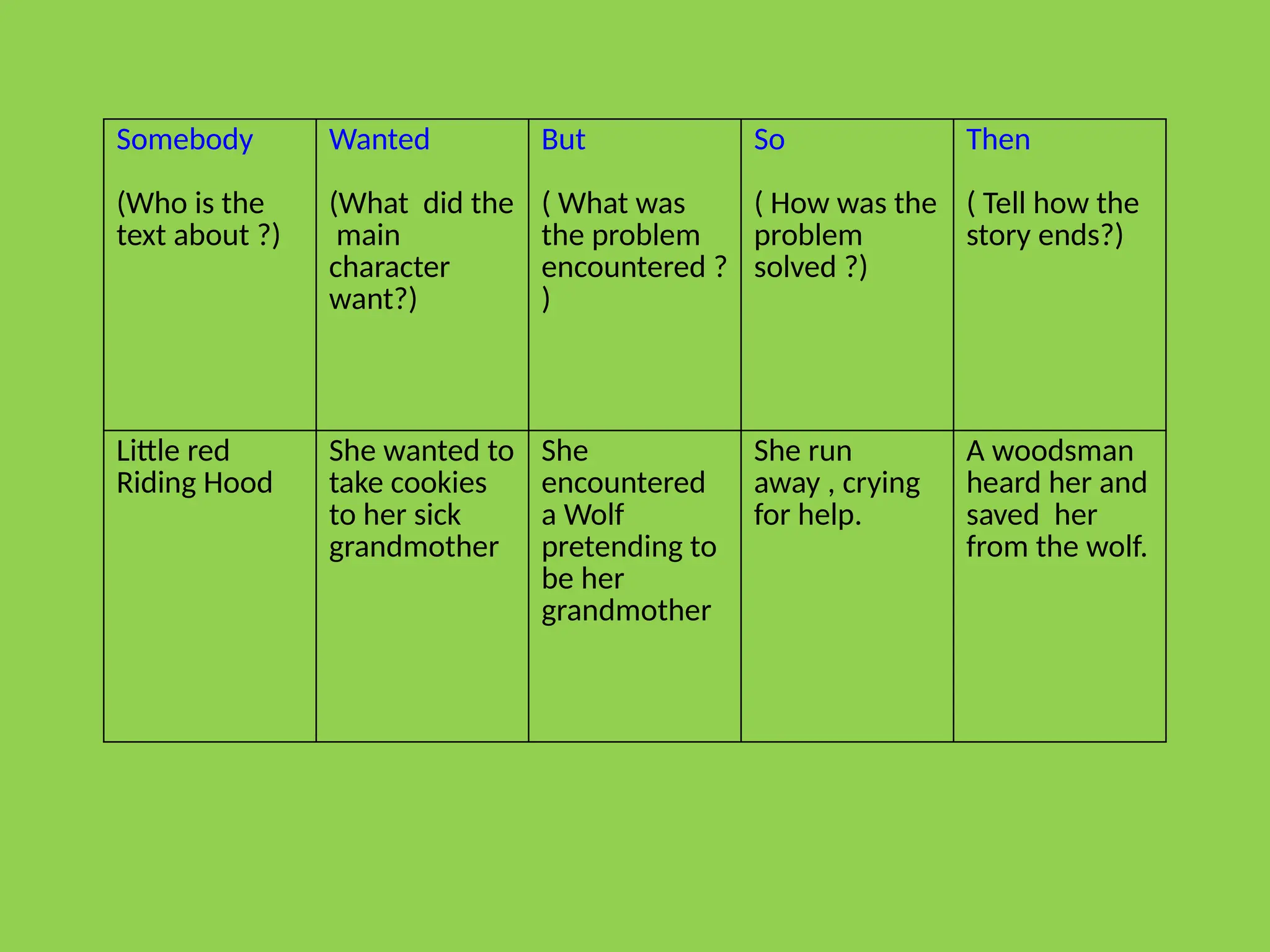
Somebody
(Who is the
textabout ?)
Wanted
(What did the
main
character
want?)
But
( What was
the problem
encountered ?
)
So
( How was the
problem
solved ?)
Then
( Tell how the
story ends?)
Little red
Riding Hood
She wanted to
take cookies
to her sick
grandmother
She
encountered
a Wolf
pretending to
be her
grandmother
She run
away , crying
for help.
A woodsman
heard her and
saved her
from the wolf.
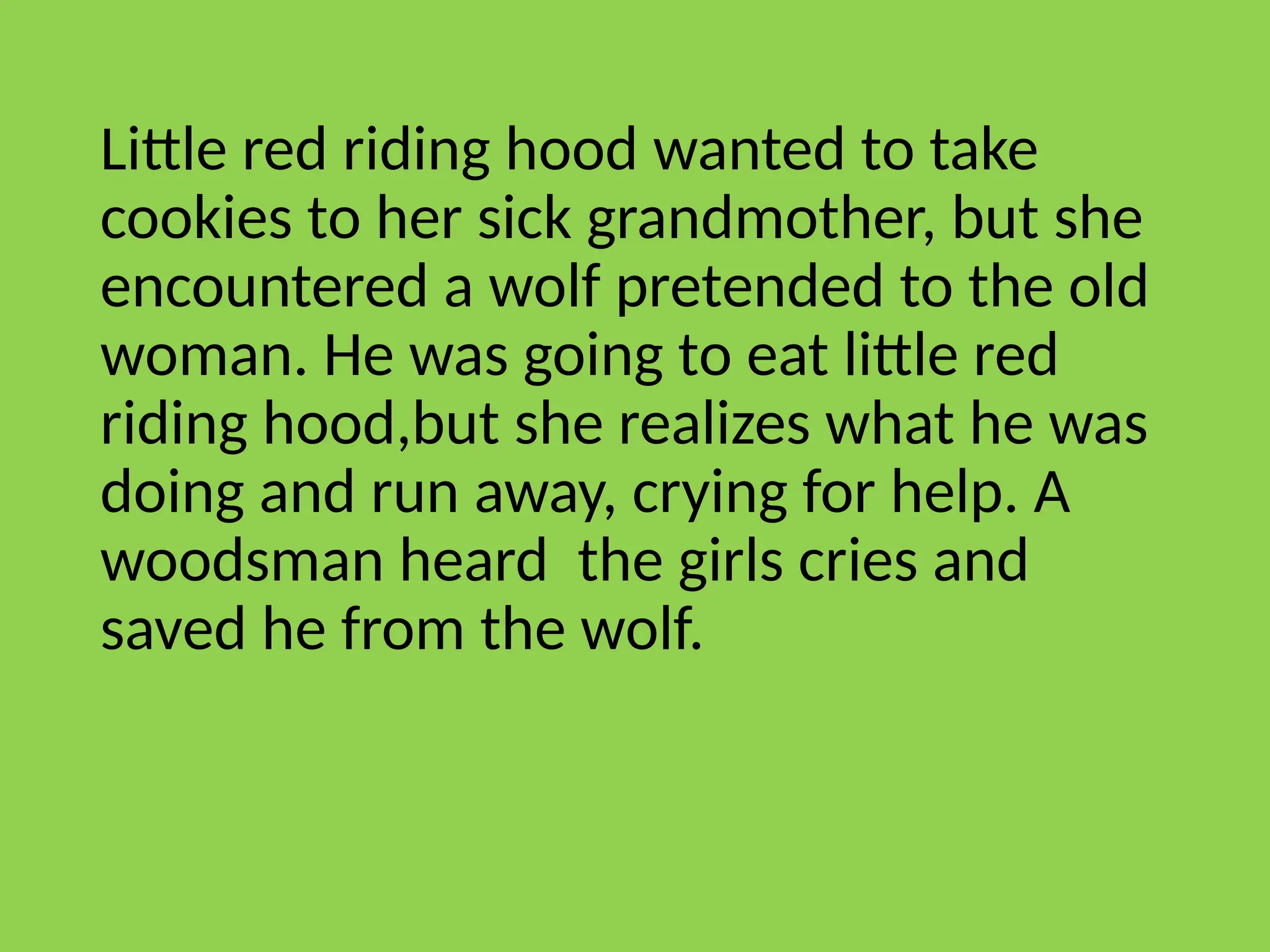
Little red ridinghood wanted to take
cookies to her sick grandmother, but she
encountered a wolf pretended to the old
woman. He was going to eat little red
riding hood,but she realizes what he was
doing and run away, crying for help. A
woodsman heard the girls cries and
saved he from the wolf.
15.
B. Saac Method
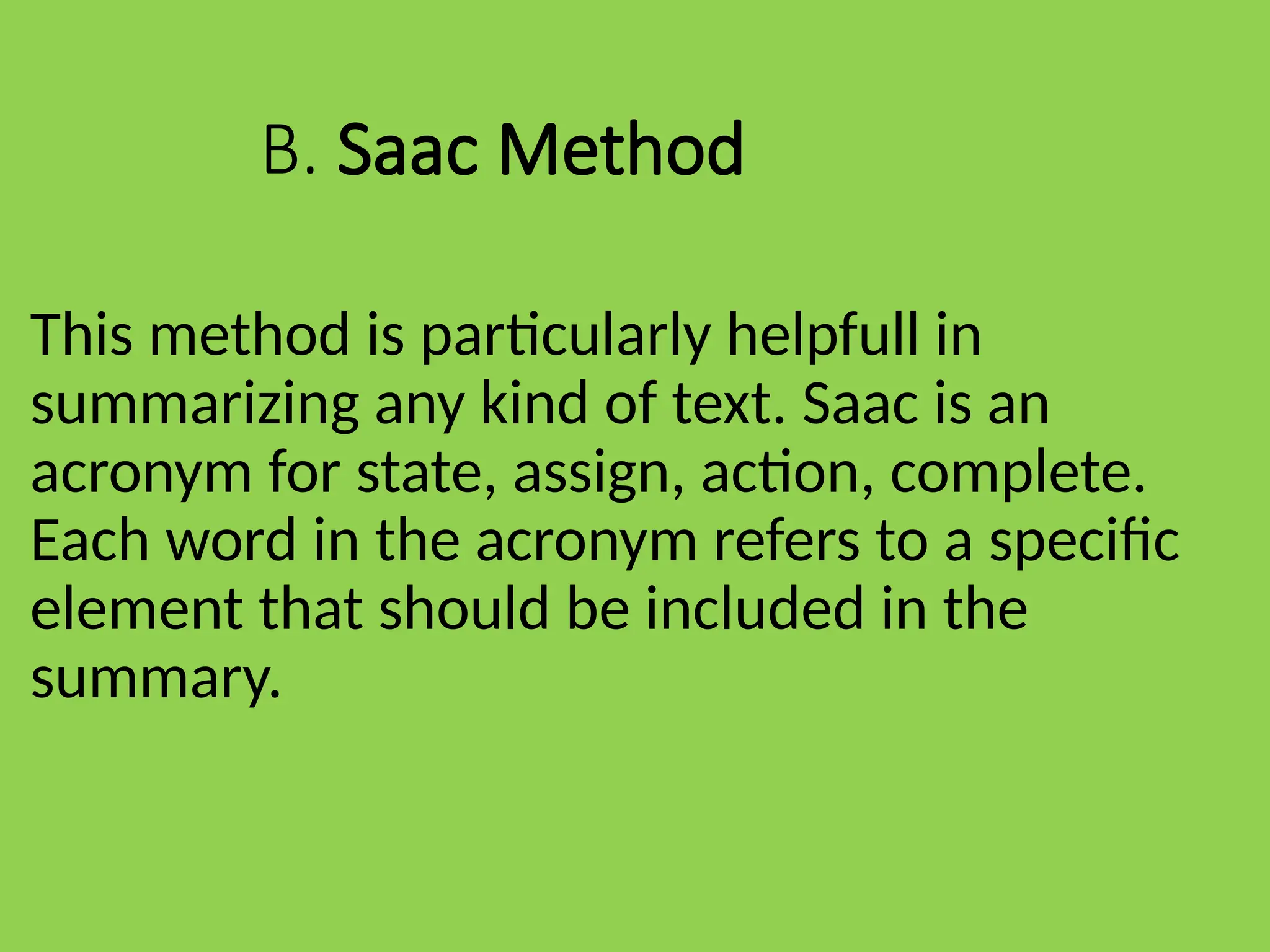
Thismethod is particularly helpfull in
summarizing any kind of text. Saac is an
acronym for state, assign, action, complete.
Each word in the acronym refers to a specific
element that should be included in the
summary.
16.
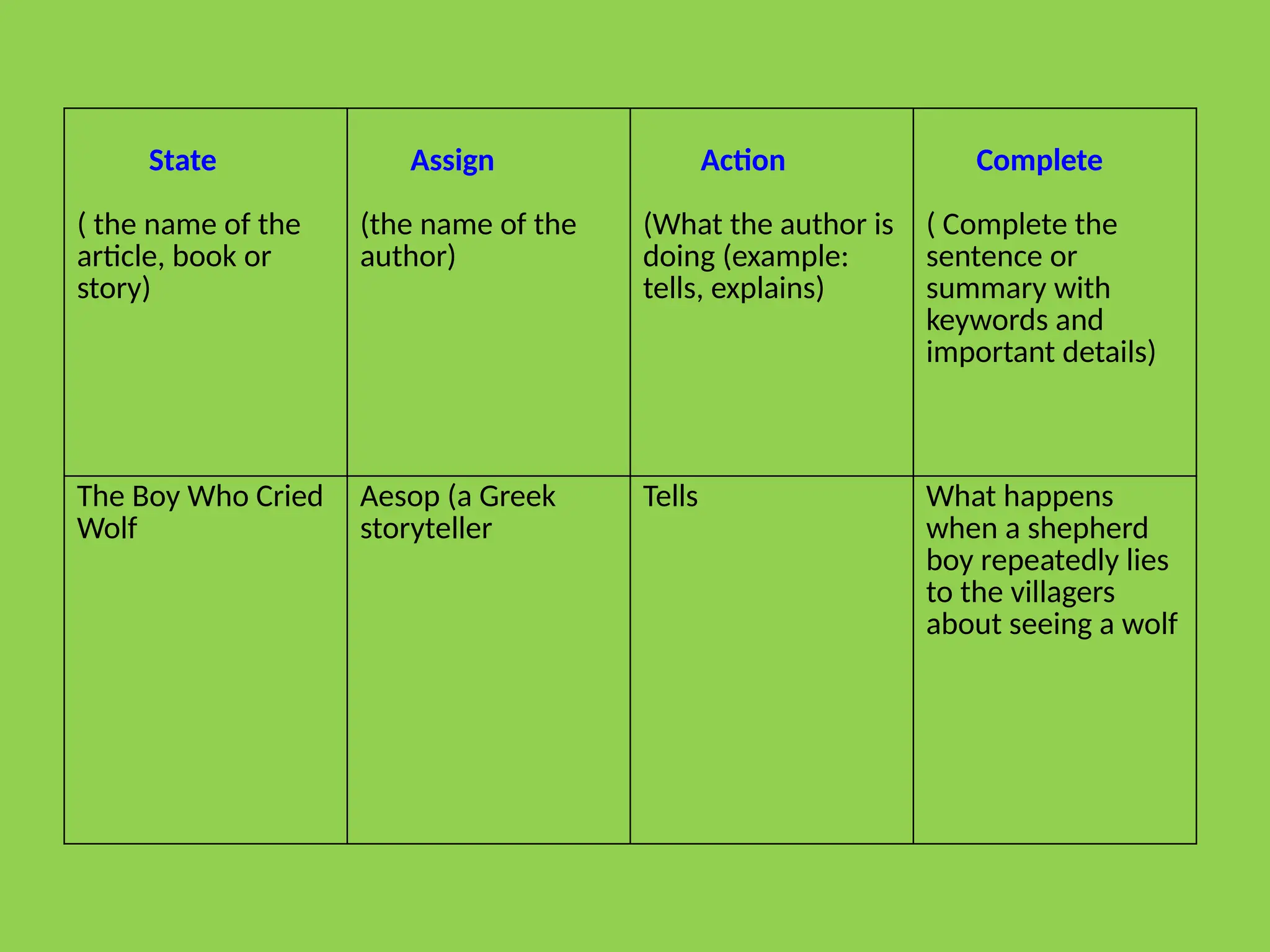
State
( the nameof the
article, book or
story)
Assign
(the name of the
author)
Action
(What the author is
doing (example:
tells, explains)
Complete
( Complete the
sentence or
summary with
keywords and
important details)
The Boy Who Cried
Wolf
Aesop (a Greek
storyteller
Tells What happens
when a shepherd
boy repeatedly lies
to the villagers
about seeing a wolf
17.
Use the fourSAAC cues to write
out a summary of The Boy Who
Cried Wolf in complete
sentences:
18.
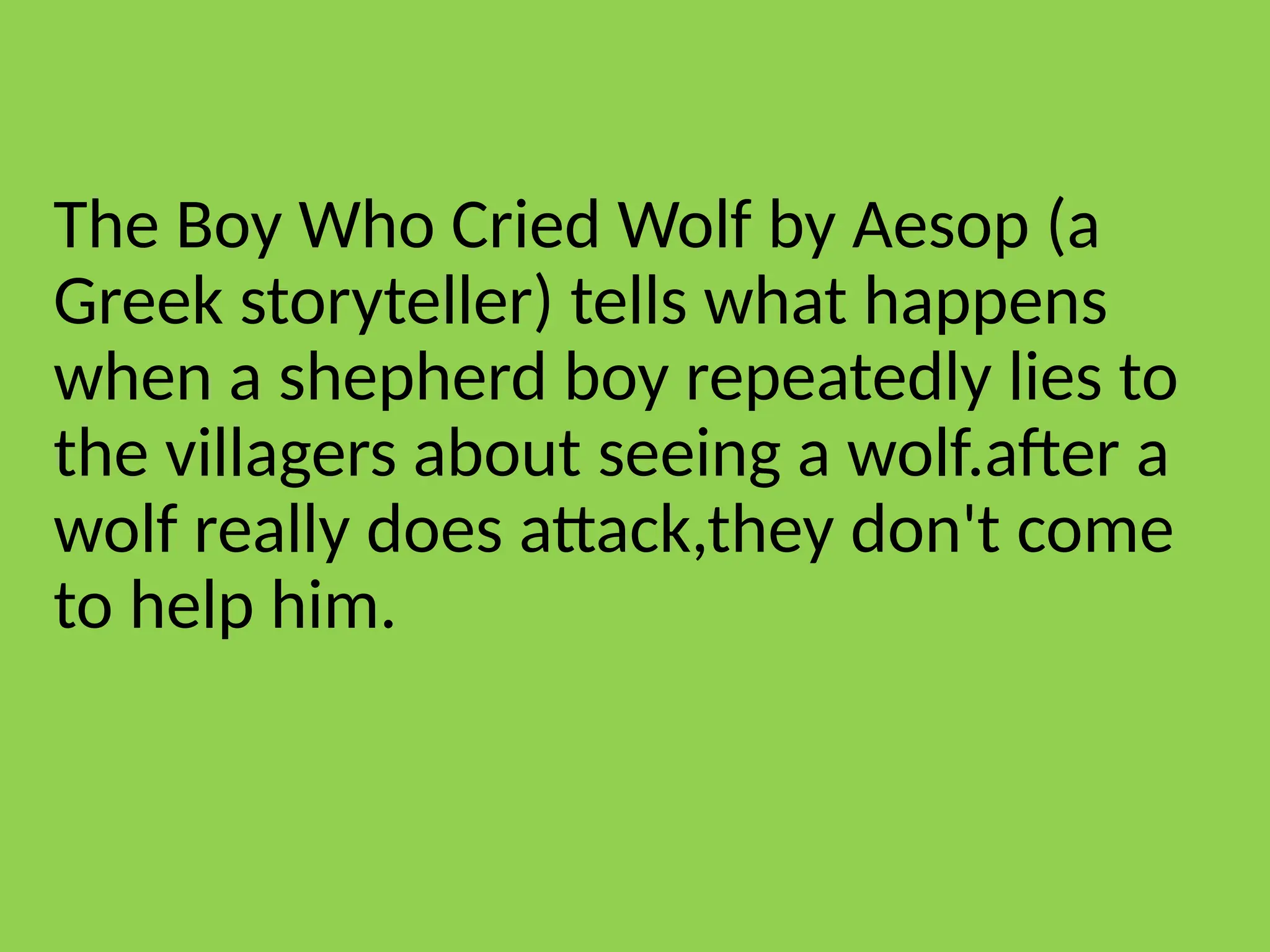
The Boy WhoCried Wolf by Aesop (a
Greek storyteller) tells what happens
when a shepherd boy repeatedly lies to
the villagers about seeing a wolf.after a
wolf really does attack,they don't come
to help him.
19.
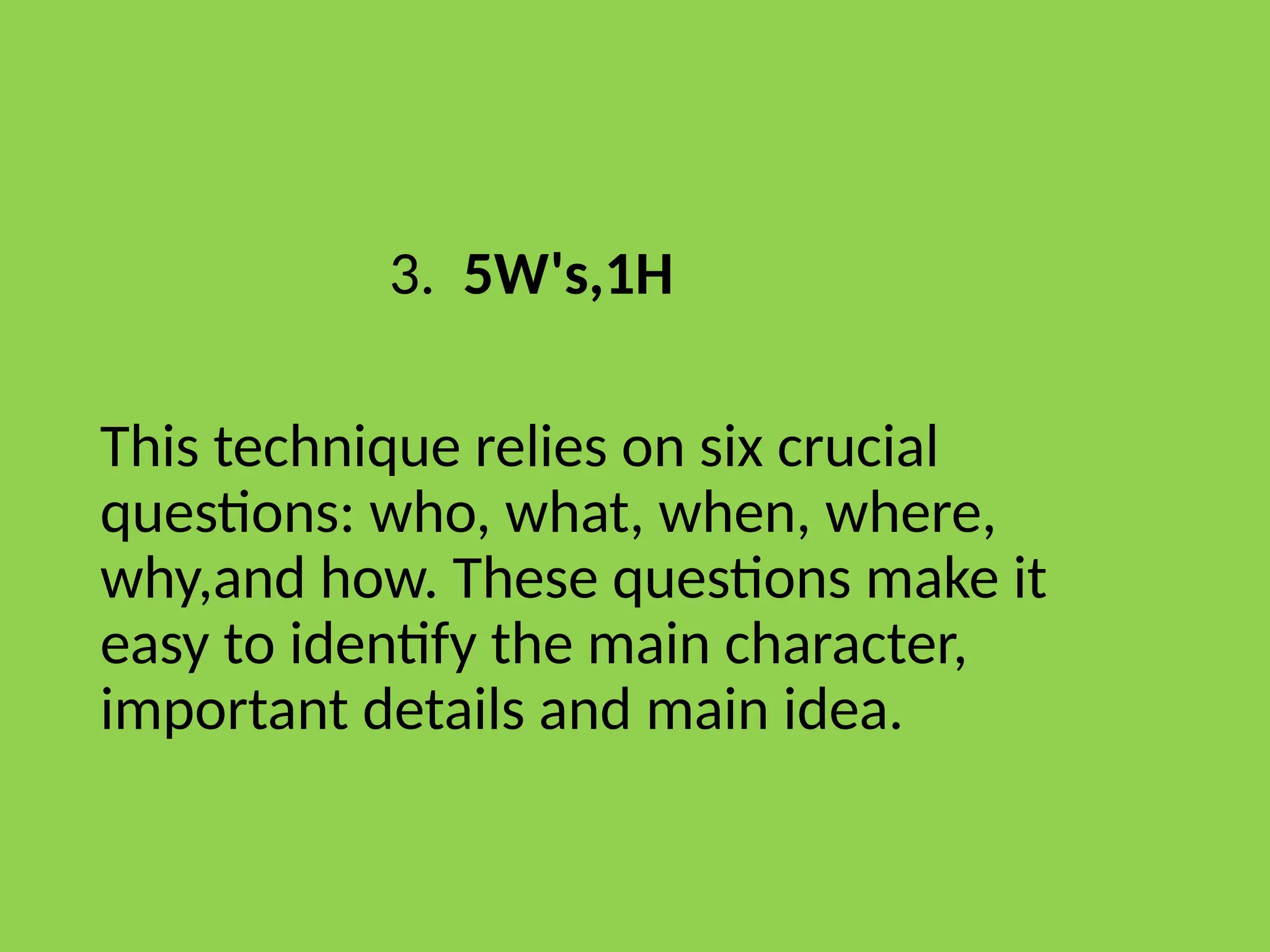
3. 5W's,1H
This techniquerelies on six crucial
questions: who, what, when, where,
why,and how. These questions make it
easy to identify the main character,
important details and main idea.
20.
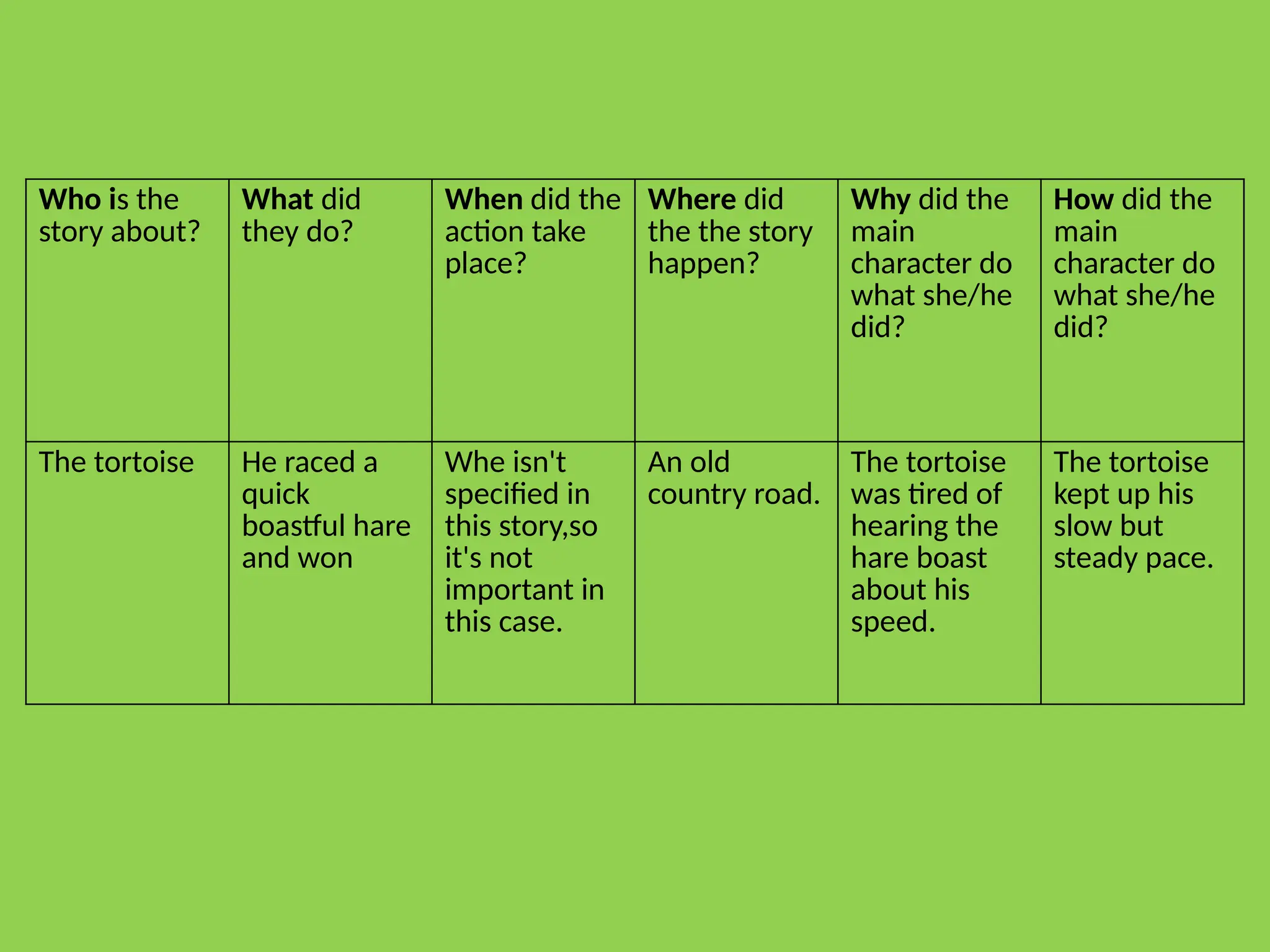
Who is the
storyabout?
What did
they do?
When did the
action take
place?
Where did
the the story
happen?
Why did the
main
character do
what she/he
did?
How did the
main
character do
what she/he
did?
The tortoise He raced a
quick
boastful hare
and won
Whe isn't
specified in
this story,so
it's not
important in
this case.
An old
country road.
The tortoise
was tired of
hearing the
hare boast
about his
speed.
The tortoise
kept up his
slow but
steady pace.
21.
4. First ThenFinally
This technique help students
summarize events in chronological
order.
22.
First: What happenedfirst? Include the
main character and main event/action
Then: What key details took place
during the event/action?
Finally: What were the results of
the event/action?
23.
Here is anexample using
Goldilocks and the Three Bears.''
First, Goldilocks entered the bears home
while they were gone. Then she ate their
food,sat in their chair and slept in their
beds. Finally, she woke up to find the
bears watching her,so she jumped up and
run away.
24.
5. Give Methe Gist
This type of techniques is like giving a
friend the gist of the story. In other
words, they want a summary - not a
retelling of every detail.