
Technical Writing Process
Prepared by Willow F. Pangket
Saint Louis University
Department of English
Summer 2014-2015
Audience and Purpose
• Audience
–Technical
–Non-technical
–Mixed
Audience Analysis
• What is their technical background?
• What is their function in the
organization?
• What are their interests?
• What level of detail do they need
from your report for it to be useful to
them?
• The primary audiences
• Secondary audiences
Guide Questions for Analysis
• What information do they have?
• What will they do with your report?
• What are their prejudices?
• What are their functions and concerns?
• How will your report affect them?
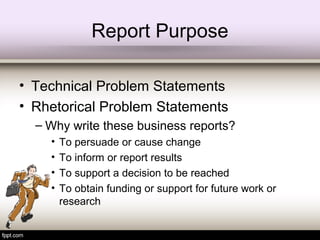
Report Purpose
• Technical Problem Statements
• Rhetorical Problem Statements
– Why write these business reports?
• To persuade or cause change
• To inform or report results
• To support a decision to be reached
• To obtain funding or support for future work or
research
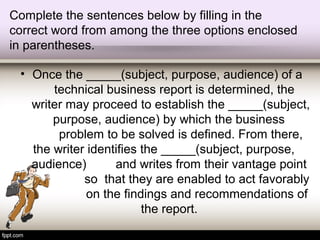
Complete the sentences below by filling in the
correct word from among the three options enclosed
in parentheses.
• Once the _____(subject, purpose, audience) of a
technical business report is determined, the
writer may proceed to establish the _____(subject,
purpose, audience) by which the business
problem to be solved is defined. From there,
the writer identifies the _____(subject, purpose,
audience) and writes from their vantage point
so that they are enabled to act favorably
on the findings and recommendations of
the report.
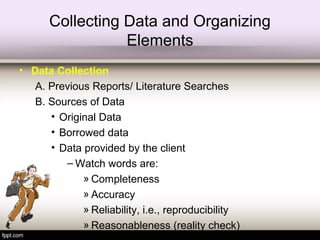
Collecting Data and Organizing
Elements
• Data Collection
A. Previous Reports/ Literature Searches
B. Sources of Data
• Original Data
• Borrowed data
• Data provided by the client
– Watch words are:
» Completeness
» Accuracy
» Reliability, i.e., reproducibility
» Reasonableness (reality check)
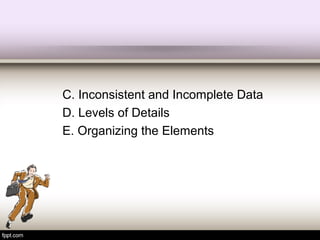
C. Inconsistent and Incomplete Data
D. Levels of Details
E. Organizing the Elements
• C. Organizing the Elements
• Textual Elements
– Main elements:
• Descriptive
• Analytical
• Comparative
• Conclusive
• Persuasive
• Summaries
Editing and Packaging Report
• Writing and Editing a Report
– Audience Analysis Review
– Sentence Length
– Word Choice
– Active and Action words
– Technical Terms and Jargons
Packaging a Report
• A matter of taste
• Simpler is usually better
• Format standardization
• Covers, bindings, color, and logos
• Tabs and dividers
• Editing for structure
• Editing for content
• Checking references
References:
Casinto, CD C.(2009). Interactive in Writing
Business Correspondence and Technical
Reports: A Communication Process
Approach. C&E Publishing, Inc.
Portillo, R. et. al. (2003). Research and
Technical Writing. Trinitas Publishing, Inc.

Technical writing

  • 1.
    Technical Writing Process Preparedby Willow F. Pangket Saint Louis University Department of English Summer 2014-2015
  • 2.
    Audience and Purpose •Audience –Technical –Non-technical –Mixed
  • 3.
    Audience Analysis • Whatis their technical background? • What is their function in the organization? • What are their interests? • What level of detail do they need from your report for it to be useful to them?
  • 4.
    • The primaryaudiences • Secondary audiences
  • 5.
    Guide Questions forAnalysis • What information do they have? • What will they do with your report? • What are their prejudices? • What are their functions and concerns? • How will your report affect them?
  • 6.
    Report Purpose • TechnicalProblem Statements • Rhetorical Problem Statements – Why write these business reports? • To persuade or cause change • To inform or report results • To support a decision to be reached • To obtain funding or support for future work or research
  • 7.
    Complete the sentencesbelow by filling in the correct word from among the three options enclosed in parentheses. • Once the _____(subject, purpose, audience) of a technical business report is determined, the writer may proceed to establish the _____(subject, purpose, audience) by which the business problem to be solved is defined. From there, the writer identifies the _____(subject, purpose, audience) and writes from their vantage point so that they are enabled to act favorably on the findings and recommendations of the report.
  • 8.
    Collecting Data andOrganizing Elements • Data Collection A. Previous Reports/ Literature Searches B. Sources of Data • Original Data • Borrowed data • Data provided by the client – Watch words are: » Completeness » Accuracy » Reliability, i.e., reproducibility » Reasonableness (reality check)
  • 9.
    C. Inconsistent andIncomplete Data D. Levels of Details E. Organizing the Elements
  • 10.
    • C. Organizingthe Elements • Textual Elements – Main elements: • Descriptive • Analytical • Comparative • Conclusive • Persuasive • Summaries
  • 11.
    Editing and PackagingReport • Writing and Editing a Report – Audience Analysis Review – Sentence Length – Word Choice – Active and Action words – Technical Terms and Jargons
  • 12.
    Packaging a Report •A matter of taste • Simpler is usually better • Format standardization • Covers, bindings, color, and logos • Tabs and dividers • Editing for structure • Editing for content • Checking references
  • 13.
    References: Casinto, CD C.(2009).Interactive in Writing Business Correspondence and Technical Reports: A Communication Process Approach. C&E Publishing, Inc. Portillo, R. et. al. (2003). Research and Technical Writing. Trinitas Publishing, Inc.