Content
▪What is TechnicalWriting?
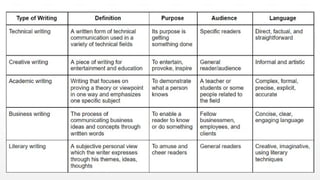
▪Technical Writing vs Other Writing Activities
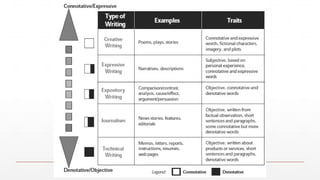
▪Spectrum of Technical Writing
▪Communication Continuum
▪Components and Attributes of an Effective
Technical Writing
Technical Writing
▪is communicationwritten for and about
business, science, industry, education,
and other specialized fields and focusing
on products and services: how to
manufacture them, market them, manage
them, deliver them, and use them.
7.
Technical Writing
▪It iswriting for a specific
purpose and with a
specific goal.
▪Usually its goal is to inform,
instruct, persuade, or argue.
8.
Technical Writing
▪Technical writingcan also be considered
transactional writing because there
are two people or groups involved in the
communication. One party has a clear
goal to inform or persuade the other
party.
9.
Technical Writing
▪This isREAL-WORLD WRITING in
every sense which impacts the world
through textbooks, instructions, web
sites, and communications from many
businesses and service organizations.
10.
Technical Writing
▪This isREAL-WORLD WRITING in
every sense which impacts the world
through textbooks, instructions, web
sites, and communications from many
businesses and service organizations.
11.
Technical Writing isNOT…
▪ literature; it is neither prose which recounts the fictional tales of
characters nor poetry which expresses deeply felt, universal
emotions through similes and metaphors;
▪ an expressive essay narrating an occurrence nor an expository
essay analyzing a topic;
▪ journalism, written to report the news; and
▪ focused on poetic images, describe personal experiences, or
report who won the basketball game.
12.
Instead, Technical Writingis…
▪ an instructional manual for repairing machinery;
▪ a memo listing meeting agenda;
▪ a letter from a vendor to a client; and
▪ a recommendation report proposing a new
computer system.
13.
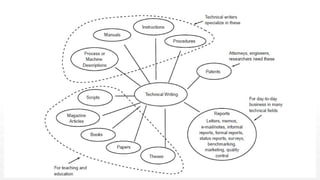
Technical Writing
▪ Technicalwriting is a broad term that encompasses a wide variety of
documents in the fields mentioned. The major types (or genres) of
documents in technical writing can be grouped into four major categories,
either in printed form or digital form:
▪ Reports and communications in day-to-day business;
▪ Technical papers, magazine articles, books, and theses for purposes of
education, teaching, and the sharing of information and knowledge;
▪ Patents; and
▪ Operational manuals, instructions, or procedures.
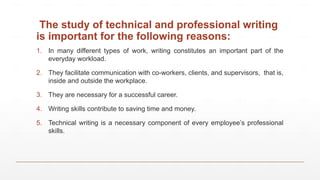
The study oftechnical and professional writing
is important for the following reasons:
1. In many different types of work, writing constitutes an important part of the
everyday workload.
2. They facilitate communication with co-workers, clients, and supervisors, that is,
inside and outside the workplace.
3. They are necessary for a successful career.
4. Writing skills contribute to saving time and money.
5. Technical writing is a necessary component of every employee’s professional
skills.
The study oftechnical and professional writing
is important for the following reasons:
1. In many different types of work, writing constitutes an important part of the
everyday workload.
2. They facilitate communication with co-workers, clients, and supervisors, that is,
inside and outside the workplace.
3. They are necessary for a successful career.
4. Writing skills contribute to saving time and money.
5. Technical writing is a necessary component of every employee’s professional
skills.
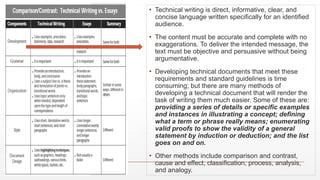
▪ Technical writingis direct, informative, clear, and
concise language written specifically for an identified
audience.
▪ The content must be accurate and complete with no
exaggerations. To deliver the intended message, the
text must be objective and persuasive without being
argumentative.
▪ Developing technical documents that meet these
requirements and standard guidelines is time
consuming; but there are many methods of
developing a technical document that will render the
task of writing them much easier. Some of these are:
providing a series of details or specific examples
and instances in illustrating a concept; defining
what a term or phrase really means; enumerating
valid proofs to show the validity of a general
statement by induction or deduction; and the list
goes on and on.
▪ Other methods include comparison and contrast,
cause and effect, classification, process, analysis,
and analogy.
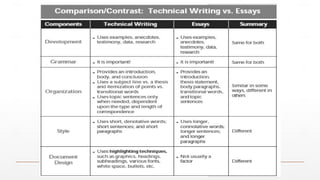
23.
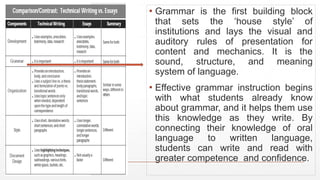
▪ Grammar isthe first building block
that sets the ‘house style’ of
institutions and lays the visual and
auditory rules of presentation for
content and mechanics. It is the
sound, structure, and meaning
system of language.
▪ Effective grammar instruction begins
with what students already know
about grammar, and it helps them use
this knowledge as they write. By
connecting their knowledge of oral
language to written language,
students can write and read with
greater competence and confidence.
24.
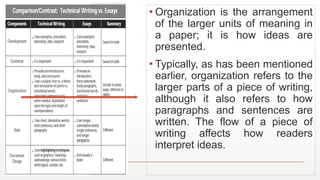
▪ Organization isthe arrangement
of the larger units of meaning in
a paper; it is how ideas are
presented.
▪ Typically, as has been mentioned
earlier, organization refers to the
larger parts of a piece of writing,
although it also refers to how
paragraphs and sentences are
written. The flow of a piece of
writing affects how readers
interpret ideas.
25.
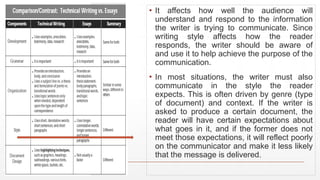
▪ It affectshow well the audience will
understand and respond to the information
the writer is trying to communicate. Since
writing style affects how the reader
responds, the writer should be aware of
and use it to help achieve the purpose of the
communication.
▪ In most situations, the writer must also
communicate in the style the reader
expects. This is often driven by genre (type
of document) and context. If the writer is
asked to produce a certain document, the
reader will have certain expectations about
what goes in it, and if the former does not
meet those expectations, it will reflect poorly
on the communicator and make it less likely
that the message is delivered.
26.
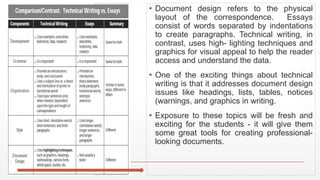
▪ Document designrefers to the physical
layout of the correspondence. Essays
consist of words separated by indentations
to create paragraphs. Technical writing, in
contrast, uses high- lighting techniques and
graphics for visual appeal to help the reader
access and understand the data.
▪ One of the exciting things about technical
writing is that it addresses document design
issues like headings, lists, tables, notices
(warnings, and graphics in writing.
▪ Exposure to these topics will be fresh and
exciting for the students - it will give them
some great tools for creating professional-
looking documents.
Five General Attributesof Technical Writing
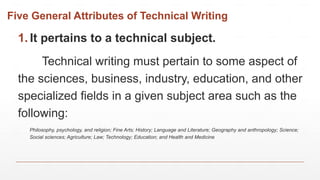
1. It pertains to a technical subject.
Technical writing must pertain to some aspect of
the sciences, business, industry, education, and other
specialized fields in a given subject area such as the
following:
Philosophy, psychology, and religion; Fine Arts; History; Language and Literature; Geography and anthropology; Science;
Social sciences; Agriculture; Law; Technology; Education; and Health and Medicine
29.
Five General Attributesof Technical Writing
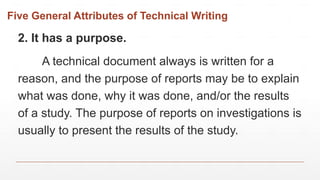
2. It has a purpose.
A technical document always is written for a
reason, and the purpose of reports may be to explain
what was done, why it was done, and/or the results
of a study. The purpose of reports on investigations is
usually to present the results of the study.
30.
Five General Attributesof Technical Writing
3. It has an objective.
The objective of a technical report is the overall reason
for doing the work. In an industrial situation, the objective of
any work is usually to make or increase profits. In the
preceding example, the objective was to reduce failure rates
to a level of less than three ppm. This will save money and
increase profits. Discriminating between purpose and
objective requires some practice, and this distinction is
discussed in more detail again in the Chapters on strategies
and introductions.
31.
Five General Attributesof Technical Writing
4. It conveys Information/facts/data.
Technical writing should have substance in
every statement. If a sentence does not convey
information pertinent to a study, leave it out.
Technical writing is focused on the technology
under discussion.
32.
Five General Attributesof Technical Writing
5. It is archival.
An intrinsic part of the value of technical writing
is that it is written in such a manner that it can be
archived and produce valuable and usable
information in the future. Conversely, technical
documents should not be generated on transient
issues or subjects that will not be pertinent in the
future.