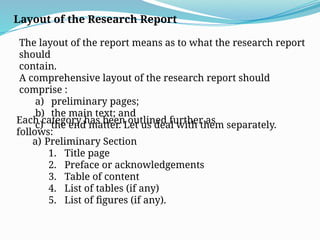
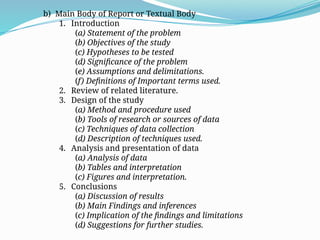
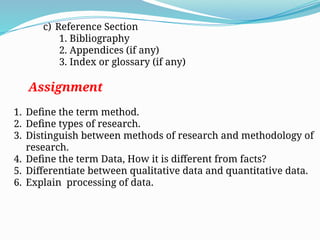
Technical Report Writing and Research Methodology.pptx
1.
Technical Report Writingand Research
Methodology
Prepared by
BIRUK B.
Mechanical Department
College of Engineering and Technology
Bule Hora University, Ethiopia.
Technical Report Writingand Research Methodology
Objectives
At the end of this section you should be able to :
Understand the technical writing report
Understand the purposes of a report
develop research proposal
design research experiment
ability to demonstrate a professional level of communication
(written, graphical/drawing and verbal) and presentation skills
with clients
Technical writing isthe process of writing and
sharing information in a professional setting.
A technical writer’s main task is to convey
information to another person or party in the most
clear and effective ways.
The information that technical writers convey is
often multipart, and to analyze the information
and present it in a format that is easy to read and
understand.
A good technical writer needs strong writing and
communication skills.
What is technical writing?
6.
Attributes of TechnicalWriting
In general, technical writing has a degree of formality, and it
generally focuses on a specific subject with the purpose of
making something happen or sharing useful information or
knowledge.
General attributes of technical writing are listed as following
• It pertains to a technical subject.
• It has a purpose.
• It has an objective.
• It conveys information/facts/data.
• It is impersonal.
• It is concise.
• It is directed.
• It is performed with a particular style and in a particular
format.
• It is archival.
7.
Pertains to aTechnical Subject
Technical writing must pertain to some aspect of
engineering or the sciences in a given subject area such
as the following:
• Philosophy, psychology, and religion
• History
• Geography and anthropology
• Social sciences
• Political science
• Law
• Education
• Fine arts
• Language and literature
• Science
• Agriculture
• Technology
8.
Has a Purpose
Atechnical document always is written for a reason, and
the purpose of reports may be to explain what was done,
why it was done, and to illustrate the results of a study.
The purpose of reports on investigations is usually to
present the results of the study.
The purpose of reports and papers should also be clearly
stated, as in the following example:
It is the purpose of this report to present the results of a
statistical study on the failure rate of spring latches on a type
D cardiology cassette. There have been a number of latch
failures uncovered in the inspection cycle, and this work is
the first step in reducing the latch failure rate to less than
three STP failure rate.
9.
Has an Objective
Theobjective of a technical report is the overall reason
for doing the work. In an industrial situation, the
objective of any work is usually to make or increase
profits. In the preceding example, the objective was to
reduce failure rates to a level of less than three STP. This
will save money and increase profits.
Conveys Information/Facts/Data
Technical writing should have substance in every
statement. If a sentence does not convey information
pertinent to a study. Technical writing is focused on the
technology under discussion.
10.
A report withoutfacts or scientific evidence to support
an opinion also usually lacks credibility, and it is likely
to be unsuccessful in achieving its purpose and
objective. The following report selection illustrates
reports with and without data.
No Data
A decision has been made to convert the machine shop grinding operations into a
three-shift operation to increase efficiency and machine utilization.
Preferred—with Data
A study was conducted to improve the elapsed time required to grind a set of
slitting knives. The average elapsed time for a regrind for the 1997 fiscal year was
11 days. A second study indicated that the largest time allotment in the 11 day
regrind time was 3.4 days waiting for grinder availability. These studies were
based on one shift (day). A three-week test with three-shift operation reduced the
waiting for machine availability time to zero. The elapsed time for thirty knife sets
that were ground in the three-week test time was less than one day. These test
results suggest that three-shift operations should be implemented.
11.
Most reports needfacts or data to support conclusions and
recommendations, and the verbs listed here are probably associated
with factual statements:
• Determined
• Solved
• Built
• Accepted
• Rejected
• Completed
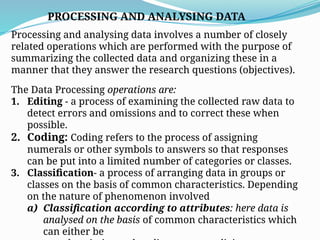
• Passed
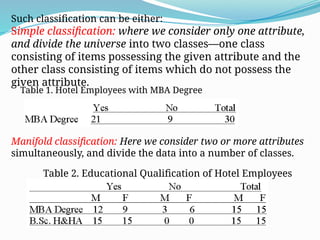
• Failed
• Broke
• Approved
• Cancelled
• Invented
• Designed
• Developed
• Discovered
• Uncovered
• Deduced
• Studied
Verbs that are often not associated
with factual statements include
words
like the following:
• Think
• May be
• Suggest
• Appear
• Suppose
12.
Impersonal (Third Person)Voice
The use of first person pronouns is usually discouraged in
technical writing. The intrusion of “I” makes the work less
authoritative. Similarly, it is in appropriate to use names of
people and/or trade names unless there is no other way to
describe the item.
Discouraged
I ran a series of hardness tests on the valve seals for Bob MacArther
from the shops division, and I found that three of the seals were below
normal. I also notified Harry Randall and Phylis Carter so that the two
of them could do Rockwell measurements on future value seals.
Preferred
A series of hardness tests were conducted on valve seals at the request
of the Shops Division, and it was determined that three parts had
abnormally low harnesses. The appropriate individuals were notified
so that they can request hardness testing on future valve-seal
shipments.
13.
Be Concise
Technical reportsare usually written for business reasons. They are
not intended to entertain; they communicate information to an
identified person or group. Say what you want to say and get out!
Wandering sentences and extra words reflect badly on the author and
often have a negative effect on the readership that you are trying to
reach.
Directed to Readers
technical reports must be directed to a particular readership. The
author is responsible for determining the specific individuals or
parties who will receive a technical document. Writing should be
aimed at the readership.
Directing a report also to determines the technical level of writing. If
you direct a report to your coworkers, you do not have to bring them
up to speed on the organization of your department. They already
know it.
14.
Style and Format
Theattributes of technical writing also include style and format.
Style is the way that you write;
format is the ordering and physical layout of a document.
The format (basic elements and their placement) of technical
papers
and reports is a more structured one than that used for other forms of
writing.
Formal technical reports have basic elements and a structure as
follows:
• Introduction (why you are doing the work)
• Procedure (what you did)
• Results (what happened)
• Discussion (what it means)
• Conclusions (what was learned)
• Recommendations (what is to be done with the new information or
knowledge)
15.
2. Writing Style
Goals
•Understand the elements of style in technical writing
• Become familiar with the style that is most suitable for
technical reports
16.
Writing Style refersto mannerisms in word usage.
• It is the way that the writer consistently and unconsciously chooses
words, forms sentences and paragraphs, and combines them with
ideas and thoughts to create a document.
• A document is a composition that integrates the elements of style
into a finished work.
• Technical writing by definition is done for a reason. There is a
purpose and objective for every document.
• Writing style will help determine success in achieving the goals of
a document.
18.
Elements of Style
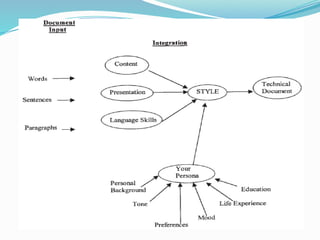
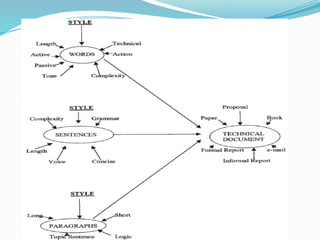
Criteriafor Good Technical Writing are document content,
presentation, and language skills, but style starts your previous.
It starts with writer choices of;
• word usage,
• how words are put into sentences,
• how paragraphs are constructed, and
• how they are presented to readership in the final work.
20.
Personal affects wordchoice and results in a particular
style.
If you are a gregarious person, you may be prone to use words like
“bold, hearty, and beautiful.”
An introverted person is likely to use words that do not draw attention
to himself or herself.
Words like “anticipate, therefore, follows” may be selected as a
reflection of an introverted personality.
21.
writing style hasa tone, which is a reflection of writer attitude or
feelings.
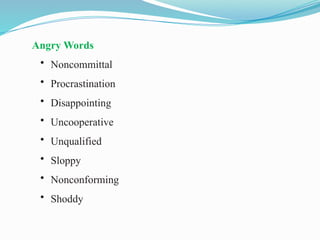
If you are angry at your manager at the time of writing, this may
show in your writing as snipping remarks or angry words.
Angry Tone
The project would have been completed as scheduled if we had
management cooperation.
Technical writing, bydefinition, should be objective and
impersonal.
The tone should be neutral.
In other words, the tone should be dispassionate, impartial, and
unbiased.
Tone may be influenced by;
your feelings at the time of writing,
how you feel about yourself,
how you feel about your boss,
company, mate, or health.
RULE DO NOT LET PERSONAL FEELINGS SHOW IN WRITING.
24.
Word Choice
There aremany types of words, and choice of words is a major part
of writing style.
Many words have a “personality” of their own, just as words may
reflect the personality of the author.
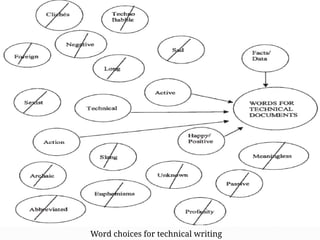
25.
Clichés are essentiallyfigures of speech. Groups of words are taken
together to have a contemporary meaning.
Foreign words are also part of the English language, such as,
restaurant (French), pizza (Italian), envoy (French), soprano (Italian),
and resume (French).
the author, must decide if your readership will know their meanings:
etc. = et cetera = and so forth
Ibid = ibidem = in the same place (cited previously)
et al. = and others
per se = by itself
i.e. = id est = that is
e.g. = exempli gratia = for example
Words with apresumption of gender: chairman, congressman,
salesman, meter maid, repairman, and so forth.
These words suggest that only a man or a woman could do them,
which is often an anachronism.
Nowadays, professional writers avoid words with any arbitrary or
presumptuous reference to a specific gender, religion, ethnic group,
or special group.
Current salutations include “Dear Resident,” “Dear
Subscriber,” and “Dear Reader.”
Salesperson is used in place of salesman. Chair is used
instead of chairman; meter monitor is used instead of
28.
Action words aremeant to evoke or elicit feelings of
excitement or progress.
The people who promote these exercises insist on using
words of action in developing these statements.
Some words by nature have that connotation. Race, fight,
beat, and convert all imply action.
When you use these words, you describe something that
happened, or you try to evoke action or excitement from
the reader.
Conversely, verbs that do not suggest as much action are
list, number, think, consider, study, and so forth. These
words are simply not as bold.
29.
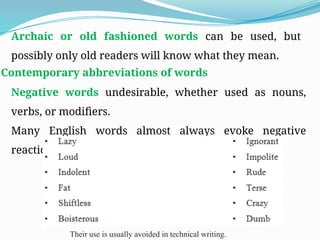
Archaic or oldfashioned words can be used, but
possibly only old readers will know what they mean.
Contemporary abbreviations of words
Negative words undesirable, whether used as nouns,
verbs, or modifiers.
Many English words almost always evoke negative
reactions:
Their use is usually avoided in technical writing.
30.
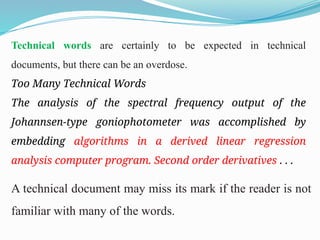
Technical words arecertainly to be expected in technical
documents, but there can be an overdose.
Too Many Technical Words
The analysis of the spectral frequency output of the
Johannsen-type goniophotometer was accomplished by
embedding algorithms in a derived linear regression
analysis computer program. Second order derivatives . . .
A technical document may miss its mark if the reader is not
familiar with many of the words.
31.
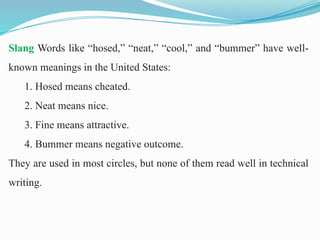
Slang Words like“hosed,” “neat,” “cool,” and “bummer” have well-
known meanings in the United States:
1. Hosed means cheated.
2. Neat means nice.
3. Fine means attractive.
4. Bummer means negative outcome.
They are used in most circles, but none of them read well in technical
writing.
32.
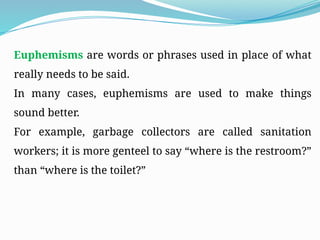
Euphemisms are wordsor phrases used in place of what
really needs to be said.
In many cases, euphemisms are used to make things
sound better.
For example, garbage collectors are called sanitation
workers; it is more genteel to say “where is the restroom?”
than “where is the toilet?”
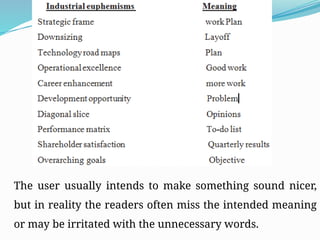
33.
The user usuallyintends to make something sound nicer,
but in reality the readers often miss the intended meaning
or may be irritated with the unnecessary words.
34.
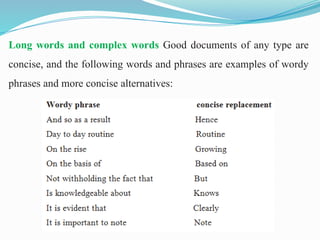
Long words andcomplex words Good documents of any type are
concise, and the following words and phrases are examples of wordy
phrases and more concise alternatives:
35.
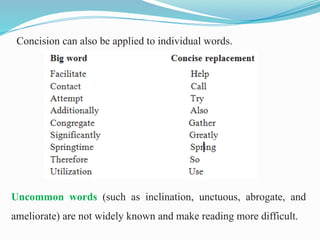
Concision can alsobe applied to individual words.
Uncommon words (such as inclination, unctuous, abrogate, and
ameliorate) are not widely known and make reading more difficult.
36.
Technobabble includes manufacturedwords and
phrases similar to some industrial euphemisms.
Every profession has words with special meanings, but
overuse of specialized terms or big words (strategize,
overarching, deliverable, and so forth) with simple
meanings may only just difficult to understand the
meaning and frustrate the readers.
These words have meaning within the profession, but the
meaning outside may be very different.
37.
Profanity is, ofcourse, totally unacceptable in any
business or technical document.
Profane language often has sexual overtones that would
violate most sexual harassment guidelines.
Active and passive words involve the reader in very different ways.
Writing in the active voice usually makes documents more readable.
The active voice is a good attribute in any form of writing, because writing
in the active voice makes your statements more forceful.
The active voice simply means that the subject of the sentence does action.
Passive voice, on the other hand, does not identify who is doing the action:
38.
Words that evokehappiness or sadness Feelings of
happiness or sadness are not objectives in report
writing, but there may be occasions to use these kinds of
words in business or day-to-day communications.
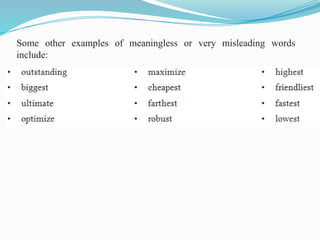
Meaningless or misleading words Many well-used words
in the English language do not provide any meaningful
information. For example, most superlatives (best,
greatest, superior, fastest, and so forth) are meaningless or
misleading words without factual foundation.
Never claim product superiority without test data to
Sentence Construction
Construction ofgood sentences follows directly from
word choice.
Build sentences with concise, vigorous/energetic, and
substantive(true idea) words in the active voice. Include
valid facts and data.
Suppress your inclination to use meaningless and
negative words, euphemisms, and abbreviations.
41.
Sentence Construction Problem
ProblemOne: Starting with Dependent Clause. It is not grammatically
wrong to start a sentence with a dependent clause, but the resulting sentences
often lack concision and are difficult to understand. Eg.
Starting with a Dependent Clause
At the start of the business year and at the beginning of the third quarter, the
laboratory has a project review with the director of research.
Starting with a Noun
The laboratory has a project review with the director of research each
January and July. The sentences in the preceding two examples
have the same meaning, but the latter is more clear and concise.
The modifying phrase with the data is still present, but it is
easier to read when moved to the end of the sentence.
42.
Beginning with aClause
Traveling to the western tank farm, he met three lab members near building
318.
Were the lab members traveling to the tank farm or was he? This is the kind
of confusion that often occurs when a dependent clause is moved away from
the word that it modifies.
Beginning with a Pronoun
He met three lab members on his way to the western tank farm. They were
near building 318.
This second version is clearer. Many times clarity can easily be improved by
breaking a long sentence into two or more sentences.
43.
Problem Two: Subjectand Verb Do Not Agree. As we all know, the rules of
English require agreement of subject and verb.
If the subject is singular, the verb must also be singular.
Long sentences with many clauses often create a significant physical
separation of the subject and verb, and this often leads to subject-verb
disagreement.
Subject and Verb Do Not Agree
Metallography of failed balls and races are key aspects of failure analysis.
The subject, metallography, is singular, but the sentence uses
a plural verb, because the author has confused the
modifying words “of balls and races” as the subject.
44.
Problem Three: IncoherentSentences. Incoherent sentences
usually result from the omission of a word. (a mistake resulting
from neglect)
Incoherent
The procedure for cutting circuit boards for failure study begins
stripping the devices.
In this example, the writer left out “with” between begins and
stripping.
Incoherent
Differential scanning calorimetry (DSC) and thermo gravimetric
analysis (TGA) to determine if any significant differences existed
between the samples identified as A and D.
It appears that a “were used” or “were employed” was intended
45.
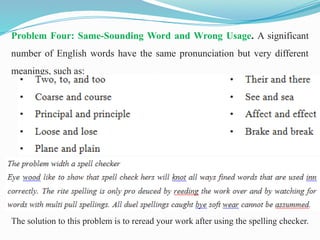
Problem Four: Same-SoundingWord and Wrong Usage. A significant
number of English words have the same pronunciation but very different
meanings, such as:
The solution to this problem is to reread your work after using the spelling checker.
46.
Problem Five: SentencesContaining Slang or Idioms. Slang is never
proper in writing.
The readers may assume that the writer does not know the proper terms and
question author credibility.
Slang and idioms are particularly inappropriate in communications.
Readers who have English as a second language may not be familiar with
slang or idiomatic expressions and may completely misread your document.
Use of an Idiomatic Expression
The rejection rate is higher than normal for the delta station chassis that we
have received from France. Please get on top of the situation.
47.
Use of Slang
Thetransport roller bearings were hammered. There was reddish goop
coming out of the seal. We decided that this baby had to go, and we served
up a new issue.
Translation
The transport bearing failed. Wear debris was apparent in the seal area,
and a decision was made to replace it.
48.
Summary
Sentences need tobe clear, concise, understandable, and
based on positive words. A writing style should use
sentences free of clauses that can confuse, slang, idioms,
and errors in grammar or punctuation.
These mistakes can easily be prevented by acquiring peer
review of every document.
49.
Paragraphs
Paragraphs make readingeasier by breaking a document into pieces.
It would be difficult to read any document without paragraphs, as the human
eye and brain need to recognize when an author finishes one thought and
moves to another.
Rule of paragraph
• Every paragraph must have a topic sentence.
• Paragraphs contain a complete thought.
• Paragraph length needs to be just right; just give enough
information for a thorough discussion of the topic sentence.
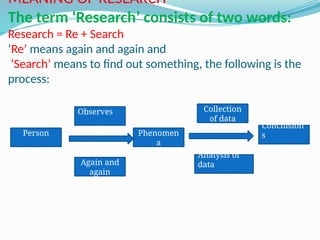
MEANING OF RESEARCH
Theterm ‘Research’ consists of two words:
Research = Re + Search
‘Re’ means again and again and
‘Search’ means to find out something, the following is the
process:
Person
Analysis of
data
Collection
of data
Again and
again
Observes
Phenomen
a
Conclusion
s
53.
Research is refersto a search for knowledge.
Once can also define research as a scientific and systematic
search for relevant information on a specific topic.
In fact, research is an art of scientific investigation.
The Advanced Learner’s Dictionary of Current English
meaning of research as “a careful investigation or inquiry
specially through search for new facts in any branch of
knowledge.”
Redman and Mory define research as a “systematized effort
to gain new knowledge.”
Some people consider research as a movement from the
known to the unknown. It is actually a voyage of discovery.
54.
According to CliffordWoody research comprises defining and redefining
problems, formulating hypothesis or suggested solutions; collecting, organizing and
evaluating data; making deductions and reaching conclusions; and at last carefully
testing the conclusions to determine whether they fit the formulating hypothesis.
In the Encyclopedia of Social Sciences define research as “the manipulation of
things, concepts or symbols for the purpose of generalizing to extend, correct or
verify knowledge, whether that knowledge aids in construction of theory or in the
practice of an art.”
It is the pursuit of truth with the help of study, observation, comparison and
experiment. In short, the search for knowledge through objective and systematic
method of finding solution to a problem is research.
The systematic approach concerning generalization and the formulation of a theory
is also research.
55.
As such theterm ‘research’ refers to the systematic method
consisting of enunciating the problem, formulating a
hypothesis, collecting the facts or data, analyzing the facts
and up to reaching certain conclusions either in the form of
solutions towards the concerned problem
56.
OBJECTIVES OF RESEARCH
Thepurpose of research is to discover answers to questions through the
application of scientific procedures.
The main aim of research is to find out the truth which is hidden and which has
not been discovered as yet. RO as diminishing into a number of following
broad grouping
1. To gain familiarity with a phenomenon or to achieve new
insights into it (studies with this object in view are termed as
exploratory or formulative research studies);
2. To show accurately the characteristics of a particular individual,
situation or a group (studies with this object in view are known
as descriptive research studies);
3. To determine the frequency with which something occurs or with
which it is associated with something else (studies with this
object in view are known as diagnostic research studies);
4. To test a hypothesis of a causal relationship between variables
(such studies are known as hypothesis-testing research studies).
57.
MOTIVATION IN RESEARCH
Whatmakes people to undertake research?
The possible motives for doing research may be either one or more of the
following:
1. Desire to get a research degree along with its consequential benefits;
2. Desire to face the challenge in solving the unsolved problems, i.e., concern
over practical problems initiates research;
3. Desire to get intellectual joy of doing some creative work;
4. Desire to be of service to society;
5. Desire to get respectability.
Many more factors such as directives of government, employment conditions,
interest about new things, desire to understand causal relationships, social
thinking and awakening, and the like may as well motivate people to perform
research operations.
58.
TYPES OF RESEARCH
Thebasic types of research are as follows:
1. Descriptive vs. Analytical: Descriptive research includes surveys and
fact-finding enquiries of different kinds. The major purpose of
descriptive research is description of the state of affairs as it exists at
present. In social science and business research we quite often use the
term Ex/post facto research for descriptive research studies. The main
characteristic of this method is that the researcher has no control over
the variables; he can only report what has happened or what is
happening.
In analytical research, on the other hand, the researcher has to use
facts or information already available, and analyze these to make a
critical evaluation of the material.
59.
2. Applied vs.Fundamental: Research can either be applied (or action) research or
fundamental (to basic or pure) research.
Applied research aims at finding a solution for an immediate problem facing a society or an
industrial/business organisation, whereas fundamental research is mainly concerned with
generalizations and with the formulation of a theory.
“Gathering knowledge for knowledge’s sake is termed ‘pure’ or ‘basic’ research.”
Research concerning some natural phenomenon or relating to pure mathematics are examples
of fundamental research. Similarly, research studies, concerning human behaviour carried on
with a view to make generalizations about human behaviour, are also examples of fundamental
research, but research aimed at certain conclusions (say, a solution) facing a concrete social or
business problem is an example of applied research.
Thus, the central aim of applied research is to discover a solution for some pressing practical
problem,
whereas basic research is directed towards finding information that has a broad base of
applications and thus, adds to the already existing organized body of scientific knowledge.
60.
3. Quantitative vs.Qualitative: Quantitative research is based on the measurement of
quantity or amount. It is applicable to phenomena that can be expressed in terms of
quantity.
Qualitative research, on the other hand, is concerned with qualitative phenomenon, i.e.,
phenomena relating to or involving quality or kind. For instance, when we are
interested in investigating the reasons for human behaviour (i.e., why people think or
do certain things), we quite often talk of ‘Motivation Research’, an important type of
qualitative research. This type of research aims at discovering the underlying motives
and desires, using in depth interviews for the purpose.
Other techniques of such research are word association tests, sentence completion tests,
story completion tests and similar other projective techniques.
Attitude or opinion research i.e., research designed to find out how people feel or what
they think about a particular subject or institution is also qualitative research.
Qualitative research is specially important in the behavioural sciences where the aim is
to discover the underlying motives of human behaviour.
61.
4. Conceptual vs.Empirical: Conceptual research is that related to some abstract idea(s) or
theory.
It is generally used by philosophers and thinkers to develop new concepts or to reinterpret existing
ones.
On the other hand, empirical research relies on experience or observation alone, often without due
regard for system and theory. It is data-based research, coming up with conclusions which are
capable of being verified by observation or experiment. We can also call it as experimental type
of research. In such a research it is necessary to get at facts firsthand, at their source, and actively
to go about doing certain things to stimulate the production of desired information.
In such a research, the researcher must first provide himself with a working hypothesis or guess as to
the probable results. He then works to get enough facts (data) to prove or disprove his hypothesis.
He then sets up experimental designs which he thinks will manipulate the persons or the materials
concerned so as to bring forth the desired information. Such research is thus characterized by the
experimenter’s control over the variables under study.
Empirical research is appropriate when proof is sought that certain variables affect other variables in
some way. Evidence gathered through experiments or empirical studies is today considered to
be the most powerful support possible for a given hypothesis.
62.
Research can beclassified from three perspectives:
1. application of research study
2. objectives in undertaking the research
3. inquiry mode employed
1.Application:
From the point of view of application, there are two broad categories of
research:
- pure research and
- applied research.
Pure research involves developing and testing theories and hypotheses
that are intellectually challenging to the researcher but may or may not
have practical application at the present time or in the future. The
knowledge produced through pure research is sought in order to add to
the existing body of research methods.
63.
Applied research isdone to solve specific, practical questions; for
policy formulation, administration and understanding of a
phenomenon.
It can be exploratory, but is usually descriptive. It is almost always
done on the basis of basic research.
Applied research can be carried out by academic or industrial
institutions.
2.Objectives:
From the view point of objectives, a research can be classified as
a-descriptive
b-correlational
c-explanatory
d-exploratory
64.
A. Descriptive researchattempts to describe systematically a situation,
problem, phenomenon, service or programme, or provides information
about , say, living condition of a community, or describes attitudes
towards an issue.
B.Correlational research attempts to discover or establish the existence
of a relationship/ interdependence between two or more aspects of a
situation.
C. Explanatory research attempts to clarify why and how there is a
relationship between two or more aspects of a situation or phenomenon.
D. Exploratory research is undertaken to explore an area where little is
known or to investigate the possibilities of undertaking a particular
research study (feasibility study/ pilot study).
65.
Inquiry Mode:
From theprocess adopted to find answer to research questions – the two
approaches are:
- Structured approach
- Unstructured approach
Structured approach:
The structured approach to inquiry is usually classified as quantitative research. Here
everything that forms the research process- objectives, design, sample, and the
questions that you plan to ask of respondents- is predetermined.
It is more appropriate to determine the extent /amount of a problem, issue or
phenomenon by quantifying the variation.
e.g. how many people have a particular problem? How many people hold a particular
attitude?
66.
Unstructured approach:
The unstructuredapproach to inquiry is usually classified as qualitative
research.
This approach allows flexibility in all aspects of the research process.
It is more appropriate to explore the nature of a problem, issue or
phenomenon without quantifying it.
Main objective is to describe the variation in a phenomenon, situation or
attitude.
e,g, description of an observed situation, the historical enumeration of
events, an explanation of different opinions different people have about an
issue, description of working condition in a particular industry.
67.
THE RESEARCH PROCESS
Theresearch process is similar to undertaking a journey. For a research
journey there are two important decisions to make-
1. What you want to find out about or what research questions
(problems) you want to find answers to;
2. How to go about finding their answers.
There are practical steps through which you must pass in your research
journey in order to find answers to your research questions.
The path to finding answers to your research questions constitute research
methodology.
At each operational step in the research process you are
required to choose from a multiplicity of methods, procedures
and models of research methodology which will help you to best
achieve your objectives.
68.
Steps in ResearchProcess:
1. Formulating the Research Problem
2. Extensive Literature Review
3. Developing the objectives with Development
of working hypotheses
4. Preparing the Research Design including
Sample Design
5. Collecting the Data With Execution of the
project:
6. Analysis of Data
7. Generalization and Interpretation
8. Preparation of the Report or Presentation of
Results-Formal write ups to conclusions
reached.
69.
Step1. Formulating theresearch problem:
It is the first and most crucial step in the research process
- Main function is to decide what you want to find out about.
- The way you formulate a problem determines almost
every step that follows.
Sources of research problems
Research in social sciences revolves around four Ps:
• People- a group of individuals
• Problems- examine the existence of certain issues or
problems relating to their lives;
to ascertain attitude of a group of people towards an issue
• Programs- to evaluate the effectiveness of an intervention
• Phenomena- to establish the existence of a regularity.
70.
Every research studyhas two aspects:
1. Study population-
• People: individuals, organizations, groups, communities
( they provide you with the information or you collect
information about them)
2. Subject area-
• Problems: issues, situations, associations, needs, profiles
• Program : content, structure, outcomes, attributes,
satisfactions, consumers, Service providers, etc.
• Phenomenon: cause-and-effect relationships, the study of
a phenomenon itself
(Information that you need to collect to find answers to your
research questions) You can examine the professional field of
your choice in the context of the four Ps in order to identify
anything that looks interesting.
71.
Considerations in selectinga research problem:
These help to ensure that your study will remain manageable and that
you will remain motivated.
1. Interest: a research endeavour is usually time consuming, and
involves
hard work and possibly unforeseen problems. One should select topic
of great interest to sustain the required motivation.
2. Magnitude: It is extremely important to select a topic that you can
manage
within the time and resources at your disposal. Narrow the topic down
to something manageable, specific and clear.
3. Measurement of concepts: Make sure that you are clear about the
indicators and measurement of concepts (if used) in your study.
4. Level of expertise: Make sure that you have adequate level of
expertise for
the task you are proposing since you need to do the work yourself.
5. Relevance: Ensure that your study adds to the existing body of
knowledge, bridges current gaps and is useful in policy formulation.
This will help you
to sustain interest in the study.
6. Availability of data: Before finalizing the topic, make sure that
72.
Steps in formulationof a research problem :
Working through these steps presupposes a reasonable level of
knowledge in the broad subject area within which the study is
to be undertaken.
Without such knowledge it is difficult to clearly and adequately
‘dissect’ a subject area.
Step 1 Identify a broad field or subject area of interest to you.
Step 2 Divide the broad area into sub areas.
Step 3 Select what is of most interest to you.
Step 4 Raise research questions.
Step 5 Formulate objectives.
Step 6 Assess your objectives.
73.
Step 2. Reviewingthe literature:
Essential preliminary task in order to notify yourself with the
available
body of knowledge in your area of interest.
Literature review is integral part of full research process
and makes
valuable contribution to every operational step.
Reviewing literature can be time-consuming, daunting and
frustrating, but is also rewarding. Its functions are:
a. Bring clarity and focus to your research problem;
b. Improve your methodology;
c. Broaden your knowledge;
d. Contextualize your findings.
74.
a. Bring clarityand focus to your research problem; The
process of reviewing the literature helps you to understand
the subject area better and thus helps you to conceptualize
your research problem clearly and accurately.
It also helps you to understand the relationship between your
research problem and the body of knowledge in the area.
b. Improve your methodology: A literature review tells you
if others have used procedures and methods similar to the
ones that you are proposing, which procedures and methods
have worked well for them, and what problems they have
faced with them.
Thus you will be better positioned to select a methodology
75.
c. Broaden yourknowledge base in your research area:
It ensures you to read widely around the subject area in which
you intend to conduct your research study.
It also helps you to understand how to findings of your study fit
into the
existing body of knowledge.
d. Contextualize your findings:
How do answers to your research questions compare with what
others have found?
What contribution have you been able to make in to the
existing body of knowledge?
How are your findings different from those of others?
For you to be able to answer these questions, you need to go
76.
Procedure for reviewingthe literature:
1. search for existing literature in your area of
study;
2. review the literature selected;
3. develop a theoretical framework;
4. develop a conceptual framework.
Search for existing literature:
-To effectively search for literature in your field of
enquiry, it is imperative that you have in mind at least
some idea of broad subject area and of the problem
you wish to investigate, in order to set parameters for
your search.
-Next compile a bibliography for this broad area.
Sources are:
1. books
2.journals
77.
BOOKS
comprise a centralpart of any bibliography.
Advantage-material published generally is of good
quality and the findings are integrated with other
research to form a coherent body of knowledge.
Disadvantage-material is not completely up to date, as
it can take a few years between the completion of a
work and publication in the form of a book.
JOURNALS
Journals provide you with the most up-to-date information, even
though there is a gap of two to three years between the completion of a
research project and the publication in a journal.
As with books, you need to prepare a list of journals for identifying
literature relevant to your study. This can be done as follows:
-locate the hard copies of the journal that are appropriate to your
study;
- use the internet
- look at the index of research abstracts in the relevant field to
identify and read the articles.
78.
THE BIBLIOGRAPHY
The bibliographyshould give a clear, complete
description of the
sources that were used while preparing the report.
It is an alphabetical list as per the author’s surname.
For a Book
Surname of author, name or two initials, Title taken from
title page-underlined or in italics, Edition (if more than
one), volume if more than one, place of publication,
publishers, date on title page or copyright date.
e.g. Kothari, C.R., Research Methodology-Methods and
Techniques,
2nd
E,1989, New Delhi :
79.
Step 3 Theformulation of objectives:
Objectives are the goals you set out to attain in your
study.
They inform a reader what you want to attain through
the study.
It is extremely important to word them clearly and
specifically.
Objectives should be listed under two headings:
a) main objectives ( aims);
b) sub-objectives.
The main objective is an overall statement of the thrust of
your study.
It is also a statement of the main associations and
relationships that you seek to discover or establish.
The sub-objectives are the specific aspects of the topic that you
want to investigate within the main framework of your study.
They should be numerically listed.
Wording should clearly, completely and specifically
Communicate to
your readers your intention.
Each objective should contain only one aspect of the Study.
Use action oriented words or verbs when writing objectives.
80.
General objective
g2
General objectiveof this project is to modify pedal
bicycle to solar assisted passenger tricycle with
improving a load capacity in order to minimize the
problem of transportation.
Specific Objectives
• To select components required for solar energy
application in
tricycle.
• To design various parts necessary for modification.
• To modify pedal bicycle into solar powered tricycle
with fully
functional prototype.
• To construct simple passenger shield to protect
81.
The objectives shouldstart with words such as
‘to determine’,
‘to find out’,
‘to ascertain’,
‘to measure’,
‘to explore’ etc.
The wording of objectives determines the type of research
(descriptive, correlation and experimental) and the type of
research design you need to adopt to achieve them.
e.g.
Descriptive studies:
To describe the types of incentives provides by Hotel XYZ to
employees
in Ethiopia.
To find out the opinion of the employees about the medical
facilities
provided by five star hotels in Ethiopia.
82.
Correlatinal studies:
-To ascertainthe impact of training on
employee
retention.
-To compare the effectivenesss of different
loyalty
programmes on repeat clientele.
Hypothesis –testing studies:
-To ascertain if an increase in working hours
will
increase the incidence of rug/alchohol abuse.
-To demonstrate that the provision of company
accommodation to employees in Ethiopia
83.
1. Objectives ofthe Research Study:
Objectives identified to answer the research
questions have to be listed making sure that
they are:
a) numbered, and
b) statement begins with an action verb.
2. Methods of Data Collection:
There are two types of data
Primary Data— collected for the first time
Secondary Data—those which have already
been collected and analyzed by someone else.
84.
Research methods maybe understood as all those
methods/techniques that are used for conduction of research.
Research methods or techniques, thus, refer to the methods the
researchers
use in performing research operations.
In other words, all those methods which are used by the researcher
during the course of studying his research problem are termed as
research methods.
Keeping this in view, research methods can be put into the
following groups:
1. In the first group we include those methods which are
concerned with the collection of data. These methods will be used
where the data already available are not sufficient to arrive at
the required solution;
2. The second group consists of those statistical techniques which
are used for establishing relationships between the data and the
unknowns;
3. The third group consists of those methods which are used to
evaluate the accuracy of the results obtained.
Research Methods
85.
Research methodology
It isa way to systematically solve the research
problem.
It may be understood as a science of studying how
research is done scientifically.
In it we study the various steps that are generally adopted
by a researcher in studying his research problem along
with the logic behind them.
It is necessary for the researcher to know not only the
research methods/techniques but also the methodology.
86.
when we talkof research methodology we not only
talk of the research methods but also consider the logic
behind the methods we use in the context of our research study and
explain why we are using a particular method or technique and
why we are not using others so that research results are capable of
being evaluated either by the researcher himself or by others.
Why a research study has been undertaken,
how the research problem has been defined,
what way and why the hypothesis has been formulated,
what data have been collected and what particular method
has been adopted,
why particular technique of analyzing data has been used and
a host of similar other questions are usually answered when
we talk of research methodology concerning a research
problem or study.
87.
MEANING AND DEFINITIONOF METHOD
Method is a style of conducting a research work which is
determined by the nature of the problem.
M.Verma has defined the term “Method is only in the abstract as
logical entities that we can distinguish between matter and
methods,
The common types of matter may be three types, hence all the
methods can be classified under three heads
1. Theoretical problem – survey, experimental method.
2. Factual problem – Historical, case study and genetic
methods.
3. Application problem – Action Research.
88.
“Method refers tothe formal structure of the
sequence of acts commonly denoted by instruction.
The term method covers both strategy and tactics
of teaching and involves the choice of what is to be
taught, and the order in which it is to be taught.”
Method is more general, it includes techniques .
The research techniques are ways of
implementing a method. Different techniques
may be employed within the same method.
Webster defined methodology as “the science of
method or arrangement” Method is defined as
“orderliness and regularity or habitual practice of
them in action”.
89.
TYPES OF RESEARCHMETHODS
George J. Mouly has classified research methods into three
basic types: 1.Survey, 2.historical and 3.experimental
methods.
1.Survey Method
It is concerned with the present and attempts to determine the status of
the phenomena under investigation.
This Survey Method has been further classified into four categories:
(a) Descriptive survey (b) Analytical survey (c) School survey and (d)
Genetic survey.
(a) Descriptive survey is of three types:
a1–Survey testing method,
a2–Questionnaire survey method,
a3–Interview survey method.
(b) Analytical survey is of five types:
b1–Documentary frequency,
b2–Observational survey,
b3–Rating survey,
b4–Critical incident,
b5–Factor analysis.
(c) School survey and
90.
2.Historical Method
This methodis concerned with the past and which
attempts to trace the past as a means for seeing the
present prospective.
The historical method can be classified into three types:
(a)Historical,
(b)Legal, and
(c)Documentary.
3. Experimental Method
It is oriented towards the discovery/finding of basic
relationship among a phenomena as means of predicting
and eventually, controlling their occurrence.
The experimental method has been further classified into
four types as given below:
(a) Simple experimental designs,
(b) Multio-variate analysis,
(c) Case study, and
91.
NORMATIVE SURVEY METHOD
Theword ‘survey’ has been derived from the words ‘sur’ or
‘sor’ and ‘veeir’ or ‘veior’ which means ‘over’ and ‘see’
respectively.
Normative survey deals with ‘‘what is” ?.
It describes and interprets what exists at
present.
In a normative survey we are concerned with
conditions or relationships that exist, practices
that prevail, beliefs, points of view or attitudes
that are held, processes that are going on,
influences that are being felt, and trends that are
developing.
Writers have used various terms like ‘Normative’,
92.
PURPOSE AND USESOF SURVEY METHOD
The major purpose of survey method in research is to
tell ‘‘what is”? i.e., to describe the problem or
phenomenon, but many surveys go beyond a simple
description of the existing situation.
For example, the survey dealing with curriculum
courses help us in obtaining information not only about
the strength and weaknesses of the current curriculum
but also can elicit recommendations for change.
Descriptive surveys, or normative surveys are often
carried out as preliminary step to be followed by
researcher employing more strong control and more
objective methods.
Descriptive surveys or studies also serve as direct
sources of valuable knowledge concerning human
behavior.
93.
Information's which theSurvey Methods Collect
The survey methods of survey studies collect the following
three types of information.
The informations are:
(i) of what exists,
(ii) of what we want, and
(iii) of how to get there.
The information of what exists is gathered by studying and
analyzing important aspects of present situation.
The information of what we want, is obtained by clarifying
goods, goals, and objectives possibly through a study of the
conditions existing else where or what experts consider to be
desirable.
The Information of how to get these are collected through
discovering the possible means of achieving the goals on
the basis of the experiences of others or opinions of
94.
Characteristics of theSurvey Method
The following are the main characteristics of the survey method
of research:
1. The survey method gathers data from a relatively large number of
cases at a particular time.
2. It is essentially cross-sectional.
3. It is not concerned with the characteristics of individuals.
4. It involves clearly defined problem.
5. It requires experts imaginative planning.
6. It Involves definite objectives.
7. It requires careful analysis and interpretation of the data
gathered.
8. It requires logical and skilful reporting of the findings.
9. Surveys vary greatly in complexity.
10. It does not seek to develop an organised body of scientific
principles.
11. It provides information ‘useful to the solution of local problems.
12. It contributes to the advancement of knowledge because affords
penetrating insight into the nature of what one is dealing with.
13. It suggests the course of future developments.
95.
TYPES OF SURVEYSTUDIES
There are three criteria for classifying the survey
research:
(a) Nature of variables
a1 – Status survey
a2 – Survey research
(b) Group Measured
b1 – Sample
b2 – Population
(c) Sources of data collection
c1 – Questionnaire
c2 – Interview
c3 – Controlled observations survey.
96.
DESCRIPTIVE STUDIES
Descriptive researchis concerned with the present and attempts to
determine the status of the phenomenon under investigation.
The Nature of Descriptive Research
The nature of descriptive research can be explained with reference to
other type of research.
(a) Descriptive and Historical Research (Longitudinal or cross
sectionals)
A clear distinction can be drawn between survey studies and historical
studies on the basis of time, the latter deals with past, the former
with present.
(b) Descriptive and Experimental Research
Descriptive research as are oriented toward the determination of the
status of a given phenomenon rather than toward the isolation of
causative factors accounting for its existence.
It is based on cross-sectional samples, the sample should be
representative of the population.
Descriptive research involves large sample and experimental research
includes small sample. Descriptive research investigates trend of
characteristics of population. This is less scientific and complicated.
(c) Descriptive and Case Study
97.
Purpose of DescriptiveResearch
The following are the main objectives of descriptive research:
1. To identify present conditions and point to present needs.
2. To study immediate status of a phenomenon.
3. Facts findings.
4. To examine the relationships of traits/ behavior and
characteristics (trends and patterns).
The descriptive survey is more realistic than experimental
research. Descriptive researches are oriented towards the
descriptive of the present status of a given phenomenon.
Special Problems of Descriptive Research
1. The problem of sampling, to select representative sample
(size of the sample).
2. The validity of the measuring instruments. Validity of the
tool is crucial to the validity of the findings of study.
98.
Types of DescriptiveResearch
(a) Survey Testing,
(b) The questionnaire, and
(c) Interview.
Survey Testing: Survey testing researches are concerned with
academic and psychological problems in which academic and
psychological tests are administered for data collection.
(a)Selection of tests
1. How the test defines the variable and the investigator
should also define the variable in the same way.
2. Validity of the tool.
3. simplicity for administration, scoring and interpretation.
(b) Construction of Tests.
It may be possible that appropriate tool is not available for
measuring
the same variable. Hence, the researcher has to construct the
tool. He has to estimate reliability and validity of the tool, it is
not essential that norm should be developed.
99.
Characteristics of SurveyTesting Research: The following are
major characteristics:
1. Descriptive-survey-test research are relatively more
scientific and
accurate.
2. It provides more accurate data.
3. The data are subjected to parametric treatments.
4. The sample is usually of large size the error of measurement
and sampling error is put to the minimum.
5. The findings are authentic and accurate.
6. The conclusions are realistic.
7. It provides the deep insight to the psychometric methods of test
construction.
100.
Collection of
Data
Most educationalresearch will lead to the gathering of data by
means of some standardized test or self-constructed research
tools.
It should provide objective data for interpretation of results
achieved in the study.
The data may be obtained by administering questionnaires,
testing, personal observations, interviews and many other
techniques of collecting quantitative and qualitative evidence.
The researcher must know how much and what kind of data
collection will take place and when. He must also be sure that the
types of data obtainable from the selected instruments will be
usable in whatever statistical model he will latter use to bring out
the significance of the study.
The data collection is the accumulation of specific evidence that
will enable the researcher to properly analyze the results of all
activities by his research design and procedures.
101.
NEED FOR DATACOLLECTION
The data are needed in a research work to serve the following
purposes:
1. Collection of data is very essential in any educational research to
provide a solid foundation for it.
2. It is something like the raw material that is used in the
production of data. Quality of data determines the quality of
research.
3. It provides a definite direction and definite answer to a research
inquiry. Whatever inquiry has to give a definite answer to an
investigation. Data are very essential for a scientific research.
4. The data are needed to validate the various arguments in
research findings.
5. The main purpose of data collection is to verify the hypotheses.
6. Statistical data are used in two basic problems of any
investigation:
• Estimation of population parameters, which helps in
drawing generalization.
• The hypotheses of any investigation are tested by data
collection procedure.
7. The qualitative data are used to find out the facts and
quantitative data are employed to formulate new theory or
102.
MEANING OF DATA
Datameans observations or evidences.
The scientific educational researches require the data by means
of some standardized research tools or self-designed
instrument. Data are both qualitative and quantitative in
nature.
Score is the numerical description of an individual with regard
to some characteristics or variables.
Measurement process is employed to quantify a variable. Data
are collected for both variables as well as attributes. These are
gathered in terms of frequency and scores. It depends on the
type of instrument employed for its measurement.
Generally tests yield the data in the form of scores and
questionnaires provide the data in the form of frequency.
Data and facts are used in educational research, therefore, it is
essential to understand them clearly.
103.
DIFFERENCE BETWEEN FACTSAND DATA
1. The facts are organized in their original form whereas data
are organized in systematic order.
2. The facts do not have any coherence of system whereas data
have an organic unity like body.
3. The facts are difficult to interpret. The interpretation of facts is
usually subjective and employs the imagination of the
researcher. Data can be interpreted easily and most
objectively.
4. The facts are mysterious /secretive in nature we have to
explore the facts but data have no mystery at all.
5. The facts are descriptive /expressive in nature whereas data
are explanatory.
6. The facts are not amenable to objective statistical treatments
whereas data can be easily subjected to in objective statistical
treatment.
7. The facts may not be directly the basis of findings or research
conclusions, but data are directly linked with research
conclusions.
8. The facts are usually too broad and are not linked and a
purposive way whereas data are always collected with a sense
104.
NATURE OF DATA
Theresearch studies in behavioural science or mainly
concerned with the characteristics or traits. Thus, tools are
administered to quantify these characteristics, but all traits or
characteristics can not be Quantified.
The data can be classified into two broad categories:
1. Qualitative data or attributes.
2. Quantitative data or variables.
1. Qualititative Data or Attributes: The characteristics or
traits for which numerical value can not be assigned, are
called attributes, e.g. motivation, confidence, honesty integrity
etc.
2. Quantitative Data or Variables: The characteristics or traits
for which numerical value can be assigned, are called
variables, e.g. Achievement Intelligent, Aptitude/ Height, Weight
etc.
The distinction is based on the process of measurement
rather than on the properties inherent in the
phenomenon or trait, for
105.
Quantification is theprocess of assigning numerical values to
the trait of the subjects of sample which normally would be
quantitative. This can be done by :
a) Observations or information by first hand experience. It is
used in small children and animals.
b) Systematic collection and analysis of factual data. This
is done in historical research.
c) Scales and inventories are designed to explore or reveal
the interests, attitude and personality. It is used in the case
of study and survey research.
d) Questionnaire, interview and opinionaire are designed to
gain information. This is employed in survey research.
e) Educational and psychological tools are administered to
quantify the variables more accurately. These tools are used
in scientific research studies.
Various types of research tools are employed to collect the data.
These tools yield different types of data.
106.
CONSTANTS
A constant isall characteristic or condition that is the
same for all the observed units or sample subjects of a
study.
A variable, on the other hand is a characteristic which
takes on different values for different sample subjects or
for all the observed units.
The use of variable and constant has been illustrated with
the help of the following example.
Suppose a study is conducted for determining the effect of
three different teaching methods upon the achievement in
secondary mathematics. Each of three ninth grade maths
sections in the same school, are taught by the same
teacher, is taught using one of the methods. Both boys and
girls are included in each method.
In this study grade level, school and teacher are
recognized as constants.
107.
VARIABLES
The variables arethose which vary from person to person
and can be quantified by employing measuring instrument.
The sample or group variation can be ascertained in terms of
numerical values. The characteristic or the trait in the
behavioural science which can be quantified is termed as
variable.
Variables can be classified into two categories:
1. Continuous variables.
2. Discrete variables.
1. Continuous variables are those for which fractional value
exists and have meaning e.g. age, weight, achievement,
where 14.5 years, 62.75 kgs and 45.50 scores or any other
fractional of a whole unit is logical and measurable within
the precision of the instrument used.
2. Discrete variables are those on the other hand, which exist
only in units not the fractional value (usually units of one)
e.g. 30 boys, 25 girls, 40 Indians and 24 Americans.
108.
VARIATE
The variable isquantified by using an instrument. The
quantified variable is termed as variate. When sample subjects
I.Q.s or scores of achievement are collected, it is known as
variate. The statistical analysis involves variate analysis: uni-
variate, bi-variate, multi-variate analysis. It is evident that data
collection means to convert variables into variates so that data
can be subjected to an appropriate statistical analysis for
obtaining the results.
QUANTIFICATION OF VARIABLE
Quantification is the process of assigning numeral value to the extend
or amount of a variable of an individual. The quantification is done by
employing the process of measurement. This process yields data and
scores.
Many studies in education produce data for the verification of research
hypotheses so as to draw conclusions. Some other studies in education
produce evidences that require evaluation by subjective methods
which do not readily permit the use of statistical analysis are termed as
qualitative data. These qualitative data may be converted first into
their quantitative data. The statistical techniques may be applied to test
the significance of data. If qualitative data cannot be converted into
109.
CHARACTERISTICS OF QUANTITATIVEDATA
The quantitative data are collected by administering the
research tools. These should possess the following
characteristics:
1. The quantitative data should be collected through
standardized tests. If self-made test is used it should be
reliable and valid.
2. They are highly reliable and valid. Therefore,
generalization and conclusions can be made easily with
certain level of accuracy.
3. The obtained results through quantitative data can be
easily interpreted with scientific accuracy. The level of
significance can also be determined.
4. The scoring system of quantitative data is highly
objective.
5. The use of quantitative data is always based upon the
purpose of the study. The specific psychometric tests are
used in difficult investigation.
6. The inferential statistical can be used with the help of
110.
TYPES OF DATA
Thereare four basic ways of quantifying the variables. They are
also called levels of measurement or scales of measurement. These
are commonly referred to as:
1. Nominal scale,
2. Ordinal or rank scale,
3. Equal-interval scale, and
4. Ratio scale.
1. Nominal Scale
The nominal scale is the least precise or crude of the four basic scales
of measurement. It simply implies the classification of an item into
two or more categories without any extent or magnitude. There is no
particular order assigned to them.
The frequency or numbers are used to give a name to something that
may be used for determining per cent, mode. For example boys and
girls; pass and fail; rural and urban.
In classroom observation the measurement is done at nominal scale.
The teaching and instruction are organized considering the mode of
the students, because teacher cannot pace with each and every
student in his teaching and learning process.
111.
2. Ordinal Scale
Theordinal scale is more precise scale than the nominal scale.
It allows the teacher to assign values by placing of arranging
the observations in relative rank order. No value is assigned to
the distances to the positions of ranking. This scale assigns
observations to categories by number and arranges them in
some logical order. It does not require the relationship of
equivalence but also requires one observation to be greater or
lesser than the other.
This scale is used frequently in the schools for prize
distribution and to provide the motivation by the technique of
competition. In asking the questions teacher considers the
place of students in the class.
112.
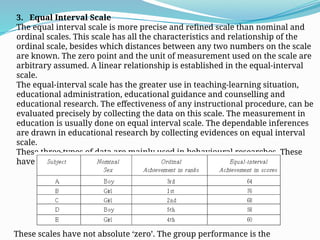
3. Equal IntervalScale
The equal interval scale is more precise and refined scale than nominal and
ordinal scales. This scale has all the characteristics and relationship of the
ordinal scale, besides which distances between any two numbers on the scale
are known. The zero point and the unit of measurement used on the scale are
arbitrary assumed. A linear relationship is established in the equal-interval
scale.
The equal-interval scale has the greater use in teaching-learning situation,
educational administration, educational guidance and counselling and
educational research. The effectiveness of any instructional procedure, can be
evaluated precisely by collecting the data on this scale. The measurement in
education is usually done on equal interval scale. The dependable inferences
are drawn in educational research by collecting evidences on equal interval
scale.
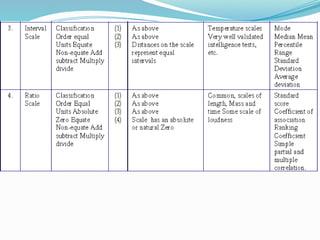
These three types of data are mainly used in behavioural researches. These
have been illustrated in the following table:
These scales have not absolute ‘zero’. The group performance is the
113.
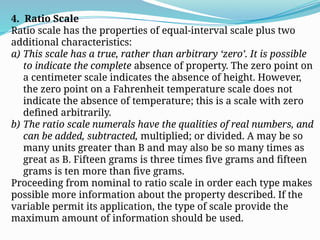
4. Ratio Scale
Ratioscale has the properties of equal-interval scale plus two
additional characteristics:
a) This scale has a true, rather than arbitrary ‘zero’. It is possible
to indicate the complete absence of property. The zero point on
a centimeter scale indicates the absence of height. However,
the zero point on a Fahrenheit temperature scale does not
indicate the absence of temperature; this is a scale with zero
defined arbitrarily.
b) The ratio scale numerals have the qualities of real numbers, and
can be added, subtracted, multiplied; or divided. A may be so
many units greater than B and may also be so many times as
great as B. Fifteen grams is three times five grams and fifteen
grams is ten more than five grams.
Proceeding from nominal to ratio scale in order each type makes
possible more information about the property described. If the
variable permit its application, the type of scale provide the
maximum amount of information should be used.
114.
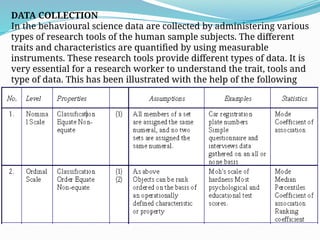
DATA COLLECTION
In thebehavioural science data are collected by administering various
types of research tools of the human sample subjects. The different
traits and characteristics are quantified by using measurable
instruments. These research tools provide different types of data. It is
very essential for a research worker to understand the trait, tools and
type of data. This has been illustrated with the help of the following
table
116.
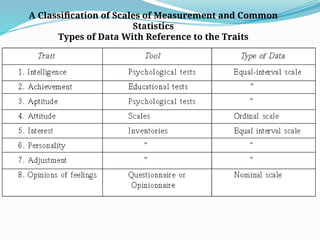
A Classification ofScales of Measurement and Common
Statistics
Types of Data With Reference to the Traits
117.
There are othertypes of research tools which are used to collect’ the
data. For example,
‘observation technique’ is most frequently used to collect the data
which yields the data at nominal scale and also at equal-interval scale.
In the following table research tools have been classified with regard
to scale for measurement and types of statistics may be employed of
analysis purpose.
Classification of Tools and Research with Regard to the Level of
Measurement
The types of data depend on nature of research tool employed for this purpose.
Statistical techniques are virtually selected by considering the nature of
research tool and data collected at nominal, ordinal or equal interval scales.
118.
Ethical considerations inCollection of Data
Any researcher who involves human sample subjects in his
research has certain responsibilities towards them. Since the
activities of the sample subjects are often closely associated with
data collection process, it is appropriate to consider ethical
considerations.
The following points have to be considered in process of data
collection:
1. The researcher must protect the dignity and welfare of
human sample subjects.
2. The human sample subjects freedom to decline participation
must be respected, and the confidentially of research data
must be maintained.
3. The researcher must guard against violation or invasion of
privacy.
4. The responsibility for maintaining ethical standard remains
with the individual researcher and the principal
investigator or supervisor is also responsible for actions of
his scholars.
119.
Precautions in DataCollection
In the data collection the following precautions should be observed:
1. The data must be relevant to the research problem.
2. It should be collected through formal or standardized research
tools.
3. The data should be such as these can be subjected to statistical
treatment easily.
4. The data should have minimum measurement error.
5. The data must be tenable for the verification of the hypotheses.
6. The data should be such as parameters of the population may
be estimated for inferential purpose.
7. The data should be complete in itself and also comprehensive
in nature.
8. The data should be collected through objective procedure.
9. The data should be accurate and precise.
10. The data should be reliable and valid.
11. The data should be such that these can be presented and
interpreted easily.
12. The scoring procedure of the research tool should be easy and
objective.
120.
ORGANIZATION OF DATA
Afterthe data have been collected. it must be organized and
analyzed to draw proper conclusion.
The mass of data collected through the use of various tools,
however reliable, valid and adequate it may be is yet but raw. It
needs to be systematized and organized i.e. edited classified and
tabulated. before it can serve any worthwhile purpose.
Editing implies the checking of gathered data for accuracy,
utility and completeness.
Classifying refers to the dividing of the information into
different categories classes or heads, for the use.
Tabulating denotes the recording of the classified material in
accurate mathematical terms e.g. marking and counting
frequency tallies for different items on which Information is
gathered. Tabulation is a tedious and painstaking process and
must be accurate.
Before, tabulating all raw data should be tested on the basis of
the purpose for which they are gathered and only the useful and
usable data should be tabulated.
121.
PROCESSING AND ANALYSINGDATA
Processing and analysing data involves a number of closely
related operations which are performed with the purpose of
summarizing the collected data and organizing these in a
manner that they answer the research questions (objectives).
The Data Processing operations are:
1. Editing - a process of examining the collected raw data to
detect errors and omissions and to correct these when
possible.
2. Coding: Coding refers to the process of assigning
numerals or other symbols to answers so that responses
can be put into a limited number of categories or classes.
3. Classification- a process of arranging data in groups or
classes on the basis of common characteristics. Depending
on the nature of phenomenon involved
a) Classification according to attributes: here data is
analysed on the basis of common characteristics which
can either be
122.
Such classification canbe either:
Simple classification: where we consider only one attribute,
and divide the universe into two classes—one class
consisting of items possessing the given attribute and the
other class consisting of items which do not possess the
given attribute.
Table 1. Hotel Employees with MBA Degree
Manifold classification: Here we consider two or more attributes
simultaneously, and divide the data into a number of classes.
Table 2. Educational Qualification of Hotel Employees
123.
b) Classification accordingto class –intervals: is done
with data relating to income, age, weight, tariff,
production, occupancy etc. Such quantitative data are
known as the statistics of variables and are classified
on the basis of class –intervals.
e.g. persons whose income are within Rs 2001 to Rs 4000 can
form one
group or class, those with income within Rs 4001 t0 Rs 6000
can form another group or class and so on. The number of
items which fall in a given class is known as the frequency of
the given class.
Table 3. Pocket Money Received by IHM
Students
124.
4. Tabulation-Tabulation isthe process of summarizing raw
data and displaying the same in compact form for further
analysis. It is an orderly arrangement of data in columns
and rows. Tabulation is essential because:
a) It conserves space and reduces explanatory and
descriptive statement to a minimum.
b) It facilitates the process of comparison.
c) It facilitates the summation of items and the detection of
errors and omissions.
d) It provides the basis for various statistical
computations.
Tabulation may also be classified as simple and complex
tabulation. Simple tabulation generally results in one-way
tables which supply answers to questions about one
characteristic of data only.
Complex tabulation usually results on two-way tables (which
give information about two inter-related characteristics of
data), three –way tables or still higher order tables, also known
as manifold tables.
125.
Need for Analysisof Data or Treatment of Data
After Administering And Scoring Research Tools Scripts, data collected
and organized. The collected data are known as ‘raw data.’
Analysis of data means to make the raw data meaningful or to draw
some results from the data after the proper treatment. The ‘null
hypotheses’ are tested with the help of analysis data so to obtain some
significant results. Thus, the analysis of data serves the following main
functions:
1. To make the raw data meaningful,
2. To test null hypothesis,
3. To obtain the significant results,
4. To draw some inferences or make generalization, and
5. To estimate parameters.
Data Analysis Methods
1. Qualitative Data Analysis:
Qualitative data analysis is a very personal process with few
rigid rules and
procedures. For this purpose, the researcher needs to go through
a process called Content Analysis.
126.
Content Analysis meansanalysis of the contents of an
interview in order to identify the main themes that emerge
from the responses given by the respondents. This process
involves a number of steps:
Step 1. Identify the main themes. The researcher needs to carefully
go through the descriptive responses given by respondents to
each question in order to understand the meaning they
communicate.
Step 2. Assign codes to the main themes: If the researcher wants to
count the number of times a theme has occurred in an interview,
he/she needs to select a few responses to an open- ended
question and identify the main themes.
Step 3. Classify responses under the main themes: Having
identified the themes Next step is to go through the transcripts of
all the interviews and classify the responses under the different
themes.
Step 4. Integrate themes and responses into the text of your report:
Having identified responses that fall within different themes, the
next step is to integrate into the text of your report.
127.
2. Quantitative DataAnalysis
This method is most suitable for large well designed and well
administered surveys using properly constructed and worded
questionnaire.
Data can be analysed either manually or with the help of a
computer .
Manual Data Analysis: This can be done if the number of
respondents is
reasonably small, and there are not many variables to analyse.
However, this is useful only for calculating frequencies and for
simple cross tabulations.
Manual data analysis is extremely time consuming. The easiest
way to do this is to code it directly onto large graph paper in
columns.
Detailed headings can be used or question numbers can be
written on each column to code information about the
question.
128.
Data Analysis Usinga Computer: If you want to analyse data
using computer, you should be familiar with the appropriate
program. In this area, knowledge of computer and statistics
plays an important role.
The most common software is SPSS for windows. However,
data input can be long and laborious process, and if data is
entered incorrectly, it will influence the final results.
129.
Layout of theResearch Report
The layout of the report means as to what the research report
should
contain.
A comprehensive layout of the research report should
comprise :
a) preliminary pages;
b) the main text; and
c) the end matter. Let us deal with them separately.
Each category has been outlined further as
follows:
a) Preliminary Section
1. Title page
2. Preface or acknowledgements
3. Table of content
4. List of tables (if any)
5. List of figures (if any).
130.
b) Main Bodyof Report or Textual Body
1. Introduction
(a) Statement of the problem
(b) Objectives of the study
(c) Hypotheses to be tested
(d) Significance of the problem
(e) Assumptions and delimitations.
(f) Definitions of Important terms used.
2. Review of related literature.
3. Design of the study
(a) Method and procedure used
(b) Tools of research or sources of data
(c) Techniques of data collection
(d) Description of techniques used.
4. Analysis and presentation of data
(a) Analysis of data
(b) Tables and interpretation
(c) Figures and interpretation.
5. Conclusions
(a) Discussion of results
(b) Main Findings and inferences
(c) Implication of the findings and limitations
(d) Suggestions for further studies.
131.
c) Reference Section
1.Bibliography
2. Appendices (if any)
3. Index or glossary (if any)
Assignment
1. Define the term method.
2. Define types of research.
3. Distinguish between methods of research and methodology of
research.
4. Define the term Data, How it is different from facts?
5. Differentiate between qualitative data and quantitative data.
6. Explain processing of data.