AUGUST 2021
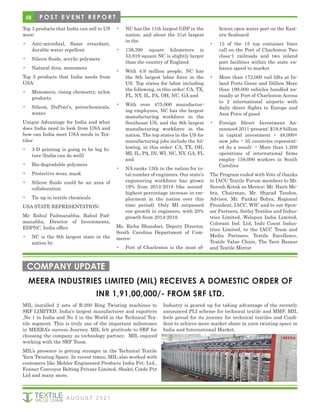
V O L U M E 9 | I S S U E N O . 8 | R S 1 0 0 | P a g e s 7 1
I S S N N O : 2 2 7 8 - 8 9 7 2 | R N I N O : M A H E N G / 2 0 1 2 / 4 3 7 0 7
www.textilevaluechain.in
Postal registration No. MNE/346/2021-23, posted at Mumbai Patrika
Channel sorting office, Pantnagar, Ghatkopar( East), Mumbai - 400075
Posting date is end of month ( 29th/ 30th / 31st )
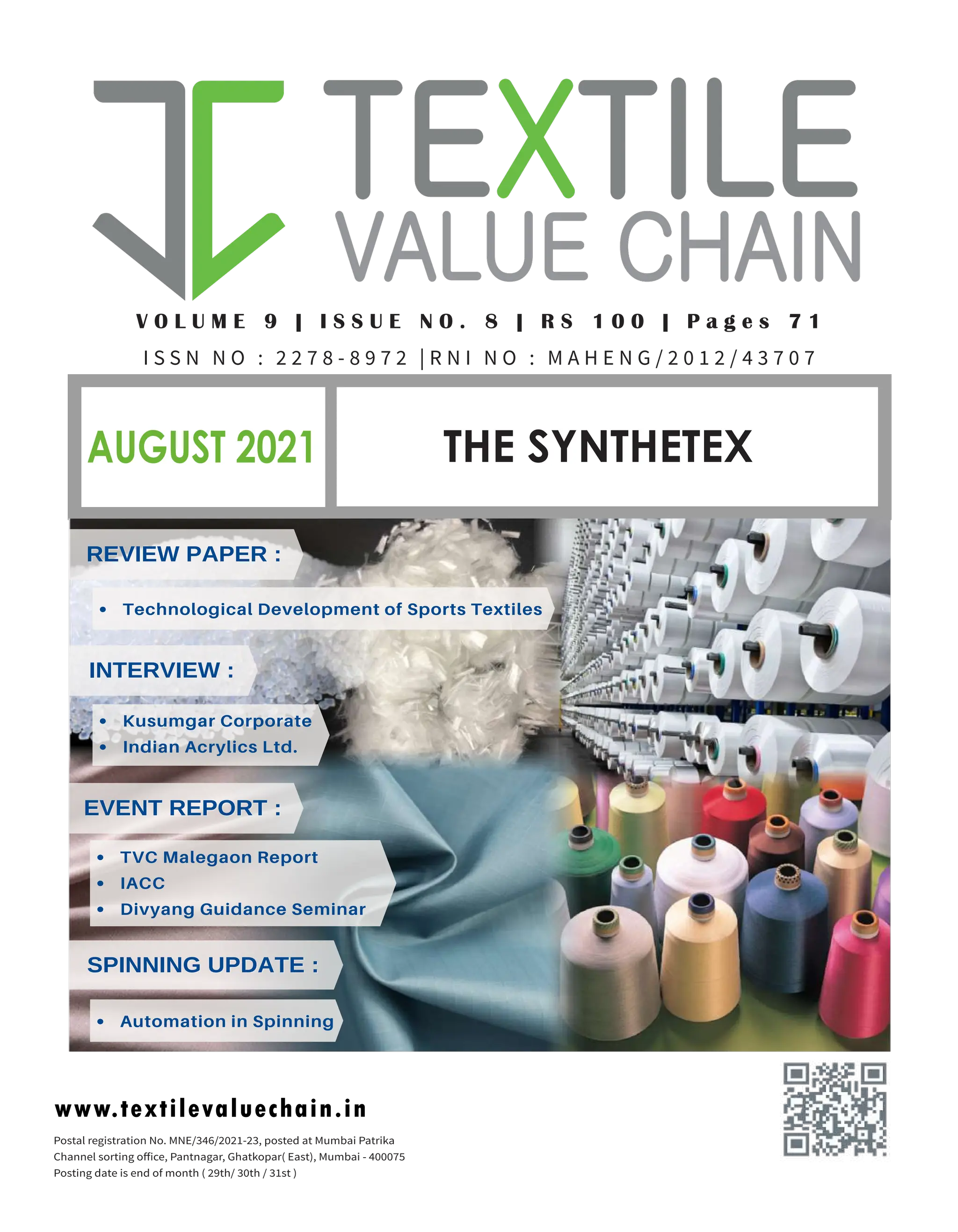
THE SYNTHETEX
REVIEW PAPER :
REVIEW PAPER :
Technological Development of Sports Textiles
INTERVIEW :
INTERVIEW :
Kusumgar Corporate
Indian Acrylics Ltd.
EVENT REPORT :
EVENT REPORT :
TVC Malegaon Report
IACC
Divyang Guidance Seminar
SPINNING UPDATE :
SPINNING UPDATE :
Automation in Spinning
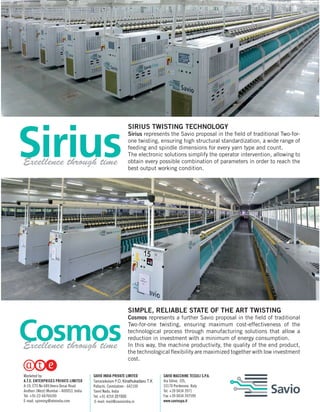
SIRIUS TWISTING TECHNOLOGY
Sirius represents the Savio proposal in the field of traditional Two-for-
one twisting, ensuring high structural standardization, a wide range of
feeding and spindle dimensions for every yarn type and count.
The electronic solutions simplify the operator intervention, allowing to
obtain every possible combination of parameters in order to reach the
best output working condition.
SIMPLE, RELIABLE STATE OF THE ART TWISTING
Cosmos represents a further Savio proposal in the field of traditional
Two-for-one twisting, ensuring maximum cost-effectiveness of the
technological process through manufacturing solutions that allow a
reduction in investment with a minimum of energy consumption.
In this way, the machine productivity, the quality of the end product,
the technological flexibility are maximized together with low investment
cost.
Excellence through time
SAVIO MACCHINE TESSILI S.P.A.
Via Udine, 105,
33170 Pordenone, Italy
Tel. +39 0434 3971
Fax +39 0434 397599
www.saviospa.it
SAVIO INDIA PRIVATE LIMITED
Tamaraikulam P.O, Kinathukadavu T.K
Pollachi, Coimbatore - 642109
Tamil Nadu, India
Tel. +91 4259 201500
E-mail: mail@savioindia.in
Marketed by:
A.T.E. ENTERPRISES PRIVATE LIMITED
A-19, CTS No 689,Veera Desai Road
Andheri (West) Mumbai - 400053, India
Tel: +91-22-66766100
E-mail: spinning@ateindia.com
+91 99250 10553 sales@nonwoventechasia.com www.nonwoventechasia.com
Support By Stall Designing Partner
Organized By
Exclusive
Nonwoven
Exhibition In India
NEW DATES
ANNOUNCING..
DECEMBER 2021
17 18 19
Pragati Maidan, Delhi, India
BOOK YOUR
STALL NOW
CONTENTS
ADVERTISER INDEX
COVER STORY
A U G U S T 2 0 2 1
Back Page: Raymond
Back Inside: Raysil
Front Inside: Rimtex
Page 3: Mag Solvics PVT. LTD.
Page 4: Intex South Asia
Page 5: Savio
Page 6: Nonwoven Tech Asia 2021
Page 62: TVC Digital Media
Page 65: FVC Forecasting Webinar
Page 66: Meera Industries
Page 67: Unitech
Page 68: Techtextil India
Page 69: Colorjet
POST EVENT REPORT
MMF REPORT
CARBON FOOTPRINT
MARKET REPORT
HOME TEXTILE REPORT
TEXTILE MACHINERY REPORT
SPINNING UPDATE
REVIEW PAPER
7
COMPANY UPDATE
09 Spandex, Nylon and Acrylic - Most Essential
materials for Athleisure- Mr. Amrish Shahi
11 Synthetic Textile: A Man-Made Comfort Ex-
perience- Ms. Kshipra Gadey
13 Processing Of Polyester Fabrics In Industries-
Dr. N. N. Mahapatra
17 Mobilon Monofilament Japanese Spandex
19 Uncertain Future, No new Investmen - Mr.
Anubhav Tewari
27 Carbon Footprint in Textile Industry -
Mr.Krishna Kant Arya
RECYCLING
31 Recycling of old clothes for Godhadi Mak-
ing - Prof. Medha Umrikar, Dr. Irfana Siddiqui
43 Blended Yarn Export Jumps In July- Textile Bea-
con
45MMF- Trade Statistics
46 H1 - 2021 : Significant Hike IN INDIA’S Textile
Exports
25 Automation In Textile Spinning- Mr. Tanveer
Malik, Mr. Ajay Shankar Joshi, Mr. T. K. Sinha
INTERVIEW
20
Kusumgar Corporates In Growth Evading Pan-
demic Challenges- Mr. Siddharth Kusumgar &
Dr. M.K. Talukdar
22 Technological Developments In Sports Tex-
tiles- DR. J. Anandhakumar
CLOUD COMPUTING
34 Cloud Computing: New Technology in Tex-
tile and Apparel Industry- MS. Somasree Roy
FACE MASK
36 A Survey on Face Masks- Ms. Aranya Mallick,
Ms. Ashlesha M. Soman
FIBER PRICE REPORT
42 Fibre Prices Seen Easing In Asia During Au-
gust- Textile Beacon
YARN REPORT
44Yarn Bazaar
48 Subsequent Rise In The Home Textile Exports
50 Growth in Indian Textile Machinery Exports
53MAGnificient 30 Years Journey....1991 to 2021
58Meera Industries Limited (Mil)
54Divyang Education & Welfare Society
55Indo – Us Bilateral Partnership
63Malegaon Cluster
NEWS
59
59
52By HEWA
Production Linked Incentive (PLI) Scheme
for Textiles
Italian Textile Machinery (ACIMIT)
Bangladesh Exports
60
Kornit Digital
61
EXPORT UPDATE
JIGNA SHAH
EDITOR AND PUBLISHER
All rights reserved Worldwide; Reproduction of any of the content from this
issue is prohibited without explicit written permission of the publisher.
Every effort has been made to ensure and present factual and accurate
information. The views expressed in the articles published in this magazine
are that of the respective authors and not necessarily that of the publisher.
Textile Value chain is not responsible for any unlikely errors that might
occur or any steps taken based in the information provided herewith.
REGISTERED OFFICE
Innovative Media and
Information Company
189/5263, Sanmati, Pantnagar,
Ghatkopar (East), Mumbai 400075.
Maharashtra, INDIA.
Cell: +91-9769442239 /
+91. 9860634305
Email: info@textilevaluechain.com
innovativemedia012@gmail.com
Web: www.textilevaluechain.com
OWNER, PUBLISHER,
PRINTER AND EDITOR -MS.
JIGNA SHAH Printed and
Processed by her at, Impression
Graphics,
Gala no.13, Shivai Industrial
Estate, Andheri Kurla Road,
Sakinaka, Andheri (East),
Mumbai 400072,
Maharashtra, India.
SUBSCRIPTION
Digital + Print Copy issue
1 Year : 12 issues : Rs. 800
2 Years : 24 issues : Rs. 1500
3 years : 36 issues : Rs. 2100
Online Registration
https://textilevaluechain.in/subscription/
Subscription Enquiry
Ms. Vaibhavi Kokane
+91-9869634305 ; textilevaluechain123@gmail.com
Marketing and Advertising enquiry
Mohammad Tanweer
+91-9167986305 ; sales@textilevaluechain.com
EDITOR AND PUBLISHER
Ms. Jigna Shah
CREATIVE DESIGNER
EDITORIAL TEAM
8
A U G U S T 2 0 2 1
The world is moving toward Work from Home
(WFM) culture, thanks to Covid 19… WFM gave
people the liberty to dress for work in their own
way. WFM also leads to increase awareness of
Fitness and health. This resulted in the growth of
athletic and leisurewear, Sportswear, Nightwear
/ Sleepwear, Home textile, Medical Textile indus-
try. MMF Fibres which is used for stretch quality,
water resister, performance wear has increased
consumption due to the rise in the application in-
dustry.
Production Linked Incentive ( PLI) scheme focus
on MMF fabrics/garments and Technical textile
will again increase consumption for synthetic
fibers. PLI is a production-based incentive that
will enhance domestic production and reduce de-
pendency on imports. MMF fibers consumption
is on rising and growth path due to natural re-
sources is diminishes and Man-Made is made by
“ Human” which can take control of production.
Man-Made Fabrics application is huge as it can
be made versatile and applied in various indus-
tries like apparel, home, intimate wear, techni-
cal textiles various segments. Technical Textile
is the niche segment for India in consumption
as compared to other advanced countries, where
technical textile is part of their culture. Synthetic
or Natural fibers both have their own stand in
the industry, both give comfort and style in differ-
ent ways, application of each fiber matters which
makes a whole different world.
We wish the industry to take benefit of PLI
scheme, make the country self-reliant, boost the
employment of the industry. Wish you a produc-
tive year ahead…!
E D I T O R I A L
MMF, Covid
and
Textiles
CONTENT WRITER
RESEARCH ANALYST
Ms. Manali Bhanushali
Ms. Kshipra Gadey
Mrs. Radhika Boddu
Fabrics.
We can see Athleasuire
which is trending has the
best of all the world looks.
Things are borrowed from
Activewear, Streetwear,
Workwear, and Gymwear.
As per the Boston Consult-
ing Group and RAI joint
study on the resurgence
of Retail in India, it found
that Indian consumers are
responding to Athleisure
very well. A major reason is
working from culture, atten-
tion to health, and dressing for comfort.
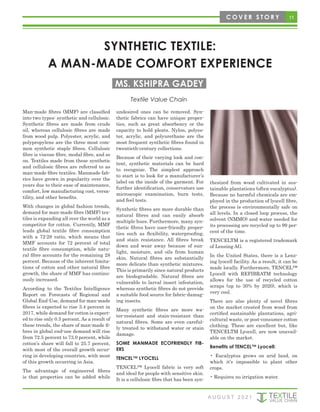
In another report by WGSN, Social media tracker #COM-
FORT, whereas there is a decline in the total consumption,
we see is a significant rise in the requirement of comfort
and loungewear clothing. As per the report, items need
to be multi-functional. We need more out of our clothes.
It seems that the current scenario of work from home is
likely to continue for a long time now. We would be getting
dressed up in easy-care tops and joggers. Would be going
out in 2mile style to grab a cup of coffee with friends or
working out just before the 4 pm meeting. All these are
possible and happening because of some innovations that
happened in the fibers and finishes.
Most of the natural fibers are not easy-care, relatively
poor in moisture management, and restrict movement.
Here innovative synthetic materials like Nylon, Spandex,
and Acrylic can play a great role. OnceOnce adds a lot
of value. We can also blend
natural and synthetic fib-
ers to get the best of both
worlds.
Let’s have a look at attrib-
utes of these manmade fab-
rics which are contributing
to make them the choice of
material for Athleisure and
2milewear.
Nylon
Nylon ( also known as Poly-
amides) has some unique
properties. It’s coming out
as the outcome of research for an alternative to silk.
Apart from its durability and easy-care properties, it’s
famous for its soft hand feel ( remember its silk alterna-
tive). Soon after its commercial launch in 1940 Nylon got
instant fame. During that time the Nylon stockings were
sold twice the price of Silk stockings.
Its properties like soft hand feel, high resistance to sun-
light, high melting point. Also, its easy care, abrasion re-
sistance, and High resistance to mildew, ETC., rot makes
it the idealistic choice for Athleisure.
It can blend with cotton, viscose, modal, wool, or any oth-
er fiber to add value to the fabric. It has its elasticity but
with spandex, you can move it like anything.
Nylon and Nylon blends can be seen in tops, sweatshirts,
shorts, track pants, and leggings.
You can follow in these fashion styles from the Athleisure
collection on yellowbacks.com
9
C O V E R S T O R Y
SPANDEX, NYLON AND ACRYLIC -
MOST ESSENTIAL MATERIALS FOR ATHLEISURE
Chief of Styling & Design
YellowBacks.com
MR. AMRISH SHAHI
A U G U S T 2 0 2 1
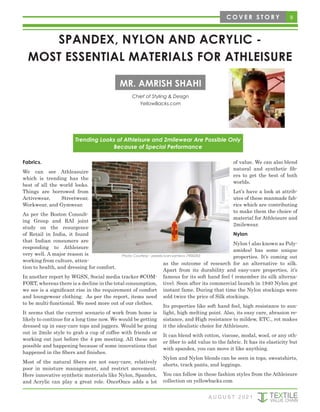
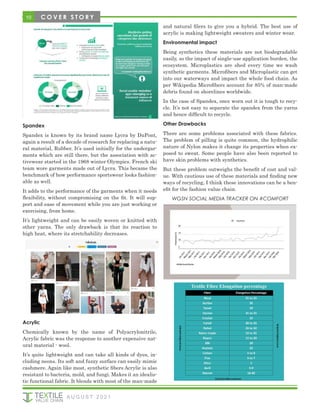
Trending Looks of Athleisure and 2milewear Are Possible Only
Because of Special Performance
Photo Courtesy - pexels-ivan-samkov-7900283
10 C O V E R S T O R Y
Spandex
Spandex is known by its brand name Lycra by DuPont,
again a result of a decade of research for replacing a natu-
ral material, Rubber. It’s used initially for the undergar-
ments which are still there, but the association with ac-
tivewear started in the 1968 winter Olympics. French ski
team wore garments made out of Lycra. This became the
benchmark of how performance sportswear looks fashion-
able as well.
It adds to the performance of the garments when it needs
flexibility, without compromising on the fit. It will sup-
port and ease of movement while you are just working or
exercising, from home.
It’s lightweight and can be easily woven or knitted with
other yarns. The only drawback is that its reaction to
high heat, where its stretchability decreases.
Acrylic
Chemically known by the name of Polyacrylonitrile,
Acrylic fabric was the response to another expensive nat-
ural material - wool.
It’s quite lightweight and can take all kinds of dyes, in-
cluding neons. Its soft and fuzzy surface can easily mimic
cashmere. Again like most, synthetic fibers Acrylic is also
resistant to bacteria, mold, and fungi. Makes it an idealis-
tic functional fabric. It blends with most of the man-made
and natural filers to give you a hybrid. The best use of
acrylic is making lightweight sweaters and winter wear.
Environmental impact
Being synthetics these materials are not biodegradable
easily, so the impact of single-use application burden, the
ecosystem. Microplastics are shed every time we wash
synthetic garments. Microfibers and Microplastic can get
into our waterways and impact the whole food chain. As
per Wikipedia Microfibers account for 85% of man-made
debris found on shorelines worldwide.
In the case of Spandex, once worn out it is tough to recy-
cle. It’s not easy to separate the spandex from the yarns
and hence difficult to recycle.
Other Drawbacks
There are some problems associated with these fabrics.
The problem of pilling is quite common, the hydrophilic
nature of Nylon makes it change its properties when ex-
posed to sweat. Some people have also been reported to
have skin problems with synthetics.
But these problem outweighs the benefit of cost and val-
ue. With cautious use of these materials and finding new
ways of recycling, I think these innovations can be a ben-
efit for the fashion value chain.
WGSN SOCIAL MEDIA TRACKER ON #COMFORT
A U G U S T 2 0 2 1
11
C O V E R S T O R Y
SYNTHETIC TEXTILE:
A MAN-MADE COMFORT EXPERIENCE
Man-made fibres (MMF) are classified
into two types: synthetic and cellulosic.
Synthetic fibres are made from crude
oil, whereas cellulosic fibres are made
from wood pulp. Polyester, acrylic, and
polypropylene are the three most com-
mon synthetic staple fibres. Cellulosic
fibre is viscose fibre, modal fibre, and so
on. Textiles made from these synthetic
and cellulosic fibres are referred to as
man-made fibre textiles. Manmade fab-
rics have grown in popularity over the
years due to their ease of maintenance,
comfort, low manufacturing cost, versa-
tility, and other benefits.
With changes in global fashion trends,
demand for man-made fibre (MMF) tex-
tiles is expanding all over the world as a
competitor for cotton. Currently, MMF
leads global textile fibre consumption
with a 72:28 ratio, which means that
MMF accounts for 72 percent of total
textile fibre consumption, while natu-
ral fibre accounts for the remaining 28
percent. Because of the inherent limita-
tions of cotton and other natural fibre
growth, the share of MMF has continu-
ously increased.
According to the Textiles Intelligence
Report on Forecasts of Regional and
Global End-Use, demand for man-made
fibres is expected to rise 3.4 percent in
2017, while demand for cotton is expect-
ed to rise only 0.5 percent. As a result of
these trends, the share of man-made fi-
bres in global end-use demand will rise
from 72.5 percent to 73.0 percent, while
cotton’s share will fall to 25.7 percent,
with most of the overall growth occur-
ring in developing countries, with most
of this growth occurring in Asia.
The advantage of engineered fibres
is that properties can be added while
undesired ones can be removed. Syn-
thetic fabrics can have unique proper-
ties, such as great absorbency or the
capacity to hold pleats. Nylon, polyes-
ter, acrylic, and polyurethane are the
most frequent synthetic fibres found in
twentieth-century collections.
Because of their varying look and con-
tent, synthetic materials can be hard
to recognize. The simplest approach
to start is to look for a manufacturer’s
label on the inside of the garment. For
further identification, conservators use
microscopic examination, burn tests,
and feel tests.
Synthetic fibres are more durable than
natural fibres and can easily absorb
multiple hues. Furthermore, many syn-
thetic fibres have user-friendly proper-
ties such as flexibility, waterproofing,
and stain resistance. All fibres break
down and wear away because of sun-
light, moisture, and oils from human
skin. Natural fibres are substantially
more delicate than synthetic mixtures.
This is primarily since natural products
are biodegradable. Natural fibres are
vulnerable to larval insect infestation,
whereas synthetic fibres do not provide
a suitable food source for fabric-damag-
ing insects.
Many synthetic fibres are more wa-
ter-resistant and stain-resistant than
natural fibres. Some are even careful-
ly treated to withstand water or stain
damage.
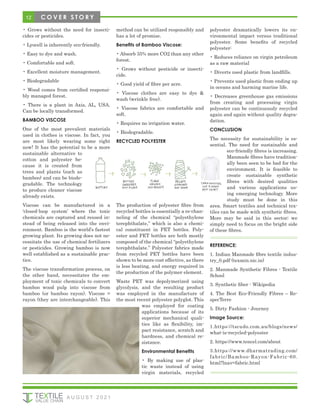
SOME MANMADE ECOFRIENDLY FIB-
ERS
TENCEL™ LYOCELL
TENCEL™ Lyocell fabric is very soft
and ideal for people with sensitive skin.
It is a cellulosic fibre that has been syn-
thesized from wood cultivated in sus-
tainable plantations (often eucalyptus).
Because no harmful chemicals are em-
ployed in the production of lyocell fibre,
the process is environmentally safe on
all levels. In a closed loop process, the
solvent (NMMO) and water needed for
its processing are recycled up to 99 per-
cent of the time.
TENCELTM is a registered trademark
of Lenzing AG.
In the United States, there is a Lenz-
ing lyocell facility. As a result, it can be
made locally. Furthermore, TENCEL™
Lyocell with REFIBRATM technology
allows for the use of recycled cotton
scraps (up to 30% by 2020), which is
very cool.
There are also plenty of novel fibres
on the market created from wood from
certified sustainable plantations, agri-
cultural waste, or post-consumer cotton
clothing. These are excellent but, like
TENCELTM Lyocell, are now unavail-
able on the market.
Benefits of TENCEL™ Lyocell:
• Eucalyptus grows on arid land, on
which it’s impossible to plant other
crops.
• Requires no irrigation water.
MS. KSHIPRA GADEY
Textile Value Chain
A U G U S T 2 0 2 1
12 C O V E R S T O R Y
• Grows without the need for insecti-
cides or pesticides.
• Lyocell is inherently eco-friendly.
• Easy to dye and wash.
• Comfortable and soft.
• Excellent moisture management.
• Biodegradable
• Wood comes from certified responsi-
bly managed forest.
• There is a plant in Axis, AL, USA.
Can be locally transformed.
BAMBOO VISCOSE
One of the most prevalent materials
used in clothes is viscose. In fact, you
are most likely wearing some right
now! It has the potential to be a more
sustainable alternative to
cotton and polyester be-
cause it is created from
trees and plants (such as
bamboo) and can be biode-
gradable. The technology
to produce cleaner viscose
already exists.
Viscose can be manufactured in a
‘closed-loop system’ where the toxic
chemicals are captured and reused in-
stead of being released into the envi-
ronment. Bamboo is the world’s fastest
growing plant. Its growing does not ne-
cessitate the use of chemical fertilizers
or pesticides. Growing bamboo is now
well established as a sustainable prac-
tice.
The viscose transformation process, on
the other hand, necessitates the em-
ployment of toxic chemicals to convert
bamboo wood pulp into viscose from
bamboo (or bamboo rayon). Viscose =
rayon (they are interchangeable). This
method can be utilized responsibly and
has a lot of promise.
Benefits of Bamboo Viscose:
• Absorb 35% more CO2 than any other
forest.
• Grows without pesticide or insecti-
cide.
• Good yield of fibre per acre.
• Viscose clothes are easy to dye &
wash (wrinkle free).
• Viscose fabrics are comfortable and
soft.
• Requires no irrigation water.
• Biodegradable.
RECYCLED POLYESTER
The production of polyester fibre from
recycled bottles is essentially a re-chan-
neling of the chemical “polyethylene
terephthalate,” which is also a chemi-
cal constituent in PET bottles. Poly-
ester and PET bottles are both mostly
composed of the chemical “polyethylene
terephthalate.” Polyester fabrics made
from recycled PET bottles have been
shown to be more cost effective, as there
is less heating, and energy required in
the production of the polymer element.
Waste PET was depolymerized using
glycolysis, and the resulting product
was employed in the manufacture of
the most recent polyester polyglot. This
was employed for coating
applications because of its
superior mechanical quali-
ties like as flexibility, im-
pact resistance, scratch and
hardness, and chemical re-
sistance.
Environmental Benefits
• By making use of plas-
tic waste instead of using
virgin materials, recycled
polyester dramatically lowers its en-
vironmental impact versus traditional
polyester. Some benefits of recycled
polyester:
• Reduces reliance on virgin petroleum
as a raw material
• Diverts used plastic from landfills.
• Prevents used plastic from ending up
in oceans and harming marine life.
• Decreases greenhouse gas emissions
from creating and processing virgin
polyester can be continuously recycled
again and again without quality degra-
dation.
CONCLUSION
The necessity for sustainability is es-
sential. The need for sustainable and
eco-friendly fibres is increasing.
Manmade fibres have tradition-
ally been seen to be bad for the
environment. It is feasible to
create sustainable synthetic
fibres with desired qualities
and various applications us-
ing emerging technology. More
study must be done in this
area. Smart textiles and technical tex-
tiles can be made with synthetic fibres.
More may be said in this sector; we
simply need to focus on the bright side
of these fibres.
REFERENCE:
1. Indian Manmade fibre textile indus-
try_0.pdf (texmin.nic.in)
2. Manmade Synthetic Fibres - Textile
School
3. Synthetic fiber - Wikipedia
4. The Best Eco-Friendly Fibres – Re-
specTerre
5. Dirty Fashion - Journey
Image Source:
1.https://tscudo.com.au/blogs/news/
what-is-recycled-polyester
2. https://www.tencel.com/about
3.https://www.dharmatrading.com/
fabric/Bamboo-Rayon-Fabric-60.
html?lnav=fabric.html
A U G U S T 2 0 2 1
13
PROCESSING OF POLYESTER
FABRICS IN INDUSTRIES
Business Head (Dyes)
SHREE PUSHKAR CHEMICALS & FERTILISERS LTD., MUMBAI
Dr. N. N. MAHAPATRA
C O V E R S T O R Y
Initially, the organized textile industry
was not allowed to weave filament warp
yarns. This privilege was reserved for
weaving units in the decentralized
sector – power looms and handlooms.
Gradually the Textile Policy in June
1985 was changed, and it was open to
the organized textile sector. At that
time, they had to face stiff competition
with the power looms. It was very dif-
ficult to weave filament warp yarns on
the overpick looms. Then the automatic
looms were preferred for weaving fila-
ment warp yarns. At that time in India,
only the twisted filament yarns were
being woven. Later, the mills started
weaving zero-twist or low twist fila-
ment yarns. Mills in Ahmedabad, Su-
rat, Bhiwandi, and Bhilwara started
making polyester sarees, suiting, shirt-
ing, and dress materials.
Polyester fabrics are made using the
following yarns
1. Filament yarns.
2. Textured yarns.
3. Spun yarns.
Filament yarns are made in monofila-
ment and multifilament forms. The
direction and amount of twist are de-
termined by the desired end-use. the
commonly used filament yarns have
a. Zero Twist.
b. Low Twist up to 200 TPM.
c. Medium Twist up to
800 TPM.
d. High Twist up to 1500 TPM.
e. Extra High Twist up to
3000 TPM.
Textured Yarns are produced of poly-
ester multifilament. they are given a
texturizing either in conjunction with
the drawing process or subsequently
as part of the throwing and texturizing
process in producing the finished yarns.
The most textured yarn used is
a. zero twists.
b. Low Twist up to 200 TPM.
c. Medium Twist up to 800 TPM.
Spun yarns are made of polyester sta-
ple fibers. It may be bright, semi-dull,
or dull. It may be regular, medium, or
high tenacity. The count varies from
2/20 s to 2/50 s Depending on the end-
use yarns are used to make the desired
fabric.
Besides the above three yarns another
yarn is also used in making polyester
fabrics are called Tangled yarns which
are Aero set or Rotoset.
Except for spun yarns all the other
yarns are made from basic flat yarns.
Compared to all spun yarns, generally
the filament yarns are stronger. The fil-
ament yarns are designated as denier /
number of constituent filaments/twist.
The figure 80/36/600 filament would in-
dicate 80 deniers with 36 filaments and
600 twist per meter. Generally, a fila-
ment yarn with a greater number of fil-
aments will produce a fuller fabric than
another filament yarn of equal denier
but with a smaller number of filaments.
The zero twist filament yarns produce
better cover than the twisted filament
yarns. The textured yarns produce full-
er fabric compared to flat yarns.
The Surat Man-Made Textile Industry
is the largest concentration of looms in
the world weaving man-made filament
fabrics. Growth of processing activity in
Surat occurred out of necessity. during
1970-80, Surat city witnessed the set-
ting up of two giant co-operative mar-
ket
1. Surat textile market.
2. Bombay market.
These attracted attention of traders
from all over India. Man-made textiles
especially nylon and polyester sarees
from Surat, became famous in all cor-
ners of the country. It is well known
that each of the 150 process houses in
Surat have a capacity to dye/print from
15,000 meters to 50,000 meters a day.
The involvement of traders in process-
ing activity has beyond doubt contrib-
uted significantly to the growth of pro-
cess houses.
Properties of polyester fabrics -
Fabrics made of regular tenacity poly-
ester filament yarns are very strong
and durable. They do not have a high
degree of elasticity which means it is
characterized as having a high degree
of stretch resistance, which means pol-
yester fabrics are not likely to stretch
out of shape too easily. This property
makes polyester suited for knitted gar-
ments, sagging and stretching that
would ordinarily occur are reduced.
Polyester fabrics have good dimension-
al stability. It has got a high degree of
resilience. Not only does a polyester fab-
ric resist wrinkling when dry, it also re-
sists wrinkling when wet. For example,
a suit of polyester will keep its pressed
appearance after many wearing, even
after exposure to rain or moist, humid
A U G U S T 2 0 2 1
14 C O V E R S T O R Y
weather. Fabrics of polyester filament
yarn have satisfactory draping quali-
ties. The trilobal filament type is more
supple and imparts better drapability.
spun yarns are also more flexible and
softer, thereby imparting the draping
quality.
Polyester fabrics are better conductors
of heat than acrylic fabrics. Polyester
fabrics have low absorbency as a result
it will dry very rapidly since almost
all the moisture will lie on the surface
rather than penetrate the yarns. So pol-
yester fabrics are well suited for water
–repellent purposes, such as rain wear.
This low absorbency means that poly-
ester fabrics will not stain easily except
oil which has got affinity for polyester,
and it is difficult to remove.
The main disadvantage due to low
absorbency is polyester fabrics are
clammy and uncomfortable in humid
weather because they will not absorb
perspiration or atmospheric moisture.
There is essentially no water shrinkage
of polyester fabrics; therefore, shirts,
blouses and even slacks may be safely
laundered. When ironing polyester
fabrics, it is best to use low to medium
heat. excessive heat will cause polyes-
ter to melt. The wrinkle resistance of
polyester is extremely good. Polyester
fabrics made from spun polyester yarns
tend to pill. Polyester fabrics shrink
as much as 20 % during wet – finish-
ing operations and they are generally
heat –set in later treatments. Polyester
fabrics are better suited for outdoor use
because it has good resistance to degra-
dation by sunlight. They are resistant
to mildew.
Pretreatment of polyester fabrics - Fol-
lowing are the steps for pretreatment of
100% polyester fabrics.
1. Drumming – It is carried out in Ro-
tary Drum
HTHP machine. It opens the yarn twist
thereby giving grainy effect to the fab-
ric. The MLR is 1:4 – 1: 6. Kleenox TEP
(Rossari Chemicals, Mumbai) is used
0.3 to 0.5 % o.w.f. The pressure is 2-3
kgs/cm2. Holding time is 45-90 mins.
2. Desizing - It is meant for regular and
water jet loom sizes i.e PVA and
Na –salts of Acrylate
co-polymers. HTHP Jet dyeing machine
is used. MLR is 1:4 in U- tube and
1:8 in long tube.
Add Kleenox BAS (Rossari chemicals,
Mumbai) - 1-2 gms/lit. Adjust pH 5.5
-6.0 with acetic acid. Run for 20 mins
at room temp. Add Soda ash 2-4 gms/
lit (pH 10- 10.5). Raise temperature to
100 deg c by 1 deg c /min gradient. Hold
for 45-60 mins. Hot drain. Hot wash at
95 deg c
with 0.5 gms/lit Kleenox BAS for 10
mins. Cold wash.
In some units they are doing single
bath desizing and drumming in the
Rotary Drum HTHP m/c. It saves time
and energy to avoid separate desizing
process in different machine e.g., Jet or
Jigger.
3. Scouring -
It is required for high twist 100 %
polyester qualities. It is carried out
as Single bath Scouring & Weight Re-
duction in HTHP Jet Dyeing machine.
The MLR is 1:3 – 1:4 in U –tube. Load
the material and give cold wash. Then
add Greenscour CPM (Rossari, Mum-
bai) – 2-3 gms/lit Kleenox BASM (Ros-
sari, Mumbai) – 2-3 gms/lit. Zylube CM
(Rossari, Mumbai) (if reqd) – 1.5 gms/
lit. Run for 15 mins at room temp. Add
Caustic soda flakes as per weight re-
duction required. Raise temp to 120-
130 deg c. hold for 30-60 mins. Hot
drain. Hot wash at 95 deg c for 15 mins
with addition of Oligo EM (Rossari,
Mumbai) -1 gm/lit. Then neutralization
with Oxalic acid – 4 gms/lit. Kleerix N
(Rossari, Mumbai) - 1 gm/lit. At 90 deg
c for 20 mins.
The basic finishing processes for 100%
polyester filament yarn fabrics may
be arranged in the following three se-
quences.
a. Scour –Heatset – Dye
b. Heat set –Scour--- Dye.
c. Scour—Dye—Heat set.
Dyeing of polyester fabrics -
There are basically two types of polyes-
ter fabrics
1. Polyester knitted fabrics.
2. Polyester woven fabrics.
Polyester knitted fabrics are used on a
large scale for outer wear of all types.
The main reasons for their success are
the wide patterning potential, the good
durability and crease resistance, and
the excellent easy-care properties. Pol-
yester knitted fabrics are composed al-
most exclusively of texturized yarn. To
avoid creases and breakages, knitted
fabric that have not been set should al-
ways be stored or treated in full width.
The process sequence for circular
knitted fabrics dyeing is as below.
Slitting –-- pre-stabilization ---- Full-
width washing ------Hydroextraction
-----Drying ---Heat-setting ---- Dyeing
----- Hydroextraction------Finishing------
Drying----Steaming.
Following are the precautions taken for
the above process.
1. Circular knitted fabrics should be
slit as soon as possible after knitting
(within 24 hours). If they cannot be fur-
ther processed immediately, they must
be rolled flat, completely free from
creases. If the goods are stored in tu-
bular form for some time, the folds will
become fixed.
2. Prestabilizing is necessary if the fab-
ric is liable to become creased during
precleaning or if the selvedges tend to
curl. This is done by running the fabric
in a tensionless state through a steam-
ing chamber ((saturated steam ,100deg
c.); the fabric relaxes, and fibres begin
to crimp.
3. Prior to dyeing, all spin finish, knit-
ting machine oil and other impurities
must be removed. At the same time
washing develops the crimp which is
lost in knitting.
4. Scouring is carried in continuous full
width washing ranges using Soda Ash
and good detergent. There should be
provision of a “sojourn” zone, in which
the fabric is able to relax completely
without longitudinal tension. The
shrinkage is often over 20 %.
5. After washing, rinsing, hydroextrac-
tion uniform drying is essential because
variations in the residual moisture con-
tent are liable to cause uneven fixation,
resulting in unlevelness in dyeing.
6. Heat setting is done in stenter at 150-
A U G U S T 2 0 2 1
15
C O V E R S T O R Y
180 deg c for 20-30 seconds. The higher
the setting temperature, the better the
dimensional stability of the treated
fabrics., but the handle becomes flatter
and harsher if the setting temperature
is too high.
7. Texturized polyester knitted fabrics
are normally dyed at 130 deg c in high
temperature winch –beck. it gives a
full, bulky handle to the goods using
medium to high sublimation fastness
disperse dyes. It can also be dyed in Jet
dyeing machines using defoamer, an-
ticrease agent etc.
The process sequence for dyeing of
polyester woven fabrics is as below ;
Full width washing ----drying ---heat
setting ----dyeing ----hydroextraction---
-finishing--------drying ----steaming.
Polyester fabrics can be dyed in the fol-
lowing machines.
a. High Temperature winch becks -
It is suitable to dye texturized polyester
knitted fabrics. It imparts a full, bulky
handle to the fabrics. Care must be tak-
en to avoid running and other creases.
The probable causes for creasing are
a. poor suitability of dyeing machine.
b. too heavy batch of fabric.
c. incorrect loading of machine.
d. dyeing
process (heating, cooling). The remedi-
al measures are adjusted temperature
programme and add a suitable lubri-
cant.
b. Jet Dyeing machines – It is suitable
for dyeing of polyester knitted fabrics
and woven fabrics.
Following are the advantages of the
above Exhaust dyeing process
a. no tailing problems.
b. better reproducibility.
c. less fastness problems.
d. good penetration.
Care must be taken to avoid Rope
marks in jet dyeing machines which
may be due to the following reasons
1. improper heat setting.
2. too low a fabric speed.
The remedial measures are
a. ensures proper heat setting.
b. at least 1 revolution per min.
c. use suitable lubricants.
c. Beam dyeing machines - It is suit-
able for dyeing smooth knitted fabric
and woven fabrics.
Following are the advantages of beam
dyeing over winch beck dyeing
1. short liquor ratio, and consequently
low costs for energy, water, and dye.
2. time saved in loading and unloading
the dyeing machine.
3. no trouble with running of the goods.
4. less danger of unlevelness caused by
variations in temperature in the dye-
bath.
The disadvantage of this method is
however, that bulky qualities may be
flattened, so that the handle and ap-
pearance suffer. Besides this problem
barriness is observed, which is unlevel
ness in dyeing material. By using suit-
able chemicals, it can be overcome.
d. Pad-Thermosol Process /Continu-
ous Dyeing – It is suitable for polyester
narrow fabrics. Following is the process
sequence to be followed.
1. padding – pick up -50 -65 %
2. drying – 1 min at 130 deg c.
3. fixing with hot air – 170 deg c to 195
deg c, 1-6 mins.
4. cold wash
5. reduction clearing - 70 deg c to 80 deg
c, 1-4 mins.
6. cold wash
Following are the advantages of the
above process.
• no spirality problem.
• Flexibility of production.
• better workflow.
• More economical.
There is listing problem encountered in
Continuous Dyeing. which may be due
to one-sided liquor feed into the trough.
Or different nip roller pressure or un-
level migration in intermediate drying
or uneven thermosoling or fixation of
dyes due to temperature differences.
It can be overcome by strict quality
checks in process, machine settings etc.
Finishing of polyester fabrics
Several finishes can be given to polyes-
ter fabrics to increase their usefulness.
Some of the important ones are as be-
low.
1. Antistatic
2. Finish – for reduction of electrostatic
build –up.
3. Calendaring – for smoothness and
reduced pilling.
4. Compressive shrinkage - for in-
creased shrink resistance.
5. Embossing – for design and luster.
6. Heat setting and stabilizing – for
permanent shape retention, wrinkle re-
sistance, and improved hand.
7. Shearing – for smooth, even pile or
nap.
8. Singeing – for improved hand and re-
duced pilling.
9. Water and Soil repellency – for com-
fort and ease of care.
Rossari chemicals, Mumbai has come
out with special finishes which are used
in the Surat market for 100 % polyester
fabrics.
a. Zylan MAT - Mat Finish
- Dose 10 -15 gms/lit. It is suitable for
bright filament –yarn qualities. It gives
good bouncy effect. It gives Matt look
with cotton feel.
b. Drybounce CST –Dose 10-15 gms/
lit. It is suitable for both bright and
georgette qualities of dress material
with heavy weight reduction. It gives
very good bouncy feel with complete
dry touch. It is suitable for both pad
and exhaust.
c Innersol GTX - Dose – 5-10 gms/lit.
It is suitable for 100 % polyester and
blends. It gives wet feel with soft sur-
face touch.
It gives smooth surface with inner soft-
ness.
d. Dry Peach - It is suitable for pad
only. It gives very high bounce with dry
A U G U S T 2 0 2 1
16 C O V E R S T O R Y
peach surface. More suitable for bright
qualities of sarees and dress material.
Following chemicals are used Zylon RS
– 20-30 gms/lit.
• Ultima XT 50 – 15-20 gms/lit
• Drybounce CST – 5-10 gms/lit.
Important Fabric Defects –
Practically all fabric defects that occur
in spun yarn fabrics can also occur in
filament yarn fabrics.
• Fabric Slip – Fabric slip occurs when
warp and weft yarns donot stay in
their respective positions as these were
placed during weaving on the loom. It is
prominent in light construction fabrics.
After heat setting the tendency to fab-
ric slip reduces considerably. Increase
in end pick density and warp-weft
crimp and early heat setting help to re-
duce fabric slip. For slip prone fabrics
special chemical finishes are required
to overcome this defect.
• Stitches – In case of filament warp
fabrics, it is the filamentation of yarns
that is mainly responsible for formation
of stitches on the loom. Application of
small amount of adhesive and ant-stat-
ic agent has been reported to reduce the
filamentation and hence warp breaks.
• Shiners – Shiners are a specific defect
of filament yarn fabrics only. These are
mainly caused by uneven surface of
the blanket on sanforising, or zero-zero
finish machine. Proper care should be
taken during buffing of the blanket.
• Temple Marks – The temple marks
are seen more prominently in filament
warp fabrics. This is because with
slight pressure the filament warp gets
disturbed and leave behind permanent
impressions. Temple spikes should not
be blunt, and rings should rotate freely.
• Formation of Balls on Fabric Surface
- Due to excessive abrasion of healds
and reeds some of the constituent fila-
ments break. These broken filaments
are collected by the reed in the form of
fiber balls which firmly adhere to warp
and fabric surface.
But nowadays polyester fabrics has be-
come a poor man fabric. But in 70 -80
s it was a rich man s fabric. Till date
Surat maintains the name of synthetic
city supplying polyester shirts, poly-
ester sarees, dress materials to the
whole of India and export to countries
like Middle east and African countries.
Polyester fabrics made from spun yarn
are used for furnishing fabrics like sofa
cover, Luxury bus seat covers, cinema
halls seat covers, Aeroplane seat covers
etc. The industries making the polyes-
ter fabrics for furnishing are in Gur-
gaon, Faridabad, Panipat etc.
There is good scope for polyester fab-
rics made from spun yarn, texturized
filament etc for school uniform, police
uniform, dress material etc. in Nigeria
and other African countries. Reliance
Industries has come out with very new
type of polyester fibre which will give
value addition to the polyester fabrics
sector such as Cationic Dyeable Poly-
ester (CDP), Easy Dyeable Polyester
(EDP), Cotlook Polyester, Low Pill Pol-
yester, Recycle Polyester, Fire-Retard-
ant Polyester etc.
NEWS UPDATE
TEXEL INDUSTRIES LTD TO START COMMERCIAL OPERATIONS OF ITS
10,080 MT GEOSYNTHETICS PRODUCTS FACILITY AT KHEDA
Company has launched Rs. 12.49 crore
Rights issue to fund the expansion;
Rights issue open from 31 August – 14
Sep at Rs. 40 per share
Speaking on the development, Mr.
Shailesh Mehta, Managing Director,
Texel Industries Ltd said, “Expansion
at our new facility in Kheda is going
as scheduled and we plan to start com-
mercial operations by end of September
2021. Post completion of the expansion,
installed capacity of the company will
double to more than 19,000 MT per
annum. Keeping in line with its con-
tinuous efforts towards sustainability,
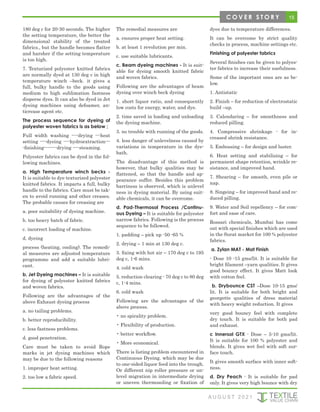
Texel is now expanding its product mix
to include various new products such as
Roof Tile Underlay, Lumber Wrap, and
a Floating cover for water reservoirs.
The floating cover is a cover for farm
ponds and water reservoirs, which pre-
vents 30% loss of water through evapo-
ration.”
The company’s manufacturing facil-
ity is located at Santej, Gandhinagar,
Gujarat having an installed capacity
of 9,000 MT per annum. The manage-
ment has successfully turned around
the company and was able to rebuild
stakeholder confidence with higher
sales and profits, resulting in it getting
deregistered from BIFR in November
2016. For the quarter ended June 2021
promoter holding stands at 40.77% – a
rise of 647 basis points from 34.3% from
June 2020.
For FY20-21, the company reported
sales of Rs. 82.79 crore and Net profit
of Rs. 2.13 crore. For the Q1FY22, the
company posted a healthy 51% growth
in the net sales at Rs. 27.74 crore, Net
Profit was up 70% at Rs. 75 lakh. The
performance was achieved on the back
of robust demand on the domestic mar-
kets in the Tier 2,3 cities & rural areas
post unlock.
Company plans to raise up to Rs. 12.49
crore from the rights issue which is
open for subscription from 31 August to
September 14. Proceeds of the rights is-
sue will be utilised to fund the proposed
expansion in Kheda facility.
Post completion of the expansion, in-
stalled capacity of the company will
double to more than 19,000 MT per an-
num.
A U G U S T 2 0 2 1
17
C O V E R S T O R Y
MOBILON MONOFILAMENT
JAPANESE SPANDEX
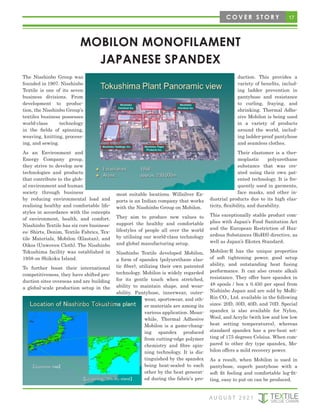
The Nisshinbo Group was
founded in 1907. Nisshinbo
Textile is one of its seven
business divisions. From
development to produc-
tion, the Nisshinbo Group’s
textiles business possesses
world-class technology
in the fields of spinning,
weaving, knitting, process-
ing, and sewing.
As an Environment and
Energy Company group,
they strive to develop new
technologies and products
that contribute to the glob-
al environment and human
society through business
by reducing environmental load and
realising healthy and comfortable life-
styles in accordance with the concepts
of environment, health, and comfort.
Nisshinbo Textile has six core business-
es: Shirts, Denim, Textile Fabrics, Tex-
tile Materials, Mobilon (Elastan), and
Oikos (Unwoven Cloth). The Nisshinbo
Tokushima facility was established in
1958 on Shikoku Island.
To further boost their international
competitiveness, they have shifted pro-
duction sites overseas and are building
a global-scale production setup in the
most suitable locations. Willsilver Ex-
ports is an Indian company that works
with the Nisshinbo Group on Mobilon.
They aim to produce new values to
support the healthy and comfortable
lifestyles of people all over the world
by utilising our world-class technology
and global manufacturing setup.
Nisshinbo Textile developed Mobilon,
a form of spandex (polyurethane elas-
tic fiber), utilizing their own patented
technology. Mobilon is widely regarded
for its gentle touch when stretched,
ability to maintain shape, and wear-
ability. Pantyhose, innerwear, outer-
wear, sportswear, and oth-
er materials are among its
various application. Mean-
while, Thermal Adhesive
Mobilon is a game-chang-
ing spandex produced
from cutting-edge polymer
chemistry and fibre spin-
ning technology. It is dis-
tinguished by the spandex
being heat-sealed to each
other by the heat generat-
ed during the fabric’s pro-
duction. This provides a
variety of benefits, includ-
ing ladder prevention in
pantyhose and resistance
to curling, fraying, and
shrinking. Thermal Adhe-
sive Mobilon is being used
in a variety of products
around the world, includ-
ing ladder-proof pantyhose
and seamless clothes.
Their elastomer is a ther-
moplastic polyurethane
substance that was cre-
ated using their own pat-
ented technology. It is fre-
quently used in garments,
face masks, and other in-
dustrial products due to its high elas-
ticity, flexibility, and durability.
This exceptionally stable product com-
plies with Japan’s Food Sanitation Act
and the European Restriction of Haz-
ardous Substances (RoHS) directive, as
well as Japan’s Ekotex Standard.
Mobilon-R has the unique properties
of soft tightening power, good setup
ability, and outstanding heat fusing
performance. It can also create alkali
resistance. They offer bare spandex in
48 spools / box x 0.450 per spool from
Nishinbo Japan and are sold by MoRi-
Rin CO., Ltd. available in the following
sizes: 20D, 30D, 40D, and 70D. Special
spandex is also available for Nylon,
Wool, and Acrylic (with low and low low
heat setting temperatures), whereas
standard spandex has a pre-heat set-
ting of 175 degrees Celsius. When com-
pared to other dry type spandex, Mo-
bilon offers a mild recovery power.
As a result, when Mobilon is used in
pantyhose, superb pantyhose with a
soft fit feeling and comfortable leg-fit-
ting, easy to put on can be produced.
A U G U S T 2 0 2 1
18 C O V E R S T O R Y
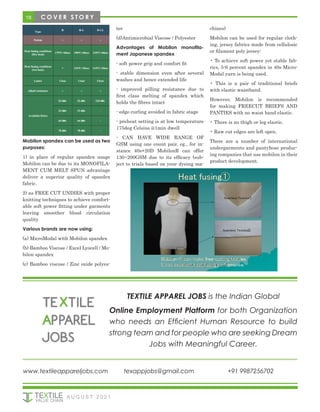
Mobilon spandex can be used as two
purposes:
1) in place of regular spandex usage
Mobilon can be due to its MONOFILA-
MENT CUM MELT SPUN advantage
deliver a superior quality of spandex
fabric.
2) as FREE CUT UNDIES with proper
knitting techniques to achieve comfort-
able soft power fitting under garments
leaving smoother blood circulation
quality
Various brands are now using:
(a) MicroModal with Mobilon spandex
(b) Bamboo Viscose / Excel Lyocell / Mo-
bilon spandex
(c) Bamboo viscose / Zinc oxide polyes-
ter
(d)Antimicrobial Viscose / Polyester
Advantages of Mobilon monofila-
ment Japanese spandex
- soft power grip and comfort fit
- stable dimension even after several
washes and hence extended life
- improved pilling resistance due to
first class melting of spandex which
holds the fibres intact
- edge curling avoided in fabric stage
- preheat setting is at low temperature
175deg Celsius @1min dwell
- CAN HAVE WIDE RANGE OF
GSM using one count pair, eg., for in-
stance 40s+20D MobilonR can offer
130~200GSM due to its efficacy (sub-
ject to trials based on your dyeing ma-
chines)
Mobilon can be used for regular cloth-
ing, jersey fabrics made from cellulosic
or filament poly jersey:
• To achieve soft power yet stable fab-
rics, 5-6 percent spandex in 40s Micro-
Modal yarn is being used.
• This is a pair of traditional briefs
with elastic waistband.
However, Mobilon is recommended
for making FREECUT BRIEFS AND
PANTIES with no waist band elastic.
• There is no thigh or leg elastic.
• Raw cut edges are left open.
There are a number of international
undergarments and pantyhose produc-
ing companies that use mobilon in their
product development.
TEXTILE APPAREL JOBS is the Indian Global
Online Employment Platform for both Organization
who needs an Efficient Human Resource to build
strong team and for people who are seeking Dream
Jobs with Meaningful Career.
www.textileappareljobs.com texappjobs@gmail.com
A U G U S T 2 0 2 1
+91 9987256702
19
C O V E R S T O R Y
UNCERTAIN FUTURE,
NO NEW INVESTMENT…
MR. ANUBHAV TEWARI
Marketing Director,
Indian Acrylics Ltd.
Indian Acrylics Ltd is India’s largest
and most efficient acrylic fiber manu-
facturer, and a prominent world player
with exports to Asia, Europe, and the
Middle East.
Its dry spun (Du Pont Technology)
acrylic fiber quality is exceptional due
to its distinctive dog bone-shaped cross-
section and offers great lustre and soft-
ness.
Indian Acrylic is a popular producer of
acrylic fiber, tops, and tows due to prod-
uct optimization, dependability, and
environmental concern (green captive
power generation since 2002). It is also
making Acrylic Yarns in dyed and grey
both through Modified Cotton and Wor-
sted route, making 1500 tons of yarns
every month.
Share your company’s journey
Acrylic fibres and yarns are what we
make. Making yarns started around ten
years ago. Both colored and grey yarns
are produced. We are one of the larg-
est yarn manufacturers in the country
and an important player globally, with
a monthly output of 1500 tons. These
yarns are exported to various countries
across the globe. We also offer different
specialty products to our customers.
Our annual capacity is about 48000
tons in Fibre. Our utilisation is basi-
cally between 70-80%. We make about
18000 tons yarns.
We sell in different countries in Asia,
Europe, Africa, the United States, and
Australia. We primarily do dyed yarns.
Challenges in Pandemic
There were a few challenges that I think
the entire acrylic industry faced dur-
ing the pandemic like exorbitant ocean
freights, long transit periods, raw ma-
terial availability and high AN prices,
and high fiber prices consequently. Due
to the high raw material prices, there is
no room for anyone in the value chain
to get some margin. Due to this hike in
prices, customers are reducing produc-
tion, switching to blends of acrylic with
other less expensive fibres, or cheaper
substitutes that are a major challenge
for acrylic fibre and yarn manufactur-
ers. Cash flow situation in the Industry
is also a major concern. Wholesalers
invest beforehand and pay advances
for the end product, but due to excep-
tionally high yarn prices, they are not
gaining anything. Thus advances are
not flowing in and small knitters are
the worst affected due this cash crunch.
There is a major impact of this on de-
mand. What has worsened the whole
situation is the fear of 3rd wave. Peo-
ple are scared that if another wave hits
and there are lockdowns, the sale will
get affected and money will get blocked
in stocks as it is a seasonal product
(only winters)
There hasn’t been much upheaval in
terms of demand from various locations
in this segment. There is no new cat-
egory or new market that is supported
during COVID. The market dynamics
have not changed much.
Technology Upgradation
COVID last year opened few possibili-
ties in terms of technology application.
However, any such upgradation etc. is
time taking and needs investments too.
We anticipate another wave in the near
future. So, the focus remains on smooth
running of operations first rather than
looking too far ahead as there is a lot of
uncertainty even now. We have extend-
ed credit to some customers and also
provide competitive product pricing.
The demand shifts majorly to basic
products because customers assume
that basic will continue to move as it
is more need based and low value prod-
uct. If you make something fancy, say
for marriages and other special occa-
sions, and for women, there is no party
happening, no marriages with large
gatherings happening, and not much
outing happening, so as a result, buy-
ers invest primarily in simple products
that are more likely to move quickly. In
such a case, there isn’t much one can do
in terms of technology, functionality or
any such thing.
Consumption
Sweaters is the main product segment,
and school uniforms are the biggest
part of it. This segment has been se-
verely impacted because schools have
been shut since last year. Then there
are Carpets manufactured in small
numbers in India (Bhadohi etc.). Iran
and Turkey are the biggest manufac-
turers of carpets that are sold to cold
countries.
Then there are shawls, ladies’ cardi-
gans, suit material, prayer mats, em-
broidery yarns, hand knitting yarns for
making sweater, caps, mufflers, gloves
etc. Then there are saris, sarongs etc.
with acrylic as a replacement of silk fi-
bre.
Overall Sweaters should be 50-55
percent of total consumption, carpets
would be about 10-15 percent and other
segments as narrated above form the
rest.
A U G U S T 2 0 2 1
20 I N T E R V I E W
KUSUMGAR CORPORATES IN GROWTH
EVADING PANDEMIC CHALLENGES
MR. SIDDHARTH KUSUMGAR
Managing Director
Kusumgar Corporates is presently recognised as a market
leader in the highly specialised Technical and Specialized
Textiles sector. Mr. Yogesh Kusumgar recognised the enor-
mous potential of a business that was still in its infancy in
1970. He founded a company to suit the complex needs of
an ever-changing textile industry, starting small but think-
ing big. The company’s agility in offering bespoke solutions,
together with world-class quality and incredibly competitive
rates, drove it to a leadership position in a short period of
time.
Kusumgar Corporates has a solid track record in the field of
specialist textiles, offering a wide range of textiles for a wide
range of applications. Cordura fabrics, custom fabrics, geo-
synthetics, recreational fabrics, parachute fabrics, protective
fabrics, ballistic fabrics, filter fabrics, parasail fabrics, im-
pression fabrics, and medical textile fabrics have all thrilled
clients throughout the years.
The company’s phenomenal performance in the early years
allowed it to further solidify its market position. Manufac-
turing capacity was continually increased by utilising the
most advanced technology and equipment. The corporation
also moved forward to allow for greater value addition to its
product line while maintaining complete control over quality
standards and delivery timelines.
The move from weaver to coater of specialist fabrics provided
the company with the confidence to advance to the next level.
Today, Kusumgar is a skilled maker of specialty textiles as
well as a well-known knowledge supplier and whole solutions
consultant in India’s difficult technical textiles business.
How would you describe your company in a few sentenc-
es? Could you please provide us information about the
products in your portfolio?
In 1970, Mr. Yogesh Kusumgar, Chairman of Kusumgar Cor-
porates Pvt. Ltd (KCPL), realized the need for textiles for
non-apparel application, that is presently known as techni-
cal textiles, and started a business to meet the ever-growing
needs of a burgeoning industry. Today, Kusumgar has com-
pleted 50 years and is regarded as a pioneer in the industry,
synonymous with the development, production, and supply
of technical textiles.
KCPL has been recognized for its many awards including
the National Award for indigenization conferred by the Min-
istry of Defence. The other honours that the company has re-
ceived over the years are the Gold Vendor Award by Garware
Bestretch, Supplier Excellence Award by Parker Hannifin,
and Quality Promise to Zero Defect Award by Johnson and
Johnson.
Despite the huge potential in the market, technical textiles
are growing at a slower pace? Why?
The global demand for technical textiles is estimated at $180
bn and growing at a CAGR of 4%. The Asia Pacific is lead-
ing with 40% share, while North America and West Europe
stand at 25% and 22% respectively. On the other hand, the
demand for technical textiles in India is meager $20 bln. The
main reasons for low growth are:
i) Consumer awareness has not been created and the market
is not growing for technical textiles.
ii) Textile Industry is fragmented and low scale; the majority
of the manufacturing units do not have proper infrastructure
and quality consciousness to meet the stringent requirement
of technical textiles.
iii) There is a lack of R&D culture.
iv) Mandate of compulsory use for protection, environment,
DR. M.K. TALUKDAR
Consultant
A U G U S T 2 0 2 1
road safety, etc.
v) Non-availability of specialty fibres and yarns.
To overcome the drawbacks, recently the Ministry of Textiles
has set up the National Technical Textiles Mission that aims
at an average growth rate of 15-20% to increase the domes-
tic market size of technical textiles $40-50 bln by the year
2024 through market development, market research, mar-
ket promotion, international technical collaboration, new in-
vestments and make in India initiative. However, we have to
wait till 20024 to see the success of the mission.
Within the technical textiles what are the major segments
do you cater and which is the fastest-growing segment as
per you?
Ans. KCPL manufactures almost the whole gamut of techni-
cal textiles. We have experience in manufacturing more than
500 types of woven technical textiles using a wide variety of
materials including specialty yarns of rayon, polyester, and
polyamide to p-aramid yarns. The linear density of fabrics
ranges from 20 gsm to 1000 gsm and can supply fabric roll
length up to 2000 m. We have integrated manufacturing fa-
cilities from weaving to processing to coating/ laminating to
provide a complete solution.
Our custom-made fabrics meet the stringent requirement of
certain industries including aerospace, medical and indus-
trial. We also make fabrics for the rubber industry, outdoor,
luggage, military material like parachute fabrics, personnel
equipment, ballistic fabrics, protective clothing and uniform,
adventure sports, and inflatables.
At the moment due to the onset of Covid 19 and the need
for other medical applications, medical textile is the fastest
growing technical textiles at the rate of 15%.
How was 2020 for your company? How was your compa-
ny’s reaction to Pandemic? What was the impact of Pan-
demic in terms of sales, staff cut down, etc?
The world faced an unprecedented crisis and challenge with
the outbreak of the Corona Virus towards the end of Novem-
ber 2019, named Covid 19. Like many other companies, our
consumer products e.g., outdoor, luggage and automobiles
are severely affected, and sales of these products are sub-
stantially reduced.
On the flip side, there has been a huge demand for PPE (Per-
sonal Protective Equipment) for providing high-level protec-
tion to the health professionals dealing with Covid 19 pa-
tients. Within a few weeks, we developed the product and
tested to meet the stringent technical requirements as pre-
scribed by the Ministry of Health and Family welfare; KCPL
has become a potential supplier of PPE kits and face mask.
There was no reduction in the salaries of our staff nor re-
trenched the workforce. This was possible by controlling the
working capital, reducing inventories, and drastically slash-
ing the fixed costs.
Your company’s share in the Indian Market and Globally.
The market share of technical textiles of KCPL in our
country is about 15 %; nevertheless, for certain segments
like parachutes, ballistic fabric, our market share is almost
100%. Although our export is increasing every year, our pres-
ence in the global context is insignificant.
Tell us about your clients in India and which are the major
markets do you cover across globally.
The clienteles of KCPL are widespread and include:
1. Ordinance Parachute Factory (OPF), Kanpur.
2. Ordinance Equipment factory (OF), Kanpur.
3. Arial Delivery Res. & Dev. Estt. (ADRDE), Agra Cantt.
4. Defence Materials @ Stores Res. & Devp. Estt. (DMSRDE),
Kanpur.
5. Tata Advance.
6. Johnson & Johnson Limited, Mumbai.
7. Zodiac Aerospace Ltd.
8. PISA, South Africa
9. Uretek Inc.
10. Trelleborg Coated Systems US Inc.
11. Decathlon.
12. Coroplast, Germany
13. Cetroplast, Germany
14. Parker Hannifin
15. Garware Bestretch
Any expansion plans in the next 5 years in terms of capac-
ity, markets, and product development?
In the global competition of today’s world, KCPL restructures
itself to become a fast-changing high valued adding creator
of a niche market. To achieve this, KCPL’s joint ventures
such as Saati Kusumgar (P) Ltd. and Toray Kusumgar Ad-
vance Textiles with leading companies across the globe have
added capabilities to its portfolio and significantly increased
the quality of services. In 2019, the company, which used to
supply only aeronautical fabrics, was offered a transfer of
technology (TOT) by the Ministry of Defence of the Govern-
ment of India for manufacturing parachutes for the Indian
Army and thus forwarding integrating the company. These
parachutes are made under the guidance of the Gaganyaan
Human Space Programme, which is all set to be launched in
the year 2022.
The company has persistently worked towards expanding its
applications and trying out new ventures. All these develop-
ments will lead to KCPL’s ambition to achieve a turnover of
$5 bln (Rs 500cr) in the next couple of years.
21
I N T E R V I E W
A U G U S T 2 0 2 1
22 R E V I E W P A P E R
TECHNOLOGICAL DEVELOPMENTS IN
SPORTS TEXTILES
Abstract
India is emerging as significant market
for Technical textiles. The Sportech is
one of the fast growing sectors of Tech-
nical Textile which contributes around
7% of Indian technical textiles mar-
ket. Sports textile sector is divided in
three major categories such as sports-
wear, sport goods and sport accessories.
Further, Sportech comprises of tech-
nical textile products used in sports
and leisure such as sport shoes, sports
composites, flying and sailing sports,
parachute fabrics, artificial turf,
ballooning fabrics etc. Textile plays
a major role in sports and without
textiles, sports existence is very
difficult. Sports textiles, is techni-
cal textiles growing in wider range
with sophisticated technology.
Developments in technology has
seen in manufacturing sportswear
to ensure special features for bet-
ter performance in their activities
and to provide comfort to player.
Sportswear is clothing including
footwear worn for sports or exer-
cises, it also includes garments
like t-shirts, tracksuits etc. and there
also specialised apparels for wet suits
for swimming, cycling etc.
The use high functional and smart
textiles have proven their high level
of performance and succeeded in their
functional properties. According to
the functional requirements of sports,
special apparels for specific sports are
manufactured. Many fibres, yarns, fab-
rics and finishes developed to meet the
needs of the sports sector.
Introduction
Sports textiles are one of the various
branches of technical textile. In vari-
ous sports, the sportswear that play-
ers wear such as: jerseys or T-shirts,
trousers, shorts, caps, footwear, etc.,
and some sports accessories is used
is known as sports textile. This type
of clothing has some special features,
which have been made possible by the
use of high-tech and smart textile tech-
nology. Increasing interest in active
sports and out-door leisure activities
like flying, sailing, climbing and cycling
has led to immense growth in the con-
sumption of textile materials in manu-
facturing sportswear, leisure wear and
related goods and equipment.
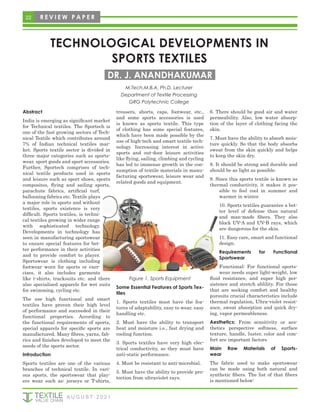
Figure 1. Sports Equipment
Some Essential Features of Sports Tex-
tiles
1. Sports textiles must have the fea-
tures of adaptability, easy to wear, easy
handling etc.
2. Must have the ability to transport
heat and moisture i.e., fast drying and
cooling function.
3. Sports textiles have very high elec-
trical conductivity, so they must have
anti-static performance.
4. Must be resistant to anti-microbial.
5. Must have the ability to provide pro-
tection from ultraviolet rays.
6. There should be good air and water
permeability. Also, low water absorp-
tion of the layer of clothing facing the
skin.
7. Must have the ability to absorb mois-
ture quickly. So that the body absorbs
sweat from the skin quickly and helps
to keep the skin dry.
8. It should be strong and durable and
should be as light as possible.
9. Since this sports textile is known as
thermal conductivity, it makes it pos-
sible to feel cool in summer and
warmer in winter.
10. Sports textiles guarantee a bet-
ter level of defense than natural
and man-made fibers. They also
block UV-A and UV-B rays, which
are dangerous for the skin.
11. Easy care, smart and functional
design.
Requirements for Functional
Sportswear
Functional: For functional sports-
wear needs super light-weight, low
fluid resistance, and super high per-
sistence and stretch ablility. For those
that are seeking comfort and healthy
pursuits crucial characteristics include
thermal regulation, Ultra-violet resist-
ance, sweat absorption and quick dry-
ing, vapor permeableness.
Aesthetics: From sensitivity or aes-
thetics perspective softness, surface
texture, handle, luster, color and com-
fort are important factors
Main Raw Materials of Sports-
wear
The fabric used to make sportswear
can be made using both natural and
synthetic fibers. The list of that fibers
is mentioned below:
DR. J. ANANDHAKUMAR
M.Tech.M.B.A. Ph.D. Lecturer
Department of Textile Processing
GRG Polytechnic College
A U G U S T 2 0 2 1
23
R E V I E W P A P E R
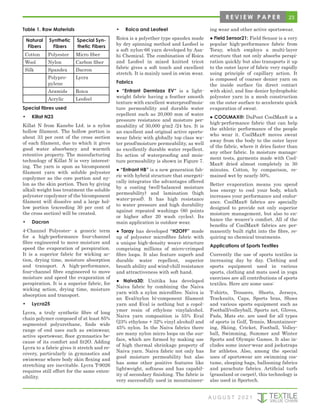
Table 1. Raw Materials
Natural
Fibers
Synthetic
Fibers
Special Syn-
thetic Fibers
Cotton Polyester Micro fiber
Wool Nylon Carbon fiber
Silk Spandex Dacron
Polypro-
pylene
Lycra
Aramids Roica
Acrylic Leofeel
Special fibres used
• Killat N23
Killat N from Kanebo Ltd. is a nylon
hollow filament. The hollow portion is
about 33 per cent of the cross section
of each filament, due to which it gives
good water absorbency and warmth
retentive property. The manufacturing
technology of Killat N is very interest-
ing. The yarn is spun as bicomponent
filament yarn with soluble polyester
copolymer as the core portion and ny-
lon as the skin portion. Then by giving
alkali weight loss treatment the soluble
polyester copolymer of the bicomponent
filament will dissolve and a large hol-
low portion (exceeding 30 per cent of
the cross section) will be created.
• Dacron
4-Channel Polyester- a generic term
for a high-performance four-channel
fibre engineered to move moisture and
speed the evaporation of perspiration.
It is a superior fabric for wicking ac-
tion, drying time, moisture absorption
and transport. A high-performance,
four-channel fibre engineered to move
moisture and speed the evaporation of
perspiration. It is a superior fabric, for
wicking action, drying time, moisture
absorption and transport.
• Lycra25
Lycra, a truly synthetic fibre of long
chain polymer composed of at least 85%
segmented polyurethane, finds wide
range of end uses such as swimwear,
active sportswear, floor gymnastics be-
cause of its comfort and fit2O. Adding
Lycra to a fabric gives it stretch and re-
covery, particularly in gymnastics and
swimwear where body skin flexing and
stretching are inevitable. Lycra T-9026
requires still effort for the same exten-
sibility.
• Roica and Leofeel
Roica is a polyether type spandex made
by dry spinning method and Leofeel is
a soft nylon-66 yarn developed by Asa-
hi Chemical. The combination of Roica
and Leofeel in mixed knitted tricot
fabric gives a soft touch and excellent
stretch. It is mainly used in swim wear.
Fabrics
● “Entrant Dermizax EV“ is a light-
weight fabric having a feather smooth
texture with excellent waterproof/mois-
ture permeability and durable water
repellent such as 20,000 mm of water
pressure resistance and moisture per-
meability of 30,000 g/m2 /24 hrs. It is
an excellent and original active sports-
wear fabric with globally top class wa-
ter proof/moisture permeability, as well
as excellently durable water repellent.
Its action of waterproofing and mois-
ture permeability is shown in Figure 7.
● “Entrant HB” is a new generation fab-
ric with hybrid structure that energeti-
cally integrates the advantages offered
by a coating (well-balanced moisture
permeability) and lamination (high
water-proof). It has high resistance
to water pressure and high durability
against repeated washings (80 points
or higher after 20 wash cycles). Its
main application is outdoor wear.
● Toray has developed “H2OFF” made
up of polyester microfibre fabric with
a unique high-density weave structure
comprising millions of micro-crimped
fibre loops. It also feature superb and
durable water repellent, superior
breath ability and wind-chill resistance
and attractiveness with soft hand.
● Naiva30: Unitika has developed
Naiva fabric by combining the Naiva
yarn with a nylon microfibre. Naiva is
an Eval/nylon bi-component filament
yarn and Eval is nothing but a copol-
ymer resin of ethylene vinylalcohol.
Naiva yarn composition is 55% Eval
(23% ethylene + 32% vinyl alcohol) and
45% nylon. In the Naiva fabrics there
are many nylon micro loops on the sur-
face, which are formed by making use
of high thermal shrinkage property of
Naiva yarn. Naiva fabric not only has
good moisture permeability but also
has some other positive features like
lightweight, softness and has capabil-
ity of secondary finishing. The fabric is
very successfully used in mountaineer-
ing wear and other active sportswear.
● Field Sensor21: Field Sensor is a very
popular high-performance fabric from
Toray, which employs a multi-layer
structure that not only absorbs perspi-
ration quickly but also transports it up
to the outer layer of fabric very rapidly
using principle of capillary action. It
is composed of coarser denier yarn on
the inside surface (in direct contact
with skin), and fine denier hydrophobic
polyester yarn in a mesh construction
on the outer surface to accelerate quick
evaporation of sweat.
● COOLMAX®: DuPont CoolMax® is a
high-performance fabric that can help
the athletic performance of the people
who wear it. CoolMax® moves sweat
away from the body to the outer layer
of the fabric, where it dries faster than
any other fabric. In moisture manage-
ment tests, garments made with Cool-
Max® dried almost completely in 30
minutes. Cotton, by comparison, re-
mained wet by nearly 50%.
Better evaporation means you spend
less energy to cool your body, which
increases your performance and endur-
ance. CoolMax® fabrics are specially
designed to provide not only superior
moisture management, but also to en-
hance the wearer’s comfort. All of the
benefits of CoolMax® fabrics are per-
manently built right into the fibre, re-
quiring no chemical treatments.
Applications of Sports Textiles
Currently the use of sports textiles is
increasing day by day. Clothing and
sports equipment used in various
sports, clothing and mats used in yoga
exercises are all contributions of sports
textiles. Here are some uses:
T-shirts, Trousers, Shorts, Jerseys,
Tracksuits, Caps, Sports bras, Shoes
and various sports equipment such as
Football/volleyball, Sports net, Gloves,
Pads, Mats etc. are used for all types
of sports in Golf, Tennis, Mountaineer-
ing, Skiing, Cricket, Football, Volley-
ball, Swimming, Summer and Winter
Sports and Olympic Games. It also in-
cludes some inner-wear and jockstraps
for athletes. Also, among the special
uses of sportswear are swimming cos-
tume, sleeping bags, ballooning fabrics
and parachute fabrics. Artificial turfs
(grassland or carpet), this technology is
also used in Sportech.
A U G U S T 2 0 2 1
24 R E V I E W P A P E R
Use of Hi-tech and Smart Technology
in Sportswear
Figure 2. Smart textiles in sportswear
The use of high-tech textile materi-
als in sports is nothing new. In recent
years, some fabrics and designs have
been observed that can quickly remove
moisture from the body, meaning it ab-
sorbs sweat faster and dries the skin.
The patches on all black jerseys help
players dry their hands faster so they
can grip better.
On the other hand, some smart tech-
nologies are being used equally, so
that the clothes can understand the
player’s heart rate, temperature and
other physiological information. Tech-
nological textiles have been able to
produce some materials harder than
wood which keep the skin dry, water-
proof like rubber and at the same time
environmentally friendly and highly
profitable. Due to the widespread use
of advanced and smart technology in
today’s sports textiles, it is becoming
possible to produce high quality and
high-performance sports garments and
the quality of sports textiles is increas-
ing day by day.
Breathable Sports Textiles
Figure 3. Breathable sportswear
Different motives in the workplace
make it mandatory for some people to
wear special protective clothing. How-
ever, those who play different sports
prefer the desired outfits that directly
affect the performance, as the comfort
and ease of the outfit is associated with
the performance. As a result, it is quite
useful to make sure that sportswear
has certain features. The most basic
property of sportswear, of course, is
shortness of breath. The word respi-
ration refers to the fact that there is
active ventilation through the fabric.
Breathable fabrics measure the mois-
ture or vapor transmission rate, that
is, whether moisture enters the fabric
quickly or slowly. Breathable sports-
wear must ensure maximum heat and
humidity control, good air and water
vapor permeability, rapid moisture ab-
sorption and easy mobility, flexibility
near the skin, quick drying, minimal
water absorption, easy care, light and
delicate feel. Special finishing processes
can be used to increase the difference in
surface strength between the front and
back of a fabric to increase the ability to
keep sweat away from the body.
Artificial Turfs
Figure 4. Artificial Turfs
Artificial turf is a covering of synthetic
fibers made to look like natural grass.
It is often used on various playgrounds,
which are played on the grass outside,
such as: football, cricket, tennis, golf,
hockey, etc. In addition to the play-
ground, it is now being used in various
residential lawns, airports and com-
mercial purposes. These artificial turfs
are used in stadiums that are covered,
partially covered, where sunlight does
not reach.
As a result, it is not necessary to take
care of the field grass or prune the
grass. However, there are some down-
sides to artificial turf, such as: low du-
rability, the need for periodic cleaning,
the use of petroleum, and toxic chemi-
cals from infill, and health and safety
concerns.
Conclusion
Through continuous research and im-
provement, a number of other features
such as respiratory water resistance,
odourless clothing etc. are being associ-
ated with sports textiles. This is lead-
ing to a few notable technological devel-
opments. The production of breathable
sportswear in various combinations
will undoubtedly increase the level of
comfort in sportswear. These qualities
are needed to keep players dry and con-
fident. Breathable fabrics combined
with features such as UV protection,
skins and compression garments are
advancing in the field of breathable
sportswear technology with the aim of
enhancing performance in sports. Also,
through the application of the smart
textiles & wearable technologies, sports
textiles are performing more functional
activities easily & smartly.
Acknowledgement
The author of this article thankful to
the Management of GRG Institutions
for their continuous support, valuable
guidance and inputs.
References
1. https://www.technicaltextile.net
2. https://www.fiber2fashion.com
3. https://www.pledgesports.org
4. Dr V K Kothari: Technical Textiles
– Growth Potential and Prospects in
India.
5.www.feelmaxsport.com/CoolMax%20
info_eng.pdf.
6. http://www.vutch.sk.
7. http://www.spiuk.com.
8. www.design-technology.org/sportss-
hoes1.htm.
9. https://www.ulster.ac.uk/scienceinso-
ciety/technologyinsport.html
10. https://www.ittaindia.org
11. https://www2.dupont.com/Sport-
ing_Goods/en_US/assets/downloads/
ap81069.pdf
12. https://www.wraindia.com/MOT-
Project
13.Source: www.global.adidas.com/
A U G U S T 2 0 2 1
25
AUTOMATION IN TEXTILE SPINNING
Faculty, SVITT, SVVV, Indore
Mr. Tanveer Malik
S P I N N I N G U P D A T E
INTRODUCTION
Every spinning mill aims to produce a
better quality of yarn with maximum
efficiency. Now microprocessor tech-
nology and solid-state circuits have
brought it on board, doing it faster than
anyone imagined. Electronics helps to
monitor machine speed, analyze down-
time problem and compute efficiency
of machines. The modern electronic
control systems offer functions for op-
timal running and supervising of all
machines thereby making step-by-step
improvements in each yarn-making
process.
1. AUTOMATION IN BLOWROOM
In modern blow room, the line whole
process is graphically indicated with
the running mode of entire installation
as well as that of individual machines.
All relevant events are registered on
the hard disc of the computer and can
be recalled, printed, or transferred to a
floppy disk at any time. In it, all ma-
chines are connected by LAN. Fiber
Control Corp. offers a package of elec-
tronics that will continuously, visually
monitor, and /or optionally record each
weigh-pan dump in a central location.
Uniflow, automatic bale opener pro-
cesses raw material with up to groups
of differing bale heights. Metal ejec-
tors electronically detect magnetic and
non-magnetic metals down 2.5 mm di-
ameter and automatically ejects them
from the material flow. Some selected
electronic controls used in blow room
are given in the next section:
1.1 Bale Height Measurement in Uni-
floc
The take-off unit of uniflow moves down
until the light’s barrier is covered. Then
a transport drive is switched on. The
differences in height are measured con-
stantly. As soon as a slight bump is de-
tected and the light barrier is also cov-
ered, the take-off unit moves upward at
low speed until the light barrier is free
again, the height is registered.
1.2 Use of Proximity Switches
In blow room, proximity switches and
limit switches are used at different
places to provide safety operations,
length measurement, collision protec-
tion, etc. Some of these functions are:
• Foreign body detection
• Length measurement
1.3 Use of Photocells
In spinning, control of linear density
is very important, to ensure smooth
working of the process. Optical sens-
ing systems find useful applications in
blow rooms. Photocells are installed at
different places to control the level of
cotton. Similarly, photocells are used in
blending chambers and filling trunks to
ensure the correct level of material.
2. Electronic application in card
Crosol Ltd. developed electronics for
chute-feed which uses electronic, logic
systems to handle the event sequence.
Zellweger Uster Ltd. markets card con-
trol which is a long-term autoleveller
system. It monitors and corrects sliver-
weight variation occurring longer than
the correction length 25-30 m.
2.1 Measurement of cylinder speed
The cylinder speed is measured by us-
ing the perforated disk mounted over
the cylinder shaft and the proximity
switch generates a pulse whenever a
hole passes in front of the proximity
switch, these pulses are counted by an
electronic counter for calculation of cyl-
inder speed.
2.2 Measurement of Delivery Speed
The delivery speed is continuously
measured using the same method as
used for cylinder speed measurement.
2.3 Regulation of Doffer Speed
The control circuit serves mainly to
automatically register the draft in the
delivery and correct the speed of the de-
livery motors using the inverter drive.
2.4 Measurement of Distance Be-
tween Flats and Cylinder
Nowadays, an electronic system is
used for the exact measurement of the
distance between flats and cylinders.
Measurement can be made with the
cylinder in rest or running condition.
For this purpose, a proximity switch is
used.
2.5 Nep Control at Card
The optical online nep control was first
introduced in the world by Trutzschler.
In this system, the guide profile un-
derneath the doffer roll is exchanged
against the nep sensor. A small video
camera passes through this profile,
which is covered with a glass plate and
takes five pictures per second on the
web. The image analyzing software
evaluates these pictures and differen-
tiates between trash and neps and ac-
cordingly, indicates size and location.
2.6 Autoleveller
It is used to measure the sliver thick-
ness variation and then act continuous-
ly to alter the draft accordingly so that
more draft is applied at thick places
and less at thin places with the result
that the sliver delivered is less irregu-
lar than it otherwise would have been.
In addition to an improvement in the
product appearance, autolevelling can
waste and constant process conditions.
The autoleveller is an online monitor-
ing device in the spinning process.
3. Electronics Application in Draw
Frame
3.1 Stop Motion in Draw Frame
To ensure the smooth working of the
draw frame, stop motion is a must.
Suppose we are feeding 8 slivers in a
draw frame, if one of the slivers gets
broken then this sliver has different
properties than the previous. If we are
using a draw frame for blending, then
their blend ratio will change. So, by use
Mr. Ajay Shankar Joshi Mr. T. K. Sinha
A U G U S T 2 0 2 1
26
of electrical and optical sensors, we can
eliminate this defect.
3.2 Draft Commander Functions
These are for example delivery speed,
production rate, sliver fineness, CV
values, single drafts, total draft, shift
data, and rotational speeds. In case of
malfunction, a detailed indication of
the trouble source appears on the dis-
play. This reduces the time for fault de-
tection and increases the availability of
the machine.
3.2 Online Collection
Online collection of all operating data
for a constant good sliver quality is done
by a microcomputer. Spectrograms,
spectrogram analysis, length variation
graphs, sliver count diagrams, produc-
tion data, shift reports, daily reports,
and lot reports, efficiency and stand-
still analysis as well as trouble reports
are readily available at any time. Every
single meter of sliver is checked auto-
matically and thus the need for lab
sampling is eliminated.
4. Electronics Application in Speed
Frame
The flyers are aerodynamically bal-
anced to a higher degree of precision
and are enclosed in design. The build-
ing motion has also been improved to
enable a better package with a mini-
mum of stretch. As a result, breakage
rates are reduced enabling a higher
speed and productivity. A fluid coupling
is introduced in the drive, which facili-
tates a soft start. The breakages at the
time of jerky start are reduced and as
the starting torque is lower, the motor
HP can be reduced enabling power sav-
ings. Electronic oft start attachments
are also offered by some parties where
the full speed is gradually reached for
20 sec. The power consumption and
maximum demand are reduced by such
attachments. Positively driven clearers
which are kept clean by an oscillating
doctor blade, overcome the problem of
stub-like defects due to the incorpora-
tion of fluff accumulated on clearer
pads into the strand. Provision of pneu-
matic and stop motions also helps to
minimize lashing in and of bobbins.
Ball-bearing footstep bearing helps to
reduce power consumption by 3%-4%.
The suspended flyer is a standard fea-
ture in the latest speed frame as tills
help to achieve higher flyer speeds and
bring down doffing time.
5. Electronics Controls in Ring Frames
Modern ring frames incorporate sev-
eral innovative electronic controls that
enable higher productivity with im-
proved quality.
5.1 Variable Speed Drives
To keep breakage under control, at
all positions of doffing. Spindle speed
should be controlled. Speeds are kept
lower at cop bottom and towards the
end of the doff and at much higher at
other positions of doffing to achieve
spindle speeds.
5.2 Servo-Motor Driven Front and
Back Rollers
Servomotor systems use an individual
motor for spindle, front roller, and back
roller which are computer controlled.
So, by just feeding the draft and TPI we
can change the yarn specifications very
easily. The advantage of using servomo-
tors is:
• Quick yarn specification change.
• Very easy to adjust yarn specifica-
tion.
• No need to change gear
• Reduction of gear noise.
5.3 Roving Stop Motion
Roving stop motion detects the end
break and stops the roving to that spin-
dle arresting the back roller movement.
Whenever yarn breaks optical sensors
detect and gives the signal for further
action.
5.4 Travelling Sensor
The sensor generates a magnetic field
that is affected by the rapidly rotating
traveler. If yarn breaks, rotation of the
traveler ceases, and the sensor detects
it and gives a pulse. The microproces-
sor already identifies the spindle from
the travel time of the sensor.
5.5 Doffing Sensor
This sensor is mounted on the spindle
rail to register the number of doffs and
the time taken for each. The indication
of end breaks using lamps, resulting
in a reduction in patrol time, and the
reports are made available at any mo-
ment and the shift end.
6. Electronics Applications in Winding
6.1 Yarn Clearer
The electronic clearer monitors yarn
quality in the yarn path at any winding
speed. Released by a yarn fault signal,
the yarn-cutting blade of the cutter ex-
ecutes cutting orders, preventing yarn
containing thick or thin places or dou-
ble ends from running onto the pack-
age.
6.2 Automatic Splicer
In modern winding machines wind-
ing head has its splicing unit which
automatically joins the two yarn ends
together after a yarn breaks or the bob-
bin changes itself. The two opened-up
yarn ends are placed, overlapped, into
an intermingling chamber. A jet of com-
pressed air, which is adjustable accord-
ing to the yarn characteristics, such as
pressure and reaction time, joins the
two ends together.
6.3 Controlling Yarn Tension and
Winding Speed
The tension sensor continuously de-
tects actual winding tension, positioned
immediately before the drum. The ten-
sion discs rotate against the direction
of the running yarn, thus preventing
the build-up of dirt particles, abrasion
or even entangling of the yarn at the
shell surface.
6.4 Auto Doffing
Auto doffer unloads the package and
places the empty cone and the reserve
of yarn at the preset length suitable for
the next process. Continuous commu-
nication between the computer and the
heads sends the trolley, in sequence,
to the next position when the preset
length is about to be reached but be-
fore it is completed. There is an empty
tube on the trolley ready for use, which
is substituted during the doffing cycle
time.
Conclusion
Electronics has made almost all the ar-
eas of the textile industry more reliable
to improve the quantity and quality of
the material.
References:
• Advanced Spinning Systems, NCUTE
Programme, IIT Delhi
• Electronic controls in textile ma-
chines, NCUTE Programme, IIT Delhi
• www.rieter.com
A U G U S T 2 0 2 1
S P I N N I N G U P D A T E
27
C A R B O N F O O T P R I N T
CARBON FOOTPRINT IN TEXTILE INDUSTRY
Mr. Krishna Kant Arya
Abstract
Global warming represents a major
subject on all society levels including
governments, economic actors, and
citizens. The textile industry is often
considered a polluting activity. In this
project, French textile manufacturers
sought to quantify the carbon footprint
(CF) of sold clothes and household
linen using the Life Cycle Assessment
in France to reduce it to meet the con-
straints of the Paris Agreement by
2050. First, manufacturers calculated
the carbon footprint of 17 clothes and
household linen products and estab-
lished alternative scenarios for four
production routes. Secondly, they mod-
eled the supply of the upstream sector
through different countries. Based on
imports of textile products, their calcu-
lated CF for one French person reaches
442 kg of CO2eq/year. Means of action
to reduce this carbon footprint by a fac-
tor of 6 (74 kg of CO2eq/person/year
for textiles) are calculated and are the
following: installing the most energy-
intensive production processes in a
country with a low carbon electricity
mix, avoiding unsold goods, implement-
ing eco-design approaches, and enhanc-
ing the value of end-of-life products
with reuse or recycling. Therefore, CF
for textiles per capita is reduced to 43
kg CO2eq/year which goes beyond the
objectives of the Paris Agreement and
facilitates carbon neutrality in the tex-
tile sector. The priority for reducing the
French carbon footprint of clothes and
household linen would be to locate tex-
tile production in countries with (i) low
carbon electricity, (ii) to reduce unsold
items, and (iii) to elaborate eco-design
of a product including the circular econ-
omy.
Keywords: textiles; clothes; apparel;
household linen; carbon footprint; cir-
cular economy; recycling; life cycle as-
sessment; LCA; Product Environmen-
tal.
1. Introduction
The awareness of global warming is om-
nipresent in political strategies, and it
is increasing more and more in consum-
er choices. Despite this fact, consump-
tion of mass-market products is grow-
ing, and global Greenhouse Gas (GHG)
emissions continue to grow. There is an
increase of 1.7% in 2017, 2.1% in 2018,
and a little decrease to 0.6% in 2019 (1).
These variations led to annual emis-
sions of more than 53 billion tons of
CO2 equivalent in 2019 (2). On a world-
wide scale, this growth seems to be un-
appeasable, even if European countries
tend towards controlling and reducing
carbon emissions. Regarding emissions
mitigation, Germany is the leading
country reaching 8% in 2019; whereas
France has difficulty in following their
example (−1% only) (3). The outcomes
are potentially serious, particularly if
the predictions believe that the warm-
ing level will reach 2◦C in 2050 and ex-
ceed 4◦C in 2100. Furthermore, beyond
the consideration of the water-level rise
that is projected to reach more than
0.7 m (1), the drastic foreseeable con-
sequences are already there, such as
an increase in climatic hazards, forest
fires, etc. (4-6). With the Paris Agree-
ment in 2015, limiting global warming
on a worldwide scale was planned to be
a maximum of 2◦C by 2100 (6). For this
objective to be reached, the GHG emis-
sions must be reduced on average by
a factor of 6 for the next 30 years. The
first strategy would require targeting
the main GHG source sectors and dras-
tically reducing them. Nevertheless,
the analysis of emissions indicates that
75% of a citizen’s emissions in unde-
veloped countries are covered by three
sectors: mobility, heating, and food (7).
In that context, dividing the emissions
by 6 seems difficult as a solution since
nobody wants to stop these three main
causes of emission. In addition, these
large emission sectors can be subdivid-
ed into small sources of GHG emissions
contributing to global warming. This
observation leads to the main proposed
solution by maintaining the same
standard of living while reducing GHG
emissions by a factor of 6. The world-
wide textile sector is accused of being
“the second most polluting industrial
sector after hydrocarbons” according to
the French President (8). However, it is
known that one consumer buys on av-
erage a few kilograms of textiles each
year. This general accusation is raising
many questions from the manufactur-
ers of textiles in France, among them,
their impact on the environment. To ad-
dress this issue, they decided to quanti-
fy the carbon impacts of the household
linen and clothes industry (excluding
footwear) using the Life Cycle Assess-
ment method (ISO 14040-44). (9,10)
This method, now highly regulated
by ADEME (French EPA) and Euro-
pean Union within the framework of
the Product Environmental Footprint
(PEF), quantifies the environmental
impact of products from the extraction
of resources till their end-of-life (11,12).
For such a calculation, the challenge
is to define the function that must be
satisfied, the scope of the study, and
the impact categories covered. For
that purpose, this work studied the
CF (carbon footprint) for one kilogram
of the textile purchases (mix of house-
hold linen and clothes) during the year
2019 (13). The textile sector is at the
same time a first-rate economic sector,
but also an industrial and retail sector
with astonishing complexity. This is
due mainly to the globalization of the
textile production sector, the successive
offshoring of production means, and
the consequences coming out of modern
fashion temporarily (14). Thus, an im-
portant part of the study is describing
the calculation methodology of the CF
and its implementation in the textile
sector to identify and quantify improve-
ment solutions.
1.1 Definition of carbon footprint
The term the carbon footprint was first
used in the concept of ecological foot-
A U G U S T 2 0 2 1
28
print proposed By Williams Reese and
other scholars. An ecological footprint is
a biologically productive regional space
that can continuously provide resourc-
es or absorb
waste areas,
which means
To maintain
the survival of
a person, re-
gion, country,
or the world,
or to accommo-
date the Waste
discharged by
human beings,
with biological
productivity of
the area (23).
1.2 The Carbon Footprint is assessed
in 2 layers
1. Primary footprint – monitors car-
bon emission directly through energy
consumption – burning Fossil fuels for
electricity, heating, and transportation,
etc.
2. footprint- relates to indirect carbon
emissions (Life cycle of products and
Sustainability).
Thus, the most effective way to de-
crease a carbon footprint is to either de-
crease the amount of energy needed for
production or to decrease the depend-
ence on carbon-emitting fuels.
The textile industry is one of the ma-
jor consumers of water and fuel (energy
required for electric power, steam, and
transportation). The per capita con-
sumption of textiles is about 20 kg/
year and Increasing day by day. The
world population has reached 7 bn out
of which almost 18 % is from India.
Thus, the energy requirement and con-
sequently the Carbon footprint of the
Textile industry In India is consider-
ably high and at the same time, the
Textile Industry in India is
Expected to grow from an estimated
size of US$ 70 bn today to US$ 220 bn
by 2020 which would Proportionately
increase the impact on our Carbon
Footprint. Thus, we must take immedi-
ate steps and develop innovative tech-
nologies and sustainable solutions that
can help reduce the environmental im-
pact. The Government is also Demand-
ing industries to comply with stricter
conditions for environmental protec-
tion (15).
Use the estimated Global consumption
and processing of textile substrates is
shown above. In India Also, Polyester
and Cotton constitute more than 80
% of textile processing. The textile in-
dustry, according to the U.S. Energy
Information Administration, is the 5th
largest Contributor to CO2 emissions.
Thus, the textile industry is huge and
is one of the largest sources of green-
house gasses on Earth. In 2008, annual
global textile production was estimated
at 60 bn Kg of fabric. The estimated en-
ergy and water needed to produce such
quantity of fabric is:
• 1,074 bn kWh of electricity or 132 mn
MT of coal and
• About 6-9 tn liters of water
Thus, the thermal energy required per
meter of cloth is 4,500-5,500 Kcal and
the electrical energy required per me-
ter of cloth is 0.45-0.55 kwh The carbon
footprint of the textiles is estimated
based on the “embodied energy’ in the
fabric, comprising all the energy used
at each step of the process needed to
create that fabric. To estimate the em-
bodied energy in any fabric it’s neces-
sary to add all the process steps from
fiber To finished goods. Based on the
fiber used the carbon footprint of vari-
ous fibers varies a lot (16)(17).
Further, based on the study done by the
Stockholm Environment Institute on
behalf of the Bioregional Development
Group, the energy used (and therefore
the CO2 emitted) to create 1 ton of
Spun fiber is much higher for synthet-
ics than for cotton:
Fiber Kg CO2/Ton
of fiber
Polyester 9.52
Cotton-conventional 5.89
Cotton 3.75
For natural fibers, the energy con-
sumption starts at planting and field
operations – mechanized Irrigation,
weed control, pest control and fertiliz-
ers (manure vs. synthetic chemicals),
harvesting, And yields. Synthetic fer-
tilizer use is a major component of
conventional agriculture: making One
ton of nitrogen fertilizer emits nearly
7 tons of CO2 equivalent greenhouse
gases. In the case of Synthetics, the fib-
ers are made from fossil fuels, where a
very high amount of energy is
consumed in extracting the oil from the
ground as well as in the production of
the polymers. (17)(18).
The Embodied Energy used in the pro-
duction of various fibers:
Fiber Energy in MJ/
Kg of fiber
Cotton 55
Wool 63
Viscose 100
Polypropylene 115
Polyester 125
Acrylic 175
Nylon 200
Natural fibers, in addition to having a
smaller carbon footprint, have many
additional benefits: Being able to be
degraded by micro-organisms and com-
posted (improving soil structure); in
this way, the fixed CO2 in the fiber will
be released and the cycle closed. On the
other hand, Synthetic fibers do not de-
compose in landfills, they release heavy
metals and other additives into soil and
groundwater. Recycling requires costly
separation, while incineration produces
Pollutants – in the case of high-density
polyethylene, 3 tons of CO2 emissions
are produced for every 1 ton of mate-
rial burnt. Substituting organic fibers
for conventionally grown fibers consid-
erably helps reduce carbon Footprint
based on (18).
• Elimination of synthetic fertilizers,
pesticides, and genetically modified or-
A U G U S T 2 0 2 1
C A R B O N F O O T P R I N T
29
ganisms (GMOs) which is an improve-
ment in human health and agro-biodi-
versity
• Conserves water – making the soil
more friable so rainwater is absorbed
better – lessening Irrigation require-
ments and erosion
An additional dimension to consider
during processing: environmental pol-
lution. Conventional Textile processing
is highly polluting:
• Up to 2000 chemicals are used in tex-
tile processing, many of them known
to be harmful To human (and animal)
health. Some of these chemicals evapo-
rate while some are Dissolved in treat-
ment water which is discharged to our
environment.
• The application of these chemicals
uses copious amounts of water. The
textile industry is the largest industri-
al polluter of fresh water on the planet.
(19)
2. Evaluation method of carbon foot-
print for the textile industry
Through consulting the literature on
the evaluation of carbon footprint in
the textile industry, it is concluded that
the evaluation methods of carbon foot-
print and carbon Footprint in the tex-
tile industry mainly include ecological
cycle evaluation method, input–Output
analysis method, and mixed life cycle
evaluation method.
First, the input-output model is an eco-
nomic quantitative method to study the
Interdependence between various parts
of the economic system, which runs in
the whole Industry cycle. Christopher
analyzed the impact of international
trade on the carbon Footprint of Ameri-
can households by using the method of
inter-regional input-output Analysis
model and life cycle assessment (LCA)
through the investigation of consump-
tion and expenditure (21)(22) then fur-
ther Expanded the research to the mul-
ti-region input-output model to make a
comparative analysis of different time
scales and different families (22).
The whole life cycle of the textile indus-
try is very long. Based on the activities
of the Textile industry, it is defined as
three stages: the first stage is the ag-
ricultural stage, i.e., the Cultivation
of textile raw materials; the second
stage is the industrial stage, i.e., the
production And processing of textiles;
and the third stage is the sales stage,
i.e. the transportation and Distribution
of textiles. The input-output method is
used to analyze the carbon emissions
generated by the economic activities of
the textile industry in different stages,
which are not only targeted but also
can avoid the truncation error. At the
same time, the input-output
An analysis table is established, which
can be used to calculate the carbon foot-
print of the textile industry easily and
quickly.
Then, LCA is a typical system analy-
sis method, which is opposite to input-
output Analysis and a bottom-up car-
bon footprint calculation method. The
evaluation steps of the LCA Method
for carbon footprint include the follow-
ing steps: the establishment of product
manufacturing flow chart, determina-
tion of system boundary, collection of
data, calculation of carbon footprint,
and test of results. To standardize and
promote the application of carbon Foot-
print accounting in enterprises, the
International Organization for Stand-
ardization, the British Standards In-
stitute, and the World Resources Insti-
tute have developed or are developing
standards for carbon footprint account-
ing of organizations and products (24).
Finally, hybrid economic input-output
LCA is gradually developed based on
LCA. This method was proposed by
Bullard after the first oil crisis in the
1970s and was mainly used for energy
input-output analysis (20). The Stock-
holm Environmental Research Insti-
tute calculated the carbon footprint of
British schools by combining process
Analysis and input-output analysis.
Based on the input-output analysis,
supplemented by Process analysis
based on the detailed data. This hybrid
method can integrate the Advantages
of process analysis and input-output
analysis. It not only has the systematic
Advantages of a top-down method but
also has the flexibility of the bottom-up
method. It also can get more objective
and systematic evaluation results.
Based on reading of domestic and for-
eign research on the carbon footprint of
the Textile industry, summarizing the
previous research results, it is found
that most of the Research on the car-
bon footprint of the textile industry is
focused on the research of textile Pro-
cessing, and there is little research on
textile industry to analyze its carbon
footprint in the whole life cycle. LCA
theory is the current research hotspot,
and the relevant Organizations in the
world generally formulate carbon emis-
sion calculation standards based On
LCA theory. Through the analysis and
comparison of the above three-carbon
emission Calculation methods, com-
bined with the research object of the
textile industry, it is suggested to Se-
lect the LCA method to calculate the
carbon emission of products (20)(22).
3. Review of Literature
3.1 Settlement
The definition of Settlement according
to UU No.1 /2011 is part of a residential
environment consisting of More than
one housing unit that has infrastruc-
ture, facilities, public utilities, and has
support for other functional activities
in urban areas or rural areas. Housing
is a collection of houses as part of settle-
ments, both urban and rural, which are
equipped with infrastructure, facilities,
and public utilities because of efforts to
fulfill livable houses. (25) Housing as
part of settlements must be produced
efficiently and sustainably to meet ba-
sic human needs for decent housing, a
healthy, safe, harmonious, and orderly
environment and to give direction to
the growth of a region and to support
development in the economic, social,
and cultural fields. other fields in the
context of improving and equitable dis-
tribution of welfare for all community
groups in accordance with the policies
of a balanced residential environment
(26).
3.2 Carbon Footprint
Relationship between the secondary
carbon footprint and the primary car-
bon produced. The carbon footprint
unit Is tons of CO2 equivalent (tCO2e)
or kg-equivalent-CO2 (kgCO2e) (28).
Calculation of carbon footprint can be
calculated by looking at the use of fos-
sil fuels used. Fossil fuel Is in the form
of petroleum or natural gas which can
A U G U S T 2 0 2 1
C A R B O N F O O T P R I N T
30
Directly produce carbon dioxide (CO2)
(27). In addition, the Carbon footprint
can also be calculated by looking at the
Use of electricity in everyday life. CO2
emissions Generated from electric-
ity usage activities come from Power
plants as suppliers of electricity used
(25). Carbon dioxide emissions are cal-
culated by multiplying the amount of
fuel consumption by emission Factors
from the type of fuel consumed. This
calculation method is a method of cal-
culating CO2 emissions based on fuel
used based which has a level of reli-
ability, so it is strongly recommended
to calculate CO2 emissions from fuel
consumption (29).
4. Conclusion
Based on literature review and expert
opinion, it is necessary to conduct re-
search related to carbon footprint from
settlement activities by adding the cal-
culation of Carbon dioxide emissions
generated from waste Generation and
consumption of clean water in House-
holds. The estimated carbon footprint
of this Carbon footprint activity is then
mapped using a Geographic Informa-
tion System to describe the Distribu-
tion of the carbon footprint of an area.
The results of this research will be ex-
pected to be used in Making appropri-
ate mitigation decisions or policies to
reduce carbon emissions. (30)(32)
References
1. Commissariat General au Development Du-
rable. Chiffres clés du Clima; Commissariat
Général au Dévelopement Durable:
Paris,France, 2020; p. 80. Available online:
https://www.statistiques.developpement-dura-
ble.gouv.fr/sites/default/files/2018-12/Datalab-
46-chiffres-cles-du-climat-edition-2019-no-
vembre2018_1.pdf (accessed on 18 November
2020).
2. Dugast, C.; Soyeux, A. Pouvoir Et Respon-
sabilité Des Individus, Des Entreprises Et De
L’état Face À L’urgence Climatique;
Carbone4:Paris, France; p. 21.
3. Amt, A. Nette Diminution des Émissions de
Gaz à Effet de Serre. 2020. Available online:
https://allemagneenfrance.diplo.de/frfr/actual-
ites-nouvelles-d-allemagne/05- Developpe-
mentdurable/-/2376492 (accessed on 18 No-
vember 2020).
4. Friedlingstein, P.; Jones, M.W.; O’Sullivan,
M.; Andrew, R.M.; Hauck, J.; Peters, G.P.; Pe-
ters, W.; Pongratz, J.; Sitch, S.;Le Quéré, C.;
et al. Global Carbon Budget 2019. Earth Syst.
Sci. Data 2019, 11, 1783–1838. [CrossRef]
5. Peters, G.P.; Andrew, R.M.; Canadell, J.G.;
Friedlingstein, P.; Jackson, R.B.; Korsbakken,
J.I.; Le Quéré, C.; Peregon, A. Carbon Diox-
ide emissions continue to grow amidst slowly
emerging climate policies. Nat. Clim. Change
2020, 10, 3–6. [CrossRef]
6. Jackson, R.B.; Friedlingstein, P.; Andrew,
R.M.; Canadell, J.G.; Le Quéré, C.; Peters, G.P.
Persistent fossil fuel growth threatens the Par-
is Agreement and planetary health. Environ.
Res. Lett. 2019, 14, 121001. [CrossRef]
7. Froemelt, A.; Dürrenmatt, D.J.; Hellweg, S.
Using Data Mining To Assess Environmental
Impacts of Household Consumption Behaviors.
Environ. Sci. Technol. 2018, 52, 8467–8478.
[CrossRef] [PubMed]
8. Les Echos. G7-L’industrie Textile, très Pol-
luante, S’engage Pour L’environnement. Inve-
stir. Available online: https://investir.Lesechos.
fr/actions/actualites/g7-l-industrie-textile-
tres-polluante-s-engage-pour-l-environne-
ment-1868705.php (accessed on 18 November
2020).
9. ISO 14040. Environmental Management—
Life Cycle Assessment—Principles and Frame-
work, 2nd ed.; International Standard Organi-
zation: Geneva, Switzerland, 2006.
10. ISO 14044. Environmental Management—
Life Cycle Assessment—Requirements and
Guidelines, 1st ed.; International Standard
Organization: Geneva, Switzerland, 2006.
11. ADEME. Déchets Chiffres clés, l’essentiel
année 2019. Available online:
https://www.ademe.fr/sites/default/files/as-
sets/Documents/dechets_chiffrecles_lessen
tiel_2019_010695.pdf (accessed on 18 Novem-
ber 2020).
12. European Commission. PEFCR Guidance
Document—Guidance for the 14 Development
of Product Environmental Footprint Category
Rules (PEFCRs), version 6.3; European Com-
mission: Brussels, Belgium, 2017.
13. Muthu, S.S. Assessing the Environmen-
tal Impact of Textiles and the Clothing Sup-
ply Chain, 2nd ed.; Elsevier: Amsterdam, The
Netherlands; Available online:
https://www.elsevier.com/books/assess-
ing-the-environmental-impact-of-tex-
t i l e s - a n d - t h e - c l o t h i n g s u p p l y - c h a i n /
muthu/978-0-12-819783-7 (accessed on 18 No-
vember 2020).
14. Ammar, G.; Roux, N. Délocalisation et Nou-
veau Modèle Économique: Le Cas du Secteur
Textile-Habillement—IRES. Available On-
line: http://www.ires.fr/publications-de-l-ires/
item/2557-delocalisation-et-nouveau-modele-
economique-le-cas-du-secteurtextile-habille-
ment (accessed on 18 November 2020).
15. June, 2009 C.K. Chow Textile Asia
16.www.eia.doe.gov/emeu/aer/txt/ptb1204.
html
17. www.naturalfibres2009.org/en/iynf/sus-
tainable.html
18. Rupp, Jurg, “Ecology and Economy in Tex-
tile Finishing”, Textile World, Nov/Dec 2008
1 9 . w w w . d o m a i n - b . c o m / e n v i r o n -
ment/20090403_carbon_footprint.html
20. 20.Bullard, C.W., Penner, P.S. and Pilati,
D.A. (1976), “Net energy analysis: handbook
for combining Process and input-output analy-
sis”, Resources and Energy, Vol. 1 No. 3, pp.
267-313.
21. Christopher, L. and Weber, H.S. (2008),
“Quantifying the global and distributional as-
pects of American Household carbon fooprint”,
Ecological Economics, Vol. 66 Nos 2/3pp. 379-
22.Ding, Z.L., Duan, X.N., Ge, Q.S., et al.
(2009), “Evaluation of international green-
house ga
22. 23.Druckman, A. and Jackson, T. (2009),
“The carbon footprint of UK households
19902004: a socioeconomically disaggregated,
quasi-multi-regional input-output model”, Eco-
logical Economics,Vol. 68 No. 7, pp. 2066-2077
23. Finkbeiner, M. (2009), “Carbon footprint-
ing – opportunities and threats”, The Interna-
tional Journal of Life Cycle Assessment, Vol.
14 No. 2, pp. 91-94
24. Ren, L.J. (2011), Research on Life Cycle As-
sessment Method and Life Cycle Assessment of
Typical Paper Products, Beijing University of
technology.
25. Y. Geng, C. Peng, M. Tian, Energy Proce-
dia, 5,370–376 (2011)
26. M. Salo, M. K. Mattinen-yuryev, A. Nissin-
en, J. Clean. Prod., 207, 658–666, (2019).
27. Z. Donglan, Z. Dequn, Z. Peng, Energy Pol-
icy,38, 7, 3377–3383, (2010).
28. L. Han, X. Xu, L. Han, J. Clean. Prod.,
103,219–230 (2015).
29. L. Yuliana, J. Hermana, R. Boedisantoso,
J.Purifikasi 16, 1, 1–10 (2016)
30. Z. Liu, Y. Geng, B. Xue, Energy Procedia, 5,
2303–2307 (2011).
31. G. Q. Dinora, Institut Teknologi Sepuluh.
Nopember (2011)
A U G U S T 2 0 2 1
C A R B O N F O O T P R I N T
31
R E C Y C L I N G
RECYCLING OF OLD CLOTHES
FOR GODHADI MAKING-
TRADITIONAL ART OF MAHARASHTRA
Department of Textiles and Apparel Designing
College of Community Science
Vasantrao Marathwada Krishi Vidyapeeth
PROF. MEDHA UMRIKAR DR. IRFANA SIDDIQUI
ABSTRACT
Clothing and Textiles are 100% recy-
clable. Recycling is the process of re-
covering fiber, yarn or fabric as well
as garment and reprocessing the tex-
tile material into useful products. The
average lifetime of a garment is esti-
mated to be for a period of three years.
All clothing has a useful second life.
Within this period in previous days
these were transferred to younger sib-
lings. Now days this is not practiced
much as the no. of children is one or
two. Hence after the life time period,
they are thrown away as old clothes.
Even useful garments are discarded as
they are no longer fashionable, or de-
sirable. Clothes and textiles that are in
good condition can be donated and sold
for re-use. Items that aren’t suitable to
be passed onto someone else can be re-
cycled and made into new items such
as padding of chairs, car seats, pillow
making etc.cotton scrapes are mostly
used in house hold work-for cleaning-
mopping cloth, door mats ,zula (cradle)
making, spreads for drying of grains,
kitchen napkins and so on. Discarded
clothes which are less faded can be uti-
lized for patchwork and appliqué work..
A patchwork quilt is a quilt in which
the top layer may consist of pieces of
fabric sewn together to form a design.
Originally this was to make full use of
left over scrapes of fabric but now fabric
is often bought specially for specific de-
sign. Very eye catching designs can be
created through patch work.
In Maharashtra godhadi making is
famous traditional art. It is a famous
hand-stitched blanket..Godhadi is es-
sentially the art of discarded textile
material. It has always been a do-
mestic craft where women at home,
mostly in the afternoon come together
and sew quilt out of waste fabric. They
make patches from cloth and these are
quilted together first as a single layer
and later the layers get added. Gener-
ally the women from rural part come
to town; they go to colonial areas to get
the work of godhadi making.
This article will focus on history, places
where this work is going on, method of
approaching customers, back ground of
families, construction method of god-
hadi, material used and today’s status
of this work. Various organizations in-
volved in this work will be discussed.
Similarly newly developed patchwork
designs will be presented.
Key words- recycling of clothes, god-
hadi, patch work
INTRODUCTION
Clothing recycling is part of textile re-
cycling. It involves recovering old cloth-
ing for sorting and processing. End
products include clothing suitable for
reuse, cloth scraps or rags as well as
fibrous material. Clothing and Textiles
are 100% recyclable. Recycling is the
process of recovering fiber, yarn or fab-
ric as well as garment and reprocessing
the textile material into useful prod-
ucts. The average lifetime of a garment
is estimated to be for a period of three
years. All clothing has a useful second
life. Within this period in previous days
these were transferred to younger sib-
lings. Now a days this is not practiced
much as the no. of children is one or
two. Hence after the life time period,
they are thrown away as old clothes.
Even useful garments are discarded
as they are no longer fashionable, or
desirable. Clothes and textiles that
are in good condition can be donated
and sold for re-use. India is a country
with people of different cultural back
ground and community. Recycling of
textiles was a domestic craft in India.
But currently there are textile clusters
and small scale industries to work on
second hand clothing. Items that aren’t
suitable to be passed onto someone
else can be recycled and made into new
items such as padding of chairs, car
seats, pillow making etc.cotton scrapes
are mostly used in house hold work-
for cleaning-mopping cloth, door mats
,zula (cradle) making, spreads for dry-
A U G U S T 2 0 2 1
32
ing of grains, kitchen napkins and so
on. Patches can be both functional and
stylish. Use your old clothes to create
patches for patchwork, quilting. You
can use colorful differently shaped
patches in a complementary pattern.
If you have many smaller pieces, you
can try making a full patchwork gar-
ment. In Maharashtra godhadi mak-
ing is famous traditional art. It is a
famous hand-stitched blanket..God-
hadi is essentially the art of discarded
textile material. It has always been a
domestic craft where women at home,
mostly in the afternoon come together
and sew quilt out of waste fabric. They
make patches from cloth and these are
quilted together first as a single layer
and later the layers get added. Gener-
ally the women from rural part come
to town, they go to colonial areas to get
the work of godhadi making.
BACK GROUND
One Sunday around at 12.00 noon, I
heard a sound ‘Godhadi Ghyaychi ka
shivun?’ meaning ‘ do you want to get
godhadi stitched ?. I called them they
were two ladies. I just enquired about
them. Both came from nearby place 20
k.m. from my place.They came by auto.I
asked what clothes or garment they
will need for making a godhadi. They
both just came inside of my main gate
and told me to show old clothes stock.
I brought two bundles wrapped in two
saris, there were duputtas, salwar, ‘t’
shirts, pillow covers, towels, napkins
etc. I asked them to make small god-
hadies for infant. The ladies were hap-
py.The size ,rate was decided-Rs.80/
piece for small size and Rs. 100/- for
biger size They took out small tool kit
from their bag. There was a big size(6
no.) stitching needle, thick thread, and
razor. Firstly they asked me the size of
small godhadi and selected sari, cut it
in to two pieces. Then selected clothes
for layering. They were taking due
care to avoid any sequin, Zari, work or
rough surface as the godhadi was be-
ing stitched for infant. The cut scrapes
were kept aside.
METHOD
Steps in godhadi making for infants.
I.Planning: Firstly the total stock of
old garments or clothing was examined
for different types of clothes such as
saries, bed sheets, salwar, kurties, ‘t’
shirts, towels, pillow covers, sari pet-
ticoats, sari blouses etc. long clothes
such as saries, dupattas .The size of
the godhadi and number of godhadies
to make was decideded.
II. Sorting: soft cotton dupattas,
smooth bed sheet, cotton sari,long
towels were selected for outer cover
making and, printed or plain soft
hosiery ‘t’ shirts, napkins,pillow
covers,salwar,kurties were used for in-
ner layers.
III. Cutting: For spreading of layers
square pieces were found more suit-
able. Soft ‘t’ shirts, salwar, kurties,
shirts were better used by separating
or cutting necklines, sleeves, lower hem
line and back and front parts were sep-
arated. Due care was taken by avoid-
ing rough surfaces,laces,sequins etc.as
it was for infant.This was kept aside
for using as stuff in small pillows and
cushions.
Preparation
1. ‘T’ shirt- firstly neckline was cut
,sleeves were cut and separated shoul-
der seam thicker edge was cut, side
seam was cut, lower hem line was cut
two square or rectangle plain pieces
were available. Cut scrapes were col-
lected & kept aside to use as stuff in
pillows and cushions.
2. Salwar -Firstly upper belt hemline
was cut, lower 7-9 inches strip was cut,
inner seam of salwar was cut, lower stiff
buckram strip was cut to get two long
rectangular pieces.These were wider at
the top and tapering at lower part from
Total 4 pieces of 2 different sizes can be
obtained or two pieces wider at lot and
narrow at bottom can also be used in
layering of pieces.
3. Sari petticoats -In sari petticoat
4-6 panels are stitched upper belt them
line is cut. Belt is kept a side lower frill
or strip is cut and separated. Panels
are separated. Seams are cut properly
to avoid any thicker edge. Long pan-
els are taken out. These are wider at
one end and tapering at another end.
Same sized squares can be cut or wide
and narrow panels as it is can be used
for layering. These panels can also be
used for outer covering of baby pillows
or round cushions (baby supporters)
4. Kurties Short or long kurties are
best for obtaining continues long or
square layers. Sorting is necessary.
Now days fancy kurties a with lot of
embellishment is a fashion trend. How-
ever these all need to be avoided. e.g.
sequins, zari work, embroidery work,
pin tucks, corded tucks, cross tucks etc
These parts are separated only plain
part is selected. Neckline, sleeves ,low-
er hemline scrapes are kept aside for
using as stuff.
IV. Stitching – Very soft and big size
layer is selected for outer cover. This is
spreaded, small pieces squares, rec-
tangles, tapering squares are spreaded
on base layer. These are joined with
running stitch or basting stitch in ver-
tical and horizontal direction. Then up-
per layer is spreaded and again bonded
with long straight basting stitches
using big needle and thicker thread.
Edges are folded and stitched with
fine hemming or blanket stitch. Row
of the stitches depends on the size of
the godhadi.If the size of the godhadi
is bigger, then stitches are taken at a
distance of 2”-2.5”.For small size,these
are taken at 1” distance. Needles size
should be suitable for thread thickness
so that threading of needle and stitch-
ing through three layers of the fabric
becomes easy.
A U G U S T 2 0 2 1
R E C Y C L I N G
33
V. Designing – floral printed, bright
colored checks designed, geometric
designed cloths or sari cloth, and bed
sheets were used for outer covering.
Generally white thread is used for
all stitching. On colorful background
this white thread stitches look attrac-
tive. The patches were placed on back
ground surface,stiching was continued
with very even medium length stitches.
Organizations involved in recycling of
textiles- Kishco Group, Mumbai, India
deals with import and export business
related to recycled clothing. Mothers
quilt one of the NGOs in Pune. One
such trained quilt maker is Archana
Jagtap, who runs ‘Quilt Culture’ where
she customizes quilts according to the
demands of the buyer. “New design,
colour, size and fabric preferences are
traditionally made and crafted using
saris like Irkal, Jijamata and Narayan-
pethi to lay emphasis on Maharashtri-
an quilt aesthetics,” she said. The fill-
ers that she uses are made of Nagpur
cotton and only finishing touches are
given using a sewing machine.
Conclusion- Textiles and clothes in
India are recycled both for the domes-
tic and the global market. Tradition-
al method of making godhadies from
discarded clothes is still exists even
Though many organizations and com-
panies have started large scale, export
quality recycled articles. House hold
level small work should be encouraged.
Two women constructed 15 baby size
godhadies in 4 hours. This was complete
hand work. They earned Rs.1500/- In
Maharashtra today there are so many
NGOS working in this area. Their god-
hadies are exported to other countries.
Machine stitched godhadies,quilts,
patch work handicrafts are very popu-
lar .However hand stitched godhad-
ies are more elegant, it has emotional
bonding –called Ajji’s (grand ma’s) God-
hadi .In rural area still today the wom-
en are making godhadies for house hold
purpose as well as small scale entre-
prizes.Which inculcates our traditional
culture and heritage .Hence such small
scale ,household entrepreneurs should
be strengthened to make our country
“Atmnirbhar India”
References
• Bairagi N.(2014) “ Recycling of Tex-
tiles inIndia (2014) Journal of Textile
Sci.Engpp.
• Textile Clothing and Life style Prod-
ucts pp 62 65
• www.hindustantimes.com
Glimpses of godhadi making
Small godhadies prepared by godhadi makers
A U G U S T 2 0 2 1
R E C Y C L I N G
34
CLOUD COMPUTING: NEW TECHNOLOGY IN
TEXTILE AND APPAREL INDUSTRY
Textile Value Chain
MS. SOMASREE ROY
C L O U D C O M P U T I N G
Since operating efficiencies are already
high, participants of the garment and
manufacturing supply chains must
search for ways to boost margins oth-
er than lowering labor expenses. One
of the most important aspects in col-
laboration with supply chain partners.
Through greater capacity utilization,
lower reject rates, fewer charge-backs,
and profitability, collaboration offers
a way to cut costs in the supply chain
in areas including product develop-
ment, inventory management, and
production. The collaboration enabled
by information technology should be
the primary focus for overcoming the
hurdles. Collaboration among partners
is becoming extremely crucial to make
the supply chain more efficient.
Cloud computing is a model for sup-
plying on-demand, self-service comput-
ing resources with ubiquitous network
connectivity, location-independent re-
source pooling, and quick flexibility
that is enabled by information technol-
ogy. Cloud computing is the next great
trend that appears vague at first, but
when measured in terms of the ser-
vices it provides, it’s the most trendy
and prominent computer system avail-
able over the internet. In the textile
and garment industries, this comput-
ing system provides a variety of impor-
tant services. There are certain unique
management systems designed to make
various company activities in the gar-
ment and textile and apparel industry
easier.
What is Cloud Computing?
Cloud computing is a type of Internet-
based computing in which shared re-
sources, software, and information are
sent to computers and other devices
on-demand, similar to electricity. Cloud
computing is the method of storing,
managing, and processing data via
an Internet-based network of remote
servers rather than a local server or a
personal computer. People in favor of
Cloud Computing believe that it helps
businesses to reduce or eliminate up-
front infrastructure costs.
Clothing, footwear, and accessory in-
dustries can profit from this technology
in various ways. It allows you to set up
a virtual office, providing access to your
company from any location at any time.
Access to your data has never been eas-
ier, thanks to the expanding number of
web-enabled devices utilized in today’s
work environment (e.g., smartphones
and tablets).
Adaptation of Cloud Computing in
Textile/Apparel/Fashion Industry
The textiles and garment industries can
be considered as a supply chain made
up of various distinct activities. The
supply chain is rapidly being organized
as an integrated production network,
with each operation being positioned
where it can add the most to the value
of the end product, from sourcing raw
materials to design and manufacture to
distribution and marketing. Expenses,
quality, delivery reliability, access to
quality inputs, and transportation and
transaction costs are all key factors to
consider when deciding where each ac-
tivity should be located.
Supply Chain Management
Supply chain management is a collabo-
rative process and project management
approach to efficiently and effectively
meet the needs of the end customer.
Collaboration is one of the most impor-
tant aspects of successful supply chain
management. It’s worth mentioning
that there are three types of flows that
happen in supply chains:
• Product returns, servicing, and re-
cycling are all examples of material
flows, which represent product flows
from suppliers. Order transmission and
Source: Tukatech.com
A U G U S T 2 0 2 1
35
tracing are represented by information
flows, which coordinate the physical
flows.
• Credit terms, payment schedules,
consignment, title ownership agree-
ments, and everything else related to
finance are all represented by financial
flows.
Three essential pillars support these
flows: processes, which combine the
firm’s logistics, new product develop-
ment, and knowledge management ca-
pabilities. Organizational structures,
which encompass a wide range of in-
teractions ranging from total vertical
integration to networked companies,
as well as management styles, perfor-
mance evaluation, and reward schemes.
Enabling technologies, which comprise
both process and information technol-
ogy, are essential for supply chain man-
agement in any firm.
Supply Chain Management in Textile/
Apparel/Garment Industry
In the textile and garment industry,
the supply chain begins with the con-
sumer and ends with the product. In
many situations, information can also
be seen to flow directly from retailers
to textile manufacturers. Textiles are
manufactured for use in the apparel
industry as well as in the home. When
decisions are made on different areas
such as patterns, colors, and materials,
there is direct and unambiguous com-
munication between retailers and tex-
tile mills in the former instance. Tex-
tile industries also supply household
appliances directly to the retailers in
the second example. Since the Indian
Apparel and Textile Industry is one of
the largest sources of foreign exchange
flow into the country, with apparel ex-
ports accounting for nearly 21% of total
exports, and also because textile is one
of the largest sectors, cloud computing
can help it grow faster and survive in
this competitive world.
Many businesses still use conventional
means of communication and other pro-
cedures nowadays. For companies in
the apparel industry, cloud computing
is the ideal solution. As more compa-
nies and retailers embrace cloud tech-
nology, it is gradually being recognized
as an efficient solution for managing
the global supply chain in the garment
industry.
Benefits of Cloud Computing in Textile
and Apparel Industry
Cloud computing has numerous advan-
tages in the textile and apparel sector.
Any disruptions in any process are al-
ways communicated to a brand. It could
be a delay in obtaining raw materials
or at the production level, or a delay in
transportation, etc. The brand is quick-
ly notified thanks to cloud technology,
and they have plenty of time to make
the best decision possible to deliver the
complete order on time.
Quick payments are yet another advan-
tage of cloud computing. A renowned
footwear firm uses this technology to
approve payments in as little as 48
hours, with no paperwork required. An
international clothing brand employs
cloud applications to notify consumers
about the discount they received for
making early payments, which reduces
the duty on payments. In exchange, the
brand receives a discount from its sup-
pliers if payment is received within 5
days of delivery. In addition, the brand
pays less duty on the invoice value. As
a result, both parties benefit from the
scenario.
Conclusion
Coordinating with all parties at all
times is a difficult task. If traditional
procedures are followed, they will re-
sult in inefficiency and will take time.
Furthermore, a typical sourcing busi-
ness agreement involves 5-15 parties.
They are also from various nations,
have different time zones, and speak
different languages. Using cloud tech-
nology, however, it is possible to com-
municate and collaborate with all par-
ties at the same time. As a result, if
adequate planning, technology, and op-
erations are carried out, cloud comput-
ing can be a true lifesaver.
With unusual consumer demands, dif-
ferent trading partners, and other fac-
tors, the textile and garment sector is
unpredictable. Since customer expec-
tations are already high, apparel and
manufacturing supply chain partners
must adopt other approaches in addi-
tion to lowering labor costs and sus-
taining profits. Cloud computing is an
ideal solution for the apparel industry
to achieve supply chain coordination.
References:
https://textilelearner.net/cloud-comput-
ing-in-textile-and-apparel-industry/
https://www.fibre2fashion.com/indus-
try-article/6906/cloud-computing-in-
textiles
https://citeseerx.ist.psu.edu/viewdoc/do
wnload?doi=10.1.1.403.3659&rep=rep1
&type=pdf
https://www.apparelsearch.com/
terms/c/cloud_computing.html
Source: Textile Learner
A U G U S T 2 0 2 1
C L O U D C O M P U T I N G
36 F A C E M A S K
A SURVEY ON FACE MASKS:
AN INDISPENSABLE TEXTILE MATERIAL IN THE
COVID TIMES
MS. ARANYA MALLICK
Department of Fibres and Textile Processing Technology,
Institute of Chemical Technology
Abstract
The Covid-19 pandemic has made masks an integral part
of our lives. Masks are being recommended as an effec-
tive tool to reduce the spread of coronavirus. They act as
a barrier, preventing the transmission of virus contain-
ing droplets to and from the environment. A study was
conducted to understand the level of awareness among
the citizens regarding the usage of masks. Their opinions
have been collected through an online survey. A thorough
study was done considering various aspects related to
masks like their effectiveness, qualities, awareness about
the material of which they are made, discomfort caused
by them, reusing, layering, cost, etc. It was found out
from the survey that respondents are aware about the
importance of masks and are consciously choosing the
right masks keeping in mind its various attributes so as
to ensure their safety.
Keywords- Awareness, Covid-19, Effectiveness, Face
masks, Prevention
1. Introduction
Since last one and half years the whole world has been
facing the Covid-19 pandemic. It is a pneumonia-based
disease caused by the infection of Severe Acute Respira-
tory Syndrome Coronavirus 2 (SARS-Cov-2). Coronavi-
ruses are a large family of viruses that can cause illness
in humans as well as in animals. In humans, coronavirus-
es cause respiratory infections ranging from the common
cold to more severe diseases such as the Middle East Res-
piratory Syndrome (MERS) and Severe Acute Respiratory
Syndrome (SARS).
The main route for spread of infection is believed to be
through respiratory droplets ranging in size from 10-5µm
and aerosols (less than 5µm). The larger droplets easily
fall out of the air due to gravity while the smaller droplets
remain suspended in mid-air. This leads to virus trans-
mission via three different methods- Droplet, Airborne
and Fomites. [1]
• Droplet transmission is a direct method of transmission
wherein a healthy individual gets infected due to inha-
lation of droplets released by infected individuals while
sneezing, coughing or talking. It occurs when a person
is in close contact (within 1-2m) with the infected indi-
vidual. [2]
Figure 1: Modes of Virus Transmission
• Airborne transmission occurs due to the aerosols that
remain suspended in air for long distances and time.
When a susceptible person inhales these aerosols, could
become infected if the aerosols contain the virus in suf-
ficient quantity. [2]
• Fomites are the surfaces or objects that are contami-
nated by the virus containing respiratory droplets. The
virus can remain on these surfaces from hours to days
depending on the ambient environment and the type of
surface. Thus, indirect transmission can occur when a
person touches these surfaces, followed by touching nose,
mouth or eyes. [1]
Various preventive measures have been suggested to
minimize the transmission of the virus which include
maintaining social distancing in public, wearing masks
to cover nose and mouth, frequently washing hands with
water and soap, avoid touching eyes, nose and mouth fre-
quently, avoiding large gatherings and crowded places,
MS. ASHLESHA M. SOMAN
A U G U S T 2 0 2 1
37
etc.
Out of all the measures stated above, the present study
focuses on masks as an important tool to prevent the
spread of the Covid-19 virus.
2. Masks
A Mask is defined as a covering worn over the mouth and
nose in order to reduce the transmission of infectious
agents, or to prevent the inhalation of pollutants and oth-
er harmful substances.
Wearing a mask can help to reduce the transmission of
virus in two ways-
a. Masks can reduce the quantity of respiratory parti-
cles entering the environment due to coughing, sneez-
ing, speaking by trapping them within the mask. This is
known as ‘source control’.
b. Masks can also prevent the respiratory particles from
the environment from reaching your nose and mouth.
Prior to covid-19, there was limited awareness that com-
munity mask wearing can reduce the spread of respira-
tory infections. During the pandemic, the scientific evi-
dence has increased. Compelling data now demonstrate
that community mask wearing is an effective nonphar-
macologic intervention to reduce the spread of infection,
especially as source control to prevent spread from infect-
ed persons.[3]
2.1 Types of Masks
Variety of masks are available in the market. The three
most common ones are surgical masks, respirator masks
like N95 and cloth masks.
Figure 2: Types of Masks
• Surgical masks or medical masks are loose-fitting dis-
posable masks which filter out large-particle droplets and
protect the wearer from sprays or splashes of virus con-
taining droplets. They are flat and rectangular in shape
with pleats or folds. [4]
• N95 respirators are more tight-fitting masks. They of-
fer more protection than surgical masks as in addition
to large droplets, they also filter out very small particles.
They are generally circular or oval in shape and form a
tight seal around the face. As they offer good fitting and
very high filtration efficiency, they are suitable for use by
healthcare providers. [4]
• Cloth masks are most widely used by common citizen.
They intend to trap respiratory droplets that are released
when the wearer talks, coughs or sneezes. They also filter
particles from the environment up to some extent. The
most effective cloths masks are made of multiple layers of
tightly woven/ knitted fabric like cotton.
2.2 Efficiency of masks
Recently many studies are being conducted to study the
efficiency of the different types of masks. One of the stud-
ies reveals that cotton masks can cause 20-40% reduction
in virus uptake while N95 masks show highest protective
efficacy with 80-90% reduction in virus uptake [5]. In ad-
dition, cotton masks and surgical masks block more than
50% of virus transmission thus helping in source control.
However, it was found that N95 masks were not able to
completely block the transmission of virus droplets/aero-
sols even when completely sealed. [5]
Another study comparing the filtration efficiencies of
masks made from different fabrics, revealed that multiple
layers of fabric show higher filtration than a single layer
and it is further increased when a combination of differ-
ent fabrics is used for the layers. It is assumed that the
enhanced performance of the hybrids is due to the com-
bined effect of mechanical and electrostatic-based filtra-
tion. The same study also revealed that a tightly woven
cotton fabric having a thread-count of 600 TPI far outper-
formed a moderate-thread-count (80 TPI) quilter’s cotton
for particles of all sizes. [6]
Double masking with surgical and cloth masks is seen to
be more effective, as revealed by a study of the United
States Centres for Disease Control and Prevention. The
CDC recorded that unknotted surgical mask blocked only
56.1% of cough particles while a knot and tuck surgi-
cal mask blocked 77% of particles. Further, cloth masks
blocked only 51.4% of cough particles. On the other hand,
a combination of cloth mask and surgical mask was seen
to block 85.4% of the particles. [7]
2.3 Necessary Qualities in a Mask
The main considerations to keep in mind while buying a
mask are-
• Fit- A well-fitted mask should seal the face, covering
both nose and mouth without leaving any obvious gaps.
It is important that a mask should fit the face perfectly
because it has been found that leakages around the sides
of a mask can reduce filtering efficiencies by 50 percent or
more. [6,8] Masks with a bendable metal nose strip can
help to create a tight seal and hold the mask in place.
• High filtration- Filtration efficiency represents the per-
centage of particles within a defined size range that are
expected to be blocked by the mask. Masks having higher
filtration efficiencies will block out more particles and
therefore can offer better protection than others. [9]
• Breathability- Breathability relates to the ease of
breathing while wearing a mask and is usually reported
as the difference in pressures measured on each side of
the mask. Masks with large pressure differences would
A U G U S T 2 0 2 1
F A C E M A S K
38
make breathing more difficult. The WHO recommends
a pressure difference of less than 100 Pascals across the
mask. [9]
• Fabric- When choosing a fabric, the tightness of the
weave is important. Tighter the weave, better is the fil-
tering efficiency. In terms of fabric type, filtering experi-
ments show that tightly woven 100% cotton fabric outper-
forms most synthetics. [8]
• Multiple Layering- Masks made out of multiple layers
of fabric or material often show improved filtration effi-
ciency compared to single-layer masks. The WHO recom-
mends fabric masks having a minimum of three layers
that include an Inner layer of absorbent material, such as
cotton; a Middle layer of non-woven non-absorbent mate-
rial, such as polypropylene; and an Outer layer of non-
absorbent material, such as polyester or polyester blend.
[10]
Figure 3: Multi-layered Mask
• Exhalation valves- Some of the commercially available
masks include exhalation valves that are meant to make
breathing easier. However, such masks are not recom-
mended as they allow the user to expel respiratory drop-
lets and thus, limit the function of the mask as source
control.
3. Method
3.1 Research Approach
This study followed a qualitative research approach.
Qualitative research is defined as a market research
method that focuses on obtaining data through open-end-
ed and conversational communication. It reveals the be-
havior and perception of a target audience with reference
to a particular topic. In this research the perception of au-
dience regarding face masks was studied. The responders
filled a questionnaire consisting of multiple-choice ques-
tions and a few short answer questions.
3.2 Data Collection
Online survey questionnaire was created using Google
Forms and sent to respondents via direct messaging. In
all, 71 responses were received. The responders belonged
to age group from 15 to 60 years with 19.7% responders
being below 20 years, 49.3% from 20-35 years, 11.3% from
35-50 years and 19.7% above 50 years. About 37 respond-
ers were females and the rest were males.
3.3 Analysis
The responses to the online survey form were collected
and summarized through charts and graphs. The an-
swers to text questions were studied and similar answers
were grouped together. A few of the responses have been
reported as it is.
4. Results and Discussion
4.1 Are respondents aware how masks prevent the
spread of virus?
There is a very good level of awareness among the re-
spondents as out of the 71 respondents surveyed, almost
all the respondents said that they knew how the masks
saved them from getting affected by the virus.
Figure 4: Do you know how masks are effective in pre-
venting the spread of corona virus?
4.2 What type of masks do respondents generally use?
Cloth masks are the most favored by respondents to cover
their nose and mouths, with around 66% of the respond-
ents choosing it. They were followed by respirators (like
N95) being used by about 63% of the respondents and sur-
gical masks used by around 48% of the respondents. A
minor percentage of respondents also used dupattas and
scarfs as masks. Most of the respondents use more than
one type of mask.
Figure 5: Which of the following do you use to cover
your nose and mouth?
Some of the reasons for cloth masks being favored by
most respondents is that they are widely available and
they can also be made at home. Also, they are not single
use like surgical masks and not as costly as N95 masks.
The N95 respirators are mostly used by healthcare provid-
ers as they give high filtration and proper coverage.
4.3 Qualities in a mask
While buying a mask the most important quality that re-
spondents look out for is the safety that it provides. Other
qualities that respondents want in a mask are breathabil-
ity, fitting, comfort and high filtration. Aesthetic appeal of
a mask is not of much importance to the respondents. Here
A U G U S T 2 0 2 1
F A C E M A S K
39
also, most of the respondents selected more than one quality
in a mask.
Figure 6: What qualities do you look for while buying a mask?
It is a good sign that respondents are looking out for the right
qualities while buying a mask. Prioritizing safety, breatha-
bility and proper fitting shows that respondents are actually
concerned about their well-being and are not willing to com-
promise on it.
4.4 Choice of fabric for mask
When asked if they would prefer masks made of natural fib-
ers or synthetic fibers, around 65% respondents gave prefer-
ence to natural fibers and only 1% for synthetic fibers. The
rest mentioned having no specific preference.
Figure 7: Would you prefer masks made from natural fib-
ers or those made from synthetic fibers?
Some of the reasons that respondents gave for choosing
masks made from natural fibers is that they found them
comfortable, breathable and safe. Some said that being nat-
ural they can easily degrade than synthetic fibers. Another
response was that natural fibers can absorb sweat and so
they can be useful in places with humid weather. Few others
also said that masks made from natural fibers were soft on
the skin.
4.5 Reusability of masks
Figure 8: Regarding re-use of masks, which of the follow-
ing do you prefer?
Of all the respondents surveyed, about 83% of the respond-
ents prefer reusable washable masks, while about 10% pre-
fer single use masks. The remaining respondents chose mul-
tiple use masks that do not need washing.
Again, with respect to washable masks, there was a very
distributed opinion about their effectiveness with about 32%
respondents saying that their effectiveness decreases after
each wash whereas 38% saying that it does not decrease
with every wash.
Figure 9: In case of washable cloth masks do you think the
effectiveness of mask decreases after every wash?
Though most respondents prefer washable reusable masks,
after few washes they lose their shape, ear loops become
loose and the fabric starts looking worn out. All this in turn
affects the effectiveness of the mask and hence respondents
should make wise decision as to its reusability.
4.6 Layering and Double masking
Figure 10: Do you think more the layering more is the ef-
fectiveness of a mask?
Around 83% of the respondents believe that more the lay-
ering more is the effectiveness of masks. Also, around 79%
respondents feel that double masking is more effective than
wearing a single mask. The basic notion among respondents
is that more the number of layers more will be the filtration
and hence more effective prevention from the virus. Howev-
er, care should be taken that the number of layers should not
be in excess so that the breathability of the mask is reduced.
Figure 11: Do you think double masking is more effective
than wearing a single mask?
A U G U S T 2 0 2 1
F A C E M A S K
40
4.7 Comfort and Effectiveness of a mask
When asked which masks did they find comfortable, about
52.5% respondents answered layered cotton/ cloth masks.
About 18.6% respondents said that they found surgical
masks comfortable while 8.5% answered N95 masks. Few
others also remarked that masks with head bands or that
can be tied are more comfortable than the traditional ones
with ear loops.
In terms of effectiveness, around half the attendees are of
the opinion that layered masks having layers of both cot-
ton, polyester and/or blends are the most effective. It is fol-
lowed by 27% of the respondents choosing masks treated
with natural/environment friendly safe chemicals. Woven
cotton masks are considered as effective by 13% of the
respondents. Remaining attendees chose non-woven poly-
ester and knitted cotton masks.
Figure 12: Which of the following masks do you think is
the most effective?
The reason for layered masks being chosen as effective by
most respondents is that by having layers of both cotton
and polyester or blends, they show a combination of good
qualities of both, that is, breathability and high filtration.
Recently, masks treated with chemicals have also gained
popularity as the chemicals provide an extra layer of pro-
tection from the virus.
4.8 Discomforts caused by masks
Masks cause various kinds of discomforts. The major
problem faced by respondents is with spectacles, which is
fogging. Another discomfort is caused by the ear loops on
mask. Though a few masks without ear loops are avail-
able in the market, they are not as comfortable and re-
spondents end up using the traditional ones leading to
irritation near the ears. Also, due to the confined space
some respondents feel breathless on wearing a mask for a
long time while for others it causes sweating or heating.
Figure 13: What is the most discomforting part of wear-
ing a mask?
4.9 Where do respondents buy masks from?
Most of the respondents said that they prefer buying
masks from local shops, followed by from online shop-
ping sites. There were also a small portion of attendees
who bought masks from small businesses and even those
whose who made masks at home.
Figure 14: From where do you usually buy your masks?
4.10 Price considerations of a mask
There are various masks available in the market costing
from Rs.2 to above Rs.500. However, masks at very low
price may not be quite effective. So, we asked respondents
if they are willing to pay less price for a mask even if it
compromises with its qualities and 83% of the attendees
responded negatively. From the survey we found that ma-
jority of the respondents buy masks in the price range of
Rs.50-100.
Figure 15: Are you willing to pay less for a mask even if
it is not fulfilling the necessary qualities like reusability,
breathability, comfort, etc?
Figure 16: While buying a mask how much money are
you willing to spend?
A U G U S T 2 0 2 1
F A C E M A S K
41
4.11 Will respondents use masks once the pandemic
ends?
We surveyed whether respondents will continue wearing
masks once the pandemic ends. 24% attendees respond-
ed positively while 17% replied negative. The remaining
stated that they would wear a mask only when in crowded
places or large gatherings.
Figure 17: Will you continue wearing masks while going
out once the pandemic ends?
4.12 Suggestions from responders
We also asked responders for suggestions to make masks
more effective and comfortable. Here are some of those -
• The top two suggestions were to increase the breatha-
bility of masks and to use some other alternatives for ear
loops like providing head bands, neck bands, adjustable
loops or providing strings to tie the mask.
• Another suggestion was that masks should be designed
as per face cut and should have proper face coverage.
• Nanofibers can be used to make masks so as to increase
filtration capacity which will in turn increase its effective-
ness.
• Absorbent fabric can be used so as to prevent sweat ac-
cumulation.
• A Gel based layer may be provided to keep masks cool.
• Masks can be designed in such a way that there is no
fogging on spectacles.
• The nose seals can be padded to make them comfort-
able.
5.Conclusion
This survey study was done to understand the level of
consciousness among the respondents regarding vari-
ous aspects related to masks. From the responses that
were collected, we conclude a positive outcome. In gen-
eral, there is very good awareness among the respondents
about the need to use masks. While purchasing masks
respondents are conscious about the qualities that need
to be given priority like effectiveness, breathability, etc.
Respondents are also wisely choosing the fabrics from
which masks are made so that their safety is ensured. In
regards of price too, respondents are making sure that
the mask quality is not compromised at the expense of its
price. The respondents are familiar about the discomforts
caused by masks and have provided very useful sugges-
tions to overcome them.
References-
1. O’Dowd K., Nair K.M., Forouzandeh P., Mathew S.,
Grant J., Moran R., Bartlett J., Bird J., Pillai S.C., Face
Masks and Respirators in the FightAgainst the COVID-19
Pandemic: A Review of Current Materials, Advances and
Future Perspectives. Materials, 13, (7), 3363, (2020).
2.https://www.who.int/news-room/commentaries/detail/
transmission-of-sars-cov-2-implications-for-infection-pre-
vention-precautions
3. Brooks JT, Butler JC., Effectiveness of Mask Wearing
to Control Community Spread of SARS-CoV-2. JAMA,
325, (2), 998, (2021).
4. https://www.healthline.com/health/coronavirus-mask
5. Ueki H, Furusawa Y, IwatsukiHorimoto K, Imai M,
Kabata H, Nishimura H, Kawaoka Y., Effectiveness of
face masks in preventing airborne transmission of SARS-
CoV2. mSphere, 5, (10), (2020).
6. Abhiteja Konda, Abhinav Prakash, Gregory A. Moss,
Michael Schmoldt, Gregory D. Grant, and Supratik
Guha., Aerosol Filtration Efficiency of Common Fabrics
Used in Respiratory Cloth Masks. ACS Nano, 14, (5),
6339, (2020).
7. Brooks JT, Beezhold DH, Noti JD, et al., Maximizing
Fit for Cloth and Medical Procedure Masks to Improve
Performance and Reduce SARS-CoV-2 Transmission and
Exposure. MMWR Morb Mortal Wkly Rep,70, (2), 254,
(2021).
8. https://medical.mit.edu/covid-19-updates/2020/08/how-
do-i-choose-cloth-face-mask
9.https://resources.hygienehub.info/en/articles/4178670-
what-should-be-considered-when-making-or-purchasing-
fabric-masks
10.https://www.who.int/news-room/q-a-detail/coronavi-
rus-disease-covid-19-masks
A U G U S T 2 0 2 1
F A C E M A S K
42 F I B E R P R I C E R E P O R T
FIBRE PRICES SEEN EASING IN ASIA DURING
AUGUST
Polyester
Polyester staple fibre prices were down
in China while they were lifted in India,
Taiwan and Pakistan in August.
In China, offers moved down in early
part of August but stablised as the month
progressed. Some sporadic offers trended
lower in Fujian while producers were un-
willing to offer lower priced goods. Ma-
terials offered by traders were concluded
at around offer levels indicating narrow
discounts in firm deals under negotia-
tion. In Shandong and Hebei, producers
offloaded materials with lower price, and
modest sales were observed. Offers for
1.4D direct-melt polyester staple in Ji-
angsu and Zhejiang averaged 6.92-7.08
Yuan a kg (US$1.07-1.09 a kg, down US
cents 3) while the same in Fujian and
Shandong were down at US$1.08-1.10 a
kg.
In Taiwan, offer for 1.4D were lifted US
cents 4 to US$1.15 a kg FOB.
In Pakistan, producers raised their offers
seeing cotton prices surging rapidly. 1.4D
PSF offers averaged PakRs.221-224 a kg
(US$1.34-1.36 a kg, up US cent 1).
In India, producers raised their offers
for August but market still swung on a
bearish footing. August offers averaged
INR101.75 a kg (US$1.37 a kg) for 1.2D
and to INR102.50 a kg (US$1.38 a kg) for
1.4D.
In Turkey, the government has decide to
impose additional tariff on imported pol-
yester fibre as a safeguard measure for
a period of three years. The additional
tariff is determined as US cents 6 a kg
in the first year, US cents 5.8 a kg in the
second year and US cents 5.6 a kg in the
third year.
Nylon
Nylon-6 staple fiber offers were raised
in August although upstream caprolac-
tum cost eased while polyamide or nylon
chip markets were sluggish. Demand
was normal but textile makers kept low
run rates due to off-season and few fresh
orders. 1.5D offers averaged 16.70-17.15
Yuan a kg (US$2.58-2.65 a kg, up US
cents 3 on the month).
Acrylic
Acrylic staple fibre prices inched up in
August in China while they were stable
in India Taiwan and Pakistan.
Offers for Taiwan origin 1.5D acrylic fi-
bre were rolled over during August at
US$2.85-2.90 a kg FOB.
In China, reference prices of cotton-type
staple fiber, tow and top were firm on
support of upstream acrylonitrile cost.
Acrylic fibre producers reported stable
selling prices, and they had no stock
pressure on the back of moderate sales.
Downstream users only made hand-to-
mouth purchase. The industrial run rate
stayed at 71% this week as demand could
hardly expand. Firming acrylonitrile cost
outside China also provided support to
acrylic fibre markets. Producers reported
balance between supply and demand as
well as low inventories. Prices for medi-
um-length and cotton-type acrylic fibre
1.5D and 3D tow averaged 18.50-18.70
Yuan a kg (US$2.85-2.89 a kg).
In Pakistan, overseas suppliers’ kept of-
fers steady at PakRs.450-455
a kg (US$2.73-2.76 a kg) in
Karachi market.
Indian producers offers
for August were kept un-
changed at INR228-230 a kg
(US$3.08-3.11 a kg).
Going ahead, acrylic fibre
prices are expected to run in
line with feedstock market.
Viscose
Viscose staple fibre market
sentiment eased in China
during August, with fresh orders fading
rapidly. Producers were still fulfilling
previous orders due to sound demand
in July. Run rates were pegged at high
levels then, resulting in a mismatch be-
tween high production and low demand.
Meanwhile, expectation of Golden Sep-
tember and Silver October persisted,
and inventory is anticipated to decrease
somewhat. Moreover, the price gap be-
tween Xinjiang and inland narrowed.
In spot, prices averaged at 12.82 Yuan a
kg (US$1.98 a kg) for 1.5D and 1.2D at
13.27 Yuan a kg (US$2.05 a kg).
In Taiwan, offers for 1.5D were lifted US
cents 4 to US$2.20 a kg FOB during the
month.
In Pakistan, overseas supplier lowered
their offer in Karachi market during
the month. Surging cotton market lim-
ited the falling trend. Offers were at
PakRs355-360 a kg (US$2.15-2.18 a kg,
down US cents 9).
In India, no change was reported in vis-
cose fibre prices as Covid related restric-
tion were easing. Offers were for 1.2-1.5D
were at INR200-202 a kg (US$2.70-2.72
a kg).
Overall, it is expected that prices will
mostly stable, with the possibility of mild
downticks, amid thin transactions.
TEXTILE BEACON
A U G U S T 2 0 2 1
43
BLENDED YARN EXPORT JUMPS IN JULY
In July 2021, basic textiles comprising fibres, spun and
filament yarns shipment were worth US$1,224 mil-lion
or INR8,876 crore, accounting for about 3.7% of total
merchandise exported from India during the month.
Spun yarns shipment totaled 147 million kg worth
US$528 million or INR3,890 crore. The unit value reali-
zation of all types of spun yarn averaged US$3.59 per kg,
about US$1.14 up year on year. Bangladesh was the larg-
est imported of spun yarns during the month, followed by
China and Peru.
Cotton yarn export was at 116 million kg worth US$436
million (INR3,210 crore). These were shipped to 78 coun-
tries at an average price of US$3.75 a kg, up US cents
11 from previous month and up US$1.27 from July 2020.
Bangladesh was the top importer of cotton yarn, followed
by China, Peru, Vietnam, and Egypt.
100% man-made fibre yarns exports were at 11 million
kg, comprising over 5 million kg of polyester yarn, 3.3
million kg of viscose yarn and 2 million kg of acrylic yarn.
Viscose yarn was worth US$11 million or INR82 crore,
exported at an average price of US$3.29 per kg in July.
The major market was Bangladesh, followed by Brazil,
Turkey and Belgium. Polyester spun yarns export was
worth US$12 million exported at average unit price of
US$2.21 a kg. Brazil was the largest importer of polyes-
ter yarn, followed by Morocco and Tur-key.
Blended spun yarns worth US$61 million were exported
in July, including 13 million kg of PC yarns and 4 million
kg of PV yarns. Bangladesh was the largest importers of
PC yarn from India followed by Egypt while Turkey was
the single largest importer of PV yarns from India fol-
lowed by Brazil.
All kinds of filament yarns shipment totaled 86 million
kg, valued at US$1538 million or INR1,127 crore.
Cotton shipment in July was 5.12 lakh bales worth
INR1,333 crore or US$181 million. This takes the to-
tal export to 101 lakh bales worth US$22,585 crore or
US$3,106 million in the first 10 months of 2020-21 mar-
keting season. Bangladesh was the largest market for
Indian cotton during the month, followed by China, Viet-
nam, and Indonesia.
Export price realisation for cotton averaged INR153 a kg
or US cents 94.41 per pound during July. This was be-
low Cotlook A index, the global spot price benchmark and
slightly higher than domestic spot price for benchmark
Gujarat Shankar-6. During the month, Cotlook averaged
US$98.44 per pound while Shankar-6 was at US cents
93.54 per pound. Courtesy: Fibre to Yarn Export Statis-
tics: India
Total merchandised exports in July 2021 stood at
US$35.43 billion, as against US$23.64 billion in July
2020, up 49% per cent. In INR terms, exports were at
INR2,640 billion, as compared with INR1,773 billion in
July 2020, registering a growth of 49%. Among textiles,
commodities/commodity groups which have recorded
positive growth during July 2021 against July 2020 were
man-made yarn/fabrics/made-ups etc. (59%), cotton yarn/
fabrics/made-ups, hand-loom products etc. (48%), handi-
crafts excl. handmade carpet (33%), RMG of all textiles
(31%), carpet (26%), jute mfg. including floor covering
(22%).
Courtesy: Textile Beacon Fibre to Yarn Export Statistics:
India
TEXTILE BEACON
Y A R N R E P O R T
A U G U S T 2 0 2 1
44 Y A R N R E P O R T
CURRENCY EXCHANGE
OUR OPINION
INR 57165.38 5.47%
60.45%
-
-
65.72%
45.08%
48.46%
45.33%
-
-
INR 296.08 0.94%
INR 50.41 0.42%
National News (13 Sept 2021) International News( 13 Sept 2021)
www.theyarnbazaar.com partner@theyarnbazaar.com +91 7208968393
INR 86.06 1.08%
INR 256.65 0.05% 42.62%
INR 66.46 1.36%
INR 403.23 0.09% -
-
-
-
-
-
A U G U S T 2 0 2 1
45
M M F R E P O R T
MMF- TRADE STATISTICS
A U G U S T 2 0 2 1
Unit: USD Millions
India - Man Made Fiber
EXPORTS
Product June 2020 June 2021 Jan- June 2020 Jan - June 2021 % Change
POLYESTER
Staple Fibre 18.05 40.29 111.37 195.58 75.61
Filament Yarn 35.94 87.33 283.94 464.34 63.53
ACRYLIC
Staple Fibre 0.17 0.48 15.47 3.8 -75.44
NYLON
Filament Yarn 1.55 2.64 9.62 11.65 21.10
VISCOSE
Staple Fibre 13.99 38.76 53.6 100.03 86.62
Filament Yarn 1.03 3.14 10.68 18.14 69.85
IMPORTS
Commodity June 2020 June 2021 Jan- June 2020" Jan - June 2021" % Change
POLYESTER
Staple Fibre 2.26 4.37 43.28 51.05 17.95
Filament Yarn 1.6 10.94 33.47 67 100.18
ACRYLIC
Staple Fibre 2.08 8.01 32.51 44.87 38.02
NYLON
Filament Yarn 0.47 2.32 6.3 12.41 96.98
VISCOSE
Staple Fibre 3.78 15.25 88.11 78.54 -10.86
Filament Yarn 1.23 10.57 61.28 100.6 64.16
Source: Ministry of Commerce and Industry
46 M A R K E T R E P O R T
H1 - 2021 : SIGNIFICANT
HIKE IN INDIA’S TEXTILE EXPORTS
Textile Value Chain
India is the world’s second largest cotton exporter and a ma-
jor producer of cotton. Cotton is an important raw material
in India’s textile industry as well as a staple crop.
India exported textile products worth 11.8 billion USD in
2020 during the first half of the year. India’s export of these
products hiked to the value of 18 billion USD during H1 in
2021 displaying a significant growth.
There was a visible increase in the exports of manmade sta-
ple fiber during H1- 2021 which was worth 304 million USD.
Manmade staple fiber exports were worth 182 million USD
in H1-2020. Exports manmade textile products also climbed
up to 4 billion USD during H1 of 2021 which was 2.9 billion
USD in 2020 during the same period. Readymade garments
from manmade material’s exports valued 1.6 billion USD
while the exports of yarn, fabric and made-up was worth 2.5
billion USD during the first half of 2021.
Exports of raw cotton including waste was worth 1.5 billion
USD during the first half of 2021 this was more than dou-
ble the amount of manufactured staple fiber exported over
the same period. During the first half of 2020, exports of the
same were less than half of what they were in the current
year. Export of cotton textiles was worth 9.1 billion USD dur-
ing H1 in 2021 out of which 5.1 billion USD was the total
value of exports of yarn, fabric and made up while exports of
readymade clothing was worth 4 billion USD.
Export of wool textiles was worth 55 million USD during
H1 2021 inclusive of yarn, fabric, made up and RMG export.
During H1 of 2021, exports of silk carpets, RMG and yarn,
fabric, made up was worth 4 million USD 85 million USD
and 27.78 million USD respectively. Handloom product ex-
ports swelled up from 91.83 million USD in 2020 to 135 mil-
lion USD in 2021 during the first half of the year. Exports of
jute products was worth 264 million USD during the same
period.
There was a visible growth in the global exports of cotton
yarn by India during the first half of 2021. These exports to
Bangladesh were more than double in H1 2021 when com-
pared with the exports in 2020 during the same period. The
exports jumped from 315 million USD in 2020 to 668 mil-
lion USD in 2021 during the H1. China’s import of cotton
yarn from India was worth 462 million USD making it the
2nd largest importer of cotton yarn from India in H1 2021.
Though there was a significant growth in these exports to all
the other nations, Turkey’s import of the same dropped from
36 million USD in 2020-H1 to 33 million USD in 2021-H1.
Cotton yarn exports are swelling up continuously in the FY
22 with the exports worth 448 million USD in the month of
June 2021, signaling the highest monthly export since FY
19.
FY 22 is witnessing a subsequent growth in the textile ex-
ports by India. Bangladesh was the highest importer of cot-
ton fabrics from India during the first half of 2020 as well
as 2021. Bangladesh’s import of the same was worth 148.51
million USD in the first half of 2021. There was a huge dif-
India’s Exports of Textile Products (USD Million)
Product Name Jan - June
20
Jan
-June 21
Fiber
Manmade Staple Fiber 182.10 304.39
Cotton raw incl. waste 687.50 1,587.99
Sub Total 869.60 1,892.38
Cotton Textiles
Yarn/Fabric/Made-up 3,081.94 5,100.29
Readymade Garments 3,057.47 4,001.11
Sub Total 6,139.41 9,101.40
Man-made Textiles
Yarn/Fabric/Made-up 1,702.86 2,558.53
Readymade garments 1,225.13 1,656.26
Sub Total 2,927.99 4,214.79
Wool Textiles (Yarn/Fabric/Made-
up/RMG)
50.12 55.88
Silk Textiles (Yarn/Fabric/Madeup) 21.12 27.78
Silk Textiles (RMG) 41.19 85.09
Silk Textiles (Carpet) 5.11 4.93
Handloom Products 91.83 135.64
Jute (Yarn/Hessian/Floor Covering/
Others)
133.96 264.00
Carpets (excluding Silk) Handmade 407.88 633.97
Other Textiles Material - Ready-
made garments
1,110.94 1,628.46
Total Exports 11,799.15 18,044.32
Unit: US$ Million
Source: Ministry of Commerce and Industry
A U G U S T 2 0 2 1
47
ference in the import of cotton fabrics of Bangladesh and
Sri Lanka which were the top two importers from India. Sri
Lanka’s import was worth 60 million USD in the first half
of H1 2021. There was huge growth in the imports of these
materials from India during H1 2021 compared to H1 2020.
UAE’s import hiked from 17 million USD in H1 2020 to 37.84
million USD in H1 2021. The global export of these materials
grew from 0.54 billion USD in H1 2020 to 0.82 billion USD
in H1 2021. These exports were worth 137.93 million USD
in June 2021.
Unit: US$Million
India’s Cotton Yarn Exports
Month Apr - Mar
19
Apr - Mar
20
Apr - Mar
21
Apr - Mar
22
April 336.78 266.05 52.60 335.37
May 348.52 241.16 153.83 396.24
June 377.64 188.30 244.02 448.60
July 332.27 185.69 255.08
August 367.48 200.10 234.49
Septem-
ber
323.25 194.93 239.48
October 308.13 221.15 227.59
Novem-
ber
298.04 245.69 239.33
Decem-
ber
285.79 252.96 271.04
January 277.90 284.19 260.08
Febru-
ary
292.89 266.47 275.47
March 346.76 213.74 337.83
Total 3,895.45 2,760.43 2,790.84 1,180.21
HS code: 5205, 5206, 5207
Source: Ministry of Commerce and Industry
Unit: US$Million
India - Cotton Yarn Exports
S.No. Country Jan - June 2020 Jan - June 2021
1 Bangladesh 315.56 668.11
2 China 266.30 462.27
3 Vietnam 71.18 116.53
4 Portugal 54.64 88.54
5 Egypt 73.19 83.43
6 Korea 38.83 67.02
7 Peru 37.00 57.99
8 Sri Lanka 30.42 54.36
9 Colombia 20.54 46.78
10 Turkey 36.59 33.60
11 Others 270.58 374.65
Total 1,214.83 2,053.28
HS code: 5205, 5206, 5207
Source: Ministry of Commerce and Industry
Unit: US$Million
India - Cotton Fabrics Exports
S.No. Country Jan - June 2020 Jan - June 2021
1 Bangladesh 116.92 148.51
2 Sri Lanka 46.49 60.69
3 Korea 44.11 51.17
4 Nigeria 26.17 49.43
5 Senegal 25.10 43.90
6 UAE 17.72 37.84
7 Sudan 20.90 36.59
8 USA 24.13 33.47
9 Nepal 14.48 27.64
10S Others 208.74 337.01
Total 544.95 826.41
HS code: 5208, 5209
Source: Ministry of Commerce and Industry
Unit: US$Million
India’s Cotton Fabrics Exports
Month Apr - Mar
19
Apr - Mar
20
Apr - Mar
21
Apr - Mar
22
April 130.65 126.03 11.37 148.73
May 126.31 131.41 47.59 129.60
June 127.87 124.57 105.01 137.93
July 120.83 131.44 124.60
August 149.21 133.10 116.87
Sep-
tember
125.03 132.17 132.34
October 139.20 138.44 139.19
Novem-
ber
118.13 115.79 122.40
Decem-
ber
128.73 136.41 139.54
Janu-
ary
135.71 131.37 134.10
Febru-
ary
128.28 139.49 129.41
March 158.78 110.10 145.88
Total 1,588.73 1,550.32 1,348.30 416.26
HS code: 5208, 5209
Source: Ministry of Commerce and Industry
A U G U S T 2 0 2 1
M A R K E T R E P O R T
48 H O M E T E X T I L E R E P O R T
Textile exports are stabilizing since the end of lockdown.
Along with the garment and fabric sector, exports of home
Textile exports are stabilizing since the end of lockdown.
Along with the garment and fabric sector, exports of home
textiles had also dropped in the year 2020. Home textile ex-
ports have significantly increased in the year 2021.
Blankets and Travelling Rugs
Exports of blankets and travelling rugs have climbed up from
63.88 million USD in 2020 to 90.95 million USD in 2021 dur-
ing Jan- June each, a 42.38% growth was seen in these ex-
ports. Blankets and traveling rugs of cotton exports jumped
from 23 million USD in Jan-June 2020 to 39 million USD
Jan-June 2021. Blankets and traveling rugs of textile ma-
terials export was worth 35 million USD in 2021 during the
same period. USA was the highest importer of these textiles
in both the years, with the exports worth 59 million USD in
Jan-June 2021. USA’s import accounts to 65% share in the
global export for the same. Exports of Blankets and traveling
rugs of wool or fine animal hair almost doubled from 1.19
million USD in 2020 to 2.9 million USD in 2021 during the
given period. There was a noticeable decrease in the exports
of electric blankets as they dropped from 0.04 million USD to
0.02 million USD in Jan-June 2021.
Unit: USD Million
Blankets and Travelling Rugs
HSCode Commodity Name "Jan -
June
2020"
"Jan -
June
2021"
%
Change
630130 Blankets (Other Than Electric Blan-
kets) And Traveling Rugs, Of Cotton
23.55 39.25 66.67
630190 Blankets (Other Than Electric Blan-
kets) And Traveling Rugs, Of Textile
Materials
27.04 35.27 30.44
630140 Blankets (Other Than Electric
Blankets) And Traveling Rugs, Of
Synthetic Fibers
12.06 13.51 12.02
630120 Blankets (Other Than Electric Blan-
kets) And Traveling Rugs, Of Wool
Or Fine Animal Hair
1.19 2.9 143.70
630110 Blankets, Electric 0.04 0.02 -50.00
Total 63.88 90.95 42.38
Source: Ministry of Commerce and Industry
Germany accounts to 4.01% share in the total global imports
of the same from India with 67.7% growth in these imports.
Its total import was worth 3.64 million USD during Jan-
June 2021. China’s import was worth 1.61 million USD in
Jan-June 2021 which was less than UK’s import during the
same period that was worth 2.65 million USD. UK imported
the blankets and traveling rugs worth 0.54 million USD in
June 2021 alone. There was a hike in the exports to Poland
in Jan-June 2021 compared to the previous year’s exports.
Poland imported blankets and traveling rugs worth 1.20 mil-
lion USD in 2021 between Jan-June.
Bed linen, Table linen, Toilet linen and Kitchen linen
Unit: USD Million
Bed linen, Table linen, Toilet linen and Kitchen linen
HSCode Commodity "Jan -
June
2020"
"Jan -
June
2021"
%
Change
630260 Toilet And Kitchen Linen Of
Cotton Terry Toweling Or
Similar Cotton Terry Fabrics
420.02 520.87 24.01
630231 Bed Linen (Other Than
Printed) Of Cotton, Not Knit-
ted Or Crocheted
67.78 348.53 414.21
630221 Bed Linen, Printed, Of Cotton,
Not Knitted Or Crocheted
10.11 49.86 393.18
630240 Table Linen, Knitted Or
Crocheted
17.99 23.09 28.35
630210 Bed Linen, Knitted Or Cro-
cheted
12.48 22.6 81.09
630239 Bed Linen (Other Than
Printed) Of Textile Materials ,
Not Knitted Or Crocheted
5.73 21.79 280.28
630291 Toilet And Kitchen Linen Of
Cotton, Other Than Of Terry
Fabrics
10.31 14.77 43.26
630251 Table Linen Of Cotton, Not
Knitted Or Crocheted
3.52 8.82 150.57
630222 Bed Linen, Printed, Of Man-
made Fibers, Not Knitted Or
Crocheted
4.02 6.3 56.72
630232 Bed Linen (Other Than
Printed) Of Manmade Fibers,
Not Knitted Or Crocheted
3.53 6.44 82.44
630259 Table Linen Of Textile Materi-
als , Not Knitted Or Crocheted
3.76 5.21 38.56
630299 Toilet And Kitchen Linen Of
Textile Materials
2.67 3.99 49.44
630293 Toilet And Kitchen Linen Of
Manmade Fibers
0.14 0.72 414.29
630229 Bed Linen, Printed, Of Textile
Materials , Not Knitted Or
Crocheted
0.43 0.52 20.93
630253 Table Linen Of Manmade Fib-
ers, Not Knitted Or Crocheted
0.73 0.4 -45.21
Total 563.22 1033.91 83.57
Source: Ministry of Commerce and Industry
A U G U S T 2 0 2 1
SUBSEQUENT RISE IN THE
HOME TEXTILE EXPORTS
Textile Value Chian
49
India exported bed linen, table linen, toilet linen and kitchen
linen worth 1033.91 million USD in Jan-June 2021 which
was almost double the exports of the same in 2020 during the
same period. Export of toilet and kitchen linen of cotton terry
toweling was the highest in this category with the growth of
24.01% from the previous year. Exports were worth 0.52 bil-
lion USD in Jan-June 2021 in this category. Exports of bed
linens swelled up from 67.78 million USD in 2020 to 0.34
billion USD in 2021, during Jan-June. Bed linen of textile
materials other than printed displayed a noticeable growth
as the exports more than doubled from 5.73 million USD to
21.79 million USD. Apart from table linen of manmade fib-
ers, all the products showed a significant rise in the exports.
USA was the highest importer of these products account-
ing to 69.28% share in the total exports. It imported these
products worth 716 million USD in Jan-June 2021. Canada
was the 2nd highest importer in Jan-June 2021 with im-
ports worth 35 million USD. Germany’s import of the same
increased from 19.71 million USD to 32 million USD in Jan-
June 2021. Exports to Australia almost doubled from 15 mil-
lion USD to 29 million USD in 2021 Jan-June. India’ export
of these products was worth 0.18 billion USD in June 2021
alone.
Curtains, drapes, interior blinds, valances
Unit: USD Million
Curtains, drapes, interior blinds, valances
HSCode Commodity "Jan -
June
2020"
"Jan -
June
2021"
%
Change
630391 Curtains (Including Drapes), In-
terior Blinds And Curtain Or Bed
Valances Of Cotton, Not Knitted
Or Crocheted
22.61 40.11 77.40
630399 Curtains (Including Drapes), In-
terior Blinds And Curtain Or Bed
Valances Of Textile Materials ,
Not Knitted Or Crocheted
42.89 26.52 -38.17
630392 Curtains (Including Drapes), In-
terior Blinds And Curtain Or Bed
Valances Of Synthetic Fibers,
Not Knitted Or Crocheted
2.98 5.21 74.83
630312 Curtains (Including Drapes),
Interior Blinds And Curtain Or
Bed Valances Of Synthetic Fib-
ers, Knitted Or Crocheted
0.59 1.88 218.64
630319 Curtains (Including Drapes), In-
terior Blinds And Curtain Or Bed
Valances Of Textile Materials ,
Knitted Or Crocheted
0.22 0.54 145.45
Total 69.29 74.26 7.17
Source: Ministry of Commerce and Industry
Curtains, drapes, interior blinds, valances export was worth
74 million USD in Jan-June 2021 significantly increasing
from 69 million USD in Jan-June 2020. Export of curtains
(including drapes), interior blinds and curtain or bed valanc-
es of cotton was worth 40 million USD in Jan - June 2021,
depicting 77.40% growth from the previous year. There was a
drop from 42.89 million USD in Jan-June 2020 to 26 million
USD in Jan-June 2021 in the exports of curtains (including
drapes), interior blinds and curtain or bed valances of textile
materials. Curtains (including drapes), interior blinds and
curtain or bed valances of synthetic fibers exports almost
doubled from 2.98 million USD to 5.21 million USD in Jan-
June 2021. Export of curtains (including drapes), interior
blinds and curtain or bed valances of synthetic fibers, knit-
ted or crocheted summed up to 1.88 million USD which was
more than the export of curtains (including drapes), interior
blinds and curtain or bed valances of textile materials, knit-
ted or crocheted that was worth 0.54 million USD.
Furnishing articles nes, except mattresses, etc
Exports of furnishing articles except mattresses, etc. was
worth 1.04 billion USD in Jan-June 2021 with 67.82%
change from previous year’s export during the same period.
Furnishing articles of cotton, almost doubled from 0.24 bil-
lion USD in Jan-June 2020 to 0.55 billion USD in Jan-June
2021. There was a subsequent growth in the exports of all
the products in this category. Bedspreads of textile materi-
als’ export summed to 0.40 billion USD in Jan-June 2021.
Exports of furnishing articles of textile materials swelled up
from 14 million USD in Jan-June 2020 to 41 million USD
in Jan-June 2021. Knitted and crocheted furnishing articles
summed up to 12.98 million USD in Jan-June 2021.
Unit: USD Million
Furnishing articles nes, except mattresses, etc
HSCode Commodity "Jan -
June
2020"
"Jan -
June
2021"
%
Change
630492 Furnishing Articles , Of Cotton,
Not Knitted Or Crocheted
242.93 551.41 126.98
630419 Bedspreads Of Textile Materials,
Not Knitted Or Crocheted
327.2 403.07 23.19
630499 Furnishing Articles , Of Tex-
tile Materials , Not Knitted Or
Crocheted
14.31 41.11 187.28
630420 Furnishing articles; excluding
those of heading no. 9404, bed
nets, specified in Subheading Note
1 to this Chapter
27.44 27.41 -0.11
630491 Furnishing Articles , Of Textile
Materials, Knitted Or Crocheted
7.95 12.98 63.27
630493 Furnishing Articles , Of Synthetic
Fibers, Not Knitted Or Crocheted
5.46 12.73 133.15
630411 Bedspreads Of Textile Materials,
Knitted Or Crocheted
0.17 0.95 458.82
Total 625.46 1049.66 67.82
Source: Ministry of Commerce and Industry
A U G U S T 2 0 2 1
H O M E T E X T I L E R E P O R T
50 T E X T I L E M A C H I N E R Y R E P O R T
GROWTH IN INDIAN
TEXTILE MACHINERY EXPORTS
The Indian textile industry is regarded as a pioneer industry,
as the resources generated by the textile industry have aided
India’s industrialization in other sectors. Textile machinery
production is a major segment of India’s machinery manu-
facturing industry. In this industry, there are approximately
1000 machinery and component manufacturing facilities.
Nearly 300 units produce complete machinery, while the re-
mainder produces textile machinery components. By 2022,
the Indian textile machinery sector is estimated to reach
INR 45,000 crore ($ $6 billion).
India’s total textile machinery exports increased in the 1st
half of 2021 as compared to the corresponding period of the
previous year.
Exports of machines for processing textile fibers by June
2020 were worth around 57 million dollars which increased
to 87 million dollars by June 2021. Auxiliary machinery and
parts for textile machinery exports increased by 44.34% as
the exports climbed up to worth around 80 million USD by
June 2021. Weaving machines(looms) exports which were
worth 14 million USD in 2020 have increased by 34.54% to
19 million USD in 2021. As of June 2021, exports of machines
for knitting, lace, embroidery, tufting, etc were worth 3.51
million dollars. Exports of machinery for making felt, nonwo-
vens, including hats, declined to 0.3 million USD compared
to the exports of the previous year. India’s total exports of
textile machinery that were worth around 130 million USD
in 2020 hiked up to 190 million USD in 2021.
Exports of machines for processing textile fibers
Since 2020, Turkey has remained the top importer of ma-
chines for processing textile fibers with imports of 7 million
USD in June 2020 and 11 million USD in June 2021. India
exported machines worth 1.67 million USD in 2020 which in-
creased to 11 million USD in 2021. Egypt, Benin, and Bang-
ladesh imported machines worth around 10 million USD
from India. Total exports of machines for processing textile
fibers were worth 57 million USD and 87 million USD in the
first half of the year 2020 and 2021.
Exports of Auxiliary Machinery and Parts for Textile Ma-
chinery
China secured the first position in both years with the im-
ports of auxiliary machinery and parts of textile machinery
worth 5.82 million USD and 10.57 million USD respectively.
China’s growth in imports is 81.62%. Japan imported ma-
chinery and parts of machinery worth 9.52 million USD in
2021 from India. Germany’s imports were worth 4.61 million
USD in the first half of 2020 which increased to 6.90 million
USD by June 2021. Both Indonesia and Singapore imported
worth around 3 million USD by June 2021. The rest of the
countries’ imports declined by 3.04% by June 2021.
Exports of Weaving Machines (Looms)
Bangladesh topped the list of importers of weaving machines
with total imports of 1.93 million USD in June 2020 and 3.77
million USD in June 2021. India exported machines worth
1.21 million dollars to both Turkey and Vietnam by the first
half of 2021. Indonesia and Mexico which imported weaving
machines worth 1.34 and 1.01 million USD by June 2020
witnessed a fall in the imports to 0.83 and 0.79 million USD
in June 2021. India’s total exports of weaving machines grew
by 34.54% by 2021.
Exports of Machines for Knitting, Lace, Embroidery, Tufting,
Etc
Germany was in the leading position in both the years 2020
and 2021 with exports worth 0.06 million USD in 2020 which
significantly increased to 2.37 million USD in 2021. USA and
Djibouti’s imports from India were worth 0.08 million dollars
as of June 2021. Thailand imported machines worth 0.06
million USD in 2021. India’s total exports of machines for
Knitting, Lace, Embroidery, Tufting, Etc were increased by
24.91% in the first half of 2021.
Exports of Machinery for Making Felt, Nonwovens, Includ-
ing Hats
Nepal has been the leading country in both the years 2020
and 2021. Though their imports by June 2021 declined by
62.50% to 0.09 million USD. By 30th June 2021, India ex-
ported machinery worth 0.08 and 0.06 million USD to Bhu-
tan and Peru respectively. Four other countries including
Fiji, France, UAE, and the USA imported machinery worth
0.01 million USD in the year 2021. Total exports of machin-
ery for making Felt, Nonwovens, Including Hats diminished
Textile Value Chian
A U G U S T 2 0 2 1
0
20
40
60
80
100
Machines for
processing
textile fibres
56.93
87.13
Indian
Auxiliary
machinery
and parts for
textile
machinery
55.44
80.02
n Textile
Jun
Weaving
machines
(looms)
14.13
19.0
e Machi
ne 2020 Jun
Machines for
knitting, lace,
embroidery,
tufting, etc
2.81
01
3.51
inery Ex
ne 2021
r
,
Machinery
for making
felt,
nonwovens,
including
hats
0.38
1 0.3
xports
51
by 21.05% by the end of June 2021.
Unit: US $ Million
India - Textile Machinery Exports
S.
No.
Commodity Name Jan -
June
2020
Jan -
June
2021
%
Change
1 Machines for process-
ing textile fibres
56.93 87.13 53.05
2 Auxiliary machinery
and parts for textile
machinery
55.44 80.02 44.34
3 Weaving machines
(looms)
14.13 19.01 34.54
4 Machines for knitting,
lace, embroidery, tuft-
ing, etc
2.81 3.51 24.91
5 Machinery for making
felt, nonwovens, includ-
ing hats
0.38 0.3 -21.05
Total 129.69 189.97 46.48
Source: Ministry of Commerce and Industry
Unit: US $ Million
Machines for processing textile fibres
S.No. Country Jan - June
2020
Jan - June
2021
% Change
1 Turkey 7.01 11.80 68.33
2 Malaysia 1.67 11.21 571.26
3 Egypt 0.10 10.90 10800.00
4 Benin 0.27 9.71 3496.30
5 Bangla-
desh
12.53 9.60 -23.38
6 Germany 1.77 3.94 122.60
7 China 0.89 3.93 341.57
8 Nether-
land
3.84 3.48 -9.38
9 Uzbeki-
stan
3.58 3.00 -16.20
10 Oman 2.22 2.98 34.23
11 Others 23.04 16.53 -28.26
Total 56.93 87.13 53.05
Source: Ministry of Commerce and Industry
Unit: US $ Million
Weaving Machines (Looms)
S.No. Country Jan - June
2020
Jan - June
2021
%Growth
1 Bangladesh 1.93 3.77 95.34
2 UAE 0.51 1.79 250.98
3 Brazil 0.06 1.36 2166.67
4 Turkey 1.2 1.21 0.83
5 Vietnam 1.59 1.21 -23.90
6 Turkeminstan 0.07 1.14 1528.57
7 Indonesia 1.34 0.83 -38.06
8 Mexico 1.01 0.79 -21.78
9 Egypt 0.8 0.68 -15.00
10 Others 5.57 6.22 11.67
Total 14.13 19.01 34.54
Source: Ministry of Commerce and Industry
Unit: US $ Million
Machines For Knitting, Lace, Embroidery, Tufting, Etc
S.No. Country Jan - June
2020
Jan - June
2021
%Growth
1 Germany 0.06 2.37 3850.00
2 Nepal 0.09 0.4 344.44
3 Japan 0.15
4 Indonesia 0.12
5 Djibouti 0.08
6 USA 0 0.08
7 Ethiopia 0.27 0.07 -74.07
8 Thailand 0.06
9 Others 2.39 0.15 -93.72
Total 2.81 3.51 24.91
Source: Ministry of Commerce and Industry
Unit: US $ Million
Machinery For Making Felt, Nonwovens, Including Hats
S.No. Country Jan - June
2020
Jan - June
2021
%Growth
1 Nepal 0.24 0.09 -62.50
2 Bhutan 0.08
3 Peru 0.06
4 Philippines 0.03
5 Fiji 0.01
6 France 0 0.01
7 UAE 0.05 0.01 -80.00
8 USA 0.02 0.01 -50.00
9 Others 0.07
Total 0.38 0.3 -21.05
Source: Ministry of Commerce and Industry
A U G U S T 2 0 2 1
T E X T I L E M A C H I N E R Y R E P O R T
52
TEXTILE BODY HEWA LAUDS PM MODI FOR
BACK TO BACK DECISIONS TO PROMOTE
INDIAN EXPORTS
During a press briefing on
09.09.2021, the Textile and Com-
merce Minister Sh. Piyush Goel and
Minister of Information and Broad-
casting Sh. Anurag Thakur declared
that Government of India has ap-
proved disbursal of hefty amount
of Rs. 56000 Crore arrear to the ex-
porters under various schemes such
as MEIS, RoSL, RoSCTL, RoDTEP.
The declaration is a very big relief
for the entire Export Industry which
includes : MEIS INR 33000 Crore,
RoSCTL & RoSL: INR 5500 Crore
and few other schemes aggregat-
ing INR 5000 Crore. An amount of
INR 12500 Crore for RoDTEP and
7000 Crore has been sanctioned for
RoSCTL in the year 2021 which is
over and above that of 56000 Crore.
As liquidity will be made available
to our exporters under various Govt.
Schemes, a transformation impact
on exporters’ cash flow will be visible
in the days to come thereby making
India a Global leader in textile sector
by achieving the target of 100 Billion
Dollar exports from present approx.
30 Billion Dollar and hence move to-
wards the cherished goal of Aatma
Nirbhar Bharat mission of PM Modi.
The declaration of release of INR
56000 crore under various tax re-
fund schemes is a result of Modi
Government’s continuous efforts and
various measures to promote Indian
Textile Exports by extending WTO
(World Trade Organization) compli-
ant RoSCTL scheme for three years,
announcement of RoDTEP rates and
also launch of PLI Scheme benefiting
MMF (Man Made Fibre) and techni-
cal textiles.All together among many
positive decisions of Modi Govern-
ment, the three decisions mentioned
in para supra along with proposed
FTA (Free Trade Agreement) in
major international markets will
give a giant leap in Investment, ex-
porters will fetch new orders which
in turn will generate more than
10 million new employment op-
portunities in Textile sector alone.
A positive characteristic of the Tex-
tile sector is that it comprises a max-
imum number of Small, Organized
and Unorganized Units and MSMEs
which employ more than 45-50 mil-
lion people working on least invest-
ment and maximum employment
model.As the Textile sector is going
to have a big chunk of benefits from
all these fund release under various
schemes the positive effect of this will
be visible during forthcoming Christ-
mas season as the Exporters will
be in a capacity to work out whole
heartedly in fulfilling their existing
order and will also dare to fetch new
orders from International Markets.
HEWA (Home Textile Exporters’
Welfare Association) whole heart-
ily thanked the Modi Government
for giving patient hearing to vari-
ous woes of Indian Textile exporters
that were brought to the cognizance
of various ministries and govern-
ment departments by HEWA.We,
at HEWA again wish to thank the
Indian Government under the able
leadership of Hon’ble PM Shri Nar-
endra Modi jee, Finance Minister
Smt. Nirmala Sitaraman, Textile
and Commerce Minister Shri Piyush
Goyal and former Commerce Min-
ister Shri Suresh P. Prabhu Ji and
former Textile Minister Smt. Smriti
Zubin Irani.HEWA office bearers are
also thankful to former Commerce
Minister Shri Suresh P. Prabhu Ji
and former Textile Minister Smt.
Smriti Zubin Irani for sparing their
precious time and having meetings
with HEWA delegates and keenly lis-
tening to various issues raised before
them.
A U G U S T 2 0 2 1
E X P O R T U P D A T E
53
MAGNIFICIENT 30 YEARS JOURNEY....
1991 TO 2021
C O M P A N Y U P D A T E
A U G U S T 2 0 2 1
MAG Solvics Private Limited is celebrating 30 successful
years in the field of textile testing instruments and online
monitoring system. Commitment towards quality of prod-
ucts and servicesto customers are the MAG’s strongest
driving forces which result in sustaining in the competi-
tive field over 3 decades.
The vision of MAG is to deliver happiness through inno-
vative solutions to customers. Innovation and continuous
improvement are the two key mantras which made MAG
as one of the known brand icon in the textile industry and
particularly at testing instrument field and online moni-
toring system.
MAG Solvics has around 8000+ installations with a strong
base of 3000+ satisfied customers from 15+ countries and
keep attracting more customers in its fold by supplying
quality products.
Uniqueness of MAG is having 72 distinct testing Instru-
ments for entire textile value chain such as Ginning,
Spinning, Weaving, Knitting, Processing, Apparels and
Garmentswith 130+ models of instruments to cater the
exact needs of the end users which will be value for money
without compromising quality.
On the occasion of the 30th year anniversary, MAG sin-
cerely thanks to all valuedcustomers for having the trust
on theirproducts and making the success in the path of
journey. Also MAG thanks to their channel partner and
associates for their valued support rendered all along its
journey.
To mark this occasion of 30th Anniversary, MAG is plan-
ning to launch a truly innovative product soonto delight
the customers further.
Fiber Testing – HVT Expert 1401 Yarn Testing – UH Expert 2012 Online Spindle Monitoring
System - SPinFo
Tensile Testing (Yarn) – Tenso-
Master
Process Testing –WashFast
Fabric Tensile Testing –
UniStretch 500
54
“AWARENESS, GUIDANCE & MOTIVATION
SEMINAR” BY DIVYANG EDUCATION &
WELFARE SOCIETY
An “Awareness, Guidance & Motiva-
tion Seminar” was organised by our
Society, representing around 1500
disabled members, on 02/09/2021 in
the Municipal School No.1, Qidwai
Road, Malegaon, Dist. Nashik, Ma-
harashtra.
The Seminar was first of its kind in
the history of Malegaon, presided
by Advocate Momin Mujeeb Ahmed
wherein several Dignitaries have
shared their precious views to hun-
dreds of our members present.
Shri Akhtar Husain, Advocate Salik,
Iqbal Ahmed, Riyaz Mama and Syed
Shabana, office bearers of our soci-
ety Welcomed the Guests and elabo-
rated brief history of the society with
Remarkable Achievements within
a short span of time not only to the
members but also to the other disa-
bled of Malegaon as also other cities.
Shri N.D. Mahartre, Director Gen-
eral (T), ITAMMA, Mumbai, the
Chief Guest briefed the Hard Work
behind receipt of the Presidential
Award about making a Handloom for
the Disabled and motivated the at-
tendees to strive for perfection and
service to the others.
Ms. Jigna Shah, Publisher, TVC,
Mumbai highlighted on Positive
Thinking and encouraged all the dis-
abled that they can do a lot if their
mental health is fine by ignoring the
shortcomings.
Shri Navin Agarwal, VP, ATE Enter-
prises Pvt. Ltd, Mumbai elaborated
that the God always
compensates for the
disability in any other
capacity to overcome
the difficulties point-
ing towards Medals se-
cured by the Disabled
n the ongoing Para
Olympics.
Shri Guruprasad Shet-
ty, ATE Enterprises
Pvt. Ltd, expressed
his pleasure on the
unity of the disabled and marvellous
achievements of the society.
Advocate Momin Musaddique
Ahmed, Bombay High Court, high-
lighted social and financial stigma
attached to disabled persons vis a
vis medically fit person and empha-
sised that a differently abled person
can perform as efficient as a normal
person. He assured his full support
to the extent possible in getting their
administrative benefits and legally
prescribed rights duly envisaged in
the Rights of Persons with Disabili-
ties as these rights and benefits are
long due for disabled people. He ex-
pressed that it is Fight for Right and
not for Charity.
Mudassir Husain, the President of
the Society, revealed the miseries
of the Disabled, unusefuleness and
denial of the benefits assured to the
disabled even during the pandemic
and requested all the Guests to draw
the ‘ attention of Wealthy and Profit
Earning Corporate Companies to un-
dertake Welfare of the Disabled from
their Corporate Social Responsibility
Funds in the form of Life Supporting
Devices.
The Seminar ended with vote of
thanks to all the Speakers and no
doubt it was a Grand Success as the
Disabled felt that there are a lot of
people in this world to care or think
for them, even apart from the Gov-
ernments whose activities are con-
fined to papers and announcements
whereas the ground realities are dif-
ferent altogether.
P O S T E V E N T R E P O R T
A U G U S T 2 0 2 1
55
A U G U S T 2 0 2 1
INDO – US BILATERAL PARTNERSHIP: NEW
OPPORTUNITIES: INNOVATIVE PRODUCTS: B2B
INAUGURAL SESSION
IACC Textile Forum organized an ex-
ploratory Webinar on Textiles: “Indo
– US Bilateral Partnership: Focused
Sector: Textiles: New Opportunities:
Innovative Products: B2B” on 2nd, 3rd,
4th September 2021, 06.30 p.m. – 09.00
pm.
Inaugural Session was addressed by
eminent speakers from the industry.
Opening Remarks was made by Mr.
Pankaj Bohra, Regional President,
IACC, WIC; Thematic remarks was de-
livered by Mr. Suresh Kotak, Chief Men-
tor, IACC Textile Forum; Introductory
Remarks was done by Mr. Harit Mehta,
Chairman, IACC Textile Forum, Spe-
cial Address by Mr. Purnachandra Rao,
National President, IACC and Keynote
Address by Mr. R D Udeshi, President,
Polyester Chain, Reliance Industries
Ltd.
IACC has resolved to focus on Textiles
as one of the major items and has de-
cided to work resolutely to achieve the
target of USD 100 billion collaborative
business in textiles. The business in-
tended also takes into account Invest-
ments, Collaborative Research and
adding dimensions by operationalizing
a wide spectrum of textile, which has
recently many new innovative textile
areas opened.
The IACC Textile forum works to cre-
ate a favorable trade equation for both
India & the USA textile supply chains.
Many Indian companies have seen suc-
cessful business relations with the US
for selling to US Buyers and buying
from US sellers.
With renewed interest as US diversifies
its sourcing, this is opportune time for
both countries to strengthen their en-
gagement easily and directly. The com-
mon language, respect of law and ease
of business is highlighted.
The forum aims at identifying oppor-
tunities in the many unexplored seg-
ments of textiles and promotes joint
investments, to create a bilateral trade
environment on both sides and gather
stakeholder’s response in exploring
various untapped areas of textiles.
Day: 1
PANEL I
Fabrics from USA
PANEL II
Garment Business from India to USA
PANEL III
Specialty Yarns & Recycled Yarns for
Bilateral Trade
PANEL IV
Special Textiles for Bilateral Trade
Fabrics from USA: The esteemed pan-
ellists for the session were Mr. Nikunj
Bagdia, Managing Director, Ken En-
terprises Private, Limited; Dr. P R Roy,
Chairman, Diagonal Consulting (In-
dia); Mr. Prem Malik, Vice Chairman,
NSL Ltd as a (Moderator)
Top 3 products that India can sell to US
were:
• Denim and jute denims has huge po-
tentiality in USA
• High quality cotton textiles (linen)
and non-woven has to be given ma-
jor push
• Polyester denim has got huge im-
portance
• Voils is already been exported to
Middle East so India can export to
USA
• Upholstery and curtain fabric India
is very good at and can be exported
to USA
Top 3 products that India needs to de-
velop so that USA can source from In-
dia
• Coated fabrics has got huge demand
for USA, so India can develop
• Viscose Staple fiber (VSF)
• Polyester fabric
• Manmade fiber (Sports and swim
wear)
• Weather proof fabric (bleach form)
has got huge opportunity
Unique Advantage for India and what
does India need to look from USA and
How can India meet USA needs in Tex-
tiles:
• Silk has got good scope in USA (but
the demand for silk is reducing at
USA, so India need to re-evaluate
its product
• India can look for technology and
design part
• India can try and develop technical
textile segment and meet USA de-
mand
• Joint collaboration (India & USA )
would be important
• Diversify business and vendor base
• India can provide good boutique
Garment Business from India to USA:
Mr. Ashok Raman, Sr. VP, Shahi Ex-
ports; Ms. Chandrima Chatterjee, Ad-
visor, APEPC; Mr Suresh Balram, Ex
Ralph Lauren & Tommy Hilfiger, Mr.
Harit Mehta, Chairman, IACC, Textile
Forum & Haren Textiles P Ltd (Mod-
erator)
Top 3 products that India can sell to US
were:
• Cotton polyester fabric
P O S T E V E N T R E P O R T
56
• Knitted t-shirts, knitted babies gar-
ments, woven men shirts
• Outer wear (sportswear and jackets)
• athleisure
Top 3 products that India needs to de-
velop so that USA can source from In-
dia:
• India can focus on synthetics and
nylon
• Cotton and yarn products which is
widely used in USA
• Spandex
• Denim fabrics need more focus in
India (laundry and design needs
more focus)
Unique Advantage for India and what
does India need to look from USA and
how can India meet USA needs in Tex-
tiles:
• Chambers and Embassy can pro-
vide linkage with USA market
• India can meet USA sustainability
challenges in order to meet needs
• Every company has unique
strength and provide end to end
customer needs
• In 2019 Apparel market in USA
(83 billion) , so India has got huge
scope and with decline in China’s
share
Specialty Yarns & Recycled Yarns for
Bilateral Trade: Mr. Makarand Kulkar-
ni, CEO, Polygenta Technologies Ltd.,
Mr. Pravin Gogia, VP, Exports, Gar-
ware Wall Ropes Limited, Mr. Bhad-
resh Dodhia, Director Dodhia Group &
Vice Chairman, SRTEPC, Mr. Sharad
Tandon, Advisor, IACC Textile Forum,
(Moderator)
Top 3 products that India can sell to US
were:
• Recycled textured yarns (micro and
fine dere products), recycle chips to
convert in to yarns, high tenacity,
recycled yarns Top 3 products that
India needs to develop so that US
can source from India
• Performance wear
• Textile chemicals
Unique Advantage for India and what
does India need to look from US and
how can India meet USA needs in Tex-
tiles:
• Transparency is important while
doing with USA
• Branding
• Customized solution is very impor-
tant in doing business with USA
Special Textiles for Bilateral Trade: Mr.
Prashant Mohota, Managing Direc-
tor GIMATex Industries Pt. Ltd, Ms.
Smita Yeole, Managing Director, Orien-
tal Mills Ltd, Mr. M K Talukdar, Advi-
sor, Kusumgar Corporates, Mr. Sharad
Tandon, Advisor, IACC Textile Forum
& CEO, Standon Consulting (Modera-
tor)
Top 3 products that India can sell to US
were:
• Parachute fabrics, coated &
• Laminated fabrics including wind
setters
• Geo textiles, geogrid
Top 3 products that India needs to de-
velop so that USA can source from In-
dia
• Cotton seed
Unique Advantage for India and what
does India need to look from USA and
how can India meet USA needs in Tex-
tiles:
• Technology has got huge role to
play if India needs to
• India needs to develop competitive-
ness
• Delivery schedule has to be well on
time
• India should open more room for
R& D on cotton seed
Day: 2
PANEL I
Sports Textiles for Bilateral Trade
PANEL II
Organic Textiles & Recycled Yarns for
Bilateral Trade
PANEL III
Technical Textiles & India’s ability for
Bilateral Trade
PANEL IV
Home Textiles and India’s ability for
Bilateral Trade
Sports Textiles for Bilateral Trade: Mr.
Avinash Mayekar, MD & CEO, Suvin
Advisors Pvt. Ltd (Moderator), Mr. Raj
Kumar Agarwal, MD, SVG Fashions,
Mr. Mukul Verma, Director, Savi Inter-
national
Top 3 products that India can sell to US
were:
• Polyester and athleisure fabrics
• Sport textiles has got huge scope as
the fitness level of people have gone
up Top 3 products that India needs
to develop so that USA can source
from India
• Garments with high end spandex
material is lacking by This is the
area where India can collaborate
• Nylon needs to be focus
Unique Advantage for India and what
does India need to look from USA and
how can India meet USA needs in Tex-
tiles:
• Digital printing is the area where
India can get help from USA
• India can meet USA needs
• Textiles is going to be main focus
for India in terms of export
• Sustainability is the prime focus
• Buyer is the key element
• Technology is the key, collaboration
in ro and nano- memobranes, recy-
cled polyester
Organic Textiles & Recycled Yarns for
Bilateral Trade: Mr. Ganesh Kasekar,
South Asia Representative Global
Organic Textile Standard, Mr. R S
Baalagurunathan, Managing Direc-
tor, Anandi Enterprises, Mr. Manoj
Kumar Patodia, Chairman, Texprocil,
Mr. Narayanswamy, General Manager,
Arm Strong Mills Ltd.
Top 3 products that India can sell to US
were:
• Organic baby wear, men’s t-shirt,
organic home furnishing
• Sustainable fibers has huge scope
in USA, Banana fibre, organic tex-
A U G U S T 2 0 2 1
P O S T E V E N T R E P O R T
57
A U G U S T 2 0 2 1
tiles, wellness products
• Bed linen and bath products
• We can identify the product is
organic through its traceability
(pack)
• To organic cotton a process to be
followed
• Standard can be identified through
GOTS label
Top 3 products that India needs to de-
velop so that USA can source from In-
dia
• Wellness product has got huge
scope in USA
• Organic textile business got big
market in USA
Unique Advantage for India and what
does India need to look from USA and
how can India meet USA needs in Tex-
tiles:
• India is quite strong in Cotton, In-
dia can meet US needs
• India needs attention in developing
MMF
• Extra-long staple fiber is imported
from USA, so India can do better in
this segment
Technical Textiles & India’s ability for
Bilateral Trade: Mr. Mohan Kavrie,
Chairman Supreme Group, Mr. Pramod
Ku. Khosla, Chairman & MD, Khosla
Profil Pvt. Ltd, Mr. Cherian Kenneth
Thomas, CEO, Advanced Textiles, Wel-
spun India Limited, Mr. Mohit Raina,
Managing Director, Raina Industries
Ltd. (Moderator)
Top 3 products that India can sell to US
were:
Geo textiles, indutech and packtech has
got huge scope for India to export to US
Hygiene products where India is al-
ready doing good at USA
Automotive and carriage has got huge
scope in USA market
Top 3 products that India needs to de-
velop so that USA can source from In-
dia
• Meditech
• Woventech composites
• Protech these three products which
India can look from USA One Sen-
tence speech for USA buyer in
Technical textiles:
• We understand each other (Mohan
Kavrie)
• The difference is in the fabric
(Pramod Khosla)
• Intellectual Capital is the key for
Indian Textile (Cherian Thomas)
Home Textiles and India’s ability for
Bilateral Trade: Mr. Updeep Singh,
President & CEO, Sutlej Textiles and
Industries Ltd, Mr. K K Lalpuria, ED
& CEO, Indo Count Ind. Ltd, Mr. Amit
Ruparelia, Partner, Trend Setter, Mr. D
R Mehta, Ex-CMD, NTC Ltd.,( Modera-
tor)
Top 3 products that India can sell to US
were:
• Fashion bedding
• Living room textiles upholstery
• Bed and Bath linen is widely ac-
cepted product in USA
Top 3 products that India needs to de-
velop so that USA can source from In-
dia:
• Bed and Bath is the product that
USA can source from India
• MMF can be developed in India
(Carpet can be one of the focus)
• Sleeping bags, outdoor living has
got huge opportunity in India
Unique Advantage for India and what
does India need to look from USA and
how can India meet USA needs in Tex-
tiles:
• India should have design studios in
the USA and hire Americans
• Bed and Bath is the requirement
which India can fulfil USA needs
• India should develop R&D facilities
• Comfort should be the key (mois-
ture management, luxury feeling)
Day: 3
PANEL I
Textile Machinery and Equipment
PANEL II
Dyes and Chemicals for Bilateral Trade
PANEL III
USA State Representation
Textile Machinery and Equipment:
Mr. Gurudas Vishwas Aras, Ex- Direc-
tor, ATE Enterprises Private Limited,
Mr. Chip Coker, Managing Partner &
Founder, Coker & Associates, South
Carolina, Mr. Sanjiv Lathia, Managing
Director, Lathia Rubber Manufacturing
Co. Pvt. Ltd, Ms. Amoli Shah, Director,
Prashant Group, (Moderator)
Top 3 products that India can sell to US
were:
• Spinning Industry is doing well
in India (technology is the key, it’s
more or less better or equal to Eu-
ropean countries)
• US Textile machinery is more cen-
tred around dyeing and finishing
• Digital printing very good scope in
USA
• Ginning machine has got huge
scope in US
Top 3 products that India needs to de-
velop so that USA can source from In-
dia:
• Knitting Industry is growing in
USA, India can focus developing
knitting industry
• Technical textile machinery is
growing in USA and India can do
well
Unique Advantage for India and what
does India need to look from USA and
how can India meet USA needs in Tex-
tiles:
• India can take help from USA in
terms of technology collaboration
• India can open up office in USA, be-
cause US needs consulting
• Joint venture can prove to be suc-
cessful in terms of forging strong
collaboration between the two
countries
Dyes and Chemicals for Bilateral
Trade: Mr. Anjani Prasad, Managing
Director, Archroma India, Mr. Prakash
Saraf, MD, Saraf Chemicals Pvt. Ltd,
Mr. Sunil Chari, MD & Co-Founder,
Rossari Biotech Limited
P O S T E V E N T R E P O R T
58
Top 3 products that India can sell to US
were:
• Anti-microbial, flame retardant,
durable water repellent
• Silicon fluids, acrylic polymers
• Natural dyes, monomers
Top 3 products that India needs from
USA:
• Monomers, rising chemistry, nylon
products
• Silicon, DuPont’s, petrochemicals,
waxes
Unique Advantage for India and what
does India need to look from USA and
how can India meet USA needs in Tex-
tiles:
• 3-D printing is going to be big fu-
ture (India can do well)
• Bio-degradable polymers
• Protective wear, mask
• Silicon fluids could be an area of
collaboration
• Tie up in textile chemicals
USA STATE REPRESENTATION:
Mr. Rahul Padmanabha, Rahul Pad-
manabha, Director of Investments,
EDPNC, India office
• NC is the 9th largest state in the
nation by
• NC has the 11th largest GDP in the
nation, and about the 31st largest
in the
• 139,390 square kilometers is
53,819 square NC is slightly larger
than the country of England.
• With 4.9 million people, NC has
the 8th largest labor force in the
US. Top states for labor including
the following, in this order: CA, TX,
FL, NY, IL, PA, OH, NC, GA and
• With over 475,000 manufactur-
ing employees, NC has the largest
manufacturing workforce in the
Southeast US, and the 9th largest
manufacturing workforce in the
nation. The top states in the US for
manufacturing jobs include the fol-
lowing, in this order: CA, TX, OH,
MI, IL, PA, IN, WI, NC, NY, GA, FL
and
• NA ranks 13th in the nation for to-
tal number of engineers. Our state’s
engineering workforce has grown
19% from 2014-2018 (the second-
highest percentage increase in em-
ployment in the nation over this
time period). Only MI surpassed
our growth in engineers, with 20%
growth from 2014-2018.
Ms. Richa Bhandari, Deputy Director,
South Carolina Department of Com-
merce:
• Port of Charleston is the most ef-
ficient open water port on the East-
ern Seaboard
• 13 of the 15 top container lines
call on the Port of Charleston Two
class-1 railroads and two inland
port facilities within the state en-
hance speed to market
• More than 172,000 rail lifts at In-
land Ports Greer and Dillion More
than 199,000 vehicles handled an-
nually at Port of Charleston Access
to 2 international airports with
daily direct flights to Europe and
Asia Price of gasol
• Foreign Direct Investment An-
nounced 2011-present: $18.8 billion
in capital investment • 48,000+
new jobs • 35 countries represent-
ed As a result: • More than 1,200
operations of international firms
employ 158,000 workers in South
Carolina
The Program ended with Vote of thanks
to IACC Textile Forum members to Mr.
Suresh Kotak as Mentor; Mr. Harit Me-
hta, Chairman, Mr. Sharad Tandon,
Advisor, Mr. Pankaj Bohra, Regional
President, IACC, WIC and to our Spon-
sor Partners, Sutlej Textiles and Indus-
tries Limited, Welspun India Limited,
Colorant Ind. Ltd, Indo Count Indus-
tries Limited, to the IACC Team and
Media Partners, Textile Excellence,
Textile Value Chain, The Yarn Bazaar
and Textile Mirror.
MEERA INDUSTRIES LIMITED (MIL) RECEIVES A DOMESTIC ORDER OF
INR 1,91,00,000/- FROM SRF LTD.
MIL installed 2 sets of R-200 Ring Twisting machines to
SRF LIMITED, India’s largest manufacturer and exporters
,No 1 in India and No 2 in the World in the Technical Tex-
tile segment. This is truly one of the important milestones
in MEERA’s success Journey. MIL felt gratitude to SRF for
choosing the company as technology partner, MIL enjoyed
working with the SRF Team.
MIL’s presence is getting stronger in the Technical Textile
Yarn Twisting Space. In recent times, MIL also worked with
customers like Mehler Engineered Products India Pvt. Ltd.,
Fenner Conveyor Belting Private Limited, Shakti Cords Pvt
Ltd and many more.
Industry is geared up for taking advantage of the recently
announced PLI scheme for technical textile and MMF. MIL
feels proud for its journey for technical textiles and Confi-
dent to achieve more market share in yarn twisting space in
India and International Market.
COMPANY UPDATE
A U G U S T 2 0 2 1
P O S T E V E N T R E P O R T
59
N E W S
GOVERNMENT HAS APPROVED PRODUCTION LINKED
INCENTIVE (PLI) SCHEME FOR TEXTILES.
Taking steps forward towards the vision of an ‘Aatmanirb-
har Bharat’, Government led by Hon’ble Prime Minister,
Shri Narendra Modi, has approved the PLI Scheme for
Textiles for MMF Apparel, MMF Fabrics and 10 segments/
products of Technical Textiles with a budgetary outlay of Rs.
10,683 crore. PLI for Textiles along with RoSCTL, RoDTEP
and other measures of Government in sector e.g. providing
raw material at competitive prices, skill development etc will
herald a new age in textiles manufacturing.
PLI scheme for Textiles is part of the overall announcement
of PLI Schemes for 13 sectors made earlier during the Union
Budget 2021-22, with an outlay of Rs. 1.97 lakh crore. With
the announcement of PLI Schemes for 13 sectors, minimum
production in India is expected to be around Rs. 37.5 lakh
crore over 5 years and minimum expected employment over
5 years is nearly 1 crore.
PLI scheme for Textiles will promote production of high val-
ue MMF Fabric, Garments and Technical Textiles in country.
The incentive structure has been so formulated that indus-
try will be encouraged to invest in fresh capacities in these
segments. This will give a major push to growing high value
MMF segment which will complement the efforts of cotton
and other natural fibre-based textiles industry in generat-
ing new opportunities for employment and trade, resultantly
helping India regain its historical dominant status in global
textiles trade.
The Technical Textiles segment is a new age textile, whose
application in several sectors of economy, including infra-
structure, water, health and hygiene, defense, security, au-
tomobiles, aviation, etc. will improve the efficiencies in those
sectors of economy. Government has also launched a Nation-
al Technical Textiles Mission in the past for promoting R&D
efforts in that sector. PLI will help further, in attracting in-
vestment in this segment.
There are two types of investment possible with different
set of incentive structure. Any person, (which includes firm /
company) willing to invest minimum Rs. 300 Crore in Plant,
Machinery, Equipment and Civil Works (excluding land and
administrative building cost) to produce products of Notified
lines (MMF Fabrics, Garment) and products of Technical
Textiles, shall be eligible to apply for participation in first
part of the scheme. In the second part any person, (which
includes firm / company) willing to invest minimum Rs. 100
Crore shall be eligible to apply for participation in this part
of the scheme. In addition, priority will be given for invest-
ment in Aspirational Districts, Tier 3, Tier 4 towns, and rural
areas and due to this priority Industry will be incentivized to
move to backward area. This scheme will positively impact
especially States like Gujarat, UP, Maharashtra, Tamilnadu,
Punjab, AP, Telangana, Odisha etc.
It is estimated that over the period of five years, the PLI
Scheme for Textiles will lead to fresh investment of more
than Rs.19,000 crore, cumulative turnover of over Rs.3 lakh
crore will be achieved under this scheme and, will create
additional employment opportunities of more than 7.5 lakh
jobs in this sector and several lakhs more for supporting ac-
tivities. The textiles industry predominantly employs wom-
en, therefore, the scheme will empower women and increase
their participation in formal economy.
A U G U S T 2 0 2 1
ITALIAN TEXTILE MACHINERY AT INDEX, THE WORLD’S
LEADING NONWOVENS TRADE SHOW
From 19 to 22 Octo-
ber, 2021, INDEX,
the reference trade
fair for the nonwo-
vens sector, will take
place in Geneva.
Also for this edition there will be more than a hundred Ital-
ian exhibitors, of whom about eighty are machinery manu-
facturers. As in the past editions, Italian Trade Agency will
organize an Italian Pavilion, where 13 Italian manufacturers
will exhibit. The following ACIMIT member companies will
be exhibiting in this area: A. Piovan, Bianco, Bombi, Color
Service, Guarneri Technology, Monti-Mac, Officina Master,
Ratti, Texera, Toscana Spazzole, Unitech. Other ACIMIT
member companies will exhibit with their own booth.
In recent years nonwovens production have grown on a
global scale, much more significantly than the traditional
textile industry. According to figures collected and compiled
by EDANA, the global association of nonwovens companies,
production of nonwovens in Europe grew by 7.2% in 2020 to
reach 3 million tonnes (and 85.9 billion square metres), with
a total estimated turnover of Euro 9.6 million.
“Index is the leading trade fair for the nonwovens industry,
comments Alex Zucchi, president of ACIMIT. It is therefore
particularly important for ACIMIT and the Italian textile
machinery industry to be present at the reference exhibition
for nonwovens, a sector that has shown strong growth during
the period of the Covid-19 pandemic. The increased demand
for nonwovens, especially those intended for the medical sec-
tor (surgical masks, but also other personal protective cloth-
ing and equipment) has rewarded the Italian technological
offer, rich in innovative solutions”.
60
The demand for nonwovens has boosted the Italian produc-
tion of nonwovens machinery during the last year. The in-
creased demand for innovative solutions is precisely what
enhances the role of Italian textile machinery manufactur-
ers. The Italian exports of machines used for producing non-
wovens (HS code 844900) reached a value of 59 million euros
in 2020. In the first six months of 2021, then, the growth
was impressive: +142% over the first half of 2020, worth 37
million euros.
A U G U S T 2 0 2 1
BANGLADESH EXPORTS RMG ITEMS WORTH $1.94
BILLION MORE THAN VIETNAM
In a bid to strengthen indigenous production through the
state and attract investors, the nodal agency for investment
promotion and facilitation for the Government of Tamil
Nadu – Guidance has signed up for Techtextil India 2021 –
the leading International Trade Fair for Technical Textiles
and Nonwovens. The TN Government will be promoting
technical textile policies through both physical and virtual
segments of the hybrid fair, enabling investors to set up in-
tegrated facilities. Leading technical textile players from Ta-
mil Nadu and across the nation confirm participation for the
three-day business event.
As one of the first major business events in India for the
technical textile sector since the pandemic, Techtextil India
2021 will reunite the industry to present a strong showcase
of technical textile technologies crucial for the development
of India across industries such as healthcare, agriculture,
construction, infrastructure, sports, apparel etc. The first
hybrid edition will take place from 25 – 27 November 2021
at the Bombay Exhibition Centre in Mumbai.
Announcing a close co-operation with Messe Frankfurt India
for the 2021 edition, the Government of Tamil Nadu further
shared that it will be promoting textile policies and high-
lighting investment prospects at the trade fair in a bid to at-
tract companies and investors to the state. Ms Pooja Kulkar-
ni IAS MD & CEO, Guidance Tamil Nadu said: “While there
are several inherent advantages for the growth of technical
textiles in Tamil Nadu specifically, many raw materials used
in the production of sanitary products, artificial ligaments,
seat belt webbings, airbags are still heavily imported. In this
context, the Techtextil India Forum can help us reduce im-
port dependency and bring investments in R&D, manufac-
turing, innovation by partnering with global technical tex-
tiles companies.
Technical textile players from Tamil Nadu such as Cyber
Textiles India Pvt Ltd, Jayashree Spun Bond, Lenzing Ag
India, Liester Technologies, Loyal Textile Mills Ltd, Milltex
Engineers Pvt Ltd, Superfil Products Pvt Ltd, Uster Technol-
ogies (India) Pvt Ltd have also confirmed their participation
for this key business event. Highlighting the state’s exper-
tise in technical textiles, Ms Kulkarni added: “The strengths
of TN are in agro-tech, build-tech, indu-tech and medi-tech.
With the largest automobile and auto-component cluster in
India, Tamil Nadu’s automobile ecosystem is well poised to
attract high value high technology Mobiltech investment.
Similarly, with 50% of India’s textile mills in Tamil Nadu
and complementary clusters of knitting, weaving and medi-
cal devices manufacturing in Coimbatore, and Tiruppur, the
region provides immense opportunities for Meditech invest-
ments. Manufacturing in India can be a win-win arrange-
ment for manufacturers as investments in Tamil Nadu will
provide access to the burgeoning market as well.”
Commenting on the developments on the Indian edition
of the trade fair, Mr Raj Manek, Executive Director and
Board Member, Messe Frankfurt Asia Holdings Ltd, shared:
“We are glad to join hands with Guidance Tamil Nadu and
strongly believe that the support of a State Partner can have
significant influence on the development of the technical
textile sector in terms of manufacturing collaborations and
localisation in India. With the 2021 edition, we hope to gen-
erate strong upward momentum for the Indian market.”
Pegged at USD 19 billion, the Indian market for technical
textiles is growing at a CAGR of 12%*, three times faster
than the global growth rate indicating strong export oppor-
tunities. The recent budget announcement of Government of
Tamil Nadu takes into account infrastructure development
for the textile sector with a greater focus on upcoming tech-
nical textile parks in Karur and Virudhunagar. The two cen-
tres for excellence for Meditech and Indutech at the South
India Textile Research Association (SITRA) and PSG College
of Technology respectively, provides a fillip to spur R&D and
innovation in TN.
Covering the most demanding application areas, the trade
fair is known to attract buyers from the fields of agriculture,
automotive, building, clothing and protective clothing, en-
vironmental protection, geo-technology, housing and home,
medical science, packaging and sports among others. Besides
leading players from the state of Tamil Nadu, technical tex-
tile companies across the country such as Park Non Woven
Pvt Ltd, Weavetech Engineers, A.T.E. Enterprises Pvt Ltd,
Sarex Chemicals, Suntech Geotextile Pvt Ltd, Khosla Profile
Pvt Ltd have also confirmed their participation for 2021 edi-
tion and will be seen showcasing their latest solutions in key
application areas. The three-day business event will also in-
clude a series of digital symposiums to present a global out-
look on the technical textile trends, current industry debate
on sustainability and digitalisation as well as opportunities
for the Indian technical textile players in the global arena.
Source:https://www.investindia.gov.in/siru/technical-tex-
tiles-future-textiles
Image Source: www.techtextil-india.co.in
N E W S
61
A U G U S T 2 0 2 1
KORNIT DIGITAL COMMITS TO SAVING 4.3
TRILLION LITERS OF WATER AND 17.2 BILLION
KILOGRAMS OF GREENHOUSE GAS EMISSIONS
Kornit’s first-ever impact report codifies brand vision of
transforming the fashion industry with uncompromising
eco-friendly production on demand: “These KPIs reflect Ko-
rnit’s core values, embedded into every aspect of our busi-
ness,” says CEO Ronen Samuel.
Kornit Digital Ltd. (NASDAQ: KRNT), a worldwide mar-
ket leader in digital textile production technologies, today
released its 2020 Impact and Environmental, Social, and
Governance (“ESG”) Report. This inaugural report affirms
Kornit’s commitment to achieving specific ESG goals. This
includes the way Kornit conducts business, creates meaning-
ful impact in local communities, and achieves environmen-
tal sustainability, in addition to how Kornit will continue to
build a diverse and inclusive company culture, foster em-
ployee growth and development, and empower fair and safe
labor practices globally.
“Our vision is to boldly transform the world of fashion and
textiles for a better, more sustainable planet,” said Ronen
Samuel, Kornit Digital’s Chief Executive Officer. “This re-
port serves as our roadmap to achieving this vision.”
Mr. Samuel continued, “The fashion industry is unfortunate-
ly responsible for severe ecological damage, producing nearly
20% of global wastewater each year and over-producing an
average of 30% as an integral part of its ‘normal’ course of
doing business. We are laser-focused on changing that trajec-
tory. Sustainability is top of mind at Kornit, in our spirit and
in practice, every single day.”
In addition to enabling eco-friendly production processes
with technology and consumables that use less water, reduce
waste, and minimize the carbon footprint, Kornit technology
solutions enable sustainable production on demand, which
eliminates overproduction of apparel and other textile goods.
A 2021 Life Cycle Assessment conducted on two flagship
products, the Kornit Atlas MAX and Kornit Presto S, demon-
strated that relative to traditional analog processes, Kornit’s
digital production systems used up to 95% less water and
94% less energy, and produced up to 83% less greenhouse
gas (GHG) emissions for the Presto S system and up to 93%
less water and 66% less energy, and produced up to 82% less
greenhouse gas (GHG) emissions for the Atlas MAX system.
Based on this study, in addition to past sustainability perfor-
mance results and strategic projections for business growth
and market expansion, by 2026 Kornit Digital’s sustainable
on-demand solutions are expected to enable the production
of approximately 2.5 billion apparel items in a responsible
manner to deliver:
Zero overproduction: By moving the industry to on-demand
manufacturing, Kornit will help eliminate the estimated 1.1
billion apparel items overproduced using traditional produc-
tion methods, based on an industry average of 30% overpro-
duction. This is about 1 apparel item for each and every per-
son living in Europe and North America – saved.
Zero water waste: In addition to eliminating overstocks,
Kornit-enabled production on demand will support saving
an estimated 4.3 trillion liters (1.1 trillion gallons) of water.
This is the estimated amount of drinking water needed for
the entire U.S. population for 11 years.
Reduced CO2 emissions: By enabling sustainable on-de-
mand production, consuming less energy, and generating
less waste, Kornit will prevent an estimated 17.2 billion
kilograms (37.9 billion pounds) of greenhouse gas emissions,
compared to traditional manufacturing methods. This is
equivalent to the estimated amount of carbon dioxide emit-
ted from circumnavigating the entire planet with a car near-
ly 2,400 times.
Furthermore, the report outlines Kornit’s commitment to
achieving KPIs that address waste, chemicals, GHG emis-
sions, energy, product development, employee training, di-
versity and inclusion, and the company’s supply chain.
“While we are proud of our progress towards achieving the
goal of being a technology leader for environmental, social,
and responsible corporate citizenship, and empowering the
global fashion industry to elevate its creative possibilities
while shrinking its ecological footprint, we know there is
more work to be done. This report holds us accountable to
our vision of providing the efficient, conscientious, uncom-
promising on-demand capabilities our stakeholders, employ-
ees, customers, and the global marketplace demand. These
KPIs reflect Kornit’s core values, embedded into every aspect
of our business,” Mr. Samuel concluded.
The report generally follows Global Reporting Initiative
Standards core reporting framework option and Sustainabil-
ity Accounting Standards Board reporting standards for the
Professional and Commercial Services sector.
N E W S
G O D I G I T A L W I T H U S
MD. TANWEER
+91 9167986305, SALES@TEXTILEVALUECHAIN.COM
LET YOUR BUSINESS WORKS DIGITALLY
INVEST TIME PRODUCTIVELY
63 P O S T E V E N T R E P O R T
A U G U S T 2 0 2 1
EASE OF DOING BUSINESS, UPGRADATION
OF TECHNOLOGY, MARKETING SUPPORT WILL
MAKE THE MALEGAON CLUSTER COMPETITIVE
TEXTILE VALUE CHAIN Media, Mumbai organized a confer-
ence in Malegaon/ Maharashtra /INDIA on 2nd September 2021
at Habeeb Lawns with the conference theme of “Malegaon Power
loom Opportunity and Challenges”. The objective of the conference
is for the development of industry, understanding the problems/
pains and trying to provide an effective solution. This is the first-
time knowledge-based conference conducted in Malegaon especially
for the textile and apparel industry. Industry associations, industry
stakeholders were happy to attend a conference. The conference’s
special guest was Mrs. Darshana Jardosh, Minister of State for
Textiles who have addressed the industry through video confer-
ence.
Mrs. Darshana Jardosh, Minister of States
for Textiles stated that the government
is communicating with various clusters,
stakeholders of the industry and under-
standing the industry textiles’ domestic
and international market requirements. We
understand the industry facing competition
from Vietnam and Bangladesh market, we
are making policies which will be benefited to industry. She men-
tioned that share industry issues and problems by email, the Textile
ministry will take care of it.
Ms. Roop Rashi, Textile Commissioner could not be able to join phys-
ically nor virtually due to a pre-commitment and busy schedule. But
she sent the message that she will visit the Malegaon cluster soon
and understand the niche requirement of
the cluster.
Malegaon Industry Veteran Advocate Mr.
Momin Mujeeb Ahmed stated that cur-
rent government policies do not support
the Malegaon industry. The industry has
1% loom strength which makes lungi and
saree, Global recession does not impact them. The rest of the indus-
try is suffering from bad debts, no working capital, closed business
due to global recession and Covid19. Maharashtra’s other clusters
like Bhiwandi and Ichalkaranji are ahead of Malegaon. The govern-
ment’s current scheme should be modified and simplified which can
be benefited and easily implemented by the Malegaon industry.
Mr. Sajid Ansari, President of Malegaon
Power-loom Udyog Vikas Samity; told that
Government doesn’t have proper informa-
tion about the Malegaon industry, so he
wants to meet the Textile Ministry / Com-
missioner to share the problems of the
Malegaon industry. Central government
role is important for Malegaon plain power loom, sizing industry,
modernization of industry. We need to change ourselves along with
government support. We have developed industry from our hard
work, if we get support then this cluster will grow. This is the start
of a new beginning towards the development of Malegaon, in the fu-
ture we will develop more useful seminars, conferences, workshops,
B2B meetings for industry benefits.
Mr. Yusuf Ilyas, President of Taluka
Malegaon Power-loom Sangharsh Samiti
stated that around 30 - 40 years back
Mumbai has all mills, Mumbai is supply-
ing yarns to Malegaon, so yarns are cost-
effective, due to low transport cost. After
Mumbai mills closed, yarn was supplied
by different states of the country. Other
clusters like Ichalkaranji, Bhiwandi have few yarn mills which
makes yarn cost-effective for the power loom industry. During the
lockdown, yarn manufactured increased the price of the cotton yarn
as they are getting a good price from export buyers also getting oth-
er tax incentives and benefits, so they have increase price of yarn
for the domestic market, due to this cost of fabric is increased and
64
P O S T E V E N T R E P O R T
A U G U S T 2 0 2 1
nobody buying cloth with increased price, due to this half of the
power loom has been closed in Malegaon. Weavers are not commit-
ting suicide as farmers, as they think they have to pay back to a
Yarn manufacturer, so many weavers have sold their units to yarn
manufacturers. Earlier there was a power loom federation, due to
that we got yarn price discount for Rs. 2 / kg. Malegaon currently
making Lungi, saree, poplin fabric with current technology, if we
advance technology with the support of subsidy and We can compete
with Ichalkaranji, Bhiwandi cluster. Bhiwandi is nearby Mumbai,
as per buyers’ different quality fabrics are made. Malegaon qual-
ity is as per Pali - Balotra industry requirement. We can supply
to Delhi and Kolkata market too. Kurta exported by India is USD
8.5 and Bangladesh exporting price is USD 6.25, USD 2 difference
makes the industry less competitive compared with our neighbor-
ing countries. Easily implemented government policy, Shuttle less
loom, Rapier loom we get then we will make good quality fabric with
low price. Expecting some revolution in the industry.
Mr. Habeeb Ansari from Malegaon Saree Manu-
facturer spoken that, the government should ar-
range to open a permanent B2B office, Malegaon’s
all quality fabrics will be displayed in the office,
and buyers from across India and the International
market can visit the office or virtually we can show
our quality of fabrics. Malegaon is behind com-
pared to other clusters, Modernization of technology and marketing
programs both are important for the growth of the cluster.
Mr. Vikas Gupta and Mr. Singh from the Regional Office of Textile
Commissioner, Navi Mumbai; jointly presented about ATUFS policy
detailed presentation. Power-loom is working then the cotton and
agriculture industry will work. Powertex and yarn bank scheme dis-
continued in March 2020, but we requested the central ministry to
continue the scheme for the benefit of the industry. Though power
loom is getting 50% subsidy of power by Maharashtra government.
Mr. ND Mhatre, Director General of ITAMMA
and Ex- BTRA Official; has visited Malegaon
frequently during his tenure in BTRA Mumbai.
Earlier done many seminars in Malegaon and
shared his wisdom/knowledge on the impor-
tance of technology in Malegaon. Malegaon has
a lot of skills but no investment capacity. The
technical textile industry is growing, assured the market for tech-
nical textiles. Lungi has international acceptance shown through
video. He majorly focused on current technology with product di-
versification like color saree can make dupatta and dress material,
color lungi with shirting and dress material, PC fabric with table-
cloth, polyester fabric with curtain cloth, cotton fabric with panache
and Terry towel; many more combination of a product shared which
can be easily and immediately implemented. He also pointed out
on Hard waste (Chindits) can be used effectively and earn revenue
from it.
Mr. Navin Agarwal, Vice President of ATE
Enterprise started as “I am not here to sale
any machine”. He has closely worked with
India’s almost all textile clusters. Since the
year 1984 connected with textile industry,
gradually seen cluster development in 15- 20
years. India’s Biggest trading house now is the
Ahmedabad cloth market. He stated examples of Dhulia, Jalgaon,
Bhiwandi, Shirpur clusters how they have started with one sizing
machine gradually shuttleless / rapier/ air jet power loom become
part of the industry now, i.e. Once sizing starts it is followed by
power loom, in this process industry will develop and grow. Gov-
ernment support for subsidy and incentive schemes like TUFS and
ATUFS is required. New generation/millennials who are Fast and
Furious need to explore new things fast, so technology upgradation
is a must. Malegaon and Burhanpur both clusters need immediate
attention for technology upgradation.
Mr. Guruprasad Shetty from ATE Shared a case
study of Ichalkaranji, Bhiwandi how they have
adopted modern, advanced machines and develop
clusters in the next level. How sizing and Morden
loom develop the market and grow. With detailed
presentation, he has conveyed a message about
the importance of speed, productivity by Morden
machine, even in the current machine how you can develop.
Mr. Badruddin Khan from MCX stated about the
future market, Commodity Market, Electronic
rate, future rate, forward trading many more. This
knowledge is important for the entire value chain,
as the industry starts with Cotton (Raw Material)
so ginning, agriculture industry, farmers, yarn in-
dustry, and entire value chain are involved in the
process. Yarn buying companies get the advantage that they know
that market price will go up or down, it will help in Export and
import. Future market price knowledge is important for weaving
units to know yarn prices and the weaving unit can plan production.
Even if companies are not trading industry should know the process
of the entire value chain, especially raw material from where the
value chain starts.
The conference is concluded with a positive note that knowledge giv-
en by speakers will be applied to industry, Organiser will be sharing
Malegaon Problems / Voice to textile ministry/commissioner and try
to resolve the issue at earliest.
Requirement of the Malegaon industry
- TUF Scheme money pending, weaving units closed.
- Make a scheme that is the benefit to the Muslim community ie
Interest-free Loan
- Yarn Bank, interest free availability of yarns
- Support on Technology Upgradation
- Marketing Office in Malegaon for National and International Buy-
ers
On 9th October 2021
Fashion Trends are all about staying ahead of time
and be aware of whats new. Know how trend
forecasting is done and you can do it too.
Time:- 5pm to 7pm
Please Registration on the given link
Learn from
the best how
to research
and filter
trends at
just ₹749
presents
Co-founder of YellowBacks.com
Contact us to book your booth
Dolly Totla +91 82915 39319
dolly.totla@india.messefrankfurt.com
Divya Patel +91 88500 64382
divya.patel@india.messefrankfurt.com
www.techtextil-india.co.in
Scan the QR code to
Book your booth
Hybrid Edition
Hybrid Edition
Fibre & Yarns
Nonwovens
Machinery &
Equipment
Functional textiles,
Manmade fabrics, Coated textiles
Composites &
Bondtec
Explore the complete universe
of technical textiles & nonwovens at the
physical and virtual expo
25 – 27 Nov 2021
Bombay Exhibition Center
Mumbai
R
Ra
ay
ysi
i
i
il
l®
®
®
P
P
P
P
Pr
r
ri
i
i
im
m
m -
- H
H
H
Hi
ig
gh
h
h P
P
P
Pe
e
e
er
r
rf
f
fo
o
or
r
r
rm
m
m
m
m
ma
a
anc
c
ce
e
e V
V
V
V
V
V
VF
F
FY
Y
Y
Y
fr
r
r
ro
o
om
m
m
m
m
m a
a
a
a
a
a u
un
n
ni
i
i
iq
q
qu
ue
e S
S
S
SS
S
S
S
S
SY
Y
Y t
t
t
te
e
e
e
e
ec
c
c
c
ch
h
hn
no
olo
o
o
og
g
g
g
g
g
gy
y
y
y
y
y
For details and samples, call: 0261-4003361/62/66 | Email: raysil@adityabirla.com
W
W
When i
it
t co
ome
mes
s to
to V
VFY
FY b
bas
a e
ed
ed
e f
f
fab
ab
br
ri
ri
ic
cs
cs
s
s, R
R
Rays
ysil
il®
P
P
Pri
r
rim
m ha
has
s
s b
be
ee
en
en t
th
he
he
e
e m
m
m
mo
os
s
st
t tr
tr
rus
uste
ted
d o
o
ov
ve
e
e
er
r t
t
th
he
he y
y
yea
ea
ea
a
ar
rs
rs
s. Th
Th
Thi
Thi
is
s unmatc
che
he
hed
d a
a
an
n
nd
d
d
d
su
upe
peri
rio
or yar
arn
n is
is p
prou
ud
ud
u ly
ly
y ‘
‘M
M
Ma
Ma
ad
d
d
de
e i
in In
nd
dia’
’ w
w
wit
ith
h st
st
sta
ate
e-
e-o
of-a
-a
art
rt
rt
t S
S
S
SS
S
SY
SY
Y t
te
ec
echnol
ol
lo
og
g
gy
y.
y.
. I
It
ts
ts
ts c
con
on
nsi
si
si
is
st
st
t
te
en
n
nt q
qu
quality, b
be
et
ette
e
er
r
runn
nab
abilit
ity
y an
and higher y
yie
i ld
d m
m
ma
ak
k
ke
e i
it
t t
t
th
h
he
he b
b
bes
st
t v
value
e
e fo
fo
for
r
r
r y
you
ur
r mo
on
one
e
ey
ey
y
y.
. Fa
Fa
Fab
br
bri
ics ma
a
ad
de
e
e f
f
fr
ro
o
o
om
m
m Ra
Ra
Ray
y
ys
ys
si
il
il®
®
P
Prim
m
m boa
ast
st
st a s
s
su
up
up
pe
er
er
rio
io
io
or d
dr
dra
ape,
color br
ril
illi
l a
ance
ce
ce a
a
and
nd
d
d t
t
th
he
he
e
h d
d
desir
re
ed
ed wrink
nk
n les
s i
in
n chi
hi
iff
ffo
ffo
ffo
ffo
on
n
ns
ns
s
s. Ju
Ju
us
st wha
at
t
t yo
yo
ou
u
u
u a
a
a
an
n
nd
d y
yo
yo
ou
u
u
ur
r
r c
cu
us
usto
om
me
mers
rs
s w
wan
an
nt
t.
t.
Ra
Ra
Rays
ys
ysil
il®
P
P
Pri
rim
m - The
The S
Sma
mart
rt W
Wea
eave
ver’
r s
s Ch
Choi
oice
ce
Negligible
Shrinkage
Glue-Free Sustainable
Less
Wastage
Be
Best
st W
Wrink
kl
les
For Chiffon
Follow us on: www.raysil.co.in
Textile Value Chain- August 2021

Textile Value Chain- August 2021

  • 1.
    AUGUST 2021 V OL U M E 9 | I S S U E N O . 8 | R S 1 0 0 | P a g e s 7 1 I S S N N O : 2 2 7 8 - 8 9 7 2 | R N I N O : M A H E N G / 2 0 1 2 / 4 3 7 0 7 www.textilevaluechain.in Postal registration No. MNE/346/2021-23, posted at Mumbai Patrika Channel sorting office, Pantnagar, Ghatkopar( East), Mumbai - 400075 Posting date is end of month ( 29th/ 30th / 31st ) THE SYNTHETEX REVIEW PAPER : REVIEW PAPER : Technological Development of Sports Textiles INTERVIEW : INTERVIEW : Kusumgar Corporate Indian Acrylics Ltd. EVENT REPORT : EVENT REPORT : TVC Malegaon Report IACC Divyang Guidance Seminar SPINNING UPDATE : SPINNING UPDATE : Automation in Spinning
  • 5.
    SIRIUS TWISTING TECHNOLOGY Siriusrepresents the Savio proposal in the field of traditional Two-for- one twisting, ensuring high structural standardization, a wide range of feeding and spindle dimensions for every yarn type and count. The electronic solutions simplify the operator intervention, allowing to obtain every possible combination of parameters in order to reach the best output working condition. SIMPLE, RELIABLE STATE OF THE ART TWISTING Cosmos represents a further Savio proposal in the field of traditional Two-for-one twisting, ensuring maximum cost-effectiveness of the technological process through manufacturing solutions that allow a reduction in investment with a minimum of energy consumption. In this way, the machine productivity, the quality of the end product, the technological flexibility are maximized together with low investment cost. Excellence through time Excellence through time SAVIO MACCHINE TESSILI S.P.A. Via Udine, 105, 33170 Pordenone, Italy Tel. +39 0434 3971 Fax +39 0434 397599 www.saviospa.it SAVIO INDIA PRIVATE LIMITED Tamaraikulam P.O, Kinathukadavu T.K Pollachi, Coimbatore - 642109 Tamil Nadu, India Tel. +91 4259 201500 E-mail: mail@savioindia.in Marketed by: A.T.E. ENTERPRISES PRIVATE LIMITED A-19, CTS No 689,Veera Desai Road Andheri (West) Mumbai - 400053, India Tel: +91-22-66766100 E-mail: spinning@ateindia.com
  • 6.
    +91 99250 10553sales@nonwoventechasia.com www.nonwoventechasia.com Support By Stall Designing Partner Organized By Exclusive Nonwoven Exhibition In India NEW DATES ANNOUNCING.. DECEMBER 2021 17 18 19 Pragati Maidan, Delhi, India BOOK YOUR STALL NOW
  • 7.
    CONTENTS ADVERTISER INDEX COVER STORY AU G U S T 2 0 2 1 Back Page: Raymond Back Inside: Raysil Front Inside: Rimtex Page 3: Mag Solvics PVT. LTD. Page 4: Intex South Asia Page 5: Savio Page 6: Nonwoven Tech Asia 2021 Page 62: TVC Digital Media Page 65: FVC Forecasting Webinar Page 66: Meera Industries Page 67: Unitech Page 68: Techtextil India Page 69: Colorjet POST EVENT REPORT MMF REPORT CARBON FOOTPRINT MARKET REPORT HOME TEXTILE REPORT TEXTILE MACHINERY REPORT SPINNING UPDATE REVIEW PAPER 7 COMPANY UPDATE 09 Spandex, Nylon and Acrylic - Most Essential materials for Athleisure- Mr. Amrish Shahi 11 Synthetic Textile: A Man-Made Comfort Ex- perience- Ms. Kshipra Gadey 13 Processing Of Polyester Fabrics In Industries- Dr. N. N. Mahapatra 17 Mobilon Monofilament Japanese Spandex 19 Uncertain Future, No new Investmen - Mr. Anubhav Tewari 27 Carbon Footprint in Textile Industry - Mr.Krishna Kant Arya RECYCLING 31 Recycling of old clothes for Godhadi Mak- ing - Prof. Medha Umrikar, Dr. Irfana Siddiqui 43 Blended Yarn Export Jumps In July- Textile Bea- con 45MMF- Trade Statistics 46 H1 - 2021 : Significant Hike IN INDIA’S Textile Exports 25 Automation In Textile Spinning- Mr. Tanveer Malik, Mr. Ajay Shankar Joshi, Mr. T. K. Sinha INTERVIEW 20 Kusumgar Corporates In Growth Evading Pan- demic Challenges- Mr. Siddharth Kusumgar & Dr. M.K. Talukdar 22 Technological Developments In Sports Tex- tiles- DR. J. Anandhakumar CLOUD COMPUTING 34 Cloud Computing: New Technology in Tex- tile and Apparel Industry- MS. Somasree Roy FACE MASK 36 A Survey on Face Masks- Ms. Aranya Mallick, Ms. Ashlesha M. Soman FIBER PRICE REPORT 42 Fibre Prices Seen Easing In Asia During Au- gust- Textile Beacon YARN REPORT 44Yarn Bazaar 48 Subsequent Rise In The Home Textile Exports 50 Growth in Indian Textile Machinery Exports 53MAGnificient 30 Years Journey....1991 to 2021 58Meera Industries Limited (Mil) 54Divyang Education & Welfare Society 55Indo – Us Bilateral Partnership 63Malegaon Cluster NEWS 59 59 52By HEWA Production Linked Incentive (PLI) Scheme for Textiles Italian Textile Machinery (ACIMIT) Bangladesh Exports 60 Kornit Digital 61 EXPORT UPDATE
  • 8.
    JIGNA SHAH EDITOR ANDPUBLISHER All rights reserved Worldwide; Reproduction of any of the content from this issue is prohibited without explicit written permission of the publisher. Every effort has been made to ensure and present factual and accurate information. The views expressed in the articles published in this magazine are that of the respective authors and not necessarily that of the publisher. Textile Value chain is not responsible for any unlikely errors that might occur or any steps taken based in the information provided herewith. REGISTERED OFFICE Innovative Media and Information Company 189/5263, Sanmati, Pantnagar, Ghatkopar (East), Mumbai 400075. Maharashtra, INDIA. Cell: +91-9769442239 / +91. 9860634305 Email: info@textilevaluechain.com innovativemedia012@gmail.com Web: www.textilevaluechain.com OWNER, PUBLISHER, PRINTER AND EDITOR -MS. JIGNA SHAH Printed and Processed by her at, Impression Graphics, Gala no.13, Shivai Industrial Estate, Andheri Kurla Road, Sakinaka, Andheri (East), Mumbai 400072, Maharashtra, India. SUBSCRIPTION Digital + Print Copy issue 1 Year : 12 issues : Rs. 800 2 Years : 24 issues : Rs. 1500 3 years : 36 issues : Rs. 2100 Online Registration https://textilevaluechain.in/subscription/ Subscription Enquiry Ms. Vaibhavi Kokane +91-9869634305 ; textilevaluechain123@gmail.com Marketing and Advertising enquiry Mohammad Tanweer +91-9167986305 ; sales@textilevaluechain.com EDITOR AND PUBLISHER Ms. Jigna Shah CREATIVE DESIGNER EDITORIAL TEAM 8 A U G U S T 2 0 2 1 The world is moving toward Work from Home (WFM) culture, thanks to Covid 19… WFM gave people the liberty to dress for work in their own way. WFM also leads to increase awareness of Fitness and health. This resulted in the growth of athletic and leisurewear, Sportswear, Nightwear / Sleepwear, Home textile, Medical Textile indus- try. MMF Fibres which is used for stretch quality, water resister, performance wear has increased consumption due to the rise in the application in- dustry. Production Linked Incentive ( PLI) scheme focus on MMF fabrics/garments and Technical textile will again increase consumption for synthetic fibers. PLI is a production-based incentive that will enhance domestic production and reduce de- pendency on imports. MMF fibers consumption is on rising and growth path due to natural re- sources is diminishes and Man-Made is made by “ Human” which can take control of production. Man-Made Fabrics application is huge as it can be made versatile and applied in various indus- tries like apparel, home, intimate wear, techni- cal textiles various segments. Technical Textile is the niche segment for India in consumption as compared to other advanced countries, where technical textile is part of their culture. Synthetic or Natural fibers both have their own stand in the industry, both give comfort and style in differ- ent ways, application of each fiber matters which makes a whole different world. We wish the industry to take benefit of PLI scheme, make the country self-reliant, boost the employment of the industry. Wish you a produc- tive year ahead…! E D I T O R I A L MMF, Covid and Textiles CONTENT WRITER RESEARCH ANALYST Ms. Manali Bhanushali Ms. Kshipra Gadey Mrs. Radhika Boddu
  • 9.
    Fabrics. We can seeAthleasuire which is trending has the best of all the world looks. Things are borrowed from Activewear, Streetwear, Workwear, and Gymwear. As per the Boston Consult- ing Group and RAI joint study on the resurgence of Retail in India, it found that Indian consumers are responding to Athleisure very well. A major reason is working from culture, atten- tion to health, and dressing for comfort. In another report by WGSN, Social media tracker #COM- FORT, whereas there is a decline in the total consumption, we see is a significant rise in the requirement of comfort and loungewear clothing. As per the report, items need to be multi-functional. We need more out of our clothes. It seems that the current scenario of work from home is likely to continue for a long time now. We would be getting dressed up in easy-care tops and joggers. Would be going out in 2mile style to grab a cup of coffee with friends or working out just before the 4 pm meeting. All these are possible and happening because of some innovations that happened in the fibers and finishes. Most of the natural fibers are not easy-care, relatively poor in moisture management, and restrict movement. Here innovative synthetic materials like Nylon, Spandex, and Acrylic can play a great role. OnceOnce adds a lot of value. We can also blend natural and synthetic fib- ers to get the best of both worlds. Let’s have a look at attrib- utes of these manmade fab- rics which are contributing to make them the choice of material for Athleisure and 2milewear. Nylon Nylon ( also known as Poly- amides) has some unique properties. It’s coming out as the outcome of research for an alternative to silk. Apart from its durability and easy-care properties, it’s famous for its soft hand feel ( remember its silk alterna- tive). Soon after its commercial launch in 1940 Nylon got instant fame. During that time the Nylon stockings were sold twice the price of Silk stockings. Its properties like soft hand feel, high resistance to sun- light, high melting point. Also, its easy care, abrasion re- sistance, and High resistance to mildew, ETC., rot makes it the idealistic choice for Athleisure. It can blend with cotton, viscose, modal, wool, or any oth- er fiber to add value to the fabric. It has its elasticity but with spandex, you can move it like anything. Nylon and Nylon blends can be seen in tops, sweatshirts, shorts, track pants, and leggings. You can follow in these fashion styles from the Athleisure collection on yellowbacks.com 9 C O V E R S T O R Y SPANDEX, NYLON AND ACRYLIC - MOST ESSENTIAL MATERIALS FOR ATHLEISURE Chief of Styling & Design YellowBacks.com MR. AMRISH SHAHI A U G U S T 2 0 2 1 Trending Looks of Athleisure and 2milewear Are Possible Only Because of Special Performance Photo Courtesy - pexels-ivan-samkov-7900283
  • 10.
    10 C OV E R S T O R Y Spandex Spandex is known by its brand name Lycra by DuPont, again a result of a decade of research for replacing a natu- ral material, Rubber. It’s used initially for the undergar- ments which are still there, but the association with ac- tivewear started in the 1968 winter Olympics. French ski team wore garments made out of Lycra. This became the benchmark of how performance sportswear looks fashion- able as well. It adds to the performance of the garments when it needs flexibility, without compromising on the fit. It will sup- port and ease of movement while you are just working or exercising, from home. It’s lightweight and can be easily woven or knitted with other yarns. The only drawback is that its reaction to high heat, where its stretchability decreases. Acrylic Chemically known by the name of Polyacrylonitrile, Acrylic fabric was the response to another expensive nat- ural material - wool. It’s quite lightweight and can take all kinds of dyes, in- cluding neons. Its soft and fuzzy surface can easily mimic cashmere. Again like most, synthetic fibers Acrylic is also resistant to bacteria, mold, and fungi. Makes it an idealis- tic functional fabric. It blends with most of the man-made and natural filers to give you a hybrid. The best use of acrylic is making lightweight sweaters and winter wear. Environmental impact Being synthetics these materials are not biodegradable easily, so the impact of single-use application burden, the ecosystem. Microplastics are shed every time we wash synthetic garments. Microfibers and Microplastic can get into our waterways and impact the whole food chain. As per Wikipedia Microfibers account for 85% of man-made debris found on shorelines worldwide. In the case of Spandex, once worn out it is tough to recy- cle. It’s not easy to separate the spandex from the yarns and hence difficult to recycle. Other Drawbacks There are some problems associated with these fabrics. The problem of pilling is quite common, the hydrophilic nature of Nylon makes it change its properties when ex- posed to sweat. Some people have also been reported to have skin problems with synthetics. But these problem outweighs the benefit of cost and val- ue. With cautious use of these materials and finding new ways of recycling, I think these innovations can be a ben- efit for the fashion value chain. WGSN SOCIAL MEDIA TRACKER ON #COMFORT A U G U S T 2 0 2 1
  • 11.
    11 C O VE R S T O R Y SYNTHETIC TEXTILE: A MAN-MADE COMFORT EXPERIENCE Man-made fibres (MMF) are classified into two types: synthetic and cellulosic. Synthetic fibres are made from crude oil, whereas cellulosic fibres are made from wood pulp. Polyester, acrylic, and polypropylene are the three most com- mon synthetic staple fibres. Cellulosic fibre is viscose fibre, modal fibre, and so on. Textiles made from these synthetic and cellulosic fibres are referred to as man-made fibre textiles. Manmade fab- rics have grown in popularity over the years due to their ease of maintenance, comfort, low manufacturing cost, versa- tility, and other benefits. With changes in global fashion trends, demand for man-made fibre (MMF) tex- tiles is expanding all over the world as a competitor for cotton. Currently, MMF leads global textile fibre consumption with a 72:28 ratio, which means that MMF accounts for 72 percent of total textile fibre consumption, while natu- ral fibre accounts for the remaining 28 percent. Because of the inherent limita- tions of cotton and other natural fibre growth, the share of MMF has continu- ously increased. According to the Textiles Intelligence Report on Forecasts of Regional and Global End-Use, demand for man-made fibres is expected to rise 3.4 percent in 2017, while demand for cotton is expect- ed to rise only 0.5 percent. As a result of these trends, the share of man-made fi- bres in global end-use demand will rise from 72.5 percent to 73.0 percent, while cotton’s share will fall to 25.7 percent, with most of the overall growth occur- ring in developing countries, with most of this growth occurring in Asia. The advantage of engineered fibres is that properties can be added while undesired ones can be removed. Syn- thetic fabrics can have unique proper- ties, such as great absorbency or the capacity to hold pleats. Nylon, polyes- ter, acrylic, and polyurethane are the most frequent synthetic fibres found in twentieth-century collections. Because of their varying look and con- tent, synthetic materials can be hard to recognize. The simplest approach to start is to look for a manufacturer’s label on the inside of the garment. For further identification, conservators use microscopic examination, burn tests, and feel tests. Synthetic fibres are more durable than natural fibres and can easily absorb multiple hues. Furthermore, many syn- thetic fibres have user-friendly proper- ties such as flexibility, waterproofing, and stain resistance. All fibres break down and wear away because of sun- light, moisture, and oils from human skin. Natural fibres are substantially more delicate than synthetic mixtures. This is primarily since natural products are biodegradable. Natural fibres are vulnerable to larval insect infestation, whereas synthetic fibres do not provide a suitable food source for fabric-damag- ing insects. Many synthetic fibres are more wa- ter-resistant and stain-resistant than natural fibres. Some are even careful- ly treated to withstand water or stain damage. SOME MANMADE ECOFRIENDLY FIB- ERS TENCEL™ LYOCELL TENCEL™ Lyocell fabric is very soft and ideal for people with sensitive skin. It is a cellulosic fibre that has been syn- thesized from wood cultivated in sus- tainable plantations (often eucalyptus). Because no harmful chemicals are em- ployed in the production of lyocell fibre, the process is environmentally safe on all levels. In a closed loop process, the solvent (NMMO) and water needed for its processing are recycled up to 99 per- cent of the time. TENCELTM is a registered trademark of Lenzing AG. In the United States, there is a Lenz- ing lyocell facility. As a result, it can be made locally. Furthermore, TENCEL™ Lyocell with REFIBRATM technology allows for the use of recycled cotton scraps (up to 30% by 2020), which is very cool. There are also plenty of novel fibres on the market created from wood from certified sustainable plantations, agri- cultural waste, or post-consumer cotton clothing. These are excellent but, like TENCELTM Lyocell, are now unavail- able on the market. Benefits of TENCEL™ Lyocell: • Eucalyptus grows on arid land, on which it’s impossible to plant other crops. • Requires no irrigation water. MS. KSHIPRA GADEY Textile Value Chain A U G U S T 2 0 2 1
  • 12.
    12 C OV E R S T O R Y • Grows without the need for insecti- cides or pesticides. • Lyocell is inherently eco-friendly. • Easy to dye and wash. • Comfortable and soft. • Excellent moisture management. • Biodegradable • Wood comes from certified responsi- bly managed forest. • There is a plant in Axis, AL, USA. Can be locally transformed. BAMBOO VISCOSE One of the most prevalent materials used in clothes is viscose. In fact, you are most likely wearing some right now! It has the potential to be a more sustainable alternative to cotton and polyester be- cause it is created from trees and plants (such as bamboo) and can be biode- gradable. The technology to produce cleaner viscose already exists. Viscose can be manufactured in a ‘closed-loop system’ where the toxic chemicals are captured and reused in- stead of being released into the envi- ronment. Bamboo is the world’s fastest growing plant. Its growing does not ne- cessitate the use of chemical fertilizers or pesticides. Growing bamboo is now well established as a sustainable prac- tice. The viscose transformation process, on the other hand, necessitates the em- ployment of toxic chemicals to convert bamboo wood pulp into viscose from bamboo (or bamboo rayon). Viscose = rayon (they are interchangeable). This method can be utilized responsibly and has a lot of promise. Benefits of Bamboo Viscose: • Absorb 35% more CO2 than any other forest. • Grows without pesticide or insecti- cide. • Good yield of fibre per acre. • Viscose clothes are easy to dye & wash (wrinkle free). • Viscose fabrics are comfortable and soft. • Requires no irrigation water. • Biodegradable. RECYCLED POLYESTER The production of polyester fibre from recycled bottles is essentially a re-chan- neling of the chemical “polyethylene terephthalate,” which is also a chemi- cal constituent in PET bottles. Poly- ester and PET bottles are both mostly composed of the chemical “polyethylene terephthalate.” Polyester fabrics made from recycled PET bottles have been shown to be more cost effective, as there is less heating, and energy required in the production of the polymer element. Waste PET was depolymerized using glycolysis, and the resulting product was employed in the manufacture of the most recent polyester polyglot. This was employed for coating applications because of its superior mechanical quali- ties like as flexibility, im- pact resistance, scratch and hardness, and chemical re- sistance. Environmental Benefits • By making use of plas- tic waste instead of using virgin materials, recycled polyester dramatically lowers its en- vironmental impact versus traditional polyester. Some benefits of recycled polyester: • Reduces reliance on virgin petroleum as a raw material • Diverts used plastic from landfills. • Prevents used plastic from ending up in oceans and harming marine life. • Decreases greenhouse gas emissions from creating and processing virgin polyester can be continuously recycled again and again without quality degra- dation. CONCLUSION The necessity for sustainability is es- sential. The need for sustainable and eco-friendly fibres is increasing. Manmade fibres have tradition- ally been seen to be bad for the environment. It is feasible to create sustainable synthetic fibres with desired qualities and various applications us- ing emerging technology. More study must be done in this area. Smart textiles and technical tex- tiles can be made with synthetic fibres. More may be said in this sector; we simply need to focus on the bright side of these fibres. REFERENCE: 1. Indian Manmade fibre textile indus- try_0.pdf (texmin.nic.in) 2. Manmade Synthetic Fibres - Textile School 3. Synthetic fiber - Wikipedia 4. The Best Eco-Friendly Fibres – Re- specTerre 5. Dirty Fashion - Journey Image Source: 1.https://tscudo.com.au/blogs/news/ what-is-recycled-polyester 2. https://www.tencel.com/about 3.https://www.dharmatrading.com/ fabric/Bamboo-Rayon-Fabric-60. html?lnav=fabric.html A U G U S T 2 0 2 1
  • 13.
    13 PROCESSING OF POLYESTER FABRICSIN INDUSTRIES Business Head (Dyes) SHREE PUSHKAR CHEMICALS & FERTILISERS LTD., MUMBAI Dr. N. N. MAHAPATRA C O V E R S T O R Y Initially, the organized textile industry was not allowed to weave filament warp yarns. This privilege was reserved for weaving units in the decentralized sector – power looms and handlooms. Gradually the Textile Policy in June 1985 was changed, and it was open to the organized textile sector. At that time, they had to face stiff competition with the power looms. It was very dif- ficult to weave filament warp yarns on the overpick looms. Then the automatic looms were preferred for weaving fila- ment warp yarns. At that time in India, only the twisted filament yarns were being woven. Later, the mills started weaving zero-twist or low twist fila- ment yarns. Mills in Ahmedabad, Su- rat, Bhiwandi, and Bhilwara started making polyester sarees, suiting, shirt- ing, and dress materials. Polyester fabrics are made using the following yarns 1. Filament yarns. 2. Textured yarns. 3. Spun yarns. Filament yarns are made in monofila- ment and multifilament forms. The direction and amount of twist are de- termined by the desired end-use. the commonly used filament yarns have a. Zero Twist. b. Low Twist up to 200 TPM. c. Medium Twist up to 800 TPM. d. High Twist up to 1500 TPM. e. Extra High Twist up to 3000 TPM. Textured Yarns are produced of poly- ester multifilament. they are given a texturizing either in conjunction with the drawing process or subsequently as part of the throwing and texturizing process in producing the finished yarns. The most textured yarn used is a. zero twists. b. Low Twist up to 200 TPM. c. Medium Twist up to 800 TPM. Spun yarns are made of polyester sta- ple fibers. It may be bright, semi-dull, or dull. It may be regular, medium, or high tenacity. The count varies from 2/20 s to 2/50 s Depending on the end- use yarns are used to make the desired fabric. Besides the above three yarns another yarn is also used in making polyester fabrics are called Tangled yarns which are Aero set or Rotoset. Except for spun yarns all the other yarns are made from basic flat yarns. Compared to all spun yarns, generally the filament yarns are stronger. The fil- ament yarns are designated as denier / number of constituent filaments/twist. The figure 80/36/600 filament would in- dicate 80 deniers with 36 filaments and 600 twist per meter. Generally, a fila- ment yarn with a greater number of fil- aments will produce a fuller fabric than another filament yarn of equal denier but with a smaller number of filaments. The zero twist filament yarns produce better cover than the twisted filament yarns. The textured yarns produce full- er fabric compared to flat yarns. The Surat Man-Made Textile Industry is the largest concentration of looms in the world weaving man-made filament fabrics. Growth of processing activity in Surat occurred out of necessity. during 1970-80, Surat city witnessed the set- ting up of two giant co-operative mar- ket 1. Surat textile market. 2. Bombay market. These attracted attention of traders from all over India. Man-made textiles especially nylon and polyester sarees from Surat, became famous in all cor- ners of the country. It is well known that each of the 150 process houses in Surat have a capacity to dye/print from 15,000 meters to 50,000 meters a day. The involvement of traders in process- ing activity has beyond doubt contrib- uted significantly to the growth of pro- cess houses. Properties of polyester fabrics - Fabrics made of regular tenacity poly- ester filament yarns are very strong and durable. They do not have a high degree of elasticity which means it is characterized as having a high degree of stretch resistance, which means pol- yester fabrics are not likely to stretch out of shape too easily. This property makes polyester suited for knitted gar- ments, sagging and stretching that would ordinarily occur are reduced. Polyester fabrics have good dimension- al stability. It has got a high degree of resilience. Not only does a polyester fab- ric resist wrinkling when dry, it also re- sists wrinkling when wet. For example, a suit of polyester will keep its pressed appearance after many wearing, even after exposure to rain or moist, humid A U G U S T 2 0 2 1
  • 14.
    14 C OV E R S T O R Y weather. Fabrics of polyester filament yarn have satisfactory draping quali- ties. The trilobal filament type is more supple and imparts better drapability. spun yarns are also more flexible and softer, thereby imparting the draping quality. Polyester fabrics are better conductors of heat than acrylic fabrics. Polyester fabrics have low absorbency as a result it will dry very rapidly since almost all the moisture will lie on the surface rather than penetrate the yarns. So pol- yester fabrics are well suited for water –repellent purposes, such as rain wear. This low absorbency means that poly- ester fabrics will not stain easily except oil which has got affinity for polyester, and it is difficult to remove. The main disadvantage due to low absorbency is polyester fabrics are clammy and uncomfortable in humid weather because they will not absorb perspiration or atmospheric moisture. There is essentially no water shrinkage of polyester fabrics; therefore, shirts, blouses and even slacks may be safely laundered. When ironing polyester fabrics, it is best to use low to medium heat. excessive heat will cause polyes- ter to melt. The wrinkle resistance of polyester is extremely good. Polyester fabrics made from spun polyester yarns tend to pill. Polyester fabrics shrink as much as 20 % during wet – finish- ing operations and they are generally heat –set in later treatments. Polyester fabrics are better suited for outdoor use because it has good resistance to degra- dation by sunlight. They are resistant to mildew. Pretreatment of polyester fabrics - Fol- lowing are the steps for pretreatment of 100% polyester fabrics. 1. Drumming – It is carried out in Ro- tary Drum HTHP machine. It opens the yarn twist thereby giving grainy effect to the fab- ric. The MLR is 1:4 – 1: 6. Kleenox TEP (Rossari Chemicals, Mumbai) is used 0.3 to 0.5 % o.w.f. The pressure is 2-3 kgs/cm2. Holding time is 45-90 mins. 2. Desizing - It is meant for regular and water jet loom sizes i.e PVA and Na –salts of Acrylate co-polymers. HTHP Jet dyeing machine is used. MLR is 1:4 in U- tube and 1:8 in long tube. Add Kleenox BAS (Rossari chemicals, Mumbai) - 1-2 gms/lit. Adjust pH 5.5 -6.0 with acetic acid. Run for 20 mins at room temp. Add Soda ash 2-4 gms/ lit (pH 10- 10.5). Raise temperature to 100 deg c by 1 deg c /min gradient. Hold for 45-60 mins. Hot drain. Hot wash at 95 deg c with 0.5 gms/lit Kleenox BAS for 10 mins. Cold wash. In some units they are doing single bath desizing and drumming in the Rotary Drum HTHP m/c. It saves time and energy to avoid separate desizing process in different machine e.g., Jet or Jigger. 3. Scouring - It is required for high twist 100 % polyester qualities. It is carried out as Single bath Scouring & Weight Re- duction in HTHP Jet Dyeing machine. The MLR is 1:3 – 1:4 in U –tube. Load the material and give cold wash. Then add Greenscour CPM (Rossari, Mum- bai) – 2-3 gms/lit Kleenox BASM (Ros- sari, Mumbai) – 2-3 gms/lit. Zylube CM (Rossari, Mumbai) (if reqd) – 1.5 gms/ lit. Run for 15 mins at room temp. Add Caustic soda flakes as per weight re- duction required. Raise temp to 120- 130 deg c. hold for 30-60 mins. Hot drain. Hot wash at 95 deg c for 15 mins with addition of Oligo EM (Rossari, Mumbai) -1 gm/lit. Then neutralization with Oxalic acid – 4 gms/lit. Kleerix N (Rossari, Mumbai) - 1 gm/lit. At 90 deg c for 20 mins. The basic finishing processes for 100% polyester filament yarn fabrics may be arranged in the following three se- quences. a. Scour –Heatset – Dye b. Heat set –Scour--- Dye. c. Scour—Dye—Heat set. Dyeing of polyester fabrics - There are basically two types of polyes- ter fabrics 1. Polyester knitted fabrics. 2. Polyester woven fabrics. Polyester knitted fabrics are used on a large scale for outer wear of all types. The main reasons for their success are the wide patterning potential, the good durability and crease resistance, and the excellent easy-care properties. Pol- yester knitted fabrics are composed al- most exclusively of texturized yarn. To avoid creases and breakages, knitted fabric that have not been set should al- ways be stored or treated in full width. The process sequence for circular knitted fabrics dyeing is as below. Slitting –-- pre-stabilization ---- Full- width washing ------Hydroextraction -----Drying ---Heat-setting ---- Dyeing ----- Hydroextraction------Finishing------ Drying----Steaming. Following are the precautions taken for the above process. 1. Circular knitted fabrics should be slit as soon as possible after knitting (within 24 hours). If they cannot be fur- ther processed immediately, they must be rolled flat, completely free from creases. If the goods are stored in tu- bular form for some time, the folds will become fixed. 2. Prestabilizing is necessary if the fab- ric is liable to become creased during precleaning or if the selvedges tend to curl. This is done by running the fabric in a tensionless state through a steam- ing chamber ((saturated steam ,100deg c.); the fabric relaxes, and fibres begin to crimp. 3. Prior to dyeing, all spin finish, knit- ting machine oil and other impurities must be removed. At the same time washing develops the crimp which is lost in knitting. 4. Scouring is carried in continuous full width washing ranges using Soda Ash and good detergent. There should be provision of a “sojourn” zone, in which the fabric is able to relax completely without longitudinal tension. The shrinkage is often over 20 %. 5. After washing, rinsing, hydroextrac- tion uniform drying is essential because variations in the residual moisture con- tent are liable to cause uneven fixation, resulting in unlevelness in dyeing. 6. Heat setting is done in stenter at 150- A U G U S T 2 0 2 1
  • 15.
    15 C O VE R S T O R Y 180 deg c for 20-30 seconds. The higher the setting temperature, the better the dimensional stability of the treated fabrics., but the handle becomes flatter and harsher if the setting temperature is too high. 7. Texturized polyester knitted fabrics are normally dyed at 130 deg c in high temperature winch –beck. it gives a full, bulky handle to the goods using medium to high sublimation fastness disperse dyes. It can also be dyed in Jet dyeing machines using defoamer, an- ticrease agent etc. The process sequence for dyeing of polyester woven fabrics is as below ; Full width washing ----drying ---heat setting ----dyeing ----hydroextraction--- -finishing--------drying ----steaming. Polyester fabrics can be dyed in the fol- lowing machines. a. High Temperature winch becks - It is suitable to dye texturized polyester knitted fabrics. It imparts a full, bulky handle to the fabrics. Care must be tak- en to avoid running and other creases. The probable causes for creasing are a. poor suitability of dyeing machine. b. too heavy batch of fabric. c. incorrect loading of machine. d. dyeing process (heating, cooling). The remedi- al measures are adjusted temperature programme and add a suitable lubri- cant. b. Jet Dyeing machines – It is suitable for dyeing of polyester knitted fabrics and woven fabrics. Following are the advantages of the above Exhaust dyeing process a. no tailing problems. b. better reproducibility. c. less fastness problems. d. good penetration. Care must be taken to avoid Rope marks in jet dyeing machines which may be due to the following reasons 1. improper heat setting. 2. too low a fabric speed. The remedial measures are a. ensures proper heat setting. b. at least 1 revolution per min. c. use suitable lubricants. c. Beam dyeing machines - It is suit- able for dyeing smooth knitted fabric and woven fabrics. Following are the advantages of beam dyeing over winch beck dyeing 1. short liquor ratio, and consequently low costs for energy, water, and dye. 2. time saved in loading and unloading the dyeing machine. 3. no trouble with running of the goods. 4. less danger of unlevelness caused by variations in temperature in the dye- bath. The disadvantage of this method is however, that bulky qualities may be flattened, so that the handle and ap- pearance suffer. Besides this problem barriness is observed, which is unlevel ness in dyeing material. By using suit- able chemicals, it can be overcome. d. Pad-Thermosol Process /Continu- ous Dyeing – It is suitable for polyester narrow fabrics. Following is the process sequence to be followed. 1. padding – pick up -50 -65 % 2. drying – 1 min at 130 deg c. 3. fixing with hot air – 170 deg c to 195 deg c, 1-6 mins. 4. cold wash 5. reduction clearing - 70 deg c to 80 deg c, 1-4 mins. 6. cold wash Following are the advantages of the above process. • no spirality problem. • Flexibility of production. • better workflow. • More economical. There is listing problem encountered in Continuous Dyeing. which may be due to one-sided liquor feed into the trough. Or different nip roller pressure or un- level migration in intermediate drying or uneven thermosoling or fixation of dyes due to temperature differences. It can be overcome by strict quality checks in process, machine settings etc. Finishing of polyester fabrics Several finishes can be given to polyes- ter fabrics to increase their usefulness. Some of the important ones are as be- low. 1. Antistatic 2. Finish – for reduction of electrostatic build –up. 3. Calendaring – for smoothness and reduced pilling. 4. Compressive shrinkage - for in- creased shrink resistance. 5. Embossing – for design and luster. 6. Heat setting and stabilizing – for permanent shape retention, wrinkle re- sistance, and improved hand. 7. Shearing – for smooth, even pile or nap. 8. Singeing – for improved hand and re- duced pilling. 9. Water and Soil repellency – for com- fort and ease of care. Rossari chemicals, Mumbai has come out with special finishes which are used in the Surat market for 100 % polyester fabrics. a. Zylan MAT - Mat Finish - Dose 10 -15 gms/lit. It is suitable for bright filament –yarn qualities. It gives good bouncy effect. It gives Matt look with cotton feel. b. Drybounce CST –Dose 10-15 gms/ lit. It is suitable for both bright and georgette qualities of dress material with heavy weight reduction. It gives very good bouncy feel with complete dry touch. It is suitable for both pad and exhaust. c Innersol GTX - Dose – 5-10 gms/lit. It is suitable for 100 % polyester and blends. It gives wet feel with soft sur- face touch. It gives smooth surface with inner soft- ness. d. Dry Peach - It is suitable for pad only. It gives very high bounce with dry A U G U S T 2 0 2 1
  • 16.
    16 C OV E R S T O R Y peach surface. More suitable for bright qualities of sarees and dress material. Following chemicals are used Zylon RS – 20-30 gms/lit. • Ultima XT 50 – 15-20 gms/lit • Drybounce CST – 5-10 gms/lit. Important Fabric Defects – Practically all fabric defects that occur in spun yarn fabrics can also occur in filament yarn fabrics. • Fabric Slip – Fabric slip occurs when warp and weft yarns donot stay in their respective positions as these were placed during weaving on the loom. It is prominent in light construction fabrics. After heat setting the tendency to fab- ric slip reduces considerably. Increase in end pick density and warp-weft crimp and early heat setting help to re- duce fabric slip. For slip prone fabrics special chemical finishes are required to overcome this defect. • Stitches – In case of filament warp fabrics, it is the filamentation of yarns that is mainly responsible for formation of stitches on the loom. Application of small amount of adhesive and ant-stat- ic agent has been reported to reduce the filamentation and hence warp breaks. • Shiners – Shiners are a specific defect of filament yarn fabrics only. These are mainly caused by uneven surface of the blanket on sanforising, or zero-zero finish machine. Proper care should be taken during buffing of the blanket. • Temple Marks – The temple marks are seen more prominently in filament warp fabrics. This is because with slight pressure the filament warp gets disturbed and leave behind permanent impressions. Temple spikes should not be blunt, and rings should rotate freely. • Formation of Balls on Fabric Surface - Due to excessive abrasion of healds and reeds some of the constituent fila- ments break. These broken filaments are collected by the reed in the form of fiber balls which firmly adhere to warp and fabric surface. But nowadays polyester fabrics has be- come a poor man fabric. But in 70 -80 s it was a rich man s fabric. Till date Surat maintains the name of synthetic city supplying polyester shirts, poly- ester sarees, dress materials to the whole of India and export to countries like Middle east and African countries. Polyester fabrics made from spun yarn are used for furnishing fabrics like sofa cover, Luxury bus seat covers, cinema halls seat covers, Aeroplane seat covers etc. The industries making the polyes- ter fabrics for furnishing are in Gur- gaon, Faridabad, Panipat etc. There is good scope for polyester fab- rics made from spun yarn, texturized filament etc for school uniform, police uniform, dress material etc. in Nigeria and other African countries. Reliance Industries has come out with very new type of polyester fibre which will give value addition to the polyester fabrics sector such as Cationic Dyeable Poly- ester (CDP), Easy Dyeable Polyester (EDP), Cotlook Polyester, Low Pill Pol- yester, Recycle Polyester, Fire-Retard- ant Polyester etc. NEWS UPDATE TEXEL INDUSTRIES LTD TO START COMMERCIAL OPERATIONS OF ITS 10,080 MT GEOSYNTHETICS PRODUCTS FACILITY AT KHEDA Company has launched Rs. 12.49 crore Rights issue to fund the expansion; Rights issue open from 31 August – 14 Sep at Rs. 40 per share Speaking on the development, Mr. Shailesh Mehta, Managing Director, Texel Industries Ltd said, “Expansion at our new facility in Kheda is going as scheduled and we plan to start com- mercial operations by end of September 2021. Post completion of the expansion, installed capacity of the company will double to more than 19,000 MT per annum. Keeping in line with its con- tinuous efforts towards sustainability, Texel is now expanding its product mix to include various new products such as Roof Tile Underlay, Lumber Wrap, and a Floating cover for water reservoirs. The floating cover is a cover for farm ponds and water reservoirs, which pre- vents 30% loss of water through evapo- ration.” The company’s manufacturing facil- ity is located at Santej, Gandhinagar, Gujarat having an installed capacity of 9,000 MT per annum. The manage- ment has successfully turned around the company and was able to rebuild stakeholder confidence with higher sales and profits, resulting in it getting deregistered from BIFR in November 2016. For the quarter ended June 2021 promoter holding stands at 40.77% – a rise of 647 basis points from 34.3% from June 2020. For FY20-21, the company reported sales of Rs. 82.79 crore and Net profit of Rs. 2.13 crore. For the Q1FY22, the company posted a healthy 51% growth in the net sales at Rs. 27.74 crore, Net Profit was up 70% at Rs. 75 lakh. The performance was achieved on the back of robust demand on the domestic mar- kets in the Tier 2,3 cities & rural areas post unlock. Company plans to raise up to Rs. 12.49 crore from the rights issue which is open for subscription from 31 August to September 14. Proceeds of the rights is- sue will be utilised to fund the proposed expansion in Kheda facility. Post completion of the expansion, in- stalled capacity of the company will double to more than 19,000 MT per an- num. A U G U S T 2 0 2 1
  • 17.
    17 C O VE R S T O R Y MOBILON MONOFILAMENT JAPANESE SPANDEX The Nisshinbo Group was founded in 1907. Nisshinbo Textile is one of its seven business divisions. From development to produc- tion, the Nisshinbo Group’s textiles business possesses world-class technology in the fields of spinning, weaving, knitting, process- ing, and sewing. As an Environment and Energy Company group, they strive to develop new technologies and products that contribute to the glob- al environment and human society through business by reducing environmental load and realising healthy and comfortable life- styles in accordance with the concepts of environment, health, and comfort. Nisshinbo Textile has six core business- es: Shirts, Denim, Textile Fabrics, Tex- tile Materials, Mobilon (Elastan), and Oikos (Unwoven Cloth). The Nisshinbo Tokushima facility was established in 1958 on Shikoku Island. To further boost their international competitiveness, they have shifted pro- duction sites overseas and are building a global-scale production setup in the most suitable locations. Willsilver Ex- ports is an Indian company that works with the Nisshinbo Group on Mobilon. They aim to produce new values to support the healthy and comfortable lifestyles of people all over the world by utilising our world-class technology and global manufacturing setup. Nisshinbo Textile developed Mobilon, a form of spandex (polyurethane elas- tic fiber), utilizing their own patented technology. Mobilon is widely regarded for its gentle touch when stretched, ability to maintain shape, and wear- ability. Pantyhose, innerwear, outer- wear, sportswear, and oth- er materials are among its various application. Mean- while, Thermal Adhesive Mobilon is a game-chang- ing spandex produced from cutting-edge polymer chemistry and fibre spin- ning technology. It is dis- tinguished by the spandex being heat-sealed to each other by the heat generat- ed during the fabric’s pro- duction. This provides a variety of benefits, includ- ing ladder prevention in pantyhose and resistance to curling, fraying, and shrinking. Thermal Adhe- sive Mobilon is being used in a variety of products around the world, includ- ing ladder-proof pantyhose and seamless clothes. Their elastomer is a ther- moplastic polyurethane substance that was cre- ated using their own pat- ented technology. It is fre- quently used in garments, face masks, and other in- dustrial products due to its high elas- ticity, flexibility, and durability. This exceptionally stable product com- plies with Japan’s Food Sanitation Act and the European Restriction of Haz- ardous Substances (RoHS) directive, as well as Japan’s Ekotex Standard. Mobilon-R has the unique properties of soft tightening power, good setup ability, and outstanding heat fusing performance. It can also create alkali resistance. They offer bare spandex in 48 spools / box x 0.450 per spool from Nishinbo Japan and are sold by MoRi- Rin CO., Ltd. available in the following sizes: 20D, 30D, 40D, and 70D. Special spandex is also available for Nylon, Wool, and Acrylic (with low and low low heat setting temperatures), whereas standard spandex has a pre-heat set- ting of 175 degrees Celsius. When com- pared to other dry type spandex, Mo- bilon offers a mild recovery power. As a result, when Mobilon is used in pantyhose, superb pantyhose with a soft fit feeling and comfortable leg-fit- ting, easy to put on can be produced. A U G U S T 2 0 2 1
  • 18.
    18 C OV E R S T O R Y Mobilon spandex can be used as two purposes: 1) in place of regular spandex usage Mobilon can be due to its MONOFILA- MENT CUM MELT SPUN advantage deliver a superior quality of spandex fabric. 2) as FREE CUT UNDIES with proper knitting techniques to achieve comfort- able soft power fitting under garments leaving smoother blood circulation quality Various brands are now using: (a) MicroModal with Mobilon spandex (b) Bamboo Viscose / Excel Lyocell / Mo- bilon spandex (c) Bamboo viscose / Zinc oxide polyes- ter (d)Antimicrobial Viscose / Polyester Advantages of Mobilon monofila- ment Japanese spandex - soft power grip and comfort fit - stable dimension even after several washes and hence extended life - improved pilling resistance due to first class melting of spandex which holds the fibres intact - edge curling avoided in fabric stage - preheat setting is at low temperature 175deg Celsius @1min dwell - CAN HAVE WIDE RANGE OF GSM using one count pair, eg., for in- stance 40s+20D MobilonR can offer 130~200GSM due to its efficacy (sub- ject to trials based on your dyeing ma- chines) Mobilon can be used for regular cloth- ing, jersey fabrics made from cellulosic or filament poly jersey: • To achieve soft power yet stable fab- rics, 5-6 percent spandex in 40s Micro- Modal yarn is being used. • This is a pair of traditional briefs with elastic waistband. However, Mobilon is recommended for making FREECUT BRIEFS AND PANTIES with no waist band elastic. • There is no thigh or leg elastic. • Raw cut edges are left open. There are a number of international undergarments and pantyhose produc- ing companies that use mobilon in their product development. TEXTILE APPAREL JOBS is the Indian Global Online Employment Platform for both Organization who needs an Efficient Human Resource to build strong team and for people who are seeking Dream Jobs with Meaningful Career. www.textileappareljobs.com texappjobs@gmail.com A U G U S T 2 0 2 1 +91 9987256702
  • 19.
    19 C O VE R S T O R Y UNCERTAIN FUTURE, NO NEW INVESTMENT… MR. ANUBHAV TEWARI Marketing Director, Indian Acrylics Ltd. Indian Acrylics Ltd is India’s largest and most efficient acrylic fiber manu- facturer, and a prominent world player with exports to Asia, Europe, and the Middle East. Its dry spun (Du Pont Technology) acrylic fiber quality is exceptional due to its distinctive dog bone-shaped cross- section and offers great lustre and soft- ness. Indian Acrylic is a popular producer of acrylic fiber, tops, and tows due to prod- uct optimization, dependability, and environmental concern (green captive power generation since 2002). It is also making Acrylic Yarns in dyed and grey both through Modified Cotton and Wor- sted route, making 1500 tons of yarns every month. Share your company’s journey Acrylic fibres and yarns are what we make. Making yarns started around ten years ago. Both colored and grey yarns are produced. We are one of the larg- est yarn manufacturers in the country and an important player globally, with a monthly output of 1500 tons. These yarns are exported to various countries across the globe. We also offer different specialty products to our customers. Our annual capacity is about 48000 tons in Fibre. Our utilisation is basi- cally between 70-80%. We make about 18000 tons yarns. We sell in different countries in Asia, Europe, Africa, the United States, and Australia. We primarily do dyed yarns. Challenges in Pandemic There were a few challenges that I think the entire acrylic industry faced dur- ing the pandemic like exorbitant ocean freights, long transit periods, raw ma- terial availability and high AN prices, and high fiber prices consequently. Due to the high raw material prices, there is no room for anyone in the value chain to get some margin. Due to this hike in prices, customers are reducing produc- tion, switching to blends of acrylic with other less expensive fibres, or cheaper substitutes that are a major challenge for acrylic fibre and yarn manufactur- ers. Cash flow situation in the Industry is also a major concern. Wholesalers invest beforehand and pay advances for the end product, but due to excep- tionally high yarn prices, they are not gaining anything. Thus advances are not flowing in and small knitters are the worst affected due this cash crunch. There is a major impact of this on de- mand. What has worsened the whole situation is the fear of 3rd wave. Peo- ple are scared that if another wave hits and there are lockdowns, the sale will get affected and money will get blocked in stocks as it is a seasonal product (only winters) There hasn’t been much upheaval in terms of demand from various locations in this segment. There is no new cat- egory or new market that is supported during COVID. The market dynamics have not changed much. Technology Upgradation COVID last year opened few possibili- ties in terms of technology application. However, any such upgradation etc. is time taking and needs investments too. We anticipate another wave in the near future. So, the focus remains on smooth running of operations first rather than looking too far ahead as there is a lot of uncertainty even now. We have extend- ed credit to some customers and also provide competitive product pricing. The demand shifts majorly to basic products because customers assume that basic will continue to move as it is more need based and low value prod- uct. If you make something fancy, say for marriages and other special occa- sions, and for women, there is no party happening, no marriages with large gatherings happening, and not much outing happening, so as a result, buy- ers invest primarily in simple products that are more likely to move quickly. In such a case, there isn’t much one can do in terms of technology, functionality or any such thing. Consumption Sweaters is the main product segment, and school uniforms are the biggest part of it. This segment has been se- verely impacted because schools have been shut since last year. Then there are Carpets manufactured in small numbers in India (Bhadohi etc.). Iran and Turkey are the biggest manufac- turers of carpets that are sold to cold countries. Then there are shawls, ladies’ cardi- gans, suit material, prayer mats, em- broidery yarns, hand knitting yarns for making sweater, caps, mufflers, gloves etc. Then there are saris, sarongs etc. with acrylic as a replacement of silk fi- bre. Overall Sweaters should be 50-55 percent of total consumption, carpets would be about 10-15 percent and other segments as narrated above form the rest. A U G U S T 2 0 2 1
  • 20.
    20 I NT E R V I E W KUSUMGAR CORPORATES IN GROWTH EVADING PANDEMIC CHALLENGES MR. SIDDHARTH KUSUMGAR Managing Director Kusumgar Corporates is presently recognised as a market leader in the highly specialised Technical and Specialized Textiles sector. Mr. Yogesh Kusumgar recognised the enor- mous potential of a business that was still in its infancy in 1970. He founded a company to suit the complex needs of an ever-changing textile industry, starting small but think- ing big. The company’s agility in offering bespoke solutions, together with world-class quality and incredibly competitive rates, drove it to a leadership position in a short period of time. Kusumgar Corporates has a solid track record in the field of specialist textiles, offering a wide range of textiles for a wide range of applications. Cordura fabrics, custom fabrics, geo- synthetics, recreational fabrics, parachute fabrics, protective fabrics, ballistic fabrics, filter fabrics, parasail fabrics, im- pression fabrics, and medical textile fabrics have all thrilled clients throughout the years. The company’s phenomenal performance in the early years allowed it to further solidify its market position. Manufac- turing capacity was continually increased by utilising the most advanced technology and equipment. The corporation also moved forward to allow for greater value addition to its product line while maintaining complete control over quality standards and delivery timelines. The move from weaver to coater of specialist fabrics provided the company with the confidence to advance to the next level. Today, Kusumgar is a skilled maker of specialty textiles as well as a well-known knowledge supplier and whole solutions consultant in India’s difficult technical textiles business. How would you describe your company in a few sentenc- es? Could you please provide us information about the products in your portfolio? In 1970, Mr. Yogesh Kusumgar, Chairman of Kusumgar Cor- porates Pvt. Ltd (KCPL), realized the need for textiles for non-apparel application, that is presently known as techni- cal textiles, and started a business to meet the ever-growing needs of a burgeoning industry. Today, Kusumgar has com- pleted 50 years and is regarded as a pioneer in the industry, synonymous with the development, production, and supply of technical textiles. KCPL has been recognized for its many awards including the National Award for indigenization conferred by the Min- istry of Defence. The other honours that the company has re- ceived over the years are the Gold Vendor Award by Garware Bestretch, Supplier Excellence Award by Parker Hannifin, and Quality Promise to Zero Defect Award by Johnson and Johnson. Despite the huge potential in the market, technical textiles are growing at a slower pace? Why? The global demand for technical textiles is estimated at $180 bn and growing at a CAGR of 4%. The Asia Pacific is lead- ing with 40% share, while North America and West Europe stand at 25% and 22% respectively. On the other hand, the demand for technical textiles in India is meager $20 bln. The main reasons for low growth are: i) Consumer awareness has not been created and the market is not growing for technical textiles. ii) Textile Industry is fragmented and low scale; the majority of the manufacturing units do not have proper infrastructure and quality consciousness to meet the stringent requirement of technical textiles. iii) There is a lack of R&D culture. iv) Mandate of compulsory use for protection, environment, DR. M.K. TALUKDAR Consultant A U G U S T 2 0 2 1
  • 21.
    road safety, etc. v)Non-availability of specialty fibres and yarns. To overcome the drawbacks, recently the Ministry of Textiles has set up the National Technical Textiles Mission that aims at an average growth rate of 15-20% to increase the domes- tic market size of technical textiles $40-50 bln by the year 2024 through market development, market research, mar- ket promotion, international technical collaboration, new in- vestments and make in India initiative. However, we have to wait till 20024 to see the success of the mission. Within the technical textiles what are the major segments do you cater and which is the fastest-growing segment as per you? Ans. KCPL manufactures almost the whole gamut of techni- cal textiles. We have experience in manufacturing more than 500 types of woven technical textiles using a wide variety of materials including specialty yarns of rayon, polyester, and polyamide to p-aramid yarns. The linear density of fabrics ranges from 20 gsm to 1000 gsm and can supply fabric roll length up to 2000 m. We have integrated manufacturing fa- cilities from weaving to processing to coating/ laminating to provide a complete solution. Our custom-made fabrics meet the stringent requirement of certain industries including aerospace, medical and indus- trial. We also make fabrics for the rubber industry, outdoor, luggage, military material like parachute fabrics, personnel equipment, ballistic fabrics, protective clothing and uniform, adventure sports, and inflatables. At the moment due to the onset of Covid 19 and the need for other medical applications, medical textile is the fastest growing technical textiles at the rate of 15%. How was 2020 for your company? How was your compa- ny’s reaction to Pandemic? What was the impact of Pan- demic in terms of sales, staff cut down, etc? The world faced an unprecedented crisis and challenge with the outbreak of the Corona Virus towards the end of Novem- ber 2019, named Covid 19. Like many other companies, our consumer products e.g., outdoor, luggage and automobiles are severely affected, and sales of these products are sub- stantially reduced. On the flip side, there has been a huge demand for PPE (Per- sonal Protective Equipment) for providing high-level protec- tion to the health professionals dealing with Covid 19 pa- tients. Within a few weeks, we developed the product and tested to meet the stringent technical requirements as pre- scribed by the Ministry of Health and Family welfare; KCPL has become a potential supplier of PPE kits and face mask. There was no reduction in the salaries of our staff nor re- trenched the workforce. This was possible by controlling the working capital, reducing inventories, and drastically slash- ing the fixed costs. Your company’s share in the Indian Market and Globally. The market share of technical textiles of KCPL in our country is about 15 %; nevertheless, for certain segments like parachutes, ballistic fabric, our market share is almost 100%. Although our export is increasing every year, our pres- ence in the global context is insignificant. Tell us about your clients in India and which are the major markets do you cover across globally. The clienteles of KCPL are widespread and include: 1. Ordinance Parachute Factory (OPF), Kanpur. 2. Ordinance Equipment factory (OF), Kanpur. 3. Arial Delivery Res. & Dev. Estt. (ADRDE), Agra Cantt. 4. Defence Materials @ Stores Res. & Devp. Estt. (DMSRDE), Kanpur. 5. Tata Advance. 6. Johnson & Johnson Limited, Mumbai. 7. Zodiac Aerospace Ltd. 8. PISA, South Africa 9. Uretek Inc. 10. Trelleborg Coated Systems US Inc. 11. Decathlon. 12. Coroplast, Germany 13. Cetroplast, Germany 14. Parker Hannifin 15. Garware Bestretch Any expansion plans in the next 5 years in terms of capac- ity, markets, and product development? In the global competition of today’s world, KCPL restructures itself to become a fast-changing high valued adding creator of a niche market. To achieve this, KCPL’s joint ventures such as Saati Kusumgar (P) Ltd. and Toray Kusumgar Ad- vance Textiles with leading companies across the globe have added capabilities to its portfolio and significantly increased the quality of services. In 2019, the company, which used to supply only aeronautical fabrics, was offered a transfer of technology (TOT) by the Ministry of Defence of the Govern- ment of India for manufacturing parachutes for the Indian Army and thus forwarding integrating the company. These parachutes are made under the guidance of the Gaganyaan Human Space Programme, which is all set to be launched in the year 2022. The company has persistently worked towards expanding its applications and trying out new ventures. All these develop- ments will lead to KCPL’s ambition to achieve a turnover of $5 bln (Rs 500cr) in the next couple of years. 21 I N T E R V I E W A U G U S T 2 0 2 1
  • 22.
    22 R EV I E W P A P E R TECHNOLOGICAL DEVELOPMENTS IN SPORTS TEXTILES Abstract India is emerging as significant market for Technical textiles. The Sportech is one of the fast growing sectors of Tech- nical Textile which contributes around 7% of Indian technical textiles mar- ket. Sports textile sector is divided in three major categories such as sports- wear, sport goods and sport accessories. Further, Sportech comprises of tech- nical textile products used in sports and leisure such as sport shoes, sports composites, flying and sailing sports, parachute fabrics, artificial turf, ballooning fabrics etc. Textile plays a major role in sports and without textiles, sports existence is very difficult. Sports textiles, is techni- cal textiles growing in wider range with sophisticated technology. Developments in technology has seen in manufacturing sportswear to ensure special features for bet- ter performance in their activities and to provide comfort to player. Sportswear is clothing including footwear worn for sports or exer- cises, it also includes garments like t-shirts, tracksuits etc. and there also specialised apparels for wet suits for swimming, cycling etc. The use high functional and smart textiles have proven their high level of performance and succeeded in their functional properties. According to the functional requirements of sports, special apparels for specific sports are manufactured. Many fibres, yarns, fab- rics and finishes developed to meet the needs of the sports sector. Introduction Sports textiles are one of the various branches of technical textile. In vari- ous sports, the sportswear that play- ers wear such as: jerseys or T-shirts, trousers, shorts, caps, footwear, etc., and some sports accessories is used is known as sports textile. This type of clothing has some special features, which have been made possible by the use of high-tech and smart textile tech- nology. Increasing interest in active sports and out-door leisure activities like flying, sailing, climbing and cycling has led to immense growth in the con- sumption of textile materials in manu- facturing sportswear, leisure wear and related goods and equipment. Figure 1. Sports Equipment Some Essential Features of Sports Tex- tiles 1. Sports textiles must have the fea- tures of adaptability, easy to wear, easy handling etc. 2. Must have the ability to transport heat and moisture i.e., fast drying and cooling function. 3. Sports textiles have very high elec- trical conductivity, so they must have anti-static performance. 4. Must be resistant to anti-microbial. 5. Must have the ability to provide pro- tection from ultraviolet rays. 6. There should be good air and water permeability. Also, low water absorp- tion of the layer of clothing facing the skin. 7. Must have the ability to absorb mois- ture quickly. So that the body absorbs sweat from the skin quickly and helps to keep the skin dry. 8. It should be strong and durable and should be as light as possible. 9. Since this sports textile is known as thermal conductivity, it makes it pos- sible to feel cool in summer and warmer in winter. 10. Sports textiles guarantee a bet- ter level of defense than natural and man-made fibers. They also block UV-A and UV-B rays, which are dangerous for the skin. 11. Easy care, smart and functional design. Requirements for Functional Sportswear Functional: For functional sports- wear needs super light-weight, low fluid resistance, and super high per- sistence and stretch ablility. For those that are seeking comfort and healthy pursuits crucial characteristics include thermal regulation, Ultra-violet resist- ance, sweat absorption and quick dry- ing, vapor permeableness. Aesthetics: From sensitivity or aes- thetics perspective softness, surface texture, handle, luster, color and com- fort are important factors Main Raw Materials of Sports- wear The fabric used to make sportswear can be made using both natural and synthetic fibers. The list of that fibers is mentioned below: DR. J. ANANDHAKUMAR M.Tech.M.B.A. Ph.D. Lecturer Department of Textile Processing GRG Polytechnic College A U G U S T 2 0 2 1
  • 23.
    23 R E VI E W P A P E R Table 1. Raw Materials Natural Fibers Synthetic Fibers Special Syn- thetic Fibers Cotton Polyester Micro fiber Wool Nylon Carbon fiber Silk Spandex Dacron Polypro- pylene Lycra Aramids Roica Acrylic Leofeel Special fibres used • Killat N23 Killat N from Kanebo Ltd. is a nylon hollow filament. The hollow portion is about 33 per cent of the cross section of each filament, due to which it gives good water absorbency and warmth retentive property. The manufacturing technology of Killat N is very interest- ing. The yarn is spun as bicomponent filament yarn with soluble polyester copolymer as the core portion and ny- lon as the skin portion. Then by giving alkali weight loss treatment the soluble polyester copolymer of the bicomponent filament will dissolve and a large hol- low portion (exceeding 30 per cent of the cross section) will be created. • Dacron 4-Channel Polyester- a generic term for a high-performance four-channel fibre engineered to move moisture and speed the evaporation of perspiration. It is a superior fabric for wicking ac- tion, drying time, moisture absorption and transport. A high-performance, four-channel fibre engineered to move moisture and speed the evaporation of perspiration. It is a superior fabric, for wicking action, drying time, moisture absorption and transport. • Lycra25 Lycra, a truly synthetic fibre of long chain polymer composed of at least 85% segmented polyurethane, finds wide range of end uses such as swimwear, active sportswear, floor gymnastics be- cause of its comfort and fit2O. Adding Lycra to a fabric gives it stretch and re- covery, particularly in gymnastics and swimwear where body skin flexing and stretching are inevitable. Lycra T-9026 requires still effort for the same exten- sibility. • Roica and Leofeel Roica is a polyether type spandex made by dry spinning method and Leofeel is a soft nylon-66 yarn developed by Asa- hi Chemical. The combination of Roica and Leofeel in mixed knitted tricot fabric gives a soft touch and excellent stretch. It is mainly used in swim wear. Fabrics ● “Entrant Dermizax EV“ is a light- weight fabric having a feather smooth texture with excellent waterproof/mois- ture permeability and durable water repellent such as 20,000 mm of water pressure resistance and moisture per- meability of 30,000 g/m2 /24 hrs. It is an excellent and original active sports- wear fabric with globally top class wa- ter proof/moisture permeability, as well as excellently durable water repellent. Its action of waterproofing and mois- ture permeability is shown in Figure 7. ● “Entrant HB” is a new generation fab- ric with hybrid structure that energeti- cally integrates the advantages offered by a coating (well-balanced moisture permeability) and lamination (high water-proof). It has high resistance to water pressure and high durability against repeated washings (80 points or higher after 20 wash cycles). Its main application is outdoor wear. ● Toray has developed “H2OFF” made up of polyester microfibre fabric with a unique high-density weave structure comprising millions of micro-crimped fibre loops. It also feature superb and durable water repellent, superior breath ability and wind-chill resistance and attractiveness with soft hand. ● Naiva30: Unitika has developed Naiva fabric by combining the Naiva yarn with a nylon microfibre. Naiva is an Eval/nylon bi-component filament yarn and Eval is nothing but a copol- ymer resin of ethylene vinylalcohol. Naiva yarn composition is 55% Eval (23% ethylene + 32% vinyl alcohol) and 45% nylon. In the Naiva fabrics there are many nylon micro loops on the sur- face, which are formed by making use of high thermal shrinkage property of Naiva yarn. Naiva fabric not only has good moisture permeability but also has some other positive features like lightweight, softness and has capabil- ity of secondary finishing. The fabric is very successfully used in mountaineer- ing wear and other active sportswear. ● Field Sensor21: Field Sensor is a very popular high-performance fabric from Toray, which employs a multi-layer structure that not only absorbs perspi- ration quickly but also transports it up to the outer layer of fabric very rapidly using principle of capillary action. It is composed of coarser denier yarn on the inside surface (in direct contact with skin), and fine denier hydrophobic polyester yarn in a mesh construction on the outer surface to accelerate quick evaporation of sweat. ● COOLMAX®: DuPont CoolMax® is a high-performance fabric that can help the athletic performance of the people who wear it. CoolMax® moves sweat away from the body to the outer layer of the fabric, where it dries faster than any other fabric. In moisture manage- ment tests, garments made with Cool- Max® dried almost completely in 30 minutes. Cotton, by comparison, re- mained wet by nearly 50%. Better evaporation means you spend less energy to cool your body, which increases your performance and endur- ance. CoolMax® fabrics are specially designed to provide not only superior moisture management, but also to en- hance the wearer’s comfort. All of the benefits of CoolMax® fabrics are per- manently built right into the fibre, re- quiring no chemical treatments. Applications of Sports Textiles Currently the use of sports textiles is increasing day by day. Clothing and sports equipment used in various sports, clothing and mats used in yoga exercises are all contributions of sports textiles. Here are some uses: T-shirts, Trousers, Shorts, Jerseys, Tracksuits, Caps, Sports bras, Shoes and various sports equipment such as Football/volleyball, Sports net, Gloves, Pads, Mats etc. are used for all types of sports in Golf, Tennis, Mountaineer- ing, Skiing, Cricket, Football, Volley- ball, Swimming, Summer and Winter Sports and Olympic Games. It also in- cludes some inner-wear and jockstraps for athletes. Also, among the special uses of sportswear are swimming cos- tume, sleeping bags, ballooning fabrics and parachute fabrics. Artificial turfs (grassland or carpet), this technology is also used in Sportech. A U G U S T 2 0 2 1
  • 24.
    24 R EV I E W P A P E R Use of Hi-tech and Smart Technology in Sportswear Figure 2. Smart textiles in sportswear The use of high-tech textile materi- als in sports is nothing new. In recent years, some fabrics and designs have been observed that can quickly remove moisture from the body, meaning it ab- sorbs sweat faster and dries the skin. The patches on all black jerseys help players dry their hands faster so they can grip better. On the other hand, some smart tech- nologies are being used equally, so that the clothes can understand the player’s heart rate, temperature and other physiological information. Tech- nological textiles have been able to produce some materials harder than wood which keep the skin dry, water- proof like rubber and at the same time environmentally friendly and highly profitable. Due to the widespread use of advanced and smart technology in today’s sports textiles, it is becoming possible to produce high quality and high-performance sports garments and the quality of sports textiles is increas- ing day by day. Breathable Sports Textiles Figure 3. Breathable sportswear Different motives in the workplace make it mandatory for some people to wear special protective clothing. How- ever, those who play different sports prefer the desired outfits that directly affect the performance, as the comfort and ease of the outfit is associated with the performance. As a result, it is quite useful to make sure that sportswear has certain features. The most basic property of sportswear, of course, is shortness of breath. The word respi- ration refers to the fact that there is active ventilation through the fabric. Breathable fabrics measure the mois- ture or vapor transmission rate, that is, whether moisture enters the fabric quickly or slowly. Breathable sports- wear must ensure maximum heat and humidity control, good air and water vapor permeability, rapid moisture ab- sorption and easy mobility, flexibility near the skin, quick drying, minimal water absorption, easy care, light and delicate feel. Special finishing processes can be used to increase the difference in surface strength between the front and back of a fabric to increase the ability to keep sweat away from the body. Artificial Turfs Figure 4. Artificial Turfs Artificial turf is a covering of synthetic fibers made to look like natural grass. It is often used on various playgrounds, which are played on the grass outside, such as: football, cricket, tennis, golf, hockey, etc. In addition to the play- ground, it is now being used in various residential lawns, airports and com- mercial purposes. These artificial turfs are used in stadiums that are covered, partially covered, where sunlight does not reach. As a result, it is not necessary to take care of the field grass or prune the grass. However, there are some down- sides to artificial turf, such as: low du- rability, the need for periodic cleaning, the use of petroleum, and toxic chemi- cals from infill, and health and safety concerns. Conclusion Through continuous research and im- provement, a number of other features such as respiratory water resistance, odourless clothing etc. are being associ- ated with sports textiles. This is lead- ing to a few notable technological devel- opments. The production of breathable sportswear in various combinations will undoubtedly increase the level of comfort in sportswear. These qualities are needed to keep players dry and con- fident. Breathable fabrics combined with features such as UV protection, skins and compression garments are advancing in the field of breathable sportswear technology with the aim of enhancing performance in sports. Also, through the application of the smart textiles & wearable technologies, sports textiles are performing more functional activities easily & smartly. Acknowledgement The author of this article thankful to the Management of GRG Institutions for their continuous support, valuable guidance and inputs. References 1. https://www.technicaltextile.net 2. https://www.fiber2fashion.com 3. https://www.pledgesports.org 4. Dr V K Kothari: Technical Textiles – Growth Potential and Prospects in India. 5.www.feelmaxsport.com/CoolMax%20 info_eng.pdf. 6. http://www.vutch.sk. 7. http://www.spiuk.com. 8. www.design-technology.org/sportss- hoes1.htm. 9. https://www.ulster.ac.uk/scienceinso- ciety/technologyinsport.html 10. https://www.ittaindia.org 11. https://www2.dupont.com/Sport- ing_Goods/en_US/assets/downloads/ ap81069.pdf 12. https://www.wraindia.com/MOT- Project 13.Source: www.global.adidas.com/ A U G U S T 2 0 2 1
  • 25.
    25 AUTOMATION IN TEXTILESPINNING Faculty, SVITT, SVVV, Indore Mr. Tanveer Malik S P I N N I N G U P D A T E INTRODUCTION Every spinning mill aims to produce a better quality of yarn with maximum efficiency. Now microprocessor tech- nology and solid-state circuits have brought it on board, doing it faster than anyone imagined. Electronics helps to monitor machine speed, analyze down- time problem and compute efficiency of machines. The modern electronic control systems offer functions for op- timal running and supervising of all machines thereby making step-by-step improvements in each yarn-making process. 1. AUTOMATION IN BLOWROOM In modern blow room, the line whole process is graphically indicated with the running mode of entire installation as well as that of individual machines. All relevant events are registered on the hard disc of the computer and can be recalled, printed, or transferred to a floppy disk at any time. In it, all ma- chines are connected by LAN. Fiber Control Corp. offers a package of elec- tronics that will continuously, visually monitor, and /or optionally record each weigh-pan dump in a central location. Uniflow, automatic bale opener pro- cesses raw material with up to groups of differing bale heights. Metal ejec- tors electronically detect magnetic and non-magnetic metals down 2.5 mm di- ameter and automatically ejects them from the material flow. Some selected electronic controls used in blow room are given in the next section: 1.1 Bale Height Measurement in Uni- floc The take-off unit of uniflow moves down until the light’s barrier is covered. Then a transport drive is switched on. The differences in height are measured con- stantly. As soon as a slight bump is de- tected and the light barrier is also cov- ered, the take-off unit moves upward at low speed until the light barrier is free again, the height is registered. 1.2 Use of Proximity Switches In blow room, proximity switches and limit switches are used at different places to provide safety operations, length measurement, collision protec- tion, etc. Some of these functions are: • Foreign body detection • Length measurement 1.3 Use of Photocells In spinning, control of linear density is very important, to ensure smooth working of the process. Optical sens- ing systems find useful applications in blow rooms. Photocells are installed at different places to control the level of cotton. Similarly, photocells are used in blending chambers and filling trunks to ensure the correct level of material. 2. Electronic application in card Crosol Ltd. developed electronics for chute-feed which uses electronic, logic systems to handle the event sequence. Zellweger Uster Ltd. markets card con- trol which is a long-term autoleveller system. It monitors and corrects sliver- weight variation occurring longer than the correction length 25-30 m. 2.1 Measurement of cylinder speed The cylinder speed is measured by us- ing the perforated disk mounted over the cylinder shaft and the proximity switch generates a pulse whenever a hole passes in front of the proximity switch, these pulses are counted by an electronic counter for calculation of cyl- inder speed. 2.2 Measurement of Delivery Speed The delivery speed is continuously measured using the same method as used for cylinder speed measurement. 2.3 Regulation of Doffer Speed The control circuit serves mainly to automatically register the draft in the delivery and correct the speed of the de- livery motors using the inverter drive. 2.4 Measurement of Distance Be- tween Flats and Cylinder Nowadays, an electronic system is used for the exact measurement of the distance between flats and cylinders. Measurement can be made with the cylinder in rest or running condition. For this purpose, a proximity switch is used. 2.5 Nep Control at Card The optical online nep control was first introduced in the world by Trutzschler. In this system, the guide profile un- derneath the doffer roll is exchanged against the nep sensor. A small video camera passes through this profile, which is covered with a glass plate and takes five pictures per second on the web. The image analyzing software evaluates these pictures and differen- tiates between trash and neps and ac- cordingly, indicates size and location. 2.6 Autoleveller It is used to measure the sliver thick- ness variation and then act continuous- ly to alter the draft accordingly so that more draft is applied at thick places and less at thin places with the result that the sliver delivered is less irregu- lar than it otherwise would have been. In addition to an improvement in the product appearance, autolevelling can waste and constant process conditions. The autoleveller is an online monitor- ing device in the spinning process. 3. Electronics Application in Draw Frame 3.1 Stop Motion in Draw Frame To ensure the smooth working of the draw frame, stop motion is a must. Suppose we are feeding 8 slivers in a draw frame, if one of the slivers gets broken then this sliver has different properties than the previous. If we are using a draw frame for blending, then their blend ratio will change. So, by use Mr. Ajay Shankar Joshi Mr. T. K. Sinha A U G U S T 2 0 2 1
  • 26.
    26 of electrical andoptical sensors, we can eliminate this defect. 3.2 Draft Commander Functions These are for example delivery speed, production rate, sliver fineness, CV values, single drafts, total draft, shift data, and rotational speeds. In case of malfunction, a detailed indication of the trouble source appears on the dis- play. This reduces the time for fault de- tection and increases the availability of the machine. 3.2 Online Collection Online collection of all operating data for a constant good sliver quality is done by a microcomputer. Spectrograms, spectrogram analysis, length variation graphs, sliver count diagrams, produc- tion data, shift reports, daily reports, and lot reports, efficiency and stand- still analysis as well as trouble reports are readily available at any time. Every single meter of sliver is checked auto- matically and thus the need for lab sampling is eliminated. 4. Electronics Application in Speed Frame The flyers are aerodynamically bal- anced to a higher degree of precision and are enclosed in design. The build- ing motion has also been improved to enable a better package with a mini- mum of stretch. As a result, breakage rates are reduced enabling a higher speed and productivity. A fluid coupling is introduced in the drive, which facili- tates a soft start. The breakages at the time of jerky start are reduced and as the starting torque is lower, the motor HP can be reduced enabling power sav- ings. Electronic oft start attachments are also offered by some parties where the full speed is gradually reached for 20 sec. The power consumption and maximum demand are reduced by such attachments. Positively driven clearers which are kept clean by an oscillating doctor blade, overcome the problem of stub-like defects due to the incorpora- tion of fluff accumulated on clearer pads into the strand. Provision of pneu- matic and stop motions also helps to minimize lashing in and of bobbins. Ball-bearing footstep bearing helps to reduce power consumption by 3%-4%. The suspended flyer is a standard fea- ture in the latest speed frame as tills help to achieve higher flyer speeds and bring down doffing time. 5. Electronics Controls in Ring Frames Modern ring frames incorporate sev- eral innovative electronic controls that enable higher productivity with im- proved quality. 5.1 Variable Speed Drives To keep breakage under control, at all positions of doffing. Spindle speed should be controlled. Speeds are kept lower at cop bottom and towards the end of the doff and at much higher at other positions of doffing to achieve spindle speeds. 5.2 Servo-Motor Driven Front and Back Rollers Servomotor systems use an individual motor for spindle, front roller, and back roller which are computer controlled. So, by just feeding the draft and TPI we can change the yarn specifications very easily. The advantage of using servomo- tors is: • Quick yarn specification change. • Very easy to adjust yarn specifica- tion. • No need to change gear • Reduction of gear noise. 5.3 Roving Stop Motion Roving stop motion detects the end break and stops the roving to that spin- dle arresting the back roller movement. Whenever yarn breaks optical sensors detect and gives the signal for further action. 5.4 Travelling Sensor The sensor generates a magnetic field that is affected by the rapidly rotating traveler. If yarn breaks, rotation of the traveler ceases, and the sensor detects it and gives a pulse. The microproces- sor already identifies the spindle from the travel time of the sensor. 5.5 Doffing Sensor This sensor is mounted on the spindle rail to register the number of doffs and the time taken for each. The indication of end breaks using lamps, resulting in a reduction in patrol time, and the reports are made available at any mo- ment and the shift end. 6. Electronics Applications in Winding 6.1 Yarn Clearer The electronic clearer monitors yarn quality in the yarn path at any winding speed. Released by a yarn fault signal, the yarn-cutting blade of the cutter ex- ecutes cutting orders, preventing yarn containing thick or thin places or dou- ble ends from running onto the pack- age. 6.2 Automatic Splicer In modern winding machines wind- ing head has its splicing unit which automatically joins the two yarn ends together after a yarn breaks or the bob- bin changes itself. The two opened-up yarn ends are placed, overlapped, into an intermingling chamber. A jet of com- pressed air, which is adjustable accord- ing to the yarn characteristics, such as pressure and reaction time, joins the two ends together. 6.3 Controlling Yarn Tension and Winding Speed The tension sensor continuously de- tects actual winding tension, positioned immediately before the drum. The ten- sion discs rotate against the direction of the running yarn, thus preventing the build-up of dirt particles, abrasion or even entangling of the yarn at the shell surface. 6.4 Auto Doffing Auto doffer unloads the package and places the empty cone and the reserve of yarn at the preset length suitable for the next process. Continuous commu- nication between the computer and the heads sends the trolley, in sequence, to the next position when the preset length is about to be reached but be- fore it is completed. There is an empty tube on the trolley ready for use, which is substituted during the doffing cycle time. Conclusion Electronics has made almost all the ar- eas of the textile industry more reliable to improve the quantity and quality of the material. References: • Advanced Spinning Systems, NCUTE Programme, IIT Delhi • Electronic controls in textile ma- chines, NCUTE Programme, IIT Delhi • www.rieter.com A U G U S T 2 0 2 1 S P I N N I N G U P D A T E
  • 27.
    27 C A RB O N F O O T P R I N T CARBON FOOTPRINT IN TEXTILE INDUSTRY Mr. Krishna Kant Arya Abstract Global warming represents a major subject on all society levels including governments, economic actors, and citizens. The textile industry is often considered a polluting activity. In this project, French textile manufacturers sought to quantify the carbon footprint (CF) of sold clothes and household linen using the Life Cycle Assessment in France to reduce it to meet the con- straints of the Paris Agreement by 2050. First, manufacturers calculated the carbon footprint of 17 clothes and household linen products and estab- lished alternative scenarios for four production routes. Secondly, they mod- eled the supply of the upstream sector through different countries. Based on imports of textile products, their calcu- lated CF for one French person reaches 442 kg of CO2eq/year. Means of action to reduce this carbon footprint by a fac- tor of 6 (74 kg of CO2eq/person/year for textiles) are calculated and are the following: installing the most energy- intensive production processes in a country with a low carbon electricity mix, avoiding unsold goods, implement- ing eco-design approaches, and enhanc- ing the value of end-of-life products with reuse or recycling. Therefore, CF for textiles per capita is reduced to 43 kg CO2eq/year which goes beyond the objectives of the Paris Agreement and facilitates carbon neutrality in the tex- tile sector. The priority for reducing the French carbon footprint of clothes and household linen would be to locate tex- tile production in countries with (i) low carbon electricity, (ii) to reduce unsold items, and (iii) to elaborate eco-design of a product including the circular econ- omy. Keywords: textiles; clothes; apparel; household linen; carbon footprint; cir- cular economy; recycling; life cycle as- sessment; LCA; Product Environmen- tal. 1. Introduction The awareness of global warming is om- nipresent in political strategies, and it is increasing more and more in consum- er choices. Despite this fact, consump- tion of mass-market products is grow- ing, and global Greenhouse Gas (GHG) emissions continue to grow. There is an increase of 1.7% in 2017, 2.1% in 2018, and a little decrease to 0.6% in 2019 (1). These variations led to annual emis- sions of more than 53 billion tons of CO2 equivalent in 2019 (2). On a world- wide scale, this growth seems to be un- appeasable, even if European countries tend towards controlling and reducing carbon emissions. Regarding emissions mitigation, Germany is the leading country reaching 8% in 2019; whereas France has difficulty in following their example (−1% only) (3). The outcomes are potentially serious, particularly if the predictions believe that the warm- ing level will reach 2◦C in 2050 and ex- ceed 4◦C in 2100. Furthermore, beyond the consideration of the water-level rise that is projected to reach more than 0.7 m (1), the drastic foreseeable con- sequences are already there, such as an increase in climatic hazards, forest fires, etc. (4-6). With the Paris Agree- ment in 2015, limiting global warming on a worldwide scale was planned to be a maximum of 2◦C by 2100 (6). For this objective to be reached, the GHG emis- sions must be reduced on average by a factor of 6 for the next 30 years. The first strategy would require targeting the main GHG source sectors and dras- tically reducing them. Nevertheless, the analysis of emissions indicates that 75% of a citizen’s emissions in unde- veloped countries are covered by three sectors: mobility, heating, and food (7). In that context, dividing the emissions by 6 seems difficult as a solution since nobody wants to stop these three main causes of emission. In addition, these large emission sectors can be subdivid- ed into small sources of GHG emissions contributing to global warming. This observation leads to the main proposed solution by maintaining the same standard of living while reducing GHG emissions by a factor of 6. The world- wide textile sector is accused of being “the second most polluting industrial sector after hydrocarbons” according to the French President (8). However, it is known that one consumer buys on av- erage a few kilograms of textiles each year. This general accusation is raising many questions from the manufactur- ers of textiles in France, among them, their impact on the environment. To ad- dress this issue, they decided to quanti- fy the carbon impacts of the household linen and clothes industry (excluding footwear) using the Life Cycle Assess- ment method (ISO 14040-44). (9,10) This method, now highly regulated by ADEME (French EPA) and Euro- pean Union within the framework of the Product Environmental Footprint (PEF), quantifies the environmental impact of products from the extraction of resources till their end-of-life (11,12). For such a calculation, the challenge is to define the function that must be satisfied, the scope of the study, and the impact categories covered. For that purpose, this work studied the CF (carbon footprint) for one kilogram of the textile purchases (mix of house- hold linen and clothes) during the year 2019 (13). The textile sector is at the same time a first-rate economic sector, but also an industrial and retail sector with astonishing complexity. This is due mainly to the globalization of the textile production sector, the successive offshoring of production means, and the consequences coming out of modern fashion temporarily (14). Thus, an im- portant part of the study is describing the calculation methodology of the CF and its implementation in the textile sector to identify and quantify improve- ment solutions. 1.1 Definition of carbon footprint The term the carbon footprint was first used in the concept of ecological foot- A U G U S T 2 0 2 1
  • 28.
    28 print proposed ByWilliams Reese and other scholars. An ecological footprint is a biologically productive regional space that can continuously provide resourc- es or absorb waste areas, which means To maintain the survival of a person, re- gion, country, or the world, or to accommo- date the Waste discharged by human beings, with biological productivity of the area (23). 1.2 The Carbon Footprint is assessed in 2 layers 1. Primary footprint – monitors car- bon emission directly through energy consumption – burning Fossil fuels for electricity, heating, and transportation, etc. 2. footprint- relates to indirect carbon emissions (Life cycle of products and Sustainability). Thus, the most effective way to de- crease a carbon footprint is to either de- crease the amount of energy needed for production or to decrease the depend- ence on carbon-emitting fuels. The textile industry is one of the ma- jor consumers of water and fuel (energy required for electric power, steam, and transportation). The per capita con- sumption of textiles is about 20 kg/ year and Increasing day by day. The world population has reached 7 bn out of which almost 18 % is from India. Thus, the energy requirement and con- sequently the Carbon footprint of the Textile industry In India is consider- ably high and at the same time, the Textile Industry in India is Expected to grow from an estimated size of US$ 70 bn today to US$ 220 bn by 2020 which would Proportionately increase the impact on our Carbon Footprint. Thus, we must take immedi- ate steps and develop innovative tech- nologies and sustainable solutions that can help reduce the environmental im- pact. The Government is also Demand- ing industries to comply with stricter conditions for environmental protec- tion (15). Use the estimated Global consumption and processing of textile substrates is shown above. In India Also, Polyester and Cotton constitute more than 80 % of textile processing. The textile in- dustry, according to the U.S. Energy Information Administration, is the 5th largest Contributor to CO2 emissions. Thus, the textile industry is huge and is one of the largest sources of green- house gasses on Earth. In 2008, annual global textile production was estimated at 60 bn Kg of fabric. The estimated en- ergy and water needed to produce such quantity of fabric is: • 1,074 bn kWh of electricity or 132 mn MT of coal and • About 6-9 tn liters of water Thus, the thermal energy required per meter of cloth is 4,500-5,500 Kcal and the electrical energy required per me- ter of cloth is 0.45-0.55 kwh The carbon footprint of the textiles is estimated based on the “embodied energy’ in the fabric, comprising all the energy used at each step of the process needed to create that fabric. To estimate the em- bodied energy in any fabric it’s neces- sary to add all the process steps from fiber To finished goods. Based on the fiber used the carbon footprint of vari- ous fibers varies a lot (16)(17). Further, based on the study done by the Stockholm Environment Institute on behalf of the Bioregional Development Group, the energy used (and therefore the CO2 emitted) to create 1 ton of Spun fiber is much higher for synthet- ics than for cotton: Fiber Kg CO2/Ton of fiber Polyester 9.52 Cotton-conventional 5.89 Cotton 3.75 For natural fibers, the energy con- sumption starts at planting and field operations – mechanized Irrigation, weed control, pest control and fertiliz- ers (manure vs. synthetic chemicals), harvesting, And yields. Synthetic fer- tilizer use is a major component of conventional agriculture: making One ton of nitrogen fertilizer emits nearly 7 tons of CO2 equivalent greenhouse gases. In the case of Synthetics, the fib- ers are made from fossil fuels, where a very high amount of energy is consumed in extracting the oil from the ground as well as in the production of the polymers. (17)(18). The Embodied Energy used in the pro- duction of various fibers: Fiber Energy in MJ/ Kg of fiber Cotton 55 Wool 63 Viscose 100 Polypropylene 115 Polyester 125 Acrylic 175 Nylon 200 Natural fibers, in addition to having a smaller carbon footprint, have many additional benefits: Being able to be degraded by micro-organisms and com- posted (improving soil structure); in this way, the fixed CO2 in the fiber will be released and the cycle closed. On the other hand, Synthetic fibers do not de- compose in landfills, they release heavy metals and other additives into soil and groundwater. Recycling requires costly separation, while incineration produces Pollutants – in the case of high-density polyethylene, 3 tons of CO2 emissions are produced for every 1 ton of mate- rial burnt. Substituting organic fibers for conventionally grown fibers consid- erably helps reduce carbon Footprint based on (18). • Elimination of synthetic fertilizers, pesticides, and genetically modified or- A U G U S T 2 0 2 1 C A R B O N F O O T P R I N T
  • 29.
    29 ganisms (GMOs) whichis an improve- ment in human health and agro-biodi- versity • Conserves water – making the soil more friable so rainwater is absorbed better – lessening Irrigation require- ments and erosion An additional dimension to consider during processing: environmental pol- lution. Conventional Textile processing is highly polluting: • Up to 2000 chemicals are used in tex- tile processing, many of them known to be harmful To human (and animal) health. Some of these chemicals evapo- rate while some are Dissolved in treat- ment water which is discharged to our environment. • The application of these chemicals uses copious amounts of water. The textile industry is the largest industri- al polluter of fresh water on the planet. (19) 2. Evaluation method of carbon foot- print for the textile industry Through consulting the literature on the evaluation of carbon footprint in the textile industry, it is concluded that the evaluation methods of carbon foot- print and carbon Footprint in the tex- tile industry mainly include ecological cycle evaluation method, input–Output analysis method, and mixed life cycle evaluation method. First, the input-output model is an eco- nomic quantitative method to study the Interdependence between various parts of the economic system, which runs in the whole Industry cycle. Christopher analyzed the impact of international trade on the carbon Footprint of Ameri- can households by using the method of inter-regional input-output Analysis model and life cycle assessment (LCA) through the investigation of consump- tion and expenditure (21)(22) then fur- ther Expanded the research to the mul- ti-region input-output model to make a comparative analysis of different time scales and different families (22). The whole life cycle of the textile indus- try is very long. Based on the activities of the Textile industry, it is defined as three stages: the first stage is the ag- ricultural stage, i.e., the Cultivation of textile raw materials; the second stage is the industrial stage, i.e., the production And processing of textiles; and the third stage is the sales stage, i.e. the transportation and Distribution of textiles. The input-output method is used to analyze the carbon emissions generated by the economic activities of the textile industry in different stages, which are not only targeted but also can avoid the truncation error. At the same time, the input-output An analysis table is established, which can be used to calculate the carbon foot- print of the textile industry easily and quickly. Then, LCA is a typical system analy- sis method, which is opposite to input- output Analysis and a bottom-up car- bon footprint calculation method. The evaluation steps of the LCA Method for carbon footprint include the follow- ing steps: the establishment of product manufacturing flow chart, determina- tion of system boundary, collection of data, calculation of carbon footprint, and test of results. To standardize and promote the application of carbon Foot- print accounting in enterprises, the International Organization for Stand- ardization, the British Standards In- stitute, and the World Resources Insti- tute have developed or are developing standards for carbon footprint account- ing of organizations and products (24). Finally, hybrid economic input-output LCA is gradually developed based on LCA. This method was proposed by Bullard after the first oil crisis in the 1970s and was mainly used for energy input-output analysis (20). The Stock- holm Environmental Research Insti- tute calculated the carbon footprint of British schools by combining process Analysis and input-output analysis. Based on the input-output analysis, supplemented by Process analysis based on the detailed data. This hybrid method can integrate the Advantages of process analysis and input-output analysis. It not only has the systematic Advantages of a top-down method but also has the flexibility of the bottom-up method. It also can get more objective and systematic evaluation results. Based on reading of domestic and for- eign research on the carbon footprint of the Textile industry, summarizing the previous research results, it is found that most of the Research on the car- bon footprint of the textile industry is focused on the research of textile Pro- cessing, and there is little research on textile industry to analyze its carbon footprint in the whole life cycle. LCA theory is the current research hotspot, and the relevant Organizations in the world generally formulate carbon emis- sion calculation standards based On LCA theory. Through the analysis and comparison of the above three-carbon emission Calculation methods, com- bined with the research object of the textile industry, it is suggested to Se- lect the LCA method to calculate the carbon emission of products (20)(22). 3. Review of Literature 3.1 Settlement The definition of Settlement according to UU No.1 /2011 is part of a residential environment consisting of More than one housing unit that has infrastruc- ture, facilities, public utilities, and has support for other functional activities in urban areas or rural areas. Housing is a collection of houses as part of settle- ments, both urban and rural, which are equipped with infrastructure, facilities, and public utilities because of efforts to fulfill livable houses. (25) Housing as part of settlements must be produced efficiently and sustainably to meet ba- sic human needs for decent housing, a healthy, safe, harmonious, and orderly environment and to give direction to the growth of a region and to support development in the economic, social, and cultural fields. other fields in the context of improving and equitable dis- tribution of welfare for all community groups in accordance with the policies of a balanced residential environment (26). 3.2 Carbon Footprint Relationship between the secondary carbon footprint and the primary car- bon produced. The carbon footprint unit Is tons of CO2 equivalent (tCO2e) or kg-equivalent-CO2 (kgCO2e) (28). Calculation of carbon footprint can be calculated by looking at the use of fos- sil fuels used. Fossil fuel Is in the form of petroleum or natural gas which can A U G U S T 2 0 2 1 C A R B O N F O O T P R I N T
  • 30.
    30 Directly produce carbondioxide (CO2) (27). In addition, the Carbon footprint can also be calculated by looking at the Use of electricity in everyday life. CO2 emissions Generated from electric- ity usage activities come from Power plants as suppliers of electricity used (25). Carbon dioxide emissions are cal- culated by multiplying the amount of fuel consumption by emission Factors from the type of fuel consumed. This calculation method is a method of cal- culating CO2 emissions based on fuel used based which has a level of reli- ability, so it is strongly recommended to calculate CO2 emissions from fuel consumption (29). 4. Conclusion Based on literature review and expert opinion, it is necessary to conduct re- search related to carbon footprint from settlement activities by adding the cal- culation of Carbon dioxide emissions generated from waste Generation and consumption of clean water in House- holds. The estimated carbon footprint of this Carbon footprint activity is then mapped using a Geographic Informa- tion System to describe the Distribu- tion of the carbon footprint of an area. The results of this research will be ex- pected to be used in Making appropri- ate mitigation decisions or policies to reduce carbon emissions. (30)(32) References 1. Commissariat General au Development Du- rable. Chiffres clés du Clima; Commissariat Général au Dévelopement Durable: Paris,France, 2020; p. 80. Available online: https://www.statistiques.developpement-dura- ble.gouv.fr/sites/default/files/2018-12/Datalab- 46-chiffres-cles-du-climat-edition-2019-no- vembre2018_1.pdf (accessed on 18 November 2020). 2. Dugast, C.; Soyeux, A. Pouvoir Et Respon- sabilité Des Individus, Des Entreprises Et De L’état Face À L’urgence Climatique; Carbone4:Paris, France; p. 21. 3. Amt, A. Nette Diminution des Émissions de Gaz à Effet de Serre. 2020. Available online: https://allemagneenfrance.diplo.de/frfr/actual- ites-nouvelles-d-allemagne/05- Developpe- mentdurable/-/2376492 (accessed on 18 No- vember 2020). 4. Friedlingstein, P.; Jones, M.W.; O’Sullivan, M.; Andrew, R.M.; Hauck, J.; Peters, G.P.; Pe- ters, W.; Pongratz, J.; Sitch, S.;Le Quéré, C.; et al. Global Carbon Budget 2019. Earth Syst. Sci. Data 2019, 11, 1783–1838. [CrossRef] 5. Peters, G.P.; Andrew, R.M.; Canadell, J.G.; Friedlingstein, P.; Jackson, R.B.; Korsbakken, J.I.; Le Quéré, C.; Peregon, A. Carbon Diox- ide emissions continue to grow amidst slowly emerging climate policies. Nat. Clim. Change 2020, 10, 3–6. [CrossRef] 6. Jackson, R.B.; Friedlingstein, P.; Andrew, R.M.; Canadell, J.G.; Le Quéré, C.; Peters, G.P. Persistent fossil fuel growth threatens the Par- is Agreement and planetary health. Environ. Res. Lett. 2019, 14, 121001. [CrossRef] 7. Froemelt, A.; Dürrenmatt, D.J.; Hellweg, S. Using Data Mining To Assess Environmental Impacts of Household Consumption Behaviors. Environ. Sci. Technol. 2018, 52, 8467–8478. [CrossRef] [PubMed] 8. Les Echos. G7-L’industrie Textile, très Pol- luante, S’engage Pour L’environnement. Inve- stir. Available online: https://investir.Lesechos. fr/actions/actualites/g7-l-industrie-textile- tres-polluante-s-engage-pour-l-environne- ment-1868705.php (accessed on 18 November 2020). 9. ISO 14040. Environmental Management— Life Cycle Assessment—Principles and Frame- work, 2nd ed.; International Standard Organi- zation: Geneva, Switzerland, 2006. 10. ISO 14044. Environmental Management— Life Cycle Assessment—Requirements and Guidelines, 1st ed.; International Standard Organization: Geneva, Switzerland, 2006. 11. ADEME. Déchets Chiffres clés, l’essentiel année 2019. Available online: https://www.ademe.fr/sites/default/files/as- sets/Documents/dechets_chiffrecles_lessen tiel_2019_010695.pdf (accessed on 18 Novem- ber 2020). 12. European Commission. PEFCR Guidance Document—Guidance for the 14 Development of Product Environmental Footprint Category Rules (PEFCRs), version 6.3; European Com- mission: Brussels, Belgium, 2017. 13. Muthu, S.S. Assessing the Environmen- tal Impact of Textiles and the Clothing Sup- ply Chain, 2nd ed.; Elsevier: Amsterdam, The Netherlands; Available online: https://www.elsevier.com/books/assess- ing-the-environmental-impact-of-tex- t i l e s - a n d - t h e - c l o t h i n g s u p p l y - c h a i n / muthu/978-0-12-819783-7 (accessed on 18 No- vember 2020). 14. Ammar, G.; Roux, N. Délocalisation et Nou- veau Modèle Économique: Le Cas du Secteur Textile-Habillement—IRES. Available On- line: http://www.ires.fr/publications-de-l-ires/ item/2557-delocalisation-et-nouveau-modele- economique-le-cas-du-secteurtextile-habille- ment (accessed on 18 November 2020). 15. June, 2009 C.K. Chow Textile Asia 16.www.eia.doe.gov/emeu/aer/txt/ptb1204. html 17. www.naturalfibres2009.org/en/iynf/sus- tainable.html 18. Rupp, Jurg, “Ecology and Economy in Tex- tile Finishing”, Textile World, Nov/Dec 2008 1 9 . w w w . d o m a i n - b . c o m / e n v i r o n - ment/20090403_carbon_footprint.html 20. 20.Bullard, C.W., Penner, P.S. and Pilati, D.A. (1976), “Net energy analysis: handbook for combining Process and input-output analy- sis”, Resources and Energy, Vol. 1 No. 3, pp. 267-313. 21. Christopher, L. and Weber, H.S. (2008), “Quantifying the global and distributional as- pects of American Household carbon fooprint”, Ecological Economics, Vol. 66 Nos 2/3pp. 379- 22.Ding, Z.L., Duan, X.N., Ge, Q.S., et al. (2009), “Evaluation of international green- house ga 22. 23.Druckman, A. and Jackson, T. (2009), “The carbon footprint of UK households 19902004: a socioeconomically disaggregated, quasi-multi-regional input-output model”, Eco- logical Economics,Vol. 68 No. 7, pp. 2066-2077 23. Finkbeiner, M. (2009), “Carbon footprint- ing – opportunities and threats”, The Interna- tional Journal of Life Cycle Assessment, Vol. 14 No. 2, pp. 91-94 24. Ren, L.J. (2011), Research on Life Cycle As- sessment Method and Life Cycle Assessment of Typical Paper Products, Beijing University of technology. 25. Y. Geng, C. Peng, M. Tian, Energy Proce- dia, 5,370–376 (2011) 26. M. Salo, M. K. Mattinen-yuryev, A. Nissin- en, J. Clean. Prod., 207, 658–666, (2019). 27. Z. Donglan, Z. Dequn, Z. Peng, Energy Pol- icy,38, 7, 3377–3383, (2010). 28. L. Han, X. Xu, L. Han, J. Clean. Prod., 103,219–230 (2015). 29. L. Yuliana, J. Hermana, R. Boedisantoso, J.Purifikasi 16, 1, 1–10 (2016) 30. Z. Liu, Y. Geng, B. Xue, Energy Procedia, 5, 2303–2307 (2011). 31. G. Q. Dinora, Institut Teknologi Sepuluh. Nopember (2011) A U G U S T 2 0 2 1 C A R B O N F O O T P R I N T
  • 31.
    31 R E CY C L I N G RECYCLING OF OLD CLOTHES FOR GODHADI MAKING- TRADITIONAL ART OF MAHARASHTRA Department of Textiles and Apparel Designing College of Community Science Vasantrao Marathwada Krishi Vidyapeeth PROF. MEDHA UMRIKAR DR. IRFANA SIDDIQUI ABSTRACT Clothing and Textiles are 100% recy- clable. Recycling is the process of re- covering fiber, yarn or fabric as well as garment and reprocessing the tex- tile material into useful products. The average lifetime of a garment is esti- mated to be for a period of three years. All clothing has a useful second life. Within this period in previous days these were transferred to younger sib- lings. Now days this is not practiced much as the no. of children is one or two. Hence after the life time period, they are thrown away as old clothes. Even useful garments are discarded as they are no longer fashionable, or de- sirable. Clothes and textiles that are in good condition can be donated and sold for re-use. Items that aren’t suitable to be passed onto someone else can be re- cycled and made into new items such as padding of chairs, car seats, pillow making etc.cotton scrapes are mostly used in house hold work-for cleaning- mopping cloth, door mats ,zula (cradle) making, spreads for drying of grains, kitchen napkins and so on. Discarded clothes which are less faded can be uti- lized for patchwork and appliqué work.. A patchwork quilt is a quilt in which the top layer may consist of pieces of fabric sewn together to form a design. Originally this was to make full use of left over scrapes of fabric but now fabric is often bought specially for specific de- sign. Very eye catching designs can be created through patch work. In Maharashtra godhadi making is famous traditional art. It is a famous hand-stitched blanket..Godhadi is es- sentially the art of discarded textile material. It has always been a do- mestic craft where women at home, mostly in the afternoon come together and sew quilt out of waste fabric. They make patches from cloth and these are quilted together first as a single layer and later the layers get added. Gener- ally the women from rural part come to town; they go to colonial areas to get the work of godhadi making. This article will focus on history, places where this work is going on, method of approaching customers, back ground of families, construction method of god- hadi, material used and today’s status of this work. Various organizations in- volved in this work will be discussed. Similarly newly developed patchwork designs will be presented. Key words- recycling of clothes, god- hadi, patch work INTRODUCTION Clothing recycling is part of textile re- cycling. It involves recovering old cloth- ing for sorting and processing. End products include clothing suitable for reuse, cloth scraps or rags as well as fibrous material. Clothing and Textiles are 100% recyclable. Recycling is the process of recovering fiber, yarn or fab- ric as well as garment and reprocessing the textile material into useful prod- ucts. The average lifetime of a garment is estimated to be for a period of three years. All clothing has a useful second life. Within this period in previous days these were transferred to younger sib- lings. Now a days this is not practiced much as the no. of children is one or two. Hence after the life time period, they are thrown away as old clothes. Even useful garments are discarded as they are no longer fashionable, or desirable. Clothes and textiles that are in good condition can be donated and sold for re-use. India is a country with people of different cultural back ground and community. Recycling of textiles was a domestic craft in India. But currently there are textile clusters and small scale industries to work on second hand clothing. Items that aren’t suitable to be passed onto someone else can be recycled and made into new items such as padding of chairs, car seats, pillow making etc.cotton scrapes are mostly used in house hold work- for cleaning-mopping cloth, door mats ,zula (cradle) making, spreads for dry- A U G U S T 2 0 2 1
  • 32.
    32 ing of grains,kitchen napkins and so on. Patches can be both functional and stylish. Use your old clothes to create patches for patchwork, quilting. You can use colorful differently shaped patches in a complementary pattern. If you have many smaller pieces, you can try making a full patchwork gar- ment. In Maharashtra godhadi mak- ing is famous traditional art. It is a famous hand-stitched blanket..God- hadi is essentially the art of discarded textile material. It has always been a domestic craft where women at home, mostly in the afternoon come together and sew quilt out of waste fabric. They make patches from cloth and these are quilted together first as a single layer and later the layers get added. Gener- ally the women from rural part come to town, they go to colonial areas to get the work of godhadi making. BACK GROUND One Sunday around at 12.00 noon, I heard a sound ‘Godhadi Ghyaychi ka shivun?’ meaning ‘ do you want to get godhadi stitched ?. I called them they were two ladies. I just enquired about them. Both came from nearby place 20 k.m. from my place.They came by auto.I asked what clothes or garment they will need for making a godhadi. They both just came inside of my main gate and told me to show old clothes stock. I brought two bundles wrapped in two saris, there were duputtas, salwar, ‘t’ shirts, pillow covers, towels, napkins etc. I asked them to make small god- hadies for infant. The ladies were hap- py.The size ,rate was decided-Rs.80/ piece for small size and Rs. 100/- for biger size They took out small tool kit from their bag. There was a big size(6 no.) stitching needle, thick thread, and razor. Firstly they asked me the size of small godhadi and selected sari, cut it in to two pieces. Then selected clothes for layering. They were taking due care to avoid any sequin, Zari, work or rough surface as the godhadi was be- ing stitched for infant. The cut scrapes were kept aside. METHOD Steps in godhadi making for infants. I.Planning: Firstly the total stock of old garments or clothing was examined for different types of clothes such as saries, bed sheets, salwar, kurties, ‘t’ shirts, towels, pillow covers, sari pet- ticoats, sari blouses etc. long clothes such as saries, dupattas .The size of the godhadi and number of godhadies to make was decideded. II. Sorting: soft cotton dupattas, smooth bed sheet, cotton sari,long towels were selected for outer cover making and, printed or plain soft hosiery ‘t’ shirts, napkins,pillow covers,salwar,kurties were used for in- ner layers. III. Cutting: For spreading of layers square pieces were found more suit- able. Soft ‘t’ shirts, salwar, kurties, shirts were better used by separating or cutting necklines, sleeves, lower hem line and back and front parts were sep- arated. Due care was taken by avoid- ing rough surfaces,laces,sequins etc.as it was for infant.This was kept aside for using as stuff in small pillows and cushions. Preparation 1. ‘T’ shirt- firstly neckline was cut ,sleeves were cut and separated shoul- der seam thicker edge was cut, side seam was cut, lower hem line was cut two square or rectangle plain pieces were available. Cut scrapes were col- lected & kept aside to use as stuff in pillows and cushions. 2. Salwar -Firstly upper belt hemline was cut, lower 7-9 inches strip was cut, inner seam of salwar was cut, lower stiff buckram strip was cut to get two long rectangular pieces.These were wider at the top and tapering at lower part from Total 4 pieces of 2 different sizes can be obtained or two pieces wider at lot and narrow at bottom can also be used in layering of pieces. 3. Sari petticoats -In sari petticoat 4-6 panels are stitched upper belt them line is cut. Belt is kept a side lower frill or strip is cut and separated. Panels are separated. Seams are cut properly to avoid any thicker edge. Long pan- els are taken out. These are wider at one end and tapering at another end. Same sized squares can be cut or wide and narrow panels as it is can be used for layering. These panels can also be used for outer covering of baby pillows or round cushions (baby supporters) 4. Kurties Short or long kurties are best for obtaining continues long or square layers. Sorting is necessary. Now days fancy kurties a with lot of embellishment is a fashion trend. How- ever these all need to be avoided. e.g. sequins, zari work, embroidery work, pin tucks, corded tucks, cross tucks etc These parts are separated only plain part is selected. Neckline, sleeves ,low- er hemline scrapes are kept aside for using as stuff. IV. Stitching – Very soft and big size layer is selected for outer cover. This is spreaded, small pieces squares, rec- tangles, tapering squares are spreaded on base layer. These are joined with running stitch or basting stitch in ver- tical and horizontal direction. Then up- per layer is spreaded and again bonded with long straight basting stitches using big needle and thicker thread. Edges are folded and stitched with fine hemming or blanket stitch. Row of the stitches depends on the size of the godhadi.If the size of the godhadi is bigger, then stitches are taken at a distance of 2”-2.5”.For small size,these are taken at 1” distance. Needles size should be suitable for thread thickness so that threading of needle and stitch- ing through three layers of the fabric becomes easy. A U G U S T 2 0 2 1 R E C Y C L I N G
  • 33.
    33 V. Designing –floral printed, bright colored checks designed, geometric designed cloths or sari cloth, and bed sheets were used for outer covering. Generally white thread is used for all stitching. On colorful background this white thread stitches look attrac- tive. The patches were placed on back ground surface,stiching was continued with very even medium length stitches. Organizations involved in recycling of textiles- Kishco Group, Mumbai, India deals with import and export business related to recycled clothing. Mothers quilt one of the NGOs in Pune. One such trained quilt maker is Archana Jagtap, who runs ‘Quilt Culture’ where she customizes quilts according to the demands of the buyer. “New design, colour, size and fabric preferences are traditionally made and crafted using saris like Irkal, Jijamata and Narayan- pethi to lay emphasis on Maharashtri- an quilt aesthetics,” she said. The fill- ers that she uses are made of Nagpur cotton and only finishing touches are given using a sewing machine. Conclusion- Textiles and clothes in India are recycled both for the domes- tic and the global market. Tradition- al method of making godhadies from discarded clothes is still exists even Though many organizations and com- panies have started large scale, export quality recycled articles. House hold level small work should be encouraged. Two women constructed 15 baby size godhadies in 4 hours. This was complete hand work. They earned Rs.1500/- In Maharashtra today there are so many NGOS working in this area. Their god- hadies are exported to other countries. Machine stitched godhadies,quilts, patch work handicrafts are very popu- lar .However hand stitched godhad- ies are more elegant, it has emotional bonding –called Ajji’s (grand ma’s) God- hadi .In rural area still today the wom- en are making godhadies for house hold purpose as well as small scale entre- prizes.Which inculcates our traditional culture and heritage .Hence such small scale ,household entrepreneurs should be strengthened to make our country “Atmnirbhar India” References • Bairagi N.(2014) “ Recycling of Tex- tiles inIndia (2014) Journal of Textile Sci.Engpp. • Textile Clothing and Life style Prod- ucts pp 62 65 • www.hindustantimes.com Glimpses of godhadi making Small godhadies prepared by godhadi makers A U G U S T 2 0 2 1 R E C Y C L I N G
  • 34.
    34 CLOUD COMPUTING: NEWTECHNOLOGY IN TEXTILE AND APPAREL INDUSTRY Textile Value Chain MS. SOMASREE ROY C L O U D C O M P U T I N G Since operating efficiencies are already high, participants of the garment and manufacturing supply chains must search for ways to boost margins oth- er than lowering labor expenses. One of the most important aspects in col- laboration with supply chain partners. Through greater capacity utilization, lower reject rates, fewer charge-backs, and profitability, collaboration offers a way to cut costs in the supply chain in areas including product develop- ment, inventory management, and production. The collaboration enabled by information technology should be the primary focus for overcoming the hurdles. Collaboration among partners is becoming extremely crucial to make the supply chain more efficient. Cloud computing is a model for sup- plying on-demand, self-service comput- ing resources with ubiquitous network connectivity, location-independent re- source pooling, and quick flexibility that is enabled by information technol- ogy. Cloud computing is the next great trend that appears vague at first, but when measured in terms of the ser- vices it provides, it’s the most trendy and prominent computer system avail- able over the internet. In the textile and garment industries, this comput- ing system provides a variety of impor- tant services. There are certain unique management systems designed to make various company activities in the gar- ment and textile and apparel industry easier. What is Cloud Computing? Cloud computing is a type of Internet- based computing in which shared re- sources, software, and information are sent to computers and other devices on-demand, similar to electricity. Cloud computing is the method of storing, managing, and processing data via an Internet-based network of remote servers rather than a local server or a personal computer. People in favor of Cloud Computing believe that it helps businesses to reduce or eliminate up- front infrastructure costs. Clothing, footwear, and accessory in- dustries can profit from this technology in various ways. It allows you to set up a virtual office, providing access to your company from any location at any time. Access to your data has never been eas- ier, thanks to the expanding number of web-enabled devices utilized in today’s work environment (e.g., smartphones and tablets). Adaptation of Cloud Computing in Textile/Apparel/Fashion Industry The textiles and garment industries can be considered as a supply chain made up of various distinct activities. The supply chain is rapidly being organized as an integrated production network, with each operation being positioned where it can add the most to the value of the end product, from sourcing raw materials to design and manufacture to distribution and marketing. Expenses, quality, delivery reliability, access to quality inputs, and transportation and transaction costs are all key factors to consider when deciding where each ac- tivity should be located. Supply Chain Management Supply chain management is a collabo- rative process and project management approach to efficiently and effectively meet the needs of the end customer. Collaboration is one of the most impor- tant aspects of successful supply chain management. It’s worth mentioning that there are three types of flows that happen in supply chains: • Product returns, servicing, and re- cycling are all examples of material flows, which represent product flows from suppliers. Order transmission and Source: Tukatech.com A U G U S T 2 0 2 1
  • 35.
    35 tracing are representedby information flows, which coordinate the physical flows. • Credit terms, payment schedules, consignment, title ownership agree- ments, and everything else related to finance are all represented by financial flows. Three essential pillars support these flows: processes, which combine the firm’s logistics, new product develop- ment, and knowledge management ca- pabilities. Organizational structures, which encompass a wide range of in- teractions ranging from total vertical integration to networked companies, as well as management styles, perfor- mance evaluation, and reward schemes. Enabling technologies, which comprise both process and information technol- ogy, are essential for supply chain man- agement in any firm. Supply Chain Management in Textile/ Apparel/Garment Industry In the textile and garment industry, the supply chain begins with the con- sumer and ends with the product. In many situations, information can also be seen to flow directly from retailers to textile manufacturers. Textiles are manufactured for use in the apparel industry as well as in the home. When decisions are made on different areas such as patterns, colors, and materials, there is direct and unambiguous com- munication between retailers and tex- tile mills in the former instance. Tex- tile industries also supply household appliances directly to the retailers in the second example. Since the Indian Apparel and Textile Industry is one of the largest sources of foreign exchange flow into the country, with apparel ex- ports accounting for nearly 21% of total exports, and also because textile is one of the largest sectors, cloud computing can help it grow faster and survive in this competitive world. Many businesses still use conventional means of communication and other pro- cedures nowadays. For companies in the apparel industry, cloud computing is the ideal solution. As more compa- nies and retailers embrace cloud tech- nology, it is gradually being recognized as an efficient solution for managing the global supply chain in the garment industry. Benefits of Cloud Computing in Textile and Apparel Industry Cloud computing has numerous advan- tages in the textile and apparel sector. Any disruptions in any process are al- ways communicated to a brand. It could be a delay in obtaining raw materials or at the production level, or a delay in transportation, etc. The brand is quick- ly notified thanks to cloud technology, and they have plenty of time to make the best decision possible to deliver the complete order on time. Quick payments are yet another advan- tage of cloud computing. A renowned footwear firm uses this technology to approve payments in as little as 48 hours, with no paperwork required. An international clothing brand employs cloud applications to notify consumers about the discount they received for making early payments, which reduces the duty on payments. In exchange, the brand receives a discount from its sup- pliers if payment is received within 5 days of delivery. In addition, the brand pays less duty on the invoice value. As a result, both parties benefit from the scenario. Conclusion Coordinating with all parties at all times is a difficult task. If traditional procedures are followed, they will re- sult in inefficiency and will take time. Furthermore, a typical sourcing busi- ness agreement involves 5-15 parties. They are also from various nations, have different time zones, and speak different languages. Using cloud tech- nology, however, it is possible to com- municate and collaborate with all par- ties at the same time. As a result, if adequate planning, technology, and op- erations are carried out, cloud comput- ing can be a true lifesaver. With unusual consumer demands, dif- ferent trading partners, and other fac- tors, the textile and garment sector is unpredictable. Since customer expec- tations are already high, apparel and manufacturing supply chain partners must adopt other approaches in addi- tion to lowering labor costs and sus- taining profits. Cloud computing is an ideal solution for the apparel industry to achieve supply chain coordination. References: https://textilelearner.net/cloud-comput- ing-in-textile-and-apparel-industry/ https://www.fibre2fashion.com/indus- try-article/6906/cloud-computing-in- textiles https://citeseerx.ist.psu.edu/viewdoc/do wnload?doi=10.1.1.403.3659&rep=rep1 &type=pdf https://www.apparelsearch.com/ terms/c/cloud_computing.html Source: Textile Learner A U G U S T 2 0 2 1 C L O U D C O M P U T I N G
  • 36.
    36 F AC E M A S K A SURVEY ON FACE MASKS: AN INDISPENSABLE TEXTILE MATERIAL IN THE COVID TIMES MS. ARANYA MALLICK Department of Fibres and Textile Processing Technology, Institute of Chemical Technology Abstract The Covid-19 pandemic has made masks an integral part of our lives. Masks are being recommended as an effec- tive tool to reduce the spread of coronavirus. They act as a barrier, preventing the transmission of virus contain- ing droplets to and from the environment. A study was conducted to understand the level of awareness among the citizens regarding the usage of masks. Their opinions have been collected through an online survey. A thorough study was done considering various aspects related to masks like their effectiveness, qualities, awareness about the material of which they are made, discomfort caused by them, reusing, layering, cost, etc. It was found out from the survey that respondents are aware about the importance of masks and are consciously choosing the right masks keeping in mind its various attributes so as to ensure their safety. Keywords- Awareness, Covid-19, Effectiveness, Face masks, Prevention 1. Introduction Since last one and half years the whole world has been facing the Covid-19 pandemic. It is a pneumonia-based disease caused by the infection of Severe Acute Respira- tory Syndrome Coronavirus 2 (SARS-Cov-2). Coronavi- ruses are a large family of viruses that can cause illness in humans as well as in animals. In humans, coronavirus- es cause respiratory infections ranging from the common cold to more severe diseases such as the Middle East Res- piratory Syndrome (MERS) and Severe Acute Respiratory Syndrome (SARS). The main route for spread of infection is believed to be through respiratory droplets ranging in size from 10-5µm and aerosols (less than 5µm). The larger droplets easily fall out of the air due to gravity while the smaller droplets remain suspended in mid-air. This leads to virus trans- mission via three different methods- Droplet, Airborne and Fomites. [1] • Droplet transmission is a direct method of transmission wherein a healthy individual gets infected due to inha- lation of droplets released by infected individuals while sneezing, coughing or talking. It occurs when a person is in close contact (within 1-2m) with the infected indi- vidual. [2] Figure 1: Modes of Virus Transmission • Airborne transmission occurs due to the aerosols that remain suspended in air for long distances and time. When a susceptible person inhales these aerosols, could become infected if the aerosols contain the virus in suf- ficient quantity. [2] • Fomites are the surfaces or objects that are contami- nated by the virus containing respiratory droplets. The virus can remain on these surfaces from hours to days depending on the ambient environment and the type of surface. Thus, indirect transmission can occur when a person touches these surfaces, followed by touching nose, mouth or eyes. [1] Various preventive measures have been suggested to minimize the transmission of the virus which include maintaining social distancing in public, wearing masks to cover nose and mouth, frequently washing hands with water and soap, avoid touching eyes, nose and mouth fre- quently, avoiding large gatherings and crowded places, MS. ASHLESHA M. SOMAN A U G U S T 2 0 2 1
  • 37.
    37 etc. Out of allthe measures stated above, the present study focuses on masks as an important tool to prevent the spread of the Covid-19 virus. 2. Masks A Mask is defined as a covering worn over the mouth and nose in order to reduce the transmission of infectious agents, or to prevent the inhalation of pollutants and oth- er harmful substances. Wearing a mask can help to reduce the transmission of virus in two ways- a. Masks can reduce the quantity of respiratory parti- cles entering the environment due to coughing, sneez- ing, speaking by trapping them within the mask. This is known as ‘source control’. b. Masks can also prevent the respiratory particles from the environment from reaching your nose and mouth. Prior to covid-19, there was limited awareness that com- munity mask wearing can reduce the spread of respira- tory infections. During the pandemic, the scientific evi- dence has increased. Compelling data now demonstrate that community mask wearing is an effective nonphar- macologic intervention to reduce the spread of infection, especially as source control to prevent spread from infect- ed persons.[3] 2.1 Types of Masks Variety of masks are available in the market. The three most common ones are surgical masks, respirator masks like N95 and cloth masks. Figure 2: Types of Masks • Surgical masks or medical masks are loose-fitting dis- posable masks which filter out large-particle droplets and protect the wearer from sprays or splashes of virus con- taining droplets. They are flat and rectangular in shape with pleats or folds. [4] • N95 respirators are more tight-fitting masks. They of- fer more protection than surgical masks as in addition to large droplets, they also filter out very small particles. They are generally circular or oval in shape and form a tight seal around the face. As they offer good fitting and very high filtration efficiency, they are suitable for use by healthcare providers. [4] • Cloth masks are most widely used by common citizen. They intend to trap respiratory droplets that are released when the wearer talks, coughs or sneezes. They also filter particles from the environment up to some extent. The most effective cloths masks are made of multiple layers of tightly woven/ knitted fabric like cotton. 2.2 Efficiency of masks Recently many studies are being conducted to study the efficiency of the different types of masks. One of the stud- ies reveals that cotton masks can cause 20-40% reduction in virus uptake while N95 masks show highest protective efficacy with 80-90% reduction in virus uptake [5]. In ad- dition, cotton masks and surgical masks block more than 50% of virus transmission thus helping in source control. However, it was found that N95 masks were not able to completely block the transmission of virus droplets/aero- sols even when completely sealed. [5] Another study comparing the filtration efficiencies of masks made from different fabrics, revealed that multiple layers of fabric show higher filtration than a single layer and it is further increased when a combination of differ- ent fabrics is used for the layers. It is assumed that the enhanced performance of the hybrids is due to the com- bined effect of mechanical and electrostatic-based filtra- tion. The same study also revealed that a tightly woven cotton fabric having a thread-count of 600 TPI far outper- formed a moderate-thread-count (80 TPI) quilter’s cotton for particles of all sizes. [6] Double masking with surgical and cloth masks is seen to be more effective, as revealed by a study of the United States Centres for Disease Control and Prevention. The CDC recorded that unknotted surgical mask blocked only 56.1% of cough particles while a knot and tuck surgi- cal mask blocked 77% of particles. Further, cloth masks blocked only 51.4% of cough particles. On the other hand, a combination of cloth mask and surgical mask was seen to block 85.4% of the particles. [7] 2.3 Necessary Qualities in a Mask The main considerations to keep in mind while buying a mask are- • Fit- A well-fitted mask should seal the face, covering both nose and mouth without leaving any obvious gaps. It is important that a mask should fit the face perfectly because it has been found that leakages around the sides of a mask can reduce filtering efficiencies by 50 percent or more. [6,8] Masks with a bendable metal nose strip can help to create a tight seal and hold the mask in place. • High filtration- Filtration efficiency represents the per- centage of particles within a defined size range that are expected to be blocked by the mask. Masks having higher filtration efficiencies will block out more particles and therefore can offer better protection than others. [9] • Breathability- Breathability relates to the ease of breathing while wearing a mask and is usually reported as the difference in pressures measured on each side of the mask. Masks with large pressure differences would A U G U S T 2 0 2 1 F A C E M A S K
  • 38.
    38 make breathing moredifficult. The WHO recommends a pressure difference of less than 100 Pascals across the mask. [9] • Fabric- When choosing a fabric, the tightness of the weave is important. Tighter the weave, better is the fil- tering efficiency. In terms of fabric type, filtering experi- ments show that tightly woven 100% cotton fabric outper- forms most synthetics. [8] • Multiple Layering- Masks made out of multiple layers of fabric or material often show improved filtration effi- ciency compared to single-layer masks. The WHO recom- mends fabric masks having a minimum of three layers that include an Inner layer of absorbent material, such as cotton; a Middle layer of non-woven non-absorbent mate- rial, such as polypropylene; and an Outer layer of non- absorbent material, such as polyester or polyester blend. [10] Figure 3: Multi-layered Mask • Exhalation valves- Some of the commercially available masks include exhalation valves that are meant to make breathing easier. However, such masks are not recom- mended as they allow the user to expel respiratory drop- lets and thus, limit the function of the mask as source control. 3. Method 3.1 Research Approach This study followed a qualitative research approach. Qualitative research is defined as a market research method that focuses on obtaining data through open-end- ed and conversational communication. It reveals the be- havior and perception of a target audience with reference to a particular topic. In this research the perception of au- dience regarding face masks was studied. The responders filled a questionnaire consisting of multiple-choice ques- tions and a few short answer questions. 3.2 Data Collection Online survey questionnaire was created using Google Forms and sent to respondents via direct messaging. In all, 71 responses were received. The responders belonged to age group from 15 to 60 years with 19.7% responders being below 20 years, 49.3% from 20-35 years, 11.3% from 35-50 years and 19.7% above 50 years. About 37 respond- ers were females and the rest were males. 3.3 Analysis The responses to the online survey form were collected and summarized through charts and graphs. The an- swers to text questions were studied and similar answers were grouped together. A few of the responses have been reported as it is. 4. Results and Discussion 4.1 Are respondents aware how masks prevent the spread of virus? There is a very good level of awareness among the re- spondents as out of the 71 respondents surveyed, almost all the respondents said that they knew how the masks saved them from getting affected by the virus. Figure 4: Do you know how masks are effective in pre- venting the spread of corona virus? 4.2 What type of masks do respondents generally use? Cloth masks are the most favored by respondents to cover their nose and mouths, with around 66% of the respond- ents choosing it. They were followed by respirators (like N95) being used by about 63% of the respondents and sur- gical masks used by around 48% of the respondents. A minor percentage of respondents also used dupattas and scarfs as masks. Most of the respondents use more than one type of mask. Figure 5: Which of the following do you use to cover your nose and mouth? Some of the reasons for cloth masks being favored by most respondents is that they are widely available and they can also be made at home. Also, they are not single use like surgical masks and not as costly as N95 masks. The N95 respirators are mostly used by healthcare provid- ers as they give high filtration and proper coverage. 4.3 Qualities in a mask While buying a mask the most important quality that re- spondents look out for is the safety that it provides. Other qualities that respondents want in a mask are breathabil- ity, fitting, comfort and high filtration. Aesthetic appeal of a mask is not of much importance to the respondents. Here A U G U S T 2 0 2 1 F A C E M A S K
  • 39.
    39 also, most ofthe respondents selected more than one quality in a mask. Figure 6: What qualities do you look for while buying a mask? It is a good sign that respondents are looking out for the right qualities while buying a mask. Prioritizing safety, breatha- bility and proper fitting shows that respondents are actually concerned about their well-being and are not willing to com- promise on it. 4.4 Choice of fabric for mask When asked if they would prefer masks made of natural fib- ers or synthetic fibers, around 65% respondents gave prefer- ence to natural fibers and only 1% for synthetic fibers. The rest mentioned having no specific preference. Figure 7: Would you prefer masks made from natural fib- ers or those made from synthetic fibers? Some of the reasons that respondents gave for choosing masks made from natural fibers is that they found them comfortable, breathable and safe. Some said that being nat- ural they can easily degrade than synthetic fibers. Another response was that natural fibers can absorb sweat and so they can be useful in places with humid weather. Few others also said that masks made from natural fibers were soft on the skin. 4.5 Reusability of masks Figure 8: Regarding re-use of masks, which of the follow- ing do you prefer? Of all the respondents surveyed, about 83% of the respond- ents prefer reusable washable masks, while about 10% pre- fer single use masks. The remaining respondents chose mul- tiple use masks that do not need washing. Again, with respect to washable masks, there was a very distributed opinion about their effectiveness with about 32% respondents saying that their effectiveness decreases after each wash whereas 38% saying that it does not decrease with every wash. Figure 9: In case of washable cloth masks do you think the effectiveness of mask decreases after every wash? Though most respondents prefer washable reusable masks, after few washes they lose their shape, ear loops become loose and the fabric starts looking worn out. All this in turn affects the effectiveness of the mask and hence respondents should make wise decision as to its reusability. 4.6 Layering and Double masking Figure 10: Do you think more the layering more is the ef- fectiveness of a mask? Around 83% of the respondents believe that more the lay- ering more is the effectiveness of masks. Also, around 79% respondents feel that double masking is more effective than wearing a single mask. The basic notion among respondents is that more the number of layers more will be the filtration and hence more effective prevention from the virus. Howev- er, care should be taken that the number of layers should not be in excess so that the breathability of the mask is reduced. Figure 11: Do you think double masking is more effective than wearing a single mask? A U G U S T 2 0 2 1 F A C E M A S K
  • 40.
    40 4.7 Comfort andEffectiveness of a mask When asked which masks did they find comfortable, about 52.5% respondents answered layered cotton/ cloth masks. About 18.6% respondents said that they found surgical masks comfortable while 8.5% answered N95 masks. Few others also remarked that masks with head bands or that can be tied are more comfortable than the traditional ones with ear loops. In terms of effectiveness, around half the attendees are of the opinion that layered masks having layers of both cot- ton, polyester and/or blends are the most effective. It is fol- lowed by 27% of the respondents choosing masks treated with natural/environment friendly safe chemicals. Woven cotton masks are considered as effective by 13% of the respondents. Remaining attendees chose non-woven poly- ester and knitted cotton masks. Figure 12: Which of the following masks do you think is the most effective? The reason for layered masks being chosen as effective by most respondents is that by having layers of both cotton and polyester or blends, they show a combination of good qualities of both, that is, breathability and high filtration. Recently, masks treated with chemicals have also gained popularity as the chemicals provide an extra layer of pro- tection from the virus. 4.8 Discomforts caused by masks Masks cause various kinds of discomforts. The major problem faced by respondents is with spectacles, which is fogging. Another discomfort is caused by the ear loops on mask. Though a few masks without ear loops are avail- able in the market, they are not as comfortable and re- spondents end up using the traditional ones leading to irritation near the ears. Also, due to the confined space some respondents feel breathless on wearing a mask for a long time while for others it causes sweating or heating. Figure 13: What is the most discomforting part of wear- ing a mask? 4.9 Where do respondents buy masks from? Most of the respondents said that they prefer buying masks from local shops, followed by from online shop- ping sites. There were also a small portion of attendees who bought masks from small businesses and even those whose who made masks at home. Figure 14: From where do you usually buy your masks? 4.10 Price considerations of a mask There are various masks available in the market costing from Rs.2 to above Rs.500. However, masks at very low price may not be quite effective. So, we asked respondents if they are willing to pay less price for a mask even if it compromises with its qualities and 83% of the attendees responded negatively. From the survey we found that ma- jority of the respondents buy masks in the price range of Rs.50-100. Figure 15: Are you willing to pay less for a mask even if it is not fulfilling the necessary qualities like reusability, breathability, comfort, etc? Figure 16: While buying a mask how much money are you willing to spend? A U G U S T 2 0 2 1 F A C E M A S K
  • 41.
    41 4.11 Will respondentsuse masks once the pandemic ends? We surveyed whether respondents will continue wearing masks once the pandemic ends. 24% attendees respond- ed positively while 17% replied negative. The remaining stated that they would wear a mask only when in crowded places or large gatherings. Figure 17: Will you continue wearing masks while going out once the pandemic ends? 4.12 Suggestions from responders We also asked responders for suggestions to make masks more effective and comfortable. Here are some of those - • The top two suggestions were to increase the breatha- bility of masks and to use some other alternatives for ear loops like providing head bands, neck bands, adjustable loops or providing strings to tie the mask. • Another suggestion was that masks should be designed as per face cut and should have proper face coverage. • Nanofibers can be used to make masks so as to increase filtration capacity which will in turn increase its effective- ness. • Absorbent fabric can be used so as to prevent sweat ac- cumulation. • A Gel based layer may be provided to keep masks cool. • Masks can be designed in such a way that there is no fogging on spectacles. • The nose seals can be padded to make them comfort- able. 5.Conclusion This survey study was done to understand the level of consciousness among the respondents regarding vari- ous aspects related to masks. From the responses that were collected, we conclude a positive outcome. In gen- eral, there is very good awareness among the respondents about the need to use masks. While purchasing masks respondents are conscious about the qualities that need to be given priority like effectiveness, breathability, etc. Respondents are also wisely choosing the fabrics from which masks are made so that their safety is ensured. In regards of price too, respondents are making sure that the mask quality is not compromised at the expense of its price. The respondents are familiar about the discomforts caused by masks and have provided very useful sugges- tions to overcome them. References- 1. O’Dowd K., Nair K.M., Forouzandeh P., Mathew S., Grant J., Moran R., Bartlett J., Bird J., Pillai S.C., Face Masks and Respirators in the FightAgainst the COVID-19 Pandemic: A Review of Current Materials, Advances and Future Perspectives. Materials, 13, (7), 3363, (2020). 2.https://www.who.int/news-room/commentaries/detail/ transmission-of-sars-cov-2-implications-for-infection-pre- vention-precautions 3. Brooks JT, Butler JC., Effectiveness of Mask Wearing to Control Community Spread of SARS-CoV-2. JAMA, 325, (2), 998, (2021). 4. https://www.healthline.com/health/coronavirus-mask 5. Ueki H, Furusawa Y, IwatsukiHorimoto K, Imai M, Kabata H, Nishimura H, Kawaoka Y., Effectiveness of face masks in preventing airborne transmission of SARS- CoV2. mSphere, 5, (10), (2020). 6. Abhiteja Konda, Abhinav Prakash, Gregory A. Moss, Michael Schmoldt, Gregory D. Grant, and Supratik Guha., Aerosol Filtration Efficiency of Common Fabrics Used in Respiratory Cloth Masks. ACS Nano, 14, (5), 6339, (2020). 7. Brooks JT, Beezhold DH, Noti JD, et al., Maximizing Fit for Cloth and Medical Procedure Masks to Improve Performance and Reduce SARS-CoV-2 Transmission and Exposure. MMWR Morb Mortal Wkly Rep,70, (2), 254, (2021). 8. https://medical.mit.edu/covid-19-updates/2020/08/how- do-i-choose-cloth-face-mask 9.https://resources.hygienehub.info/en/articles/4178670- what-should-be-considered-when-making-or-purchasing- fabric-masks 10.https://www.who.int/news-room/q-a-detail/coronavi- rus-disease-covid-19-masks A U G U S T 2 0 2 1 F A C E M A S K
  • 42.
    42 F IB E R P R I C E R E P O R T FIBRE PRICES SEEN EASING IN ASIA DURING AUGUST Polyester Polyester staple fibre prices were down in China while they were lifted in India, Taiwan and Pakistan in August. In China, offers moved down in early part of August but stablised as the month progressed. Some sporadic offers trended lower in Fujian while producers were un- willing to offer lower priced goods. Ma- terials offered by traders were concluded at around offer levels indicating narrow discounts in firm deals under negotia- tion. In Shandong and Hebei, producers offloaded materials with lower price, and modest sales were observed. Offers for 1.4D direct-melt polyester staple in Ji- angsu and Zhejiang averaged 6.92-7.08 Yuan a kg (US$1.07-1.09 a kg, down US cents 3) while the same in Fujian and Shandong were down at US$1.08-1.10 a kg. In Taiwan, offer for 1.4D were lifted US cents 4 to US$1.15 a kg FOB. In Pakistan, producers raised their offers seeing cotton prices surging rapidly. 1.4D PSF offers averaged PakRs.221-224 a kg (US$1.34-1.36 a kg, up US cent 1). In India, producers raised their offers for August but market still swung on a bearish footing. August offers averaged INR101.75 a kg (US$1.37 a kg) for 1.2D and to INR102.50 a kg (US$1.38 a kg) for 1.4D. In Turkey, the government has decide to impose additional tariff on imported pol- yester fibre as a safeguard measure for a period of three years. The additional tariff is determined as US cents 6 a kg in the first year, US cents 5.8 a kg in the second year and US cents 5.6 a kg in the third year. Nylon Nylon-6 staple fiber offers were raised in August although upstream caprolac- tum cost eased while polyamide or nylon chip markets were sluggish. Demand was normal but textile makers kept low run rates due to off-season and few fresh orders. 1.5D offers averaged 16.70-17.15 Yuan a kg (US$2.58-2.65 a kg, up US cents 3 on the month). Acrylic Acrylic staple fibre prices inched up in August in China while they were stable in India Taiwan and Pakistan. Offers for Taiwan origin 1.5D acrylic fi- bre were rolled over during August at US$2.85-2.90 a kg FOB. In China, reference prices of cotton-type staple fiber, tow and top were firm on support of upstream acrylonitrile cost. Acrylic fibre producers reported stable selling prices, and they had no stock pressure on the back of moderate sales. Downstream users only made hand-to- mouth purchase. The industrial run rate stayed at 71% this week as demand could hardly expand. Firming acrylonitrile cost outside China also provided support to acrylic fibre markets. Producers reported balance between supply and demand as well as low inventories. Prices for medi- um-length and cotton-type acrylic fibre 1.5D and 3D tow averaged 18.50-18.70 Yuan a kg (US$2.85-2.89 a kg). In Pakistan, overseas suppliers’ kept of- fers steady at PakRs.450-455 a kg (US$2.73-2.76 a kg) in Karachi market. Indian producers offers for August were kept un- changed at INR228-230 a kg (US$3.08-3.11 a kg). Going ahead, acrylic fibre prices are expected to run in line with feedstock market. Viscose Viscose staple fibre market sentiment eased in China during August, with fresh orders fading rapidly. Producers were still fulfilling previous orders due to sound demand in July. Run rates were pegged at high levels then, resulting in a mismatch be- tween high production and low demand. Meanwhile, expectation of Golden Sep- tember and Silver October persisted, and inventory is anticipated to decrease somewhat. Moreover, the price gap be- tween Xinjiang and inland narrowed. In spot, prices averaged at 12.82 Yuan a kg (US$1.98 a kg) for 1.5D and 1.2D at 13.27 Yuan a kg (US$2.05 a kg). In Taiwan, offers for 1.5D were lifted US cents 4 to US$2.20 a kg FOB during the month. In Pakistan, overseas supplier lowered their offer in Karachi market during the month. Surging cotton market lim- ited the falling trend. Offers were at PakRs355-360 a kg (US$2.15-2.18 a kg, down US cents 9). In India, no change was reported in vis- cose fibre prices as Covid related restric- tion were easing. Offers were for 1.2-1.5D were at INR200-202 a kg (US$2.70-2.72 a kg). Overall, it is expected that prices will mostly stable, with the possibility of mild downticks, amid thin transactions. TEXTILE BEACON A U G U S T 2 0 2 1
  • 43.
    43 BLENDED YARN EXPORTJUMPS IN JULY In July 2021, basic textiles comprising fibres, spun and filament yarns shipment were worth US$1,224 mil-lion or INR8,876 crore, accounting for about 3.7% of total merchandise exported from India during the month. Spun yarns shipment totaled 147 million kg worth US$528 million or INR3,890 crore. The unit value reali- zation of all types of spun yarn averaged US$3.59 per kg, about US$1.14 up year on year. Bangladesh was the larg- est imported of spun yarns during the month, followed by China and Peru. Cotton yarn export was at 116 million kg worth US$436 million (INR3,210 crore). These were shipped to 78 coun- tries at an average price of US$3.75 a kg, up US cents 11 from previous month and up US$1.27 from July 2020. Bangladesh was the top importer of cotton yarn, followed by China, Peru, Vietnam, and Egypt. 100% man-made fibre yarns exports were at 11 million kg, comprising over 5 million kg of polyester yarn, 3.3 million kg of viscose yarn and 2 million kg of acrylic yarn. Viscose yarn was worth US$11 million or INR82 crore, exported at an average price of US$3.29 per kg in July. The major market was Bangladesh, followed by Brazil, Turkey and Belgium. Polyester spun yarns export was worth US$12 million exported at average unit price of US$2.21 a kg. Brazil was the largest importer of polyes- ter yarn, followed by Morocco and Tur-key. Blended spun yarns worth US$61 million were exported in July, including 13 million kg of PC yarns and 4 million kg of PV yarns. Bangladesh was the largest importers of PC yarn from India followed by Egypt while Turkey was the single largest importer of PV yarns from India fol- lowed by Brazil. All kinds of filament yarns shipment totaled 86 million kg, valued at US$1538 million or INR1,127 crore. Cotton shipment in July was 5.12 lakh bales worth INR1,333 crore or US$181 million. This takes the to- tal export to 101 lakh bales worth US$22,585 crore or US$3,106 million in the first 10 months of 2020-21 mar- keting season. Bangladesh was the largest market for Indian cotton during the month, followed by China, Viet- nam, and Indonesia. Export price realisation for cotton averaged INR153 a kg or US cents 94.41 per pound during July. This was be- low Cotlook A index, the global spot price benchmark and slightly higher than domestic spot price for benchmark Gujarat Shankar-6. During the month, Cotlook averaged US$98.44 per pound while Shankar-6 was at US cents 93.54 per pound. Courtesy: Fibre to Yarn Export Statis- tics: India Total merchandised exports in July 2021 stood at US$35.43 billion, as against US$23.64 billion in July 2020, up 49% per cent. In INR terms, exports were at INR2,640 billion, as compared with INR1,773 billion in July 2020, registering a growth of 49%. Among textiles, commodities/commodity groups which have recorded positive growth during July 2021 against July 2020 were man-made yarn/fabrics/made-ups etc. (59%), cotton yarn/ fabrics/made-ups, hand-loom products etc. (48%), handi- crafts excl. handmade carpet (33%), RMG of all textiles (31%), carpet (26%), jute mfg. including floor covering (22%). Courtesy: Textile Beacon Fibre to Yarn Export Statistics: India TEXTILE BEACON Y A R N R E P O R T A U G U S T 2 0 2 1
  • 44.
    44 Y AR N R E P O R T CURRENCY EXCHANGE OUR OPINION INR 57165.38 5.47% 60.45% - - 65.72% 45.08% 48.46% 45.33% - - INR 296.08 0.94% INR 50.41 0.42% National News (13 Sept 2021) International News( 13 Sept 2021) www.theyarnbazaar.com partner@theyarnbazaar.com +91 7208968393 INR 86.06 1.08% INR 256.65 0.05% 42.62% INR 66.46 1.36% INR 403.23 0.09% - - - - - - A U G U S T 2 0 2 1
  • 45.
    45 M M FR E P O R T MMF- TRADE STATISTICS A U G U S T 2 0 2 1 Unit: USD Millions India - Man Made Fiber EXPORTS Product June 2020 June 2021 Jan- June 2020 Jan - June 2021 % Change POLYESTER Staple Fibre 18.05 40.29 111.37 195.58 75.61 Filament Yarn 35.94 87.33 283.94 464.34 63.53 ACRYLIC Staple Fibre 0.17 0.48 15.47 3.8 -75.44 NYLON Filament Yarn 1.55 2.64 9.62 11.65 21.10 VISCOSE Staple Fibre 13.99 38.76 53.6 100.03 86.62 Filament Yarn 1.03 3.14 10.68 18.14 69.85 IMPORTS Commodity June 2020 June 2021 Jan- June 2020" Jan - June 2021" % Change POLYESTER Staple Fibre 2.26 4.37 43.28 51.05 17.95 Filament Yarn 1.6 10.94 33.47 67 100.18 ACRYLIC Staple Fibre 2.08 8.01 32.51 44.87 38.02 NYLON Filament Yarn 0.47 2.32 6.3 12.41 96.98 VISCOSE Staple Fibre 3.78 15.25 88.11 78.54 -10.86 Filament Yarn 1.23 10.57 61.28 100.6 64.16 Source: Ministry of Commerce and Industry
  • 46.
    46 M AR K E T R E P O R T H1 - 2021 : SIGNIFICANT HIKE IN INDIA’S TEXTILE EXPORTS Textile Value Chain India is the world’s second largest cotton exporter and a ma- jor producer of cotton. Cotton is an important raw material in India’s textile industry as well as a staple crop. India exported textile products worth 11.8 billion USD in 2020 during the first half of the year. India’s export of these products hiked to the value of 18 billion USD during H1 in 2021 displaying a significant growth. There was a visible increase in the exports of manmade sta- ple fiber during H1- 2021 which was worth 304 million USD. Manmade staple fiber exports were worth 182 million USD in H1-2020. Exports manmade textile products also climbed up to 4 billion USD during H1 of 2021 which was 2.9 billion USD in 2020 during the same period. Readymade garments from manmade material’s exports valued 1.6 billion USD while the exports of yarn, fabric and made-up was worth 2.5 billion USD during the first half of 2021. Exports of raw cotton including waste was worth 1.5 billion USD during the first half of 2021 this was more than dou- ble the amount of manufactured staple fiber exported over the same period. During the first half of 2020, exports of the same were less than half of what they were in the current year. Export of cotton textiles was worth 9.1 billion USD dur- ing H1 in 2021 out of which 5.1 billion USD was the total value of exports of yarn, fabric and made up while exports of readymade clothing was worth 4 billion USD. Export of wool textiles was worth 55 million USD during H1 2021 inclusive of yarn, fabric, made up and RMG export. During H1 of 2021, exports of silk carpets, RMG and yarn, fabric, made up was worth 4 million USD 85 million USD and 27.78 million USD respectively. Handloom product ex- ports swelled up from 91.83 million USD in 2020 to 135 mil- lion USD in 2021 during the first half of the year. Exports of jute products was worth 264 million USD during the same period. There was a visible growth in the global exports of cotton yarn by India during the first half of 2021. These exports to Bangladesh were more than double in H1 2021 when com- pared with the exports in 2020 during the same period. The exports jumped from 315 million USD in 2020 to 668 mil- lion USD in 2021 during the H1. China’s import of cotton yarn from India was worth 462 million USD making it the 2nd largest importer of cotton yarn from India in H1 2021. Though there was a significant growth in these exports to all the other nations, Turkey’s import of the same dropped from 36 million USD in 2020-H1 to 33 million USD in 2021-H1. Cotton yarn exports are swelling up continuously in the FY 22 with the exports worth 448 million USD in the month of June 2021, signaling the highest monthly export since FY 19. FY 22 is witnessing a subsequent growth in the textile ex- ports by India. Bangladesh was the highest importer of cot- ton fabrics from India during the first half of 2020 as well as 2021. Bangladesh’s import of the same was worth 148.51 million USD in the first half of 2021. There was a huge dif- India’s Exports of Textile Products (USD Million) Product Name Jan - June 20 Jan -June 21 Fiber Manmade Staple Fiber 182.10 304.39 Cotton raw incl. waste 687.50 1,587.99 Sub Total 869.60 1,892.38 Cotton Textiles Yarn/Fabric/Made-up 3,081.94 5,100.29 Readymade Garments 3,057.47 4,001.11 Sub Total 6,139.41 9,101.40 Man-made Textiles Yarn/Fabric/Made-up 1,702.86 2,558.53 Readymade garments 1,225.13 1,656.26 Sub Total 2,927.99 4,214.79 Wool Textiles (Yarn/Fabric/Made- up/RMG) 50.12 55.88 Silk Textiles (Yarn/Fabric/Madeup) 21.12 27.78 Silk Textiles (RMG) 41.19 85.09 Silk Textiles (Carpet) 5.11 4.93 Handloom Products 91.83 135.64 Jute (Yarn/Hessian/Floor Covering/ Others) 133.96 264.00 Carpets (excluding Silk) Handmade 407.88 633.97 Other Textiles Material - Ready- made garments 1,110.94 1,628.46 Total Exports 11,799.15 18,044.32 Unit: US$ Million Source: Ministry of Commerce and Industry A U G U S T 2 0 2 1
  • 47.
    47 ference in theimport of cotton fabrics of Bangladesh and Sri Lanka which were the top two importers from India. Sri Lanka’s import was worth 60 million USD in the first half of H1 2021. There was huge growth in the imports of these materials from India during H1 2021 compared to H1 2020. UAE’s import hiked from 17 million USD in H1 2020 to 37.84 million USD in H1 2021. The global export of these materials grew from 0.54 billion USD in H1 2020 to 0.82 billion USD in H1 2021. These exports were worth 137.93 million USD in June 2021. Unit: US$Million India’s Cotton Yarn Exports Month Apr - Mar 19 Apr - Mar 20 Apr - Mar 21 Apr - Mar 22 April 336.78 266.05 52.60 335.37 May 348.52 241.16 153.83 396.24 June 377.64 188.30 244.02 448.60 July 332.27 185.69 255.08 August 367.48 200.10 234.49 Septem- ber 323.25 194.93 239.48 October 308.13 221.15 227.59 Novem- ber 298.04 245.69 239.33 Decem- ber 285.79 252.96 271.04 January 277.90 284.19 260.08 Febru- ary 292.89 266.47 275.47 March 346.76 213.74 337.83 Total 3,895.45 2,760.43 2,790.84 1,180.21 HS code: 5205, 5206, 5207 Source: Ministry of Commerce and Industry Unit: US$Million India - Cotton Yarn Exports S.No. Country Jan - June 2020 Jan - June 2021 1 Bangladesh 315.56 668.11 2 China 266.30 462.27 3 Vietnam 71.18 116.53 4 Portugal 54.64 88.54 5 Egypt 73.19 83.43 6 Korea 38.83 67.02 7 Peru 37.00 57.99 8 Sri Lanka 30.42 54.36 9 Colombia 20.54 46.78 10 Turkey 36.59 33.60 11 Others 270.58 374.65 Total 1,214.83 2,053.28 HS code: 5205, 5206, 5207 Source: Ministry of Commerce and Industry Unit: US$Million India - Cotton Fabrics Exports S.No. Country Jan - June 2020 Jan - June 2021 1 Bangladesh 116.92 148.51 2 Sri Lanka 46.49 60.69 3 Korea 44.11 51.17 4 Nigeria 26.17 49.43 5 Senegal 25.10 43.90 6 UAE 17.72 37.84 7 Sudan 20.90 36.59 8 USA 24.13 33.47 9 Nepal 14.48 27.64 10S Others 208.74 337.01 Total 544.95 826.41 HS code: 5208, 5209 Source: Ministry of Commerce and Industry Unit: US$Million India’s Cotton Fabrics Exports Month Apr - Mar 19 Apr - Mar 20 Apr - Mar 21 Apr - Mar 22 April 130.65 126.03 11.37 148.73 May 126.31 131.41 47.59 129.60 June 127.87 124.57 105.01 137.93 July 120.83 131.44 124.60 August 149.21 133.10 116.87 Sep- tember 125.03 132.17 132.34 October 139.20 138.44 139.19 Novem- ber 118.13 115.79 122.40 Decem- ber 128.73 136.41 139.54 Janu- ary 135.71 131.37 134.10 Febru- ary 128.28 139.49 129.41 March 158.78 110.10 145.88 Total 1,588.73 1,550.32 1,348.30 416.26 HS code: 5208, 5209 Source: Ministry of Commerce and Industry A U G U S T 2 0 2 1 M A R K E T R E P O R T
  • 48.
    48 H OM E T E X T I L E R E P O R T Textile exports are stabilizing since the end of lockdown. Along with the garment and fabric sector, exports of home Textile exports are stabilizing since the end of lockdown. Along with the garment and fabric sector, exports of home textiles had also dropped in the year 2020. Home textile ex- ports have significantly increased in the year 2021. Blankets and Travelling Rugs Exports of blankets and travelling rugs have climbed up from 63.88 million USD in 2020 to 90.95 million USD in 2021 dur- ing Jan- June each, a 42.38% growth was seen in these ex- ports. Blankets and traveling rugs of cotton exports jumped from 23 million USD in Jan-June 2020 to 39 million USD Jan-June 2021. Blankets and traveling rugs of textile ma- terials export was worth 35 million USD in 2021 during the same period. USA was the highest importer of these textiles in both the years, with the exports worth 59 million USD in Jan-June 2021. USA’s import accounts to 65% share in the global export for the same. Exports of Blankets and traveling rugs of wool or fine animal hair almost doubled from 1.19 million USD in 2020 to 2.9 million USD in 2021 during the given period. There was a noticeable decrease in the exports of electric blankets as they dropped from 0.04 million USD to 0.02 million USD in Jan-June 2021. Unit: USD Million Blankets and Travelling Rugs HSCode Commodity Name "Jan - June 2020" "Jan - June 2021" % Change 630130 Blankets (Other Than Electric Blan- kets) And Traveling Rugs, Of Cotton 23.55 39.25 66.67 630190 Blankets (Other Than Electric Blan- kets) And Traveling Rugs, Of Textile Materials 27.04 35.27 30.44 630140 Blankets (Other Than Electric Blankets) And Traveling Rugs, Of Synthetic Fibers 12.06 13.51 12.02 630120 Blankets (Other Than Electric Blan- kets) And Traveling Rugs, Of Wool Or Fine Animal Hair 1.19 2.9 143.70 630110 Blankets, Electric 0.04 0.02 -50.00 Total 63.88 90.95 42.38 Source: Ministry of Commerce and Industry Germany accounts to 4.01% share in the total global imports of the same from India with 67.7% growth in these imports. Its total import was worth 3.64 million USD during Jan- June 2021. China’s import was worth 1.61 million USD in Jan-June 2021 which was less than UK’s import during the same period that was worth 2.65 million USD. UK imported the blankets and traveling rugs worth 0.54 million USD in June 2021 alone. There was a hike in the exports to Poland in Jan-June 2021 compared to the previous year’s exports. Poland imported blankets and traveling rugs worth 1.20 mil- lion USD in 2021 between Jan-June. Bed linen, Table linen, Toilet linen and Kitchen linen Unit: USD Million Bed linen, Table linen, Toilet linen and Kitchen linen HSCode Commodity "Jan - June 2020" "Jan - June 2021" % Change 630260 Toilet And Kitchen Linen Of Cotton Terry Toweling Or Similar Cotton Terry Fabrics 420.02 520.87 24.01 630231 Bed Linen (Other Than Printed) Of Cotton, Not Knit- ted Or Crocheted 67.78 348.53 414.21 630221 Bed Linen, Printed, Of Cotton, Not Knitted Or Crocheted 10.11 49.86 393.18 630240 Table Linen, Knitted Or Crocheted 17.99 23.09 28.35 630210 Bed Linen, Knitted Or Cro- cheted 12.48 22.6 81.09 630239 Bed Linen (Other Than Printed) Of Textile Materials , Not Knitted Or Crocheted 5.73 21.79 280.28 630291 Toilet And Kitchen Linen Of Cotton, Other Than Of Terry Fabrics 10.31 14.77 43.26 630251 Table Linen Of Cotton, Not Knitted Or Crocheted 3.52 8.82 150.57 630222 Bed Linen, Printed, Of Man- made Fibers, Not Knitted Or Crocheted 4.02 6.3 56.72 630232 Bed Linen (Other Than Printed) Of Manmade Fibers, Not Knitted Or Crocheted 3.53 6.44 82.44 630259 Table Linen Of Textile Materi- als , Not Knitted Or Crocheted 3.76 5.21 38.56 630299 Toilet And Kitchen Linen Of Textile Materials 2.67 3.99 49.44 630293 Toilet And Kitchen Linen Of Manmade Fibers 0.14 0.72 414.29 630229 Bed Linen, Printed, Of Textile Materials , Not Knitted Or Crocheted 0.43 0.52 20.93 630253 Table Linen Of Manmade Fib- ers, Not Knitted Or Crocheted 0.73 0.4 -45.21 Total 563.22 1033.91 83.57 Source: Ministry of Commerce and Industry A U G U S T 2 0 2 1 SUBSEQUENT RISE IN THE HOME TEXTILE EXPORTS Textile Value Chian
  • 49.
    49 India exported bedlinen, table linen, toilet linen and kitchen linen worth 1033.91 million USD in Jan-June 2021 which was almost double the exports of the same in 2020 during the same period. Export of toilet and kitchen linen of cotton terry toweling was the highest in this category with the growth of 24.01% from the previous year. Exports were worth 0.52 bil- lion USD in Jan-June 2021 in this category. Exports of bed linens swelled up from 67.78 million USD in 2020 to 0.34 billion USD in 2021, during Jan-June. Bed linen of textile materials other than printed displayed a noticeable growth as the exports more than doubled from 5.73 million USD to 21.79 million USD. Apart from table linen of manmade fib- ers, all the products showed a significant rise in the exports. USA was the highest importer of these products account- ing to 69.28% share in the total exports. It imported these products worth 716 million USD in Jan-June 2021. Canada was the 2nd highest importer in Jan-June 2021 with im- ports worth 35 million USD. Germany’s import of the same increased from 19.71 million USD to 32 million USD in Jan- June 2021. Exports to Australia almost doubled from 15 mil- lion USD to 29 million USD in 2021 Jan-June. India’ export of these products was worth 0.18 billion USD in June 2021 alone. Curtains, drapes, interior blinds, valances Unit: USD Million Curtains, drapes, interior blinds, valances HSCode Commodity "Jan - June 2020" "Jan - June 2021" % Change 630391 Curtains (Including Drapes), In- terior Blinds And Curtain Or Bed Valances Of Cotton, Not Knitted Or Crocheted 22.61 40.11 77.40 630399 Curtains (Including Drapes), In- terior Blinds And Curtain Or Bed Valances Of Textile Materials , Not Knitted Or Crocheted 42.89 26.52 -38.17 630392 Curtains (Including Drapes), In- terior Blinds And Curtain Or Bed Valances Of Synthetic Fibers, Not Knitted Or Crocheted 2.98 5.21 74.83 630312 Curtains (Including Drapes), Interior Blinds And Curtain Or Bed Valances Of Synthetic Fib- ers, Knitted Or Crocheted 0.59 1.88 218.64 630319 Curtains (Including Drapes), In- terior Blinds And Curtain Or Bed Valances Of Textile Materials , Knitted Or Crocheted 0.22 0.54 145.45 Total 69.29 74.26 7.17 Source: Ministry of Commerce and Industry Curtains, drapes, interior blinds, valances export was worth 74 million USD in Jan-June 2021 significantly increasing from 69 million USD in Jan-June 2020. Export of curtains (including drapes), interior blinds and curtain or bed valanc- es of cotton was worth 40 million USD in Jan - June 2021, depicting 77.40% growth from the previous year. There was a drop from 42.89 million USD in Jan-June 2020 to 26 million USD in Jan-June 2021 in the exports of curtains (including drapes), interior blinds and curtain or bed valances of textile materials. Curtains (including drapes), interior blinds and curtain or bed valances of synthetic fibers exports almost doubled from 2.98 million USD to 5.21 million USD in Jan- June 2021. Export of curtains (including drapes), interior blinds and curtain or bed valances of synthetic fibers, knit- ted or crocheted summed up to 1.88 million USD which was more than the export of curtains (including drapes), interior blinds and curtain or bed valances of textile materials, knit- ted or crocheted that was worth 0.54 million USD. Furnishing articles nes, except mattresses, etc Exports of furnishing articles except mattresses, etc. was worth 1.04 billion USD in Jan-June 2021 with 67.82% change from previous year’s export during the same period. Furnishing articles of cotton, almost doubled from 0.24 bil- lion USD in Jan-June 2020 to 0.55 billion USD in Jan-June 2021. There was a subsequent growth in the exports of all the products in this category. Bedspreads of textile materi- als’ export summed to 0.40 billion USD in Jan-June 2021. Exports of furnishing articles of textile materials swelled up from 14 million USD in Jan-June 2020 to 41 million USD in Jan-June 2021. Knitted and crocheted furnishing articles summed up to 12.98 million USD in Jan-June 2021. Unit: USD Million Furnishing articles nes, except mattresses, etc HSCode Commodity "Jan - June 2020" "Jan - June 2021" % Change 630492 Furnishing Articles , Of Cotton, Not Knitted Or Crocheted 242.93 551.41 126.98 630419 Bedspreads Of Textile Materials, Not Knitted Or Crocheted 327.2 403.07 23.19 630499 Furnishing Articles , Of Tex- tile Materials , Not Knitted Or Crocheted 14.31 41.11 187.28 630420 Furnishing articles; excluding those of heading no. 9404, bed nets, specified in Subheading Note 1 to this Chapter 27.44 27.41 -0.11 630491 Furnishing Articles , Of Textile Materials, Knitted Or Crocheted 7.95 12.98 63.27 630493 Furnishing Articles , Of Synthetic Fibers, Not Knitted Or Crocheted 5.46 12.73 133.15 630411 Bedspreads Of Textile Materials, Knitted Or Crocheted 0.17 0.95 458.82 Total 625.46 1049.66 67.82 Source: Ministry of Commerce and Industry A U G U S T 2 0 2 1 H O M E T E X T I L E R E P O R T
  • 50.
    50 T EX T I L E M A C H I N E R Y R E P O R T GROWTH IN INDIAN TEXTILE MACHINERY EXPORTS The Indian textile industry is regarded as a pioneer industry, as the resources generated by the textile industry have aided India’s industrialization in other sectors. Textile machinery production is a major segment of India’s machinery manu- facturing industry. In this industry, there are approximately 1000 machinery and component manufacturing facilities. Nearly 300 units produce complete machinery, while the re- mainder produces textile machinery components. By 2022, the Indian textile machinery sector is estimated to reach INR 45,000 crore ($ $6 billion). India’s total textile machinery exports increased in the 1st half of 2021 as compared to the corresponding period of the previous year. Exports of machines for processing textile fibers by June 2020 were worth around 57 million dollars which increased to 87 million dollars by June 2021. Auxiliary machinery and parts for textile machinery exports increased by 44.34% as the exports climbed up to worth around 80 million USD by June 2021. Weaving machines(looms) exports which were worth 14 million USD in 2020 have increased by 34.54% to 19 million USD in 2021. As of June 2021, exports of machines for knitting, lace, embroidery, tufting, etc were worth 3.51 million dollars. Exports of machinery for making felt, nonwo- vens, including hats, declined to 0.3 million USD compared to the exports of the previous year. India’s total exports of textile machinery that were worth around 130 million USD in 2020 hiked up to 190 million USD in 2021. Exports of machines for processing textile fibers Since 2020, Turkey has remained the top importer of ma- chines for processing textile fibers with imports of 7 million USD in June 2020 and 11 million USD in June 2021. India exported machines worth 1.67 million USD in 2020 which in- creased to 11 million USD in 2021. Egypt, Benin, and Bang- ladesh imported machines worth around 10 million USD from India. Total exports of machines for processing textile fibers were worth 57 million USD and 87 million USD in the first half of the year 2020 and 2021. Exports of Auxiliary Machinery and Parts for Textile Ma- chinery China secured the first position in both years with the im- ports of auxiliary machinery and parts of textile machinery worth 5.82 million USD and 10.57 million USD respectively. China’s growth in imports is 81.62%. Japan imported ma- chinery and parts of machinery worth 9.52 million USD in 2021 from India. Germany’s imports were worth 4.61 million USD in the first half of 2020 which increased to 6.90 million USD by June 2021. Both Indonesia and Singapore imported worth around 3 million USD by June 2021. The rest of the countries’ imports declined by 3.04% by June 2021. Exports of Weaving Machines (Looms) Bangladesh topped the list of importers of weaving machines with total imports of 1.93 million USD in June 2020 and 3.77 million USD in June 2021. India exported machines worth 1.21 million dollars to both Turkey and Vietnam by the first half of 2021. Indonesia and Mexico which imported weaving machines worth 1.34 and 1.01 million USD by June 2020 witnessed a fall in the imports to 0.83 and 0.79 million USD in June 2021. India’s total exports of weaving machines grew by 34.54% by 2021. Exports of Machines for Knitting, Lace, Embroidery, Tufting, Etc Germany was in the leading position in both the years 2020 and 2021 with exports worth 0.06 million USD in 2020 which significantly increased to 2.37 million USD in 2021. USA and Djibouti’s imports from India were worth 0.08 million dollars as of June 2021. Thailand imported machines worth 0.06 million USD in 2021. India’s total exports of machines for Knitting, Lace, Embroidery, Tufting, Etc were increased by 24.91% in the first half of 2021. Exports of Machinery for Making Felt, Nonwovens, Includ- ing Hats Nepal has been the leading country in both the years 2020 and 2021. Though their imports by June 2021 declined by 62.50% to 0.09 million USD. By 30th June 2021, India ex- ported machinery worth 0.08 and 0.06 million USD to Bhu- tan and Peru respectively. Four other countries including Fiji, France, UAE, and the USA imported machinery worth 0.01 million USD in the year 2021. Total exports of machin- ery for making Felt, Nonwovens, Including Hats diminished Textile Value Chian A U G U S T 2 0 2 1 0 20 40 60 80 100 Machines for processing textile fibres 56.93 87.13 Indian Auxiliary machinery and parts for textile machinery 55.44 80.02 n Textile Jun Weaving machines (looms) 14.13 19.0 e Machi ne 2020 Jun Machines for knitting, lace, embroidery, tufting, etc 2.81 01 3.51 inery Ex ne 2021 r , Machinery for making felt, nonwovens, including hats 0.38 1 0.3 xports
  • 51.
    51 by 21.05% bythe end of June 2021. Unit: US $ Million India - Textile Machinery Exports S. No. Commodity Name Jan - June 2020 Jan - June 2021 % Change 1 Machines for process- ing textile fibres 56.93 87.13 53.05 2 Auxiliary machinery and parts for textile machinery 55.44 80.02 44.34 3 Weaving machines (looms) 14.13 19.01 34.54 4 Machines for knitting, lace, embroidery, tuft- ing, etc 2.81 3.51 24.91 5 Machinery for making felt, nonwovens, includ- ing hats 0.38 0.3 -21.05 Total 129.69 189.97 46.48 Source: Ministry of Commerce and Industry Unit: US $ Million Machines for processing textile fibres S.No. Country Jan - June 2020 Jan - June 2021 % Change 1 Turkey 7.01 11.80 68.33 2 Malaysia 1.67 11.21 571.26 3 Egypt 0.10 10.90 10800.00 4 Benin 0.27 9.71 3496.30 5 Bangla- desh 12.53 9.60 -23.38 6 Germany 1.77 3.94 122.60 7 China 0.89 3.93 341.57 8 Nether- land 3.84 3.48 -9.38 9 Uzbeki- stan 3.58 3.00 -16.20 10 Oman 2.22 2.98 34.23 11 Others 23.04 16.53 -28.26 Total 56.93 87.13 53.05 Source: Ministry of Commerce and Industry Unit: US $ Million Weaving Machines (Looms) S.No. Country Jan - June 2020 Jan - June 2021 %Growth 1 Bangladesh 1.93 3.77 95.34 2 UAE 0.51 1.79 250.98 3 Brazil 0.06 1.36 2166.67 4 Turkey 1.2 1.21 0.83 5 Vietnam 1.59 1.21 -23.90 6 Turkeminstan 0.07 1.14 1528.57 7 Indonesia 1.34 0.83 -38.06 8 Mexico 1.01 0.79 -21.78 9 Egypt 0.8 0.68 -15.00 10 Others 5.57 6.22 11.67 Total 14.13 19.01 34.54 Source: Ministry of Commerce and Industry Unit: US $ Million Machines For Knitting, Lace, Embroidery, Tufting, Etc S.No. Country Jan - June 2020 Jan - June 2021 %Growth 1 Germany 0.06 2.37 3850.00 2 Nepal 0.09 0.4 344.44 3 Japan 0.15 4 Indonesia 0.12 5 Djibouti 0.08 6 USA 0 0.08 7 Ethiopia 0.27 0.07 -74.07 8 Thailand 0.06 9 Others 2.39 0.15 -93.72 Total 2.81 3.51 24.91 Source: Ministry of Commerce and Industry Unit: US $ Million Machinery For Making Felt, Nonwovens, Including Hats S.No. Country Jan - June 2020 Jan - June 2021 %Growth 1 Nepal 0.24 0.09 -62.50 2 Bhutan 0.08 3 Peru 0.06 4 Philippines 0.03 5 Fiji 0.01 6 France 0 0.01 7 UAE 0.05 0.01 -80.00 8 USA 0.02 0.01 -50.00 9 Others 0.07 Total 0.38 0.3 -21.05 Source: Ministry of Commerce and Industry A U G U S T 2 0 2 1 T E X T I L E M A C H I N E R Y R E P O R T
  • 52.
    52 TEXTILE BODY HEWALAUDS PM MODI FOR BACK TO BACK DECISIONS TO PROMOTE INDIAN EXPORTS During a press briefing on 09.09.2021, the Textile and Com- merce Minister Sh. Piyush Goel and Minister of Information and Broad- casting Sh. Anurag Thakur declared that Government of India has ap- proved disbursal of hefty amount of Rs. 56000 Crore arrear to the ex- porters under various schemes such as MEIS, RoSL, RoSCTL, RoDTEP. The declaration is a very big relief for the entire Export Industry which includes : MEIS INR 33000 Crore, RoSCTL & RoSL: INR 5500 Crore and few other schemes aggregat- ing INR 5000 Crore. An amount of INR 12500 Crore for RoDTEP and 7000 Crore has been sanctioned for RoSCTL in the year 2021 which is over and above that of 56000 Crore. As liquidity will be made available to our exporters under various Govt. Schemes, a transformation impact on exporters’ cash flow will be visible in the days to come thereby making India a Global leader in textile sector by achieving the target of 100 Billion Dollar exports from present approx. 30 Billion Dollar and hence move to- wards the cherished goal of Aatma Nirbhar Bharat mission of PM Modi. The declaration of release of INR 56000 crore under various tax re- fund schemes is a result of Modi Government’s continuous efforts and various measures to promote Indian Textile Exports by extending WTO (World Trade Organization) compli- ant RoSCTL scheme for three years, announcement of RoDTEP rates and also launch of PLI Scheme benefiting MMF (Man Made Fibre) and techni- cal textiles.All together among many positive decisions of Modi Govern- ment, the three decisions mentioned in para supra along with proposed FTA (Free Trade Agreement) in major international markets will give a giant leap in Investment, ex- porters will fetch new orders which in turn will generate more than 10 million new employment op- portunities in Textile sector alone. A positive characteristic of the Tex- tile sector is that it comprises a max- imum number of Small, Organized and Unorganized Units and MSMEs which employ more than 45-50 mil- lion people working on least invest- ment and maximum employment model.As the Textile sector is going to have a big chunk of benefits from all these fund release under various schemes the positive effect of this will be visible during forthcoming Christ- mas season as the Exporters will be in a capacity to work out whole heartedly in fulfilling their existing order and will also dare to fetch new orders from International Markets. HEWA (Home Textile Exporters’ Welfare Association) whole heart- ily thanked the Modi Government for giving patient hearing to vari- ous woes of Indian Textile exporters that were brought to the cognizance of various ministries and govern- ment departments by HEWA.We, at HEWA again wish to thank the Indian Government under the able leadership of Hon’ble PM Shri Nar- endra Modi jee, Finance Minister Smt. Nirmala Sitaraman, Textile and Commerce Minister Shri Piyush Goyal and former Commerce Min- ister Shri Suresh P. Prabhu Ji and former Textile Minister Smt. Smriti Zubin Irani.HEWA office bearers are also thankful to former Commerce Minister Shri Suresh P. Prabhu Ji and former Textile Minister Smt. Smriti Zubin Irani for sparing their precious time and having meetings with HEWA delegates and keenly lis- tening to various issues raised before them. A U G U S T 2 0 2 1 E X P O R T U P D A T E
  • 53.
    53 MAGNIFICIENT 30 YEARSJOURNEY.... 1991 TO 2021 C O M P A N Y U P D A T E A U G U S T 2 0 2 1 MAG Solvics Private Limited is celebrating 30 successful years in the field of textile testing instruments and online monitoring system. Commitment towards quality of prod- ucts and servicesto customers are the MAG’s strongest driving forces which result in sustaining in the competi- tive field over 3 decades. The vision of MAG is to deliver happiness through inno- vative solutions to customers. Innovation and continuous improvement are the two key mantras which made MAG as one of the known brand icon in the textile industry and particularly at testing instrument field and online moni- toring system. MAG Solvics has around 8000+ installations with a strong base of 3000+ satisfied customers from 15+ countries and keep attracting more customers in its fold by supplying quality products. Uniqueness of MAG is having 72 distinct testing Instru- ments for entire textile value chain such as Ginning, Spinning, Weaving, Knitting, Processing, Apparels and Garmentswith 130+ models of instruments to cater the exact needs of the end users which will be value for money without compromising quality. On the occasion of the 30th year anniversary, MAG sin- cerely thanks to all valuedcustomers for having the trust on theirproducts and making the success in the path of journey. Also MAG thanks to their channel partner and associates for their valued support rendered all along its journey. To mark this occasion of 30th Anniversary, MAG is plan- ning to launch a truly innovative product soonto delight the customers further. Fiber Testing – HVT Expert 1401 Yarn Testing – UH Expert 2012 Online Spindle Monitoring System - SPinFo Tensile Testing (Yarn) – Tenso- Master Process Testing –WashFast Fabric Tensile Testing – UniStretch 500
  • 54.
    54 “AWARENESS, GUIDANCE &MOTIVATION SEMINAR” BY DIVYANG EDUCATION & WELFARE SOCIETY An “Awareness, Guidance & Motiva- tion Seminar” was organised by our Society, representing around 1500 disabled members, on 02/09/2021 in the Municipal School No.1, Qidwai Road, Malegaon, Dist. Nashik, Ma- harashtra. The Seminar was first of its kind in the history of Malegaon, presided by Advocate Momin Mujeeb Ahmed wherein several Dignitaries have shared their precious views to hun- dreds of our members present. Shri Akhtar Husain, Advocate Salik, Iqbal Ahmed, Riyaz Mama and Syed Shabana, office bearers of our soci- ety Welcomed the Guests and elabo- rated brief history of the society with Remarkable Achievements within a short span of time not only to the members but also to the other disa- bled of Malegaon as also other cities. Shri N.D. Mahartre, Director Gen- eral (T), ITAMMA, Mumbai, the Chief Guest briefed the Hard Work behind receipt of the Presidential Award about making a Handloom for the Disabled and motivated the at- tendees to strive for perfection and service to the others. Ms. Jigna Shah, Publisher, TVC, Mumbai highlighted on Positive Thinking and encouraged all the dis- abled that they can do a lot if their mental health is fine by ignoring the shortcomings. Shri Navin Agarwal, VP, ATE Enter- prises Pvt. Ltd, Mumbai elaborated that the God always compensates for the disability in any other capacity to overcome the difficulties point- ing towards Medals se- cured by the Disabled n the ongoing Para Olympics. Shri Guruprasad Shet- ty, ATE Enterprises Pvt. Ltd, expressed his pleasure on the unity of the disabled and marvellous achievements of the society. Advocate Momin Musaddique Ahmed, Bombay High Court, high- lighted social and financial stigma attached to disabled persons vis a vis medically fit person and empha- sised that a differently abled person can perform as efficient as a normal person. He assured his full support to the extent possible in getting their administrative benefits and legally prescribed rights duly envisaged in the Rights of Persons with Disabili- ties as these rights and benefits are long due for disabled people. He ex- pressed that it is Fight for Right and not for Charity. Mudassir Husain, the President of the Society, revealed the miseries of the Disabled, unusefuleness and denial of the benefits assured to the disabled even during the pandemic and requested all the Guests to draw the ‘ attention of Wealthy and Profit Earning Corporate Companies to un- dertake Welfare of the Disabled from their Corporate Social Responsibility Funds in the form of Life Supporting Devices. The Seminar ended with vote of thanks to all the Speakers and no doubt it was a Grand Success as the Disabled felt that there are a lot of people in this world to care or think for them, even apart from the Gov- ernments whose activities are con- fined to papers and announcements whereas the ground realities are dif- ferent altogether. P O S T E V E N T R E P O R T A U G U S T 2 0 2 1
  • 55.
    55 A U GU S T 2 0 2 1 INDO – US BILATERAL PARTNERSHIP: NEW OPPORTUNITIES: INNOVATIVE PRODUCTS: B2B INAUGURAL SESSION IACC Textile Forum organized an ex- ploratory Webinar on Textiles: “Indo – US Bilateral Partnership: Focused Sector: Textiles: New Opportunities: Innovative Products: B2B” on 2nd, 3rd, 4th September 2021, 06.30 p.m. – 09.00 pm. Inaugural Session was addressed by eminent speakers from the industry. Opening Remarks was made by Mr. Pankaj Bohra, Regional President, IACC, WIC; Thematic remarks was de- livered by Mr. Suresh Kotak, Chief Men- tor, IACC Textile Forum; Introductory Remarks was done by Mr. Harit Mehta, Chairman, IACC Textile Forum, Spe- cial Address by Mr. Purnachandra Rao, National President, IACC and Keynote Address by Mr. R D Udeshi, President, Polyester Chain, Reliance Industries Ltd. IACC has resolved to focus on Textiles as one of the major items and has de- cided to work resolutely to achieve the target of USD 100 billion collaborative business in textiles. The business in- tended also takes into account Invest- ments, Collaborative Research and adding dimensions by operationalizing a wide spectrum of textile, which has recently many new innovative textile areas opened. The IACC Textile forum works to cre- ate a favorable trade equation for both India & the USA textile supply chains. Many Indian companies have seen suc- cessful business relations with the US for selling to US Buyers and buying from US sellers. With renewed interest as US diversifies its sourcing, this is opportune time for both countries to strengthen their en- gagement easily and directly. The com- mon language, respect of law and ease of business is highlighted. The forum aims at identifying oppor- tunities in the many unexplored seg- ments of textiles and promotes joint investments, to create a bilateral trade environment on both sides and gather stakeholder’s response in exploring various untapped areas of textiles. Day: 1 PANEL I Fabrics from USA PANEL II Garment Business from India to USA PANEL III Specialty Yarns & Recycled Yarns for Bilateral Trade PANEL IV Special Textiles for Bilateral Trade Fabrics from USA: The esteemed pan- ellists for the session were Mr. Nikunj Bagdia, Managing Director, Ken En- terprises Private, Limited; Dr. P R Roy, Chairman, Diagonal Consulting (In- dia); Mr. Prem Malik, Vice Chairman, NSL Ltd as a (Moderator) Top 3 products that India can sell to US were: • Denim and jute denims has huge po- tentiality in USA • High quality cotton textiles (linen) and non-woven has to be given ma- jor push • Polyester denim has got huge im- portance • Voils is already been exported to Middle East so India can export to USA • Upholstery and curtain fabric India is very good at and can be exported to USA Top 3 products that India needs to de- velop so that USA can source from In- dia • Coated fabrics has got huge demand for USA, so India can develop • Viscose Staple fiber (VSF) • Polyester fabric • Manmade fiber (Sports and swim wear) • Weather proof fabric (bleach form) has got huge opportunity Unique Advantage for India and what does India need to look from USA and How can India meet USA needs in Tex- tiles: • Silk has got good scope in USA (but the demand for silk is reducing at USA, so India need to re-evaluate its product • India can look for technology and design part • India can try and develop technical textile segment and meet USA de- mand • Joint collaboration (India & USA ) would be important • Diversify business and vendor base • India can provide good boutique Garment Business from India to USA: Mr. Ashok Raman, Sr. VP, Shahi Ex- ports; Ms. Chandrima Chatterjee, Ad- visor, APEPC; Mr Suresh Balram, Ex Ralph Lauren & Tommy Hilfiger, Mr. Harit Mehta, Chairman, IACC, Textile Forum & Haren Textiles P Ltd (Mod- erator) Top 3 products that India can sell to US were: • Cotton polyester fabric P O S T E V E N T R E P O R T
  • 56.
    56 • Knitted t-shirts,knitted babies gar- ments, woven men shirts • Outer wear (sportswear and jackets) • athleisure Top 3 products that India needs to de- velop so that USA can source from In- dia: • India can focus on synthetics and nylon • Cotton and yarn products which is widely used in USA • Spandex • Denim fabrics need more focus in India (laundry and design needs more focus) Unique Advantage for India and what does India need to look from USA and how can India meet USA needs in Tex- tiles: • Chambers and Embassy can pro- vide linkage with USA market • India can meet USA sustainability challenges in order to meet needs • Every company has unique strength and provide end to end customer needs • In 2019 Apparel market in USA (83 billion) , so India has got huge scope and with decline in China’s share Specialty Yarns & Recycled Yarns for Bilateral Trade: Mr. Makarand Kulkar- ni, CEO, Polygenta Technologies Ltd., Mr. Pravin Gogia, VP, Exports, Gar- ware Wall Ropes Limited, Mr. Bhad- resh Dodhia, Director Dodhia Group & Vice Chairman, SRTEPC, Mr. Sharad Tandon, Advisor, IACC Textile Forum, (Moderator) Top 3 products that India can sell to US were: • Recycled textured yarns (micro and fine dere products), recycle chips to convert in to yarns, high tenacity, recycled yarns Top 3 products that India needs to develop so that US can source from India • Performance wear • Textile chemicals Unique Advantage for India and what does India need to look from US and how can India meet USA needs in Tex- tiles: • Transparency is important while doing with USA • Branding • Customized solution is very impor- tant in doing business with USA Special Textiles for Bilateral Trade: Mr. Prashant Mohota, Managing Direc- tor GIMATex Industries Pt. Ltd, Ms. Smita Yeole, Managing Director, Orien- tal Mills Ltd, Mr. M K Talukdar, Advi- sor, Kusumgar Corporates, Mr. Sharad Tandon, Advisor, IACC Textile Forum & CEO, Standon Consulting (Modera- tor) Top 3 products that India can sell to US were: • Parachute fabrics, coated & • Laminated fabrics including wind setters • Geo textiles, geogrid Top 3 products that India needs to de- velop so that USA can source from In- dia • Cotton seed Unique Advantage for India and what does India need to look from USA and how can India meet USA needs in Tex- tiles: • Technology has got huge role to play if India needs to • India needs to develop competitive- ness • Delivery schedule has to be well on time • India should open more room for R& D on cotton seed Day: 2 PANEL I Sports Textiles for Bilateral Trade PANEL II Organic Textiles & Recycled Yarns for Bilateral Trade PANEL III Technical Textiles & India’s ability for Bilateral Trade PANEL IV Home Textiles and India’s ability for Bilateral Trade Sports Textiles for Bilateral Trade: Mr. Avinash Mayekar, MD & CEO, Suvin Advisors Pvt. Ltd (Moderator), Mr. Raj Kumar Agarwal, MD, SVG Fashions, Mr. Mukul Verma, Director, Savi Inter- national Top 3 products that India can sell to US were: • Polyester and athleisure fabrics • Sport textiles has got huge scope as the fitness level of people have gone up Top 3 products that India needs to develop so that USA can source from India • Garments with high end spandex material is lacking by This is the area where India can collaborate • Nylon needs to be focus Unique Advantage for India and what does India need to look from USA and how can India meet USA needs in Tex- tiles: • Digital printing is the area where India can get help from USA • India can meet USA needs • Textiles is going to be main focus for India in terms of export • Sustainability is the prime focus • Buyer is the key element • Technology is the key, collaboration in ro and nano- memobranes, recy- cled polyester Organic Textiles & Recycled Yarns for Bilateral Trade: Mr. Ganesh Kasekar, South Asia Representative Global Organic Textile Standard, Mr. R S Baalagurunathan, Managing Direc- tor, Anandi Enterprises, Mr. Manoj Kumar Patodia, Chairman, Texprocil, Mr. Narayanswamy, General Manager, Arm Strong Mills Ltd. Top 3 products that India can sell to US were: • Organic baby wear, men’s t-shirt, organic home furnishing • Sustainable fibers has huge scope in USA, Banana fibre, organic tex- A U G U S T 2 0 2 1 P O S T E V E N T R E P O R T
  • 57.
    57 A U GU S T 2 0 2 1 tiles, wellness products • Bed linen and bath products • We can identify the product is organic through its traceability (pack) • To organic cotton a process to be followed • Standard can be identified through GOTS label Top 3 products that India needs to de- velop so that USA can source from In- dia • Wellness product has got huge scope in USA • Organic textile business got big market in USA Unique Advantage for India and what does India need to look from USA and how can India meet USA needs in Tex- tiles: • India is quite strong in Cotton, In- dia can meet US needs • India needs attention in developing MMF • Extra-long staple fiber is imported from USA, so India can do better in this segment Technical Textiles & India’s ability for Bilateral Trade: Mr. Mohan Kavrie, Chairman Supreme Group, Mr. Pramod Ku. Khosla, Chairman & MD, Khosla Profil Pvt. Ltd, Mr. Cherian Kenneth Thomas, CEO, Advanced Textiles, Wel- spun India Limited, Mr. Mohit Raina, Managing Director, Raina Industries Ltd. (Moderator) Top 3 products that India can sell to US were: Geo textiles, indutech and packtech has got huge scope for India to export to US Hygiene products where India is al- ready doing good at USA Automotive and carriage has got huge scope in USA market Top 3 products that India needs to de- velop so that USA can source from In- dia • Meditech • Woventech composites • Protech these three products which India can look from USA One Sen- tence speech for USA buyer in Technical textiles: • We understand each other (Mohan Kavrie) • The difference is in the fabric (Pramod Khosla) • Intellectual Capital is the key for Indian Textile (Cherian Thomas) Home Textiles and India’s ability for Bilateral Trade: Mr. Updeep Singh, President & CEO, Sutlej Textiles and Industries Ltd, Mr. K K Lalpuria, ED & CEO, Indo Count Ind. Ltd, Mr. Amit Ruparelia, Partner, Trend Setter, Mr. D R Mehta, Ex-CMD, NTC Ltd.,( Modera- tor) Top 3 products that India can sell to US were: • Fashion bedding • Living room textiles upholstery • Bed and Bath linen is widely ac- cepted product in USA Top 3 products that India needs to de- velop so that USA can source from In- dia: • Bed and Bath is the product that USA can source from India • MMF can be developed in India (Carpet can be one of the focus) • Sleeping bags, outdoor living has got huge opportunity in India Unique Advantage for India and what does India need to look from USA and how can India meet USA needs in Tex- tiles: • India should have design studios in the USA and hire Americans • Bed and Bath is the requirement which India can fulfil USA needs • India should develop R&D facilities • Comfort should be the key (mois- ture management, luxury feeling) Day: 3 PANEL I Textile Machinery and Equipment PANEL II Dyes and Chemicals for Bilateral Trade PANEL III USA State Representation Textile Machinery and Equipment: Mr. Gurudas Vishwas Aras, Ex- Direc- tor, ATE Enterprises Private Limited, Mr. Chip Coker, Managing Partner & Founder, Coker & Associates, South Carolina, Mr. Sanjiv Lathia, Managing Director, Lathia Rubber Manufacturing Co. Pvt. Ltd, Ms. Amoli Shah, Director, Prashant Group, (Moderator) Top 3 products that India can sell to US were: • Spinning Industry is doing well in India (technology is the key, it’s more or less better or equal to Eu- ropean countries) • US Textile machinery is more cen- tred around dyeing and finishing • Digital printing very good scope in USA • Ginning machine has got huge scope in US Top 3 products that India needs to de- velop so that USA can source from In- dia: • Knitting Industry is growing in USA, India can focus developing knitting industry • Technical textile machinery is growing in USA and India can do well Unique Advantage for India and what does India need to look from USA and how can India meet USA needs in Tex- tiles: • India can take help from USA in terms of technology collaboration • India can open up office in USA, be- cause US needs consulting • Joint venture can prove to be suc- cessful in terms of forging strong collaboration between the two countries Dyes and Chemicals for Bilateral Trade: Mr. Anjani Prasad, Managing Director, Archroma India, Mr. Prakash Saraf, MD, Saraf Chemicals Pvt. Ltd, Mr. Sunil Chari, MD & Co-Founder, Rossari Biotech Limited P O S T E V E N T R E P O R T
  • 58.
    58 Top 3 productsthat India can sell to US were: • Anti-microbial, flame retardant, durable water repellent • Silicon fluids, acrylic polymers • Natural dyes, monomers Top 3 products that India needs from USA: • Monomers, rising chemistry, nylon products • Silicon, DuPont’s, petrochemicals, waxes Unique Advantage for India and what does India need to look from USA and how can India meet USA needs in Tex- tiles: • 3-D printing is going to be big fu- ture (India can do well) • Bio-degradable polymers • Protective wear, mask • Silicon fluids could be an area of collaboration • Tie up in textile chemicals USA STATE REPRESENTATION: Mr. Rahul Padmanabha, Rahul Pad- manabha, Director of Investments, EDPNC, India office • NC is the 9th largest state in the nation by • NC has the 11th largest GDP in the nation, and about the 31st largest in the • 139,390 square kilometers is 53,819 square NC is slightly larger than the country of England. • With 4.9 million people, NC has the 8th largest labor force in the US. Top states for labor including the following, in this order: CA, TX, FL, NY, IL, PA, OH, NC, GA and • With over 475,000 manufactur- ing employees, NC has the largest manufacturing workforce in the Southeast US, and the 9th largest manufacturing workforce in the nation. The top states in the US for manufacturing jobs include the fol- lowing, in this order: CA, TX, OH, MI, IL, PA, IN, WI, NC, NY, GA, FL and • NA ranks 13th in the nation for to- tal number of engineers. Our state’s engineering workforce has grown 19% from 2014-2018 (the second- highest percentage increase in em- ployment in the nation over this time period). Only MI surpassed our growth in engineers, with 20% growth from 2014-2018. Ms. Richa Bhandari, Deputy Director, South Carolina Department of Com- merce: • Port of Charleston is the most ef- ficient open water port on the East- ern Seaboard • 13 of the 15 top container lines call on the Port of Charleston Two class-1 railroads and two inland port facilities within the state en- hance speed to market • More than 172,000 rail lifts at In- land Ports Greer and Dillion More than 199,000 vehicles handled an- nually at Port of Charleston Access to 2 international airports with daily direct flights to Europe and Asia Price of gasol • Foreign Direct Investment An- nounced 2011-present: $18.8 billion in capital investment • 48,000+ new jobs • 35 countries represent- ed As a result: • More than 1,200 operations of international firms employ 158,000 workers in South Carolina The Program ended with Vote of thanks to IACC Textile Forum members to Mr. Suresh Kotak as Mentor; Mr. Harit Me- hta, Chairman, Mr. Sharad Tandon, Advisor, Mr. Pankaj Bohra, Regional President, IACC, WIC and to our Spon- sor Partners, Sutlej Textiles and Indus- tries Limited, Welspun India Limited, Colorant Ind. Ltd, Indo Count Indus- tries Limited, to the IACC Team and Media Partners, Textile Excellence, Textile Value Chain, The Yarn Bazaar and Textile Mirror. MEERA INDUSTRIES LIMITED (MIL) RECEIVES A DOMESTIC ORDER OF INR 1,91,00,000/- FROM SRF LTD. MIL installed 2 sets of R-200 Ring Twisting machines to SRF LIMITED, India’s largest manufacturer and exporters ,No 1 in India and No 2 in the World in the Technical Tex- tile segment. This is truly one of the important milestones in MEERA’s success Journey. MIL felt gratitude to SRF for choosing the company as technology partner, MIL enjoyed working with the SRF Team. MIL’s presence is getting stronger in the Technical Textile Yarn Twisting Space. In recent times, MIL also worked with customers like Mehler Engineered Products India Pvt. Ltd., Fenner Conveyor Belting Private Limited, Shakti Cords Pvt Ltd and many more. Industry is geared up for taking advantage of the recently announced PLI scheme for technical textile and MMF. MIL feels proud for its journey for technical textiles and Confi- dent to achieve more market share in yarn twisting space in India and International Market. COMPANY UPDATE A U G U S T 2 0 2 1 P O S T E V E N T R E P O R T
  • 59.
    59 N E WS GOVERNMENT HAS APPROVED PRODUCTION LINKED INCENTIVE (PLI) SCHEME FOR TEXTILES. Taking steps forward towards the vision of an ‘Aatmanirb- har Bharat’, Government led by Hon’ble Prime Minister, Shri Narendra Modi, has approved the PLI Scheme for Textiles for MMF Apparel, MMF Fabrics and 10 segments/ products of Technical Textiles with a budgetary outlay of Rs. 10,683 crore. PLI for Textiles along with RoSCTL, RoDTEP and other measures of Government in sector e.g. providing raw material at competitive prices, skill development etc will herald a new age in textiles manufacturing. PLI scheme for Textiles is part of the overall announcement of PLI Schemes for 13 sectors made earlier during the Union Budget 2021-22, with an outlay of Rs. 1.97 lakh crore. With the announcement of PLI Schemes for 13 sectors, minimum production in India is expected to be around Rs. 37.5 lakh crore over 5 years and minimum expected employment over 5 years is nearly 1 crore. PLI scheme for Textiles will promote production of high val- ue MMF Fabric, Garments and Technical Textiles in country. The incentive structure has been so formulated that indus- try will be encouraged to invest in fresh capacities in these segments. This will give a major push to growing high value MMF segment which will complement the efforts of cotton and other natural fibre-based textiles industry in generat- ing new opportunities for employment and trade, resultantly helping India regain its historical dominant status in global textiles trade. The Technical Textiles segment is a new age textile, whose application in several sectors of economy, including infra- structure, water, health and hygiene, defense, security, au- tomobiles, aviation, etc. will improve the efficiencies in those sectors of economy. Government has also launched a Nation- al Technical Textiles Mission in the past for promoting R&D efforts in that sector. PLI will help further, in attracting in- vestment in this segment. There are two types of investment possible with different set of incentive structure. Any person, (which includes firm / company) willing to invest minimum Rs. 300 Crore in Plant, Machinery, Equipment and Civil Works (excluding land and administrative building cost) to produce products of Notified lines (MMF Fabrics, Garment) and products of Technical Textiles, shall be eligible to apply for participation in first part of the scheme. In the second part any person, (which includes firm / company) willing to invest minimum Rs. 100 Crore shall be eligible to apply for participation in this part of the scheme. In addition, priority will be given for invest- ment in Aspirational Districts, Tier 3, Tier 4 towns, and rural areas and due to this priority Industry will be incentivized to move to backward area. This scheme will positively impact especially States like Gujarat, UP, Maharashtra, Tamilnadu, Punjab, AP, Telangana, Odisha etc. It is estimated that over the period of five years, the PLI Scheme for Textiles will lead to fresh investment of more than Rs.19,000 crore, cumulative turnover of over Rs.3 lakh crore will be achieved under this scheme and, will create additional employment opportunities of more than 7.5 lakh jobs in this sector and several lakhs more for supporting ac- tivities. The textiles industry predominantly employs wom- en, therefore, the scheme will empower women and increase their participation in formal economy. A U G U S T 2 0 2 1 ITALIAN TEXTILE MACHINERY AT INDEX, THE WORLD’S LEADING NONWOVENS TRADE SHOW From 19 to 22 Octo- ber, 2021, INDEX, the reference trade fair for the nonwo- vens sector, will take place in Geneva. Also for this edition there will be more than a hundred Ital- ian exhibitors, of whom about eighty are machinery manu- facturers. As in the past editions, Italian Trade Agency will organize an Italian Pavilion, where 13 Italian manufacturers will exhibit. The following ACIMIT member companies will be exhibiting in this area: A. Piovan, Bianco, Bombi, Color Service, Guarneri Technology, Monti-Mac, Officina Master, Ratti, Texera, Toscana Spazzole, Unitech. Other ACIMIT member companies will exhibit with their own booth. In recent years nonwovens production have grown on a global scale, much more significantly than the traditional textile industry. According to figures collected and compiled by EDANA, the global association of nonwovens companies, production of nonwovens in Europe grew by 7.2% in 2020 to reach 3 million tonnes (and 85.9 billion square metres), with a total estimated turnover of Euro 9.6 million. “Index is the leading trade fair for the nonwovens industry, comments Alex Zucchi, president of ACIMIT. It is therefore particularly important for ACIMIT and the Italian textile machinery industry to be present at the reference exhibition for nonwovens, a sector that has shown strong growth during the period of the Covid-19 pandemic. The increased demand for nonwovens, especially those intended for the medical sec- tor (surgical masks, but also other personal protective cloth- ing and equipment) has rewarded the Italian technological offer, rich in innovative solutions”.
  • 60.
    60 The demand fornonwovens has boosted the Italian produc- tion of nonwovens machinery during the last year. The in- creased demand for innovative solutions is precisely what enhances the role of Italian textile machinery manufactur- ers. The Italian exports of machines used for producing non- wovens (HS code 844900) reached a value of 59 million euros in 2020. In the first six months of 2021, then, the growth was impressive: +142% over the first half of 2020, worth 37 million euros. A U G U S T 2 0 2 1 BANGLADESH EXPORTS RMG ITEMS WORTH $1.94 BILLION MORE THAN VIETNAM In a bid to strengthen indigenous production through the state and attract investors, the nodal agency for investment promotion and facilitation for the Government of Tamil Nadu – Guidance has signed up for Techtextil India 2021 – the leading International Trade Fair for Technical Textiles and Nonwovens. The TN Government will be promoting technical textile policies through both physical and virtual segments of the hybrid fair, enabling investors to set up in- tegrated facilities. Leading technical textile players from Ta- mil Nadu and across the nation confirm participation for the three-day business event. As one of the first major business events in India for the technical textile sector since the pandemic, Techtextil India 2021 will reunite the industry to present a strong showcase of technical textile technologies crucial for the development of India across industries such as healthcare, agriculture, construction, infrastructure, sports, apparel etc. The first hybrid edition will take place from 25 – 27 November 2021 at the Bombay Exhibition Centre in Mumbai. Announcing a close co-operation with Messe Frankfurt India for the 2021 edition, the Government of Tamil Nadu further shared that it will be promoting textile policies and high- lighting investment prospects at the trade fair in a bid to at- tract companies and investors to the state. Ms Pooja Kulkar- ni IAS MD & CEO, Guidance Tamil Nadu said: “While there are several inherent advantages for the growth of technical textiles in Tamil Nadu specifically, many raw materials used in the production of sanitary products, artificial ligaments, seat belt webbings, airbags are still heavily imported. In this context, the Techtextil India Forum can help us reduce im- port dependency and bring investments in R&D, manufac- turing, innovation by partnering with global technical tex- tiles companies. Technical textile players from Tamil Nadu such as Cyber Textiles India Pvt Ltd, Jayashree Spun Bond, Lenzing Ag India, Liester Technologies, Loyal Textile Mills Ltd, Milltex Engineers Pvt Ltd, Superfil Products Pvt Ltd, Uster Technol- ogies (India) Pvt Ltd have also confirmed their participation for this key business event. Highlighting the state’s exper- tise in technical textiles, Ms Kulkarni added: “The strengths of TN are in agro-tech, build-tech, indu-tech and medi-tech. With the largest automobile and auto-component cluster in India, Tamil Nadu’s automobile ecosystem is well poised to attract high value high technology Mobiltech investment. Similarly, with 50% of India’s textile mills in Tamil Nadu and complementary clusters of knitting, weaving and medi- cal devices manufacturing in Coimbatore, and Tiruppur, the region provides immense opportunities for Meditech invest- ments. Manufacturing in India can be a win-win arrange- ment for manufacturers as investments in Tamil Nadu will provide access to the burgeoning market as well.” Commenting on the developments on the Indian edition of the trade fair, Mr Raj Manek, Executive Director and Board Member, Messe Frankfurt Asia Holdings Ltd, shared: “We are glad to join hands with Guidance Tamil Nadu and strongly believe that the support of a State Partner can have significant influence on the development of the technical textile sector in terms of manufacturing collaborations and localisation in India. With the 2021 edition, we hope to gen- erate strong upward momentum for the Indian market.” Pegged at USD 19 billion, the Indian market for technical textiles is growing at a CAGR of 12%*, three times faster than the global growth rate indicating strong export oppor- tunities. The recent budget announcement of Government of Tamil Nadu takes into account infrastructure development for the textile sector with a greater focus on upcoming tech- nical textile parks in Karur and Virudhunagar. The two cen- tres for excellence for Meditech and Indutech at the South India Textile Research Association (SITRA) and PSG College of Technology respectively, provides a fillip to spur R&D and innovation in TN. Covering the most demanding application areas, the trade fair is known to attract buyers from the fields of agriculture, automotive, building, clothing and protective clothing, en- vironmental protection, geo-technology, housing and home, medical science, packaging and sports among others. Besides leading players from the state of Tamil Nadu, technical tex- tile companies across the country such as Park Non Woven Pvt Ltd, Weavetech Engineers, A.T.E. Enterprises Pvt Ltd, Sarex Chemicals, Suntech Geotextile Pvt Ltd, Khosla Profile Pvt Ltd have also confirmed their participation for 2021 edi- tion and will be seen showcasing their latest solutions in key application areas. The three-day business event will also in- clude a series of digital symposiums to present a global out- look on the technical textile trends, current industry debate on sustainability and digitalisation as well as opportunities for the Indian technical textile players in the global arena. Source:https://www.investindia.gov.in/siru/technical-tex- tiles-future-textiles Image Source: www.techtextil-india.co.in N E W S
  • 61.
    61 A U GU S T 2 0 2 1 KORNIT DIGITAL COMMITS TO SAVING 4.3 TRILLION LITERS OF WATER AND 17.2 BILLION KILOGRAMS OF GREENHOUSE GAS EMISSIONS Kornit’s first-ever impact report codifies brand vision of transforming the fashion industry with uncompromising eco-friendly production on demand: “These KPIs reflect Ko- rnit’s core values, embedded into every aspect of our busi- ness,” says CEO Ronen Samuel. Kornit Digital Ltd. (NASDAQ: KRNT), a worldwide mar- ket leader in digital textile production technologies, today released its 2020 Impact and Environmental, Social, and Governance (“ESG”) Report. This inaugural report affirms Kornit’s commitment to achieving specific ESG goals. This includes the way Kornit conducts business, creates meaning- ful impact in local communities, and achieves environmen- tal sustainability, in addition to how Kornit will continue to build a diverse and inclusive company culture, foster em- ployee growth and development, and empower fair and safe labor practices globally. “Our vision is to boldly transform the world of fashion and textiles for a better, more sustainable planet,” said Ronen Samuel, Kornit Digital’s Chief Executive Officer. “This re- port serves as our roadmap to achieving this vision.” Mr. Samuel continued, “The fashion industry is unfortunate- ly responsible for severe ecological damage, producing nearly 20% of global wastewater each year and over-producing an average of 30% as an integral part of its ‘normal’ course of doing business. We are laser-focused on changing that trajec- tory. Sustainability is top of mind at Kornit, in our spirit and in practice, every single day.” In addition to enabling eco-friendly production processes with technology and consumables that use less water, reduce waste, and minimize the carbon footprint, Kornit technology solutions enable sustainable production on demand, which eliminates overproduction of apparel and other textile goods. A 2021 Life Cycle Assessment conducted on two flagship products, the Kornit Atlas MAX and Kornit Presto S, demon- strated that relative to traditional analog processes, Kornit’s digital production systems used up to 95% less water and 94% less energy, and produced up to 83% less greenhouse gas (GHG) emissions for the Presto S system and up to 93% less water and 66% less energy, and produced up to 82% less greenhouse gas (GHG) emissions for the Atlas MAX system. Based on this study, in addition to past sustainability perfor- mance results and strategic projections for business growth and market expansion, by 2026 Kornit Digital’s sustainable on-demand solutions are expected to enable the production of approximately 2.5 billion apparel items in a responsible manner to deliver: Zero overproduction: By moving the industry to on-demand manufacturing, Kornit will help eliminate the estimated 1.1 billion apparel items overproduced using traditional produc- tion methods, based on an industry average of 30% overpro- duction. This is about 1 apparel item for each and every per- son living in Europe and North America – saved. Zero water waste: In addition to eliminating overstocks, Kornit-enabled production on demand will support saving an estimated 4.3 trillion liters (1.1 trillion gallons) of water. This is the estimated amount of drinking water needed for the entire U.S. population for 11 years. Reduced CO2 emissions: By enabling sustainable on-de- mand production, consuming less energy, and generating less waste, Kornit will prevent an estimated 17.2 billion kilograms (37.9 billion pounds) of greenhouse gas emissions, compared to traditional manufacturing methods. This is equivalent to the estimated amount of carbon dioxide emit- ted from circumnavigating the entire planet with a car near- ly 2,400 times. Furthermore, the report outlines Kornit’s commitment to achieving KPIs that address waste, chemicals, GHG emis- sions, energy, product development, employee training, di- versity and inclusion, and the company’s supply chain. “While we are proud of our progress towards achieving the goal of being a technology leader for environmental, social, and responsible corporate citizenship, and empowering the global fashion industry to elevate its creative possibilities while shrinking its ecological footprint, we know there is more work to be done. This report holds us accountable to our vision of providing the efficient, conscientious, uncom- promising on-demand capabilities our stakeholders, employ- ees, customers, and the global marketplace demand. These KPIs reflect Kornit’s core values, embedded into every aspect of our business,” Mr. Samuel concluded. The report generally follows Global Reporting Initiative Standards core reporting framework option and Sustainabil- ity Accounting Standards Board reporting standards for the Professional and Commercial Services sector. N E W S
  • 62.
    G O DI G I T A L W I T H U S MD. TANWEER +91 9167986305, SALES@TEXTILEVALUECHAIN.COM LET YOUR BUSINESS WORKS DIGITALLY INVEST TIME PRODUCTIVELY
  • 63.
    63 P OS T E V E N T R E P O R T A U G U S T 2 0 2 1 EASE OF DOING BUSINESS, UPGRADATION OF TECHNOLOGY, MARKETING SUPPORT WILL MAKE THE MALEGAON CLUSTER COMPETITIVE TEXTILE VALUE CHAIN Media, Mumbai organized a confer- ence in Malegaon/ Maharashtra /INDIA on 2nd September 2021 at Habeeb Lawns with the conference theme of “Malegaon Power loom Opportunity and Challenges”. The objective of the conference is for the development of industry, understanding the problems/ pains and trying to provide an effective solution. This is the first- time knowledge-based conference conducted in Malegaon especially for the textile and apparel industry. Industry associations, industry stakeholders were happy to attend a conference. The conference’s special guest was Mrs. Darshana Jardosh, Minister of State for Textiles who have addressed the industry through video confer- ence. Mrs. Darshana Jardosh, Minister of States for Textiles stated that the government is communicating with various clusters, stakeholders of the industry and under- standing the industry textiles’ domestic and international market requirements. We understand the industry facing competition from Vietnam and Bangladesh market, we are making policies which will be benefited to industry. She men- tioned that share industry issues and problems by email, the Textile ministry will take care of it. Ms. Roop Rashi, Textile Commissioner could not be able to join phys- ically nor virtually due to a pre-commitment and busy schedule. But she sent the message that she will visit the Malegaon cluster soon and understand the niche requirement of the cluster. Malegaon Industry Veteran Advocate Mr. Momin Mujeeb Ahmed stated that cur- rent government policies do not support the Malegaon industry. The industry has 1% loom strength which makes lungi and saree, Global recession does not impact them. The rest of the indus- try is suffering from bad debts, no working capital, closed business due to global recession and Covid19. Maharashtra’s other clusters like Bhiwandi and Ichalkaranji are ahead of Malegaon. The govern- ment’s current scheme should be modified and simplified which can be benefited and easily implemented by the Malegaon industry. Mr. Sajid Ansari, President of Malegaon Power-loom Udyog Vikas Samity; told that Government doesn’t have proper informa- tion about the Malegaon industry, so he wants to meet the Textile Ministry / Com- missioner to share the problems of the Malegaon industry. Central government role is important for Malegaon plain power loom, sizing industry, modernization of industry. We need to change ourselves along with government support. We have developed industry from our hard work, if we get support then this cluster will grow. This is the start of a new beginning towards the development of Malegaon, in the fu- ture we will develop more useful seminars, conferences, workshops, B2B meetings for industry benefits. Mr. Yusuf Ilyas, President of Taluka Malegaon Power-loom Sangharsh Samiti stated that around 30 - 40 years back Mumbai has all mills, Mumbai is supply- ing yarns to Malegaon, so yarns are cost- effective, due to low transport cost. After Mumbai mills closed, yarn was supplied by different states of the country. Other clusters like Ichalkaranji, Bhiwandi have few yarn mills which makes yarn cost-effective for the power loom industry. During the lockdown, yarn manufactured increased the price of the cotton yarn as they are getting a good price from export buyers also getting oth- er tax incentives and benefits, so they have increase price of yarn for the domestic market, due to this cost of fabric is increased and
  • 64.
    64 P O ST E V E N T R E P O R T A U G U S T 2 0 2 1 nobody buying cloth with increased price, due to this half of the power loom has been closed in Malegaon. Weavers are not commit- ting suicide as farmers, as they think they have to pay back to a Yarn manufacturer, so many weavers have sold their units to yarn manufacturers. Earlier there was a power loom federation, due to that we got yarn price discount for Rs. 2 / kg. Malegaon currently making Lungi, saree, poplin fabric with current technology, if we advance technology with the support of subsidy and We can compete with Ichalkaranji, Bhiwandi cluster. Bhiwandi is nearby Mumbai, as per buyers’ different quality fabrics are made. Malegaon qual- ity is as per Pali - Balotra industry requirement. We can supply to Delhi and Kolkata market too. Kurta exported by India is USD 8.5 and Bangladesh exporting price is USD 6.25, USD 2 difference makes the industry less competitive compared with our neighbor- ing countries. Easily implemented government policy, Shuttle less loom, Rapier loom we get then we will make good quality fabric with low price. Expecting some revolution in the industry. Mr. Habeeb Ansari from Malegaon Saree Manu- facturer spoken that, the government should ar- range to open a permanent B2B office, Malegaon’s all quality fabrics will be displayed in the office, and buyers from across India and the International market can visit the office or virtually we can show our quality of fabrics. Malegaon is behind com- pared to other clusters, Modernization of technology and marketing programs both are important for the growth of the cluster. Mr. Vikas Gupta and Mr. Singh from the Regional Office of Textile Commissioner, Navi Mumbai; jointly presented about ATUFS policy detailed presentation. Power-loom is working then the cotton and agriculture industry will work. Powertex and yarn bank scheme dis- continued in March 2020, but we requested the central ministry to continue the scheme for the benefit of the industry. Though power loom is getting 50% subsidy of power by Maharashtra government. Mr. ND Mhatre, Director General of ITAMMA and Ex- BTRA Official; has visited Malegaon frequently during his tenure in BTRA Mumbai. Earlier done many seminars in Malegaon and shared his wisdom/knowledge on the impor- tance of technology in Malegaon. Malegaon has a lot of skills but no investment capacity. The technical textile industry is growing, assured the market for tech- nical textiles. Lungi has international acceptance shown through video. He majorly focused on current technology with product di- versification like color saree can make dupatta and dress material, color lungi with shirting and dress material, PC fabric with table- cloth, polyester fabric with curtain cloth, cotton fabric with panache and Terry towel; many more combination of a product shared which can be easily and immediately implemented. He also pointed out on Hard waste (Chindits) can be used effectively and earn revenue from it. Mr. Navin Agarwal, Vice President of ATE Enterprise started as “I am not here to sale any machine”. He has closely worked with India’s almost all textile clusters. Since the year 1984 connected with textile industry, gradually seen cluster development in 15- 20 years. India’s Biggest trading house now is the Ahmedabad cloth market. He stated examples of Dhulia, Jalgaon, Bhiwandi, Shirpur clusters how they have started with one sizing machine gradually shuttleless / rapier/ air jet power loom become part of the industry now, i.e. Once sizing starts it is followed by power loom, in this process industry will develop and grow. Gov- ernment support for subsidy and incentive schemes like TUFS and ATUFS is required. New generation/millennials who are Fast and Furious need to explore new things fast, so technology upgradation is a must. Malegaon and Burhanpur both clusters need immediate attention for technology upgradation. Mr. Guruprasad Shetty from ATE Shared a case study of Ichalkaranji, Bhiwandi how they have adopted modern, advanced machines and develop clusters in the next level. How sizing and Morden loom develop the market and grow. With detailed presentation, he has conveyed a message about the importance of speed, productivity by Morden machine, even in the current machine how you can develop. Mr. Badruddin Khan from MCX stated about the future market, Commodity Market, Electronic rate, future rate, forward trading many more. This knowledge is important for the entire value chain, as the industry starts with Cotton (Raw Material) so ginning, agriculture industry, farmers, yarn in- dustry, and entire value chain are involved in the process. Yarn buying companies get the advantage that they know that market price will go up or down, it will help in Export and import. Future market price knowledge is important for weaving units to know yarn prices and the weaving unit can plan production. Even if companies are not trading industry should know the process of the entire value chain, especially raw material from where the value chain starts. The conference is concluded with a positive note that knowledge giv- en by speakers will be applied to industry, Organiser will be sharing Malegaon Problems / Voice to textile ministry/commissioner and try to resolve the issue at earliest. Requirement of the Malegaon industry - TUF Scheme money pending, weaving units closed. - Make a scheme that is the benefit to the Muslim community ie Interest-free Loan - Yarn Bank, interest free availability of yarns - Support on Technology Upgradation - Marketing Office in Malegaon for National and International Buy- ers
  • 65.
    On 9th October2021 Fashion Trends are all about staying ahead of time and be aware of whats new. Know how trend forecasting is done and you can do it too. Time:- 5pm to 7pm Please Registration on the given link Learn from the best how to research and filter trends at just ₹749 presents Co-founder of YellowBacks.com
  • 68.
    Contact us tobook your booth Dolly Totla +91 82915 39319 dolly.totla@india.messefrankfurt.com Divya Patel +91 88500 64382 divya.patel@india.messefrankfurt.com www.techtextil-india.co.in Scan the QR code to Book your booth Hybrid Edition Hybrid Edition Fibre & Yarns Nonwovens Machinery & Equipment Functional textiles, Manmade fabrics, Coated textiles Composites & Bondtec Explore the complete universe of technical textiles & nonwovens at the physical and virtual expo 25 – 27 Nov 2021 Bombay Exhibition Center Mumbai
  • 70.
    R Ra ay ysi i i il l® ® ® P P P P Pr r ri i i im m m - - H H H Hi ig gh h hP P P Pe e e er r rf f fo o or r r rm m m m m ma a anc c ce e e V V V V V V VF F FY Y Y Y fr r r ro o om m m m m m a a a a a a u un n ni i i iq q qu ue e S S S SS S S S S SY Y Y t t t te e e e e ec c c c ch h hn no olo o o og g g g g g gy y y y y y For details and samples, call: 0261-4003361/62/66 | Email: raysil@adityabirla.com W W When i it t co ome mes s to to V VFY FY b bas a e ed ed e f f fab ab br ri ri ic cs cs s s, R R Rays ysil il® P P Pri r rim m ha has s s b be ee en en t th he he e e m m m mo os s st t tr tr rus uste ted d o o ov ve e e er r t t th he he y y yea ea ea a ar rs rs s. Th Th Thi Thi is s unmatc che he hed d a a an n nd d d d su upe peri rio or yar arn n is is p prou ud ud u ly ly y ‘ ‘M M Ma Ma ad d d de e i in In nd dia’ ’ w w wit ith h st st sta ate e- e-o of-a -a art rt rt t S S S SS S SY SY Y t te ec echnol ol lo og g gy y. y. . I It ts ts ts c con on nsi si si is st st t te en n nt q qu quality, b be et ette e er r runn nab abilit ity y an and higher y yie i ld d m m ma ak k ke e i it t t t th h he he b b bes st t v value e e fo fo for r r r y you ur r mo on one e ey ey y y. . Fa Fa Fab br bri ics ma a ad de e e f f fr ro o o om m m Ra Ra Ray y ys ys si il il® ® P Prim m m boa ast st st a s s su up up pe er er rio io io or d dr dra ape, color br ril illi l a ance ce ce a a and nd d d t t th he he e h d d desir re ed ed wrink nk n les s i in n chi hi iff ffo ffo ffo ffo on n ns ns s s. Ju Ju us st wha at t t yo yo ou u u u a a a an n nd d y yo yo ou u u ur r r c cu us usto om me mers rs s w wan an nt t. t. Ra Ra Rays ys ysil il® P P Pri rim m - The The S Sma mart rt W Wea eave ver’ r s s Ch Choi oice ce Negligible Shrinkage Glue-Free Sustainable Less Wastage Be Best st W Wrink kl les For Chiffon Follow us on: www.raysil.co.in