Digital Printing
By:-Sukhvir Sabharwal
Triburg ///
1 sukhvir.sabharwal.tit07@gmail.com
Digital Printing
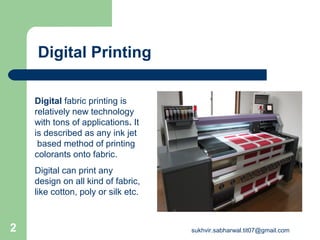
Digital fabric printing is
relatively new technology
with tons of applications. It
is described as any ink jet
based method of printing
colorants onto fabric.
Digital can print any
design on all kind of fabric,
like cotton, poly or silk etc.
2 sukhvir.sabharwal.tit07@gmail.com
Pre-Treatment for digital print
Before going to digital print all fabric
need to coated with chemicals and
prepared for digital printing.
3 sukhvir.sabharwal.tit07@gmail.com
Digital Printing Process
 During the printing process, the fabric is fed through
thr printer using feed roller and ink is applied to
surface of fabric in the form of thousand tiny
droplets.
 fabric is printed by digital printers with the design
prepared on computer using ink jet based method of
printing colorants onto fabric.
 The fabric is then passed through steam/heat
chamber to cure the ink.
 Then steamed fabric required washing and drying.
4
sukhvir.sabharwal.tit07@gmail.co
m
Cost for production
 So for the print where we can’t achieve desired result on rotary
printing machine we have option of going for sublimation print
thru roller printing machine (true for only polyester fabric), but
because of the cost of the roller sampling is problem (cost of
one copper roll appx 50000 to 60000 rupees ),
 We take the route of printing of paper by digital printing machine
using low sublimation disperse dyes and transfer on to the fabric
using hot paper press for sampling only.
 The result of heat transfer printing and digital printing using low
sublimation disperse dyes would be the same.
 Cost-sublimation/heat transfer in the bulk is cheaper than the
normal rotary print but the quantity per print should be more
than 20000 meter otherwise the cost of printing will be high
because of copper roll cost.5 sukhvir.sabharwal.tit07@gmail.com
Advantage of Digital Printing
 The image can be printed all over the entire item, with no
difficulty in printing all the way to the edges.
 Colors can be extraordinarily brilliant due to the bonding of the
dye to the transparent fibers of the synthetic fabric.
 It is time saving for sampling as compare to rotary process.
 Truly continuous tones can be achieved that are equivalent to
photographs, without the use special techniques such as half-
screen printing.
 Time saving for sampling only.
6
sukhvir.sabharwal.tit07@gmail.co
m
Disadvantage of Digital Printing
 Back side of fabric always be white.
 Sampling and production cost is high.
 Cost and lead time will be high for bigger
run.
 Speed of digital printing is very slow.
7 sukhvir.sabharwal.tit07@gmail.com

Thank You
8 sukhvir.sabharwal.tit07@gmail.com

Digital Printing ppt by Sukhvir Sabharwal

  • 1.
    Digital Printing By:-Sukhvir Sabharwal Triburg/// 1 sukhvir.sabharwal.tit07@gmail.com
  • 2.
    Digital Printing Digital fabricprinting is relatively new technology with tons of applications. It is described as any ink jet based method of printing colorants onto fabric. Digital can print any design on all kind of fabric, like cotton, poly or silk etc. 2 sukhvir.sabharwal.tit07@gmail.com
  • 3.
    Pre-Treatment for digitalprint Before going to digital print all fabric need to coated with chemicals and prepared for digital printing. 3 sukhvir.sabharwal.tit07@gmail.com
  • 4.
    Digital Printing Process During the printing process, the fabric is fed through thr printer using feed roller and ink is applied to surface of fabric in the form of thousand tiny droplets.  fabric is printed by digital printers with the design prepared on computer using ink jet based method of printing colorants onto fabric.  The fabric is then passed through steam/heat chamber to cure the ink.  Then steamed fabric required washing and drying. 4 sukhvir.sabharwal.tit07@gmail.co m
  • 5.
    Cost for production So for the print where we can’t achieve desired result on rotary printing machine we have option of going for sublimation print thru roller printing machine (true for only polyester fabric), but because of the cost of the roller sampling is problem (cost of one copper roll appx 50000 to 60000 rupees ),  We take the route of printing of paper by digital printing machine using low sublimation disperse dyes and transfer on to the fabric using hot paper press for sampling only.  The result of heat transfer printing and digital printing using low sublimation disperse dyes would be the same.  Cost-sublimation/heat transfer in the bulk is cheaper than the normal rotary print but the quantity per print should be more than 20000 meter otherwise the cost of printing will be high because of copper roll cost.5 sukhvir.sabharwal.tit07@gmail.com
  • 6.
    Advantage of DigitalPrinting  The image can be printed all over the entire item, with no difficulty in printing all the way to the edges.  Colors can be extraordinarily brilliant due to the bonding of the dye to the transparent fibers of the synthetic fabric.  It is time saving for sampling as compare to rotary process.  Truly continuous tones can be achieved that are equivalent to photographs, without the use special techniques such as half- screen printing.  Time saving for sampling only. 6 sukhvir.sabharwal.tit07@gmail.co m
  • 7.
    Disadvantage of DigitalPrinting  Back side of fabric always be white.  Sampling and production cost is high.  Cost and lead time will be high for bigger run.  Speed of digital printing is very slow. 7 sukhvir.sabharwal.tit07@gmail.com
  • 8.