Experiences and
expectations of tomorrow's
teachers for online learning
Online Learning Institute
Julie Evans, Project Tomorrow CEO
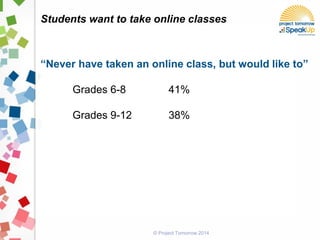
Students want to take online classes
© Project Tomorrow 2014
“Never have taken an online class, but would like to”
Grades 6-8 41%
Grades 9-12 38%
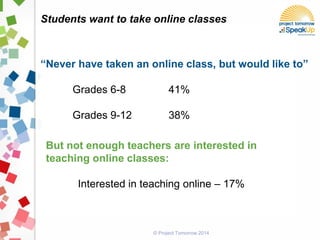
Students want to take online classes
© Project Tomorrow 2014
“Never have taken an online class, but would like to”
Grades 6-8 41%
Grades 9-12 38%
But not enough teachers are interested in
teaching online classes:
Interested in teaching online – 17%
© Project Tomorrow 2014
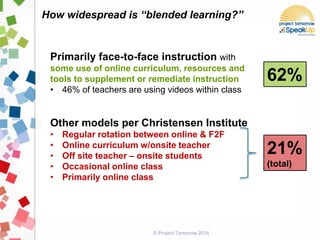
How widespread is “blended learning?”
Primarily face-to-face instruction with
some use of online curriculum, resources and
tools to supplement or remediate instruction
• 46% of teachers are using videos within class
Other models per Christensen Institute
• Regular rotation between online & F2F
• Online curriculum w/onsite teacher
• Off site teacher – onsite students
• Occasional online class
• Primarily online class
62%
21%
(total)
© Project Tomorrow 2014
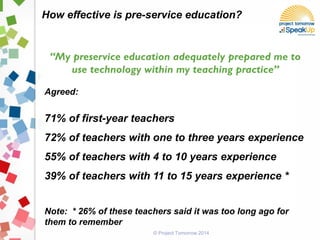
How effective is pre-service education?
“My preservice education adequately prepared me to
use technology within my teaching practice”
Agreed:
71% of first-year teachers
72% of teachers with one to three years experience
55% of teachers with 4 to 10 years experience
39% of teachers with 11 to 15 years experience *
Note: * 26% of these teachers said it was too long ago for
them to remember
© Project Tomorrow 2014
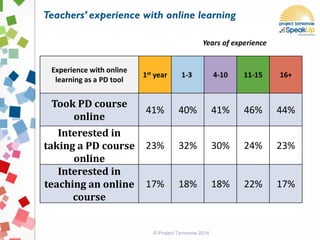
Experience with online
learning as a PD tool
1st year 1-3 4-10 11-15 16+
Took PD course
online
41% 40% 41% 46% 44%
Interested in
taking a PD course
online
23% 32% 30% 24% 23%
Interested in
teaching an online
course
17% 18% 18% 22% 17%
Teachers’ experience with online learning
Years of experience
© Project Tomorrow 2014
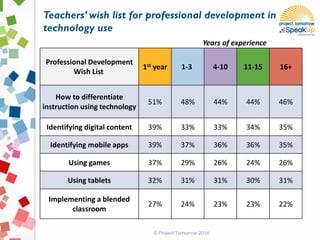
Professional Development
Wish List
1st year 1-3 4-10 11-15 16+
How to differentiate
instruction using technology
51% 48% 44% 44% 46%
Identifying digital content 39% 33% 33% 34% 35%
Identifying mobile apps 39% 37% 36% 36% 35%
Using games 37% 29% 26% 24% 26%
Using tablets 32% 31% 31% 30% 31%
Implementing a blended
classroom
27% 24% 23% 23% 22%
Teachers’ wish list for professional development in
technology use
Years of experience
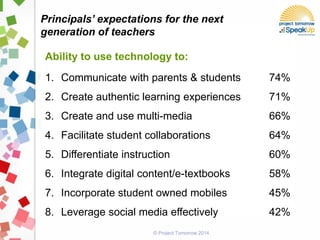
Principals’ expectations for the next
generation of teachers
Ability to use technology to:
1. Communicate with parents & students 74%
2. Create authentic learning experiences 71%
3. Create and use multi-media 66%
4. Facilitate student collaborations 64%
5. Differentiate instruction 60%
6. Integrate digital content/e-textbooks 58%
7. Incorporate student owned mobiles 45%
8. Leverage social media effectively 42%
© Project Tomorrow 2014
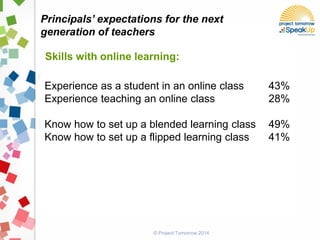
Principals’ expectations for the next
generation of teachers
Skills with online learning:
© Project Tomorrow 2014
Experience as a student in an online class 43%
Experience teaching an online class 28%
Know how to set up a blended learning class 49%
Know how to set up a flipped learning class 41%
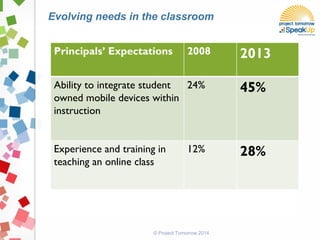
Evolving needs in the classroom
Principals’ Expectations 2008 2013
Ability to integrate student
owned mobile devices within
instruction
24% 45%
Experience and training in
teaching an online class
12% 28%
© Project Tomorrow 2014
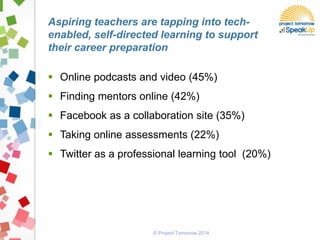
Aspiring teachers are tapping into tech-
enabled, self-directed learning to support
their career preparation
 Online podcasts and video (45%)
 Finding mentors online (42%)
 Facebook as a collaboration site (35%)
 Taking online assessments (22%)
 Twitter as a professional learning tool (20%)
© Project Tomorrow 2014
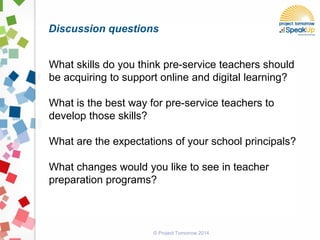
Discussion questions
What skills do you think pre-service teachers should
be acquiring to support online and digital learning?
What is the best way for pre-service teachers to
develop those skills?
What are the expectations of your school principals?
What changes would you like to see in teacher
preparation programs?
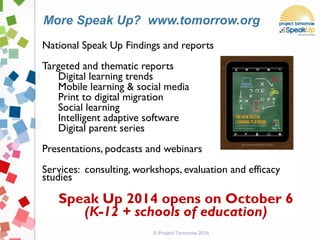
National Speak Up Findings and reports
Targeted and thematic reports
Digital learning trends
Mobile learning & social media
Print to digital migration
Social learning
Intelligent adaptive software
Digital parent series
Presentations, podcasts and webinars
Services: consulting, workshops, evaluation and efficacy
studies
Speak Up 2014 opens on October 6
(K-12 + schools of education)
© Project Tomorrow 2014
More Speak Up? www.tomorrow.org
Thank you.
Let’s continue this conversation.
Julie Evans
Project Tomorrow
jevans@tomorrow.org
949-609-4660 x15
Twitter: JulieEvans_PT
SpeakUpEd
Copyright Project Tomorrow 2014
This work is the intellectual property of the author. Permission is granted
for this material to be shared for non-commercial, educational purposes,
provided that this copyright statement appears on the reproduced
materials and notice is given that the copying is by permission of the
author. To disseminate otherwise or to republish requires written
permission from the author.
© Project Tomorrow 2014

Online Learning Institute - Roundtable Session

  • 1.
    Experiences and expectations oftomorrow's teachers for online learning Online Learning Institute Julie Evans, Project Tomorrow CEO
  • 2.
    Students want totake online classes © Project Tomorrow 2014 “Never have taken an online class, but would like to” Grades 6-8 41% Grades 9-12 38%
  • 3.
    Students want totake online classes © Project Tomorrow 2014 “Never have taken an online class, but would like to” Grades 6-8 41% Grades 9-12 38% But not enough teachers are interested in teaching online classes: Interested in teaching online – 17%
  • 4.
    © Project Tomorrow2014 How widespread is “blended learning?” Primarily face-to-face instruction with some use of online curriculum, resources and tools to supplement or remediate instruction • 46% of teachers are using videos within class Other models per Christensen Institute • Regular rotation between online & F2F • Online curriculum w/onsite teacher • Off site teacher – onsite students • Occasional online class • Primarily online class 62% 21% (total)
  • 5.
    © Project Tomorrow2014 How effective is pre-service education? “My preservice education adequately prepared me to use technology within my teaching practice” Agreed: 71% of first-year teachers 72% of teachers with one to three years experience 55% of teachers with 4 to 10 years experience 39% of teachers with 11 to 15 years experience * Note: * 26% of these teachers said it was too long ago for them to remember
  • 6.
    © Project Tomorrow2014 Experience with online learning as a PD tool 1st year 1-3 4-10 11-15 16+ Took PD course online 41% 40% 41% 46% 44% Interested in taking a PD course online 23% 32% 30% 24% 23% Interested in teaching an online course 17% 18% 18% 22% 17% Teachers’ experience with online learning Years of experience
  • 7.
    © Project Tomorrow2014 Professional Development Wish List 1st year 1-3 4-10 11-15 16+ How to differentiate instruction using technology 51% 48% 44% 44% 46% Identifying digital content 39% 33% 33% 34% 35% Identifying mobile apps 39% 37% 36% 36% 35% Using games 37% 29% 26% 24% 26% Using tablets 32% 31% 31% 30% 31% Implementing a blended classroom 27% 24% 23% 23% 22% Teachers’ wish list for professional development in technology use Years of experience
  • 8.
    Principals’ expectations forthe next generation of teachers Ability to use technology to: 1. Communicate with parents & students 74% 2. Create authentic learning experiences 71% 3. Create and use multi-media 66% 4. Facilitate student collaborations 64% 5. Differentiate instruction 60% 6. Integrate digital content/e-textbooks 58% 7. Incorporate student owned mobiles 45% 8. Leverage social media effectively 42% © Project Tomorrow 2014
  • 9.
    Principals’ expectations forthe next generation of teachers Skills with online learning: © Project Tomorrow 2014 Experience as a student in an online class 43% Experience teaching an online class 28% Know how to set up a blended learning class 49% Know how to set up a flipped learning class 41%
  • 10.
    Evolving needs inthe classroom Principals’ Expectations 2008 2013 Ability to integrate student owned mobile devices within instruction 24% 45% Experience and training in teaching an online class 12% 28% © Project Tomorrow 2014
  • 11.
    Aspiring teachers aretapping into tech- enabled, self-directed learning to support their career preparation  Online podcasts and video (45%)  Finding mentors online (42%)  Facebook as a collaboration site (35%)  Taking online assessments (22%)  Twitter as a professional learning tool (20%) © Project Tomorrow 2014
  • 12.
    © Project Tomorrow2014 Discussion questions What skills do you think pre-service teachers should be acquiring to support online and digital learning? What is the best way for pre-service teachers to develop those skills? What are the expectations of your school principals? What changes would you like to see in teacher preparation programs?
  • 13.
    National Speak UpFindings and reports Targeted and thematic reports Digital learning trends Mobile learning & social media Print to digital migration Social learning Intelligent adaptive software Digital parent series Presentations, podcasts and webinars Services: consulting, workshops, evaluation and efficacy studies Speak Up 2014 opens on October 6 (K-12 + schools of education) © Project Tomorrow 2014 More Speak Up? www.tomorrow.org
  • 14.
    Thank you. Let’s continuethis conversation. Julie Evans Project Tomorrow jevans@tomorrow.org 949-609-4660 x15 Twitter: JulieEvans_PT SpeakUpEd Copyright Project Tomorrow 2014 This work is the intellectual property of the author. Permission is granted for this material to be shared for non-commercial, educational purposes, provided that this copyright statement appears on the reproduced materials and notice is given that the copying is by permission of the author. To disseminate otherwise or to republish requires written permission from the author. © Project Tomorrow 2014