TECHNOLOGY & IT’S ADOPTION BY
THE 55+ GROUP
durpani@gmail.com Dr David Urpani
About me
Architect, Civil & Structural Engineer
PhD Artificial Intelligence, Swinburne Uni
Research Scientist, CSIRO
Data Scientist, Oracle Corp
Co-Founder, iSelect
Mentor & Business Advisor
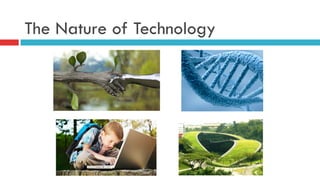
The Nature of Technology
Defining Technology
Technology is …
“… anything that doesn’t work yet.”
Danny Hillis, The Pattern on the Stone: The Simple Ideas that Make Computers Work, 1998
“… anything invented after you were born.”
Alan Kay at Hong Kong press conference, late 1980s
“… anything useful invented by a mind.”
Kevin Kelly, What Technology Wants, 2010
“… a programming of phenomena to our purposes.”
W.Brian Arthur, The Nature of Technology, 2009
The Evolution of Technology
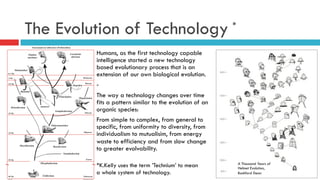
Humans, as the first technology capable
intelligence started a new technology
based evolutionary process that is an
extension of our own biological evolution.
-
The way a technology changes over time
fits a pattern similar to the evolution of an
organic species:
From simple to complex, from general to
specific, from uniformity to diversity, from
individualism to mutualisim, from energy
waste to efficiency and from slow change
to greater evolvability.
*
*K.Kelly uses the term ’Technium’ to mean
a whole system of technology.
A Thousand Years of
Helmet Evolution,
Bashford Dean
The Seventh Kingdom
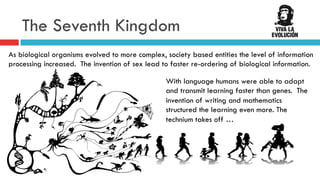
As biological organisms evolved to more complex, society based entities the level of information
processing increased. The invention of sex lead to faster re-ordering of biological information.
With language humans were able to adapt
and transmit learning faster than genes. The
invention of writing and mathematics
structured the learning even more. The
technium takes off …
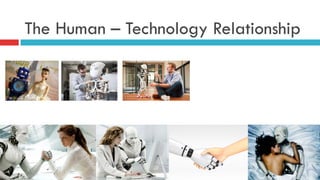
The Human – Technology Relationship
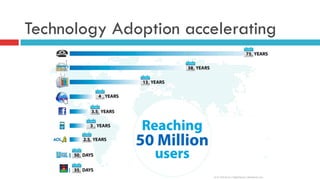
Technology Adoption accelerating
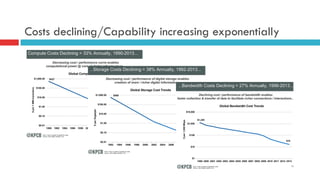
Costs declining/Capability increasing exponentially
Radio Shack brochure, 1981
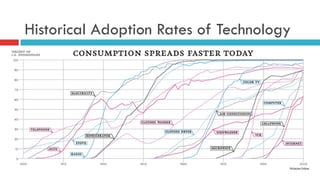
Historical Adoption Rates of Technology
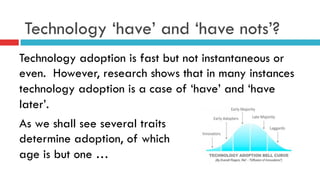
Technology ‘have’ and ‘have nots’?
Technology adoption is fast but not instantaneous or
even. However, research shows that in many instances
technology adoption is a case of ‘have’ and ‘have
later’.
As we shall see several traits
determine adoption, of which
age is but one …
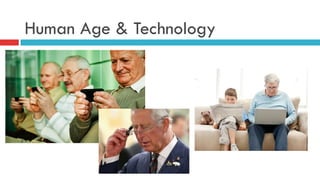
Human Age & Technology
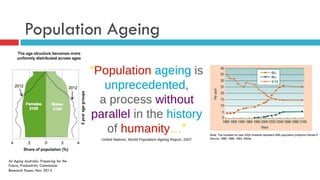
Population Ageing
An Aging Australia: Preparing for the
Future, Productivity Commission
Research Paper, Nov. 2013
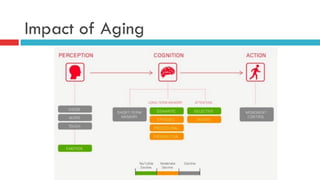
Impact of Aging
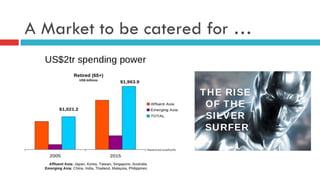
A Market to be catered for …
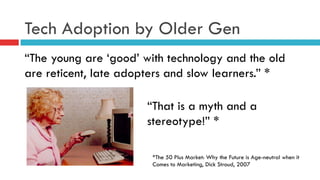
Tech Adoption by Older Gen
“The young are ‘good’ with technology and the old
are reticent, late adopters and slow learners.” *
*The 50 Plus Market: Why the Future is Age-neutral when it
Comes to Marketing, Dick Stroud, 2007
“That is a myth and a
stereotype!” *
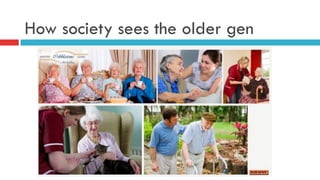
How society sees the older gen
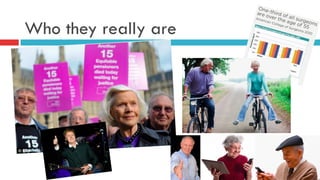
Who they really are
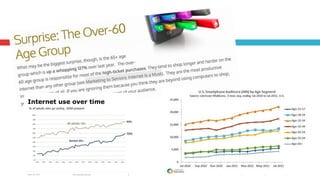
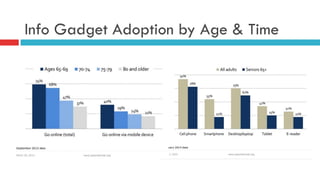
Info Gadget Adoption by Age & Time
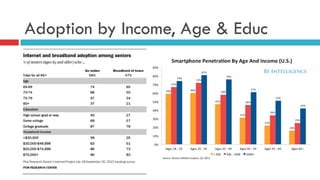
Adoption by Income, Age & Educ
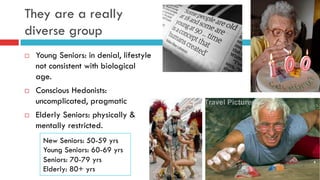
They are a really
diverse group
¨  Young Seniors: in denial, lifestyle
not consistent with biological
age.
¨  Conscious Hedonists:
uncomplicated, pragmatic
¨  Elderly Seniors: physically &
mentally restricted.
New Seniors: 50-59 yrs
Young Seniors: 60-69 yrs
Seniors: 70-79 yrs
Elderly: 80+ yrs
The ‘average’ consumer is changing
The consumer base is becoming increasingly different from the
theoretical “average user” used in design of products.
In fact, in current product design, an increasingly bigger proportion
of the potential customer base is being ignored as the demographic
curve bulges upward. However their needs grow as their
capabilities diminish.
The challenge to innovators and to businesses is that everyone, with
all their differences, are potential users/consumers and desire to
use the same products and services as everyone else.
Material translated & adapted from “Design Pour Tous – comment s’y prendre. Preconisations pour une conception pour le plus
gran nombre”, Collectif Designers+, 2005
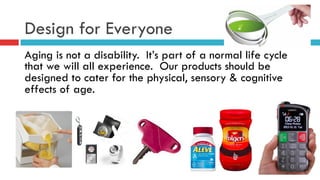
Design for Everyone
Aging is not a disability. It’s part of a normal life cycle
that we will all experience. Our products should be
designed to cater for the physical, sensory & cognitive
effects of age.
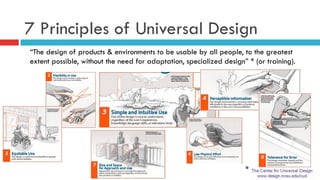
7 Principles of Universal Design
“The design of products & environments to be usable by all people, to the greatest
extent possible, without the need for adaptation, specialized design” * (or training).
*
Conclusion
Technology is pervasive & unrelenting.
It is up to us to use it wisely to increase the quality of
everyone’s lives in a sustainable manner.
Thank you!
durpani@gmail.com David Urpani

Tech 55+ 20 feb15

  • 1.
    TECHNOLOGY & IT’SADOPTION BY THE 55+ GROUP durpani@gmail.com Dr David Urpani
  • 2.
    About me Architect, Civil& Structural Engineer PhD Artificial Intelligence, Swinburne Uni Research Scientist, CSIRO Data Scientist, Oracle Corp Co-Founder, iSelect Mentor & Business Advisor
  • 3.
    The Nature ofTechnology
  • 4.
    Defining Technology Technology is… “… anything that doesn’t work yet.” Danny Hillis, The Pattern on the Stone: The Simple Ideas that Make Computers Work, 1998 “… anything invented after you were born.” Alan Kay at Hong Kong press conference, late 1980s “… anything useful invented by a mind.” Kevin Kelly, What Technology Wants, 2010 “… a programming of phenomena to our purposes.” W.Brian Arthur, The Nature of Technology, 2009
  • 5.
    The Evolution ofTechnology Humans, as the first technology capable intelligence started a new technology based evolutionary process that is an extension of our own biological evolution. - The way a technology changes over time fits a pattern similar to the evolution of an organic species: From simple to complex, from general to specific, from uniformity to diversity, from individualism to mutualisim, from energy waste to efficiency and from slow change to greater evolvability. * *K.Kelly uses the term ’Technium’ to mean a whole system of technology. A Thousand Years of Helmet Evolution, Bashford Dean
  • 6.
    The Seventh Kingdom Asbiological organisms evolved to more complex, society based entities the level of information processing increased. The invention of sex lead to faster re-ordering of biological information. With language humans were able to adapt and transmit learning faster than genes. The invention of writing and mathematics structured the learning even more. The technium takes off …
  • 7.
    The Human –Technology Relationship
  • 8.
  • 9.
  • 10.
  • 11.
  • 12.
    Technology ‘have’ and‘have nots’? Technology adoption is fast but not instantaneous or even. However, research shows that in many instances technology adoption is a case of ‘have’ and ‘have later’. As we shall see several traits determine adoption, of which age is but one …
  • 13.
    Human Age &Technology
  • 14.
    Population Ageing An AgingAustralia: Preparing for the Future, Productivity Commission Research Paper, Nov. 2013
  • 15.
  • 16.
    A Market tobe catered for …
  • 17.
    Tech Adoption byOlder Gen “The young are ‘good’ with technology and the old are reticent, late adopters and slow learners.” * *The 50 Plus Market: Why the Future is Age-neutral when it Comes to Marketing, Dick Stroud, 2007 “That is a myth and a stereotype!” *
  • 18.
    How society seesthe older gen
  • 19.
  • 21.
    Info Gadget Adoptionby Age & Time
  • 22.
  • 23.
    They are areally diverse group ¨  Young Seniors: in denial, lifestyle not consistent with biological age. ¨  Conscious Hedonists: uncomplicated, pragmatic ¨  Elderly Seniors: physically & mentally restricted. New Seniors: 50-59 yrs Young Seniors: 60-69 yrs Seniors: 70-79 yrs Elderly: 80+ yrs
  • 24.
    The ‘average’ consumeris changing The consumer base is becoming increasingly different from the theoretical “average user” used in design of products. In fact, in current product design, an increasingly bigger proportion of the potential customer base is being ignored as the demographic curve bulges upward. However their needs grow as their capabilities diminish. The challenge to innovators and to businesses is that everyone, with all their differences, are potential users/consumers and desire to use the same products and services as everyone else. Material translated & adapted from “Design Pour Tous – comment s’y prendre. Preconisations pour une conception pour le plus gran nombre”, Collectif Designers+, 2005
  • 25.
    Design for Everyone Agingis not a disability. It’s part of a normal life cycle that we will all experience. Our products should be designed to cater for the physical, sensory & cognitive effects of age.
  • 26.
    7 Principles ofUniversal Design “The design of products & environments to be usable by all people, to the greatest extent possible, without the need for adaptation, specialized design” * (or training). *
  • 27.
    Conclusion Technology is pervasive& unrelenting. It is up to us to use it wisely to increase the quality of everyone’s lives in a sustainable manner. Thank you! durpani@gmail.com David Urpani