A PARTNERSHIP BETWEEN
THE
INDIGENOUS
DIGITAL
EXCELLENCE
INITIATIVE
Australia’s First Peoples have been innovating for
more than 40,000 years. So what happens when
digital technology is embraced by the world’s
oldest living culture?
We believe the answer is
Indigenous Digital Excellence.
How might Aboriginal & Torres Strait Islander
people leverage digital technologies to
increase wellbeing for themselves
and their community?
Seeking answers to the question:
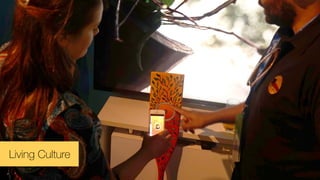
Living Culture
Kinship
Physical health
Social & emotional
wellness
Youth empowerment
Learning engagement
Cyber-safety
Digital fluency
PAGE 17
PART 1 – WHAT IS IDX?
NATIONAL IDX STRATEGY:
DISCUSSION PAPER
PAGE 18
PART 1 – WHAT IS IDX?
NATIONAL IDX STRATEGY:
DISCUSSION PAPER
3
See Identifying the IDX opportunity
on p. 64 for more on these
activities.
4
http://www.google.com/glass/
start/
5
http://en.wikipedia.org/
wiki/3D_printing
6
The diffusion of innovations [see
reference 1] serves as the basis for
this element. We acknowledge
that this may be somewhat
subjective and definitely
changes over time. For example,
at the time of writing ‘tablet
computing’ would probably
be considered ‘emerging’, yet
based on its adoption rate this
type of technology will likely be
considered ‘mainstream’ within
18 months to two years.
7
http://fitbit.com
WHAT DOES IDX
LOOK LIKE?
So what, exactly, is IDX? How do we tell if something is IDX? What are we
working towards achieving?
We started exploring these questions through the IDEA Summit, as well as
through conversations with community3. As we dug deeper, we felt it would be
useful to assemble a wide set of examples of projects, initiatives and activities
that could be considered IDX and analyse them. From this foundation we were
able to develop a ‘working model’ of what IDX looks like in practice.
WHAT IS ‘DIGITAL EXCELLENCE’?
We first sought to define what ‘Digital Excellence’ might be, regardless of its
origin.
We propose that for something to be viewed as an expression/achievement of
Digital Excellence, it needs to be positioned ‘above the line’ in at least one of
the following two elements (i.e. more than As intended usage of a Mainstream
tool).
Usage
Is how the technology being used innovative in itself? Is it being used in a
way that is creative? i.e. even where the technology itself isn’t necessarily
innovative in its design, is the way something is used or engaged with still
an example of innovation? Has it been specifically adapted or customised
(especially to reflect an Indigenous perspective and/or culture)? Is the software
being used on a device (e.g. an app or website) newly created?
Device
How much innovation is there in the device itself? For an existing technology,
are they ‘cutting edge’ (e.g. Google Glass4 or 3D printing5), or ‘emerging’ and
being engaged by early adopters6 (e.g. Fitbit7 or similar ‘quantified self’ tools)?
Or is the technology being newly created (e.g. a new type of digital device)? Or
is it just an existing, mainstream tool (e.g. a laptop or smartphone)?
The Indigenous Digital Excellence Vision
discussion paper: http://idx.org.au/vision
DIGITAL RANGERS + STORY
MAPS
Living Culture
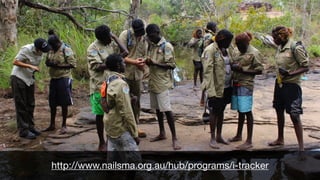
http://www.nailsma.org.au/hub/programs/i-tracker
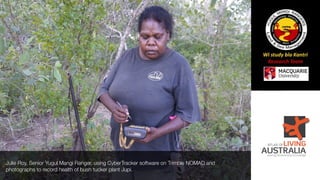
Julie Roy, Senior Yugul Mangi Ranger, using CyberTracker software on Trimble NOMAD and
photographs to record health of bush tucker plant Jupi.
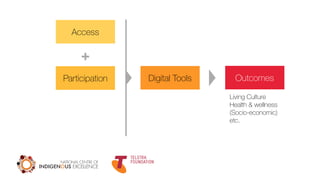
Access
Participation
+
Outcomes
Living Culture
Health & wellness
(Socio-economic)
etc.
Digital Tools
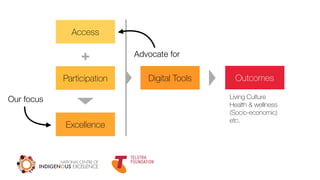
Access
Participation
+
Excellence
Advocate for
Outcomes
Living Culture
Health & wellness
(Socio-economic)
etc.
Our focus
Digital Tools
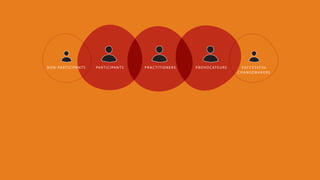
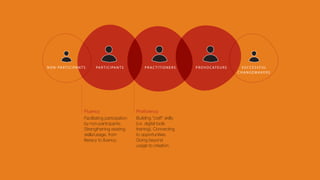
PROVOCATEURSPRAC TITIONERSPARTICIPANTSNON-PARTICIPANTS SUCCESSFUL
CHANGEMAKERS
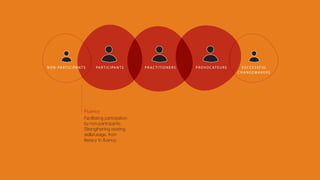
PROVOCATEURSPRAC TITIONERSPARTICIPANTSNON-PARTICIPANTS SUCCESSFUL
CHANGEMAKERS
Fluency
Facilitating participation
by non-participants.
Strengthening existing
skills/usage, from
literacy to fluency.
PROVOCATEURSPRAC TITIONERSPARTICIPANTSNON-PARTICIPANTS SUCCESSFUL
CHANGEMAKERS
Fluency Proficiency
Facilitating participation
by non-participants.
Strengthening existing
skills/usage, from
literacy to fluency.
Building "craft" skills
(i.e. digital tools
training). Connecting
to opportunities.
Going beyond
usage to creation.
PROVOCATEURSPRAC TITIONERSPARTICIPANTSNON-PARTICIPANTS SUCCESSFUL
CHANGEMAKERS
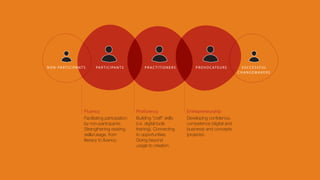
Fluency Proficiency Entrepreneurship
Facilitating participation
by non-participants.
Strengthening existing
skills/usage, from
literacy to fluency.
Building "craft" skills
(i.e. digital tools
training). Connecting
to opportunities.
Going beyond
usage to creation.
Developing confidence,
competence (digital and
business) and concepts
(projects).
How might we inspire, build and
connect the next generation of
Indigenous digital makers?
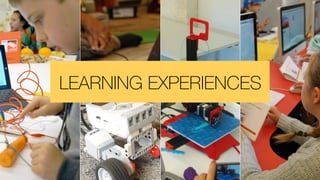
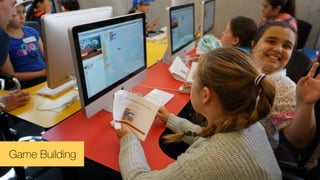
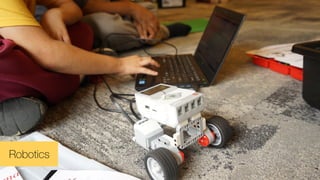
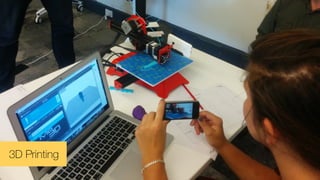
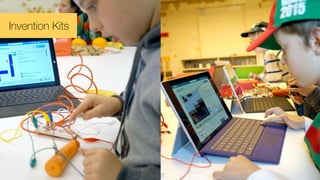
LEARNING EXPERIENCES
Game Building
Robotics
3D Printing
Invention Kits
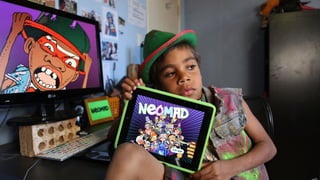
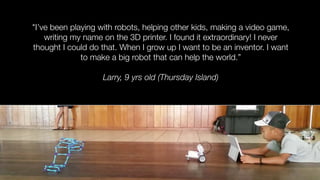
"I’ve been playing with robots, helping other kids, making a video game,
writing my name on the 3D printer. I found it extraordinary! I never
thought I could do that. When I grow up I want to be an inventor. I want
to make a big robot that can help the world.”
Larry, 9 yrs old (Thursday Island)
IDX FLINT
http://idx.org.au/flint
💬
Connect with us…
Grant Young
(Former) IDX Director
@grantyoung
team@ncie.idx.org.au
April Long
General Manager Enterprises & Programs
@theNCIE
@IndigenousDX
april.long@ncie.org.au
http://ncie.org.au
http://idx.org.au
http://ncie-idx.tumblr.com

What is Indigenous Digital Excellence—Puliima 2015

  • 1.
  • 2.
    Australia’s First Peopleshave been innovating for more than 40,000 years. So what happens when digital technology is embraced by the world’s oldest living culture? We believe the answer is Indigenous Digital Excellence.
  • 3.
    How might Aboriginal& Torres Strait Islander people leverage digital technologies to increase wellbeing for themselves and their community? Seeking answers to the question:
  • 4.
    Living Culture Kinship Physical health Social& emotional wellness Youth empowerment Learning engagement Cyber-safety Digital fluency
  • 5.
    PAGE 17 PART 1– WHAT IS IDX? NATIONAL IDX STRATEGY: DISCUSSION PAPER PAGE 18 PART 1 – WHAT IS IDX? NATIONAL IDX STRATEGY: DISCUSSION PAPER 3 See Identifying the IDX opportunity on p. 64 for more on these activities. 4 http://www.google.com/glass/ start/ 5 http://en.wikipedia.org/ wiki/3D_printing 6 The diffusion of innovations [see reference 1] serves as the basis for this element. We acknowledge that this may be somewhat subjective and definitely changes over time. For example, at the time of writing ‘tablet computing’ would probably be considered ‘emerging’, yet based on its adoption rate this type of technology will likely be considered ‘mainstream’ within 18 months to two years. 7 http://fitbit.com WHAT DOES IDX LOOK LIKE? So what, exactly, is IDX? How do we tell if something is IDX? What are we working towards achieving? We started exploring these questions through the IDEA Summit, as well as through conversations with community3. As we dug deeper, we felt it would be useful to assemble a wide set of examples of projects, initiatives and activities that could be considered IDX and analyse them. From this foundation we were able to develop a ‘working model’ of what IDX looks like in practice. WHAT IS ‘DIGITAL EXCELLENCE’? We first sought to define what ‘Digital Excellence’ might be, regardless of its origin. We propose that for something to be viewed as an expression/achievement of Digital Excellence, it needs to be positioned ‘above the line’ in at least one of the following two elements (i.e. more than As intended usage of a Mainstream tool). Usage Is how the technology being used innovative in itself? Is it being used in a way that is creative? i.e. even where the technology itself isn’t necessarily innovative in its design, is the way something is used or engaged with still an example of innovation? Has it been specifically adapted or customised (especially to reflect an Indigenous perspective and/or culture)? Is the software being used on a device (e.g. an app or website) newly created? Device How much innovation is there in the device itself? For an existing technology, are they ‘cutting edge’ (e.g. Google Glass4 or 3D printing5), or ‘emerging’ and being engaged by early adopters6 (e.g. Fitbit7 or similar ‘quantified self’ tools)? Or is the technology being newly created (e.g. a new type of digital device)? Or is it just an existing, mainstream tool (e.g. a laptop or smartphone)? The Indigenous Digital Excellence Vision discussion paper: http://idx.org.au/vision
  • 6.
    DIGITAL RANGERS +STORY MAPS Living Culture
  • 8.
  • 9.
    Julie Roy, SeniorYugul Mangi Ranger, using CyberTracker software on Trimble NOMAD and photographs to record health of bush tucker plant Jupi.
  • 14.
    Access Participation + Outcomes Living Culture Health &wellness (Socio-economic) etc. Digital Tools
  • 15.
    Access Participation + Excellence Advocate for Outcomes Living Culture Health& wellness (Socio-economic) etc. Our focus Digital Tools
  • 16.
  • 17.
    PROVOCATEURSPRAC TITIONERSPARTICIPANTSNON-PARTICIPANTS SUCCESSFUL CHANGEMAKERS Fluency Facilitatingparticipation by non-participants. Strengthening existing skills/usage, from literacy to fluency.
  • 18.
    PROVOCATEURSPRAC TITIONERSPARTICIPANTSNON-PARTICIPANTS SUCCESSFUL CHANGEMAKERS FluencyProficiency Facilitating participation by non-participants. Strengthening existing skills/usage, from literacy to fluency. Building "craft" skills (i.e. digital tools training). Connecting to opportunities. Going beyond usage to creation.
  • 19.
    PROVOCATEURSPRAC TITIONERSPARTICIPANTSNON-PARTICIPANTS SUCCESSFUL CHANGEMAKERS FluencyProficiency Entrepreneurship Facilitating participation by non-participants. Strengthening existing skills/usage, from literacy to fluency. Building "craft" skills (i.e. digital tools training). Connecting to opportunities. Going beyond usage to creation. Developing confidence, competence (digital and business) and concepts (projects).
  • 20.
    How might weinspire, build and connect the next generation of Indigenous digital makers?
  • 21.
  • 23.
  • 24.
  • 25.
  • 26.
  • 28.
    "I’ve been playingwith robots, helping other kids, making a video game, writing my name on the 3D printer. I found it extraordinary! I never thought I could do that. When I grow up I want to be an inventor. I want to make a big robot that can help the world.” Larry, 9 yrs old (Thursday Island)
  • 29.
  • 30.
  • 31.
    Grant Young (Former) IDXDirector @grantyoung team@ncie.idx.org.au April Long General Manager Enterprises & Programs @theNCIE @IndigenousDX april.long@ncie.org.au http://ncie.org.au http://idx.org.au http://ncie-idx.tumblr.com