Teamwork
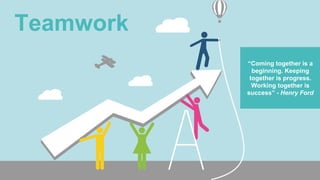
“Coming together is a
beginning. Keeping
together is progress.
Working together is
success” - Henry Ford
Teamwork
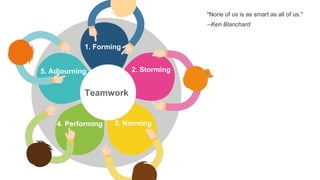
2. Storming
3. Norming4. Performing
5. Adjourning
1. Forming
"None of us is as smart as all of us."
--Ken Blanchard
1. Forming
What am
I doing?
%@~#? I feel anxious
What is
my role?Yes
please
Tip for
leaders
1. Forming - Leadership focus
● Direct the team
● Establish clear objectives for team
and individuals
2. Storming
Tip for
leaders
2. Storming - Leadership focus
● Establish processes and structures
● Encourage and build trust and good relationships
between team members
● Resolve conflicts quickly and provide support to
insecure members
● Remain positive and firm if challenged (leadership and
team goals)
● Explain the model (Forming, Storming, Norming,
Performing, Mourning)
● Use psychometric measures (Myers-Briggs etc.) for
people to learn of different working styles
3. Norming Tip for
leaders
3. Norming - Leadership focus
● Step back, allow team
members to take
responsibility for
progress towards the
goal.
● A team building event
would work wonders
here.
4. Performing
Tip for
leaders
Success!
4. Performing - Leadership focus
● Delegate tasks and
projects as much as
possible.
● You can focus on other
goals and areas of work.
5. Adjourning (mourning)
Yes!
We’re
doing
great!
I don’t
think I
belong :(
I’m part
of the
team!
Tip for
leaders
5. Adjourning - Leadership focus
Take time to
celebrate the team’s
achievements - you
may work with the
members again and
it’s great if past
experiences are
viewed in a positive
light
Key points
Team formation usually follows easily
recognisable stages, known as "forming,
storming, norming, performing, and later added
mourning" (created by Psychologist Bruce
Tuckman).
You can use Tuckman's model to help your team
reach the performing stage as quickly as
possible.
First, identify the stage of development that your
team is at. Then, use strategies that move your
team through to the next stage in the team
formation process. With focus and hard work,
you'll quickly have a high-performing team.

Teamwork

  • 1.
    Teamwork “Coming together isa beginning. Keeping together is progress. Working together is success” - Henry Ford
  • 2.
    Teamwork 2. Storming 3. Norming4.Performing 5. Adjourning 1. Forming "None of us is as smart as all of us." --Ken Blanchard
  • 3.
    1. Forming What am Idoing? %@~#? I feel anxious What is my role?Yes please Tip for leaders
  • 4.
    1. Forming -Leadership focus ● Direct the team ● Establish clear objectives for team and individuals
  • 5.
  • 6.
    2. Storming -Leadership focus ● Establish processes and structures ● Encourage and build trust and good relationships between team members ● Resolve conflicts quickly and provide support to insecure members ● Remain positive and firm if challenged (leadership and team goals) ● Explain the model (Forming, Storming, Norming, Performing, Mourning) ● Use psychometric measures (Myers-Briggs etc.) for people to learn of different working styles
  • 7.
    3. Norming Tipfor leaders
  • 8.
    3. Norming -Leadership focus ● Step back, allow team members to take responsibility for progress towards the goal. ● A team building event would work wonders here.
  • 9.
  • 10.
    4. Performing -Leadership focus ● Delegate tasks and projects as much as possible. ● You can focus on other goals and areas of work.
  • 11.
    5. Adjourning (mourning) Yes! We’re doing great! Idon’t think I belong :( I’m part of the team! Tip for leaders
  • 12.
    5. Adjourning -Leadership focus Take time to celebrate the team’s achievements - you may work with the members again and it’s great if past experiences are viewed in a positive light
  • 13.
    Key points Team formationusually follows easily recognisable stages, known as "forming, storming, norming, performing, and later added mourning" (created by Psychologist Bruce Tuckman). You can use Tuckman's model to help your team reach the performing stage as quickly as possible. First, identify the stage of development that your team is at. Then, use strategies that move your team through to the next stage in the team formation process. With focus and hard work, you'll quickly have a high-performing team.