SCOPE MANAGEMENT

                       Group 2


 Randall Dickey: 5.1
 Peter Frasca: 5.2
 Wendy Grant: 5.3 and 5.6
 Wanda Groves:5.4
 Ricky Erwin: 5.5
Scope Reporting

 In the beginning:
 Team and Clients must determine their need for
  project updates
 How many, How often, and to whom
 Scope Reporting fulfills to whom gets what and how
  often the will receive it.
 How the information will be acquired and
  distributed out.
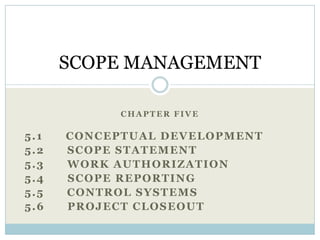
SCOPE MANAGEMENT

            CHAPTER FIVE

5.1   CONCEPTUAL DEVELOPMENT
5.2   SCOPE STATEMENT
5.3   WORK AUTHORIZATION
5.4   SCOPE REPORTING
5.5   CONTROL SYSTEMS
5.6   PROJECT CLOSEOUT
Scope Management

 Understand the importance of scope management
  for project success.
 Construct a Work Breakdown Structure for a project.
 Develop a Responsibility Assignment Matrix for a
  project.
 Describe the roles of changes and configuration
  management in assessing project scope
CONCEPTUAL DEVELOPMENT


 Problem Statement
 Information Gathering
 Constraints
 Alternative Analysis
 Project objectives
 Statement of Work
CONCEPTUAL DEVELOPMENT


 Problem or Need Statement
   Begin   with a statement of Goals
CONCEPTUAL DEVELOPMENT


 Information Gathering
 Research and gather relevant data
CONCEPTUAL DEVELOPMENT


 Constraints
 Bring restrictions and client demands
CONCEPTUAL DEVELOPMENT


 Alternative Analysis
 More than one solution
CONCEPTUAL DEVELOPMENT


 Project Objectives
 Conclude with a clear statement of the final
 objectives for the project, let logic flow
CONCEPTUAL DEVELOPMENT


 Statement of Work
CONCEPTUAL DEVELOPMENT

 The Statement of Work
 Aka: (SOW)


 Detailed narrative description of the work required
  for a project.
 This can be highly descriptive or relatively general.
 (RFP) Request for Proposal for a (DOD) Department
  of Defense may entail very specific needs.
 (SOW) may specify final requirements without
  details.
CONCEPTUAL DEVELOPMENT


             Elements in the (SOW)
 Introduction and background
 Problem statement
 Technical description of the project
 Clear analysis and technical capabilities
 Timeline and milestones
 Discuss (ATC)anticipated time to completion
 And the key project deliverables
SCOPE MANAGEMENT

 Conceptual Development Summary


 Useful (SOW) should clearly detail the expectations
 of the project client, the intended problem of the
 project, and the work to complete the tasks of the
 project to completion.
5.2 The Scope Statement


 THE HEART OF SCOPE
    MANAGEMENT
Scope Statement


 Reflects the project teams best efforts at creating the
 documentation and approval of all important project
 parameters prior to proceeding to the development
 phase
Key Steps in the Scope Statement Process

 Establish the project goal criteria. Criteria include
 cost, schedule, performance and deliverables, and
 key review and approval “gates” with important
 project stakeholders. Deliverables: any
 measurable, tangible, verifiable outcome, result, or
 item that must be produced to complete a project or
 part of a project. Goal criteria serve as the key project
 constraints and targets around which a project team
 must labor.
Developing the Management Plan for the
                   Project

 Consist of the organizational structure for the
 project team, the policies and procedures under
 which team members will be expected to
 operate, their appropriate job descriptions, and a
 well understood reporting structure for each member
 of the team. Creates control systems to ensure that
 all team members know their roles, their
 responsibilities, and professional relationship
Establishing a Work Breakdown Structure
                 (WBS)


 One of the most vital planning mechanisms, the
 WBS divides the project into its component sub steps
 in order to establish critical interrelationships
 among activities. Accurate scheduling can only begin
 with an accurate and meaningful WBS. The WBS will
 determine the interrelationships among the various
 activities within a project. Which steps precede
 others, and which are independent of each other.
Creating a Scope Baseline

 The scope baseline is a document that provides a
 summary description of each component of the
 project’s goal, including basic budget and schedule
 information for each activity. Creation of the scope
 baseline is the final step in the process of
 systematically laying out all pre-work information, in
 which each sub-routine of the project has been
 identified and given its control parameters of cost
 and schedule.
The Work Breakdown Structure

 The Work Breakdown Structure is a process that sets
 a project’s scope by breaking down its overall
 mission into a cohesive set of
 synchronous, increasingly specific tasks. The
 resulting document lays out the individual building
 blocks that will construct the project.
The Six Main Purposes of the Work
          Breakdown Structure

 1. Echoes the project objectives. Given the mission of
  the project, the WBS identifies the main work
  activities that will be necessary to accomplish this
  goal or set of goals.
 2. Organization chart for the project. A WBS offers a
  logical structure for a project, identifying the key
  tasks and sub-tasks that need attention and he
  logical flow between activities.
The Six Main Purposes of the Work
         Breakdown Structure

 3. Creates the logic for tracking costs, schedule, and
  performance specifications for each element in a
  project. All project activities identified in the WBS can
  be assigned their own budgets and performance
  expectations. This is the first step in establishing a
  comprehensive method of project control.
 4. Used to communicate project status. Once tasks have
  been identified and responsibilities assigned, it can be
  determined which tasks are on schedule, which are
  critical and pending, and who is responsible for their
  status
The Six Main Purposes of the Work
         Breakdown Structure

 5. Used to improve overall project communication.
  The WBS breaks down the project into identifiable
  parts, shows how those parts are integrated, and
  who is responsible for each component. This
  structure inspires communication within the project
  team.
 6. Demonstrates how the project will be controlled.
  The general structure of the project demonstrates
  the key focus that project control will take on. The
  WBS gives logic to the control approach and the
  most appropriate control methods.
The Organization Breakdown Structure
                   (OBS)

 The organization of the work needed to be performed
  into cost control accounts that are assignable to the
  various units within the company that are engaged in
  performing project activities. OBS allows the company to
  define the work to be accomplished and assign it to the
  owners of the work packages.
 Work packages are the lowest level in the
  WBS, composed of short duration tasks that have a
  defined beginning and end, are assigned cost, and
  consume some resources.
 The benefit of using an OBS is that it allows for better
  initial linking of project activities and their
  budgets, either at a departmental level or even more
  directly on an individual basis.
The Responsibility Assignment Matrix
                 (RAM)


 The RAM identifies team personnel who will be
  directly responsible for each task in the project’s
  development ( AKA linear responsibility chart )
 Although the RAM is considered a separate
  document, it is developed in conjunction with the
  WBS.
Benefits of the Responsibility Assignment
                  Matrix


 Allows the project manager to determine how to best
  team people for maximum efficiency.
 Identifies where a person can go for task
  support, who should next be notified of task
  completion, and any sign-off requirements.
 Allows the project manager to establish a method for
  coordinating the work activities of team
  members, realizing the efficiencies that take place as
  all team members provide support, notification, or
  approval for each other’s project responsibilities.
Summary

            The Scope Statement
 Key Steps in the Scope Statement Process
 Developing the Management Plan for the project
 Establishing a Work Breakdown Structure (WBS)
 Creating a Scope Baseline
 The Work Breakdown Structure
 The Organization Breakdown Structure (OBS)
 The Responsibility Assignment Matrix (RAM)
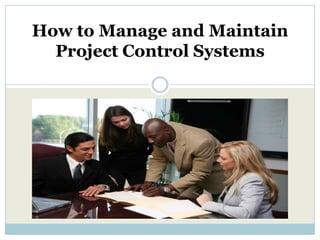
How to Manage and Maintain
  Project Control Systems
Executive Summary
ONE OF THE MOST IMPORTANT SYSTEMS
THAT A COMPANY HAS IS THE CONTROL
SYSTEM. CONTROL SYSTEMS ARE VITAL TO
ENSURE THAT ANY CHANGES TO THE
PROJECT’S BASELINE ARE CONDUCTED IN A
SYSTEMATIC AND THOROUGH MANNER.
DURING THIS PRESENTATION I WILL BE
DISCUSSING:


• CONFIGURATION CONTROL
• DESIGN CONTROL
• TREND MONITORING
• DOCUMENT CONTROL
• ACQUISITION CONTROL
• SPECIFICATION CONTROL
Summary
Control systems are vital to ensure that any changes to the project
baseline are conducted in a systematic and thorough manner. Project
managers can use a number of types of project control systems to track
the status of their projects. Solid communication between all concerned
parties and paying close attention to the project’s development is a key
element in the scope management of project control.
Configuration Control

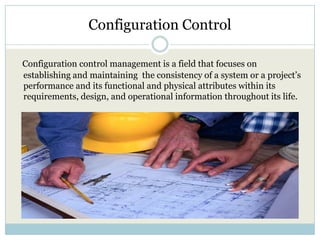
Configuration control management is a field that focuses on
establishing and maintaining the consistency of a system or a project’s
performance and its functional and physical attributes within its
requirements, design, and operational information throughout its life.
Design Control
Design control relates to systems for monitoring the project’s scope, schedule, and costs during the design stage.
Chrysler developed Platform Design Teams (PDTs) , composed of members from functional departments, to ensu
that new automobile designs could be immediately evaluated by experts in engineering, production, and marketin
Trend Monitoring

Trend monitoring is the process of tracking the estimated costs, schedules, and
resources needed against those planned. Trend monitoring shows significant
deviations from norms for any of those important project metrics.
Document Control


Document control ensures that important documentation is
compiled and disseminated in an orderly and timely fashion.
Document control is a way of making sure that anything contractual
or legal is documented and distributed.
Acquisition Control

 Acquisition control monitors systems used to acquire necessary project
equipment, materials, or services needed for project development and
implementation.
Specification Control

 Specification control ensures that project specifications are prepared
  clearly, communicated to all concerned parties, and changed only with
  proper authorization
Conclusion

 One of the most important pieces of advise for project managers and teams is
to establish and maintain a reasonable level of control. Knowing the right
project control system to use and how often to employ them can eliminate
much of the guesswork when dealing with project delays or cost overruns.
Building a level of trust when working together will bring great satisfaction in
the end.

Team Final_Scope Management

  • 1.
    SCOPE MANAGEMENT  Group 2  Randall Dickey: 5.1  Peter Frasca: 5.2  Wendy Grant: 5.3 and 5.6  Wanda Groves:5.4  Ricky Erwin: 5.5
  • 2.
    Scope Reporting  Inthe beginning:  Team and Clients must determine their need for project updates  How many, How often, and to whom  Scope Reporting fulfills to whom gets what and how often the will receive it.  How the information will be acquired and distributed out.
  • 3.
    SCOPE MANAGEMENT CHAPTER FIVE 5.1 CONCEPTUAL DEVELOPMENT 5.2 SCOPE STATEMENT 5.3 WORK AUTHORIZATION 5.4 SCOPE REPORTING 5.5 CONTROL SYSTEMS 5.6 PROJECT CLOSEOUT
  • 4.
    Scope Management  Understandthe importance of scope management for project success.  Construct a Work Breakdown Structure for a project.  Develop a Responsibility Assignment Matrix for a project.  Describe the roles of changes and configuration management in assessing project scope
  • 5.
    CONCEPTUAL DEVELOPMENT  ProblemStatement  Information Gathering  Constraints  Alternative Analysis  Project objectives  Statement of Work
  • 6.
    CONCEPTUAL DEVELOPMENT  Problemor Need Statement Begin with a statement of Goals
  • 7.
    CONCEPTUAL DEVELOPMENT  InformationGathering  Research and gather relevant data
  • 8.
    CONCEPTUAL DEVELOPMENT  Constraints Bring restrictions and client demands
  • 9.
    CONCEPTUAL DEVELOPMENT  AlternativeAnalysis  More than one solution
  • 10.
    CONCEPTUAL DEVELOPMENT  ProjectObjectives  Conclude with a clear statement of the final objectives for the project, let logic flow
  • 11.
  • 12.
    CONCEPTUAL DEVELOPMENT  TheStatement of Work  Aka: (SOW)  Detailed narrative description of the work required for a project.  This can be highly descriptive or relatively general.  (RFP) Request for Proposal for a (DOD) Department of Defense may entail very specific needs.  (SOW) may specify final requirements without details.
  • 13.
    CONCEPTUAL DEVELOPMENT  Elements in the (SOW)  Introduction and background  Problem statement  Technical description of the project  Clear analysis and technical capabilities  Timeline and milestones  Discuss (ATC)anticipated time to completion  And the key project deliverables
  • 14.
    SCOPE MANAGEMENT  ConceptualDevelopment Summary  Useful (SOW) should clearly detail the expectations of the project client, the intended problem of the project, and the work to complete the tasks of the project to completion.
  • 15.
    5.2 The ScopeStatement THE HEART OF SCOPE MANAGEMENT
  • 16.
    Scope Statement  Reflectsthe project teams best efforts at creating the documentation and approval of all important project parameters prior to proceeding to the development phase
  • 17.
    Key Steps inthe Scope Statement Process  Establish the project goal criteria. Criteria include cost, schedule, performance and deliverables, and key review and approval “gates” with important project stakeholders. Deliverables: any measurable, tangible, verifiable outcome, result, or item that must be produced to complete a project or part of a project. Goal criteria serve as the key project constraints and targets around which a project team must labor.
  • 18.
    Developing the ManagementPlan for the Project  Consist of the organizational structure for the project team, the policies and procedures under which team members will be expected to operate, their appropriate job descriptions, and a well understood reporting structure for each member of the team. Creates control systems to ensure that all team members know their roles, their responsibilities, and professional relationship
  • 19.
    Establishing a WorkBreakdown Structure (WBS)  One of the most vital planning mechanisms, the WBS divides the project into its component sub steps in order to establish critical interrelationships among activities. Accurate scheduling can only begin with an accurate and meaningful WBS. The WBS will determine the interrelationships among the various activities within a project. Which steps precede others, and which are independent of each other.
  • 20.
    Creating a ScopeBaseline  The scope baseline is a document that provides a summary description of each component of the project’s goal, including basic budget and schedule information for each activity. Creation of the scope baseline is the final step in the process of systematically laying out all pre-work information, in which each sub-routine of the project has been identified and given its control parameters of cost and schedule.
  • 21.
    The Work BreakdownStructure  The Work Breakdown Structure is a process that sets a project’s scope by breaking down its overall mission into a cohesive set of synchronous, increasingly specific tasks. The resulting document lays out the individual building blocks that will construct the project.
  • 22.
    The Six MainPurposes of the Work Breakdown Structure  1. Echoes the project objectives. Given the mission of the project, the WBS identifies the main work activities that will be necessary to accomplish this goal or set of goals.  2. Organization chart for the project. A WBS offers a logical structure for a project, identifying the key tasks and sub-tasks that need attention and he logical flow between activities.
  • 23.
    The Six MainPurposes of the Work Breakdown Structure  3. Creates the logic for tracking costs, schedule, and performance specifications for each element in a project. All project activities identified in the WBS can be assigned their own budgets and performance expectations. This is the first step in establishing a comprehensive method of project control.  4. Used to communicate project status. Once tasks have been identified and responsibilities assigned, it can be determined which tasks are on schedule, which are critical and pending, and who is responsible for their status
  • 24.
    The Six MainPurposes of the Work Breakdown Structure  5. Used to improve overall project communication. The WBS breaks down the project into identifiable parts, shows how those parts are integrated, and who is responsible for each component. This structure inspires communication within the project team.  6. Demonstrates how the project will be controlled. The general structure of the project demonstrates the key focus that project control will take on. The WBS gives logic to the control approach and the most appropriate control methods.
  • 25.
    The Organization BreakdownStructure (OBS)  The organization of the work needed to be performed into cost control accounts that are assignable to the various units within the company that are engaged in performing project activities. OBS allows the company to define the work to be accomplished and assign it to the owners of the work packages.  Work packages are the lowest level in the WBS, composed of short duration tasks that have a defined beginning and end, are assigned cost, and consume some resources.  The benefit of using an OBS is that it allows for better initial linking of project activities and their budgets, either at a departmental level or even more directly on an individual basis.
  • 26.
    The Responsibility AssignmentMatrix (RAM)  The RAM identifies team personnel who will be directly responsible for each task in the project’s development ( AKA linear responsibility chart )  Although the RAM is considered a separate document, it is developed in conjunction with the WBS.
  • 27.
    Benefits of theResponsibility Assignment Matrix  Allows the project manager to determine how to best team people for maximum efficiency.  Identifies where a person can go for task support, who should next be notified of task completion, and any sign-off requirements.  Allows the project manager to establish a method for coordinating the work activities of team members, realizing the efficiencies that take place as all team members provide support, notification, or approval for each other’s project responsibilities.
  • 28.
    Summary  The Scope Statement  Key Steps in the Scope Statement Process  Developing the Management Plan for the project  Establishing a Work Breakdown Structure (WBS)  Creating a Scope Baseline  The Work Breakdown Structure  The Organization Breakdown Structure (OBS)  The Responsibility Assignment Matrix (RAM)
  • 29.
    How to Manageand Maintain Project Control Systems
  • 30.
    Executive Summary ONE OFTHE MOST IMPORTANT SYSTEMS THAT A COMPANY HAS IS THE CONTROL SYSTEM. CONTROL SYSTEMS ARE VITAL TO ENSURE THAT ANY CHANGES TO THE PROJECT’S BASELINE ARE CONDUCTED IN A SYSTEMATIC AND THOROUGH MANNER. DURING THIS PRESENTATION I WILL BE DISCUSSING: • CONFIGURATION CONTROL • DESIGN CONTROL • TREND MONITORING • DOCUMENT CONTROL • ACQUISITION CONTROL • SPECIFICATION CONTROL
  • 31.
    Summary Control systems arevital to ensure that any changes to the project baseline are conducted in a systematic and thorough manner. Project managers can use a number of types of project control systems to track the status of their projects. Solid communication between all concerned parties and paying close attention to the project’s development is a key element in the scope management of project control.
  • 32.
    Configuration Control Configuration controlmanagement is a field that focuses on establishing and maintaining the consistency of a system or a project’s performance and its functional and physical attributes within its requirements, design, and operational information throughout its life.
  • 33.
    Design Control Design controlrelates to systems for monitoring the project’s scope, schedule, and costs during the design stage. Chrysler developed Platform Design Teams (PDTs) , composed of members from functional departments, to ensu that new automobile designs could be immediately evaluated by experts in engineering, production, and marketin
  • 34.
    Trend Monitoring Trend monitoringis the process of tracking the estimated costs, schedules, and resources needed against those planned. Trend monitoring shows significant deviations from norms for any of those important project metrics.
  • 35.
    Document Control Document controlensures that important documentation is compiled and disseminated in an orderly and timely fashion. Document control is a way of making sure that anything contractual or legal is documented and distributed.
  • 36.
    Acquisition Control Acquisitioncontrol monitors systems used to acquire necessary project equipment, materials, or services needed for project development and implementation.
  • 37.
    Specification Control  Specificationcontrol ensures that project specifications are prepared clearly, communicated to all concerned parties, and changed only with proper authorization
  • 38.
    Conclusion One ofthe most important pieces of advise for project managers and teams is to establish and maintain a reasonable level of control. Knowing the right project control system to use and how often to employ them can eliminate much of the guesswork when dealing with project delays or cost overruns. Building a level of trust when working together will bring great satisfaction in the end.