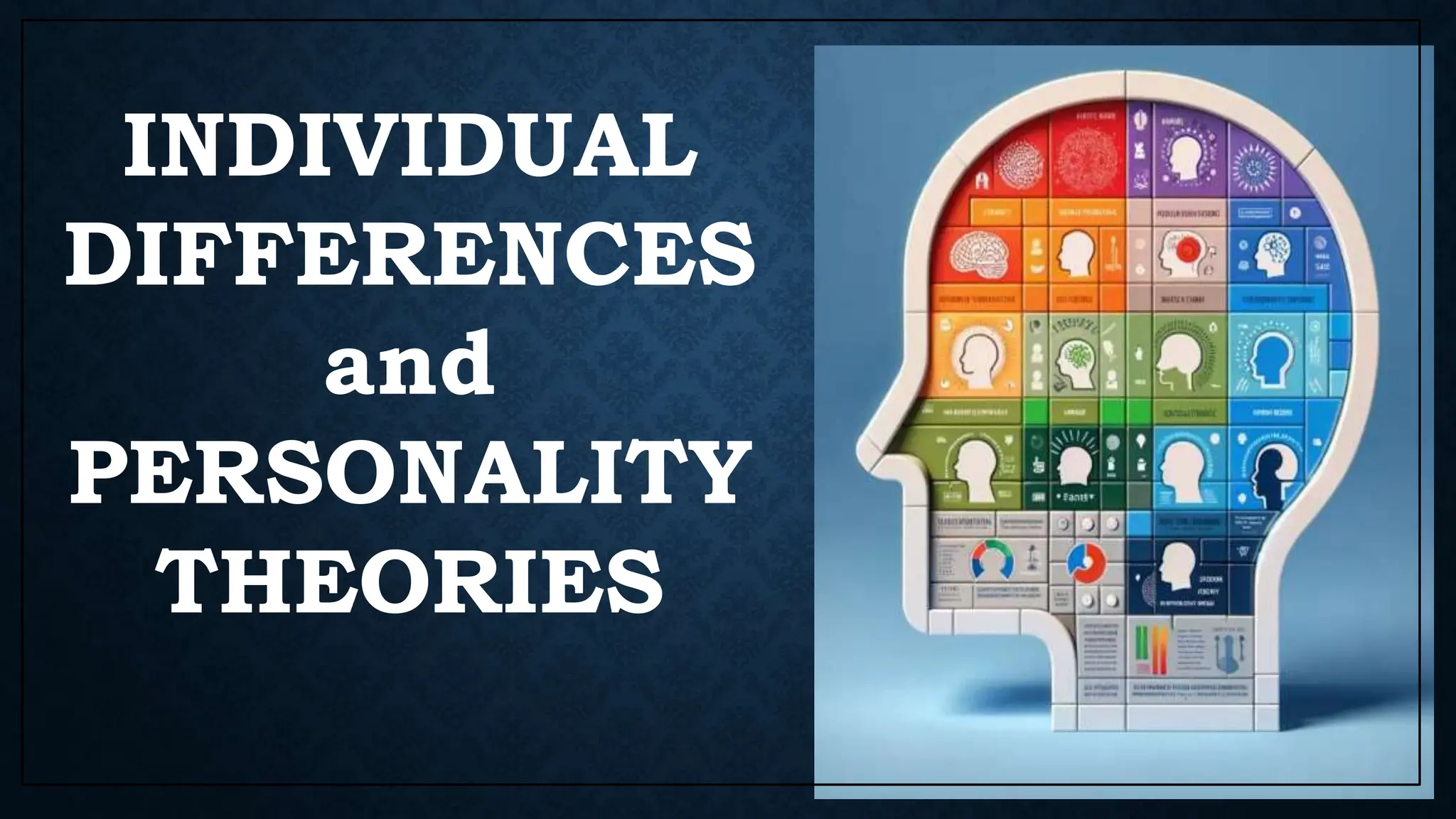
INDIVIDUAL
DIFFERENCES
and
PERSONALITY
THEORIES
MOTIVATION:
SELF ASSESSMENT
PERSONALITY ASSESSMENT
ANALYN S. RIVEL
ASSIGNED
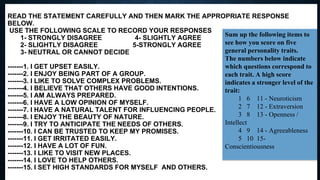
READ THE STATEMENT CAREFULLY AND THEN MARK THE APPROPRIATE RESPONSE
BELOW.
USE THE FOLLOWING SCALE TO RECORD YOUR RESPONSES
1- STRONGLY DISAGREE 4- SLIGHTLY AGREE
2- SLIGHTLY DISAGREE 5-STRONGLY AGREE
3- NEUTRAL OR CANNOT DECIDE
-------1. I GET UPSET EASILY.
-------2. I ENJOY BEING PART OF A GROUP.
-------3. I LIKE TO SOLVE COMPLEX PROBLEMS.
-------4. I BELIEVE THAT OTHERS HAVE GOOD INTENTIONS.
-------5. I AM ALWAYS PREPARED.
-------6. I HAVE A LOW OPINION OF MYSELF.
-------7. I HAVE A NATURAL TALENT FOR INFLUENCING PEOPLE.
-------8. I ENJOY THE BEAUTY OF NATURE.
-------9. I TRY TO ANTICIPATE THE NEEDS OF OTHERS.
-------10. I CAN BE TRUSTED TO KEEP MY PROMISES.
-------11. I GET IRRITATED EASILY.
-------12. I HAVE A LOT OF FUN.
-------13. I LIKE TO VISIT NEW PLACES.
-------14. I LOVE TO HELP OTHERS.
-------15. I SET HIGH STANDARDS FOR MYSELF AND OTHERS.
Sum up the following items to
see how you score on five
general personality traits.
The numbers below indicate
which questions correspond to
each trait. A high score
indicates a stronger level of the
trait:
1 6 11 - Neuroticism
2 7 12 - Extraversion
3 8 13 - Openness /
Intellect
4 9 14 - Agreeableness
5 10 15-
Conscientiousness
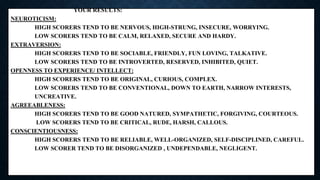
YOUR RESULTS:
NEUROTICISM:
HIGH SCORERS TEND TO BE NERVOUS, HIGH-STRUNG, INSECURE, WORRYING.
LOW SCORERS TEND TO BE CALM, RELAXED, SECURE AND HARDY.
EXTRAVERSION:
HIGH SCORERS TEND TO BE SOCIABLE, FRIENDLY, FUN LOVING, TALKATIVE.
LOW SCORERS TEND TO BE INTROVERTED, RESERVED, INHIBITED, QUIET.
OPENNESS TO EXPERIENCE/ INTELLECT:
HIGH SCORERS TEND TO BE ORIGINAL, CURIOUS, COMPLEX.
LOW SCORERS TEND TO BE CONVENTIONAL, DOWN TO EARTH, NARROW INTERESTS,
UNCREATIVE.
AGREEABLENESS:
HIGH SCORERS TEND TO BE GOOD NATURED, SYMPATHETIC, FORGIVING, COURTEOUS.
LOW SCORERS TEND TO BE CRITICAL, RUDE, HARSH, CALLOUS.
CONSCIENTIOUSNESS:
HIGH SCORERS TEND TO BE RELIABLE, WELL-ORGANIZED, SELF-DISCIPLINED, CAREFUL.
LOW SCORER TEND TO BE DISORGANIZED , UNDEPENDABLE, NEGLIGENT.
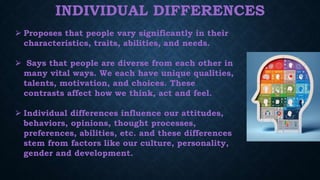
INDIVIDUAL DIFFERENCES
⮚ Proposes that people vary significantly in their
characteristics, traits, abilities, and needs.
⮚ Says that people are diverse from each other in
many vital ways. We each have unique qualities,
talents, motivation, and choices. These
contrasts affect how we think, act and feel.
⮚ Individual differences influence our attitudes,
behaviors, opinions, thought processes,
preferences, abilities, etc. and these differences
stem from factors like our culture, personality,
gender and development.
PERSONALITY THEORY
❑ Personality – a pattern of relatively permanent
traits and characteristics that give both
consistency and individuality to a person’s behavior.
⮚Address the origins of personality as well as the traits
that define a personality.
⮚Studies how an individual develops their personality and
can be utilized in studying personality disorders.
⮚These theories look to understand why people develop
different character traits and respond to external and
internal stimuli differently.
o Understanding personality type can help you understand
your preferences of other people and how or why these
might be different. Personality types are useful for
recognizing how we lead, influence, communicate,
collaborate, negotiate business and manage stress.
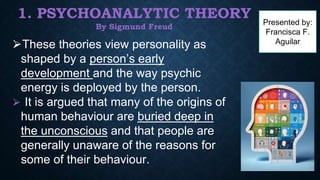
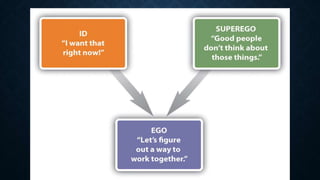
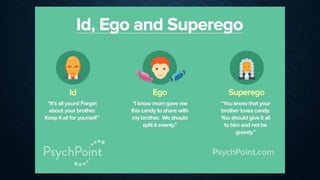
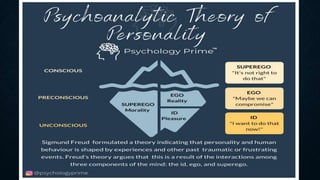
1. PSYCHOANALYTIC THEORY
By Sigmund Freud
⮚These theories view personality as
shaped by a person’s early
development and the way psychic
energy is deployed by the person.
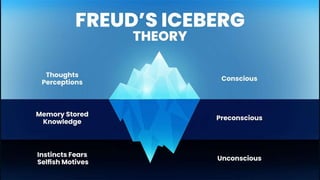
⮚ It is argued that many of the origins of
human behaviour are buried deep in
the unconscious and that people are
generally unaware of the reasons for
some of their behaviour.
Presented by:
Francisca F.
Aguilar
1. PSYCHOANALYTIC THEORY
By Sigmund Freud
⮚Organisational psychology which is
concerned with systems, not only
organisational systems and dynamics
but also with individuals and groups
within the system fostering worker
adjustment, productivity and
satisfaction.
⮚Within organisational systems,
psychodynamics is concerned with
individual differences within the system
1. PSYCHOANALYTIC THEORY
By Sigmund Freud
⮚The focus is on the profound nature of
resistance to change when individuals
encounter dysfunctional leadership,
interpersonal conflicts and ineffective team
processes.
⮚Individuals’ subjective and frequently
unconscious feelings in response to anxiety
and how ego defences are used by
individuals against perceived threats are
considered.
1. PSYCHOANALYTIC THEORY
By Sigmund Freud
⮚Understanding organisations in this
way enables an understanding that
individual differences are not only
bound within individuals but also
manifest in group differences within the
organisation.
⮚This subjective approach may assist
individuals in becoming aware of why
they and others behave in certain ways.
Presented by: Ianroy L. Altahan
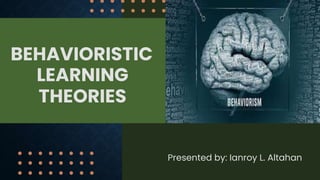
BEHAVIORISTIC
LEARNING
THEORIES
TABLE OF CONTENTS
Looking Back Behaviorism
Definition
Classical
Conditioning
Operant
Conditioning
Wrap-up
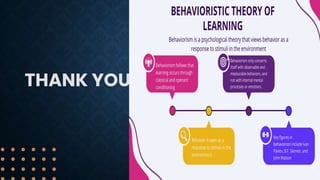
BEHAVIORISM
Definitio
n
Behaviors are acquired through
conditioning, and conditioning occurs
through interaction with the
environment
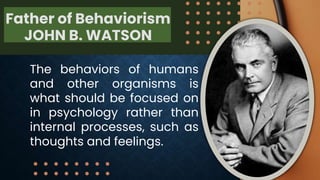
Father of Behaviorism
JOHN B. WATSON
The behaviors of humans
and other organisms is
what should be focused on
in psychology rather than
internal processes, such as
thoughts and feelings.
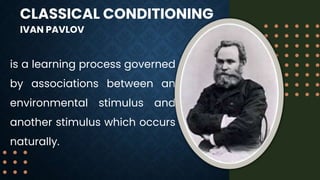
CLASSICAL CONDITIONING
IVAN PAVLOV
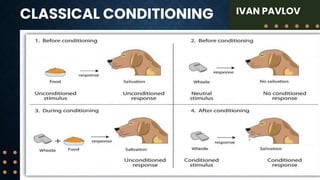
is a learning process governed
by associations between an
environmental stimulus and
another stimulus which occurs
naturally.
CLASSICAL CONDITIONING IVAN PAVLOV
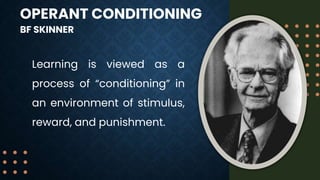
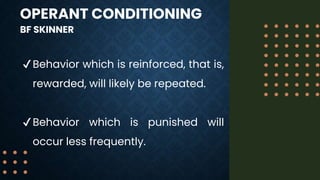
OPERANT CONDITIONING
BF SKINNER
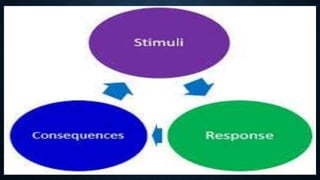
Learning is viewed as a
process of “conditioning” in
an environment of stimulus,
reward, and punishment.
OPERANT CONDITIONING
BF SKINNER
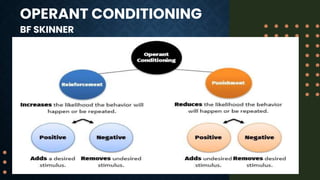
✔Behavior which is reinforced, that is,
rewarded, will likely be repeated.
✔Behavior which is punished will
occur less frequently.
OPERANT CONDITIONING
BF SKINNER
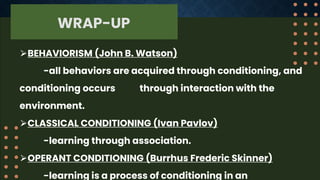
WRAP-UP
⮚BEHAVIORISM (John B. Watson)
-all behaviors are acquired through conditioning, and
conditioning occurs through interaction with the
environment.
⮚CLASSICAL CONDITIONING (Ivan Pavlov)
-learning through association.
⮚OPERANT CONDITIONING (Burrhus Frederic Skinner)
-learning is a process of conditioning in an
THANK YOU
HUMANISTIC
THEORIES OF
PERSONALITY
Presented by:
Josephine R. Amarga
❖Humanistic theories of personality stress the basic
goodness of human beings and the need to achieve
one’s full potential
❖Rejected the assumption of behaviorism and
psychoanalytic approach
❖Two well-known psychologists for their humanistic
theories
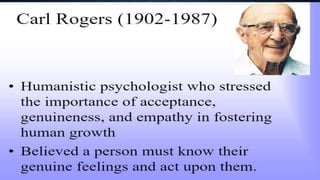
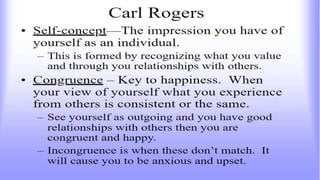
-Carl Rogers
-Abraham Maslow
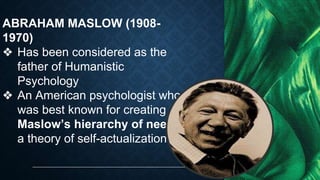
ABRAHAM MASLOW (1908-
1970)
❖ Has been considered as the
father of Humanistic
Psychology
❖ An American psychologist who
was best known for creating
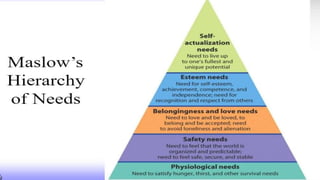
Maslow’s hierarchy of needs,
a theory of self-actualization
20XX
Presentation title 32
CARL ROGERS
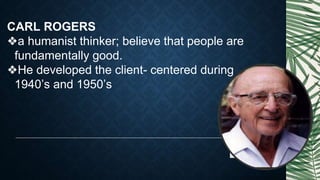
❖a humanist thinker; believe that people are
fundamentally good.
❖He developed the client- centered during
1940’s and 1950’s
INTRODUCTION
At Contoso, we empower organizations to foster
collaborative thinking to further drive workplace
innovation. By closing the loop and leveraging
agile frameworks, we help business
grow organically and foster a consumer-
first mindset.
Presentation title 35
20XX
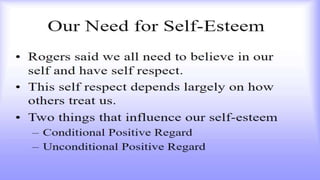
❖ Humanistic theories of personality stress the basic goodness of human beings and
the need to achieve one’s full potential
❖ Rejected the assumption of behaviorism and psychoanalytic approach
❖ Two well-known psychologists for their humanistic theories
-Carl Rogers
-Abraham Maslow
QUARTERLY PERFORMANCE
2.0 2.0
3.0
5.0
2.4
4.4
1.8
2.8
4.3
2.5
3.5
4.5
-
1.0
2.0
3.0
4.0
5.0
6.0
Q1 Q2 Q3 Q4
Series 1 Series 2 Series 3
Presentation title 37
20XX
AREAS OF GROWTH
B2B Supply chain ROI E-commerce
Q1 4.5 2.3 1.7 5.0
Q2 3.2 5.1 4.4 3.0
Q3 2.1 1.7 2.5 2.8
Q4 4.5 2.2 1.7 7.0
Presentation title 38
20XX
MEET OUR TEAM
TAKUMA HAYASHI
President
MIRJAM NILSSON
Chief Executive Officer
FLORA BERGGREN
Chief Operations Officer
RAJESH SANTOSHI
VP Marketing
Presentation title 39
20XX
PERSONALITY
TRAIT THEORY
Think about one of your friends
or a member of your family and
write down eight words that
describe their personality.
TRAIT THEORIES
• Personality trait: a personality
characteristic that endures (lasts)
over time and across different
situations.
• Trait theories of personality
focus on measuring,
identifying and describing
individual differences in
personality in terms of traits
ASSUMPTIONS
1.Personality traits are relatively stable and predictable
over time.
2.Personality traits are relatively stable in different
situations.
3.Personality consists of a number of different traits,
some people have ‘more’ or ‘less’ of each trait than
others.
4.Some traits are closely interrelated than others and
occur together.
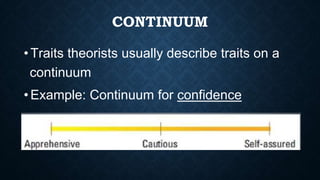
CONTINUUM
• Traits theorists usually describe traits on a
continuum
• Example: Continuum for confidence
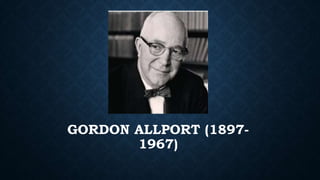
GORDON ALLPORT (1897-
1967)
GORDON ALLPORT (1897-1967)
• Searched the entire dictionary for words that could describe
personality – 17,953
• Eliminated synonyms e.g. nasty, horrible, mean, awful and
spiteful
• Eliminated words not often used e.g. chrematistic and
stultiloquent
• Left 4500 words
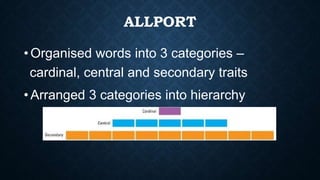
ALLPORT
• Organised words into 3 categories –
cardinal, central and secondary traits
• Arranged 3 categories into hierarchy
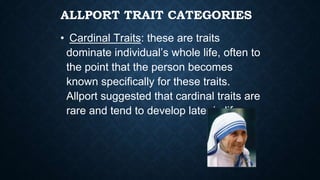
ALLPORT TRAIT CATEGORIES
• Cardinal Traits: these are traits
dominate individual’s whole life, often to
the point that the person becomes
known specifically for these traits.
Allport suggested that cardinal traits are
rare and tend to develop later in life
ALLPORT TRAIT CATEGORIES
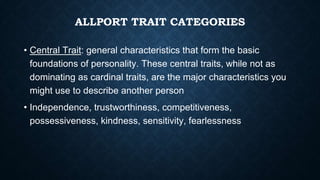
• Central Trait: general characteristics that form the basic
foundations of personality. These central traits, while not as
dominating as cardinal traits, are the major characteristics you
might use to describe another person
• Independence, trustworthiness, competitiveness,
possessiveness, kindness, sensitivity, fearlessness
ALLPORT TRAIT CATEGORIES
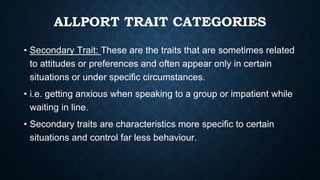
• Secondary Trait: These are the traits that are sometimes related
to attitudes or preferences and often appear only in certain
situations or under specific circumstances.
• i.e. getting anxious when speaking to a group or impatient while
waiting in line.
• Secondary traits are characteristics more specific to certain
situations and control far less behaviour.
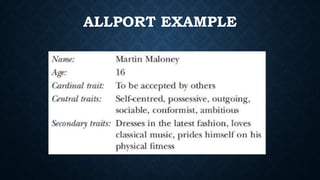
ALLPORT EXAMPLE
ACTIVITY
Using Allport’s trait Theory and based on the example of
Martin Maloney on the previous slide, write a personality
profile for yourself or someone you know
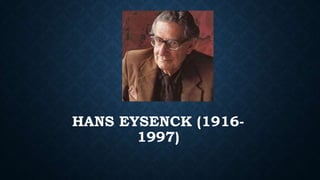
HANS EYSENCK (1916-
1997)
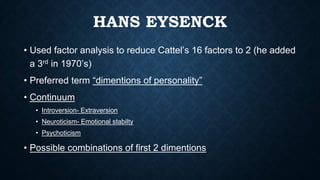
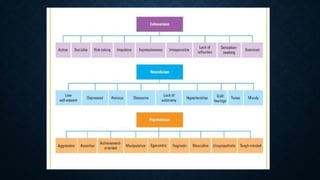
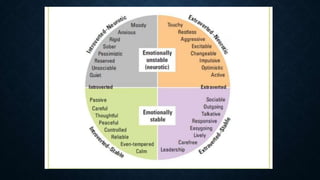
HANS EYSENCK
• Used factor analysis to reduce Cattel’s 16 factors to 2 (he added
a 3rd in 1970’s)
• Preferred term “dimentions of personality”
• Continuum
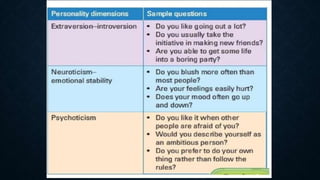
• Introversion- Extraversion
• Neuroticism- Emotional stabilty
• Psychoticism
• Possible combinations of first 2 dimentions
RESEARCH
• Individual differences of personality due to:
• Genetic make-up(tendency to be ‘low’ or ‘high’)
• Research – identical twins obtain similar scores on personality trait
tests
• Functioning of brain and nervous sytem
• Eysenck Personality Questionnaire (EPQ)
TRAIT THEORIES- STRENGTHS
• Provide useful descriptions of personality and
its structure
• Basis for development of reliable and valid
personality tests
• Tell us:
• Why we develop the traits we have
• How we come to have combinations we do
• Why we have more or less of particular traits
• Why traits are enduring and stable across different
situations
TRAIT THEORIES-
LIMITATIONS
• Lead people to use oversimplified
classifications and descriptions of people
– human personality too complex to be
described by simple labels
• Under- estimate the way(s) in which
specific situations and socio-cultural
factors influence behaviour
• Identification of personality traits through
statistical procedures- human behaviour
Thank you for
listening!
https://slideplayer.com/slide/16849822

TEAM B - Individual-Differences-Personality-Theories.pptx

  • 1.
  • 2.
  • 3.
    READ THE STATEMENTCAREFULLY AND THEN MARK THE APPROPRIATE RESPONSE BELOW. USE THE FOLLOWING SCALE TO RECORD YOUR RESPONSES 1- STRONGLY DISAGREE 4- SLIGHTLY AGREE 2- SLIGHTLY DISAGREE 5-STRONGLY AGREE 3- NEUTRAL OR CANNOT DECIDE -------1. I GET UPSET EASILY. -------2. I ENJOY BEING PART OF A GROUP. -------3. I LIKE TO SOLVE COMPLEX PROBLEMS. -------4. I BELIEVE THAT OTHERS HAVE GOOD INTENTIONS. -------5. I AM ALWAYS PREPARED. -------6. I HAVE A LOW OPINION OF MYSELF. -------7. I HAVE A NATURAL TALENT FOR INFLUENCING PEOPLE. -------8. I ENJOY THE BEAUTY OF NATURE. -------9. I TRY TO ANTICIPATE THE NEEDS OF OTHERS. -------10. I CAN BE TRUSTED TO KEEP MY PROMISES. -------11. I GET IRRITATED EASILY. -------12. I HAVE A LOT OF FUN. -------13. I LIKE TO VISIT NEW PLACES. -------14. I LOVE TO HELP OTHERS. -------15. I SET HIGH STANDARDS FOR MYSELF AND OTHERS. Sum up the following items to see how you score on five general personality traits. The numbers below indicate which questions correspond to each trait. A high score indicates a stronger level of the trait: 1 6 11 - Neuroticism 2 7 12 - Extraversion 3 8 13 - Openness / Intellect 4 9 14 - Agreeableness 5 10 15- Conscientiousness
  • 4.
    YOUR RESULTS: NEUROTICISM: HIGH SCORERSTEND TO BE NERVOUS, HIGH-STRUNG, INSECURE, WORRYING. LOW SCORERS TEND TO BE CALM, RELAXED, SECURE AND HARDY. EXTRAVERSION: HIGH SCORERS TEND TO BE SOCIABLE, FRIENDLY, FUN LOVING, TALKATIVE. LOW SCORERS TEND TO BE INTROVERTED, RESERVED, INHIBITED, QUIET. OPENNESS TO EXPERIENCE/ INTELLECT: HIGH SCORERS TEND TO BE ORIGINAL, CURIOUS, COMPLEX. LOW SCORERS TEND TO BE CONVENTIONAL, DOWN TO EARTH, NARROW INTERESTS, UNCREATIVE. AGREEABLENESS: HIGH SCORERS TEND TO BE GOOD NATURED, SYMPATHETIC, FORGIVING, COURTEOUS. LOW SCORERS TEND TO BE CRITICAL, RUDE, HARSH, CALLOUS. CONSCIENTIOUSNESS: HIGH SCORERS TEND TO BE RELIABLE, WELL-ORGANIZED, SELF-DISCIPLINED, CAREFUL. LOW SCORER TEND TO BE DISORGANIZED , UNDEPENDABLE, NEGLIGENT.
  • 5.
    INDIVIDUAL DIFFERENCES ⮚ Proposesthat people vary significantly in their characteristics, traits, abilities, and needs. ⮚ Says that people are diverse from each other in many vital ways. We each have unique qualities, talents, motivation, and choices. These contrasts affect how we think, act and feel. ⮚ Individual differences influence our attitudes, behaviors, opinions, thought processes, preferences, abilities, etc. and these differences stem from factors like our culture, personality, gender and development.
  • 6.
    PERSONALITY THEORY ❑ Personality– a pattern of relatively permanent traits and characteristics that give both consistency and individuality to a person’s behavior. ⮚Address the origins of personality as well as the traits that define a personality. ⮚Studies how an individual develops their personality and can be utilized in studying personality disorders. ⮚These theories look to understand why people develop different character traits and respond to external and internal stimuli differently.
  • 7.
    o Understanding personalitytype can help you understand your preferences of other people and how or why these might be different. Personality types are useful for recognizing how we lead, influence, communicate, collaborate, negotiate business and manage stress.
  • 8.
    1. PSYCHOANALYTIC THEORY BySigmund Freud ⮚These theories view personality as shaped by a person’s early development and the way psychic energy is deployed by the person. ⮚ It is argued that many of the origins of human behaviour are buried deep in the unconscious and that people are generally unaware of the reasons for some of their behaviour. Presented by: Francisca F. Aguilar
  • 14.
    1. PSYCHOANALYTIC THEORY BySigmund Freud ⮚Organisational psychology which is concerned with systems, not only organisational systems and dynamics but also with individuals and groups within the system fostering worker adjustment, productivity and satisfaction. ⮚Within organisational systems, psychodynamics is concerned with individual differences within the system
  • 15.
    1. PSYCHOANALYTIC THEORY BySigmund Freud ⮚The focus is on the profound nature of resistance to change when individuals encounter dysfunctional leadership, interpersonal conflicts and ineffective team processes. ⮚Individuals’ subjective and frequently unconscious feelings in response to anxiety and how ego defences are used by individuals against perceived threats are considered.
  • 16.
    1. PSYCHOANALYTIC THEORY BySigmund Freud ⮚Understanding organisations in this way enables an understanding that individual differences are not only bound within individuals but also manifest in group differences within the organisation. ⮚This subjective approach may assist individuals in becoming aware of why they and others behave in certain ways.
  • 17.
    Presented by: IanroyL. Altahan BEHAVIORISTIC LEARNING THEORIES
  • 18.
    TABLE OF CONTENTS LookingBack Behaviorism Definition Classical Conditioning Operant Conditioning Wrap-up
  • 19.
    BEHAVIORISM Definitio n Behaviors are acquiredthrough conditioning, and conditioning occurs through interaction with the environment
  • 20.
    Father of Behaviorism JOHNB. WATSON The behaviors of humans and other organisms is what should be focused on in psychology rather than internal processes, such as thoughts and feelings.
  • 22.
    CLASSICAL CONDITIONING IVAN PAVLOV isa learning process governed by associations between an environmental stimulus and another stimulus which occurs naturally.
  • 23.
  • 24.
    OPERANT CONDITIONING BF SKINNER Learningis viewed as a process of “conditioning” in an environment of stimulus, reward, and punishment.
  • 25.
    OPERANT CONDITIONING BF SKINNER ✔Behaviorwhich is reinforced, that is, rewarded, will likely be repeated. ✔Behavior which is punished will occur less frequently.
  • 26.
  • 27.
    WRAP-UP ⮚BEHAVIORISM (John B.Watson) -all behaviors are acquired through conditioning, and conditioning occurs through interaction with the environment. ⮚CLASSICAL CONDITIONING (Ivan Pavlov) -learning through association. ⮚OPERANT CONDITIONING (Burrhus Frederic Skinner) -learning is a process of conditioning in an
  • 28.
  • 29.
  • 30.
    ❖Humanistic theories ofpersonality stress the basic goodness of human beings and the need to achieve one’s full potential ❖Rejected the assumption of behaviorism and psychoanalytic approach ❖Two well-known psychologists for their humanistic theories -Carl Rogers -Abraham Maslow
  • 31.
    ABRAHAM MASLOW (1908- 1970) ❖Has been considered as the father of Humanistic Psychology ❖ An American psychologist who was best known for creating Maslow’s hierarchy of needs, a theory of self-actualization
  • 32.
  • 33.
    CARL ROGERS ❖a humanistthinker; believe that people are fundamentally good. ❖He developed the client- centered during 1940’s and 1950’s
  • 35.
    INTRODUCTION At Contoso, weempower organizations to foster collaborative thinking to further drive workplace innovation. By closing the loop and leveraging agile frameworks, we help business grow organically and foster a consumer- first mindset. Presentation title 35 20XX
  • 36.
    ❖ Humanistic theoriesof personality stress the basic goodness of human beings and the need to achieve one’s full potential ❖ Rejected the assumption of behaviorism and psychoanalytic approach ❖ Two well-known psychologists for their humanistic theories -Carl Rogers -Abraham Maslow
  • 37.
  • 38.
    AREAS OF GROWTH B2BSupply chain ROI E-commerce Q1 4.5 2.3 1.7 5.0 Q2 3.2 5.1 4.4 3.0 Q3 2.1 1.7 2.5 2.8 Q4 4.5 2.2 1.7 7.0 Presentation title 38 20XX
  • 39.
    MEET OUR TEAM TAKUMAHAYASHI President MIRJAM NILSSON Chief Executive Officer FLORA BERGGREN Chief Operations Officer RAJESH SANTOSHI VP Marketing Presentation title 39 20XX
  • 40.
  • 41.
    Think about oneof your friends or a member of your family and write down eight words that describe their personality.
  • 42.
    TRAIT THEORIES • Personalitytrait: a personality characteristic that endures (lasts) over time and across different situations.
  • 43.
    • Trait theoriesof personality focus on measuring, identifying and describing individual differences in personality in terms of traits
  • 44.
    ASSUMPTIONS 1.Personality traits arerelatively stable and predictable over time. 2.Personality traits are relatively stable in different situations. 3.Personality consists of a number of different traits, some people have ‘more’ or ‘less’ of each trait than others. 4.Some traits are closely interrelated than others and occur together.
  • 46.
    CONTINUUM • Traits theoristsusually describe traits on a continuum • Example: Continuum for confidence
  • 47.
  • 48.
    GORDON ALLPORT (1897-1967) •Searched the entire dictionary for words that could describe personality – 17,953 • Eliminated synonyms e.g. nasty, horrible, mean, awful and spiteful • Eliminated words not often used e.g. chrematistic and stultiloquent • Left 4500 words
  • 49.
    ALLPORT • Organised wordsinto 3 categories – cardinal, central and secondary traits • Arranged 3 categories into hierarchy
  • 50.
    ALLPORT TRAIT CATEGORIES •Cardinal Traits: these are traits dominate individual’s whole life, often to the point that the person becomes known specifically for these traits. Allport suggested that cardinal traits are rare and tend to develop later in life
  • 51.
    ALLPORT TRAIT CATEGORIES •Central Trait: general characteristics that form the basic foundations of personality. These central traits, while not as dominating as cardinal traits, are the major characteristics you might use to describe another person • Independence, trustworthiness, competitiveness, possessiveness, kindness, sensitivity, fearlessness
  • 52.
    ALLPORT TRAIT CATEGORIES •Secondary Trait: These are the traits that are sometimes related to attitudes or preferences and often appear only in certain situations or under specific circumstances. • i.e. getting anxious when speaking to a group or impatient while waiting in line. • Secondary traits are characteristics more specific to certain situations and control far less behaviour.
  • 53.
  • 54.
    ACTIVITY Using Allport’s traitTheory and based on the example of Martin Maloney on the previous slide, write a personality profile for yourself or someone you know
  • 55.
  • 56.
    HANS EYSENCK • Usedfactor analysis to reduce Cattel’s 16 factors to 2 (he added a 3rd in 1970’s) • Preferred term “dimentions of personality” • Continuum • Introversion- Extraversion • Neuroticism- Emotional stabilty • Psychoticism • Possible combinations of first 2 dimentions
  • 59.
    RESEARCH • Individual differencesof personality due to: • Genetic make-up(tendency to be ‘low’ or ‘high’) • Research – identical twins obtain similar scores on personality trait tests • Functioning of brain and nervous sytem • Eysenck Personality Questionnaire (EPQ)
  • 61.
    TRAIT THEORIES- STRENGTHS •Provide useful descriptions of personality and its structure • Basis for development of reliable and valid personality tests • Tell us: • Why we develop the traits we have • How we come to have combinations we do • Why we have more or less of particular traits • Why traits are enduring and stable across different situations
  • 62.
    TRAIT THEORIES- LIMITATIONS • Leadpeople to use oversimplified classifications and descriptions of people – human personality too complex to be described by simple labels • Under- estimate the way(s) in which specific situations and socio-cultural factors influence behaviour • Identification of personality traits through statistical procedures- human behaviour
  • 63.