Personality
“An individual’s unique and relatively
consistent patterns of thinking, feeling, and
behaving.”
Personality – an attempt to describe and explain how
people are similar, how they are different, and why
every individual is unique.
• tries to explain the whole person.
Personality
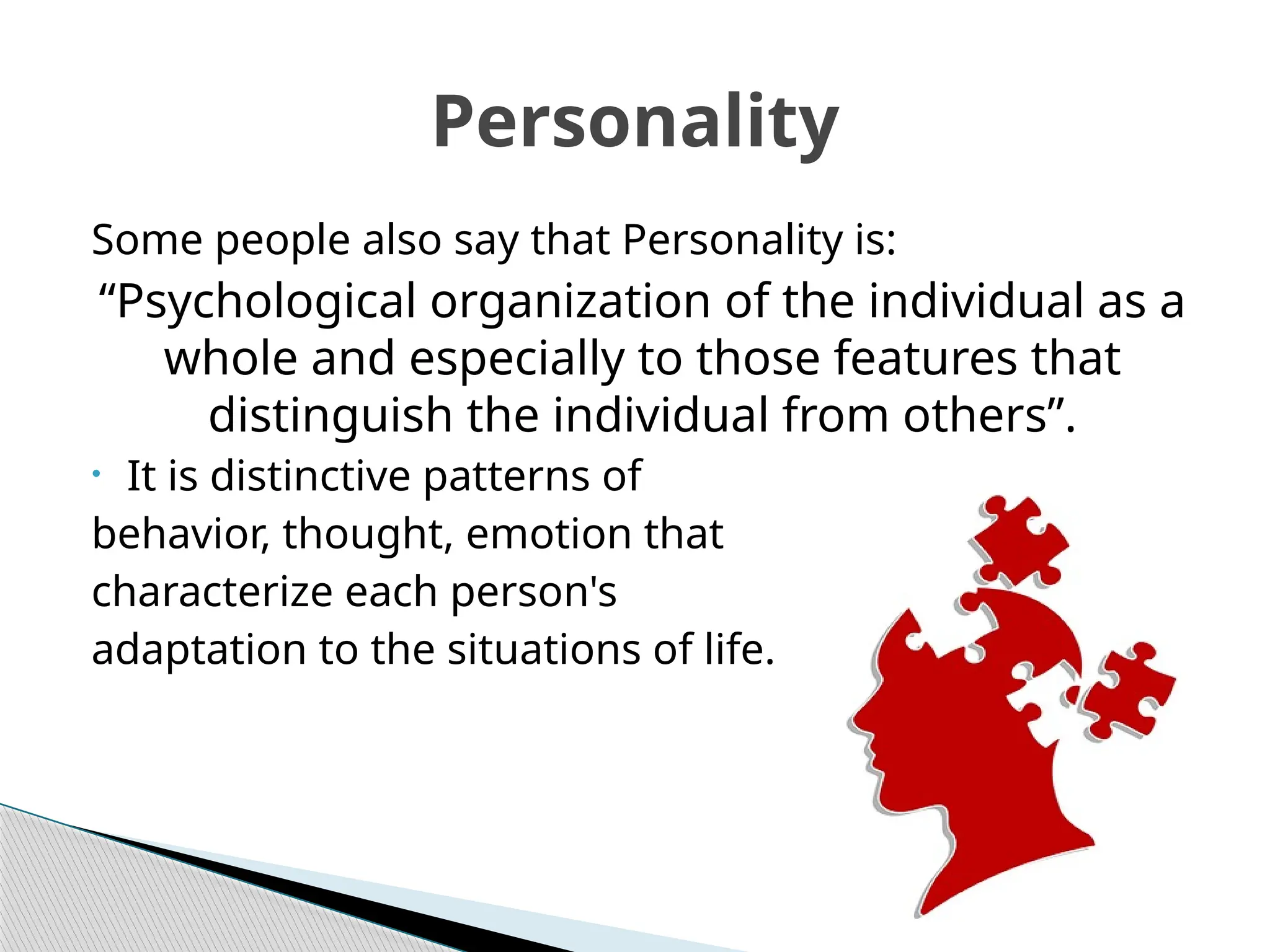
Some people also say that Personality is:
“Psychological organization of the individual as a
whole and especially to those features that
distinguish the individual from others”.
• It is distinctive patterns of
behavior, thought, emotion that
characterize each person's
adaptation to the situations of life.
Personality
Personality
Personality - A relatively stable set of
characteristics that influences an individual’s
behavior.
Depends on how you study personality…
Cross sectional studies vs. Longitudinal studies.
Depends on how, what aspect of personality you
are measuring…Theories of Personality
Does Personality Change Over Time?
Personality Types
Positive Affect - an individual’s tendency to
portray the positive aspects of oneself, other
people, and the world in general
Negative Affect - an individual’s tendency to
portray the negative aspects of oneself, other
people, and the world in general
Personality Characteristics
 The personal interview
 Direct observation
 Projective tests
Personality Assessment
 Interview: Face-to-face meeting designed to gain
information about someone’s personality, current
psychological state, or personal history
◦ Unstructured Interview: Conversation is informal, and topics
are discussed as they arise
◦ Structured Interview: Follows a prearranged plan, using a
series of planned questions
 Halo Effect: Tendency to generalize a favorable or
unfavorable first impression to unrelated details of
personality.
 Direct Observation: Assessing behavior through
direct surveillance
Personality Assessment
 A projective test is a personality test in which
subjects are shown ambiguous images and
asked to interpret them.
Projective assessments
 Trait Theory
 Psychodynamic Theory
 Humanistic Theory
 Behavioral Theory
Personality Theories
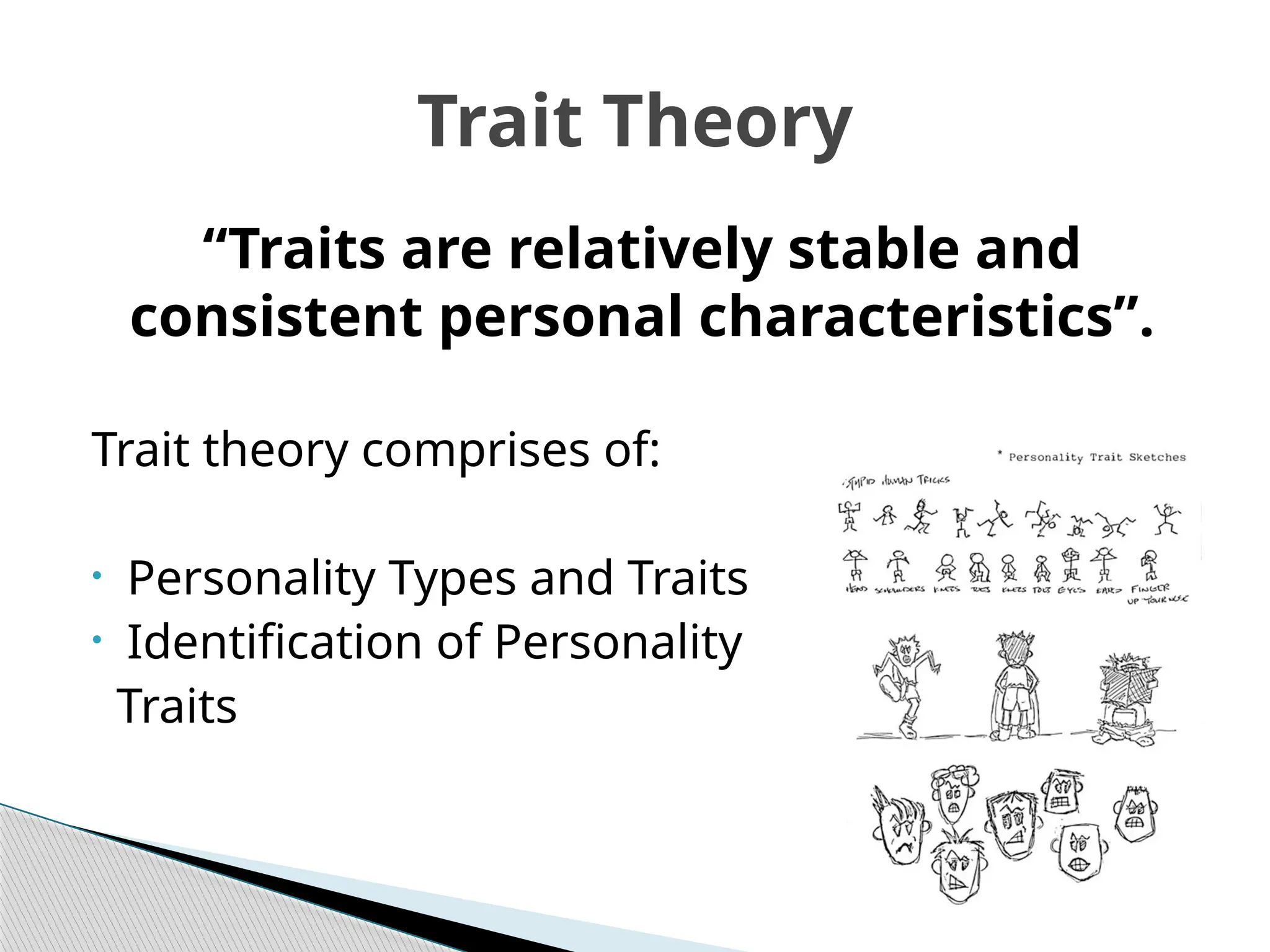
“Traits are relatively stable and
consistent personal characteristics”.
Trait theory comprises of:
• Personality Types and Traits
• Identification of Personality
Traits
Trait Theory
 A personality type is a discrete category into
which a person can be sorted.
 A personality trait is an enduring personal
characteristic that underlies a person’s
reactions to a variety of situations
Personality Types and Traits
 Assumption of trait stability has led researchers
to examine personality traits longitudinally
 McCrae and Costa (1984, 1990) proposed 5-
factor model of personality traits:
• Neuroticism
• Extraversion
• Openness to experience
• Agreeableness
• Conscientiousness
Trait Theory
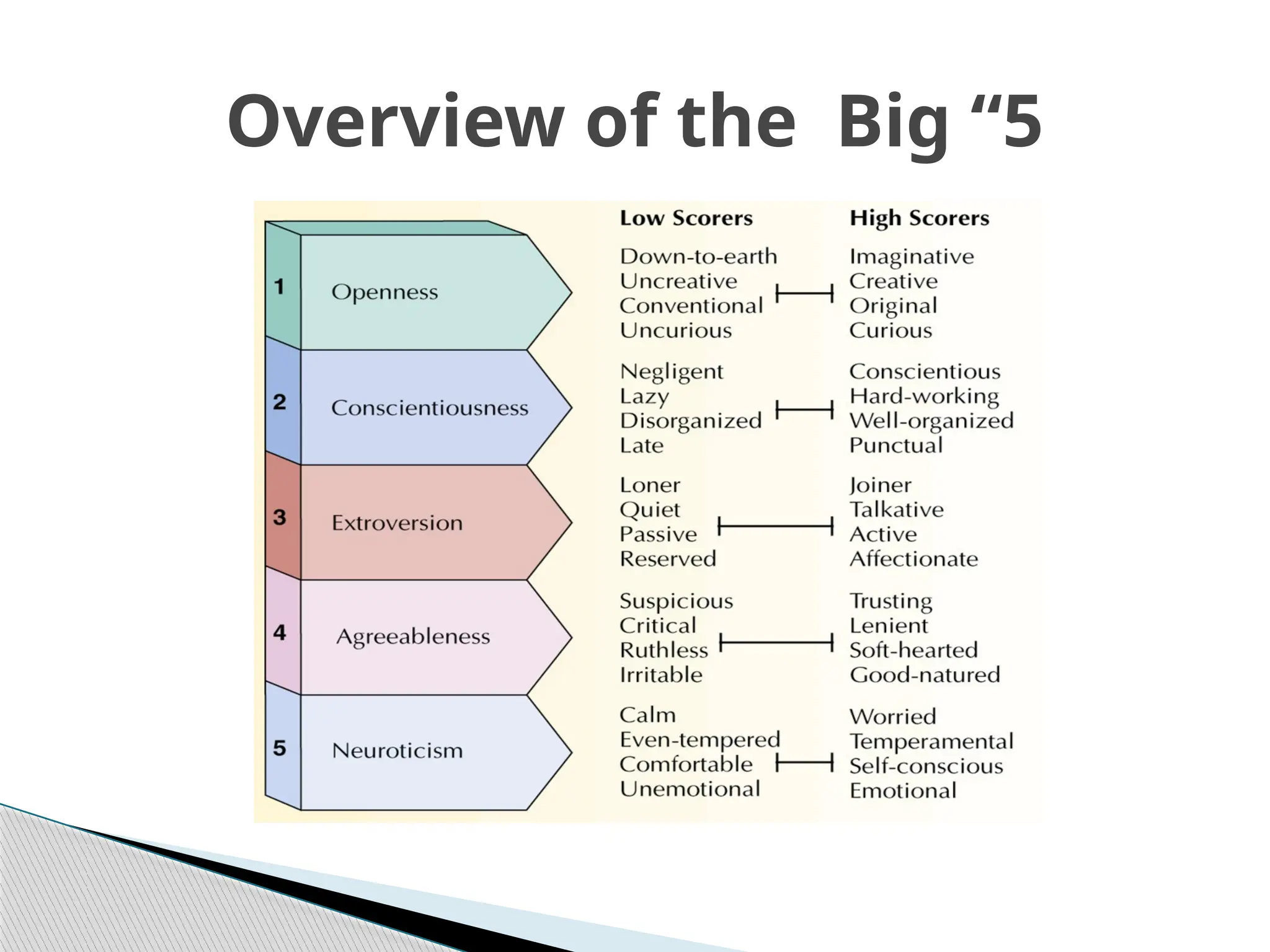
Modern personality research argues for 5 basic
personality traits (OCEAN)
• Neuroticism: a person’s level of emotional stability.
• Extraversion: whether a person is sociable,
outgoing and affectionate
• Openness to experience: whether a person is
open to new experiences
• Agreeableness: whether a person is cooperative,
trusting, and helpful
• Conscientiousness: whether a person is disciplined
and responsible
The “Big 5”
Overview of the Big “5
Personality theory contending that
“behavior results from psychological forces that
interact within the individual that explain human
behavior and personality”.
Psychodynamic theory (sometimes called psychoanalytic
theory) explains personality in terms of unconscious
psychological processes (for example, wishes and fears
of which we’re not fully aware), and contends that
childhood experiences are crucial in shaping adult
personality.
Psychodynamic theory
Humanistic psychologists contended that the
most important factor in personality is the
individual’s perception of his or her self.
“It views people as inherently good and self-
motivated to improve”.
Humanistic Theory
- Humanistic theories view each person as
basically good and that people are striving for
self-fulfillment
- Humanistic theory argues that people carry a
perception of themselves and of the world
- The goal for a humanist is to develop/promote
a positive self-concept
Humanistic Theory
According to the behaviorists, learning can be
defined as
“the relatively permanent change in behavior
brought about as a result of experience or
practice.”
Behavioral Theory
 The focus of the behavioral approach is on how
the environment impacts overt behavior.
 Remember that biological maturation or
genetics is an alternative explanation for
relatively permanent change.
 Behaviorists are not interested in the conscious
decision of the individual to disrupt, modify, or
go against the conditioning process, they are
only interested in that aspect of feedback that
connects directly to overt behavior.
Behavioral Theory
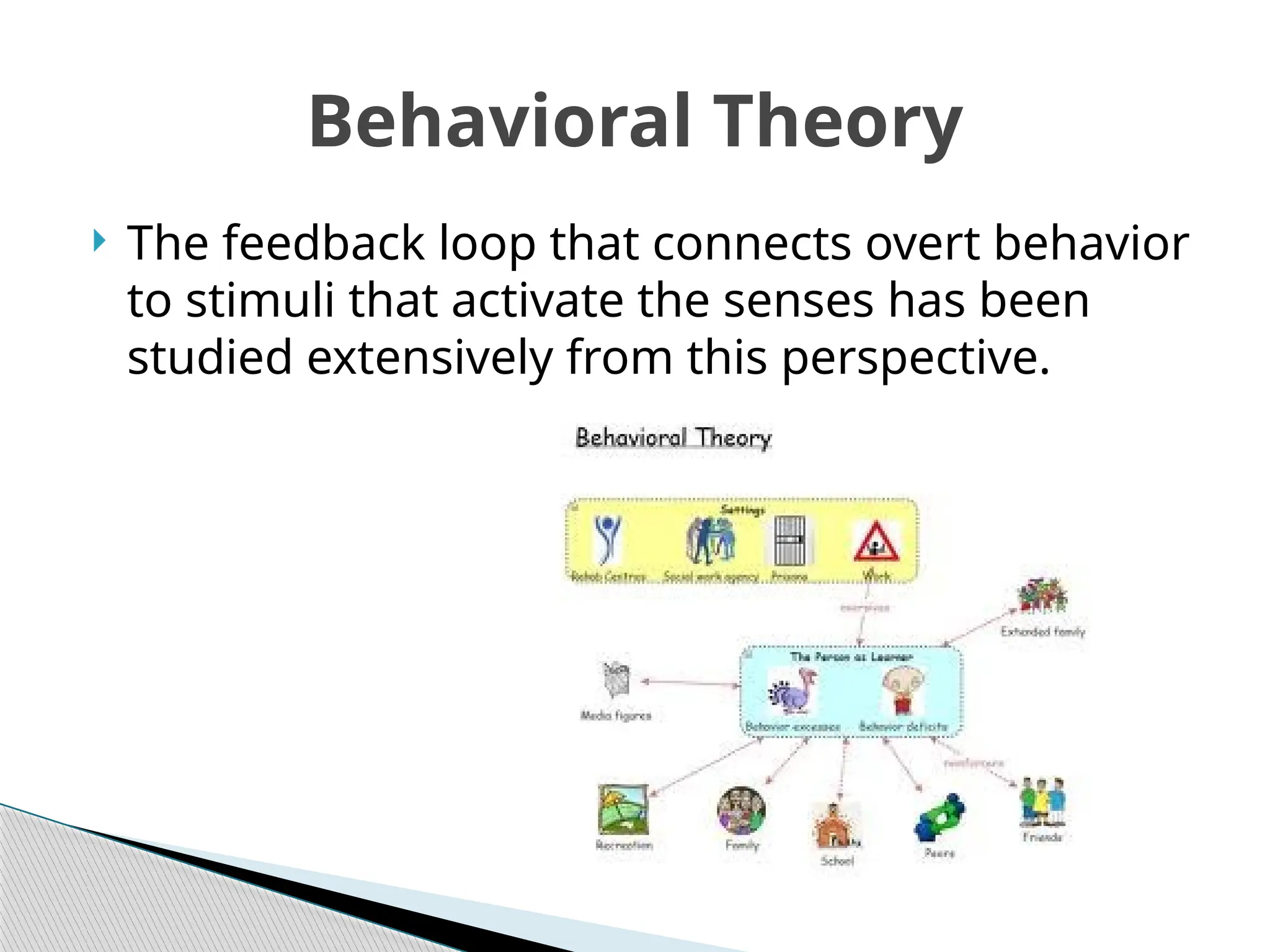
 The feedback loop that connects overt behavior
to stimuli that activate the senses has been
studied extensively from this perspective.
Behavioral Theory

Document_from_Manahil.pptxbhfhvffyjbvbbh

  • 1.
  • 2.
    “An individual’s uniqueand relatively consistent patterns of thinking, feeling, and behaving.” Personality – an attempt to describe and explain how people are similar, how they are different, and why every individual is unique. • tries to explain the whole person. Personality
  • 3.
    Some people alsosay that Personality is: “Psychological organization of the individual as a whole and especially to those features that distinguish the individual from others”. • It is distinctive patterns of behavior, thought, emotion that characterize each person's adaptation to the situations of life. Personality
  • 4.
    Personality Personality - Arelatively stable set of characteristics that influences an individual’s behavior.
  • 5.
    Depends on howyou study personality… Cross sectional studies vs. Longitudinal studies. Depends on how, what aspect of personality you are measuring…Theories of Personality Does Personality Change Over Time?
  • 6.
  • 7.
    Positive Affect -an individual’s tendency to portray the positive aspects of oneself, other people, and the world in general Negative Affect - an individual’s tendency to portray the negative aspects of oneself, other people, and the world in general Personality Characteristics
  • 8.
     The personalinterview  Direct observation  Projective tests Personality Assessment
  • 9.
     Interview: Face-to-facemeeting designed to gain information about someone’s personality, current psychological state, or personal history ◦ Unstructured Interview: Conversation is informal, and topics are discussed as they arise ◦ Structured Interview: Follows a prearranged plan, using a series of planned questions  Halo Effect: Tendency to generalize a favorable or unfavorable first impression to unrelated details of personality.  Direct Observation: Assessing behavior through direct surveillance Personality Assessment
  • 10.
     A projectivetest is a personality test in which subjects are shown ambiguous images and asked to interpret them. Projective assessments
  • 11.
     Trait Theory Psychodynamic Theory  Humanistic Theory  Behavioral Theory Personality Theories
  • 12.
    “Traits are relativelystable and consistent personal characteristics”. Trait theory comprises of: • Personality Types and Traits • Identification of Personality Traits Trait Theory
  • 13.
     A personalitytype is a discrete category into which a person can be sorted.  A personality trait is an enduring personal characteristic that underlies a person’s reactions to a variety of situations Personality Types and Traits
  • 14.
     Assumption oftrait stability has led researchers to examine personality traits longitudinally  McCrae and Costa (1984, 1990) proposed 5- factor model of personality traits: • Neuroticism • Extraversion • Openness to experience • Agreeableness • Conscientiousness Trait Theory
  • 15.
    Modern personality researchargues for 5 basic personality traits (OCEAN) • Neuroticism: a person’s level of emotional stability. • Extraversion: whether a person is sociable, outgoing and affectionate • Openness to experience: whether a person is open to new experiences • Agreeableness: whether a person is cooperative, trusting, and helpful • Conscientiousness: whether a person is disciplined and responsible The “Big 5”
  • 16.
  • 17.
    Personality theory contendingthat “behavior results from psychological forces that interact within the individual that explain human behavior and personality”. Psychodynamic theory (sometimes called psychoanalytic theory) explains personality in terms of unconscious psychological processes (for example, wishes and fears of which we’re not fully aware), and contends that childhood experiences are crucial in shaping adult personality. Psychodynamic theory
  • 18.
    Humanistic psychologists contendedthat the most important factor in personality is the individual’s perception of his or her self. “It views people as inherently good and self- motivated to improve”. Humanistic Theory
  • 19.
    - Humanistic theoriesview each person as basically good and that people are striving for self-fulfillment - Humanistic theory argues that people carry a perception of themselves and of the world - The goal for a humanist is to develop/promote a positive self-concept Humanistic Theory
  • 20.
    According to thebehaviorists, learning can be defined as “the relatively permanent change in behavior brought about as a result of experience or practice.” Behavioral Theory
  • 21.
     The focusof the behavioral approach is on how the environment impacts overt behavior.  Remember that biological maturation or genetics is an alternative explanation for relatively permanent change.  Behaviorists are not interested in the conscious decision of the individual to disrupt, modify, or go against the conditioning process, they are only interested in that aspect of feedback that connects directly to overt behavior. Behavioral Theory
  • 22.
     The feedbackloop that connects overt behavior to stimuli that activate the senses has been studied extensively from this perspective. Behavioral Theory