CONTENTS
01
DEFINITION
02
COMPONENTS
03
THEORIES
Personality
PART 01: Definition
comes for a latin word “persona”, which referred to theatrical
masks worn by Roman actors in Greek dramas to portray.
• Personality is the unique and enduring
pattern of thoughts, feelings, and
behaviors that make up an individual.
• It's what distinguishes you from
everyone else, shaping how you perceive
the world, interact with others, and make
decisions.
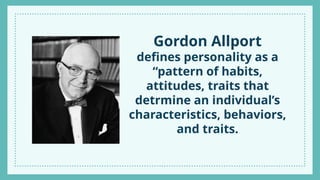
Gordon Allport
defines personality as a
“pattern of habits,
attitudes, traits that
detrmine an individual’s
characteristics, behaviors,
and traits.
Your Title Here
PART 02
Components of Personality
1.Physical
2.Intelectual
3.Social
4.Emotional
5.Values System
PART 03
Theories of Personality
PART 03.1
Type Theory
fascinating approach to understanding how we differ. They
categorize people into distinct types based on shared
characteristics and behavioral patterns.
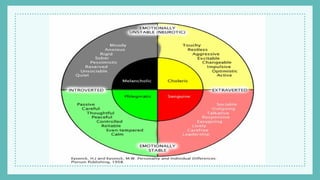
Here are some prominent type theories:
1. Hippocrates' Four Temperaments (Ancient
Greece)
• Sanguine: Optimistic, cheerful, sociable, and
active.
• Choleric: Passionate, assertive, ambitious, and
prone to anger.
• Melancholic: Introspective, thoughtful, creative,
and prone to sadness.
• Phlegmatic: Calm, peaceful, easygoing, and
slow to anger.
Here are some prominent type theories:
2. Carl Jung's Psychological Types (Early 20th
Century)
• Introverted - Individuals who are primarily introverted
tend to focus their energy inward, towards their own
thoughts, feelings, and internal experiences.
• Extraverted - Extraverted individuals direct their
energy outward, towards the external world, people,
and activities. They thrive in social settings, find
excitement in external stimulation, and enjoy being the
center of attention.
Here are some prominent type theories:
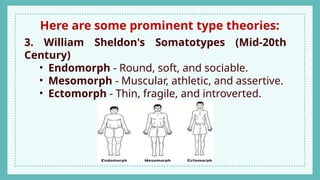
3. William Sheldon's Somatotypes (Mid-20th
Century)
• Endomorph - Round, soft, and sociable.
• Mesomorph - Muscular, athletic, and assertive.
• Ectomorph - Thin, fragile, and introverted.
Here are some prominent type theories:
4. Myers-Briggs Type Indicator (MBTI)
• It categorizes people into 16 types based on
four dichotomies:
• Introversion (I) vs. Extroversion (E)
• Sensing (S) vs. Intuition (N)
• Thinking (T) vs. Feeling (F)
• Judging (J) vs. Perceiving (P)
Here are some prominent type theories:
5. Meyer Friedman and Ray Rosenman Theory
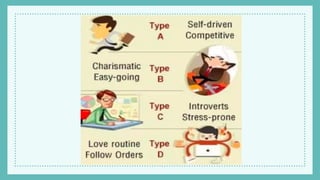
• Type A individuals were characterized as being
highly competitive, ambitious, impatient, time-
conscious, and prone to hostility.
• Type B individuals, on the other hand, were
described as relaxed, easygoing, and less
competitive . They were less driven by deadlines
and more tolerant of delays and ambiguity
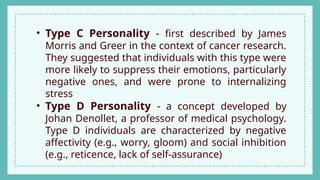
• Type C Personality - first described by James
Morris and Greer in the context of cancer research.
They suggested that individuals with this type were
more likely to suppress their emotions, particularly
negative ones, and were prone to internalizing
stress
• Type D Personality - a concept developed by
Johan Denollet, a professor of medical psychology.
Type D individuals are characterized by negative
affectivity (e.g., worry, gloom) and social inhibition
(e.g., reticence, lack of self-assurance)
PART 03.2
Trait Theory
major approach in psychology that focus on identifying and
measuring individual differences in personality.
Trait Theory
1. Gordon Allport's trait theory of personality was one of the first
attempts to systematically understand individual differences.
Allport proposed three levels of traits:
• Cardinal Traits - are dominant traits that shape a person's
entire life and are often so pervasive they become
synonymous with the individual. They are rare and only a few
people develop them.
• Central Traits -These are general characteristics that
describe a person's core personality.
• Secondary Traits -These are less consistent traits that appear
only in specific situations or under specific circumstances.
They are often related to attitudes or preferences.
Trait Theory
2. Raymond Cattell's trait theory - focusing on identifying and
measuring the underlying dimensions of personality. He
believed that personality is composed of a set of traits, which
are relatively stable and enduring characteristics that influence
our behavior, thoughts, and feelings.
• Source Traits - are fundamental, underlying personality
dimensions that influence a person's observable behaviors and
characteristics. These traits are considered to be the building
blocks of personality, shaping a person's thoughts, feelings, and
actions in a consistent manner.
• Surface Traits - These are the observable characteristics that
we see in people's behavior, such as being outgoing, shy, or
anxious.
Trait Theory
3. Hans Eysenck's theory of personality - known for its
empirical rigor and its emphasis on the biological
underpinnings of behavior. His theory revolves around three
primary dimensions:
• Extraversion - Introversion (E) - This dimension reflects an
individual's sociability, energy, and assertiveness.
• Neuroticism - Stability (N) - This dimension denotes emotional
instability and a tendency to experience negative emotions such
as anxiety and depression.
• Self-control - Psychoticism (P) - This dimension, added later to
the model, is associated with aggressiveness, creativity, and
nonconformity.
Trait Theory
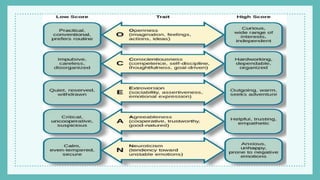
4. The Five Factor Theory, a.k.a Big Five Model, is a prominent
theory in personality psychology that proposes five broad dimensions
to describe human personality. While many researchers contributed
to its development, Paul T. Costa Jr. and Robert R. McCrae are
particularly recognized for their significant contributions to the
theory and its refinement.
• Openness to Experience - This dimension reflects an
individual's curiosity, imagination, and willingness to try new
things. People high in openness are often described as
intellectually curious, adventurous, and open to new ideas.
• Conscientiousness - This dimension represents an individual's
level of organization, responsibility, and self-discipline. People
high in conscientiousness are typically dependable,
hardworking, and goal-oriented.
• Extraversion - This dimension captures an individual's
sociability, assertiveness, and energy levels. Extraverts are
often outgoing, enjoy social interactions, and thrive in
stimulating environments
• Agreeableness - This dimension reflects an individual's level of
empathy, cooperation, and concern for others. People high in
agreeableness are typically trusting, compassionate, and
helpful.
• Neuroticism - This dimension represents an individual's
emotional stability and tendency to experience negative
emotions. People high in neuroticism are often prone to
anxiety, worry, and mood swings.
PART 03.3
Developmental Theory
explain how our personalities form and change throughout
our lives. They explore the influences of various factors,
including biological predispositions, environmental
interactions, and social experiences, on the development of
our unique traits, beliefs, and behaviors.
Prominent Developmental Theories:
1. Psychoanalytic Theory (Sigmund Freud)
Freud's psychoanalytic theory emphasizes the role of the
unconscious mind in shaping personality. He proposed that
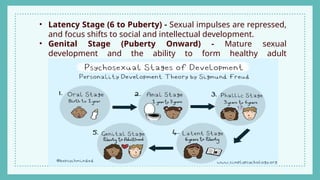
personality develops through a series of psychosexual stages:
• Oral Stage (Birth to 18 Months) - Focus on oral gratification
through sucking, biting, and chewing. Fixation at this stage can
lead to traits like dependency and passivity.
• Anal Stage (18 Months to 3 Years) - Focus on controlling
bowel movements. Fixation can lead to traits like orderliness,
stubbornness, or messiness.
• Phallic Stage (3 to 6 Years) - Focus on the genitals and the
Oedipus complex (boys) or Electra complex (girls). Fixation can
lead to sexual identity issues or problems with authority.
• Latency Stage (6 to Puberty) - Sexual impulses are repressed,
and focus shifts to social and intellectual development.
• Genital Stage (Puberty Onward) - Mature sexual
development and the ability to form healthy adult
relationships.
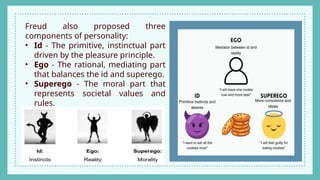
Freud also proposed three
components of personality:
• Id - The primitive, instinctual part
driven by the pleasure principle.
• Ego - The rational, mediating part
that balances the id and superego.
• Superego - The moral part that
represents societal values and
rules.
Prominent Developmental Theories:
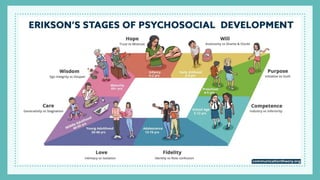
2. Psychosocial Theory (Erik Erikson)
Erikson expanded on Freud's work, focusing on the social and
cultural influences on personality development. He proposed eight
stages of psychosocial development, each with a specific crisis to be
resolved:
• Trust vs. Mistrust (Birth to 1 Year) - Developing a sense of
trust in caregivers.
• Autonomy vs. Shame and Doubt (1 to 3 Years) - Developing a
sense of independence and self-control.
• Initiative vs. Guilt (3 to 5 Years) - Developing a sense of
purpose and initiative.
• Industry vs. Inferiority (5 to 12 Years) - Developing a sense of
competence and accomplishment.
• Identity vs. Role Confusion (Adolescence) - Developing a
sense of self and identity.
• Intimacy vs. Isolation (Young Adulthood) - Developing close
relationships and intimacy.
• Generativity vs. Stagnation (Middle Adulthood) -
Contributing to society and leaving a legacy.
• Ego Integrity vs. Despair (Late Adulthood) - Accepting one's
life and finding meaning in it.
Prominent Developmental Theories:
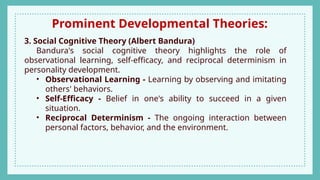
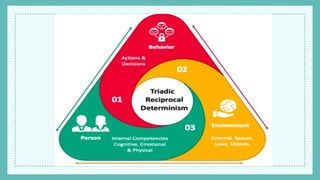
3. Social Cognitive Theory (Albert Bandura)
Bandura's social cognitive theory highlights the role of
observational learning, self-efficacy, and reciprocal determinism in
personality development.
• Observational Learning - Learning by observing and imitating
others' behaviors.
• Self-Efficacy - Belief in one's ability to succeed in a given
situation.
• Reciprocal Determinism - The ongoing interaction between
personal factors, behavior, and the environment.
Prominent Developmental Theories:
4. Humanistic Theory (Carl Rogers and Abraham Maslow)
Humanistic theories focus on the individual's subjective
experience, free will, and potential for growth.
• Carl Rogers - Emphasized the concept of self-actualization, the
process of becoming the best version of oneself. He believed
that unconditional positive regard from others is crucial for
healthy personality development.
• Abraham Maslow - Proposed a hierarchy of needs, suggesting
that individuals strive to fulfill basic needs before moving on to
higher-level needs like self-actualization.
Humanistic theories emphasize the importance of personal
growth, self-awareness, and meaning-making in shaping
personality.
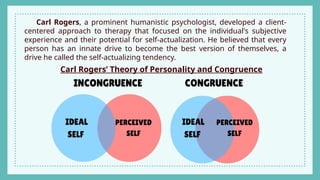
Carl Rogers, a prominent humanistic psychologist, developed a client-
centered approach to therapy that focused on the individual's subjective
experience and their potential for self-actualization. He believed that every
person has an innate drive to become the best version of themselves, a
drive he called the self-actualizing tendency.
Carl Rogers’ Theory of Personality and Congruence
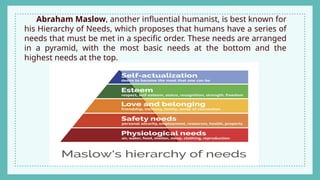
Abraham Maslow, another influential humanist, is best known for
his Hierarchy of Needs, which proposes that humans have a series of
needs that must be met in a specific order. These needs are arranged
in a pyramid, with the most basic needs at the bottom and the
highest needs at the top.
PART 03.4
Theories of Personality Dynamics
involves exploring the forces that drive and shape an
individual's thoughts, feelings, and behaviors. These forces are
complex and multifaceted, and different theories offer unique
perspectives on how they operate.
Theories of Personality Dynamics
1. Psychodynamic Theories
1.1 Freud's Psychoanalytic Theory - This theory, developed by
Sigmund Freud, emphasizes the role of unconscious drives and
conflicts in shaping personality. Freud proposed that the mind is
structured into three parts:
a. Id
b. Ego
c. Superego
• Defense Mechanisms: Freud believed that the ego uses
defense mechanisms to protect itself from anxiety and to
manage the conflicts between the id and superego. These
mechanisms include repression, denial, projection, and
displacement.
Theories of Personality Dynamics
1.2 Erikson's Psychosocial Theory - Erik Erikson expanded on
Freud's work, focusing on the psychosocial stages of development
throughout the lifespan. He proposed that individuals face specific
challenges at each stage, and successful resolution of these
challenges contributes to a healthy personality.
2. Trait Theories
2.1 Eysenck's Three-Factor Theory - Hans Eysenck proposed that
personality can be understood in terms of three dimensions:
• Introversion-Extroversion
• Neuroticism-Stability
• Psychoticism-Normality
Theories of Personality Dynamics
2.2 The Big Five Model - This model, also known as the Five-
Factor Model, is widely accepted in contemporary psychology and
identifies five broad personality traits:
• Openness to Experience
• Conscientiousness
• Extraversion
• Agreeableness
• Neuroticism
Theories of Personality Dynamics
3. Social Cognitive Theory
Bandura's Social Cognitive Theory: Albert Bandura's theory
emphasizes the role of cognitive processes, social interactions, and
environmental factors in shaping personality. It highlights the
concept of reciprocal determinism, where individuals are both
influenced by and influence their environment.
4. Humanistic Theories
4.1 Rogers' Client-Centered Theory - Carl Rogers emphasized the
importance of self-actualization, the innate drive to become the best
version of oneself.
4.2 Maslow's Hierarchy of Needs - Abraham Maslow proposed
that humans have a hierarchy of needs that must be met in a specific
order. The highest level of need is self-actualization.
PART 03.5
Overcompensation Theory
concept primarily associated with Alfred Adler, a prominent
figure in the field of individual psychology.
Overcompensation Theory
It suggests that individuals who feel inadequate or inferior in certain
areas of their lives often strive to compensate for these perceived
weaknesses by excelling in other areas. This striving for superiority,
or overcompensation, can significantly influence their behavior and
personality development.
Key Points
• Inferiority Complex - Adler believed that all individuals
experience feelings of inferiority to some degree, stemming
from childhood experiences, comparisons with others, or
perceived physical or mental limitations.
• Striving for Superiority - This sense of inferiority drives
individuals to seek ways to overcome these feelings and achieve
a sense of competence and self-worth. This striving for
superiority is a fundamental motivator in human behavior.
Overcompensation Theory
• Overcompensation - When the striving for superiority
becomes excessive or exaggerated, it becomes
overcompensation. Individuals may overachieve in specific
areas, become overly competitive, or develop a need for control
and dominance to mask their underlying insecurities.
Examples:
• A student who struggles in math might overcompensate by
excelling in writing or art.
• A person with a physical disability might become highly successful
in their career to prove their worth.
• An individual who feels socially awkward might become overly
assertive or aggressive to compensate for their perceived lack of
social skills.
PART 03.6
Need Theories of Personality
refers to a psychological concept that explains how individuals'
personalities are shaped by their underlying needs and
motivations
Need Theories of Personality
Need theories are a type of motivation theory that focuses on
identifying and understanding the basic needs that drive human
behavior. These needs can influence personality in the following
ways:
• Prioritization of Needs - Individuals have different levels of
need strength. Some might prioritize belonging and social
connection, while others prioritize achievement and self-
actualization.
• Need Satisfaction - How well a person's needs are met
influences their emotional state and behavior.
• Need Development - Needs can change over time, and how we
learn to satisfy them influences our personality.
Examples of Need Theories:
• Maslow's Hierarchy of Needs - This theory proposes a
hierarchy of needs, with basic needs needing to be met before
higher-level needs can emerge.
• Alderfer's ERG Theory - This theory simplifies Maslow's
hierarchy into three categories: Existence, Relatedness, and
Growth, allowing for more flexibility in need fulfillment.
• Frederick Herzberg's Two-Factor Theory, also known as
Motivation-Hygiene Theory, posits that there are two distinct
sets of factors that influence job satisfaction and dissatisfaction,
working independently of each other.
How can
understanding
personality theories
help us to better
understand human
behavior?
THANK YOU!

Personality, PErsonality Development.pptx

  • 2.
  • 4.
    Personality PART 01: Definition comesfor a latin word “persona”, which referred to theatrical masks worn by Roman actors in Greek dramas to portray.
  • 5.
    • Personality isthe unique and enduring pattern of thoughts, feelings, and behaviors that make up an individual. • It's what distinguishes you from everyone else, shaping how you perceive the world, interact with others, and make decisions.
  • 6.
    Gordon Allport defines personalityas a “pattern of habits, attitudes, traits that detrmine an individual’s characteristics, behaviors, and traits. Your Title Here
  • 7.
  • 8.
  • 9.
  • 10.
    PART 03.1 Type Theory fascinatingapproach to understanding how we differ. They categorize people into distinct types based on shared characteristics and behavioral patterns.
  • 11.
    Here are someprominent type theories: 1. Hippocrates' Four Temperaments (Ancient Greece) • Sanguine: Optimistic, cheerful, sociable, and active. • Choleric: Passionate, assertive, ambitious, and prone to anger. • Melancholic: Introspective, thoughtful, creative, and prone to sadness. • Phlegmatic: Calm, peaceful, easygoing, and slow to anger.
  • 13.
    Here are someprominent type theories: 2. Carl Jung's Psychological Types (Early 20th Century) • Introverted - Individuals who are primarily introverted tend to focus their energy inward, towards their own thoughts, feelings, and internal experiences. • Extraverted - Extraverted individuals direct their energy outward, towards the external world, people, and activities. They thrive in social settings, find excitement in external stimulation, and enjoy being the center of attention.
  • 14.
    Here are someprominent type theories: 3. William Sheldon's Somatotypes (Mid-20th Century) • Endomorph - Round, soft, and sociable. • Mesomorph - Muscular, athletic, and assertive. • Ectomorph - Thin, fragile, and introverted.
  • 15.
    Here are someprominent type theories: 4. Myers-Briggs Type Indicator (MBTI) • It categorizes people into 16 types based on four dichotomies: • Introversion (I) vs. Extroversion (E) • Sensing (S) vs. Intuition (N) • Thinking (T) vs. Feeling (F) • Judging (J) vs. Perceiving (P)
  • 16.
    Here are someprominent type theories: 5. Meyer Friedman and Ray Rosenman Theory • Type A individuals were characterized as being highly competitive, ambitious, impatient, time- conscious, and prone to hostility. • Type B individuals, on the other hand, were described as relaxed, easygoing, and less competitive . They were less driven by deadlines and more tolerant of delays and ambiguity
  • 17.
    • Type CPersonality - first described by James Morris and Greer in the context of cancer research. They suggested that individuals with this type were more likely to suppress their emotions, particularly negative ones, and were prone to internalizing stress • Type D Personality - a concept developed by Johan Denollet, a professor of medical psychology. Type D individuals are characterized by negative affectivity (e.g., worry, gloom) and social inhibition (e.g., reticence, lack of self-assurance)
  • 19.
    PART 03.2 Trait Theory majorapproach in psychology that focus on identifying and measuring individual differences in personality.
  • 20.
    Trait Theory 1. GordonAllport's trait theory of personality was one of the first attempts to systematically understand individual differences. Allport proposed three levels of traits: • Cardinal Traits - are dominant traits that shape a person's entire life and are often so pervasive they become synonymous with the individual. They are rare and only a few people develop them. • Central Traits -These are general characteristics that describe a person's core personality. • Secondary Traits -These are less consistent traits that appear only in specific situations or under specific circumstances. They are often related to attitudes or preferences.
  • 21.
    Trait Theory 2. RaymondCattell's trait theory - focusing on identifying and measuring the underlying dimensions of personality. He believed that personality is composed of a set of traits, which are relatively stable and enduring characteristics that influence our behavior, thoughts, and feelings. • Source Traits - are fundamental, underlying personality dimensions that influence a person's observable behaviors and characteristics. These traits are considered to be the building blocks of personality, shaping a person's thoughts, feelings, and actions in a consistent manner. • Surface Traits - These are the observable characteristics that we see in people's behavior, such as being outgoing, shy, or anxious.
  • 22.
    Trait Theory 3. HansEysenck's theory of personality - known for its empirical rigor and its emphasis on the biological underpinnings of behavior. His theory revolves around three primary dimensions: • Extraversion - Introversion (E) - This dimension reflects an individual's sociability, energy, and assertiveness. • Neuroticism - Stability (N) - This dimension denotes emotional instability and a tendency to experience negative emotions such as anxiety and depression. • Self-control - Psychoticism (P) - This dimension, added later to the model, is associated with aggressiveness, creativity, and nonconformity.
  • 23.
    Trait Theory 4. TheFive Factor Theory, a.k.a Big Five Model, is a prominent theory in personality psychology that proposes five broad dimensions to describe human personality. While many researchers contributed to its development, Paul T. Costa Jr. and Robert R. McCrae are particularly recognized for their significant contributions to the theory and its refinement. • Openness to Experience - This dimension reflects an individual's curiosity, imagination, and willingness to try new things. People high in openness are often described as intellectually curious, adventurous, and open to new ideas. • Conscientiousness - This dimension represents an individual's level of organization, responsibility, and self-discipline. People high in conscientiousness are typically dependable, hardworking, and goal-oriented.
  • 24.
    • Extraversion -This dimension captures an individual's sociability, assertiveness, and energy levels. Extraverts are often outgoing, enjoy social interactions, and thrive in stimulating environments • Agreeableness - This dimension reflects an individual's level of empathy, cooperation, and concern for others. People high in agreeableness are typically trusting, compassionate, and helpful. • Neuroticism - This dimension represents an individual's emotional stability and tendency to experience negative emotions. People high in neuroticism are often prone to anxiety, worry, and mood swings.
  • 26.
    PART 03.3 Developmental Theory explainhow our personalities form and change throughout our lives. They explore the influences of various factors, including biological predispositions, environmental interactions, and social experiences, on the development of our unique traits, beliefs, and behaviors.
  • 27.
    Prominent Developmental Theories: 1.Psychoanalytic Theory (Sigmund Freud) Freud's psychoanalytic theory emphasizes the role of the unconscious mind in shaping personality. He proposed that personality develops through a series of psychosexual stages: • Oral Stage (Birth to 18 Months) - Focus on oral gratification through sucking, biting, and chewing. Fixation at this stage can lead to traits like dependency and passivity. • Anal Stage (18 Months to 3 Years) - Focus on controlling bowel movements. Fixation can lead to traits like orderliness, stubbornness, or messiness. • Phallic Stage (3 to 6 Years) - Focus on the genitals and the Oedipus complex (boys) or Electra complex (girls). Fixation can lead to sexual identity issues or problems with authority.
  • 28.
    • Latency Stage(6 to Puberty) - Sexual impulses are repressed, and focus shifts to social and intellectual development. • Genital Stage (Puberty Onward) - Mature sexual development and the ability to form healthy adult relationships.
  • 29.
    Freud also proposedthree components of personality: • Id - The primitive, instinctual part driven by the pleasure principle. • Ego - The rational, mediating part that balances the id and superego. • Superego - The moral part that represents societal values and rules.
  • 30.
    Prominent Developmental Theories: 2.Psychosocial Theory (Erik Erikson) Erikson expanded on Freud's work, focusing on the social and cultural influences on personality development. He proposed eight stages of psychosocial development, each with a specific crisis to be resolved: • Trust vs. Mistrust (Birth to 1 Year) - Developing a sense of trust in caregivers. • Autonomy vs. Shame and Doubt (1 to 3 Years) - Developing a sense of independence and self-control. • Initiative vs. Guilt (3 to 5 Years) - Developing a sense of purpose and initiative. • Industry vs. Inferiority (5 to 12 Years) - Developing a sense of competence and accomplishment.
  • 31.
    • Identity vs.Role Confusion (Adolescence) - Developing a sense of self and identity. • Intimacy vs. Isolation (Young Adulthood) - Developing close relationships and intimacy. • Generativity vs. Stagnation (Middle Adulthood) - Contributing to society and leaving a legacy. • Ego Integrity vs. Despair (Late Adulthood) - Accepting one's life and finding meaning in it.
  • 33.
    Prominent Developmental Theories: 3.Social Cognitive Theory (Albert Bandura) Bandura's social cognitive theory highlights the role of observational learning, self-efficacy, and reciprocal determinism in personality development. • Observational Learning - Learning by observing and imitating others' behaviors. • Self-Efficacy - Belief in one's ability to succeed in a given situation. • Reciprocal Determinism - The ongoing interaction between personal factors, behavior, and the environment.
  • 35.
    Prominent Developmental Theories: 4.Humanistic Theory (Carl Rogers and Abraham Maslow) Humanistic theories focus on the individual's subjective experience, free will, and potential for growth. • Carl Rogers - Emphasized the concept of self-actualization, the process of becoming the best version of oneself. He believed that unconditional positive regard from others is crucial for healthy personality development. • Abraham Maslow - Proposed a hierarchy of needs, suggesting that individuals strive to fulfill basic needs before moving on to higher-level needs like self-actualization. Humanistic theories emphasize the importance of personal growth, self-awareness, and meaning-making in shaping personality.
  • 36.
    Carl Rogers, aprominent humanistic psychologist, developed a client- centered approach to therapy that focused on the individual's subjective experience and their potential for self-actualization. He believed that every person has an innate drive to become the best version of themselves, a drive he called the self-actualizing tendency. Carl Rogers’ Theory of Personality and Congruence
  • 37.
    Abraham Maslow, anotherinfluential humanist, is best known for his Hierarchy of Needs, which proposes that humans have a series of needs that must be met in a specific order. These needs are arranged in a pyramid, with the most basic needs at the bottom and the highest needs at the top.
  • 38.
    PART 03.4 Theories ofPersonality Dynamics involves exploring the forces that drive and shape an individual's thoughts, feelings, and behaviors. These forces are complex and multifaceted, and different theories offer unique perspectives on how they operate.
  • 39.
    Theories of PersonalityDynamics 1. Psychodynamic Theories 1.1 Freud's Psychoanalytic Theory - This theory, developed by Sigmund Freud, emphasizes the role of unconscious drives and conflicts in shaping personality. Freud proposed that the mind is structured into three parts: a. Id b. Ego c. Superego • Defense Mechanisms: Freud believed that the ego uses defense mechanisms to protect itself from anxiety and to manage the conflicts between the id and superego. These mechanisms include repression, denial, projection, and displacement.
  • 40.
    Theories of PersonalityDynamics 1.2 Erikson's Psychosocial Theory - Erik Erikson expanded on Freud's work, focusing on the psychosocial stages of development throughout the lifespan. He proposed that individuals face specific challenges at each stage, and successful resolution of these challenges contributes to a healthy personality. 2. Trait Theories 2.1 Eysenck's Three-Factor Theory - Hans Eysenck proposed that personality can be understood in terms of three dimensions: • Introversion-Extroversion • Neuroticism-Stability • Psychoticism-Normality
  • 41.
    Theories of PersonalityDynamics 2.2 The Big Five Model - This model, also known as the Five- Factor Model, is widely accepted in contemporary psychology and identifies five broad personality traits: • Openness to Experience • Conscientiousness • Extraversion • Agreeableness • Neuroticism
  • 42.
    Theories of PersonalityDynamics 3. Social Cognitive Theory Bandura's Social Cognitive Theory: Albert Bandura's theory emphasizes the role of cognitive processes, social interactions, and environmental factors in shaping personality. It highlights the concept of reciprocal determinism, where individuals are both influenced by and influence their environment. 4. Humanistic Theories 4.1 Rogers' Client-Centered Theory - Carl Rogers emphasized the importance of self-actualization, the innate drive to become the best version of oneself. 4.2 Maslow's Hierarchy of Needs - Abraham Maslow proposed that humans have a hierarchy of needs that must be met in a specific order. The highest level of need is self-actualization.
  • 43.
    PART 03.5 Overcompensation Theory conceptprimarily associated with Alfred Adler, a prominent figure in the field of individual psychology.
  • 44.
    Overcompensation Theory It suggeststhat individuals who feel inadequate or inferior in certain areas of their lives often strive to compensate for these perceived weaknesses by excelling in other areas. This striving for superiority, or overcompensation, can significantly influence their behavior and personality development. Key Points • Inferiority Complex - Adler believed that all individuals experience feelings of inferiority to some degree, stemming from childhood experiences, comparisons with others, or perceived physical or mental limitations. • Striving for Superiority - This sense of inferiority drives individuals to seek ways to overcome these feelings and achieve a sense of competence and self-worth. This striving for superiority is a fundamental motivator in human behavior.
  • 45.
    Overcompensation Theory • Overcompensation- When the striving for superiority becomes excessive or exaggerated, it becomes overcompensation. Individuals may overachieve in specific areas, become overly competitive, or develop a need for control and dominance to mask their underlying insecurities. Examples: • A student who struggles in math might overcompensate by excelling in writing or art. • A person with a physical disability might become highly successful in their career to prove their worth. • An individual who feels socially awkward might become overly assertive or aggressive to compensate for their perceived lack of social skills.
  • 46.
    PART 03.6 Need Theoriesof Personality refers to a psychological concept that explains how individuals' personalities are shaped by their underlying needs and motivations
  • 47.
    Need Theories ofPersonality Need theories are a type of motivation theory that focuses on identifying and understanding the basic needs that drive human behavior. These needs can influence personality in the following ways: • Prioritization of Needs - Individuals have different levels of need strength. Some might prioritize belonging and social connection, while others prioritize achievement and self- actualization. • Need Satisfaction - How well a person's needs are met influences their emotional state and behavior. • Need Development - Needs can change over time, and how we learn to satisfy them influences our personality.
  • 48.
    Examples of NeedTheories: • Maslow's Hierarchy of Needs - This theory proposes a hierarchy of needs, with basic needs needing to be met before higher-level needs can emerge. • Alderfer's ERG Theory - This theory simplifies Maslow's hierarchy into three categories: Existence, Relatedness, and Growth, allowing for more flexibility in need fulfillment. • Frederick Herzberg's Two-Factor Theory, also known as Motivation-Hygiene Theory, posits that there are two distinct sets of factors that influence job satisfaction and dissatisfaction, working independently of each other.

  • 49.
    How can understanding personality theories helpus to better understand human behavior?
  • 50.