Teaching quality
Theoretical foundations, effectiveness studies,
and cross-national comparison
Eckhard Klieme
German Institute for International Educational Research (DIPF)
Frankfurt am Main, Germany
WERA Conference
Cape Town, South Africa
August 4, 2018
2
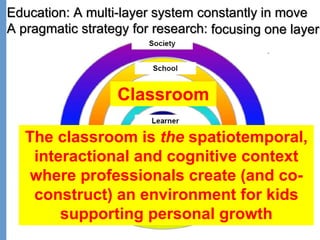
Education: A multi-layer system constantly in move
A pragmatic strategy for research:
Classroom
focusing one layer
The classroom is the spatiotemporal,
interactional and cognitive context
where professionals create (and co-
construct) an environment for kids
supporting personal growth
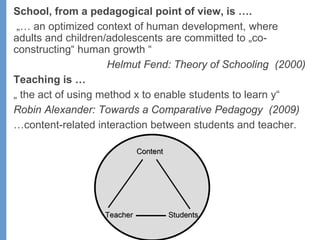
School, from a pedagogical point of view, is ….
„… an optimized context of human development, where
adults and children/adolescents are committed to „co-
constructing“ human growth “
Helmut Fend: Theory of Schooling (2000)
Teaching is …
„ the act of using method x to enable students to learn y“
Robin Alexander: Towards a Comparative Pedagogy (2009)
…content-related interaction between students and teacher.
School, from a pedagogical point of view, is ….
„… an optimized context of human development, where
adults and children/adolescents are committed to „co-
constructing“ human growth “
Helmut Fend: Theory of Schooling (2000)
Teaching is …
„ the act of using method x to enable students to learn y“
Robin Alexander: Towards a Comparative Pedagogy (2009)
…content-related interaction between students and teacher.
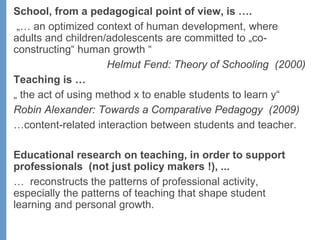
Educational research on teaching, in order to support
professionals (not just policy makers !), ...
… reconstructs the patterns of professional activity,
especially the patterns of teaching that shape student
learning and personal growth.
Page
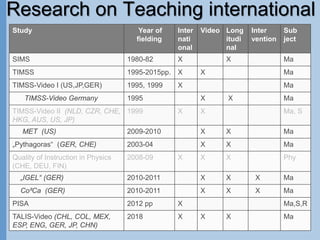
Research on Teaching international
5
Study Year of
fielding
Inter
nati
onal
Video Long
itudi
nal
Inter
vention
Sub
ject
SIMS 1980-82 X X Ma
TIMSS 1995-2015pp. X X Ma
TIMSS-Video I (US,JP,GER) 1995, 1999 X Ma
TIMSS-Video Germany 1995 X X Ma
TIMSS-Video II (NLD, CZR, CHE,
HKG, AUS, US, JP)
1999 X X Ma, S
MET (US) 2009-2010 X X Ma
„Pythagoras“ (GER, CHE) 2003-04 X X Ma
Quality of Instruction in Physics
(CHE, DEU, FIN)
2008-09 X X X Phy
„IGEL“ (GER) 2010-2011 X X X Ma
Co²Ca (GER) 2010-2011 X X X Ma
PISA 2012 pp X Ma,S,R
TALIS-Video (CHL, COL, MEX,
ESP, ENG, GER, JP, CHN)
2018 X X X Ma
Page
Research on Teaching
in international perspective
1) Teaching goals
2) Teaching content
3) Teaching practices
4) Teaching quality
5) Teaching effectiveness
6
Page 7
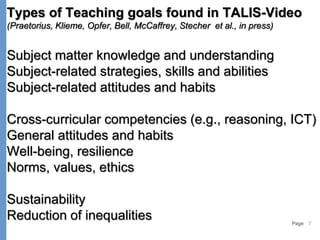
Types of Teaching goals found in TALIS-Video
(Praetorius, Klieme, Opfer, Bell, McCaffrey, Stecher et al., in press)
Subject matter knowledge and understanding
Subject-related strategies, skills and abilities
Subject-related attitudes and habits
Cross-curricular competencies (e.g., reasoning, ICT)
General attitudes and habits
Well-being, resilience
Norms, values, ethics
Sustainability
Reduction of inequalities
Page
Research on Teaching
in international perspective
1) Teaching goals
2) Teaching content
3) Teaching practices
4) Teaching quality
5) Teaching effectiveness
8
Page
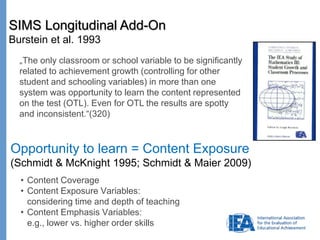
„The only classroom or school variable to be significantly
related to achievement growth (controlling for other
student and schooling variables) in more than one
system was opportunity to learn the content represented
on the test (OTL). Even for OTL the results are spotty
and inconsistent.“(320)
SIMS Longitudinal Add-On
Burstein et al. 1993
Opportunity to learn = Content Exposure
(Schmidt & McKnight 1995; Schmidt & Maier 2009)
• Content Coverage
• Content Exposure Variables:
considering time and depth of teaching
• Content Emphasis Variables:
e.g., lower vs. higher order skills
Klieme: Was ist guter (Mathematik-) Unterricht? GDM 2011, Freiburg
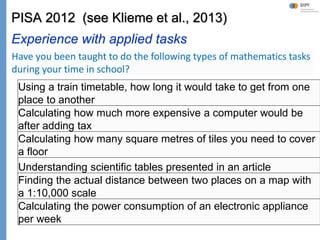
PISA 2012 (see Klieme et al., 2013)
Experience with applied tasks
Using a train timetable, how long it would take to get from one
place to another
Calculating how much more expensive a computer would be
after adding tax
Calculating how many square metres of tiles you need to cover
a floor
Understanding scientific tables presented in an article
Finding the actual distance between two places on a map with
a 1:10,000 scale
Calculating the power consumption of an electronic appliance
per week
Have you been taught to do the following types of mathematics tasks
during your time in school?
Klieme: Was ist guter (Mathematik-) Unterricht? GDM 2011, Freiburg
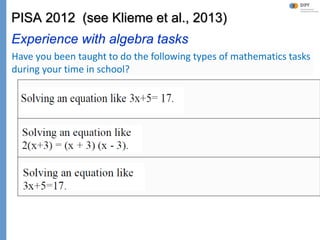
PISA 2012 (see Klieme et al., 2013)
Experience with algebra tasks
Have you been taught to do the following types of mathematics tasks
during your time in school?
Page
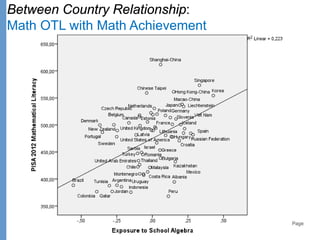
Between Country Relationship:
Math OTL with Math Achievement
Page
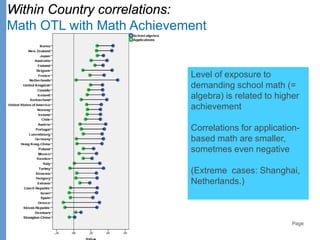
Within Country correlations:
Math OTL with Math Achievement
Level of exposure to
demanding school math (=
algebra) is related to higher
achievement
Correlations for application-
based math are smaller,
sometmes even negative
(Extreme cases: Shanghai,
Netherlands.)
Page
Research on Teaching
in international perspective
1) Teaching goals
2) Teaching content
3) Teaching practices
4) Teaching quality
5) Teaching effectiveness
14
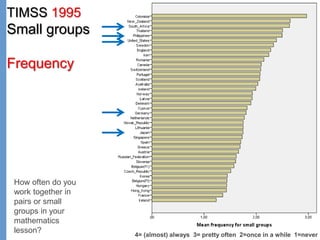
TIMSS 1995
Small groups
Frequency
How often do you
work together in
pairs or small
groups in your
mathematics
lesson?
4= (almost) always 3= pretty often 2=once in a while 1=never
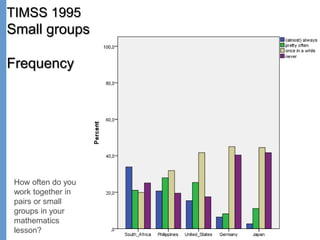
TIMSS 1995
Small groups
Frequency
How often do you
work together in
pairs or small
groups in your
mathematics
lesson?
17
This video can be found at
http://www.timssvideo.com/japan-mathematics-lessons/
as „JP1“
TIMSS-Video 1995 – Teaching practices
Japan: Setting up & managing group work
18
TIMSS-Video 1995 – Teaching practices
Japan: Setting up & managing group work
Practices=
Shared patterns of activity within a culturally
shaped social, physical, and intellectual space –
Combination of doing, saying, handling artefacts.
Teaching Practices=
Patterns of classroom activity – Chains of teacher
and student activities which establish, represent,
and negotiate subject matter understanding.
19
This video is unfortunataly not available for public
access.
TIMSS-Video 1995 – Teaching practices
Germany: Whole class discussion
20
This video clip has been shot for public use, but so far it
is available on CD-ROM only.
You may request a file copy from the author.
TIMSS-Video 1995 Follow Up – Teaching practices
Germany: Mix = “Teacher-led group work”
Summary: Teaching practices
1. Teaching is a “cultural activity” (Stiegler & Hiebert, 1999).
Within a given (rather: constructed) cultural context, (qualitative)
research may identify recurring patterns of teacher and student
activities grounded in shared knowledge = teaching practices.
2. Teaching practices may change over the years, partly
through adapting practices from other cultures.
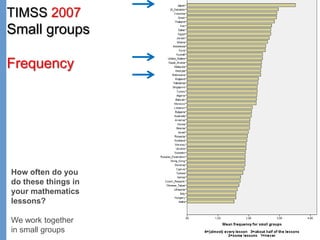
TIMSS 2007
Small groups
Frequency
How often do you
do these things in
your mathematics
lessons?
We work together
in small groups
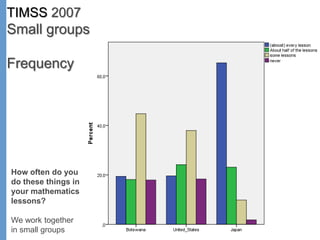
TIMSS 2007
Small groups
Frequency
How often do you
do these things in
your mathematics
lessons?
We work together
in small groups
Summary: Teaching practices
1. Teaching is a “cultural activity” (Stiegler & Hiebert, 1999).
Within a given (rather: constructed) cultural context, (qualitative)
research may identify recurring patterns of teacher and student
activities grounded in shared knowledge = teaching practices.
2. Teaching practices may change over the years, partly
through adapting practices from other cultures.
3. International surveys inform about frequencies of teaching
and learning activities (e.g., lecturing, small group work) that are
obviously shaped by cultural/pedagogical background. The same
activity structure (e.g., small groups) may have different meaning
across cultures.
4. Thesis: (a) We need video data to understand teaching.
(b) Rather than comparing PRACTICES across cultures, we may
be able to compare QUALITY and EFFECTS of teaching.
Page
Research on Teaching
in international perspective
1) Teaching goals
2) Teaching content
3) Teaching practices
4) Teaching quality
5) Teaching effectiveness
25
Page
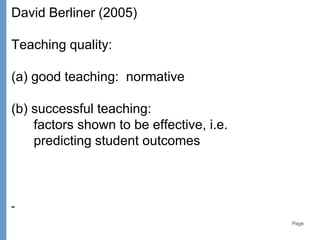
David Berliner (2005)
Teaching quality:
(a) good teaching: normative
(b) successful teaching:
factors shown to be effective, i.e.
predicting student outcomes
-
Page
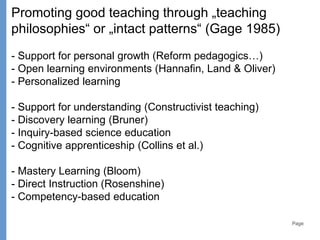
Promoting good teaching through „teaching
philosophies“ or „intact patterns“ (Gage 1985)
- Support for personal growth (Reform pedagogics…)
- Open learning environments (Hannafin, Land & Oliver)
- Personalized learning
- Support for understanding (Constructivist teaching)
- Discovery learning (Bruner)
- Inquiry-based science education
- Cognitive apprenticeship (Collins et al.)
- Mastery Learning (Bloom)
- Direct Instruction (Rosenshine)
- Competency-based education
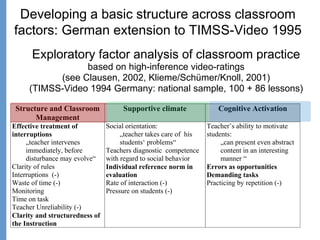
Exploratory factor analysis of classroom practice
based on high-inference video-ratings
(see Clausen, 2002, Klieme/Schümer/Knoll, 2001)
(TIMSS-Video 1994 Germany: national sample, 100 + 86 lessons)
Structure and Classroom
Management
Supportive climate Cognitive Activation
Effective treatment of
interruptions
„teacher intervenes
immediately, before
disturbance may evolve“
Clarity of rules
Interruptions (-)
Waste of time (-)
Monitoring
Time on task
Teacher Unreliability (-)
Clarity and structuredness of
the Instruction
Social orientation:
„teacher takes care of his
students‘ problems“
Teachers diagnostic competence
with regard to social behavior
Individual reference norm in
evaluation
Rate of interaction (-)
Pressure on students (-)
Teacher’s ability to motivate
students:
„can present even abstract
content in an interesting
manner “
Errors as opportunities
Demanding tasks
Practicing by repetition (-)
Developing a basic structure across classroom
factors: German extension to TIMSS-Video 1995
Klieme: Was ist guter (Mathematik-) Unterricht? GDM 2011, Freiburg
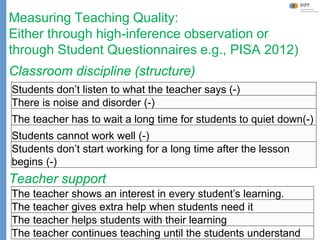
Measuring Teaching Quality:
Either through high-inference observation or
through Student Questionnaires e.g., PISA 2012)
Classroom discipline (structure)
Teacher support
Students don’t listen to what the teacher says (-)
There is noise and disorder (-)
The teacher has to wait a long time for students to quiet down(-)
Students cannot work well (-)
Students don’t start working for a long time after the lesson
begins (-)
29
The teacher shows an interest in every student’s learning.
The teacher gives extra help when students need it
The teacher helps students with their learning
The teacher continues teaching until the students understand
Klieme: Was ist guter (Mathematik-) Unterricht? GDM 2011, Freiburg
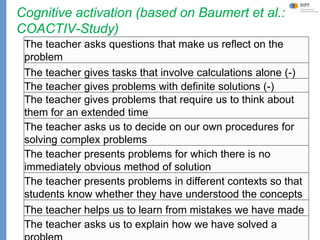
Cognitive activation (based on Baumert et al.:
COACTIV-Study)
The teacher asks questions that make us reflect on the
problem
The teacher gives tasks that involve calculations alone (-)
The teacher gives problems with definite solutions (-)
The teacher gives problems that require us to think about
them for an extended time
The teacher asks us to decide on our own procedures for
solving complex problems
The teacher presents problems for which there is no
immediately obvious method of solution
The teacher presents problems in different contexts so that
students know whether they have understood the concepts
The teacher helps us to learn from mistakes we have made
The teacher asks us to explain how we have solved a
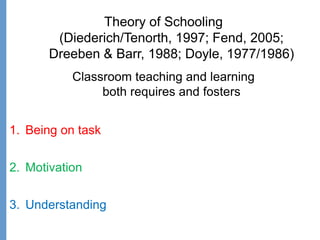
Theory of Schooling
(Diederich/Tenorth, 1997; Fend, 2005;
Dreeben & Barr, 1988; Doyle, 1977/1986)
Classroom teaching and learning
both requires and fosters
1. Being on task
2. Motivation
3. Understanding
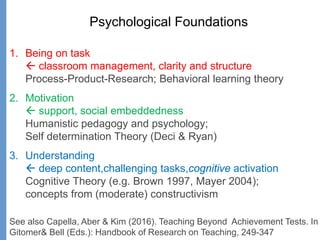
Psychological Foundations
1. Being on task
 classroom management, clarity and structure
Process-Product-Research; Behavioral learning theory
2. Motivation
 support, social embeddedness
Humanistic pedagogy and psychology;
Self determination Theory (Deci & Ryan)
3. Understanding
 deep content,challenging tasks,cognitive activation
Cognitive Theory (e.g. Brown 1997, Mayer 2004);
concepts from (moderate) constructivism
See also Capella, Aber & Kim (2016). Teaching Beyond Achievement Tests. In
Gitomer& Bell (Eds.): Handbook of Research on Teaching, 249-347
Klieme: Was ist guter (Mathematik-) Unterricht? GDM 2011, Freiburg
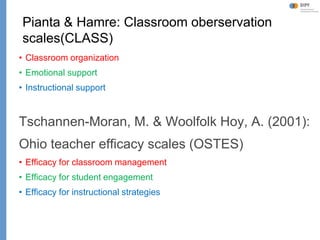
Pianta & Hamre: Classroom oberservation
scales(CLASS)
• Classroom organization
• Emotional support
• Instructional support
Tschannen-Moran, M. & Woolfolk Hoy, A. (2001):
Ohio teacher efficacy scales (OSTES)
• Efficacy for classroom management
• Efficacy for student engagement
• Efficacy for instructional strategies
Page
Research on Teaching
in international perspective
1) Teaching goals
2) Teaching content
3) Teaching practices
4) Teaching quality
5) Teaching effectiveness
34
Page
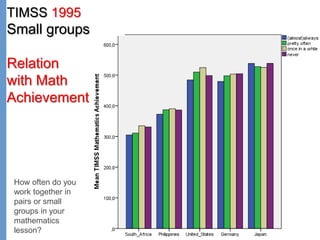
How often do you
work together in
pairs or small
groups in your
mathematics
lesson?
TIMSS 1995
Small groups
Relation
with Math
Achievement
Page
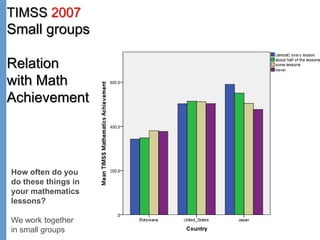
How often do you
do these things in
your mathematics
lessons?
We work together
in small groups
TIMSS 2007
Small groups
Relation
with Math
Achievement
Page
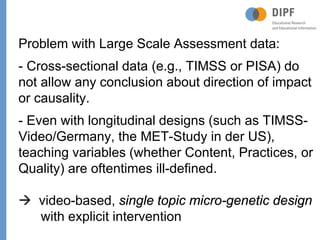
Problem with Large Scale Assessment data:
- Cross-sectional data (e.g., TIMSS or PISA) do
not allow any conclusion about direction of impact
or causality.
- Even with longitudinal designs (such as TIMSS-
Video/Germany, the MET-Study in der US),
teaching variables (whether Content, Practices, or
Quality) are oftentimes ill-defined.
 video-based, single topic micro-genetic design
with explicit intervention
Page
 The study is tied to one specific topic of instruction.
The “focal unit” has a well-defined starting point and covers
all content taught until a different topic is addressed.
 All participating teachers teach the focal unit as they usually do.
 Tests/Questionnaires administered closely before/after the unit.
 All measures of teaching and learning (OTL, Teaching Practices,
Teaching Quality, outcomes, predictors) are related to the unit
Single Topic, micro-genetic design
as developed in the “Pythagoras” study (Klieme/Pauli/Reusser 2009),
with intervention
as developed in the “IGEL” (Decristan, Hardy, Klieme et al.) and
“Co²Ca” (Klieme, Rakoczy, Blum, Leiss at al.) studies
38
Klieme: Was ist guter (Mathematik-) Unterricht? GDM 2011, Freiburg
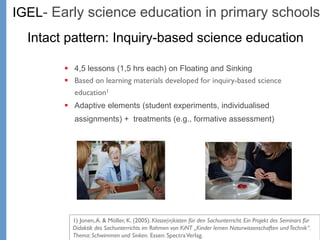
 4,5 lessons (1,5 hrs each) on Floating and Sinking
 Based on learning materials developed for inquiry-based science
education1
 Adaptive elements (student experiments, individualised
assignments) + treatments (e.g., formative assessment)
IGEL- Early science education in primary schools
Intact pattern: Inquiry-based science education
1) Jonen,A. & Möller, K. (2005). Klasse(n)kisten für den Sachunterricht. Ein Projekt des Seminars für
Didaktik des Sachunterrichts im Rahmen von KiNT „Kinder lernen Naturwissenschaften undTechnik“.
Thema: Schwimmen und Sinken. Essen: SpectraVerlag.
Klieme: Was ist guter (Mathematik-) Unterricht? GDM 2011, Freiburg
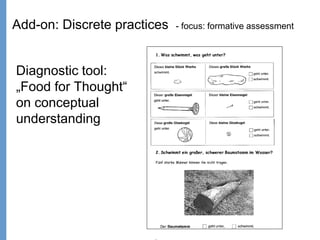
1. Was schwimmt, was geht unter?
2. Schwimmt ein großer, schwerer Baumstamm im Wasser?
Fünf starke Männer können ihn nicht tragen.
Diagnostic tool:
„Food for Thought“
on conceptual
understanding
Add-on: Discrete practices - focus: formative assessment
Klieme: Was ist guter (Mathematik-) Unterricht? GDM 2011, Freiburg
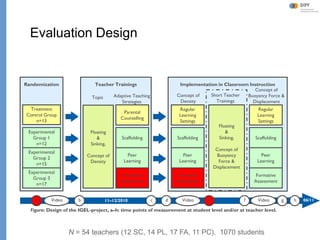
Evaluation Design
e
Figure: Design of the IGEL-project, a–h: time points of measurement at student level and/or at teacher level.
09/2010 11–12/2010 01–02/2011
Randomization
Treatment
Control Group
n=13
Experimental
Group 1
n=12
Experimental
Group 2
n=15
Experimental
Group 3
n=17
Teacher Trainings
Topic
Implementation in Classroom Instruction
Formative
Assessment
Peer
Learning
Scaffolding
Regular
Learning
Settings
Concept of
Density
Floating
&
Sinking,
Concept of
Buoyancy
Force &
Displacement
Short Teacher
Trainings
Concept of
Buoyancy Force &
Displacement
Regular
Learning
Settings
Scaffolding
Formative
Assessment
Peer
Learning
Formative
Assessment
Peer
Learning
Scaffolding
Parental
Counselling
Adaptive Teaching
Strategies
03/2011 06/11
Floating
&
Sinking,
Concept of
Density
f g ha b c d Video VideoVideo
N = 54 teachers (12 SC, 14 PL, 17 FA, 11 PC), 1070 students
Klieme: Was ist guter (Mathematik-) Unterricht? GDM 2011, Freiburg
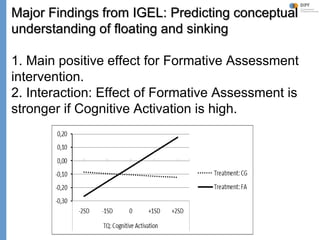
Major Findings from IGEL: Predicting conceptual
understanding of floating and sinking
1. Main positive effect for Formative Assessment
intervention.
2. Interaction: Effect of Formative Assessment is
stronger if Cognitive Activation is high.
Klieme: Was ist guter (Mathematik-) Unterricht? GDM 2011, Freiburg
Major Findings from IGEL: Predicting conceptual
understanding of floating and sinking
1. Main positive effect for Formative Assessment
intervention.
2. Interaction: Effect of Formative Assessment is
stronger if Cognitive Activation is high.
3. Moderation: Effect of formative assessment is
stronger for students with language problems
4. Main positive effect for Classroom management.
5. Moderation: Supportive Climate and Cognitive
Activation do have a positive Effect in
heterogeneous classrooms.
Klieme: Was ist guter (Mathematik-) Unterricht? GDM 2011, Freiburg
Major Findings from IGEL: Predicting student
interest in science
1. Main positive effect for Formative Assessment
intervention.
2. Mediation by perceived competence
3. Main positive effect of Supportive Climate and
Cognitive Activation.
(Decristan et al. 2014, 2015a,b, 2017a,b; Fauth et
al. 2014, 2018; Hondrich et al. 2016, 2018)
Klieme: Was ist guter (Mathematik-) Unterricht? GDM 2011, Freiburg
Limitations of IGEL
- No integrated model available. (Partly because of small sample
size.)
- Unexpected direct effect of Cognitive Activation on student
motivation.
- Teaching quality mainly assessed through student perceptions.
- No add-on effects for other practices (peer learning, scaffolding).
- Content matter and teaching pattern (=didactical approach) were
kept constant  further research needed
- German context only.
Klieme: Was ist guter (Mathematik-) Unterricht? GDM 2011, Freiburg
“What works where? The relationship between instructional
variables and schools' mean scores in mathematics and
science in low-, medium-, and high-achieving countries”
Ruth Zuzovsky (2013)
Based on TIMSS 2007:
HLM analyses
run separately for individual practice items
including 7,201 schools from 48 countries,
controlling for individual student background
Finding: Constructivist practices (e.g., “We work on problems
on our own.”) will be more beneficial for students only in high-
achieving countries.
Page
Research on Teaching
in international perspective
 Challenge:
Running video-based
a) longitudinal surveys (such as MET),
b) single-topic micro-genetic studies (Pythagoras),
c) intervention studies (IGEL)
in multiple countries in order to
understand the role of culture in teaching,
support professional development in a given country, and
prevent simple “borrowing” across countries.
TALIS-Video (ongoing) is a first step for type b).
47
Page
Research on Teaching
in international perspective
 Challenge:
In line with Felice Levine’s remarks at the Presidential Session,
we as a research community need to
- collaborate across nations,
- take all kinds of goals into account (subject-related&personal)
- combine research disciplines in theory and empirical studies,
- establish rich data sets (involving video data)
- get into dialogue with practitioners.
48
Page
Thank you for your attention !
Eckhard Klieme
klieme@dipf.de

Eckhard Klieme: "Teaching quality - Theoretical foundations, effectiveness studies and cross-national comparison"

  • 1.
    Teaching quality Theoretical foundations,effectiveness studies, and cross-national comparison Eckhard Klieme German Institute for International Educational Research (DIPF) Frankfurt am Main, Germany WERA Conference Cape Town, South Africa August 4, 2018
  • 2.
    2 Education: A multi-layersystem constantly in move A pragmatic strategy for research: Classroom focusing one layer The classroom is the spatiotemporal, interactional and cognitive context where professionals create (and co- construct) an environment for kids supporting personal growth
  • 3.
    School, from apedagogical point of view, is …. „… an optimized context of human development, where adults and children/adolescents are committed to „co- constructing“ human growth “ Helmut Fend: Theory of Schooling (2000) Teaching is … „ the act of using method x to enable students to learn y“ Robin Alexander: Towards a Comparative Pedagogy (2009) …content-related interaction between students and teacher.
  • 4.
    School, from apedagogical point of view, is …. „… an optimized context of human development, where adults and children/adolescents are committed to „co- constructing“ human growth “ Helmut Fend: Theory of Schooling (2000) Teaching is … „ the act of using method x to enable students to learn y“ Robin Alexander: Towards a Comparative Pedagogy (2009) …content-related interaction between students and teacher. Educational research on teaching, in order to support professionals (not just policy makers !), ... … reconstructs the patterns of professional activity, especially the patterns of teaching that shape student learning and personal growth.
  • 5.
    Page Research on Teachinginternational 5 Study Year of fielding Inter nati onal Video Long itudi nal Inter vention Sub ject SIMS 1980-82 X X Ma TIMSS 1995-2015pp. X X Ma TIMSS-Video I (US,JP,GER) 1995, 1999 X Ma TIMSS-Video Germany 1995 X X Ma TIMSS-Video II (NLD, CZR, CHE, HKG, AUS, US, JP) 1999 X X Ma, S MET (US) 2009-2010 X X Ma „Pythagoras“ (GER, CHE) 2003-04 X X Ma Quality of Instruction in Physics (CHE, DEU, FIN) 2008-09 X X X Phy „IGEL“ (GER) 2010-2011 X X X Ma Co²Ca (GER) 2010-2011 X X X Ma PISA 2012 pp X Ma,S,R TALIS-Video (CHL, COL, MEX, ESP, ENG, GER, JP, CHN) 2018 X X X Ma
  • 6.
    Page Research on Teaching ininternational perspective 1) Teaching goals 2) Teaching content 3) Teaching practices 4) Teaching quality 5) Teaching effectiveness 6
  • 7.
    Page 7 Types ofTeaching goals found in TALIS-Video (Praetorius, Klieme, Opfer, Bell, McCaffrey, Stecher et al., in press) Subject matter knowledge and understanding Subject-related strategies, skills and abilities Subject-related attitudes and habits Cross-curricular competencies (e.g., reasoning, ICT) General attitudes and habits Well-being, resilience Norms, values, ethics Sustainability Reduction of inequalities
  • 8.
    Page Research on Teaching ininternational perspective 1) Teaching goals 2) Teaching content 3) Teaching practices 4) Teaching quality 5) Teaching effectiveness 8
  • 9.
    Page „The only classroomor school variable to be significantly related to achievement growth (controlling for other student and schooling variables) in more than one system was opportunity to learn the content represented on the test (OTL). Even for OTL the results are spotty and inconsistent.“(320) SIMS Longitudinal Add-On Burstein et al. 1993 Opportunity to learn = Content Exposure (Schmidt & McKnight 1995; Schmidt & Maier 2009) • Content Coverage • Content Exposure Variables: considering time and depth of teaching • Content Emphasis Variables: e.g., lower vs. higher order skills
  • 10.
    Klieme: Was istguter (Mathematik-) Unterricht? GDM 2011, Freiburg PISA 2012 (see Klieme et al., 2013) Experience with applied tasks Using a train timetable, how long it would take to get from one place to another Calculating how much more expensive a computer would be after adding tax Calculating how many square metres of tiles you need to cover a floor Understanding scientific tables presented in an article Finding the actual distance between two places on a map with a 1:10,000 scale Calculating the power consumption of an electronic appliance per week Have you been taught to do the following types of mathematics tasks during your time in school?
  • 11.
    Klieme: Was istguter (Mathematik-) Unterricht? GDM 2011, Freiburg PISA 2012 (see Klieme et al., 2013) Experience with algebra tasks Have you been taught to do the following types of mathematics tasks during your time in school?
  • 12.
    Page Between Country Relationship: MathOTL with Math Achievement
  • 13.
    Page Within Country correlations: MathOTL with Math Achievement Level of exposure to demanding school math (= algebra) is related to higher achievement Correlations for application- based math are smaller, sometmes even negative (Extreme cases: Shanghai, Netherlands.)
  • 14.
    Page Research on Teaching ininternational perspective 1) Teaching goals 2) Teaching content 3) Teaching practices 4) Teaching quality 5) Teaching effectiveness 14
  • 15.
    TIMSS 1995 Small groups Frequency Howoften do you work together in pairs or small groups in your mathematics lesson? 4= (almost) always 3= pretty often 2=once in a while 1=never
  • 16.
    TIMSS 1995 Small groups Frequency Howoften do you work together in pairs or small groups in your mathematics lesson?
  • 17.
    17 This video canbe found at http://www.timssvideo.com/japan-mathematics-lessons/ as „JP1“ TIMSS-Video 1995 – Teaching practices Japan: Setting up & managing group work
  • 18.
    18 TIMSS-Video 1995 –Teaching practices Japan: Setting up & managing group work Practices= Shared patterns of activity within a culturally shaped social, physical, and intellectual space – Combination of doing, saying, handling artefacts. Teaching Practices= Patterns of classroom activity – Chains of teacher and student activities which establish, represent, and negotiate subject matter understanding.
  • 19.
    19 This video isunfortunataly not available for public access. TIMSS-Video 1995 – Teaching practices Germany: Whole class discussion
  • 20.
    20 This video cliphas been shot for public use, but so far it is available on CD-ROM only. You may request a file copy from the author. TIMSS-Video 1995 Follow Up – Teaching practices Germany: Mix = “Teacher-led group work”
  • 21.
    Summary: Teaching practices 1.Teaching is a “cultural activity” (Stiegler & Hiebert, 1999). Within a given (rather: constructed) cultural context, (qualitative) research may identify recurring patterns of teacher and student activities grounded in shared knowledge = teaching practices. 2. Teaching practices may change over the years, partly through adapting practices from other cultures.
  • 22.
    TIMSS 2007 Small groups Frequency Howoften do you do these things in your mathematics lessons? We work together in small groups
  • 23.
    TIMSS 2007 Small groups Frequency Howoften do you do these things in your mathematics lessons? We work together in small groups
  • 24.
    Summary: Teaching practices 1.Teaching is a “cultural activity” (Stiegler & Hiebert, 1999). Within a given (rather: constructed) cultural context, (qualitative) research may identify recurring patterns of teacher and student activities grounded in shared knowledge = teaching practices. 2. Teaching practices may change over the years, partly through adapting practices from other cultures. 3. International surveys inform about frequencies of teaching and learning activities (e.g., lecturing, small group work) that are obviously shaped by cultural/pedagogical background. The same activity structure (e.g., small groups) may have different meaning across cultures. 4. Thesis: (a) We need video data to understand teaching. (b) Rather than comparing PRACTICES across cultures, we may be able to compare QUALITY and EFFECTS of teaching.
  • 25.
    Page Research on Teaching ininternational perspective 1) Teaching goals 2) Teaching content 3) Teaching practices 4) Teaching quality 5) Teaching effectiveness 25
  • 26.
    Page David Berliner (2005) Teachingquality: (a) good teaching: normative (b) successful teaching: factors shown to be effective, i.e. predicting student outcomes -
  • 27.
    Page Promoting good teachingthrough „teaching philosophies“ or „intact patterns“ (Gage 1985) - Support for personal growth (Reform pedagogics…) - Open learning environments (Hannafin, Land & Oliver) - Personalized learning - Support for understanding (Constructivist teaching) - Discovery learning (Bruner) - Inquiry-based science education - Cognitive apprenticeship (Collins et al.) - Mastery Learning (Bloom) - Direct Instruction (Rosenshine) - Competency-based education
  • 28.
    Exploratory factor analysisof classroom practice based on high-inference video-ratings (see Clausen, 2002, Klieme/Schümer/Knoll, 2001) (TIMSS-Video 1994 Germany: national sample, 100 + 86 lessons) Structure and Classroom Management Supportive climate Cognitive Activation Effective treatment of interruptions „teacher intervenes immediately, before disturbance may evolve“ Clarity of rules Interruptions (-) Waste of time (-) Monitoring Time on task Teacher Unreliability (-) Clarity and structuredness of the Instruction Social orientation: „teacher takes care of his students‘ problems“ Teachers diagnostic competence with regard to social behavior Individual reference norm in evaluation Rate of interaction (-) Pressure on students (-) Teacher’s ability to motivate students: „can present even abstract content in an interesting manner “ Errors as opportunities Demanding tasks Practicing by repetition (-) Developing a basic structure across classroom factors: German extension to TIMSS-Video 1995
  • 29.
    Klieme: Was istguter (Mathematik-) Unterricht? GDM 2011, Freiburg Measuring Teaching Quality: Either through high-inference observation or through Student Questionnaires e.g., PISA 2012) Classroom discipline (structure) Teacher support Students don’t listen to what the teacher says (-) There is noise and disorder (-) The teacher has to wait a long time for students to quiet down(-) Students cannot work well (-) Students don’t start working for a long time after the lesson begins (-) 29 The teacher shows an interest in every student’s learning. The teacher gives extra help when students need it The teacher helps students with their learning The teacher continues teaching until the students understand
  • 30.
    Klieme: Was istguter (Mathematik-) Unterricht? GDM 2011, Freiburg Cognitive activation (based on Baumert et al.: COACTIV-Study) The teacher asks questions that make us reflect on the problem The teacher gives tasks that involve calculations alone (-) The teacher gives problems with definite solutions (-) The teacher gives problems that require us to think about them for an extended time The teacher asks us to decide on our own procedures for solving complex problems The teacher presents problems for which there is no immediately obvious method of solution The teacher presents problems in different contexts so that students know whether they have understood the concepts The teacher helps us to learn from mistakes we have made The teacher asks us to explain how we have solved a
  • 31.
    Theory of Schooling (Diederich/Tenorth,1997; Fend, 2005; Dreeben & Barr, 1988; Doyle, 1977/1986) Classroom teaching and learning both requires and fosters 1. Being on task 2. Motivation 3. Understanding
  • 32.
    Psychological Foundations 1. Beingon task  classroom management, clarity and structure Process-Product-Research; Behavioral learning theory 2. Motivation  support, social embeddedness Humanistic pedagogy and psychology; Self determination Theory (Deci & Ryan) 3. Understanding  deep content,challenging tasks,cognitive activation Cognitive Theory (e.g. Brown 1997, Mayer 2004); concepts from (moderate) constructivism See also Capella, Aber & Kim (2016). Teaching Beyond Achievement Tests. In Gitomer& Bell (Eds.): Handbook of Research on Teaching, 249-347
  • 33.
    Klieme: Was istguter (Mathematik-) Unterricht? GDM 2011, Freiburg Pianta & Hamre: Classroom oberservation scales(CLASS) • Classroom organization • Emotional support • Instructional support Tschannen-Moran, M. & Woolfolk Hoy, A. (2001): Ohio teacher efficacy scales (OSTES) • Efficacy for classroom management • Efficacy for student engagement • Efficacy for instructional strategies
  • 34.
    Page Research on Teaching ininternational perspective 1) Teaching goals 2) Teaching content 3) Teaching practices 4) Teaching quality 5) Teaching effectiveness 34
  • 35.
    Page How often doyou work together in pairs or small groups in your mathematics lesson? TIMSS 1995 Small groups Relation with Math Achievement
  • 36.
    Page How often doyou do these things in your mathematics lessons? We work together in small groups TIMSS 2007 Small groups Relation with Math Achievement
  • 37.
    Page Problem with LargeScale Assessment data: - Cross-sectional data (e.g., TIMSS or PISA) do not allow any conclusion about direction of impact or causality. - Even with longitudinal designs (such as TIMSS- Video/Germany, the MET-Study in der US), teaching variables (whether Content, Practices, or Quality) are oftentimes ill-defined.  video-based, single topic micro-genetic design with explicit intervention
  • 38.
    Page  The studyis tied to one specific topic of instruction. The “focal unit” has a well-defined starting point and covers all content taught until a different topic is addressed.  All participating teachers teach the focal unit as they usually do.  Tests/Questionnaires administered closely before/after the unit.  All measures of teaching and learning (OTL, Teaching Practices, Teaching Quality, outcomes, predictors) are related to the unit Single Topic, micro-genetic design as developed in the “Pythagoras” study (Klieme/Pauli/Reusser 2009), with intervention as developed in the “IGEL” (Decristan, Hardy, Klieme et al.) and “Co²Ca” (Klieme, Rakoczy, Blum, Leiss at al.) studies 38
  • 39.
    Klieme: Was istguter (Mathematik-) Unterricht? GDM 2011, Freiburg  4,5 lessons (1,5 hrs each) on Floating and Sinking  Based on learning materials developed for inquiry-based science education1  Adaptive elements (student experiments, individualised assignments) + treatments (e.g., formative assessment) IGEL- Early science education in primary schools Intact pattern: Inquiry-based science education 1) Jonen,A. & Möller, K. (2005). Klasse(n)kisten für den Sachunterricht. Ein Projekt des Seminars für Didaktik des Sachunterrichts im Rahmen von KiNT „Kinder lernen Naturwissenschaften undTechnik“. Thema: Schwimmen und Sinken. Essen: SpectraVerlag.
  • 40.
    Klieme: Was istguter (Mathematik-) Unterricht? GDM 2011, Freiburg 1. Was schwimmt, was geht unter? 2. Schwimmt ein großer, schwerer Baumstamm im Wasser? Fünf starke Männer können ihn nicht tragen. Diagnostic tool: „Food for Thought“ on conceptual understanding Add-on: Discrete practices - focus: formative assessment
  • 41.
    Klieme: Was istguter (Mathematik-) Unterricht? GDM 2011, Freiburg Evaluation Design e Figure: Design of the IGEL-project, a–h: time points of measurement at student level and/or at teacher level. 09/2010 11–12/2010 01–02/2011 Randomization Treatment Control Group n=13 Experimental Group 1 n=12 Experimental Group 2 n=15 Experimental Group 3 n=17 Teacher Trainings Topic Implementation in Classroom Instruction Formative Assessment Peer Learning Scaffolding Regular Learning Settings Concept of Density Floating & Sinking, Concept of Buoyancy Force & Displacement Short Teacher Trainings Concept of Buoyancy Force & Displacement Regular Learning Settings Scaffolding Formative Assessment Peer Learning Formative Assessment Peer Learning Scaffolding Parental Counselling Adaptive Teaching Strategies 03/2011 06/11 Floating & Sinking, Concept of Density f g ha b c d Video VideoVideo N = 54 teachers (12 SC, 14 PL, 17 FA, 11 PC), 1070 students
  • 42.
    Klieme: Was istguter (Mathematik-) Unterricht? GDM 2011, Freiburg Major Findings from IGEL: Predicting conceptual understanding of floating and sinking 1. Main positive effect for Formative Assessment intervention. 2. Interaction: Effect of Formative Assessment is stronger if Cognitive Activation is high.
  • 43.
    Klieme: Was istguter (Mathematik-) Unterricht? GDM 2011, Freiburg Major Findings from IGEL: Predicting conceptual understanding of floating and sinking 1. Main positive effect for Formative Assessment intervention. 2. Interaction: Effect of Formative Assessment is stronger if Cognitive Activation is high. 3. Moderation: Effect of formative assessment is stronger for students with language problems 4. Main positive effect for Classroom management. 5. Moderation: Supportive Climate and Cognitive Activation do have a positive Effect in heterogeneous classrooms.
  • 44.
    Klieme: Was istguter (Mathematik-) Unterricht? GDM 2011, Freiburg Major Findings from IGEL: Predicting student interest in science 1. Main positive effect for Formative Assessment intervention. 2. Mediation by perceived competence 3. Main positive effect of Supportive Climate and Cognitive Activation. (Decristan et al. 2014, 2015a,b, 2017a,b; Fauth et al. 2014, 2018; Hondrich et al. 2016, 2018)
  • 45.
    Klieme: Was istguter (Mathematik-) Unterricht? GDM 2011, Freiburg Limitations of IGEL - No integrated model available. (Partly because of small sample size.) - Unexpected direct effect of Cognitive Activation on student motivation. - Teaching quality mainly assessed through student perceptions. - No add-on effects for other practices (peer learning, scaffolding). - Content matter and teaching pattern (=didactical approach) were kept constant  further research needed - German context only.
  • 46.
    Klieme: Was istguter (Mathematik-) Unterricht? GDM 2011, Freiburg “What works where? The relationship between instructional variables and schools' mean scores in mathematics and science in low-, medium-, and high-achieving countries” Ruth Zuzovsky (2013) Based on TIMSS 2007: HLM analyses run separately for individual practice items including 7,201 schools from 48 countries, controlling for individual student background Finding: Constructivist practices (e.g., “We work on problems on our own.”) will be more beneficial for students only in high- achieving countries.
  • 47.
    Page Research on Teaching ininternational perspective  Challenge: Running video-based a) longitudinal surveys (such as MET), b) single-topic micro-genetic studies (Pythagoras), c) intervention studies (IGEL) in multiple countries in order to understand the role of culture in teaching, support professional development in a given country, and prevent simple “borrowing” across countries. TALIS-Video (ongoing) is a first step for type b). 47
  • 48.
    Page Research on Teaching ininternational perspective  Challenge: In line with Felice Levine’s remarks at the Presidential Session, we as a research community need to - collaborate across nations, - take all kinds of goals into account (subject-related&personal) - combine research disciplines in theory and empirical studies, - establish rich data sets (involving video data) - get into dialogue with practitioners. 48
  • 49.
    Page Thank you foryour attention ! Eckhard Klieme klieme@dipf.de