1
International Summit
on the Teaching
Profession
Framing the issues
Andreas Schleicher
Director for Education and Skills
OECD
The kind of things that
are easy to teach are
now easy to automate,
digitize or outsource
35
40
45
50
55
60
65
70
1960 1970 1980 1990 2000 2006 2009
Routine manual
Nonroutine manual
Routine cognitive
Nonroutine analytic
Nonroutine interpersonal
Mean task input in percentiles of 1960 task
Robotics
The Auto-auto
>1m km,
one minor accident,
occasional human intervention
Augmented Reality
A lot more to come
• 3D printing
• Synthetic biology
• Brain enhancements
• Nanomaterials
• Etc.
Everyone wants to live in your countries
-20
-15
-10
-5
0
5
10
15
20
25
1960 1965 1970 1975 1980 1985 1990 1995 2000 2005 2010
High income OECD members
Low income Middle income
Source : OECD (2013), Trends Shaping Education.
Primary source: World Bank (2012), World Databank: Net Migration.
Net migration (in millions of people) into regions,
with countries grouped by income level and OECD members, 1960-2010
.
Education in the past
Education now
Dimensions of student learning
What knowledge, skills
and character qualities do
successful teachers require?
Session 1
What knowledge, skills
and character qualities do
successful teachers require?
96% of teachers: My role as a teacher
is to facilitate students own inquiry
What knowledge, skills
and character qualities do
successful teachers require?
86%: Students learn best
by findings solutions on their own
What knowledge, skills
and character qualities do
successful teachers require?
74%: Thinking and reasoning is more
important than curriculum content
Prevalence of memorisation
rehearsal, routine exercises, drill and
practice and/or repetition
-2.00 -1.50 -1.00 -0.50 0.00 0.00 0.50 1.00 1.50 2.00
Switzerland
Poland
Germany
Japan
Korea
France
Sweden
Shanghai-China
Canada
Singapore
United States
Norway
Spain
Netherlands
United Kingdom
Prevalence of elaboration
reasoning, deep learning, intrinsic
motivation, critical thinking,
creativity, non-routine problems
High Low Low High
0.00
0.50
1.00
1.50
2.00
2.50
VietNam
Macao-China
Shanghai-China
Turkey
Uruguay
Greece
HongKong-China
ChineseTaipei
Portugal
Brazil
Serbia
Bulgaria
Singapore
Netherlands
Japan
Argentina
CostaRica
Lithuania
Tunisia
NewZealand
CzechRepublic
Israel
Korea
Latvia
Qatar
Italy
UnitedStates
Estonia
Ireland
Australia
Mexico
UnitedArabEmirates
Norway
Malaysia
Kazakhstan
UnitedKingdom
Romania
OECDaverage
Albania
Colombia
Indonesia
Sweden
Belgium
Peru
Thailand
Denmark
RussianFederation
Canada
SlovakRepublic
Hungary
Germany
Croatia
Luxembourg
Montenegro
Chile
Poland
Finland
Austria
Slovenia
France
Switzerland
Jordan
Liechtenstein
Spain
Iceland
Indexofexposuretowordproblems
Focus on word problems Fig I.3.1a
15
Word problems- Formal math
situated in a word problem, where it
is obvious to students what
mathematical knowledge and skills
are needed
0.00
0.50
1.00
1.50
2.00
2.50
Sweden
Iceland
Tunisia
Argentina
Switzerland
Brazil
Luxembourg
Ireland
Netherlands
NewZealand
CostaRica
Austria
Liechtenstein
Malaysia
Indonesia
Denmark
UnitedKingdom
Uruguay
Lithuania
Germany
Australia
Chile
OECDaverage
SlovakRepublic
Thailand
Qatar
Finland
Portugal
Colombia
Mexico
Peru
CzechRepublic
Israel
Italy
Belgium
HongKong-China
Poland
France
Spain
Montenegro
Greece
Turkey
Slovenia
VietNam
Hungary
Bulgaria
Kazakhstan
ChineseTaipei
Canada
UnitedStates
Estonia
Romania
Latvia
Serbia
Japan
Korea
Croatia
Albania
RussianFederation
UnitedArabEmirates
Jordan
Macao-China
Singapore
Shanghai-China
Indexofexposuretoformalmathematics
Focus on conceptual understanding Fig I.3.1b
16
Focus on conceptual understanding
17 Teaching strategies and learning outcomes
-0.4
-0.3
-0.2
-0.1
0.0
0.1
0.2
0.3
0.4
0.5
0.6
Below Level
1
Level 1 Level 2 Level 3 Level 4 Level 5 Level 6
Index of student-oriented instruction
Index of teacher-directed instruction
Index of cognitive-activation instruction
Students' proficiency level in PISA mathematics
Mean
Index
Students at Level 5 and 6 can
develop and work with models
for complex situations, and
work strategically with
advanced thinking and
reasoning skills
Students below Level 2 have
difficulties using basic
algorithms, formulae,
procedures or conventions to
solve problems involving
whole numbers
18 Professional knowledge and expertise in teaching
Behaviour
Cognition
Content
Character
• Effectiveness is evidenced by teacher
behaviour and student learning outcomes
• Teachers as thoughtful, sentient beings,
characterised by intentions, strategies,
decisions and reflections
• The nature and adequacy of teacher
knowledge of the substance of the
curriculum being taught
• The teachers serve as moral agents,
deploying a moral-pedagogical craft
Teacher knowledge of, and sensitivity to, cultural, social and
political contexts and the environments of their students.
19
Second generation immigrant students’ performance
in mathematics, by country of origin and destination
370 390 410 430 450 470 490 510
Austria
Belgium
Switzerland
Germany
Denmark
Netherlands
Austria
Belgium
Switzerland
Germany
Denmark
Netherlands
PISA score points in mathematics
First-generation immigrants' score, after accounting for socio-economic…
2nd generation
students from
Turkey in:
The country where migrants go to school matters more
than the country where they came from
1st generation
students from
Turkey in:
First generation immigrant students’ performance in mathematics,
by country of origin and destination
20
Immigrant students’ performance in mathematics,
by country of origin and destination
300 350 400 450 500 550 600
Australia
Macao-China
New Zealand
Hong Kong-China
Qatar
Finland
Denmark
United Arab…
Netherlands
PISA score points in mathematics
First-generation immigrants' score, after accounting for socio-economic…
Students from
Arabic-speaking
countries in:
50 55 60 65 70 75 80 85 90 95
Denmark
Qatar
United Arab Emirates
Netherlands
Finland
%
Percentage of students with an immigrant background
who reported that they feel like they belong at school
Students from
Arabic-speaking
countries in:
The country where migrants go to school matters more
than the country where they came from
21
21
21
Make learning central, encourage
engagement and responsibility
Be acutely sensitive to individual
differences
Provide continual assessment with
formative feedback
Be demanding for every student with
a high level of cognitive activation
Ensure that students feel valued and
included and learning is collaborative
A continuum of support
What policies can help?
Session 2
Student-level
• Initiating and managing learning processes, including active learning
• Responding to the learning needs of individual learners
• Integrating formative and summative assessment
Classroom level
• Teaching in multicultural classrooms
• Emphasising cross-curricular studies
• Integrating students with special needs
School level
• Working and planning in teams and partner with other schools
• Evaluating and planning for improvement
• Using ICT for teaching and administration, etc.
23 Challenges for teachers
Developing Teaching
as a profession
Recruit top candidates
into the profession
Support teachers in
continued
development of
practice
Retain and recognise
effective teachers –
path for growth
Improve the
societal view of
teaching as a
profession
Mean mathematics performance, by school location, after acc
ounting for socio-economic status2
4
Implementing highly effective teacher policy and practice
25 Teachers’ skills
Numeracy test scores of tertiary graduates and teachers
Numeracy score215 235 255 275 295 315 335 355 375
Spain
Poland
Estonia
United States
Canada
Ireland
Korea
England (UK)
England/N. Ireland (UK)
Denmark
Northern Ireland (UK)
France
Australia
Sweden
Czech Republic
Austria
Netherlands
Norway
Germany
Flanders (Belgium)
Finland
Japan
Numeracy score
Numeracy skills of
middle half of
college graduates
26 Teachers’ skills
Numeracy test scores of tertiary graduates and teachers
Numeracy score215 235 255 275 295 315 335 355 375
Spain
Poland
Estonia
United States
Canada
Ireland
Korea
England (UK)
England/N. Ireland (UK)
Denmark
Northern Ireland (UK)
France
Australia
Sweden
Czech Republic
Austria
Netherlands
Norway
Germany
Flanders (Belgium)
Finland
Japan
Numeracy score
Numeracy skills of
teachers
External forces
exerting pressure and
influence inward on
an occupation
Internal motivation and
efforts of the members
of the profession itself
27 Professionalism
Professionalism is the level of autonomy and
internal regulation exercised by members of an
occupation in providing services to society
Policy levers to teacher professionalism
Knowledge base for teaching
(initial education and incentives for
professional development)
Autonomy: Teachers’ decision-
making power over their work
(teaching content, course offerings,
discipline practices)
Peer networks: Opportunities for
exchange and support needed
to maintain high standards of
teaching (participation in induction,
mentoring, networks, feedback from direct
observations)
Teacher
professionalism
Teacher professionalism
Knowledge base for teaching
(initial education and incentives for
professional development)
Autonomy: Teachers’ decision-
making power over their work
(teaching content, course offerings,
discipline practices)
Peer networks: Opportunities for
exchange and support needed
to maintain high standards of
teaching (participation in induction,
mentoring, networks, feedback from direct
observations)
High Peer Networks/
Low Autonomy
High Autonomy Knowledge Emphasis
Balanced Domains/
High Professionalism
Balanced Domains/
Low Professionalism
Teacher professionalism
0
1
2
3
4
5
6
7
8
9
10
Spain
Japan
France
Brazil
Finland
Flanders
Norway
Alberta(Canada)
Australia
Denmark
Israel
Korea
UnitedStates
CzechRepublic
Shanghai(China)
Latvia
Netherlands
Poland
England
NewZealand
Singapore
Estonia
Networks Autonomy Knowledge
Mean mathematics performance, by school location, after
accounting for socio-economic status Fig II.3.3
3131 TALIS Teacher professionalism index
0
1
2
3
4
5
6
7
8
9
10
Spain
Japan
France
Brazil
Finland
Flanders
Norway
Alberta(Canada)
Australia
Denmark
Israel
Korea
UnitedStates
CzechRepublic
Shanghai(China)
Latvia
Netherlands
Poland
England
NewZealand
Singapore
Estonia
Networks Autonomy Knowledge
Mean mathematics performance, by school location, after
accounting for socio-economic status Fig II.3.3
3232 TALIS Teacher professionalism and PISA learning
Australia
Flanders Belgium)
Alberta (Canada)
Shanghai (China)
Czech RepublicSpain England (UK)
Spain
EstoniaFinland
France Spain
Israel
Japan
Korea
Latvia
The Netherlands
Norway
New Zealand
Poland
Singapore
Sweden
350
400
450
500
550
600
650
5.0 5.5 6.0 6.5 7.0 7.5 8.0 8.5 9.0 9.5 10.0
PISAmathematicsscore
Teacher professionalism index
Status of the
profession
Teachers’
perception of
the extent to
which teaching
is valued as a
profession
Satisfaction with
the profession
Teachers’ report
on the extent
to which
teachers are
happy with
their decision
to become a
teacher.
Satisfaction with
work
environment
Teachers’ report
on the extent
to which
teachers are
happy with
their current
schools.
Self-efficacy
Teachers’
perception of
their
capabilities (e.g.
controlling
disruptive
behaviour, use
a variety of
assessment
strategies, etc.).
3
3333 Mean mathematics performance, by school location, after
accounting for socio-economic status Fig II.3.3
3333 Teacher outcomes
0
10
20
30
40
50
60
70
Low professionalism
Medium professionalism
High professionalism
Mean mathematics performance, by school location, after
accounting for socio-economic status Fig II.3.3
3434 Teacher professionalism index and teacher outcomes
Perceptions of
teachers’ status
Satisfaction with
the profession
Satisfaction with the
work environment
Teachers’
self-efficacy
Predicted percentile
3
5
3
5
Mean mathematics performance, by school location,
after accounting for socio-economic status
Fig II.3.3
3
5
3
5
Knowledge domain in high and low socio-economically
disadvantaged schools and teacher job satisfaction
-0.40
-0.20
0.00
0.20
0.40
0.60
0.80
1.00 Norway
AbuDhabi(UAE)
Israel
Netherlands
England(UK)
Belgium(Flanders)
Alberta(Canada)
Italy
Australia
Serbia
Croatia
Shanghai(China)
Spain
Singapore
Poland
Malaysia
SlovakRepublic
Mexico
Chile
Estonia
Brazil
NewZealand
Romania
Latvia
Portugal
France
Georgia
Japan
Sweden
Korea
Bulgaria
Low
High
Association between satisfaction with current working environment and knowledge domain for each country separated by a
high and low socio-economically disadvantaged concentration level.
Unstandardisedcoefficients
3
6
3
6
Mean mathematics performance, by school location,
after accounting for socio-economic status
Fig II.3.3
3
6
3
6
Peer networks domain in high and low socio-economically
disadvantaged schools and teacher job satisfaction
-0.40
-0.20
0.00
0.20
0.40
0.60
0.80
1.00
Bulgaria
Australia
Netherlands
AbuDhabi(UAE)
England(UK)
NewZealand
Serbia
Singapore
Estonia
Croatia
Chile
Sweden
Shanghai(China)
Norway
Belgium(Flanders)
Mexico
SlovakRepublic
Brazil
Alberta(Canada)
Poland
Portugal
Malaysia
Italy
Spain
France
Korea
Latvia
Romania
Israel
Japan
Georgia
Low
High
Association between satisfaction with current working environment and peer networks domain for each country separated by
a high and low socio-economically disadvantaged concentration level.
Unstandardisedcoefficients
0
1
2
3
4
5
6
7
8
9
10
Spain
Japan
France
Brazil
Finland
Flanders
Norway
Alberta(Canada)
Australia
Denmark
Israel
Korea
UnitedStates
CzechRepublic
Shanghai(China)
Latvia
Netherlands
Poland
England
NewZealand
Singapore
Estonia
Networks Autonomy Knowledge
Mean mathematics performance, by school location, after
accounting for socio-economic status Fig II.3.3
3737 TALIS Teacher professionalism index
Percentage of lower secondary teachers with less than 3 years experience at their school and as a teacher, who are working in schools with
the following reported access to formal induction programmes, and their reported participation in such programmes
0
10
20
30
40
50
60
70
80
90
100
Iceland
Finland
Georgia
Serbia
Japan
SlovakRepublic
Netherlands
Norway
Alberta(Canada)
Flanders(Belgium)
Australia
UnitedStates
Croatia
Korea
Average
Russia
Chile
Israel
NewZealand
Malaysia
England(United…
Romania
CzechRepublic
Singapore
Shanghai(China)
Access
Participation
%
Not everywhere where induction programmes are accessible
do teachers use them
39 Induction and professional development
0.0
0.5
1.0
1.5
2.0
2.5
Brazil
CzechRepublic
Spain
Israel
Poland
Estonia
Finland
Flanders(Belgium)
Japan
Denmark
Latvia
Korea
Sweden
Netherlands
France
Oddsratios
Probability of participation in three or more professional development activities for lower secondary
teachers who reported having participated in a formal induction programme versus teachers who reported
that they had not participated in such programmes
0
10
20
30
40
50
60
70
80
90
100
Discussindividual
students
Shareresources
Teamconferences
Collaboratefor
common
standards
Teamteaching
CollaborativePD
Jointactivities
Classroom
observations
Percentageofteachers
Average Shanghai (China)
Professional collaboration
Percentage of lower secondary teachers who report doing the following activities at least once per month
Teacher co-operation
Exchange and co-ordination
Teachers Self-Efficacy and Professional Collaboration
11.40
11.60
11.80
12.00
12.20
12.40
12.60
12.80
13.00
13.20
13.40
Never
Onceayearorless
2-4timesayear
5-10timesayear
1-3timesamonth
Onceaweekormore
Teacherself-efficacy(level)
Teach jointly as a
team in the same class
Observe other
teachers’ classes and
provide feedback
Engage in joint
activities across
different classes
Take part in
collaborative
professional learning
Less
frequently
More
frequently
0
10
20
30
40
50
60
70
80
90
100 England(UK)
Estonia
Singapore
Netherlands
Shanghai
(China)
NewZealand
Brazil
Japan
UnitedStates
Australia
Norway
Israel
Alberta
(Canada)
Poland
Spain
Korea
Flanders
(Belgium)
Italy
Sweden
Denmark
France
Finland
Percentageofteachers
School Management Principals Other teachers
Mean mathematics performance, by school location,
after accounting for socio-economic status
Fig II.3.3
4
2
4
2
Teachers feedback :
direct classroom observations
43
What principals say about involving teachers
in decision making at school
0%
10%
20%
30%
40%
50%
60%
70%
80%
90%
100%
This school
provides staff
with
opportunities to
actively
participate in
school decisions
There is a
collaborative
school culture
that is
characterised by
mutual support
This school
provides parents
or guardians with
opportunities to
actively
participate in
school decisions
This school
provides
students with
opportunities to
actively
participate in
school decisions
I make important
decisions on my
own
Strongly disagree
Disagree
Agree
Strongly agree
Percentage of lower secondary principals who "strongly disagree", "disagree", "agree" or "strongly agree"
with the following statements about their school
Percentageofteachers
44
What principals say about involving teachers
in decision making at school
Percentage of lower secondary principals who reported that they "often" or "very often" distributed leadership activiti
other stakeholders in and around the school during the 12 months prior to the survey
0
50
100
150
200
250
300
Latvia
Shanghai(China)
Poland
Korea
Estonia
Norway
Flanders(Belgium)
Brazil
CzechRepublic
Alberta(Canada)
Spain
Australia
England(UK)
NewZealand
Denmark
Netherlands
Singapore
France
Sweden
Finland
Italy
Japan
This school provides students with opportunities to actively participate in school decisions
This school provides parents or guardians with opportunities to actively participate in school decisions
This school provides staff with opportunities to actively participate in school decisions
Cumulativepercentage
45 Impact of professional development on teaching
0 10 20 30 40 50 60
Knowledge and understanding of subject field(s)
Pedagogical competencies in teaching subject field(s)
Student evaluation and assessment practices
Knowledge of the curriculum
ICT skills for teaching
Student behaviour and classroom management
Approaches to individual learning
New technologies in the workplace
Teaching cross-curricular skills
Teaching students with special needs
Student career guidance and counselling
Approaches to developing cross-occupational competencies
School management and administration
Teaching in a multicultural/lingual setting
Moderate
Large
Percentage of teachers who participated in professional development activities with the following content in the 12 months prior to the survey,
and reported moderate or large positive impact of this activity on their teaching
Percentage of teachers
What can governments
do to implement policies
more effectively?
Session 3
• Clear and consistent priorities (across
governments and across time), ambition and
urgency, and the capacity to learn rapidly.
Shared vision
• Appropriate targets, real-time data, monitoring,
incentives aligned to targets, accountability, and
the capacity to intervene where necessary.
Performance
management
• Building professional capabilities, sharing best
practice and innovation, flexible management, and
frontline ethos aligned with system objectives.
Frontline capacity
• Strong leadership at every level, including teacher
leadership, adequate process design and
consistency of focus across agencies.
Delivery architecture
47 Successful reform delivery
Strive for
consensus
Engage
stakeholders
Careful
piloting
Sustainable
resources
Careful
timing
Partnership
with unions
• Acknowledge divergent views and interests
• Communicate, communicate, communicate
– Feedback reduces the likelihood of strong opposition
– Involvement of stakeholders cultivates a sense of joint
ownership over policies, and hence helps build consensus
over both the need and the relevance of reforms
• Mechanisms of regular and institutionalised
consultation contribute to the development of trust
among parties, and help them reach consensus
– Regular interactions raise awareness of the concerns of
others, thus fostering a climate of compromise
• External pressures can be used to build a compelling
case for change .
48 Successful reform implementation
Strive for
consensus about
the aims without
compromising the drive
for improvement
Strive for
consensus
Engage
stakeholders
Careful
piloting
Sustainable
resources
Careful
timing
Partnership
with unions
• Regular involvement by stakeholders in policy design
helps to build capacity and shared ideas over time
• Several countries have established teaching councils
that provide teachers and other stakeholder groups
with both a forum for policy development and,
critically, a mechanism for profession-led standard
setting and quality assurance in teacher education,
teacher induction, teacher performance and career
development
• Policy can encourage the formation of such
communities .
49 Successful reform implementation
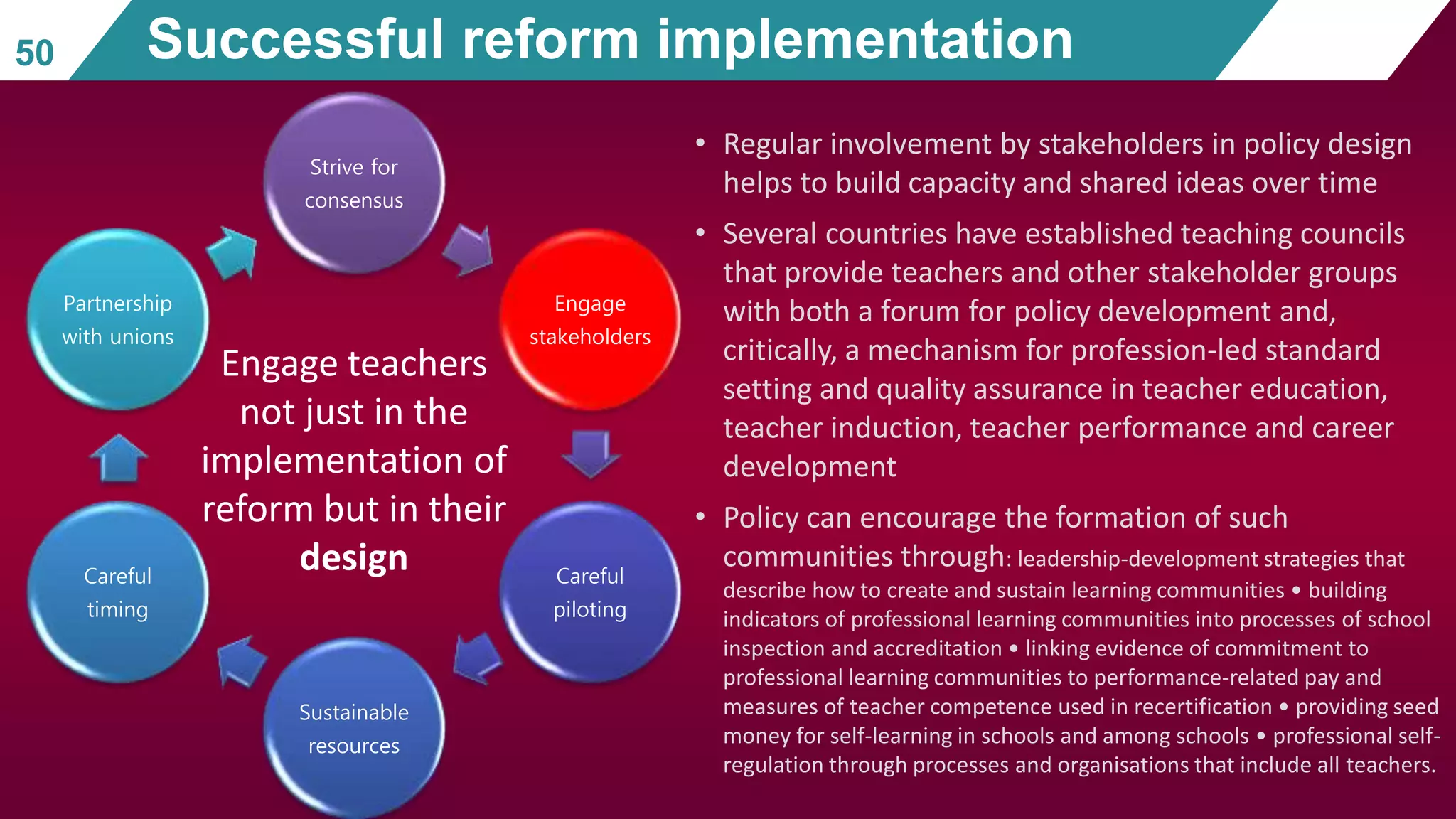
Engage teachers
not just in the
implementation of
reform but in their
design
Strive for
consensus
Engage
stakeholders
Careful
piloting
Sustainable
resources
Careful
timing
Partnership
with unions
• Regular involvement by stakeholders in policy design
helps to build capacity and shared ideas over time
• Several countries have established teaching councils
that provide teachers and other stakeholder groups
with both a forum for policy development and,
critically, a mechanism for profession-led standard
setting and quality assurance in teacher education,
teacher induction, teacher performance and career
development
• Policy can encourage the formation of such
communities through: leadership-development strategies that
describe how to create and sustain learning communities • building
indicators of professional learning communities into processes of school
inspection and accreditation • linking evidence of commitment to
professional learning communities to performance-related pay and
measures of teacher competence used in recertification • providing seed
money for self-learning in schools and among schools • professional self-
regulation through processes and organisations that include all teachers.
50 Successful reform implementation
Engage teachers
not just in the
implementation of
reform but in their
design
Strive for
consensus
Engage
stakeholders
Careful
piloting
Sustainable
resources
Careful
timing
Partnership
with unions
• Currently only one in ten educational
reforms is evaluated
• Policy experimentation can help build
consensus on implementation and can
prove powerful in testing out policy
initiatives and – by virtue of their
temporary nature and limited scope –
overcoming fears and resistance by specific
groups of stakeholders.
51 Successful reform implementation
Use and evaluate
pilot projects before
full implementation
Strive for
consensus
Engage
stakeholders
Careful
piloting
Sustainable
resources
Careful
timing
Partnership
with unions
• Capacity
• Money
52 Successful reform implementation
Back reforms with
sustainable financing
Strive for
consensus
Engage
stakeholders
Careful
piloting
Sustainable
resources
Careful
timing
Partnership
with unions
• All political players and stakeholders need
to develop realistic expectations about the
pace and nature of reforms to improve
outcomes
• Certain reform measures are best
introduced before others, particularly
because of the substantial gap between the
time at which the initial cost of reform is
incurred, and the time when the intended
benefits of reforms materialise
• Time is needed to learn about and
understand impact, to build trust and
develop capacity for the next stage .
53 Successful reform implementation
Time implementation
carefully
Strive for
consensus
Engage
stakeholders
Careful
piloting
Sustainable
resources
Careful
timing
Partnership
with unions
• Putting the teaching profession at the heart
of education reform requires a fruitful
dialogue between governments and unions
• Teachers should not just be part of the
implementation of reforms but also part of
their design
• Conflict isn’t best addressed by weak
unions but by strong social partnership .
54 Successful reform implementation
Build partnerships
with education
unions to design and
implement reforms
Routine cognitive skills Conceptual understanding, complex ways
of thinking, ways of working
Some students learn at high levels All students need to learn at high levels
Student inclusion
Curriculum, instruction and assessment
Standardisation and compliance High-level professional knowledge workers
Teacher quality
‘Tayloristic’, hierarchical Flat, collegial
Work organisation
Primarily to authorities Primarily to peers and stakeholders
Accountability
What it all means
The old bureaucratic system The modern enabling system
5656Lessonsfromhighperformers
56
56 Thank you
Find out more about our work at www.oecd.org
– All publications
– The complete micro-level database
Email: Andreas.Schleicher@OECD.org
Twitter: SchleicherEDU
and remember:

International Summit on the Teaching Profession - Framing the Issues

  • 1.
    1 International Summit on theTeaching Profession Framing the issues Andreas Schleicher Director for Education and Skills OECD
  • 2.
    The kind ofthings that are easy to teach are now easy to automate, digitize or outsource 35 40 45 50 55 60 65 70 1960 1970 1980 1990 2000 2006 2009 Routine manual Nonroutine manual Routine cognitive Nonroutine analytic Nonroutine interpersonal Mean task input in percentiles of 1960 task
  • 3.
    Robotics The Auto-auto >1m km, oneminor accident, occasional human intervention
  • 4.
  • 5.
    A lot moreto come • 3D printing • Synthetic biology • Brain enhancements • Nanomaterials • Etc.
  • 6.
    Everyone wants tolive in your countries -20 -15 -10 -5 0 5 10 15 20 25 1960 1965 1970 1975 1980 1985 1990 1995 2000 2005 2010 High income OECD members Low income Middle income Source : OECD (2013), Trends Shaping Education. Primary source: World Bank (2012), World Databank: Net Migration. Net migration (in millions of people) into regions, with countries grouped by income level and OECD members, 1960-2010 .
  • 7.
  • 8.
  • 9.
  • 10.
    What knowledge, skills andcharacter qualities do successful teachers require? Session 1
  • 11.
    What knowledge, skills andcharacter qualities do successful teachers require? 96% of teachers: My role as a teacher is to facilitate students own inquiry
  • 12.
    What knowledge, skills andcharacter qualities do successful teachers require? 86%: Students learn best by findings solutions on their own
  • 13.
    What knowledge, skills andcharacter qualities do successful teachers require? 74%: Thinking and reasoning is more important than curriculum content
  • 14.
    Prevalence of memorisation rehearsal,routine exercises, drill and practice and/or repetition -2.00 -1.50 -1.00 -0.50 0.00 0.00 0.50 1.00 1.50 2.00 Switzerland Poland Germany Japan Korea France Sweden Shanghai-China Canada Singapore United States Norway Spain Netherlands United Kingdom Prevalence of elaboration reasoning, deep learning, intrinsic motivation, critical thinking, creativity, non-routine problems High Low Low High
  • 15.
    0.00 0.50 1.00 1.50 2.00 2.50 VietNam Macao-China Shanghai-China Turkey Uruguay Greece HongKong-China ChineseTaipei Portugal Brazil Serbia Bulgaria Singapore Netherlands Japan Argentina CostaRica Lithuania Tunisia NewZealand CzechRepublic Israel Korea Latvia Qatar Italy UnitedStates Estonia Ireland Australia Mexico UnitedArabEmirates Norway Malaysia Kazakhstan UnitedKingdom Romania OECDaverage Albania Colombia Indonesia Sweden Belgium Peru Thailand Denmark RussianFederation Canada SlovakRepublic Hungary Germany Croatia Luxembourg Montenegro Chile Poland Finland Austria Slovenia France Switzerland Jordan Liechtenstein Spain Iceland Indexofexposuretowordproblems Focus on wordproblems Fig I.3.1a 15 Word problems- Formal math situated in a word problem, where it is obvious to students what mathematical knowledge and skills are needed
  • 16.
  • 17.
    17 Teaching strategiesand learning outcomes -0.4 -0.3 -0.2 -0.1 0.0 0.1 0.2 0.3 0.4 0.5 0.6 Below Level 1 Level 1 Level 2 Level 3 Level 4 Level 5 Level 6 Index of student-oriented instruction Index of teacher-directed instruction Index of cognitive-activation instruction Students' proficiency level in PISA mathematics Mean Index Students at Level 5 and 6 can develop and work with models for complex situations, and work strategically with advanced thinking and reasoning skills Students below Level 2 have difficulties using basic algorithms, formulae, procedures or conventions to solve problems involving whole numbers
  • 18.
    18 Professional knowledgeand expertise in teaching Behaviour Cognition Content Character • Effectiveness is evidenced by teacher behaviour and student learning outcomes • Teachers as thoughtful, sentient beings, characterised by intentions, strategies, decisions and reflections • The nature and adequacy of teacher knowledge of the substance of the curriculum being taught • The teachers serve as moral agents, deploying a moral-pedagogical craft Teacher knowledge of, and sensitivity to, cultural, social and political contexts and the environments of their students.
  • 19.
    19 Second generation immigrantstudents’ performance in mathematics, by country of origin and destination 370 390 410 430 450 470 490 510 Austria Belgium Switzerland Germany Denmark Netherlands Austria Belgium Switzerland Germany Denmark Netherlands PISA score points in mathematics First-generation immigrants' score, after accounting for socio-economic… 2nd generation students from Turkey in: The country where migrants go to school matters more than the country where they came from 1st generation students from Turkey in: First generation immigrant students’ performance in mathematics, by country of origin and destination
  • 20.
    20 Immigrant students’ performancein mathematics, by country of origin and destination 300 350 400 450 500 550 600 Australia Macao-China New Zealand Hong Kong-China Qatar Finland Denmark United Arab… Netherlands PISA score points in mathematics First-generation immigrants' score, after accounting for socio-economic… Students from Arabic-speaking countries in: 50 55 60 65 70 75 80 85 90 95 Denmark Qatar United Arab Emirates Netherlands Finland % Percentage of students with an immigrant background who reported that they feel like they belong at school Students from Arabic-speaking countries in: The country where migrants go to school matters more than the country where they came from
  • 21.
    21 21 21 Make learning central,encourage engagement and responsibility Be acutely sensitive to individual differences Provide continual assessment with formative feedback Be demanding for every student with a high level of cognitive activation Ensure that students feel valued and included and learning is collaborative A continuum of support
  • 22.
    What policies canhelp? Session 2
  • 23.
    Student-level • Initiating andmanaging learning processes, including active learning • Responding to the learning needs of individual learners • Integrating formative and summative assessment Classroom level • Teaching in multicultural classrooms • Emphasising cross-curricular studies • Integrating students with special needs School level • Working and planning in teams and partner with other schools • Evaluating and planning for improvement • Using ICT for teaching and administration, etc. 23 Challenges for teachers
  • 24.
    Developing Teaching as aprofession Recruit top candidates into the profession Support teachers in continued development of practice Retain and recognise effective teachers – path for growth Improve the societal view of teaching as a profession Mean mathematics performance, by school location, after acc ounting for socio-economic status2 4 Implementing highly effective teacher policy and practice
  • 25.
    25 Teachers’ skills Numeracytest scores of tertiary graduates and teachers Numeracy score215 235 255 275 295 315 335 355 375 Spain Poland Estonia United States Canada Ireland Korea England (UK) England/N. Ireland (UK) Denmark Northern Ireland (UK) France Australia Sweden Czech Republic Austria Netherlands Norway Germany Flanders (Belgium) Finland Japan Numeracy score Numeracy skills of middle half of college graduates
  • 26.
    26 Teachers’ skills Numeracytest scores of tertiary graduates and teachers Numeracy score215 235 255 275 295 315 335 355 375 Spain Poland Estonia United States Canada Ireland Korea England (UK) England/N. Ireland (UK) Denmark Northern Ireland (UK) France Australia Sweden Czech Republic Austria Netherlands Norway Germany Flanders (Belgium) Finland Japan Numeracy score Numeracy skills of teachers
  • 27.
    External forces exerting pressureand influence inward on an occupation Internal motivation and efforts of the members of the profession itself 27 Professionalism Professionalism is the level of autonomy and internal regulation exercised by members of an occupation in providing services to society
  • 28.
    Policy levers toteacher professionalism Knowledge base for teaching (initial education and incentives for professional development) Autonomy: Teachers’ decision- making power over their work (teaching content, course offerings, discipline practices) Peer networks: Opportunities for exchange and support needed to maintain high standards of teaching (participation in induction, mentoring, networks, feedback from direct observations) Teacher professionalism
  • 29.
    Teacher professionalism Knowledge basefor teaching (initial education and incentives for professional development) Autonomy: Teachers’ decision- making power over their work (teaching content, course offerings, discipline practices) Peer networks: Opportunities for exchange and support needed to maintain high standards of teaching (participation in induction, mentoring, networks, feedback from direct observations)
  • 30.
    High Peer Networks/ LowAutonomy High Autonomy Knowledge Emphasis Balanced Domains/ High Professionalism Balanced Domains/ Low Professionalism Teacher professionalism
  • 31.
  • 32.
    0 1 2 3 4 5 6 7 8 9 10 Spain Japan France Brazil Finland Flanders Norway Alberta(Canada) Australia Denmark Israel Korea UnitedStates CzechRepublic Shanghai(China) Latvia Netherlands Poland England NewZealand Singapore Estonia Networks Autonomy Knowledge Meanmathematics performance, by school location, after accounting for socio-economic status Fig II.3.3 3232 TALIS Teacher professionalism and PISA learning Australia Flanders Belgium) Alberta (Canada) Shanghai (China) Czech RepublicSpain England (UK) Spain EstoniaFinland France Spain Israel Japan Korea Latvia The Netherlands Norway New Zealand Poland Singapore Sweden 350 400 450 500 550 600 650 5.0 5.5 6.0 6.5 7.0 7.5 8.0 8.5 9.0 9.5 10.0 PISAmathematicsscore Teacher professionalism index
  • 33.
    Status of the profession Teachers’ perceptionof the extent to which teaching is valued as a profession Satisfaction with the profession Teachers’ report on the extent to which teachers are happy with their decision to become a teacher. Satisfaction with work environment Teachers’ report on the extent to which teachers are happy with their current schools. Self-efficacy Teachers’ perception of their capabilities (e.g. controlling disruptive behaviour, use a variety of assessment strategies, etc.). 3 3333 Mean mathematics performance, by school location, after accounting for socio-economic status Fig II.3.3 3333 Teacher outcomes
  • 34.
    0 10 20 30 40 50 60 70 Low professionalism Medium professionalism Highprofessionalism Mean mathematics performance, by school location, after accounting for socio-economic status Fig II.3.3 3434 Teacher professionalism index and teacher outcomes Perceptions of teachers’ status Satisfaction with the profession Satisfaction with the work environment Teachers’ self-efficacy Predicted percentile
  • 35.
    3 5 3 5 Mean mathematics performance,by school location, after accounting for socio-economic status Fig II.3.3 3 5 3 5 Knowledge domain in high and low socio-economically disadvantaged schools and teacher job satisfaction -0.40 -0.20 0.00 0.20 0.40 0.60 0.80 1.00 Norway AbuDhabi(UAE) Israel Netherlands England(UK) Belgium(Flanders) Alberta(Canada) Italy Australia Serbia Croatia Shanghai(China) Spain Singapore Poland Malaysia SlovakRepublic Mexico Chile Estonia Brazil NewZealand Romania Latvia Portugal France Georgia Japan Sweden Korea Bulgaria Low High Association between satisfaction with current working environment and knowledge domain for each country separated by a high and low socio-economically disadvantaged concentration level. Unstandardisedcoefficients
  • 36.
    3 6 3 6 Mean mathematics performance,by school location, after accounting for socio-economic status Fig II.3.3 3 6 3 6 Peer networks domain in high and low socio-economically disadvantaged schools and teacher job satisfaction -0.40 -0.20 0.00 0.20 0.40 0.60 0.80 1.00 Bulgaria Australia Netherlands AbuDhabi(UAE) England(UK) NewZealand Serbia Singapore Estonia Croatia Chile Sweden Shanghai(China) Norway Belgium(Flanders) Mexico SlovakRepublic Brazil Alberta(Canada) Poland Portugal Malaysia Italy Spain France Korea Latvia Romania Israel Japan Georgia Low High Association between satisfaction with current working environment and peer networks domain for each country separated by a high and low socio-economically disadvantaged concentration level. Unstandardisedcoefficients
  • 37.
  • 38.
    Percentage of lowersecondary teachers with less than 3 years experience at their school and as a teacher, who are working in schools with the following reported access to formal induction programmes, and their reported participation in such programmes 0 10 20 30 40 50 60 70 80 90 100 Iceland Finland Georgia Serbia Japan SlovakRepublic Netherlands Norway Alberta(Canada) Flanders(Belgium) Australia UnitedStates Croatia Korea Average Russia Chile Israel NewZealand Malaysia England(United… Romania CzechRepublic Singapore Shanghai(China) Access Participation % Not everywhere where induction programmes are accessible do teachers use them
  • 39.
    39 Induction andprofessional development 0.0 0.5 1.0 1.5 2.0 2.5 Brazil CzechRepublic Spain Israel Poland Estonia Finland Flanders(Belgium) Japan Denmark Latvia Korea Sweden Netherlands France Oddsratios Probability of participation in three or more professional development activities for lower secondary teachers who reported having participated in a formal induction programme versus teachers who reported that they had not participated in such programmes
  • 40.
    0 10 20 30 40 50 60 70 80 90 100 Discussindividual students Shareresources Teamconferences Collaboratefor common standards Teamteaching CollaborativePD Jointactivities Classroom observations Percentageofteachers Average Shanghai (China) Professionalcollaboration Percentage of lower secondary teachers who report doing the following activities at least once per month Teacher co-operation Exchange and co-ordination
  • 41.
    Teachers Self-Efficacy andProfessional Collaboration 11.40 11.60 11.80 12.00 12.20 12.40 12.60 12.80 13.00 13.20 13.40 Never Onceayearorless 2-4timesayear 5-10timesayear 1-3timesamonth Onceaweekormore Teacherself-efficacy(level) Teach jointly as a team in the same class Observe other teachers’ classes and provide feedback Engage in joint activities across different classes Take part in collaborative professional learning Less frequently More frequently
  • 42.
    0 10 20 30 40 50 60 70 80 90 100 England(UK) Estonia Singapore Netherlands Shanghai (China) NewZealand Brazil Japan UnitedStates Australia Norway Israel Alberta (Canada) Poland Spain Korea Flanders (Belgium) Italy Sweden Denmark France Finland Percentageofteachers School ManagementPrincipals Other teachers Mean mathematics performance, by school location, after accounting for socio-economic status Fig II.3.3 4 2 4 2 Teachers feedback : direct classroom observations
  • 43.
    43 What principals sayabout involving teachers in decision making at school 0% 10% 20% 30% 40% 50% 60% 70% 80% 90% 100% This school provides staff with opportunities to actively participate in school decisions There is a collaborative school culture that is characterised by mutual support This school provides parents or guardians with opportunities to actively participate in school decisions This school provides students with opportunities to actively participate in school decisions I make important decisions on my own Strongly disagree Disagree Agree Strongly agree Percentage of lower secondary principals who "strongly disagree", "disagree", "agree" or "strongly agree" with the following statements about their school Percentageofteachers
  • 44.
    44 What principals sayabout involving teachers in decision making at school Percentage of lower secondary principals who reported that they "often" or "very often" distributed leadership activiti other stakeholders in and around the school during the 12 months prior to the survey 0 50 100 150 200 250 300 Latvia Shanghai(China) Poland Korea Estonia Norway Flanders(Belgium) Brazil CzechRepublic Alberta(Canada) Spain Australia England(UK) NewZealand Denmark Netherlands Singapore France Sweden Finland Italy Japan This school provides students with opportunities to actively participate in school decisions This school provides parents or guardians with opportunities to actively participate in school decisions This school provides staff with opportunities to actively participate in school decisions Cumulativepercentage
  • 45.
    45 Impact ofprofessional development on teaching 0 10 20 30 40 50 60 Knowledge and understanding of subject field(s) Pedagogical competencies in teaching subject field(s) Student evaluation and assessment practices Knowledge of the curriculum ICT skills for teaching Student behaviour and classroom management Approaches to individual learning New technologies in the workplace Teaching cross-curricular skills Teaching students with special needs Student career guidance and counselling Approaches to developing cross-occupational competencies School management and administration Teaching in a multicultural/lingual setting Moderate Large Percentage of teachers who participated in professional development activities with the following content in the 12 months prior to the survey, and reported moderate or large positive impact of this activity on their teaching Percentage of teachers
  • 46.
    What can governments doto implement policies more effectively? Session 3
  • 47.
    • Clear andconsistent priorities (across governments and across time), ambition and urgency, and the capacity to learn rapidly. Shared vision • Appropriate targets, real-time data, monitoring, incentives aligned to targets, accountability, and the capacity to intervene where necessary. Performance management • Building professional capabilities, sharing best practice and innovation, flexible management, and frontline ethos aligned with system objectives. Frontline capacity • Strong leadership at every level, including teacher leadership, adequate process design and consistency of focus across agencies. Delivery architecture 47 Successful reform delivery
  • 48.
    Strive for consensus Engage stakeholders Careful piloting Sustainable resources Careful timing Partnership with unions •Acknowledge divergent views and interests • Communicate, communicate, communicate – Feedback reduces the likelihood of strong opposition – Involvement of stakeholders cultivates a sense of joint ownership over policies, and hence helps build consensus over both the need and the relevance of reforms • Mechanisms of regular and institutionalised consultation contribute to the development of trust among parties, and help them reach consensus – Regular interactions raise awareness of the concerns of others, thus fostering a climate of compromise • External pressures can be used to build a compelling case for change . 48 Successful reform implementation Strive for consensus about the aims without compromising the drive for improvement
  • 49.
    Strive for consensus Engage stakeholders Careful piloting Sustainable resources Careful timing Partnership with unions •Regular involvement by stakeholders in policy design helps to build capacity and shared ideas over time • Several countries have established teaching councils that provide teachers and other stakeholder groups with both a forum for policy development and, critically, a mechanism for profession-led standard setting and quality assurance in teacher education, teacher induction, teacher performance and career development • Policy can encourage the formation of such communities . 49 Successful reform implementation Engage teachers not just in the implementation of reform but in their design
  • 50.
    Strive for consensus Engage stakeholders Careful piloting Sustainable resources Careful timing Partnership with unions •Regular involvement by stakeholders in policy design helps to build capacity and shared ideas over time • Several countries have established teaching councils that provide teachers and other stakeholder groups with both a forum for policy development and, critically, a mechanism for profession-led standard setting and quality assurance in teacher education, teacher induction, teacher performance and career development • Policy can encourage the formation of such communities through: leadership-development strategies that describe how to create and sustain learning communities • building indicators of professional learning communities into processes of school inspection and accreditation • linking evidence of commitment to professional learning communities to performance-related pay and measures of teacher competence used in recertification • providing seed money for self-learning in schools and among schools • professional self- regulation through processes and organisations that include all teachers. 50 Successful reform implementation Engage teachers not just in the implementation of reform but in their design
  • 51.
    Strive for consensus Engage stakeholders Careful piloting Sustainable resources Careful timing Partnership with unions •Currently only one in ten educational reforms is evaluated • Policy experimentation can help build consensus on implementation and can prove powerful in testing out policy initiatives and – by virtue of their temporary nature and limited scope – overcoming fears and resistance by specific groups of stakeholders. 51 Successful reform implementation Use and evaluate pilot projects before full implementation
  • 52.
    Strive for consensus Engage stakeholders Careful piloting Sustainable resources Careful timing Partnership with unions •Capacity • Money 52 Successful reform implementation Back reforms with sustainable financing
  • 53.
    Strive for consensus Engage stakeholders Careful piloting Sustainable resources Careful timing Partnership with unions •All political players and stakeholders need to develop realistic expectations about the pace and nature of reforms to improve outcomes • Certain reform measures are best introduced before others, particularly because of the substantial gap between the time at which the initial cost of reform is incurred, and the time when the intended benefits of reforms materialise • Time is needed to learn about and understand impact, to build trust and develop capacity for the next stage . 53 Successful reform implementation Time implementation carefully
  • 54.
    Strive for consensus Engage stakeholders Careful piloting Sustainable resources Careful timing Partnership with unions •Putting the teaching profession at the heart of education reform requires a fruitful dialogue between governments and unions • Teachers should not just be part of the implementation of reforms but also part of their design • Conflict isn’t best addressed by weak unions but by strong social partnership . 54 Successful reform implementation Build partnerships with education unions to design and implement reforms
  • 55.
    Routine cognitive skillsConceptual understanding, complex ways of thinking, ways of working Some students learn at high levels All students need to learn at high levels Student inclusion Curriculum, instruction and assessment Standardisation and compliance High-level professional knowledge workers Teacher quality ‘Tayloristic’, hierarchical Flat, collegial Work organisation Primarily to authorities Primarily to peers and stakeholders Accountability What it all means The old bureaucratic system The modern enabling system
  • 56.
    5656Lessonsfromhighperformers 56 56 Thank you Findout more about our work at www.oecd.org – All publications – The complete micro-level database Email: Andreas.Schleicher@OECD.org Twitter: SchleicherEDU and remember: