TOWARDS A FRAMEWORK OF
TEACHING EFFECTIVENESS IN
PUBLIC SCHOOLS:
A Mixed Methods Study of
Excellence in Classroom Practice
A Research Proposal
What constitutes and influences teaching
effectiveness and what are the factors that makes a
teacher effective.

It will take into account the influences of
factors that may contribute to effective teacher’s
classroom practices;
Republic Act No. 7784 defines
"Excellence in education" as
pertaining to the ‘efficient,
effective and innovative delivery of
relevant, functional, and quality
programs’ in the teaching and
learning process.
The excellence in providing quality
education happens with the interplay of the
schools, teachers, social support to
learning, complementary interventions,
and good leaders. Collaboration of all
these basic components are important to
promote “breakthrough” practices and
these practices are characterized by shared
responsibility of all stakeholders for
student success. (Fullan, Hill and Crevola,
2006).
In building a framework for teaching
effectiveness, this study aims to accomplish four
main aims:
(1) To describe, analyze and explain the
factors that influences effective teacher’s
classroom practices using methods of
observation, standardized performance appraisal
system, detailed field notes and pupil and
teachers’ perceptions;
(2)

To explore classroom
practice of the respondent
teachers across different school
contexts, professional life phases
and ages in relation to
observation
of
professional
practice and,
(3) To analyze the relationships between observed
classroom practice and students needs, school context,
teacher professional life and ages, and most of all,
(4) Implications for key stakeholders who are
involved in raising standards for schools and for
teacher development.
The in-depth analysis of quantitative and
qualitative investigation will provide the
framework of teaching effectiveness which
highlights teaching practices and processes
that will inform educational leaders’ the
evidence-based
decisions
and
draw
conclusions and recommendations about
their implications for the systems at large.
Research Gaps
What does previous researches
recommend for future study?
1. Teaching is a part of nearly every
professional's activities and, for some, it is a
career (Ursano, Amy M; Kartheiser, Paul H;
Ursano, Robert J).
However, the complex and essential nature
of teaching in our professions is often
overlooked. The teacher's essential skills,
attitudes, and behaviors are rarely described
and even less often given thought
(Weissmann, et al., 2006).
2. Teaching effectiveness is a multidimensional
construct
(Kington,
et.al.,2010) --that is, it is possible that a
teacher may excel in some aspects of
teaching, but not in others. Thus,
articulating the old adage that: “Nobody
has the monopoly of everything.”
3. Specific focus on characteristics and
practices of teachers who appear to be
successful in their teaching.
This study would come up with an
analysis of the best practices and what
works best in ensuring quality
education which will form a framework
of teaching effectiveness.
4. The current literature does not
identify what makes a teacher
effective
in
different
circumstances and at different
times or age, different school
contexts, and professional life
phases.
(Creemers , 1994; Muijs and Reynolds,
2000; Scheerens, 1992; Teddlie and Liu,
2008).
Does not combine observational studies with
other key factors that affect the quality of
teachers, teaching and pupil outcomes such as
career phase, teacher identity, and school
processes, and social contexts.
(Creemers , 1994; Muijs and Reynolds, 2000;
Scheerens, 1992; Teddlie and Liu, 2008). This has
continued to be an area of interest in this study.
There is a need for research in the country to
examine more closely the links between
effectiveness at the school level and the ways in
which it can promote and support effective
teaching
within
individual
classrooms,
particularly since the impact of classroom level
effectiveness has been shown to influence
practice more directly than whole school
effectiveness
(Creemers , 1994; Muijs and Reynolds, 2000; Scheerens,
1992; Teddlie and Liu, 2008).

This enabled a research-informed
account
and
explanation
of
the
relationships
between
teacher’s
backgrounds, context, interactions, and
experiences over time and their classroom
practice.
Methods
The study shall employ the MixedMethod –
a combination of quantitative and
quantitative method of research.
Collecting different types of data by different
methods from different sources produces a wider
scope of coverage, and might result in a fuller picture
of the phenomena under study than would have been
achieve otherwise (Bonoma, 1985).
This study seeks to establish a multi-dimensional picture
of teaching effectiveness by integrating a range of
teacher, principal, and pupil perspectives;
Classroom observations and a contextual perspective of
the teachers.
The main instrument in collecting
quantitative
data
is
the
survey
questionnaire in Likert Model formulated
by the researcher for the teachers and
their school heads, pupils or students.
This survey questionnaire contains all
items reflected from the aspects of school
effectiveness framework
The Survey Questionnaire: use to
a)identify key characteristics of teachers in terms
of age, years in teaching and school sector; and
b)establish, in conjunction with the literature, key
factors thought to influence teachers’ classroom
practice and student learning and attainment.
The purpose of the pupil questionnaire was to gather
information about pupils‟ perceptions of different
aspects of their classroom experiences, including their
attitudes towards their school and views of teaching.
It also provided further measures of classroom
practice, attitudes towards school and views of teaching
centered on students’ perceptions of the teacher.
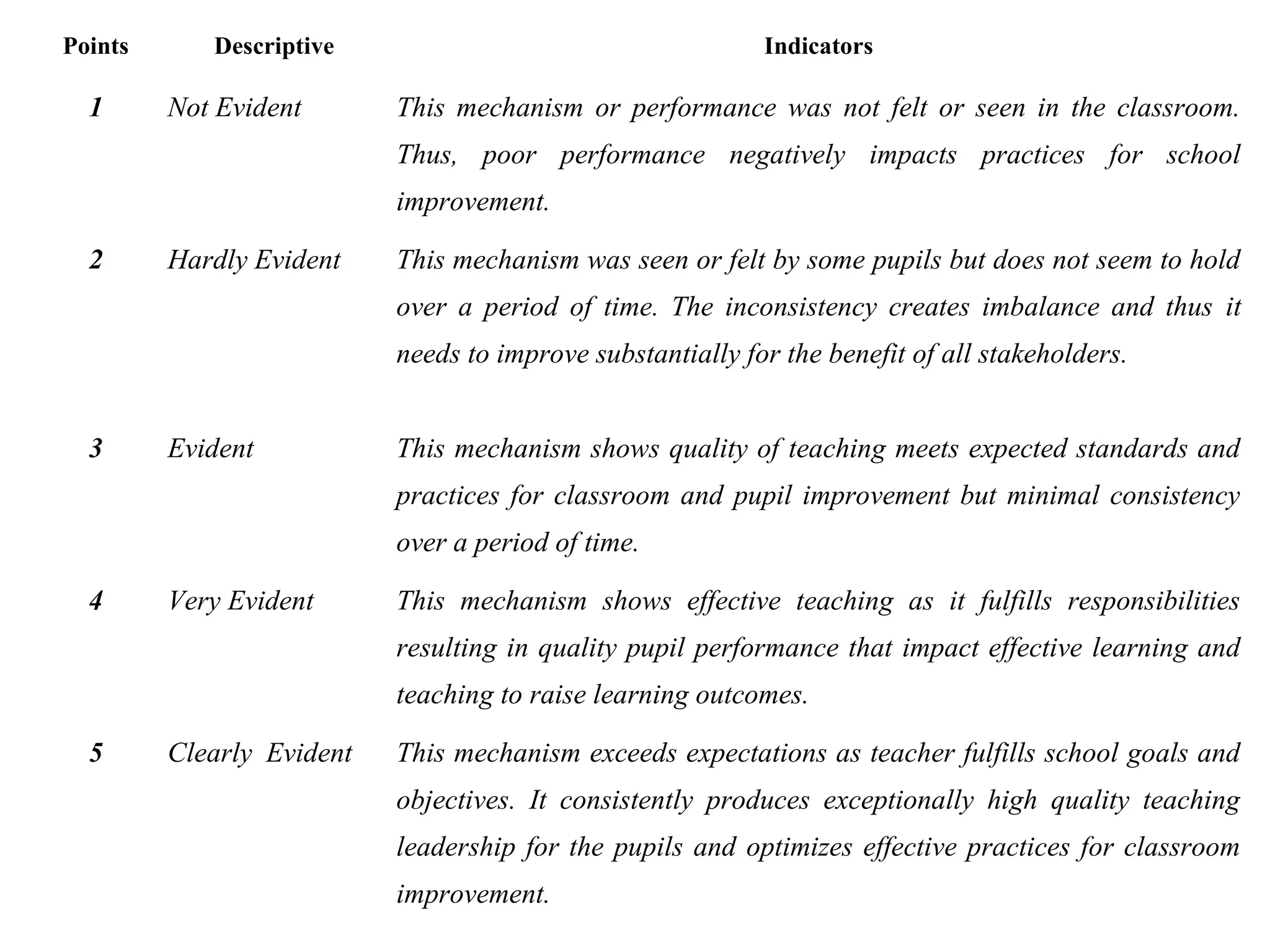
Points

1

Descriptive

Not Evident

Indicators

This mechanism or performance was not felt or seen in the classroom.
Thus, poor performance negatively impacts practices for school
improvement.

2

Hardly Evident

This mechanism was seen or felt by some pupils but does not seem to hold
over a period of time. The inconsistency creates imbalance and thus it
needs to improve substantially for the benefit of all stakeholders.

3

Evident

This mechanism shows quality of teaching meets expected standards and
practices for classroom and pupil improvement but minimal consistency
over a period of time.

4

Very Evident

This mechanism shows effective teaching as it fulfills responsibilities
resulting in quality pupil performance that impact effective learning and
teaching to raise learning outcomes.

5

Clearly Evident

This mechanism exceeds expectations as teacher fulfills school goals and
objectives. It consistently produces exceptionally high quality teaching
leadership for the pupils and optimizes effective practices for classroom
improvement.
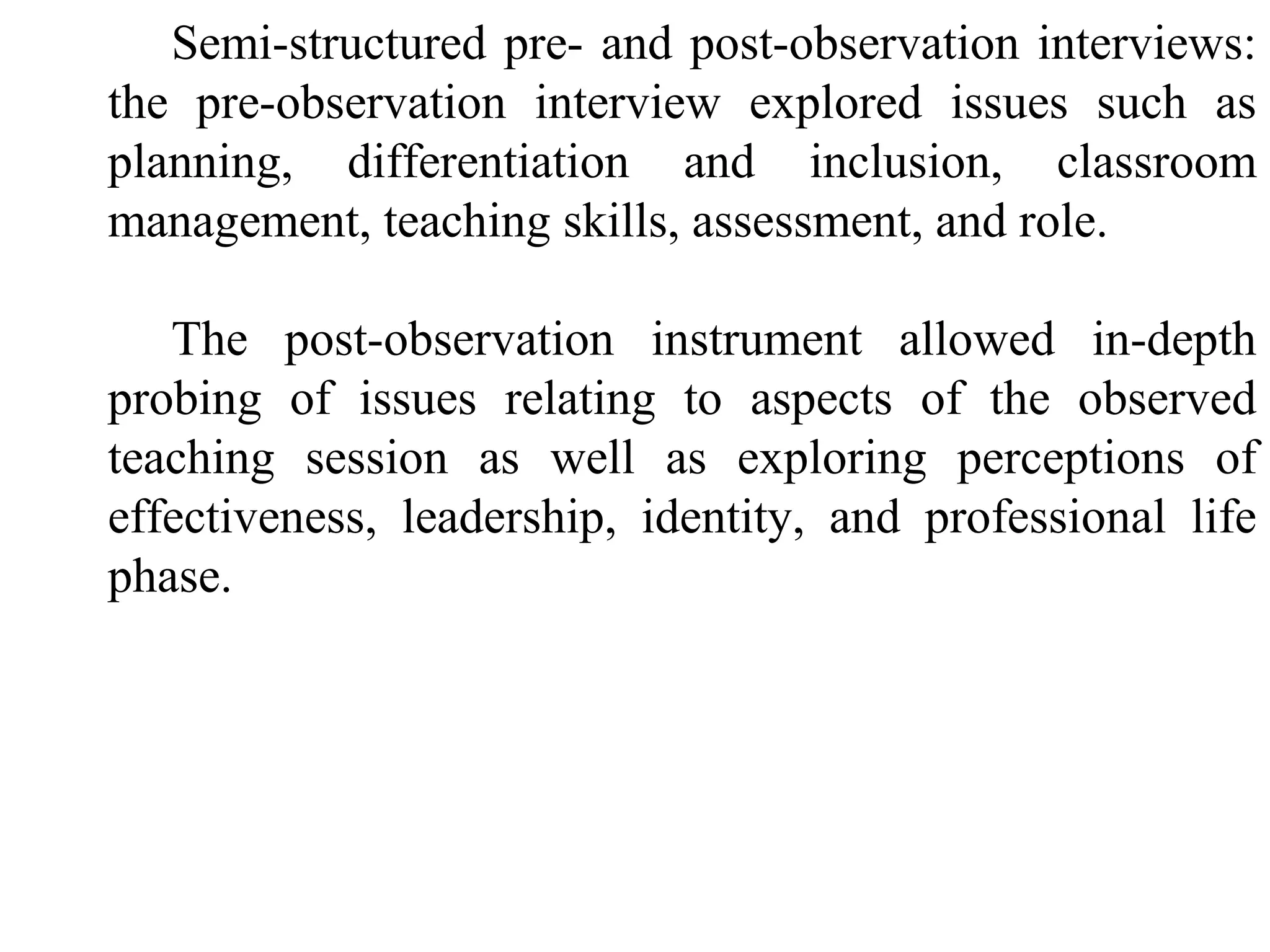
Semi-structured pre- and post-observation interviews:
the pre-observation interview explored issues such as
planning, differentiation and inclusion, classroom
management, teaching skills, assessment, and role.
The post-observation instrument allowed in-depth
probing of issues relating to aspects of the observed
teaching session as well as exploring perceptions of
effectiveness, leadership, identity, and professional life
phase.
Semi-structured interviews with school leaders
can be use to
a)collect information relating to pupil intake,
behavior, parental involvement, and school
culture; and
b)b) provide a further perspective on the
practice and effectiveness of participating
teachers, and the role of school leadership.
Kathleen Eisenhardt’s Process of
Building Theory from Case Study
Research (Eisenhardt, 1989 as
cited by Pare’ 2002)
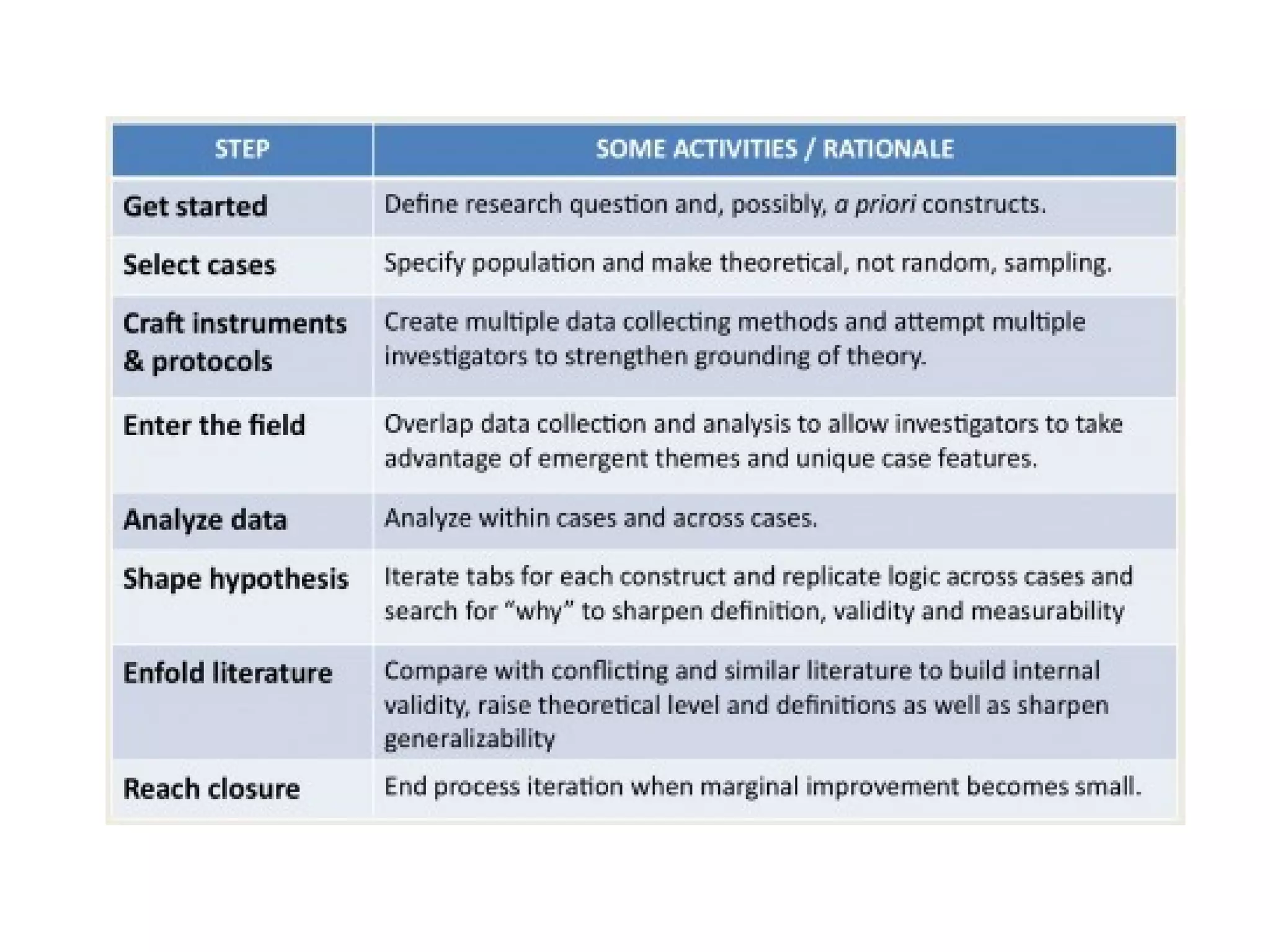
Step 1. Getting Started
In pursuit of this objective, five (5)
interrelated research questions were initially
stated:
(1.) What are the factors which influence
teachers effective classroom practices?
(2.) Do the factors which influence
effectiveness vary for teachers working in
different school cultures contexts, or for
different kinds of outcomes, ages and
professional life phases? If so, how and why?
(3.) What are the similarities and differences in the
factors that influence classroom practice in different
school phases and context?
(4.) What are the relationships between observed
classroom practice and policy, school context, teacher
professional life phase, and professional identity?
(5.) What are the implications of this for key
stakeholders who are involved in raising standards in
schools?
The Characteristics of Effective
Practice.
Step 2. Selecting Cases
This research relies on theoretical sampling
(i.e. cases are chosen for theoretical, not
statistical, reasons).
As Pettigrew (1988) noted, given the limited
number of cases which can usually be studied, it
makes sense to choose cases such as extreme
situations and polar types in which the process of
interest is "transparently observable." Thus, the
goal of theoretical sampling is to choose cases
which are likely to replicate or extend the
emergent theory.
Step 3. Crafting Instruments and
Protocols
The study shall use mixed-method of inquiry or a combination of
quantitative and qualitative in analyzing data.
Quantitative evidence can indicate relationships which may not be salient to
the researcher. It also can keep researchers from being carried away by vivid,
but false, impressions in qualitative data, and it can bolster findings when it
corroborates those findings from qualitative evidence.

The qualitative data are useful for understanding the rationale or
theory underlying relationships revealed in the quantitative data or
may suggest directly theory which can then be strengthened by
quantitative support (Jick, 1979 as cited by Pare, 2004).
Step 4. Entering the Field
Data can be taken from key informants
interview, focused group discussions,
classroom observations and other related
documents that could answer the research
problem and questions. Field notes are
valuable tool of recording first-hand information
in the inquiry process.
As described by Van Maanen (1988), field
notes are an ongoing stream-of-consciousness
commentary about what is happening in the
research.
Step 5. Analyzing Data
Coding in qualitative research involves segmenting the data
into units (Hammersley & Atkinson, 1983) and rearranging
them into categories that facilitate insight, comparison, and the
development of theory (Strauss & Corbin, 1990). Codes serve
as retrieval and organizing devices that allow the rapid retrieval
and clustering of all the segments related to a particular
question, concept, or theme.
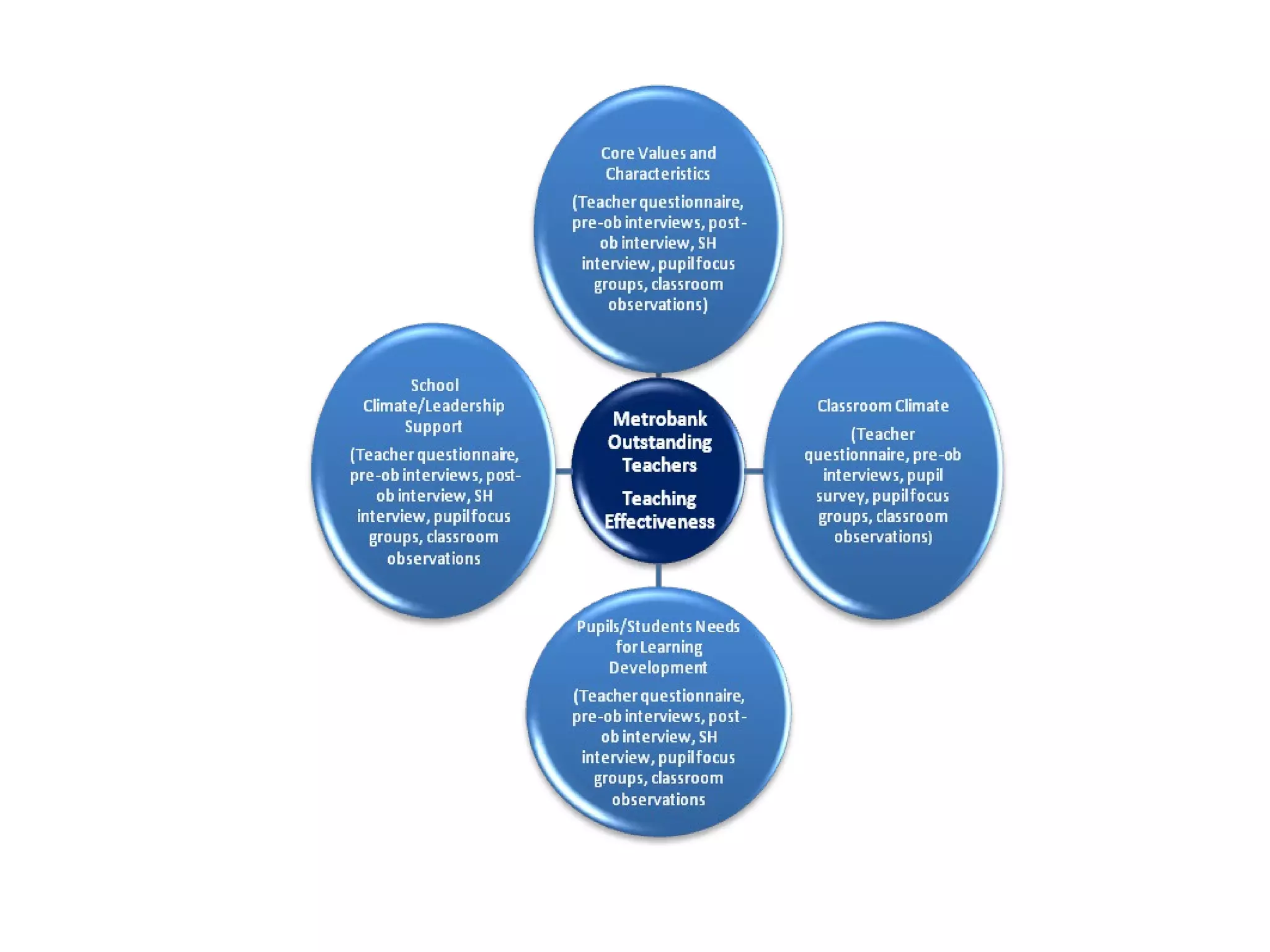
The coding scheme proposed in this study was divided into
four broad categories: (1) School Climate (2) Teacher’s Core
Values and Characteristics, (3) Pupils’ Needs, and (4)
Classroom Climate.
On the other hand, Cross-Case Analysis
allows the researcher to compare responses from
the respondents and look for similarities and
differences which may lead to an in-depth
understanding of school effectiveness. As
patterns begin to emerge, certain evidence may
stand out as being in conflict with the patterns.
In those cases, the investigator conducts followup focused interviews to confirm or correct the
initial data in order to tie the evidence to the
findings and to state relationships in answer to
the research questions.
Step 6. Shaping Hypotheses
The next step of this highly iterative
process is to compare systematically the
emerging theory with the evidence from
each project in order to assess how well
or poorly it fits with the data. The central
idea is that researchers constantly
compare theory and data - iterating
toward a theory that closely fits the data
(Eisenhardt, 2002 as cited by Pare’,
2004).
Step 7. Enfolding Literature
An essential feature of theory
building is comparison of the
emergent concepts, theory, or
hypotheses with the extant literature
(Eisenhardt, 2002). This involves
asking what is similar to, what does it
contradict, and why.
Step 8. Reaching Closure
An important issue in reaching closure is
when to stop adding cases. Ideally,
researchers should stop adding cases when
theoretical
saturation
is
reached
(Eisenhardt, 2002). Theoretical saturation is
the point at which incremental learning is
minimal because the researchers are
observing phenomena seen before (Glaser
& Strauss, 1999).
Participants to the Study
The respondents considered for this
study are the 30 winners to the
Metrobank Search for Outstanding
Teachers from Central Luzon and
National Capital Region.
☻
Thank You
and
Good Day !!!

Towards a framework of teaching effectiveness in public

  • 1.
    TOWARDS A FRAMEWORKOF TEACHING EFFECTIVENESS IN PUBLIC SCHOOLS: A Mixed Methods Study of Excellence in Classroom Practice A Research Proposal
  • 2.
    What constitutes andinfluences teaching effectiveness and what are the factors that makes a teacher effective. It will take into account the influences of factors that may contribute to effective teacher’s classroom practices;
  • 3.
    Republic Act No.7784 defines "Excellence in education" as pertaining to the ‘efficient, effective and innovative delivery of relevant, functional, and quality programs’ in the teaching and learning process.
  • 4.
    The excellence inproviding quality education happens with the interplay of the schools, teachers, social support to learning, complementary interventions, and good leaders. Collaboration of all these basic components are important to promote “breakthrough” practices and these practices are characterized by shared responsibility of all stakeholders for student success. (Fullan, Hill and Crevola, 2006).
  • 5.
    In building aframework for teaching effectiveness, this study aims to accomplish four main aims: (1) To describe, analyze and explain the factors that influences effective teacher’s classroom practices using methods of observation, standardized performance appraisal system, detailed field notes and pupil and teachers’ perceptions;
  • 6.
    (2) To explore classroom practiceof the respondent teachers across different school contexts, professional life phases and ages in relation to observation of professional practice and,
  • 7.
    (3) To analyzethe relationships between observed classroom practice and students needs, school context, teacher professional life and ages, and most of all, (4) Implications for key stakeholders who are involved in raising standards for schools and for teacher development.
  • 8.
    The in-depth analysisof quantitative and qualitative investigation will provide the framework of teaching effectiveness which highlights teaching practices and processes that will inform educational leaders’ the evidence-based decisions and draw conclusions and recommendations about their implications for the systems at large.
  • 9.
    Research Gaps What doesprevious researches recommend for future study?
  • 10.
    1. Teaching isa part of nearly every professional's activities and, for some, it is a career (Ursano, Amy M; Kartheiser, Paul H; Ursano, Robert J). However, the complex and essential nature of teaching in our professions is often overlooked. The teacher's essential skills, attitudes, and behaviors are rarely described and even less often given thought (Weissmann, et al., 2006).
  • 11.
    2. Teaching effectivenessis a multidimensional construct (Kington, et.al.,2010) --that is, it is possible that a teacher may excel in some aspects of teaching, but not in others. Thus, articulating the old adage that: “Nobody has the monopoly of everything.”
  • 12.
    3. Specific focuson characteristics and practices of teachers who appear to be successful in their teaching. This study would come up with an analysis of the best practices and what works best in ensuring quality education which will form a framework of teaching effectiveness.
  • 13.
    4. The currentliterature does not identify what makes a teacher effective in different circumstances and at different times or age, different school contexts, and professional life phases. (Creemers , 1994; Muijs and Reynolds, 2000; Scheerens, 1992; Teddlie and Liu, 2008).
  • 14.
    Does not combineobservational studies with other key factors that affect the quality of teachers, teaching and pupil outcomes such as career phase, teacher identity, and school processes, and social contexts. (Creemers , 1994; Muijs and Reynolds, 2000; Scheerens, 1992; Teddlie and Liu, 2008). This has continued to be an area of interest in this study.
  • 15.
    There is aneed for research in the country to examine more closely the links between effectiveness at the school level and the ways in which it can promote and support effective teaching within individual classrooms, particularly since the impact of classroom level effectiveness has been shown to influence practice more directly than whole school effectiveness (Creemers , 1994; Muijs and Reynolds, 2000; Scheerens, 1992; Teddlie and Liu, 2008).
  • 16.
    This enabled aresearch-informed account and explanation of the relationships between teacher’s backgrounds, context, interactions, and experiences over time and their classroom practice.
  • 17.
    Methods The study shallemploy the MixedMethod – a combination of quantitative and quantitative method of research. Collecting different types of data by different methods from different sources produces a wider scope of coverage, and might result in a fuller picture of the phenomena under study than would have been achieve otherwise (Bonoma, 1985).
  • 18.
    This study seeksto establish a multi-dimensional picture of teaching effectiveness by integrating a range of teacher, principal, and pupil perspectives; Classroom observations and a contextual perspective of the teachers.
  • 19.
    The main instrumentin collecting quantitative data is the survey questionnaire in Likert Model formulated by the researcher for the teachers and their school heads, pupils or students. This survey questionnaire contains all items reflected from the aspects of school effectiveness framework
  • 20.
    The Survey Questionnaire:use to a)identify key characteristics of teachers in terms of age, years in teaching and school sector; and b)establish, in conjunction with the literature, key factors thought to influence teachers’ classroom practice and student learning and attainment.
  • 21.
    The purpose ofthe pupil questionnaire was to gather information about pupils‟ perceptions of different aspects of their classroom experiences, including their attitudes towards their school and views of teaching. It also provided further measures of classroom practice, attitudes towards school and views of teaching centered on students’ perceptions of the teacher.
  • 22.
    Points 1 Descriptive Not Evident Indicators This mechanismor performance was not felt or seen in the classroom. Thus, poor performance negatively impacts practices for school improvement. 2 Hardly Evident This mechanism was seen or felt by some pupils but does not seem to hold over a period of time. The inconsistency creates imbalance and thus it needs to improve substantially for the benefit of all stakeholders. 3 Evident This mechanism shows quality of teaching meets expected standards and practices for classroom and pupil improvement but minimal consistency over a period of time. 4 Very Evident This mechanism shows effective teaching as it fulfills responsibilities resulting in quality pupil performance that impact effective learning and teaching to raise learning outcomes. 5 Clearly Evident This mechanism exceeds expectations as teacher fulfills school goals and objectives. It consistently produces exceptionally high quality teaching leadership for the pupils and optimizes effective practices for classroom improvement.
  • 23.
    Semi-structured pre- andpost-observation interviews: the pre-observation interview explored issues such as planning, differentiation and inclusion, classroom management, teaching skills, assessment, and role. The post-observation instrument allowed in-depth probing of issues relating to aspects of the observed teaching session as well as exploring perceptions of effectiveness, leadership, identity, and professional life phase.
  • 24.
    Semi-structured interviews withschool leaders can be use to a)collect information relating to pupil intake, behavior, parental involvement, and school culture; and b)b) provide a further perspective on the practice and effectiveness of participating teachers, and the role of school leadership.
  • 25.
    Kathleen Eisenhardt’s Processof Building Theory from Case Study Research (Eisenhardt, 1989 as cited by Pare’ 2002)
  • 27.
    Step 1. GettingStarted In pursuit of this objective, five (5) interrelated research questions were initially stated: (1.) What are the factors which influence teachers effective classroom practices? (2.) Do the factors which influence effectiveness vary for teachers working in different school cultures contexts, or for different kinds of outcomes, ages and professional life phases? If so, how and why?
  • 28.
    (3.) What arethe similarities and differences in the factors that influence classroom practice in different school phases and context? (4.) What are the relationships between observed classroom practice and policy, school context, teacher professional life phase, and professional identity? (5.) What are the implications of this for key stakeholders who are involved in raising standards in schools?
  • 29.
    The Characteristics ofEffective Practice.
  • 30.
    Step 2. SelectingCases This research relies on theoretical sampling (i.e. cases are chosen for theoretical, not statistical, reasons). As Pettigrew (1988) noted, given the limited number of cases which can usually be studied, it makes sense to choose cases such as extreme situations and polar types in which the process of interest is "transparently observable." Thus, the goal of theoretical sampling is to choose cases which are likely to replicate or extend the emergent theory.
  • 31.
    Step 3. CraftingInstruments and Protocols The study shall use mixed-method of inquiry or a combination of quantitative and qualitative in analyzing data. Quantitative evidence can indicate relationships which may not be salient to the researcher. It also can keep researchers from being carried away by vivid, but false, impressions in qualitative data, and it can bolster findings when it corroborates those findings from qualitative evidence. The qualitative data are useful for understanding the rationale or theory underlying relationships revealed in the quantitative data or may suggest directly theory which can then be strengthened by quantitative support (Jick, 1979 as cited by Pare, 2004).
  • 33.
    Step 4. Enteringthe Field Data can be taken from key informants interview, focused group discussions, classroom observations and other related documents that could answer the research problem and questions. Field notes are valuable tool of recording first-hand information in the inquiry process. As described by Van Maanen (1988), field notes are an ongoing stream-of-consciousness commentary about what is happening in the research.
  • 34.
    Step 5. AnalyzingData Coding in qualitative research involves segmenting the data into units (Hammersley & Atkinson, 1983) and rearranging them into categories that facilitate insight, comparison, and the development of theory (Strauss & Corbin, 1990). Codes serve as retrieval and organizing devices that allow the rapid retrieval and clustering of all the segments related to a particular question, concept, or theme. The coding scheme proposed in this study was divided into four broad categories: (1) School Climate (2) Teacher’s Core Values and Characteristics, (3) Pupils’ Needs, and (4) Classroom Climate.
  • 35.
    On the otherhand, Cross-Case Analysis allows the researcher to compare responses from the respondents and look for similarities and differences which may lead to an in-depth understanding of school effectiveness. As patterns begin to emerge, certain evidence may stand out as being in conflict with the patterns. In those cases, the investigator conducts followup focused interviews to confirm or correct the initial data in order to tie the evidence to the findings and to state relationships in answer to the research questions.
  • 36.
    Step 6. ShapingHypotheses The next step of this highly iterative process is to compare systematically the emerging theory with the evidence from each project in order to assess how well or poorly it fits with the data. The central idea is that researchers constantly compare theory and data - iterating toward a theory that closely fits the data (Eisenhardt, 2002 as cited by Pare’, 2004).
  • 37.
    Step 7. EnfoldingLiterature An essential feature of theory building is comparison of the emergent concepts, theory, or hypotheses with the extant literature (Eisenhardt, 2002). This involves asking what is similar to, what does it contradict, and why.
  • 38.
    Step 8. ReachingClosure An important issue in reaching closure is when to stop adding cases. Ideally, researchers should stop adding cases when theoretical saturation is reached (Eisenhardt, 2002). Theoretical saturation is the point at which incremental learning is minimal because the researchers are observing phenomena seen before (Glaser & Strauss, 1999).
  • 39.
    Participants to theStudy The respondents considered for this study are the 30 winners to the Metrobank Search for Outstanding Teachers from Central Luzon and National Capital Region.
  • 40.

Editor's Notes