


DOWN WITH
GRAMMAR!
THE UNENDING SEARCH FOR OPTIMAL WAYS OF LEARNING ANOTHER
LANGUAGE
Revised and extended February 2017
1
Dennis Newson
These slides were prepared for a webinar given for IATEFL‘s GISIG on 19th.
February, 2017 and were a revision of earlier versions of the presentation
given at conferences in Turkey, Russia, Bulgaria and as part of EVO 2012.
Parts of the webinar were also first formulated in a talk given in Second
Life:
Second Life presentation
They functioned as prompts for the unscripted talk that I gave on each
occasion. In their present revision they are emerging more as a self-study
resource have been extended and their presentation as a set of slides
reveals their origin. They remain a „work in progress“ since every time I
open Powerpoint I edit and extend. For this reason , for those readers who
are interested I recommend that as well as watching this presentation they
visit the following site which will contain an annotated bibliography on the
topic Grammar in EFL .
Down with grammar!
These slides also contain a recommendation to follow the precepts of Luke
Meddings and Scott Thornbury‘s Teaching Unplugged and Susan
Hillyard‘s English Through Drama: Creative activities for inclusive ELT
classes . Links to reviews of and notes on these books can be found in the
the Down with grammar! site as well links to further information about the
work of Larsen-Freeman on ELT and complexity theory.
2
3
I have to
teach a
private pupil
the use of
the three IF
clauses
tomorrow.
My Devil‘s advocate, alter ego is echoing the comment of a close
member
of the family, a
practising EFL
Teacher,
„frustrated by
people with the
time and
energy to
indulge in
armchair
theorizing
comfortably
removed from
the nitty-gritty
chalk face of
actual
teaching.“
Despite this criticism and
far from oblivious of the
facts of routine, day-to-
day demands and
impositions on the
teacher and their
learners I still say:
4
5
My conviction is that the widespread misunderstand of what grammar is and is not and the
role it plays in the learning and acquisition of a second/foreign/other language blocks the
implementation of effective ways of learning and acquiring a second/foreign/other
language. This state of affairs prevails world-wide. It is a global problem, albeit not to be
ranked along with poverty, starvation, climate change or the exploitation and abuse of
young children as cheap labour or sex workers. But it is a serious educational, pedagogical
problem.
DOWN WITH GRAMMAR! The unending search for
optimal ways of learning another language.
[ For the webinar for which these slides were produced I promised to make 10
statements in support of my views on grammar. ]
1
6
7
I do not intend to spar in the definition game. The linguist, Sidney Greenbaum in his, Good
English and the Grammarian: Longman (1988 ) distinguishes 12 different meaning of the
word „grammar“ for example Grammar 4 ‚ the contents of a grammar book‘ as in „a
grammar is a book about grammar.“Grammar 9, as in „English is easier to learn than
German because it has hardly any grammar“. „Grammar“ here means inflections, cases. In
this presentation I am using „grammar“ as most of us use it in day-to-day contexts
meaning: the (mis)use of the article, prepositions, tenses, IF clauses, Reported Speech etc.
In the formation of my opinion I have given particular attention not only to theoretical
discussions of language learning but to what I have learned from learners themselves
and to the written accounts of how people have learned English as a
second/foreign/other language.
118
One factor is the need to examine why it is that so many teachers are so vehement about
their views on grammar and its role in facilitating language learning and acquisition. Many –
most - teachers are quick to voice their opinions about the importance of grammar and to
defend these views energetically. It appears hard for them to accept non-traditional views
on the nature of grammar.
111
9
Grammar exists. This is not an eccentric denial of its existence. It is a weighty subject and
teachers if not their pupils have to come to terms with it. For the most part, though, it
describes the language immobile, at rest. Some argue that is represents what the learner of a
second/foreign/other language must learn and perhaps acquire.
IV
10
Grammar, whose business it is to describe a language,
provides no insights whatsoever, no useful hints as to
how a language should be learned. This is not in its
remit.
V
11
One major root of the problem is the persistence of the
belief that language is linear, that it consists of static
blocks , bricks (words, lexical items) that can be
assembled in rule-based ways.
VI
12
An alternative, more convincing view, is that language is
not linear, not static. But this view, this theory requires a
considerable mind-shift and it is not like falling off a log to
understand. To do so it is necessary to grapple with
complexity theory – complex systems as applied to
theories of language learning. I accept the suggestion that
we need to prioritize understanding of complexity theory,
complex systems as applied to language in order to obtain
a true understanding of the nature of language and assist
us in appropriately and effectively facilitating language
learning.
VII
13
I also subscribe to the forceful, persuasive views on grammar
and its connection with power, financial profit and the
individual teacher’s self-appraisal contained in the short
but stunning article by Scott Thornbury: Grammar, Power
and Bottled Water.
VIII
14
But notwithstanding the continuance of the
grammar centred approach it is important to
accept there are also a host of creative, innovative
approaches being practised on many parts of ther
world. It is not so much a question of finding new
approaches, the task is to spread these best
practices widely. And here there is a clear role for
an organisation like IATEFL and its SIGs.
IX
15
For the post-grammar future i.e “Up with what?” if it is
“Down with grammar!” - I strongly recommend as
accounts of best practice the approach through drama
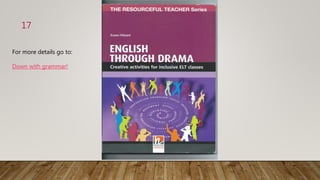
described by Susan Hillyard in her recent book: English
Through Drama: Creative activities for inclusive ELT
classes and Luke Meddings and Scott Thornbury’s
learner-centred, dialogic stance outlined in : Teaching
Unplugged.
[See a later slide for details.]
X16
17
For more details go to:
Down with grammar!
For more details
go to:
Down with
grammar!
18
From the learner‘s
point of view
Some comments on
the learning of a
foreign/second/othe
r language
La Grammaire
12th. Century
Chatres cathedral
France
One boy pulls
another‘s hair
and the
grammar
teacher is
poised to
administer a
reprimand.
19
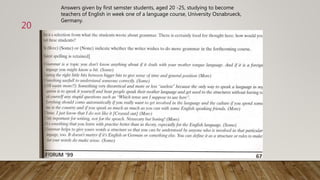
Answers given by first semster students, aged 20 -25, studying to become
teachers of English in week one of a language course, University Osnabrueck,
Germany.
20
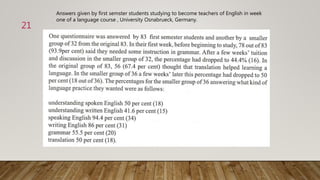
Answers given by first semster students studying to become teachers of English in week
one of a language course , University Osnabrueck, Germany.
21
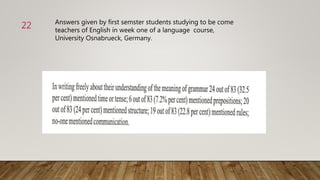
Answers given by first semster students studying to be come
teachers of English in week one of a language course,
University Osnabrueck, Germany.
22
23
Of course it is a mistake to assume that the most
effecient or statistically normal procedure for learning
a foreign or second language can only take place in a
classroom with a teacher at the front faced by learners
with a textbook . In the real world many people pick
up foreign languages on the job with no teachers and
no instruction in grammar.
24
25
How important
is „correct“
grammar to the
taxi drivers of
Istanbul? Their
English is
adequate
enough to
negotiate a fare
with English-
speaking
customers.
26
On a visit to Istanbul I
asked a carpet-seller in the
market where he had
learned to speak such
excellent German and
English and he replied:
„Trying to sell carpets to
people like you.“ And he
added:
„One of these days I really
must learn some grammar.“
I‘ve always regretted that I
did not ask him: „Why?“
27
How important is
„correct
grammar“ to
these waiters?
28
In markets in many
parts of the world
traders and buyers
will typically speak
several languages and
dialects none of them,
probably, learned
formally at school.
29
Over the years
when I have asked
people where they
learned their
English they
frequently answer:
„By watching films
with English sub-
titles“,
„Listening to songs
sung in English.“
„YouTube!“
They rarely answer:
„At school.“
30
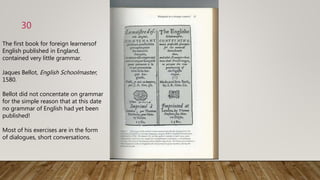
The first book for foreign learnersof
English published in England,
contained very little grammar.
Jaques Bellot, English Schoolmaster,
1580.
Bellot did not concentate on grammar
for the simple reason that at this date
no grammar of English had yet been
published!
Most of his exercises are in the form
of dialogues, short conversations.
31
A.P.R. Howat, A
History of English
Language
Teaching, Oxford
(1984)
Howat writes (p 16)
„We cannot blame
Bellot for the
inadequacy of...[the]
...grammar notes
considering that the
English had so far
failed to produce
anything substantial
themselves.“
A dialogue
between
Barbara and
the boy
Peter.
Jaques
Bellot,
English
Schoolmast
er.
„Where lade
you your
nightcap?“
32
The very first grammar of
English was published in
1586 .
W. Baullokar, Edmund
Bollifant London (1586]
33
Grammar – a weighty
subject.
Longman 1972
Weight: 2
kg.
Number of
pages: 1,120
Knowledge is
power.
To own this
particular
knowledge
costs money.
Price: 34.44
pounds
sterling
34
The next 9 slides
give details of
important
published
grammars.
35
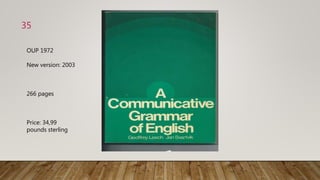
OUP 1972
New version: 2003
266 pages
Price: 34,99
pounds sterling
36
Price:
15.99
pounds
sterling
Collins 1990
486 pages
37
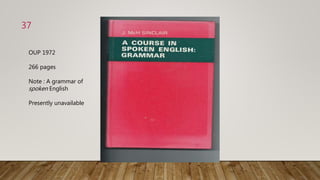
OUP 1972
266 pages
Note : A grammar of
spoken English
Presently unavailable
38
Cambridge 2002
Pages: 1,842
[Cost – roughly one
pound sterling per page]
Weight: 3.1 kilos
Price: 188.64 pounds
sterling. „Only 5 left in stock.
Order soon.“ Amazon. 10.03.2017
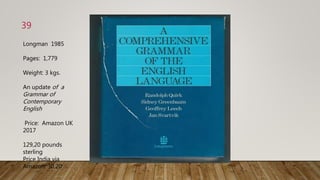
39
Longman 1985
Pages: 1,779
Weight: 3 kgs.
An update of a
Grammar of
Contemporary
English
Price: Amazon UK
2017
129,20 pounds
sterling
Price India via
Amazon: 30,20
40
George Allan and
Unwin 1933
Pages: 387
Price: 34,99
pounds sterling
Amazon 2017
41
Longman:
Weight, with box: 2,9
kilos
Pages: 973
Price: 204.10 pounds
sterling
See notice/review
Notice - Longman
Grammar of Spoken and
Written English
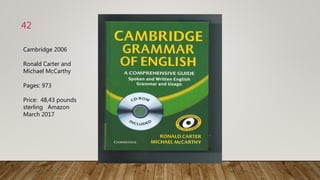
42
Cambridge 2006
Ronald Carter and
Michael McCarthy
Pages: 973
Price: 48,43 pounds
sterling Amazon
March 2017
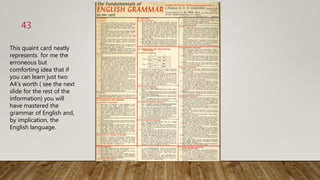
43
This quaint card neatly
represents for me the
erroneous but
comforting idea that if
you can learn just two
A4‘s worth ( see the next
slide for the rest of the
information) you will
have mastered the
grammar of English and,
by implication, the
English language.
44
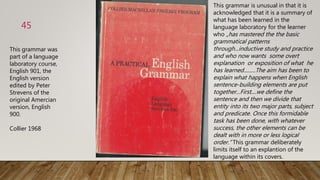
45
This grammar was
part of a language
laboratory course,
English 901, the
English version
edited by Peter
Strevens of the
original Amercian
version, English
900.
Collier 1968
This grammar is unusual in that it is
acknowledged that it is a summary of
what has been learned in the
language laboratory for the learner
who „has mastered the the basic
grammatical patterns
through...inductive study and practice
and who now wants some overt
explanation or exposition of what he
has learned.........The aim has been to
explain what happens when English
sentence-building elements are put
together...First....we define the
sentence and then we divide that
entity into its two major parts, subject
and predicate. Once this formidable
task has been done, with whatever
success, the other elements can be
dealt with in more or less logical
order.“ This grammar deliberately
limits itself to an explantion of the
language within its covers.
46
I can provide at least anecdotal evidence
of the fact that at least two people, former
scientists on scholarships to the
Norwegian Technical Highschool (NTH,
Trondheim, Norway) - now retired
professors, one in Romania the other in
Bulgaria, successfully learnt English by
working alone in the language laboratory
through English 901 twice, supplementing
their lonely learning by socialising
equipped with their emerging English
with the tutor in charge of the language
laboratory, one Dennis Newson, and other
English-speaking members of staff
working in NTH, Trondheim, Norway.
47
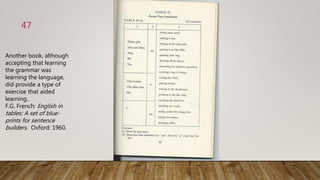
Another book, although
accepting that learning
the grammar was
learning the language,
did provide a type of
exercise that aided
learning..
F.G. French: English in
tables: A set of blue-
prints for sentence
builders. Oxford: 1960.
48
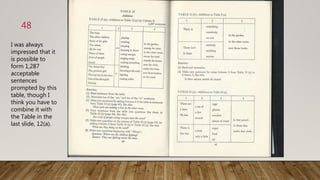
I was always
impressed that it
is possible to
form 1,287
acceptable
sentences
prompted by this
table, though I
think you have to
combine it with
the Table in the
last slide, 12(a).
“Listening to Sinatra , I learned to pronounce every word distinctly.
He never swallowed a syllable. From him I learned rhythms, inflecti
9ons and the sounds of a l oanguage that was so different from the
one I spoke everyday. „
But even dearer to my heart…..I listened to Mel Allen do the play-
by-play for the Yankees and…Vin Scully broadcast the Brooklyn
Dodgers. Glued to the radio following the exploits of my heroes, I
absorbed the language of excitement and disappointment. I
learned storytelling and the art of filling dead time.“
Jose Serrano (Born Pueerto Rico, 1943) U.S. Congresdsman since 1
How I learned English edited Tom Miller, National Geographic
‚Society, 2007 ISBN 978-1-4262-0097-7990, Learning English by
the Sinatra Method
49
Two
accounts
of how
individuals
Learnt
English.
„My system was simple. On my way down to the subway, I
would look for older people who didn‘t seem in a hurry and I
would ask them how to get to an address. They tried to
explain, and almost always they would ask who I was, where
was I from and what was I doing in New York. Each time I
understood a little more and I could answer a little better.
At the end of each day, I‘d incorporate new words into my
dictionary and prepare the sentences that would start a new
conversation... I complemented this procedure by watching
televsion.
Every night I chose ten new words... And I‘d try to use them in
my increasingly lengthy subway conversations......After 90 days
I could navigate pretty well and after a year I felt I had enough
ability to join in conversations and understand almost
everything being said.“
Mario Kreutzberger op.cit.,
50
GRAMMAR,
POWERandBOTTLEDWATER51
GPBW 1
„Grammar is the engine that drives classroom practice. It is in grammatical terms that
pedagogical aims are articulated; it is for linguistical purposes that texts are chosen and
exploited ; it is the reproduction of specific forms that motivates classroom interactions. It is
their lack of accuracy that prompts teacher feedback; and it is mastery of form that is still largely
the standardby which learning is evaluated“.
52
GPBW 2
[Suggesting that university deparments have an
invested interest in promolgating the importance
of grammar] „By claiming ownership of grammar
the applied linguistics departments assert their
influence over the industry that trades in that
commodity....Teachers, construed here as being
grammatically challenged, have no choice but to
beat a path, cap in hand, to the grammar bank.“
53
GPBW 3
With reference to Sinclair‘s (1997) claim that: „those who teach languages
depend on those who describe them“ (p299) „not only asserts the hieratic
role of linguists as guardians of the sacred mysteries, but serve to
disenfranchise teachers by undervaluing the pedagogical power of their
experience and intuitions.“
54
GPBW 4
„Publishers, of course, want a share of the pie, too. By swearing
allegiance to grammar , they are guarenteed a slice......Despite
paying lip-service to communication...current ELT materials are
resolutely form-driven.“
55
GPBW 5
Quotes an article in the ELT Journal by
Allwright (1981) who called for a move
away from producing more teaching
materials to learning materials. He also
suggested a move away from global
materials to „something much less
ambitious, probably locally
Thornbury senses here a devolution of
power to the learner .
56
GPBW 6
With reference to Candlin‘s (1994) claim that task-
based learning „empowers learners to make
meanings for themselves“, he writes: „While
grammar-based materials work on the assumption
that there is something learners don‘t know, task-
based materials work on the assumption that that
there is something learners can do.“
57
GPBW 7
„But grammar is not just order. Grammar is power. Grammar invests EFL teachers with
transmittable knowledge......Classroom discourse is not so much discourse as
metadiscourse....It is talk about talk . It is content teaching where the only content is
grammar. Real language use, if it occurs at all in the insterstices and marginalia of
lessons...The effect of this „overt teacher grammar display behaviour“ is not only to
deprive learners of valable practice opportunities but to maintain the unequal power
relationship that already exists in many classrooms.“
58
The concept of aims seems to be based on the fallacy that
language learning is the incremental accumulation of
discrete-items of linguistic knowledge. But, as Diane
Larsen-Freeman (1997) reminds us, "learning linguistic
items is not a linear process - learners do not master one
item and then move on to another. In fact, the learning
curve for a single item is not linear either. The curve is
filled with peaks and valleys, progress and backslidings"
(p. 18).
59
60
The importance of the complexity theory view of the nature of
language is that it is radically different from the commonly-
held, traditional view. It follows, if language is different from
what we have always imagined to be, then different
approaches and methods of learning it will be necessary.
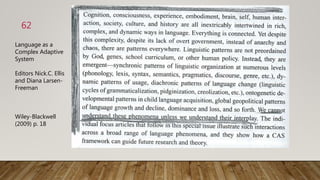
Language as a complex adaptive system [Language as a
complex adaptive system edited Nick C. Ellis and Diane Larsen-
Freeman, Wiley-Blackwell (2007)] is relatively new theory and
is being continously developed - but the key concepts are
outlined on the next slide.
61
62
Language as a
Complex Adaptive
System
Editors Nick.C. Ellis
and Diana Larsen-
Freeman
Wiley-Blackwell
(2009) p. 18
This view of language totally rejects the linear
view of language – and it follows that
approaches and methods that assume
language is linear are going to be
inappropriate and probably a hindrance to
effective learning. One crucial factor is that
the learning of a language cannot be seen as
a matter of systematically learning discrete
units nor the practice of stringing them
together like pieces of Leggo. This point is
clearly stated by the linguist Rod Brens.
.
63
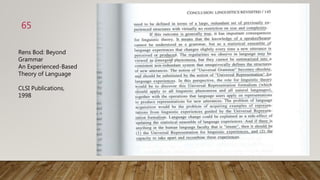
Beyond Grammar An Experienced-Based Theory of Language Rens Bod CLSI Publications, Standford,
California (1988) Preface xi, xii
„Data Orientated Parsing“ „DOP“ embodies the assumption that human language comprehension and
production works with representations of concrete past languagae experiences, rather than with abstract
grammatical rules.“
He describes various models for various kinds of linguistic representations and comes to the conclusion that:
„The productive units of natural language cannot be definied in terms of minmal set of rules (or contraints or
principles).....In particular, it means that the knowledge of a speaker/hearer cannot be understood as a
grammar, but as a statistical ensemble of language experiences that change slightly every time a new
utterance is processed.“
Summing up conclusions from his investigations he writes: [p 144] „We deprive from [them] that the
productive units of natural language cannot be defined in terms of a minmal set of rues (or contraints or
principles).......but need to be defined in terms of a large, redundant set of previously experienced structures
with virtually no restriction on size and complexity.“
64
Rens Bod: Beyond
Grammar
An Experienced-Based
Theory of Language
CLSI Publications,
1998
65
What the *theory implies, quite simply, is that language
acquisition, first or second, occurs when comprehension of real
messages occurs, and when the acquirer is not 'on the
defensive'... **Language acquisition does not require extensive
use of conscious grammatical rules, and does not require
tedious drill. It does not occur overnight, however…. The best
methods are therefore those that supply 'comprehensible input'
in low anxiety situations, containing messages that students
really want to hear.
* Comprehensible input ** My underlining, DJN
There has been support for a non grammar obsessed approach to language
learning for many years. Stephen Krashen. 1981. Principles and Practice in
Second Language Acquisition. English Language Teaching series. London: Prentice-
Hall International (UK) Ltd. 202 pages
66
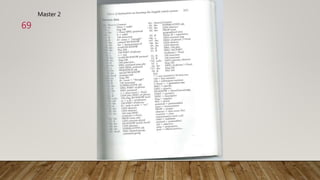
Just one example of an interesting account of the teaching of grammar that
at first glance appears to have been successful.
Peter Master in Terence Odlin Perspectives on Pedagogical Grammar, CUP
1994 pps. 229 -249 claims that systematic instruction on learning the
English article system brought positive results. The rules that were taught
and the test that were administered are copied on the next two slides.
My own students‘ reaction when we worked with this exercise was that the
grammar rule was far too complicated. They wanted the rule simplified....
My view is that all that all the study demonstrates is that students acquired
the skill to do well in a particular kind of exercise which had nothing to do
with mastery of a language with which to communicate.
67
Master 1
68
Master 2
69
My statement 3
(Slide 9) notes
the fervour
with which
teachers in
general cling to
their view of
the nature and
importance of
grammar.
It appears to be
existential, an
example of the
reassurance of
imposed order.
70
My favourite
shop. Every
object has its
place and is
listed in an
orderly
fashion.English hymn
„All things bright
and beautiful“
“The rich man in
his castle,
The poor man at
his gate,
God made them
high and lowly,
And ordered their
estate.”
„We inevitably know the world only through our own eyes – our own senses – coupled with our
struggle against death this means that each of us has an ultimate need to feel that he or she is „an
object of primary value in a world of meaningful actions………..If what reinforces your self-image
contradicts or detracts from mine, then mine is threatened………And so a language class [a staff
room DJN] is one arena in which a number of private universes intersect one another. Each person
is the centre of his or her universe of perceptions and values, and each is affected by what the
others do.“
Earl W. Stevick : Teaching Languages: A Way and Ways Heinle and Heinle 1980
„Why are teachers so resolute in defence of their individual views on
grammar?
71
The magnitude of
the reality in
which we live
engenders a
longing for the
reassurance of
order.
McNeile Dixon,
Gifford Lectures
Glasgow, 1936.
72
Scott: Post-grammar
„A pedagogy where grammar is deconsecrated, where
learners are empowered to make their own meanings, where
teachers are emboldened to subvert the dictates of non-
teachers and where teachers and learners together construct
a shared discourse of possibilty.“
A vision for the future
73
No help here. Deliberately „Anon“
74
I‘m afraid
studying books
of this kind
Will not help you
to master the
English
language.
A final statement
I would go even further than Scott. I stand by the argument that
attention to grammar is not within the territory of learning and
acquiring a foreign/second/another language. The role assigned to
grammar is based on a misaprehension of the true nature of language.
It is, by contrast, quite clearly, a central subject for teachers in
training.
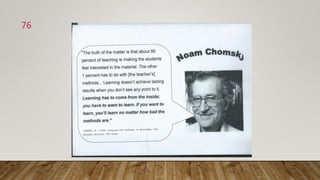
I will give the last word to someone we all might have expected to
argue powerfullly for the importance of teaching grammar.
75
76

Down with grammar!

  • 1.
    DOWN WITH GRAMMAR! THE UNENDINGSEARCH FOR OPTIMAL WAYS OF LEARNING ANOTHER LANGUAGE Revised and extended February 2017 1 Dennis Newson
  • 2.
    These slides wereprepared for a webinar given for IATEFL‘s GISIG on 19th. February, 2017 and were a revision of earlier versions of the presentation given at conferences in Turkey, Russia, Bulgaria and as part of EVO 2012. Parts of the webinar were also first formulated in a talk given in Second Life: Second Life presentation They functioned as prompts for the unscripted talk that I gave on each occasion. In their present revision they are emerging more as a self-study resource have been extended and their presentation as a set of slides reveals their origin. They remain a „work in progress“ since every time I open Powerpoint I edit and extend. For this reason , for those readers who are interested I recommend that as well as watching this presentation they visit the following site which will contain an annotated bibliography on the topic Grammar in EFL . Down with grammar! These slides also contain a recommendation to follow the precepts of Luke Meddings and Scott Thornbury‘s Teaching Unplugged and Susan Hillyard‘s English Through Drama: Creative activities for inclusive ELT classes . Links to reviews of and notes on these books can be found in the the Down with grammar! site as well links to further information about the work of Larsen-Freeman on ELT and complexity theory. 2
  • 3.
    3 I have to teacha private pupil the use of the three IF clauses tomorrow. My Devil‘s advocate, alter ego is echoing the comment of a close member of the family, a practising EFL Teacher, „frustrated by people with the time and energy to indulge in armchair theorizing comfortably removed from the nitty-gritty chalk face of actual teaching.“
  • 4.
    Despite this criticismand far from oblivious of the facts of routine, day-to- day demands and impositions on the teacher and their learners I still say: 4
  • 5.
  • 6.
    My conviction isthat the widespread misunderstand of what grammar is and is not and the role it plays in the learning and acquisition of a second/foreign/other language blocks the implementation of effective ways of learning and acquiring a second/foreign/other language. This state of affairs prevails world-wide. It is a global problem, albeit not to be ranked along with poverty, starvation, climate change or the exploitation and abuse of young children as cheap labour or sex workers. But it is a serious educational, pedagogical problem. DOWN WITH GRAMMAR! The unending search for optimal ways of learning another language. [ For the webinar for which these slides were produced I promised to make 10 statements in support of my views on grammar. ] 1 6
  • 7.
    7 I do notintend to spar in the definition game. The linguist, Sidney Greenbaum in his, Good English and the Grammarian: Longman (1988 ) distinguishes 12 different meaning of the word „grammar“ for example Grammar 4 ‚ the contents of a grammar book‘ as in „a grammar is a book about grammar.“Grammar 9, as in „English is easier to learn than German because it has hardly any grammar“. „Grammar“ here means inflections, cases. In this presentation I am using „grammar“ as most of us use it in day-to-day contexts meaning: the (mis)use of the article, prepositions, tenses, IF clauses, Reported Speech etc.
  • 8.
    In the formationof my opinion I have given particular attention not only to theoretical discussions of language learning but to what I have learned from learners themselves and to the written accounts of how people have learned English as a second/foreign/other language. 118
  • 9.
    One factor isthe need to examine why it is that so many teachers are so vehement about their views on grammar and its role in facilitating language learning and acquisition. Many – most - teachers are quick to voice their opinions about the importance of grammar and to defend these views energetically. It appears hard for them to accept non-traditional views on the nature of grammar. 111 9
  • 10.
    Grammar exists. Thisis not an eccentric denial of its existence. It is a weighty subject and teachers if not their pupils have to come to terms with it. For the most part, though, it describes the language immobile, at rest. Some argue that is represents what the learner of a second/foreign/other language must learn and perhaps acquire. IV 10
  • 11.
    Grammar, whose businessit is to describe a language, provides no insights whatsoever, no useful hints as to how a language should be learned. This is not in its remit. V 11
  • 12.
    One major rootof the problem is the persistence of the belief that language is linear, that it consists of static blocks , bricks (words, lexical items) that can be assembled in rule-based ways. VI 12
  • 13.
    An alternative, moreconvincing view, is that language is not linear, not static. But this view, this theory requires a considerable mind-shift and it is not like falling off a log to understand. To do so it is necessary to grapple with complexity theory – complex systems as applied to theories of language learning. I accept the suggestion that we need to prioritize understanding of complexity theory, complex systems as applied to language in order to obtain a true understanding of the nature of language and assist us in appropriately and effectively facilitating language learning. VII 13
  • 14.
    I also subscribeto the forceful, persuasive views on grammar and its connection with power, financial profit and the individual teacher’s self-appraisal contained in the short but stunning article by Scott Thornbury: Grammar, Power and Bottled Water. VIII 14
  • 15.
    But notwithstanding thecontinuance of the grammar centred approach it is important to accept there are also a host of creative, innovative approaches being practised on many parts of ther world. It is not so much a question of finding new approaches, the task is to spread these best practices widely. And here there is a clear role for an organisation like IATEFL and its SIGs. IX 15
  • 16.
    For the post-grammarfuture i.e “Up with what?” if it is “Down with grammar!” - I strongly recommend as accounts of best practice the approach through drama described by Susan Hillyard in her recent book: English Through Drama: Creative activities for inclusive ELT classes and Luke Meddings and Scott Thornbury’s learner-centred, dialogic stance outlined in : Teaching Unplugged. [See a later slide for details.] X16
  • 17.
    17 For more detailsgo to: Down with grammar!
  • 18.
    For more details goto: Down with grammar! 18
  • 19.
    From the learner‘s pointof view Some comments on the learning of a foreign/second/othe r language La Grammaire 12th. Century Chatres cathedral France One boy pulls another‘s hair and the grammar teacher is poised to administer a reprimand. 19
  • 20.
    Answers given byfirst semster students, aged 20 -25, studying to become teachers of English in week one of a language course, University Osnabrueck, Germany. 20
  • 21.
    Answers given byfirst semster students studying to become teachers of English in week one of a language course , University Osnabrueck, Germany. 21
  • 22.
    Answers given byfirst semster students studying to be come teachers of English in week one of a language course, University Osnabrueck, Germany. 22
  • 23.
  • 24.
    Of course itis a mistake to assume that the most effecient or statistically normal procedure for learning a foreign or second language can only take place in a classroom with a teacher at the front faced by learners with a textbook . In the real world many people pick up foreign languages on the job with no teachers and no instruction in grammar. 24
  • 25.
    25 How important is „correct“ grammarto the taxi drivers of Istanbul? Their English is adequate enough to negotiate a fare with English- speaking customers.
  • 26.
    26 On a visitto Istanbul I asked a carpet-seller in the market where he had learned to speak such excellent German and English and he replied: „Trying to sell carpets to people like you.“ And he added: „One of these days I really must learn some grammar.“ I‘ve always regretted that I did not ask him: „Why?“
  • 27.
  • 28.
    28 In markets inmany parts of the world traders and buyers will typically speak several languages and dialects none of them, probably, learned formally at school.
  • 29.
    29 Over the years whenI have asked people where they learned their English they frequently answer: „By watching films with English sub- titles“, „Listening to songs sung in English.“ „YouTube!“ They rarely answer: „At school.“
  • 30.
    30 The first bookfor foreign learnersof English published in England, contained very little grammar. Jaques Bellot, English Schoolmaster, 1580. Bellot did not concentate on grammar for the simple reason that at this date no grammar of English had yet been published! Most of his exercises are in the form of dialogues, short conversations.
  • 31.
    31 A.P.R. Howat, A Historyof English Language Teaching, Oxford (1984) Howat writes (p 16) „We cannot blame Bellot for the inadequacy of...[the] ...grammar notes considering that the English had so far failed to produce anything substantial themselves.“ A dialogue between Barbara and the boy Peter. Jaques Bellot, English Schoolmast er. „Where lade you your nightcap?“
  • 32.
    32 The very firstgrammar of English was published in 1586 . W. Baullokar, Edmund Bollifant London (1586]
  • 33.
  • 34.
    Grammar – aweighty subject. Longman 1972 Weight: 2 kg. Number of pages: 1,120 Knowledge is power. To own this particular knowledge costs money. Price: 34.44 pounds sterling 34 The next 9 slides give details of important published grammars.
  • 35.
    35 OUP 1972 New version:2003 266 pages Price: 34,99 pounds sterling
  • 36.
  • 37.
    37 OUP 1972 266 pages Note: A grammar of spoken English Presently unavailable
  • 38.
    38 Cambridge 2002 Pages: 1,842 [Cost– roughly one pound sterling per page] Weight: 3.1 kilos Price: 188.64 pounds sterling. „Only 5 left in stock. Order soon.“ Amazon. 10.03.2017
  • 39.
    39 Longman 1985 Pages: 1,779 Weight:3 kgs. An update of a Grammar of Contemporary English Price: Amazon UK 2017 129,20 pounds sterling Price India via Amazon: 30,20
  • 40.
    40 George Allan and Unwin1933 Pages: 387 Price: 34,99 pounds sterling Amazon 2017
  • 41.
    41 Longman: Weight, with box:2,9 kilos Pages: 973 Price: 204.10 pounds sterling See notice/review Notice - Longman Grammar of Spoken and Written English
  • 42.
    42 Cambridge 2006 Ronald Carterand Michael McCarthy Pages: 973 Price: 48,43 pounds sterling Amazon March 2017
  • 43.
    43 This quaint cardneatly represents for me the erroneous but comforting idea that if you can learn just two A4‘s worth ( see the next slide for the rest of the information) you will have mastered the grammar of English and, by implication, the English language.
  • 44.
  • 45.
    45 This grammar was partof a language laboratory course, English 901, the English version edited by Peter Strevens of the original Amercian version, English 900. Collier 1968 This grammar is unusual in that it is acknowledged that it is a summary of what has been learned in the language laboratory for the learner who „has mastered the the basic grammatical patterns through...inductive study and practice and who now wants some overt explanation or exposition of what he has learned.........The aim has been to explain what happens when English sentence-building elements are put together...First....we define the sentence and then we divide that entity into its two major parts, subject and predicate. Once this formidable task has been done, with whatever success, the other elements can be dealt with in more or less logical order.“ This grammar deliberately limits itself to an explantion of the language within its covers.
  • 46.
    46 I can provideat least anecdotal evidence of the fact that at least two people, former scientists on scholarships to the Norwegian Technical Highschool (NTH, Trondheim, Norway) - now retired professors, one in Romania the other in Bulgaria, successfully learnt English by working alone in the language laboratory through English 901 twice, supplementing their lonely learning by socialising equipped with their emerging English with the tutor in charge of the language laboratory, one Dennis Newson, and other English-speaking members of staff working in NTH, Trondheim, Norway.
  • 47.
    47 Another book, although acceptingthat learning the grammar was learning the language, did provide a type of exercise that aided learning.. F.G. French: English in tables: A set of blue- prints for sentence builders. Oxford: 1960.
  • 48.
    48 I was always impressedthat it is possible to form 1,287 acceptable sentences prompted by this table, though I think you have to combine it with the Table in the last slide, 12(a).
  • 49.
    “Listening to Sinatra, I learned to pronounce every word distinctly. He never swallowed a syllable. From him I learned rhythms, inflecti 9ons and the sounds of a l oanguage that was so different from the one I spoke everyday. „ But even dearer to my heart…..I listened to Mel Allen do the play- by-play for the Yankees and…Vin Scully broadcast the Brooklyn Dodgers. Glued to the radio following the exploits of my heroes, I absorbed the language of excitement and disappointment. I learned storytelling and the art of filling dead time.“ Jose Serrano (Born Pueerto Rico, 1943) U.S. Congresdsman since 1 How I learned English edited Tom Miller, National Geographic ‚Society, 2007 ISBN 978-1-4262-0097-7990, Learning English by the Sinatra Method 49 Two accounts of how individuals Learnt English.
  • 50.
    „My system wassimple. On my way down to the subway, I would look for older people who didn‘t seem in a hurry and I would ask them how to get to an address. They tried to explain, and almost always they would ask who I was, where was I from and what was I doing in New York. Each time I understood a little more and I could answer a little better. At the end of each day, I‘d incorporate new words into my dictionary and prepare the sentences that would start a new conversation... I complemented this procedure by watching televsion. Every night I chose ten new words... And I‘d try to use them in my increasingly lengthy subway conversations......After 90 days I could navigate pretty well and after a year I felt I had enough ability to join in conversations and understand almost everything being said.“ Mario Kreutzberger op.cit., 50
  • 51.
  • 52.
    GPBW 1 „Grammar isthe engine that drives classroom practice. It is in grammatical terms that pedagogical aims are articulated; it is for linguistical purposes that texts are chosen and exploited ; it is the reproduction of specific forms that motivates classroom interactions. It is their lack of accuracy that prompts teacher feedback; and it is mastery of form that is still largely the standardby which learning is evaluated“. 52
  • 53.
    GPBW 2 [Suggesting thatuniversity deparments have an invested interest in promolgating the importance of grammar] „By claiming ownership of grammar the applied linguistics departments assert their influence over the industry that trades in that commodity....Teachers, construed here as being grammatically challenged, have no choice but to beat a path, cap in hand, to the grammar bank.“ 53
  • 54.
    GPBW 3 With referenceto Sinclair‘s (1997) claim that: „those who teach languages depend on those who describe them“ (p299) „not only asserts the hieratic role of linguists as guardians of the sacred mysteries, but serve to disenfranchise teachers by undervaluing the pedagogical power of their experience and intuitions.“ 54
  • 55.
    GPBW 4 „Publishers, ofcourse, want a share of the pie, too. By swearing allegiance to grammar , they are guarenteed a slice......Despite paying lip-service to communication...current ELT materials are resolutely form-driven.“ 55
  • 56.
    GPBW 5 Quotes anarticle in the ELT Journal by Allwright (1981) who called for a move away from producing more teaching materials to learning materials. He also suggested a move away from global materials to „something much less ambitious, probably locally Thornbury senses here a devolution of power to the learner . 56
  • 57.
    GPBW 6 With referenceto Candlin‘s (1994) claim that task- based learning „empowers learners to make meanings for themselves“, he writes: „While grammar-based materials work on the assumption that there is something learners don‘t know, task- based materials work on the assumption that that there is something learners can do.“ 57
  • 58.
    GPBW 7 „But grammaris not just order. Grammar is power. Grammar invests EFL teachers with transmittable knowledge......Classroom discourse is not so much discourse as metadiscourse....It is talk about talk . It is content teaching where the only content is grammar. Real language use, if it occurs at all in the insterstices and marginalia of lessons...The effect of this „overt teacher grammar display behaviour“ is not only to deprive learners of valable practice opportunities but to maintain the unequal power relationship that already exists in many classrooms.“ 58
  • 59.
    The concept ofaims seems to be based on the fallacy that language learning is the incremental accumulation of discrete-items of linguistic knowledge. But, as Diane Larsen-Freeman (1997) reminds us, "learning linguistic items is not a linear process - learners do not master one item and then move on to another. In fact, the learning curve for a single item is not linear either. The curve is filled with peaks and valleys, progress and backslidings" (p. 18). 59
  • 60.
  • 61.
    The importance ofthe complexity theory view of the nature of language is that it is radically different from the commonly- held, traditional view. It follows, if language is different from what we have always imagined to be, then different approaches and methods of learning it will be necessary. Language as a complex adaptive system [Language as a complex adaptive system edited Nick C. Ellis and Diane Larsen- Freeman, Wiley-Blackwell (2007)] is relatively new theory and is being continously developed - but the key concepts are outlined on the next slide. 61
  • 62.
    62 Language as a ComplexAdaptive System Editors Nick.C. Ellis and Diana Larsen- Freeman Wiley-Blackwell (2009) p. 18
  • 63.
    This view oflanguage totally rejects the linear view of language – and it follows that approaches and methods that assume language is linear are going to be inappropriate and probably a hindrance to effective learning. One crucial factor is that the learning of a language cannot be seen as a matter of systematically learning discrete units nor the practice of stringing them together like pieces of Leggo. This point is clearly stated by the linguist Rod Brens. . 63
  • 64.
    Beyond Grammar AnExperienced-Based Theory of Language Rens Bod CLSI Publications, Standford, California (1988) Preface xi, xii „Data Orientated Parsing“ „DOP“ embodies the assumption that human language comprehension and production works with representations of concrete past languagae experiences, rather than with abstract grammatical rules.“ He describes various models for various kinds of linguistic representations and comes to the conclusion that: „The productive units of natural language cannot be definied in terms of minmal set of rules (or contraints or principles).....In particular, it means that the knowledge of a speaker/hearer cannot be understood as a grammar, but as a statistical ensemble of language experiences that change slightly every time a new utterance is processed.“ Summing up conclusions from his investigations he writes: [p 144] „We deprive from [them] that the productive units of natural language cannot be defined in terms of a minmal set of rues (or contraints or principles).......but need to be defined in terms of a large, redundant set of previously experienced structures with virtually no restriction on size and complexity.“ 64
  • 65.
    Rens Bod: Beyond Grammar AnExperienced-Based Theory of Language CLSI Publications, 1998 65
  • 66.
    What the *theoryimplies, quite simply, is that language acquisition, first or second, occurs when comprehension of real messages occurs, and when the acquirer is not 'on the defensive'... **Language acquisition does not require extensive use of conscious grammatical rules, and does not require tedious drill. It does not occur overnight, however…. The best methods are therefore those that supply 'comprehensible input' in low anxiety situations, containing messages that students really want to hear. * Comprehensible input ** My underlining, DJN There has been support for a non grammar obsessed approach to language learning for many years. Stephen Krashen. 1981. Principles and Practice in Second Language Acquisition. English Language Teaching series. London: Prentice- Hall International (UK) Ltd. 202 pages 66
  • 67.
    Just one exampleof an interesting account of the teaching of grammar that at first glance appears to have been successful. Peter Master in Terence Odlin Perspectives on Pedagogical Grammar, CUP 1994 pps. 229 -249 claims that systematic instruction on learning the English article system brought positive results. The rules that were taught and the test that were administered are copied on the next two slides. My own students‘ reaction when we worked with this exercise was that the grammar rule was far too complicated. They wanted the rule simplified.... My view is that all that all the study demonstrates is that students acquired the skill to do well in a particular kind of exercise which had nothing to do with mastery of a language with which to communicate. 67
  • 68.
  • 69.
  • 70.
    My statement 3 (Slide9) notes the fervour with which teachers in general cling to their view of the nature and importance of grammar. It appears to be existential, an example of the reassurance of imposed order. 70 My favourite shop. Every object has its place and is listed in an orderly fashion.English hymn „All things bright and beautiful“ “The rich man in his castle, The poor man at his gate, God made them high and lowly, And ordered their estate.”
  • 71.
    „We inevitably knowthe world only through our own eyes – our own senses – coupled with our struggle against death this means that each of us has an ultimate need to feel that he or she is „an object of primary value in a world of meaningful actions………..If what reinforces your self-image contradicts or detracts from mine, then mine is threatened………And so a language class [a staff room DJN] is one arena in which a number of private universes intersect one another. Each person is the centre of his or her universe of perceptions and values, and each is affected by what the others do.“ Earl W. Stevick : Teaching Languages: A Way and Ways Heinle and Heinle 1980 „Why are teachers so resolute in defence of their individual views on grammar? 71
  • 72.
    The magnitude of thereality in which we live engenders a longing for the reassurance of order. McNeile Dixon, Gifford Lectures Glasgow, 1936. 72
  • 73.
    Scott: Post-grammar „A pedagogywhere grammar is deconsecrated, where learners are empowered to make their own meanings, where teachers are emboldened to subvert the dictates of non- teachers and where teachers and learners together construct a shared discourse of possibilty.“ A vision for the future 73
  • 74.
    No help here.Deliberately „Anon“ 74 I‘m afraid studying books of this kind Will not help you to master the English language.
  • 75.
    A final statement Iwould go even further than Scott. I stand by the argument that attention to grammar is not within the territory of learning and acquiring a foreign/second/another language. The role assigned to grammar is based on a misaprehension of the true nature of language. It is, by contrast, quite clearly, a central subject for teachers in training. I will give the last word to someone we all might have expected to argue powerfullly for the importance of teaching grammar. 75
  • 76.

Editor's Notes

  • #64 Further support from Stephen Krashen taxi drivers carpet sellers African market and waiters