A WINDOW ON THE WORLD
Open educational practices in language teaching
Shona Whyte, iTILT Multiplier Event, 13 January 2016, Nice
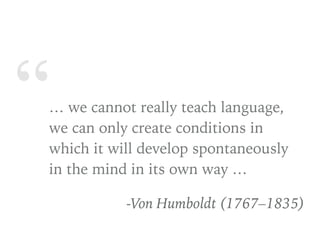
“… we cannot really teach language,
we can only create conditions in
which it will develop spontaneously
in the mind in its own way …
-Von Humboldt (1767–1835)
BELIEFS
ABOUT
LANGUAGE
TEACHING AND
LEARNING
Quiz
LIGHTBOWN & SPADA: HOW LANGUAGES ARE LEARNED.
➤ Languages are learned mainly through imitation.
➤ The earlier a second language is introduced in school
programmes, the greater the likelihood of success.
➤ Most of the mistakes which second language learners make are
due to interference from their first language.
➤ Teachers should use materials that expose students only to
those language structures which they have already been taught.
➤ Learners' errors should be corrected as soon as they are made
in order to prevent the formation of bad habits.
➤ When learners are allowed to interact freely (e.g., in pair or
group activities), they learn each others' mistakes.
TASK CRITERIA
➤ focus on meaning (not form)
➤ information gap
➤ language not all pre-taught
➤ outcome
authentic language use
telecollaboration
professional
networks
copyright &
permissions
Tasks for language teaching and learning
TELECOLLABORATION
➤ what do we mean by tele-
collaboration?
➤ why is it useful for language
learning?
➤ what kinds of activities work
best?
Technology in language learning/teaching: the contribution of telecollaboration
TELECOLLABORATION
➤ types of collaboration
➤ synchronous versus asychronous
➤ written versus oral

➤ tasks
➤ information exchange tasks
➤ comparison and analysis tasks
➤ collaborative tasks 

➤ tools
“… telecollaborative tasks can be of an informal type,
requiring learners to engage in general conversation with
their partners about hobbies and interests, or they can be
very structured in nature, requiring students to collaborate
in the production of a particular document or product. Some
telecollaborative tasks may involve a clear focus on linguistic
form, while others may lead to greater reflection on cultural
aspects of the foreign language.
O’Dowd & Ware, 2009
SECONDARY EFL
➤ live communication
➤ French and Dutch pupils
➤ English as a lingua franca
Robert O’Dowd
INTENT PROJECT:
UNICOLLABORATION
http://uni-collaboration.eu/
TILA: EU PROJECT
http://tilaproject.eu/
COPYRIGHT & PERMISSIONS
➤ playing fair

Creative commons licences
➤ playing safe

permissions
Odd one out?
x
copyright
x
x
CCO - NO ATTRIBUTION
➤ morguefile
➤ unsplash
➤ pixabay
http://bit.ly/1Sh0ePW
PROFESSIONAL NETWORKS
➤ EU projects
➤ TILA
➤ INTENT

➤ http://www.scoop.it/t/telt/?
q=telecollaboration
➤ Cyberlangues
REFERENCES
➤ Goodman, E. (2015). Teach
me what I need to say.
(Videocast)
➤ Kurek, M. & Skowron, A.
(2015). Going open with
LangOER. PDF
➤ UNESCO (2012). Paris OER
declaration. PDF

Open educational practices in language teaching

  • 1.
    A WINDOW ONTHE WORLD Open educational practices in language teaching Shona Whyte, iTILT Multiplier Event, 13 January 2016, Nice
  • 2.
    “… we cannotreally teach language, we can only create conditions in which it will develop spontaneously in the mind in its own way … -Von Humboldt (1767–1835)
  • 3.
  • 4.
    LIGHTBOWN & SPADA:HOW LANGUAGES ARE LEARNED. ➤ Languages are learned mainly through imitation. ➤ The earlier a second language is introduced in school programmes, the greater the likelihood of success. ➤ Most of the mistakes which second language learners make are due to interference from their first language. ➤ Teachers should use materials that expose students only to those language structures which they have already been taught. ➤ Learners' errors should be corrected as soon as they are made in order to prevent the formation of bad habits. ➤ When learners are allowed to interact freely (e.g., in pair or group activities), they learn each others' mistakes.
  • 6.
    TASK CRITERIA ➤ focuson meaning (not form) ➤ information gap ➤ language not all pre-taught ➤ outcome authentic language use
  • 8.
  • 9.
    TELECOLLABORATION ➤ what dowe mean by tele- collaboration? ➤ why is it useful for language learning? ➤ what kinds of activities work best?
  • 10.
    Technology in languagelearning/teaching: the contribution of telecollaboration
  • 11.
    TELECOLLABORATION ➤ types ofcollaboration ➤ synchronous versus asychronous ➤ written versus oral
 ➤ tasks ➤ information exchange tasks ➤ comparison and analysis tasks ➤ collaborative tasks 
 ➤ tools
  • 12.
    “… telecollaborative taskscan be of an informal type, requiring learners to engage in general conversation with their partners about hobbies and interests, or they can be very structured in nature, requiring students to collaborate in the production of a particular document or product. Some telecollaborative tasks may involve a clear focus on linguistic form, while others may lead to greater reflection on cultural aspects of the foreign language. O’Dowd & Ware, 2009
  • 13.
    SECONDARY EFL ➤ livecommunication ➤ French and Dutch pupils ➤ English as a lingua franca
  • 14.
  • 15.
  • 16.
  • 17.
    COPYRIGHT & PERMISSIONS ➤playing fair
 Creative commons licences ➤ playing safe
 permissions
  • 18.
  • 20.
    CCO - NOATTRIBUTION ➤ morguefile ➤ unsplash ➤ pixabay http://bit.ly/1Sh0ePW
  • 21.
    PROFESSIONAL NETWORKS ➤ EUprojects ➤ TILA ➤ INTENT
 ➤ http://www.scoop.it/t/telt/? q=telecollaboration ➤ Cyberlangues
  • 22.
    REFERENCES ➤ Goodman, E.(2015). Teach me what I need to say. (Videocast) ➤ Kurek, M. & Skowron, A. (2015). Going open with LangOER. PDF ➤ UNESCO (2012). Paris OER declaration. PDF