


Teaching and Learning
In a World of Technology
Dr. Mark Sivy

marksivy.com
Education is…



a natural response to the struggle to
surviving in an ever changing culture
the transmission of the values and
accumulated knowledge of a society
A Philosophy of Teaching






States personal and professional purpose as
to why one is an instructor
Communicates what goals and objectives one
wants to accomplish as an instructor
Conveys instructor’s belief system
Provides stability, continuity, and long-term
guidance
Meaningful Learning






Active – interact with the learning
environment
Constructive – reflect on learning activities
to assign meaning to them
Intentional – identify with learning goals and
their progress
Authentic – relate content to real-life context
Cooperative – experience learning through
and with others
Seven Principles For Good Practice
in Undergraduate Education
(Chickering & Gamson, 1987)








Encourages contact between students
and faculty
Develops reciprocity and cooperation
among students
Encourages active learning
Gives prompt feedback
Emphasizes time on task
Communicates high expectations
Respects diverse talents and ways of
learning
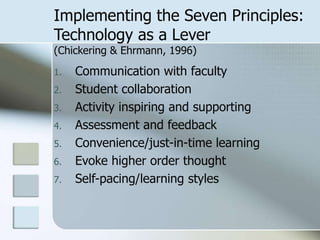
Implementing the Seven Principles:
Technology as a Lever
(Chickering & Ehrmann, 1996)
1.

2.
3.
4.

5.
6.
7.

Communication with faculty
Student collaboration
Activity inspiring and supporting
Assessment and feedback
Convenience/just-in-time learning
Evoke higher order thought
Self-pacing/learning styles
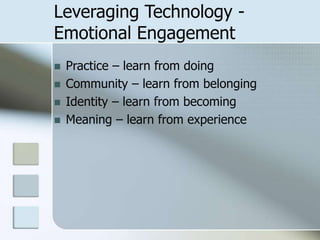
Leveraging Technology Emotional Engagement





Practice – learn from doing
Community – learn from belonging
Identity – learn from becoming
Meaning – learn from experience
E-Learning 1.0 –
Course Centered
Email
 PowerPoint
 Research - Britannica Online
 Personal websites
 Course management systems –
vendors (WebCT, Blackboard)
 Directories

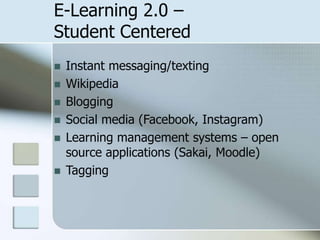
E-Learning 2.0 –
Student Centered







Instant messaging/texting
Wikipedia
Blogging
Social media (Facebook, Instagram)
Learning management systems – open
source applications (Sakai, Moodle)
Tagging
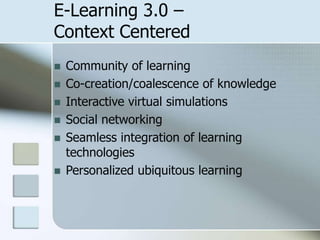
E-Learning 3.0 –
Context Centered







Community of learning
Co-creation/coalescence of knowledge
Interactive virtual simulations
Social networking
Seamless integration of learning
technologies
Personalized ubiquitous learning
Culture of Today’s Student
Technology impacts the way they work,
collaborate, and communicate:
 Increased globalization
 User-created content
 Smart, mobile, and wearable technologies
 Instant connections
 Maker culture
 Gamification
 Role-playing, experiential activity
 Transmedia and self-publication
“Computers are magnificent tools for the
realization of our dreams, but no
machine can replace the human spark
of spirit, compassion, love, and
understanding.”
– Louis Gerstner, CEO, IBM
References




Chickering, A. W., & Ehrmann, S. C. (1996).
Implementing the seven principles: Technology as
lever. AAHE bulletin, 49, 3-6.
Chickering, A. W., & Gamson, Z. F. (1987). Seven
principles for good practice in undergraduate
education. AAHE bulletin, 3, 7.

Teaching, Learning, and Technology

  • 1.
    Teaching and Learning Ina World of Technology Dr. Mark Sivy marksivy.com
  • 2.
    Education is…   a naturalresponse to the struggle to surviving in an ever changing culture the transmission of the values and accumulated knowledge of a society
  • 3.
    A Philosophy ofTeaching     States personal and professional purpose as to why one is an instructor Communicates what goals and objectives one wants to accomplish as an instructor Conveys instructor’s belief system Provides stability, continuity, and long-term guidance
  • 4.
    Meaningful Learning      Active –interact with the learning environment Constructive – reflect on learning activities to assign meaning to them Intentional – identify with learning goals and their progress Authentic – relate content to real-life context Cooperative – experience learning through and with others
  • 5.
    Seven Principles ForGood Practice in Undergraduate Education (Chickering & Gamson, 1987)        Encourages contact between students and faculty Develops reciprocity and cooperation among students Encourages active learning Gives prompt feedback Emphasizes time on task Communicates high expectations Respects diverse talents and ways of learning
  • 6.
    Implementing the SevenPrinciples: Technology as a Lever (Chickering & Ehrmann, 1996) 1. 2. 3. 4. 5. 6. 7. Communication with faculty Student collaboration Activity inspiring and supporting Assessment and feedback Convenience/just-in-time learning Evoke higher order thought Self-pacing/learning styles
  • 7.
    Leveraging Technology EmotionalEngagement     Practice – learn from doing Community – learn from belonging Identity – learn from becoming Meaning – learn from experience
  • 8.
    E-Learning 1.0 – CourseCentered Email  PowerPoint  Research - Britannica Online  Personal websites  Course management systems – vendors (WebCT, Blackboard)  Directories 
  • 9.
    E-Learning 2.0 – StudentCentered       Instant messaging/texting Wikipedia Blogging Social media (Facebook, Instagram) Learning management systems – open source applications (Sakai, Moodle) Tagging
  • 10.
    E-Learning 3.0 – ContextCentered       Community of learning Co-creation/coalescence of knowledge Interactive virtual simulations Social networking Seamless integration of learning technologies Personalized ubiquitous learning
  • 11.
    Culture of Today’sStudent Technology impacts the way they work, collaborate, and communicate:  Increased globalization  User-created content  Smart, mobile, and wearable technologies  Instant connections  Maker culture  Gamification  Role-playing, experiential activity  Transmedia and self-publication
  • 12.
    “Computers are magnificenttools for the realization of our dreams, but no machine can replace the human spark of spirit, compassion, love, and understanding.” – Louis Gerstner, CEO, IBM
  • 13.
    References   Chickering, A. W.,& Ehrmann, S. C. (1996). Implementing the seven principles: Technology as lever. AAHE bulletin, 49, 3-6. Chickering, A. W., & Gamson, Z. F. (1987). Seven principles for good practice in undergraduate education. AAHE bulletin, 3, 7.