TEACHING ELECTRONIC
LITERATURE
USING ELECTRONIC
LITERATURE
Scott Rettberg
Professor of Digital Culture
University of Bergen
Teaching Digital Literature
Conference – Coimbra
26.07.2019
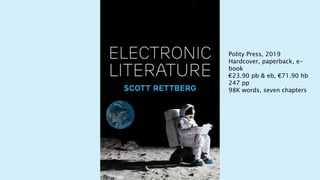
Polity Press, 2019
Hardcover, paperback, e-
book
€23.90 pb & eb, €71.90 hb
247 pp
98K words, seven chapters
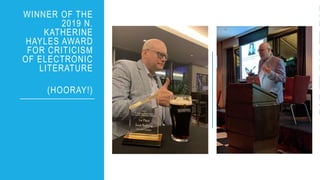
WINNER OF THE
2019 N.
KATHERINE
HAYLES AWARD
FOR CRITICISM
OF ELECTRONIC
LITERATURE
(HOORAY!)
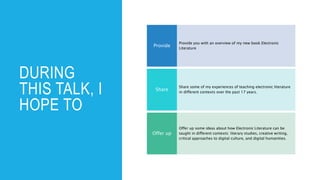
DURING
THIS TALK, I
HOPE TO
Provide you with an overview of my new book Electronic
Literature
Provide
Share some of my experiences of teaching electronic literature
in different contexts over the past 17 years.
Share
Offer up some ideas about how Electronic Literature can be
taught in different contexts: literary studies, creative writing,
critical approaches to digital culture, and digital humanities.
Offer up
Imagine a book. That should be easy enough, you’re holding one now. The book is a particular reading technology, and it’s a good one. It took a long
time to develop. The codex book is portable and can be easily lugged from place to place. It is addressable. It has page numbers so I can easily communicate with you
exactly where any piece of information is within its volume: we can get on the same page and read the same words. The book has a complex and multifunctional
navigational apparatus. There is a table of contents, there is an index, and so the book can be navigated non-linearly. The book is verifiable. It has a copyright page
with a publisher and a place and a year and an author. The book is fixed. If I put it on the shelf now and come back and pull it out ten years later, the same words will
be on the same pages as when I last opened the book. While the book could be destroyed in a fire or flood or might slowly decay, there is a sense of permanence to it.
One of its main functionalities is to get thoughts down in print and carry them through time.
Imagine that the book were different. Imagine it offered other affordances (see Norman, 1999) and material properties. Imagine
that instead of turning pages you could make any word in the book a link to some other part of the book, or even some other book. Imagine it were bound on a spool,
so that you could enter and exit anywhere; a book without beginning or end. Imagine what you would do with that as a storyteller. Imagine what it would mean if every
time you put the book up on the shelf, the words in the book shifted order and rearranged themselves. Would it still be the same book? What would you do with that as
a poet? Imagine if, when you pulled the book down from the shelf and opened up the first page, the book asked you in what direction you wanted to go, and would not
begin to tell a story until you responded. Imagine if the book were a conversation, a novel that you had to talk to. Imagine that, as you read a poem on the page of the
book, the words jumped off the page into three-dimensional space and began flying around the room, shifting form and regrouping in the physical environment. Imagine
that when you opened the book, it was filled with threads connecting it to all of the other books in your library, which would make it possible to pull part of another book
right into the text of the one you were reading. Imagine if the book could read the newspaper and change its content depending on the time of the day, or the weather,
or the season. Imagine if you opened the book and found all those of your friends who were reading the book at the same time leaving their comments in the margins.
Imagine that when you opened the book, those same friends were all writing the book simultaneously. Imagine the book as a network, always on, always connected,
and always changing. Imagine what you could do as a reader. Imagine what you could do as a writer.
Imagine the book as a networked computer.
GENRE?
WHY GENRE?
(so boring)
AVANT GARDE?
GARDE DERRIERE?
If you would know your
history
Then you would know where
you’re coming from
RUPTURE
is so exciting but
CONTINUITY
builds a field
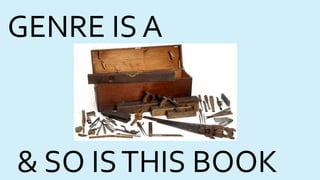
GENRE IS A
& SO ISTHIS BOOK
WHAT’S IN THE BOX? Unboxing Electronic
Literature
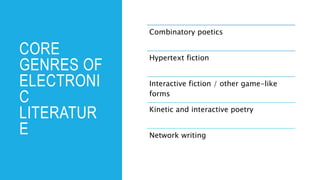
CORE
GENRES OF
ELECTRONI
C
LITERATUR
E
Combinatory poetics
Hypertext fiction
Interactive fiction / other game-like
forms
Kinetic and interactive poetry
Network writing
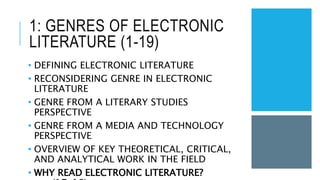
1: GENRES OF ELECTRONIC
LITERATURE (1-19)
• DEFINING ELECTRONIC LITERATURE
• RECONSIDERING GENRE IN ELECTRONIC
LITERATURE
• GENRE FROM A LITERARY STUDIES
PERSPECTIVE
• GENRE FROM A MEDIA AND TECHNOLOGY
PERSPECTIVE
• OVERVIEW OF KEY THEORETICAL, CRITICAL,
AND ANALYTICAL WORK IN THE FIELD
• WHY READ ELECTRONIC LITERATURE?
2:
COMBINAT
ORY
POETICS
(20-53)
• ARTISTIC AND LITERARY
CONTEXTS FOR COMBINATORY
POETICS
• THE EARLY HISTORY OF DIGITAL
COMBINATORY WRITING
• PROCEDURAL, SYNTACTIC POETRY
GENERATION SYSTEMS
• CONTEMPORARY COMBINATORY
DIGITAL POETICS
• REGENERATING AND MUTATING
EXISTING TEXTS
• BOTS
• BIG DATA POETICS
3:
HYPERTEX
T FICTION
(54-86)
• LITERARY ANTECEDENTS TO
HYPERTEXT
• Modernist influences
• Postmodern multilinearity
• Metafiction and reflexivity
• HYPERTEXT IN TECHNOLOGICAL
CONTEXT
• EARLY HYPERTEXT FICTION
• HYPERTEXT ON THE WEB
4:
INTERACTI
VE FICTION
& LUDIC
FORMS (87-
117)
• INTERACTIVE FICTION AND THE IF
COMMUNITY
• AN ADVENTURE BEGINS
• ZORK AND THE COMPUTER GAME
INDUSTRY IT SPAWNED
• AN AMATEUR INTERACTIVE FICTION
COMMUNITY TAKES SHAPE
• WORLDS, PUZZLES, CHARACTERS, AND
WORDPLAY IN IF
• MODELING ETHICAL CHOICE AND
MORAL COMPLICITY
• HYPERTEXT + INTERACTIVE FICTION =
TWINE
• GAMES AS LITERARY PLATFORMS
• GAMES AS DIGITAL VERNACULAR
5: KINETIC
&
INTERACTI
VE POETRY
(118-151)
• CHARACTERISTICS OF KINETIC
AND INTERACTIVE POETRY
• Time and movement
• The materiality of language
• DIGITAL POETRY IN RELATION TO
LITERARY AND ARTISTIC
TRADITIONS
• Concrete poetry
• Symbolism, Futurism, and Lettrism
• Visual poetry
• Sound poetry
• Moving letters in film
5: KINETIC
&
INTERACTI
VE POETRY
CTD. (118-
151)
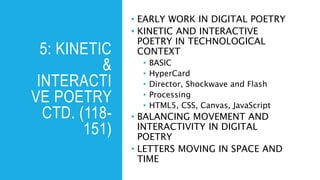
• EARLY WORK IN DIGITAL POETRY
• KINETIC AND INTERACTIVE
POETRY IN TECHNOLOGICAL
CONTEXT
• BASIC
• HyperCard
• Director, Shockwave and Flash
• Processing
• HTML5, CSS, Canvas, JavaScript
• BALANCING MOVEMENT AND
INTERACTIVITY IN DIGITAL
POETRY
• LETTERS MOVING IN SPACE AND
TIME
6:
NETWORK
WRITING
(152-182)
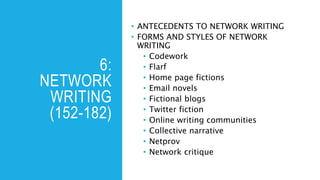
• ANTECEDENTS TO NETWORK WRITING
• FORMS AND STYLES OF NETWORK
WRITING
• Codework
• Flarf
• Home page fictions
• Email novels
• Fictional blogs
• Twitter fiction
• Online writing communities
• Collective narrative
• Netprov
• Network critique
7:
DIVERGENT
STREAMS
(183-204)
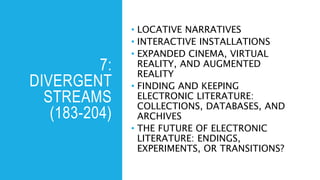
• LOCATIVE NARRATIVES
• INTERACTIVE INSTALLATIONS
• EXPANDED CINEMA, VIRTUAL
REALITY, AND AUGMENTED
REALITY
• FINDING AND KEEPING
ELECTRONIC LITERATURE:
COLLECTIONS, DATABASES, AND
ARCHIVES
• THE FUTURE OF ELECTRONIC
LITERATURE: ENDINGS,
EXPERIMENTS, OR TRANSITIONS?
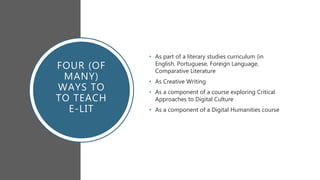
FOUR (OF
MANY)
WAYS TO
TO TEACH
E-LIT
• As part of a literary studies curriculum (in
English, Portuguese, Foreign Language,
Comparative Literature
• As Creative Writing
• As a component of a course exploring Critical
Approaches to Digital Culture
• As a component of a Digital Humanities course
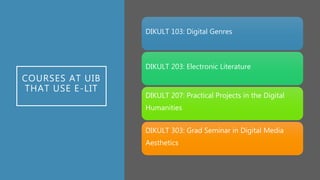
COURSES AT UIB
THAT USE E-LIT
DIKULT 103: Digital Genres
DIKULT 203: Electronic Literature
DIKULT 207: Practical Projects in the Digital
Humanities
DIKULT 303: Grad Seminar in Digital Media
Aesthetics
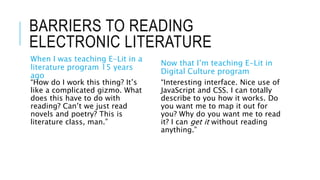
BARRIERS TO READING
ELECTRONIC LITERATURE
When I was teaching E-Lit in a
literature program 15 years
ago
“How do I work this thing? It’s
like a complicated gizmo. What
does this have to do with
reading? Can’t we just read
novels and poetry? This is
literature class, man.”
Now that I’m teaching E-Lit in
Digital Culture program
“Interesting interface. Nice use of
JavaScript and CSS. I can totally
describe to you how it works. Do
you want me to map it out for
you? Why do you want me to read
it? I can get it without reading
anything.”
TEACHING ELECTRONIC
LITERATURE AS
LITERATURE
Alongside Print Literature
Example: Combinatory
Poetics
DRILL DOWN:
COMBINATORY POETICS
An example of how a
practice in electronic
literature is driven by
literary tradition and
technological context
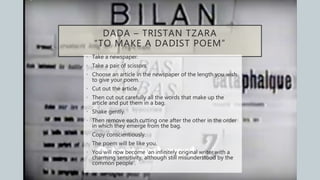
DADA – TRISTAN TZARA
“TO MAKE A DADIST POEM”
• Take a newspaper.
• Take a pair of scissors.
• Choose an article in the newspaper of the length you wish
to give your poem.
• Cut out the article.
• Then cut out carefully all the words that make up the
article and put them in a bag.
• Shake gently.
• Then remove each cutting one after the other in the order
in which they emerge from the bag.
• Copy conscientiously.
• The poem will be like you.
• You will now become ‘an infinitely original writer with a
charming sensitivity, although still misunderstood by the
common people’.
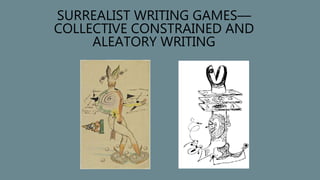
SURREALIST WRITING GAMES—
COLLECTIVE CONSTRAINED AND
ALEATORY WRITING
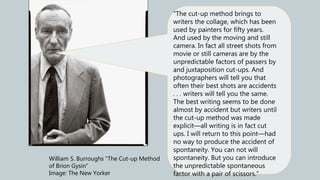
William S. Burroughs “The Cut-up Method
of Brion Gysin”
Image: The New Yorker
“The cut-up method brings to
writers the collage, which has been
used by painters for fifty years.
And used by the moving and still
camera. In fact all street shots from
movie or still cameras are by the
unpredictable factors of passers by
and juxtaposition cut-ups. And
photographers will tell you that
often their best shots are accidents
. . . writers will tell you the same.
The best writing seems to be done
almost by accident but writers until
the cut-up method was made
explicit—all writing is in fact cut
ups. I will return to this point—had
no way to produce the accident of
spontaneity. You can not will
spontaneity. But you can introduce
the unpredictable spontaneous
factor with a pair of scissors.”
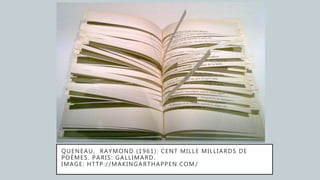
QUENEAU, RAYMOND (1961): CENT MILLE MILLIARDS DE
POÈMES. PARIS: GALLIMARD.
IMAGE: HTTP://MAKINGARTHAPPEN.COM/
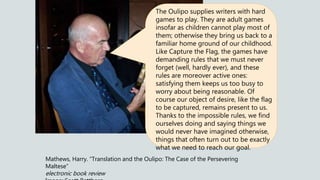
Mathews, Harry. “Translation and the Oulipo: The Case of the Persevering
Maltese”
electronic book review
The Oulipo supplies writers with hard
games to play. They are adult games
insofar as children cannot play most of
them; otherwise they bring us back to a
familiar home ground of our childhood.
Like Capture the Flag, the games have
demanding rules that we must never
forget (well, hardly ever), and these
rules are moreover active ones:
satisfying them keeps us too busy to
worry about being reasonable. Of
course our object of desire, like the flag
to be captured, remains present to us.
Thanks to the impossible rules, we find
ourselves doing and saying things we
would never have imagined otherwise,
things that often turn out to be exactly
what we need to reach our goal.
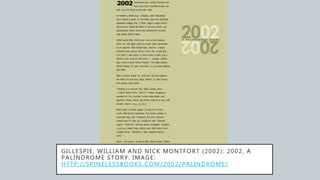
GILLESPIE, WILLIAM AND NICK MONTFORT (2002): 2002, A
PALINDROME STORY. IMAGE:
HTTP://SPINELESSBOOKS.COM/2002/PALINDROME/
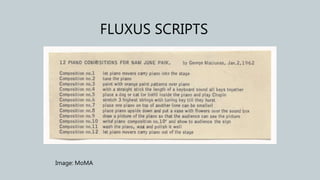
FLUXUS SCRIPTS
Image: MoMA
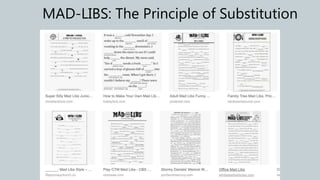
MAD-LIBS: The Principle of Substitution
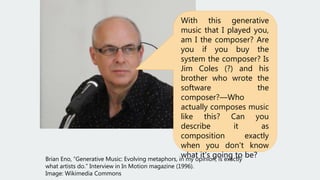
Brian Eno, “Generative Music: Evolving metaphors, in my opinion, is exactly
what artists do.” Interview in In Motion magazine (1996).
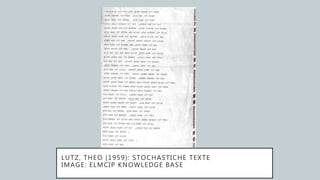
Image: Wikimedia Commons
With this generative
music that I played you,
am I the composer? Are
you if you buy the
system the composer? Is
Jim Coles (?) and his
brother who wrote the
software the
composer?—Who
actually composes music
like this? Can you
describe it as
composition exactly
when you don't know
what it's going to be?
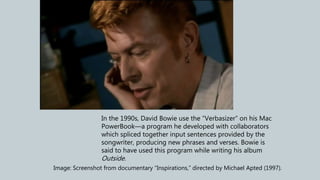
In the 1990s, David Bowie use the “Verbasizer” on his Mac
PowerBook—a program he developed with collaborators
which spliced together input sentences provided by the
songwriter, producing new phrases and verses. Bowie is
said to have used this program while writing his album
Outside.
Image: Screenshot from documentary “Inspirations,” directed by Michael Apted (1997).
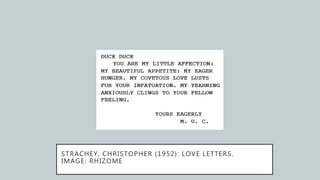
STRACHEY, CHRISTOPHER (1952): LOVE LETTERS.
IMAGE: RHIZOME
LUTZ, THEO (1959): STOCHASTICHE TEXTE
IMAGE: ELMCIP KNOWLEDGE BASE
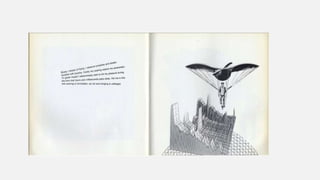
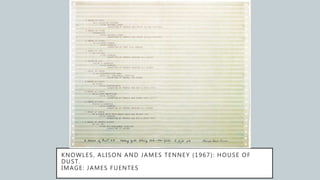
KNOWLES, ALISON AND JAMES TENNEY (1967): HOUSE OF
DUST.
IMAGE: JAMES FUENTES
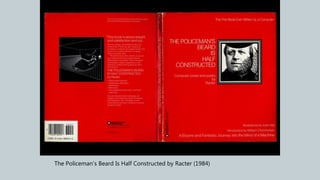
The Policeman’s Beard Is Half Constructed by Racter (1984)
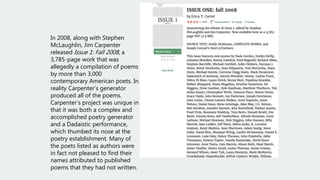
In 2008, along with Stephen
McLaughlin, Jim Carpenter
released Issue 1: Fall 2008, a
3,785-page work that was
allegedly a compilation of poems
by more than 3,000
contemporary American poets. In
reality Carpenter’s generator
produced all of the poems.
Carpenter’s project was unique in
that it was both a complex and
accomplished poetry generator
and a Dadaistic performance,
which thumbed its nose at the
poetry establishment. Many of
the poets listed as authors were
in fact not pleased to find their
names attributed to published
poems that they had not written.
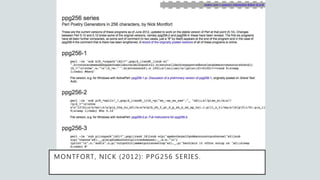
MONTFORT, NICK (2012): PPG256 SERIES.
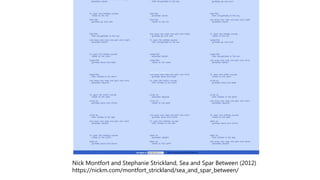
Nick Montfort and Stephanie Strickland, Sea and Spar Between (2012)
https://nickm.com/montfort_strickland/sea_and_spar_between/
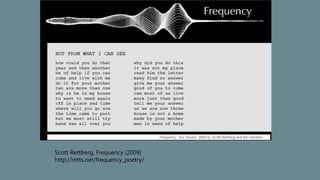
Scott Rettberg, Frequency (2009)
http://retts.net/frequency_poetry/
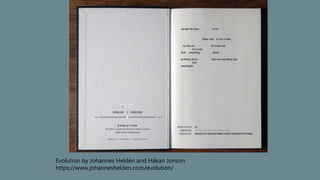
Evolution by Johannes Heldén and Håkan Jonson
https://www.johanneshelden.com/evolution/
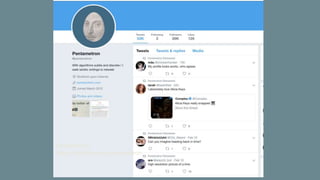
Pentametron
https://twitter.com/pentametron
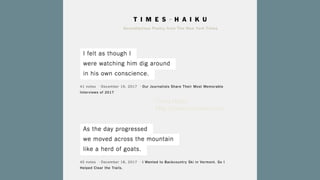
Times Haiku
http://haiku.nytimes.com/
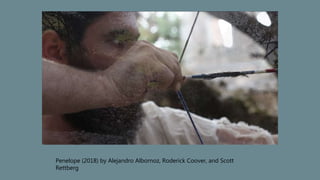
Penelope (2018) by Alejandro Albornoz, Roderick Coover, and Scott
Rettberg
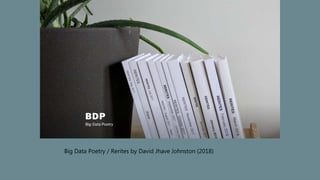
Big Data Poetry / Rerites by David Jhave Johnston (2018)
TEACHING ELECTRONIC
LITERATURE AS CREATIVE
WRITING
Informed by knowledge of e-
lit genres
Using assignments with low
entry threshold
CORE IDEAS FOR TEACHING E-LIT
WRITING
1) Inform writing by reading and knowledge of existing work and
genres
2) Create opportunities for collaborative practices, emphasize social
practices of writing and co-creation
3) Allow students with particular skill-sets (e.g. writing, images,
music, code) to use their particular talents to their best advantage
4) Emphasize ideas, stories, poetics, over technics (I teach creative
practice—I don’t teach C++, Python, CSS, etc.) while supporting
training in technical skills
5) Dedicate ample class time to work-in-progress, group critique
6) Work with an awareness that most students are not going to
become “professional” digital writers, but are learning writing
skills, digital literacy, project management, and creativity through
SOME TYPES OF EASY-TO-GET-
GOING E-LIT WRITING
ASSIGNMENTS
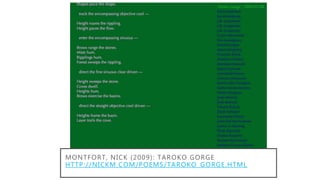
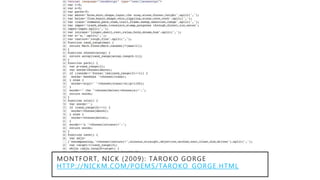
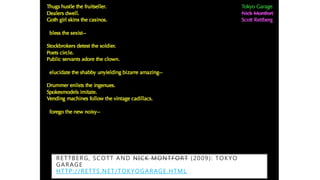
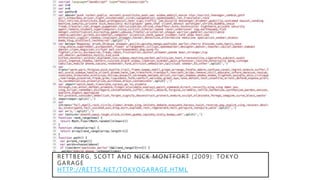
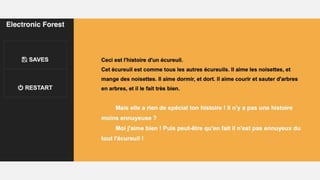
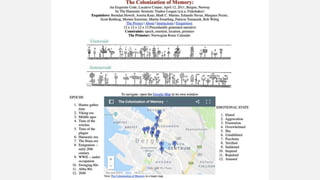
1) Hack a Gorge (Combinatory Poetics)
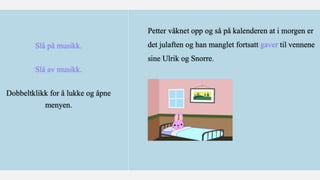
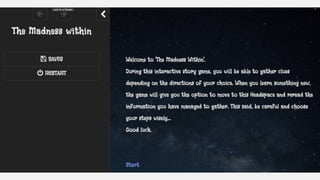
2) Spin an Interactive Narrative in Twine (Hypertext / Interactive
Fiction)
3) Write a locative novel together in a Google Map / the real world
around you
4) Perform a Netprov with others from all over the world (Collective
Narrative)
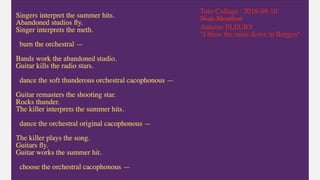
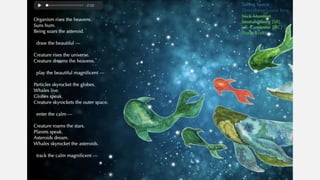
MONTFORT, NICK (2009): TAROKO GORGE
HTTP://NICKM.COM/POEMS/TAROKO_GORGE.HTML
MONTFORT, NICK (2009): TAROKO GORGE
HTTP://NICKM.COM/POEMS/TAROKO_GORGE.HTML
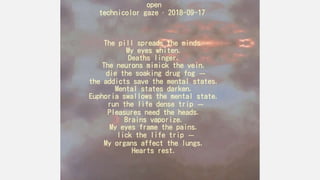
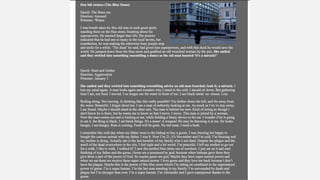
RETTBERG, SCOTT AND NICK MONTFORT (2009): TOKYO
GARAGE
HTTP://RETTS.NET/TOKYOGARAGE.HTML
RETTBERG, SCOTT AND NICK MONTFORT (2009): TOKYO
GARAGE
HTTP://RETTS.NET/TOKYOGARAGE.HTML
HACKING A
GORGE
1) Anyone who can work with words can do it
2) Exposes students to code without demanding
immediate knowledge of programming
3) Demonstrates effectively the poetic power of
recombination
4) Scales for different skill levels
5) Shows that writing, coding, and playing are
intertwined
TWINE
1) Low learning curve for entry, but highly extensible
2) Integrates both the best features of early
hypertext software and elements of interactive
fiction software, and exposes students to
conventions of both forms.
3) Allows for many modes of multimedia literacy
4) Immediately interactive – the joy of linking
5) Immediately “publishable” and supported by a
large user community.
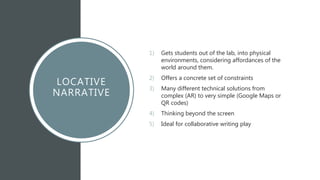
LOCATIVE
NARRATIVE
1) Gets students out of the lab, into physical
environments, considering affordances of the
world around them.
2) Offers a concrete set of constraints
3) Many different technical solutions from
complex (AR) to very simple (Google Maps or
QR codes)
4) Thinking beyond the screen
5) Ideal for collaborative writing play
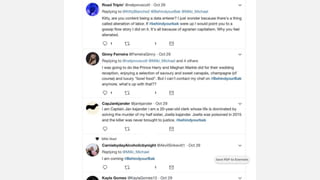
NETPROV
1) Drives students to consider the
constraints, effects, and uses of social
media platforms.
2) Role-playing aspects: more character-
driven than many other forms of e-lit
3) Responsive: students are getting
feedback from other writers in the form
of creative and playful interaction
4) Complicates ideas of digital genre and
the distinction between writing and
performance
5) Allows for reflective critique of everyday
behaviors and interactions on the
network
TEACHING CRITICAL
APPROACHES TO DIGITAL
CULTURE THROUGH
ELECTRONIC LITERATURE
Many works of e-lit are
reflective of concerns about
network society, the
environment, and other
significant contemporary
societal challenges
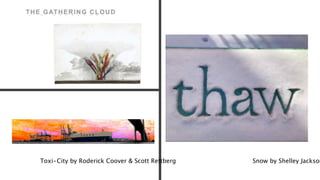
Toxi•City by Roderick Coover & Scott Rettberg Snow by Shelley Jackson
TEACHING DIGITAL HUMANITIES
THROUGH
ELECTRONIC LITERATURE
Electronic Literature is a
field that has built its own
digital publishing and
research infrastructure,
collectively built and
presenting opportunities for
born-digital DH research.
IN OUR DIGITAL HUMANITIES IN
PRACTICE COURSE, STUDENTS
• Contribute to the large-scale documentation of the field of electronic
literature
• Learn about the broader context and debates within the Digital
Humanities
• Gain specific training in databases and archives
• Develop research collections addressing specific research questions of
particular phenomena within electronic literature
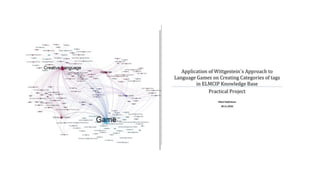
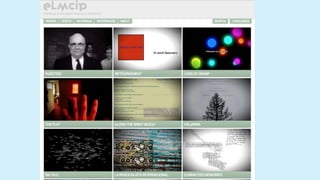
• Use the ELMCIP Electronic Literature Knowledge Base to do data-mining
and visualization to map large-scale trends and patterns and do “distant
reading” of electronic literature.
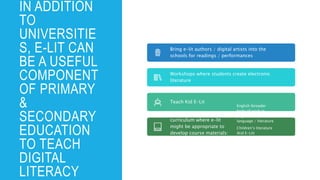
IN ADDITION
TO
UNIVERSITIE
S, E-LIT CAN
BE A USEFUL
COMPONENT
OF PRIMARY
&
SECONDARY
EDUCATION
TO TEACH
DIGITAL
LITERACY
Bring e-lit authors / digital artists into the
schools for readings / performances
Workshops where students create electronic
literature
Teach Kid E-Lit
Consider parts of the
curriculum where e-lit
might be appropriate to
develop course materials:
English (broader
body of work in
English) & other
language / literature
Children’s literature
(Kid E-Lit)
Digital Literacy
Art
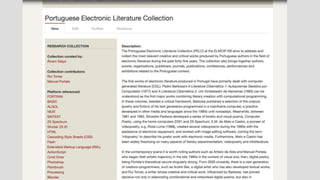
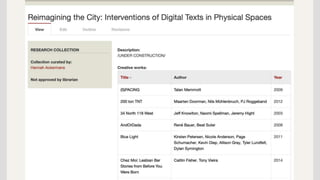
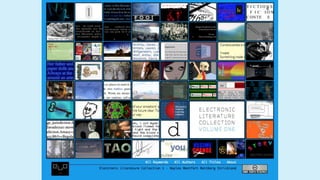
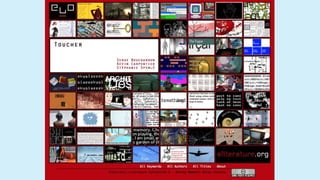
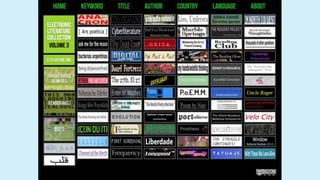
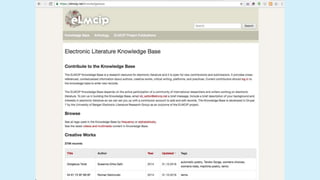
WHERE TO FIND E-LIT? Collections and Databases
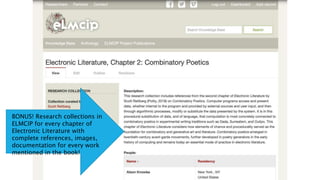
BONUS! Research collections in
ELMCIP for every chapter of
Electronic Literature with
complete references, images,
documentation for every work
mentioned in the book!
THANKS!
TUSEN TAKK!
MUITO OBRIGADO!

Teaching Electronic Literature Using Electronic Literature

  • 1.
    TEACHING ELECTRONIC LITERATURE USING ELECTRONIC LITERATURE ScottRettberg Professor of Digital Culture University of Bergen Teaching Digital Literature Conference – Coimbra 26.07.2019
  • 2.
    Polity Press, 2019 Hardcover,paperback, e- book €23.90 pb & eb, €71.90 hb 247 pp 98K words, seven chapters
  • 3.
    WINNER OF THE 2019N. KATHERINE HAYLES AWARD FOR CRITICISM OF ELECTRONIC LITERATURE (HOORAY!)
  • 4.
    DURING THIS TALK, I HOPETO Provide you with an overview of my new book Electronic Literature Provide Share some of my experiences of teaching electronic literature in different contexts over the past 17 years. Share Offer up some ideas about how Electronic Literature can be taught in different contexts: literary studies, creative writing, critical approaches to digital culture, and digital humanities. Offer up
  • 5.
    Imagine a book.That should be easy enough, you’re holding one now. The book is a particular reading technology, and it’s a good one. It took a long time to develop. The codex book is portable and can be easily lugged from place to place. It is addressable. It has page numbers so I can easily communicate with you exactly where any piece of information is within its volume: we can get on the same page and read the same words. The book has a complex and multifunctional navigational apparatus. There is a table of contents, there is an index, and so the book can be navigated non-linearly. The book is verifiable. It has a copyright page with a publisher and a place and a year and an author. The book is fixed. If I put it on the shelf now and come back and pull it out ten years later, the same words will be on the same pages as when I last opened the book. While the book could be destroyed in a fire or flood or might slowly decay, there is a sense of permanence to it. One of its main functionalities is to get thoughts down in print and carry them through time. Imagine that the book were different. Imagine it offered other affordances (see Norman, 1999) and material properties. Imagine that instead of turning pages you could make any word in the book a link to some other part of the book, or even some other book. Imagine it were bound on a spool, so that you could enter and exit anywhere; a book without beginning or end. Imagine what you would do with that as a storyteller. Imagine what it would mean if every time you put the book up on the shelf, the words in the book shifted order and rearranged themselves. Would it still be the same book? What would you do with that as a poet? Imagine if, when you pulled the book down from the shelf and opened up the first page, the book asked you in what direction you wanted to go, and would not begin to tell a story until you responded. Imagine if the book were a conversation, a novel that you had to talk to. Imagine that, as you read a poem on the page of the book, the words jumped off the page into three-dimensional space and began flying around the room, shifting form and regrouping in the physical environment. Imagine that when you opened the book, it was filled with threads connecting it to all of the other books in your library, which would make it possible to pull part of another book right into the text of the one you were reading. Imagine if the book could read the newspaper and change its content depending on the time of the day, or the weather, or the season. Imagine if you opened the book and found all those of your friends who were reading the book at the same time leaving their comments in the margins. Imagine that when you opened the book, those same friends were all writing the book simultaneously. Imagine the book as a network, always on, always connected, and always changing. Imagine what you could do as a reader. Imagine what you could do as a writer. Imagine the book as a networked computer.
  • 6.
  • 7.
  • 8.
    If you wouldknow your history Then you would know where you’re coming from
  • 9.
    RUPTURE is so excitingbut CONTINUITY builds a field
  • 10.
    GENRE IS A &SO ISTHIS BOOK
  • 11.
    WHAT’S IN THEBOX? Unboxing Electronic Literature
  • 12.
    CORE GENRES OF ELECTRONI C LITERATUR E Combinatory poetics Hypertextfiction Interactive fiction / other game-like forms Kinetic and interactive poetry Network writing
  • 13.
    1: GENRES OFELECTRONIC LITERATURE (1-19) • DEFINING ELECTRONIC LITERATURE • RECONSIDERING GENRE IN ELECTRONIC LITERATURE • GENRE FROM A LITERARY STUDIES PERSPECTIVE • GENRE FROM A MEDIA AND TECHNOLOGY PERSPECTIVE • OVERVIEW OF KEY THEORETICAL, CRITICAL, AND ANALYTICAL WORK IN THE FIELD • WHY READ ELECTRONIC LITERATURE?
  • 14.
    2: COMBINAT ORY POETICS (20-53) • ARTISTIC ANDLITERARY CONTEXTS FOR COMBINATORY POETICS • THE EARLY HISTORY OF DIGITAL COMBINATORY WRITING • PROCEDURAL, SYNTACTIC POETRY GENERATION SYSTEMS • CONTEMPORARY COMBINATORY DIGITAL POETICS • REGENERATING AND MUTATING EXISTING TEXTS • BOTS • BIG DATA POETICS
  • 15.
    3: HYPERTEX T FICTION (54-86) • LITERARYANTECEDENTS TO HYPERTEXT • Modernist influences • Postmodern multilinearity • Metafiction and reflexivity • HYPERTEXT IN TECHNOLOGICAL CONTEXT • EARLY HYPERTEXT FICTION • HYPERTEXT ON THE WEB
  • 16.
    4: INTERACTI VE FICTION & LUDIC FORMS(87- 117) • INTERACTIVE FICTION AND THE IF COMMUNITY • AN ADVENTURE BEGINS • ZORK AND THE COMPUTER GAME INDUSTRY IT SPAWNED • AN AMATEUR INTERACTIVE FICTION COMMUNITY TAKES SHAPE • WORLDS, PUZZLES, CHARACTERS, AND WORDPLAY IN IF • MODELING ETHICAL CHOICE AND MORAL COMPLICITY • HYPERTEXT + INTERACTIVE FICTION = TWINE • GAMES AS LITERARY PLATFORMS • GAMES AS DIGITAL VERNACULAR
  • 17.
    5: KINETIC & INTERACTI VE POETRY (118-151) •CHARACTERISTICS OF KINETIC AND INTERACTIVE POETRY • Time and movement • The materiality of language • DIGITAL POETRY IN RELATION TO LITERARY AND ARTISTIC TRADITIONS • Concrete poetry • Symbolism, Futurism, and Lettrism • Visual poetry • Sound poetry • Moving letters in film
  • 18.
    5: KINETIC & INTERACTI VE POETRY CTD.(118- 151) • EARLY WORK IN DIGITAL POETRY • KINETIC AND INTERACTIVE POETRY IN TECHNOLOGICAL CONTEXT • BASIC • HyperCard • Director, Shockwave and Flash • Processing • HTML5, CSS, Canvas, JavaScript • BALANCING MOVEMENT AND INTERACTIVITY IN DIGITAL POETRY • LETTERS MOVING IN SPACE AND TIME
  • 19.
    6: NETWORK WRITING (152-182) • ANTECEDENTS TONETWORK WRITING • FORMS AND STYLES OF NETWORK WRITING • Codework • Flarf • Home page fictions • Email novels • Fictional blogs • Twitter fiction • Online writing communities • Collective narrative • Netprov • Network critique
  • 20.
    7: DIVERGENT STREAMS (183-204) • LOCATIVE NARRATIVES •INTERACTIVE INSTALLATIONS • EXPANDED CINEMA, VIRTUAL REALITY, AND AUGMENTED REALITY • FINDING AND KEEPING ELECTRONIC LITERATURE: COLLECTIONS, DATABASES, AND ARCHIVES • THE FUTURE OF ELECTRONIC LITERATURE: ENDINGS, EXPERIMENTS, OR TRANSITIONS?
  • 21.
    FOUR (OF MANY) WAYS TO TOTEACH E-LIT • As part of a literary studies curriculum (in English, Portuguese, Foreign Language, Comparative Literature • As Creative Writing • As a component of a course exploring Critical Approaches to Digital Culture • As a component of a Digital Humanities course
  • 22.
    COURSES AT UIB THATUSE E-LIT DIKULT 103: Digital Genres DIKULT 203: Electronic Literature DIKULT 207: Practical Projects in the Digital Humanities DIKULT 303: Grad Seminar in Digital Media Aesthetics
  • 23.
    BARRIERS TO READING ELECTRONICLITERATURE When I was teaching E-Lit in a literature program 15 years ago “How do I work this thing? It’s like a complicated gizmo. What does this have to do with reading? Can’t we just read novels and poetry? This is literature class, man.” Now that I’m teaching E-Lit in Digital Culture program “Interesting interface. Nice use of JavaScript and CSS. I can totally describe to you how it works. Do you want me to map it out for you? Why do you want me to read it? I can get it without reading anything.”
  • 24.
    TEACHING ELECTRONIC LITERATURE AS LITERATURE AlongsidePrint Literature Example: Combinatory Poetics
  • 25.
    DRILL DOWN: COMBINATORY POETICS Anexample of how a practice in electronic literature is driven by literary tradition and technological context
  • 26.
    DADA – TRISTANTZARA “TO MAKE A DADIST POEM” • Take a newspaper. • Take a pair of scissors. • Choose an article in the newspaper of the length you wish to give your poem. • Cut out the article. • Then cut out carefully all the words that make up the article and put them in a bag. • Shake gently. • Then remove each cutting one after the other in the order in which they emerge from the bag. • Copy conscientiously. • The poem will be like you. • You will now become ‘an infinitely original writer with a charming sensitivity, although still misunderstood by the common people’.
  • 27.
    SURREALIST WRITING GAMES— COLLECTIVECONSTRAINED AND ALEATORY WRITING
  • 28.
    William S. Burroughs“The Cut-up Method of Brion Gysin” Image: The New Yorker “The cut-up method brings to writers the collage, which has been used by painters for fifty years. And used by the moving and still camera. In fact all street shots from movie or still cameras are by the unpredictable factors of passers by and juxtaposition cut-ups. And photographers will tell you that often their best shots are accidents . . . writers will tell you the same. The best writing seems to be done almost by accident but writers until the cut-up method was made explicit—all writing is in fact cut ups. I will return to this point—had no way to produce the accident of spontaneity. You can not will spontaneity. But you can introduce the unpredictable spontaneous factor with a pair of scissors.”
  • 29.
    QUENEAU, RAYMOND (1961):CENT MILLE MILLIARDS DE POÈMES. PARIS: GALLIMARD. IMAGE: HTTP://MAKINGARTHAPPEN.COM/
  • 30.
    Mathews, Harry. “Translationand the Oulipo: The Case of the Persevering Maltese” electronic book review The Oulipo supplies writers with hard games to play. They are adult games insofar as children cannot play most of them; otherwise they bring us back to a familiar home ground of our childhood. Like Capture the Flag, the games have demanding rules that we must never forget (well, hardly ever), and these rules are moreover active ones: satisfying them keeps us too busy to worry about being reasonable. Of course our object of desire, like the flag to be captured, remains present to us. Thanks to the impossible rules, we find ourselves doing and saying things we would never have imagined otherwise, things that often turn out to be exactly what we need to reach our goal.
  • 31.
    GILLESPIE, WILLIAM ANDNICK MONTFORT (2002): 2002, A PALINDROME STORY. IMAGE: HTTP://SPINELESSBOOKS.COM/2002/PALINDROME/
  • 32.
  • 33.
    MAD-LIBS: The Principleof Substitution
  • 34.
    Brian Eno, “GenerativeMusic: Evolving metaphors, in my opinion, is exactly what artists do.” Interview in In Motion magazine (1996). Image: Wikimedia Commons With this generative music that I played you, am I the composer? Are you if you buy the system the composer? Is Jim Coles (?) and his brother who wrote the software the composer?—Who actually composes music like this? Can you describe it as composition exactly when you don't know what it's going to be?
  • 35.
    In the 1990s,David Bowie use the “Verbasizer” on his Mac PowerBook—a program he developed with collaborators which spliced together input sentences provided by the songwriter, producing new phrases and verses. Bowie is said to have used this program while writing his album Outside. Image: Screenshot from documentary “Inspirations,” directed by Michael Apted (1997).
  • 36.
    STRACHEY, CHRISTOPHER (1952):LOVE LETTERS. IMAGE: RHIZOME
  • 37.
    LUTZ, THEO (1959):STOCHASTICHE TEXTE IMAGE: ELMCIP KNOWLEDGE BASE
  • 38.
    KNOWLES, ALISON ANDJAMES TENNEY (1967): HOUSE OF DUST. IMAGE: JAMES FUENTES
  • 39.
    The Policeman’s BeardIs Half Constructed by Racter (1984)
  • 42.
    In 2008, alongwith Stephen McLaughlin, Jim Carpenter released Issue 1: Fall 2008, a 3,785-page work that was allegedly a compilation of poems by more than 3,000 contemporary American poets. In reality Carpenter’s generator produced all of the poems. Carpenter’s project was unique in that it was both a complex and accomplished poetry generator and a Dadaistic performance, which thumbed its nose at the poetry establishment. Many of the poets listed as authors were in fact not pleased to find their names attributed to published poems that they had not written.
  • 43.
    MONTFORT, NICK (2012):PPG256 SERIES.
  • 44.
    Nick Montfort andStephanie Strickland, Sea and Spar Between (2012) https://nickm.com/montfort_strickland/sea_and_spar_between/
  • 45.
    Scott Rettberg, Frequency(2009) http://retts.net/frequency_poetry/
  • 46.
    Evolution by JohannesHeldén and Håkan Jonson https://www.johanneshelden.com/evolution/
  • 47.
  • 48.
  • 49.
    Penelope (2018) byAlejandro Albornoz, Roderick Coover, and Scott Rettberg
  • 50.
    Big Data Poetry/ Rerites by David Jhave Johnston (2018)
  • 51.
    TEACHING ELECTRONIC LITERATURE ASCREATIVE WRITING Informed by knowledge of e- lit genres Using assignments with low entry threshold
  • 52.
    CORE IDEAS FORTEACHING E-LIT WRITING 1) Inform writing by reading and knowledge of existing work and genres 2) Create opportunities for collaborative practices, emphasize social practices of writing and co-creation 3) Allow students with particular skill-sets (e.g. writing, images, music, code) to use their particular talents to their best advantage 4) Emphasize ideas, stories, poetics, over technics (I teach creative practice—I don’t teach C++, Python, CSS, etc.) while supporting training in technical skills 5) Dedicate ample class time to work-in-progress, group critique 6) Work with an awareness that most students are not going to become “professional” digital writers, but are learning writing skills, digital literacy, project management, and creativity through
  • 53.
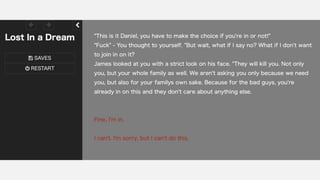
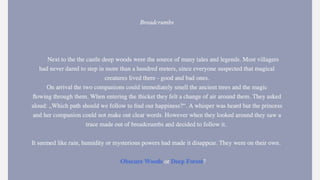
    SOME TYPES OFEASY-TO-GET- GOING E-LIT WRITING ASSIGNMENTS 1) Hack a Gorge (Combinatory Poetics) 2) Spin an Interactive Narrative in Twine (Hypertext / Interactive Fiction) 3) Write a locative novel together in a Google Map / the real world around you 4) Perform a Netprov with others from all over the world (Collective Narrative)
  • 54.
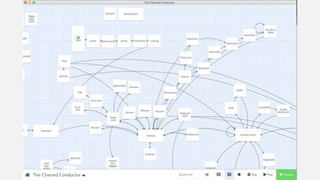
    MONTFORT, NICK (2009):TAROKO GORGE HTTP://NICKM.COM/POEMS/TAROKO_GORGE.HTML
  • 55.
    MONTFORT, NICK (2009):TAROKO GORGE HTTP://NICKM.COM/POEMS/TAROKO_GORGE.HTML
  • 56.
    RETTBERG, SCOTT ANDNICK MONTFORT (2009): TOKYO GARAGE HTTP://RETTS.NET/TOKYOGARAGE.HTML
  • 57.
    RETTBERG, SCOTT ANDNICK MONTFORT (2009): TOKYO GARAGE HTTP://RETTS.NET/TOKYOGARAGE.HTML
  • 61.
    HACKING A GORGE 1) Anyonewho can work with words can do it 2) Exposes students to code without demanding immediate knowledge of programming 3) Demonstrates effectively the poetic power of recombination 4) Scales for different skill levels 5) Shows that writing, coding, and playing are intertwined
  • 69.
    TWINE 1) Low learningcurve for entry, but highly extensible 2) Integrates both the best features of early hypertext software and elements of interactive fiction software, and exposes students to conventions of both forms. 3) Allows for many modes of multimedia literacy 4) Immediately interactive – the joy of linking 5) Immediately “publishable” and supported by a large user community.
  • 72.
    LOCATIVE NARRATIVE 1) Gets studentsout of the lab, into physical environments, considering affordances of the world around them. 2) Offers a concrete set of constraints 3) Many different technical solutions from complex (AR) to very simple (Google Maps or QR codes) 4) Thinking beyond the screen 5) Ideal for collaborative writing play
  • 75.
    NETPROV 1) Drives studentsto consider the constraints, effects, and uses of social media platforms. 2) Role-playing aspects: more character- driven than many other forms of e-lit 3) Responsive: students are getting feedback from other writers in the form of creative and playful interaction 4) Complicates ideas of digital genre and the distinction between writing and performance 5) Allows for reflective critique of everyday behaviors and interactions on the network
  • 76.
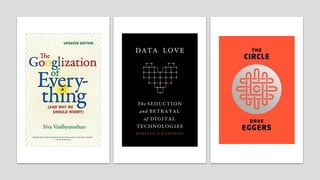
    TEACHING CRITICAL APPROACHES TODIGITAL CULTURE THROUGH ELECTRONIC LITERATURE Many works of e-lit are reflective of concerns about network society, the environment, and other significant contemporary societal challenges
  • 78.
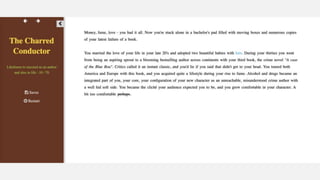
    Toxi•City by RoderickCoover & Scott Rettberg Snow by Shelley Jackson
  • 81.
    TEACHING DIGITAL HUMANITIES THROUGH ELECTRONICLITERATURE Electronic Literature is a field that has built its own digital publishing and research infrastructure, collectively built and presenting opportunities for born-digital DH research.
  • 82.
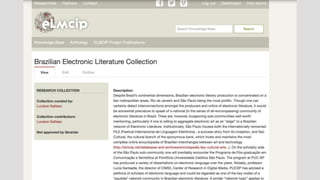
    IN OUR DIGITALHUMANITIES IN PRACTICE COURSE, STUDENTS • Contribute to the large-scale documentation of the field of electronic literature • Learn about the broader context and debates within the Digital Humanities • Gain specific training in databases and archives • Develop research collections addressing specific research questions of particular phenomena within electronic literature • Use the ELMCIP Electronic Literature Knowledge Base to do data-mining and visualization to map large-scale trends and patterns and do “distant reading” of electronic literature.
  • 87.
    IN ADDITION TO UNIVERSITIE S, E-LITCAN BE A USEFUL COMPONENT OF PRIMARY & SECONDARY EDUCATION TO TEACH DIGITAL LITERACY Bring e-lit authors / digital artists into the schools for readings / performances Workshops where students create electronic literature Teach Kid E-Lit Consider parts of the curriculum where e-lit might be appropriate to develop course materials: English (broader body of work in English) & other language / literature Children’s literature (Kid E-Lit) Digital Literacy Art
  • 88.
    WHERE TO FINDE-LIT? Collections and Databases
  • 94.
    BONUS! Research collectionsin ELMCIP for every chapter of Electronic Literature with complete references, images, documentation for every work mentioned in the book!
  • 95.

Editor's Notes

  • #7 Teaching genre both in terms of literary lineage and history of experimentation with digital media but also in terms of technological context, platforms, and contemporary social context.
  • #41 Slowly I dream of flying. I observe turnpikes and streets studded with bushes. Coldly my soaring widens my awareness To guide myself determinedly start to kill my pleasure during the time that hours and milliseconds pass away. Aid me in this and soaring is formidable, do not and winging is unhinged
  • #96 Thanks very much for your attention, and thanks also to everyone who contributed to the book, whether through direct advice, or through your own work as writers and critics. In the introduction, I describe the work as a kind of choral narrative, as so many of your voices are heard in the book. It is meant, more than anything else, to present the field as a whole. I hope it will be of interest and use to you.