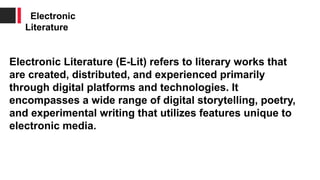
Electronic Literature (E-Lit)refers to literary works that
are created, distributed, and experienced primarily
through digital platforms and technologies. It
encompasses a wide range of digital storytelling, poetry,
and experimental writing that utilizes features unique to
electronic media.
Electronic
Literature
3.
Key
Characteristic
s
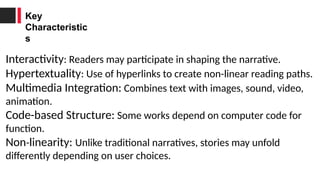
Interactivity: Readers mayparticipate in shaping the narrative.
Hypertextuality: Use of hyperlinks to create non-linear reading paths.
Multimedia Integration: Combines text with images, sound, video,
animation.
Code-based Structure: Some works depend on computer code for
function.
Non-linearity: Unlike traditional narratives, stories may unfold
differently depending on user choices.
4.
Formal of
Electronic
Letirature
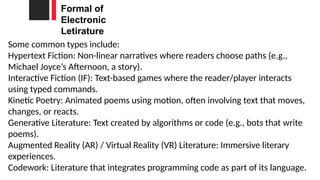
Some commontypes include:
Hypertext Fiction: Non-linear narratives where readers choose paths (e.g.,
Michael Joyce’s Afternoon, a story).
Interactive Fiction (IF): Text-based games where the reader/player interacts
using typed commands.
Kinetic Poetry: Animated poems using motion, often involving text that moves,
changes, or reacts.
Generative Literature: Text created by algorithms or code (e.g., bots that write
poems).
Augmented Reality (AR) / Virtual Reality (VR) Literature: Immersive literary
experiences.
Codework: Literature that integrates programming code as part of its language.
5.
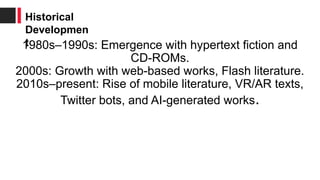
1980s–1990s: Emergence withhypertext fiction and
CD-ROMs.
2000s: Growth with web-based works, Flash literature.
2010s–present: Rise of mobile literature, VR/AR texts,
Twitter bots, and AI-generated works.
Historical
Developmen
t
6.
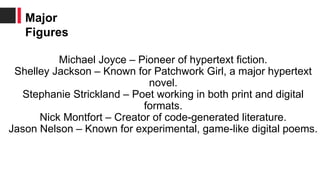
Michael Joyce –Pioneer of hypertext fiction.
Shelley Jackson – Known for Patchwork Girl, a major hypertext
novel.
Stephanie Strickland – Poet working in both print and digital
formats.
Nick Montfort – Creator of code-generated literature.
Jason Nelson – Known for experimental, game-like digital poems.
Major
Figures
7.
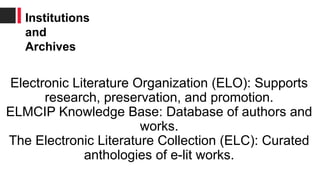
Electronic Literature Organization(ELO): Supports
research, preservation, and promotion.
ELMCIP Knowledge Base: Database of authors and
works.
The Electronic Literature Collection (ELC): Curated
anthologies of e-lit works.
Institutions
and
Archives
8.
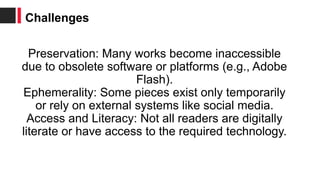
Preservation: Many worksbecome inaccessible
due to obsolete software or platforms (e.g., Adobe
Flash).
Ephemerality: Some pieces exist only temporarily
or rely on external systems like social media.
Access and Literacy: Not all readers are digitally
literate or have access to the required technology.
Challenges
9.
Expands traditional literaryboundaries.
Offers new ways to engage readers through
interaction.
Blends literature with visual arts, game studies,
computer science.
Explored in digital humanities, media studies, and
literary theory.
Cultural
and
Academic
Relevance
10.
Afternoon, a storyby Michael Joyce
Patchwork Girl by Shelley Jackson
Reagan Library by Stuart Moulthrop
The Unknown (hypertext novel)
Sea and Spar Between by Stephanie
Strickland and Nick Montfort
Examples of Notable
Works
11.
1. It issupports research , preservation, and promotion.
2. Afternoon, a story By ____________?
3. Use of hyperlink to create non-linear reading path.
4. Some pieces exist only temporarily or rely on external systems like social
media.
5. Refers to literary works that are created, distributed, and experienced
primarily through digital platforms and technologies.
6-10. Name the 5 key characteristics of Electronic Letirature. In any order.
Question