Assessment of IL   Albert K. Boekhorst Universiteit van Amsterdam University of Pretoria Tallinn University
Definition Assessment is a process of gathering and documenting information about the achievement, skills, abilities, and personality variables of an individual.
Description Assessment is used in both an educational and psychological setting by teachers, psychologists, and counselors to accomplish a range of objectives.
These include the following: to learn more about the competencies and deficiencies of the individual being tested  to identify specific problem areas and/or needs  to evaluate the individual's performance in relation to others  to evaluate the individual's performance in relation to a set of standards or goals  to provide teachers with feedback on effectiveness of instruction  to evaluate the impact of psychological or neurological abnormalities on learning and behavior  to predict an individual's aptitudes or future capabilities
Modes of assessment Expert assessment Self assessment Peer assessment
Types Formative and summative Objective and subjective Referencing: criterion-referenced norm-referenced  ipsative Informal and formal
Summative and Formative Summative assessment generally carried out at the end of a course or project. In an educational setting, summative assessments are typically used to assign students a course grade.  Formative assessment generally carried out throughout a course or project. Formative assessment, also referred to as educative assessment, is used to aid learning. In an educational setting, formative assessment might be a teacher (or peer) or the learner, providing feedback on a student's work, and would not necessarily be used for grading purposes.
http://www.reference.com/search?q=assessment http://en.wikipedia.org/wiki/Assessment
Instruments (digital) portfolio assessment / development center Overall test Criterium oriented interview Competence test Assessment talk (Dochy en Nickmans 2005)
What do you need? Standards – norms ALA / ISLMA Information Literacy Standards for Student Learning  http://21cif.imsa.edu/resources/materials/survey/standards/alastandards.htm http:// www.ala.org / ala / aasl / aaslproftools / informationpower / InformationLiteracyStandards _ final.pdf ACRL http://www.ala.org/ala/acrl/acrlstandards/informationliteracycompetency.cfm
ALA Levels of Proficiency  items for the indicators within each standard In Information Power: Building Partnerships for Learning: Standards in Action  that provide examples of potential situations requiring information literacy for each standard Examples of Content-Area Standards  for each standard
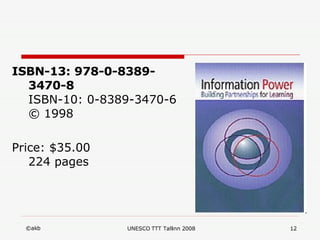
ISBN-13: 978-0-8389-3470-8  ISBN-10: 0-8389-3470-6  © 1998  Price: $35.00  224 pages
ALA 3 Categories Information Literacy Independent Learning Social Responsibility
Category I: Information Literacy   Standard 1: The student who is information literate accesses information efficiently and effectively. Standard 2: The student who is information literate evaluates information critically and competently.  Standard 3: The student who is information literate uses information accurately and creatively.
Category II: Independent Learning Standard 4: The student who is an independent learner is information literate and pursues information related to personal interests.   Standard 5: The student who is an independent learner is information literate and appreciates literature and other creative expressions of information.  Standard 6: The student who is an independent learner is information literate and strives for excellence in information seeking and knowledge generation.
Category III: Social Responsibility Standard 7: The student who contributes positively to the learning community and to society is information literate and recognizes the importance of information to a democratic society.  Standard 8: The student who contributes positively to the learning community and to society is information literate and practices ethical behavior in regard to information and information technology.  Standard 9: The student who contributes positively to the learning community and to society is information literate and participates effectively in groups to pursue and generate information.
Standard 1 Indicators Indicator 1.  Recognizes the need for information Indicator 2.  Recognizes that accurate and comprehensive information is the basis for intelligent decision making Indicator 3.  Formulates questions based on information needs Indicator 4.  Identifies a variety of potential sources of information Indicator 5.  Develops and uses successful strategies for locating information
ACRL 5 Competency Standards  Performance Indicators Outcomes:
ACRL Competency Standards  1: The information literate student determines the extent of the information neede 2: The information literate student accesses needed information effectively and efficiently 3: The information literate student evaluates information and its sources critically and incorporates selected information into his or her knowledge base and value system 4: The information literate student, individually or as a member of a group, uses information effectively to accomplish a specific purpose 5: The information literate student understands many of the economic, legal and social issues surrounding the use of information and accesses and uses information ethically and legally
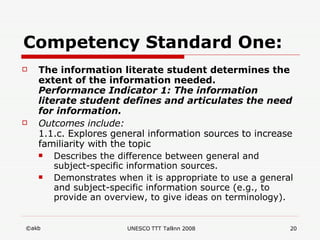
Competency Standard One: The information literate student determines the extent of the information needed. Performance Indicator 1: The information literate student defines and articulates the need for information. Outcomes include: 1.1.c. Explores general information sources to increase familiarity with the topic Describes the difference between general and subject-specific information sources.  Demonstrates when it is appropriate to use a general and subject-specific information source (e.g., to provide an overview, to give ideas on terminology).
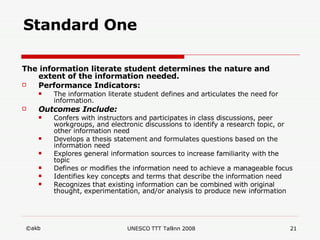
Standard One The information literate student determines the nature and extent of the information needed.   Performance Indicators: The information literate student defines and articulates the need for information.  Outcomes Include: Confers with instructors and participates in class discussions, peer workgroups, and electronic discussions to identify a research topic, or other information need  Develops a thesis statement and formulates questions based on the information need  Explores general information sources to increase familiarity with the topic  Defines or modifies the information need to achieve a manageable focus  Identifies key concepts and terms that describe the information need  Recognizes that existing information can be combined with original thought, experimentation, and/or analysis to produce new information
Team Stakeholders Management institute/school Teachers ‘ Librarians’ ICT staff … Start with small team of ‘sympathetics’
 
Period Standards after each year Standards after a phase End terms
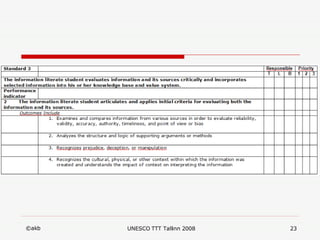
Result Matrix Items Responsabel persons Priority list
Next step Put the matrix on the ‘teaching’ scheme of the ‘group’ and individual ‘teacher’, librarian etc….
Tests and Surveys UCLA's   Information   Competencies   Survey Cal Poly Pomona "Information Competence Assessment: Web-Based Assessment of University entry-Level Information Competency" UC Berkeley Teaching Library Information Literacy Survey University of Charleston, West Virginia Basic Skills Survey Information Literacy Assessment, T Smalley Cabrillo College Wartburg College Information Literacy Assessment James Madison University - "Go For the Gold": A web-based program for developing information literacy skills that culminates in the  Information-Seeking   Skills  Test . The outline of a presentation on developing this test can be found  here  (Word document). http://www.ala.org/ala/acrl/acrlissues/acrlinfolit/infolitresources/infolitinaction/iltestssurveys.cfm
Exercise Make groups Fill out a matrix for Standard 3
Questions? [email_address]

Assessment Ct

  • 1.
    Assessment of IL Albert K. Boekhorst Universiteit van Amsterdam University of Pretoria Tallinn University
  • 2.
    Definition Assessment isa process of gathering and documenting information about the achievement, skills, abilities, and personality variables of an individual.
  • 3.
    Description Assessment isused in both an educational and psychological setting by teachers, psychologists, and counselors to accomplish a range of objectives.
  • 4.
    These include thefollowing: to learn more about the competencies and deficiencies of the individual being tested to identify specific problem areas and/or needs to evaluate the individual's performance in relation to others to evaluate the individual's performance in relation to a set of standards or goals to provide teachers with feedback on effectiveness of instruction to evaluate the impact of psychological or neurological abnormalities on learning and behavior to predict an individual's aptitudes or future capabilities
  • 5.
    Modes of assessmentExpert assessment Self assessment Peer assessment
  • 6.
    Types Formative andsummative Objective and subjective Referencing: criterion-referenced norm-referenced ipsative Informal and formal
  • 7.
    Summative and FormativeSummative assessment generally carried out at the end of a course or project. In an educational setting, summative assessments are typically used to assign students a course grade. Formative assessment generally carried out throughout a course or project. Formative assessment, also referred to as educative assessment, is used to aid learning. In an educational setting, formative assessment might be a teacher (or peer) or the learner, providing feedback on a student's work, and would not necessarily be used for grading purposes.
  • 8.
  • 9.
    Instruments (digital) portfolioassessment / development center Overall test Criterium oriented interview Competence test Assessment talk (Dochy en Nickmans 2005)
  • 10.
    What do youneed? Standards – norms ALA / ISLMA Information Literacy Standards for Student Learning http://21cif.imsa.edu/resources/materials/survey/standards/alastandards.htm http:// www.ala.org / ala / aasl / aaslproftools / informationpower / InformationLiteracyStandards _ final.pdf ACRL http://www.ala.org/ala/acrl/acrlstandards/informationliteracycompetency.cfm
  • 11.
    ALA Levels ofProficiency items for the indicators within each standard In Information Power: Building Partnerships for Learning: Standards in Action that provide examples of potential situations requiring information literacy for each standard Examples of Content-Area Standards for each standard
  • 12.
    ISBN-13: 978-0-8389-3470-8 ISBN-10: 0-8389-3470-6 © 1998 Price: $35.00 224 pages
  • 13.
    ALA 3 CategoriesInformation Literacy Independent Learning Social Responsibility
  • 14.
    Category I: InformationLiteracy Standard 1: The student who is information literate accesses information efficiently and effectively. Standard 2: The student who is information literate evaluates information critically and competently. Standard 3: The student who is information literate uses information accurately and creatively.
  • 15.
    Category II: IndependentLearning Standard 4: The student who is an independent learner is information literate and pursues information related to personal interests. Standard 5: The student who is an independent learner is information literate and appreciates literature and other creative expressions of information. Standard 6: The student who is an independent learner is information literate and strives for excellence in information seeking and knowledge generation.
  • 16.
    Category III: SocialResponsibility Standard 7: The student who contributes positively to the learning community and to society is information literate and recognizes the importance of information to a democratic society. Standard 8: The student who contributes positively to the learning community and to society is information literate and practices ethical behavior in regard to information and information technology. Standard 9: The student who contributes positively to the learning community and to society is information literate and participates effectively in groups to pursue and generate information.
  • 17.
    Standard 1 IndicatorsIndicator 1. Recognizes the need for information Indicator 2. Recognizes that accurate and comprehensive information is the basis for intelligent decision making Indicator 3. Formulates questions based on information needs Indicator 4. Identifies a variety of potential sources of information Indicator 5. Develops and uses successful strategies for locating information
  • 18.
    ACRL 5 CompetencyStandards Performance Indicators Outcomes:
  • 19.
    ACRL Competency Standards 1: The information literate student determines the extent of the information neede 2: The information literate student accesses needed information effectively and efficiently 3: The information literate student evaluates information and its sources critically and incorporates selected information into his or her knowledge base and value system 4: The information literate student, individually or as a member of a group, uses information effectively to accomplish a specific purpose 5: The information literate student understands many of the economic, legal and social issues surrounding the use of information and accesses and uses information ethically and legally
  • 20.
    Competency Standard One:The information literate student determines the extent of the information needed. Performance Indicator 1: The information literate student defines and articulates the need for information. Outcomes include: 1.1.c. Explores general information sources to increase familiarity with the topic Describes the difference between general and subject-specific information sources. Demonstrates when it is appropriate to use a general and subject-specific information source (e.g., to provide an overview, to give ideas on terminology).
  • 21.
    Standard One Theinformation literate student determines the nature and extent of the information needed. Performance Indicators: The information literate student defines and articulates the need for information. Outcomes Include: Confers with instructors and participates in class discussions, peer workgroups, and electronic discussions to identify a research topic, or other information need Develops a thesis statement and formulates questions based on the information need Explores general information sources to increase familiarity with the topic Defines or modifies the information need to achieve a manageable focus Identifies key concepts and terms that describe the information need Recognizes that existing information can be combined with original thought, experimentation, and/or analysis to produce new information
  • 22.
    Team Stakeholders Managementinstitute/school Teachers ‘ Librarians’ ICT staff … Start with small team of ‘sympathetics’
  • 23.
  • 24.
    Period Standards aftereach year Standards after a phase End terms
  • 25.
    Result Matrix ItemsResponsabel persons Priority list
  • 26.
    Next step Putthe matrix on the ‘teaching’ scheme of the ‘group’ and individual ‘teacher’, librarian etc….
  • 27.
    Tests and SurveysUCLA's Information Competencies Survey Cal Poly Pomona "Information Competence Assessment: Web-Based Assessment of University entry-Level Information Competency" UC Berkeley Teaching Library Information Literacy Survey University of Charleston, West Virginia Basic Skills Survey Information Literacy Assessment, T Smalley Cabrillo College Wartburg College Information Literacy Assessment James Madison University - "Go For the Gold": A web-based program for developing information literacy skills that culminates in the Information-Seeking Skills Test . The outline of a presentation on developing this test can be found here (Word document). http://www.ala.org/ala/acrl/acrlissues/acrlinfolit/infolitresources/infolitinaction/iltestssurveys.cfm
  • 28.
    Exercise Make groupsFill out a matrix for Standard 3
  • 29.