Teaching of life science 1
TEACHING AIDS
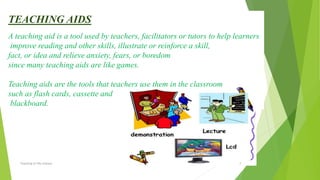
A teaching aid is a tool used by teachers, facilitators or tutors to help learners
improve reading and other skills, illustrate or reinforce a skill,
fact, or idea and relieve anxiety, fears, or boredom
since many teaching aids are like games.
Teaching aids are the tools that teachers use them in the classroom
such as flash cards, cassette and
blackboard.
Teaching of life science 2
DEFINATION
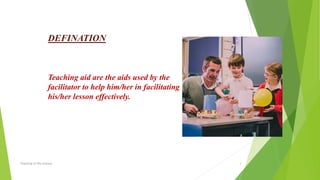
Teaching aid are the aids used by the
facilitator to help him/her in facilitating
his/her lesson effectively.
Teaching of life science 3
Characterstics of Teaching aids
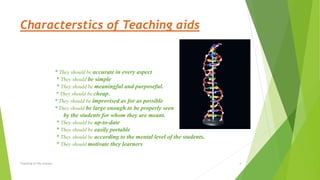
* They should be accurate in every aspect
* They should be simple
* They should be meaningful and purposeful.
* They should be cheap.
* They should be improvised as for as possible
* They should be large enough to be properly seen
by the students for whom they are meant.
* They should be up-to-date
* They should be easily portable
* They should be according to the mental level of the students.
* They should motivate they learners
Teaching of life science 4
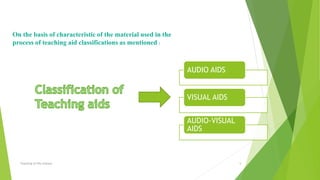
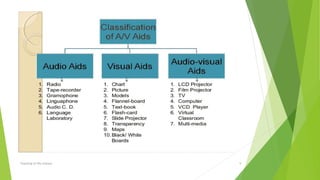
On the basis of characteristic of the material used in the
process of teaching aid classifications as mentioned :
AUDIO AIDS
VISUAL AIDS
AUDIO-VISUAL
AIDS
Teaching of life science 5
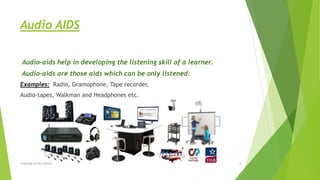
Audio AIDS
Audio-aids help in developing the listening skill of a learner.
Audio-aids are those aids which can be only listened.
Examples: Radio, Gramophone, Tape recorder,
Audio-tapes, Walkman and Headphones etc.
Teaching of life science 6
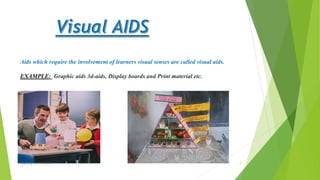
Aids which require the involvement of learners visual senses are called visual aids.
EXAMPLE: Graphic aids 3d-aids, Display boards and Print material etc.
Teaching of life science 7
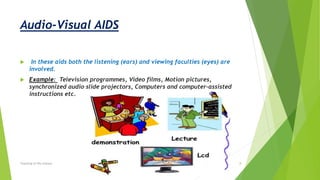
Audio-Visual AIDS
 In these aids both the listening (ears) and viewing faculties (eyes) are
involved.
 Example: Television programmes, Video films, Motion pictures,
synchronized audio slide projectors, Computers and computer-assisted
instructions etc.
Teaching of life science 8
Teaching of life science 9
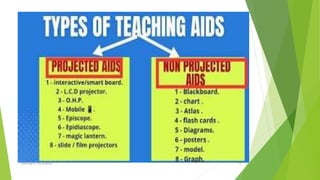
Projected aids
 Aids which are used to introduce concepts by projecting them on a screen
. These are the types of audio visual aids that maximize learning with
the help of both auditory and visual systems .
Advantages:
 Provides enjoyment in learning.
 Stimulates rapid learning
 Increases retention.
 Compels attention
 Enlarges/ reduces actual size of objects
 Bring distant , past and present into classroom
Teaching of life science 10
SLIDES
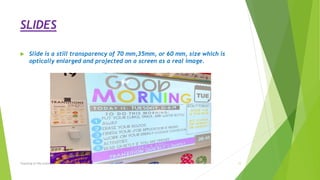
 Slide is a still transparency of 70 mm,35mm, or 60 mm, size which is
optically enlarged and projected on a screen as a real image.
Teaching of life science 11
Slide projector
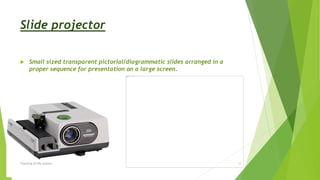
 Small sized transparent pictorial/diagrammatic slides arranged in a
proper sequence for presentation on a large screen.
Teaching of life science 12
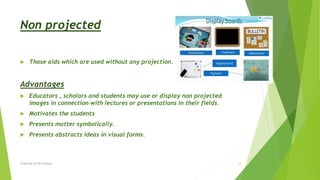
Non projected
 Those aids which are used without any projection.
Advantages
 Educators , scholars and students may use or display non projected
images in connection with lectures or presentations in their fields.
 Motivates the students
 Presents matter symbolically.
 Presents abstracts ideas in visual forms.
Teaching of life science 13
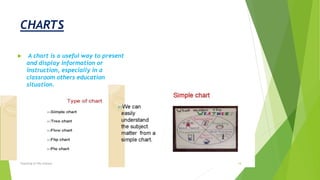
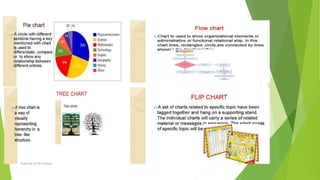
CHARTS
 A chart is a useful way to present
and display information or
instruction, especially in a
classroom others education
situation.
Teaching of life science 14
Teaching of life science 15
Advantages of chart
i) They can be made quickly.
ii)They have a better appeal.
iii)Only bare essential can be shown in
the chart and
unnecessary details can be avoided.
iv)Chart are available from various
sources.
Teaching of life science 16
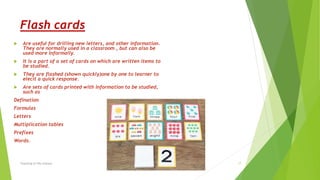
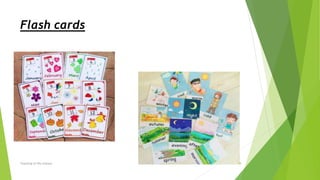
Flash cards
 Are useful for drilling new letters, and other information.
They are normally used in a classroom , but can also be
used more informally.
 It is a part of a set of cards on which are written items to
be studied.
 They are flashed (shown quickly)one by one to learner to
elecit a quick response.
 Are sets of cards printed with information to be studied,
such as
Defination
Formulas
Letters
Multiplication tables
Prefixes
Words.
Teaching of life science 17
Flash cards
Teaching of life science 18
Teaching of life science 19
NEED AND IMPORTANCE
 Clarity
 Attention and Interests
 Best motivators
 Use of maximum senses
 Saving time and effort
 Fixing and recalling the knowledge
 Meeting and individual differences
 Encouraging activites
 Introductory variety
 Development of scientific attitudes
 Direct Experiences
 Promotion of international understanding
Teaching of life science 20
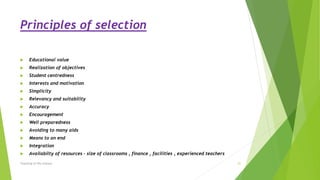
Principles of selection
 Educational value
 Realization of objectives
 Student centredness
 Interests and motivation
 Simplicity
 Relevancy and suitability
 Accuracy
 Encouragement
 Well preparedness
 Avoiding to many aids
 Means to an end
 Integration
 Availabilty of resources – size of classrooms , finance , facilities , experienced teachers
Teaching of life science 21
Teaching of life science 22

Teaching aids

  • 1.
  • 2.
    TEACHING AIDS A teachingaid is a tool used by teachers, facilitators or tutors to help learners improve reading and other skills, illustrate or reinforce a skill, fact, or idea and relieve anxiety, fears, or boredom since many teaching aids are like games. Teaching aids are the tools that teachers use them in the classroom such as flash cards, cassette and blackboard. Teaching of life science 2
  • 3.
    DEFINATION Teaching aid arethe aids used by the facilitator to help him/her in facilitating his/her lesson effectively. Teaching of life science 3
  • 4.
    Characterstics of Teachingaids * They should be accurate in every aspect * They should be simple * They should be meaningful and purposeful. * They should be cheap. * They should be improvised as for as possible * They should be large enough to be properly seen by the students for whom they are meant. * They should be up-to-date * They should be easily portable * They should be according to the mental level of the students. * They should motivate they learners Teaching of life science 4
  • 5.
    On the basisof characteristic of the material used in the process of teaching aid classifications as mentioned : AUDIO AIDS VISUAL AIDS AUDIO-VISUAL AIDS Teaching of life science 5
  • 6.
    Audio AIDS Audio-aids helpin developing the listening skill of a learner. Audio-aids are those aids which can be only listened. Examples: Radio, Gramophone, Tape recorder, Audio-tapes, Walkman and Headphones etc. Teaching of life science 6
  • 7.
    Aids which requirethe involvement of learners visual senses are called visual aids. EXAMPLE: Graphic aids 3d-aids, Display boards and Print material etc. Teaching of life science 7
  • 8.
    Audio-Visual AIDS  Inthese aids both the listening (ears) and viewing faculties (eyes) are involved.  Example: Television programmes, Video films, Motion pictures, synchronized audio slide projectors, Computers and computer-assisted instructions etc. Teaching of life science 8
  • 9.
  • 10.
    Projected aids  Aidswhich are used to introduce concepts by projecting them on a screen . These are the types of audio visual aids that maximize learning with the help of both auditory and visual systems . Advantages:  Provides enjoyment in learning.  Stimulates rapid learning  Increases retention.  Compels attention  Enlarges/ reduces actual size of objects  Bring distant , past and present into classroom Teaching of life science 10
  • 11.
    SLIDES  Slide isa still transparency of 70 mm,35mm, or 60 mm, size which is optically enlarged and projected on a screen as a real image. Teaching of life science 11
  • 12.
    Slide projector  Smallsized transparent pictorial/diagrammatic slides arranged in a proper sequence for presentation on a large screen. Teaching of life science 12
  • 13.
    Non projected  Thoseaids which are used without any projection. Advantages  Educators , scholars and students may use or display non projected images in connection with lectures or presentations in their fields.  Motivates the students  Presents matter symbolically.  Presents abstracts ideas in visual forms. Teaching of life science 13
  • 14.
    CHARTS  A chartis a useful way to present and display information or instruction, especially in a classroom others education situation. Teaching of life science 14
  • 15.
    Teaching of lifescience 15
  • 16.
    Advantages of chart i)They can be made quickly. ii)They have a better appeal. iii)Only bare essential can be shown in the chart and unnecessary details can be avoided. iv)Chart are available from various sources. Teaching of life science 16
  • 17.
    Flash cards  Areuseful for drilling new letters, and other information. They are normally used in a classroom , but can also be used more informally.  It is a part of a set of cards on which are written items to be studied.  They are flashed (shown quickly)one by one to learner to elecit a quick response.  Are sets of cards printed with information to be studied, such as Defination Formulas Letters Multiplication tables Prefixes Words. Teaching of life science 17
  • 18.
    Flash cards Teaching oflife science 18
  • 19.
    Teaching of lifescience 19
  • 20.
    NEED AND IMPORTANCE Clarity  Attention and Interests  Best motivators  Use of maximum senses  Saving time and effort  Fixing and recalling the knowledge  Meeting and individual differences  Encouraging activites  Introductory variety  Development of scientific attitudes  Direct Experiences  Promotion of international understanding Teaching of life science 20
  • 21.
    Principles of selection Educational value  Realization of objectives  Student centredness  Interests and motivation  Simplicity  Relevancy and suitability  Accuracy  Encouragement  Well preparedness  Avoiding to many aids  Means to an end  Integration  Availabilty of resources – size of classrooms , finance , facilities , experienced teachers Teaching of life science 21
  • 22.
    Teaching of lifescience 22