1
WELCOME TO MY PRESENTATION
Presentation on : 1. Introduction to Fabric Structure & Design
2. Plain Weave
Dhaka University of Engineering & Technology
Department of Textile Engineering
Fabric
Structur
e
&
Design
Presented To:
Mr. Shamsuzzaman Sheikh
Assistant Professor
Department of Textile Engineering
Dhaka University of Engineering & Technology,
Gazipur-1707
Presented By:
Name : Imam Hossain
Id : 175054
Year/Semester : 3rd/ 2nd
Session : 2019-20
Department : TE
1
Introduction To Fabric Structure & Design
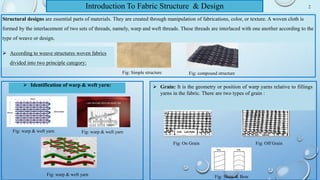
Structural designs are essential parts of materials. They are created through manipulation of fabrications, color, or texture. A woven cloth is
formed by the interlacement of two sets of threads, namely, warp and weft threads. These threads are interlaced with one another according to the
type of weave or design.
 According to weave structures woven fabrics
divided into two principle category:
Fig: Simple structure Fig: compound structure
 Identification of warp & weft yarn:
Fig: warp & weft yarn Fig: warp & weft yarn
Fig: warp & weft yarn
 Grain: It is the geometry or position of warp yarns relative to fillings
yarns in the fabric. There are two types of grain :
Fig: On Grain Fig: Off Grain
Fig: Skew & Bow
2
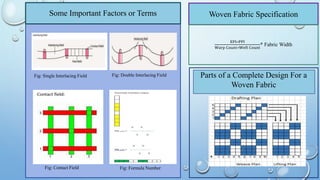
Some Important Factors or Terms
Fig: Contact Field
Fig: Single Interlacing Field
Fig: Formula Number
3
Woven Fabric Specification
EPI∗PPI
Warp Count∗Weft Count
* Fabric Width
Parts of a Complete Design For a
Woven Fabric
Fig: Double Interlacing Field
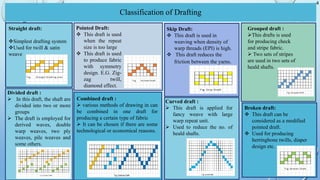
Curved draft :
 This draft is applied for
fancy weave with large
warp repeat unit.
 Used to reduce the no. of
heald shafts.
Classification of Drafting
4
Straight draft:
Simplest drafting system
Used for twill & satin
weave
Pointed Draft:
 This draft is used
when the repeat
size is too large
 This draft is used
to produce fabric
with symmetry
design. E.G. Zig-
zag twill,
diamond effect.
Skip Draft:
 This draft is used in
weaving when density of
warp threads (EPI) is high.
 This draft reduces the
friction between the yarns.
Broken draft:
 This draft can be
considered as a modified
pointed draft.
 Used for producing
herringbone twills, diaper
design etc.
Divided draft :
 In this draft, the shaft are
divided into two or more
groups
 The draft is employed for
derived waves, double
warp weaves, two ply
weaves, pile weaves and
some others.
Grouped draft :
This drafts is used
for producing check
and stripe fabric.
 Two sets of stripes
are used in two sets of
heald shafts.
Combined draft :
 various methods of drawing in can
be combined in one draft for
producing a certain type of fabric
 It can be chosen if there are some
technological or economical reasons.
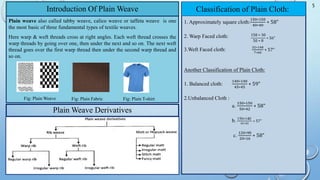
Introduction Of Plain Weave
Plain weave also called tabby weave, calico weave or taffeta weave is one
the most basic of three fundamental types of textile weaves.
Here warp & weft threads cross at right angles. Each weft thread crosses the
warp threads by going over one, then under the next and so on. The next weft
thread goes over the first warp thread then under the second warp thread and
so on.
Fig: Plain Weave
5
Fig: Plain Fabric Fig: Plain T-shirt
1. Approximately square cloth:
150∗150
40∗40
∗ 58"
2. Warp Faced cloth:
3.Weft Faced cloth:
32∗148
7∗60
∗ 57“
Another Classification of Plain Cloth:
1. Balanced cloth:
140∗140
45∗45
∗ 59"
2.Unbalanced Cloth :
a.
150∗150
50∗42
∗ 58"
b. 150∗140
42∗42
∗ 57"
c.
120∗90
20∗16
∗ 58"
150 ∗ 30
50 ∗ 8
∗ 56"
Plain Weave Derivatives
Classification of Plain Cloth:
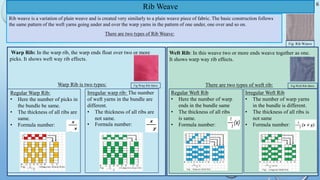
Warp Rib: In the warp rib, the warp ends float over two or more
picks. It shows weft way rib effects.
Warp Rib is two types:
Rib Weave
Rib weave is a variation of plain weave and is created very similarly to a plain weave piece of fabric. The basic construction follows
the same pattern of the weft yarns going under and over the warp yarns in the pattern of one under, one over and so on.
There are two types of Rib Weave:
Weft Rib: In this weave two or more ends weave together as one.
It shows warp way rib effects.
There are two types of weft rib:
6
Regular Warp Rib:
• Here the number of picks in
the bundle be same.
• The thickness of all ribs are
same.
• Formula number:
Irregular warp rib: The number
of weft yarns in the bundle are
different.
• The thickness of all ribs are
not same.
• Formula number:
Regular Weft Rib
• Here the number of warp
ends in the bundle same
• The thickness of all ribs
is same.
• Formula number:
Irregular Weft Rib
• The number of warp yarns
in the bundle is different.
• The thickness of all ribs is
not same
• Formula number:
Fig: Rib Weave
Fig:Warp Rib fabric Fig:Weft Rib fabric
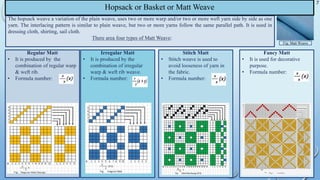
Hopsack or Basket or Matt Weave
The hopsack weave a variation of the plain weave, uses two or more warp and/or two or more weft yarn side by side as one
yarn. The interlacing pattern is similar to plain weave, but two or more yarns follow the same parallel path. It is used in
dressing cloth, shirting, sail cloth.
There area four types of Matt Weave:
Regular Matt
• It is produced by the
combination of regular warp
& weft rib.
• Formula number:
Irregular Matt
• It is produced by the
combination of irregular
warp & weft rib weave.
• Formula number:
Stitch Matt
• Stitch weave is used to
avoid looseness of yarn in
the fabric.
• Formula number:
Fancy Matt
• It is used for decorative
purpose.
• Formula number:
7
Fig: Matt Weave
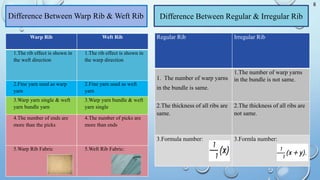
Difference Between Warp Rib & Weft Rib
Regular Rib Irregular Rib
1. The number of warp yarns
in the bundle is same.
1.The number of warp yarns
in the bundle is not same.
2.The thickness of all ribs are
same.
2.The thickness of all ribs are
not same.
3.Formula number: 3.Formla number:
Difference Between Regular & Irregular Rib
Warp Rib Weft Rib
1.The rib effect is shown in
the weft direction
1.The rib effect is shown in
the warp direction
2.Fine yarn used as warp
yarn
2.Fine yarn used as weft
yarn
3.Warp yarn single & weft
yarn bundle yarn
3.Warp yarn bundle & weft
yarn single
4.The number of ends are
more than the picks
4.The number of picks are
more than ends
5.Warp Rib Fabric 5.Weft Rib Fabric:
8
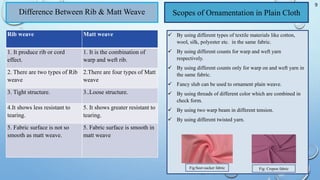
Difference Between Rib & Matt Weave
Rib weave Matt weave
1. It produce rib or cord
effect.
1. It is the combination of
warp and weft rib.
2. There are two types of Rib
weave
2.There are four types of Matt
weave
3. Tight structure. 3..Loose structure.
4.It shows less resistant to
tearing.
5. It shows greater resistant to
tearing.
5. Fabric surface is not so
smooth as matt weave.
5. Fabric surface is smooth in
matt weave
9
Scopes of Ornamentation in Plain Cloth
 By using different types of textile materials like cotton,
wool, silk, polyester etc. in the same fabric.
 By using different counts for warp and weft yarn
respectively.
 By using different counts only for warp on and weft yarn in
the same fabric.
 Fancy slub can be used to ornament plain weave.
 By using threads of different color which are combined in
check form.
 By using two warp beam in different tension.
 By using different twisted yarn.
Fig:Seer-sucker fabric Fig: Crepon fabric
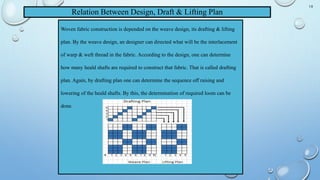
Relation Between Design, Draft & Lifting Plan
Woven fabric construction is depended on the weave design, its drafting & lifting
plan. By the weave design, an designer can directed what will be the interlacement
of warp & weft thread in the fabric. According to the design, one can determine
how many heald shafts are required to construct that fabric. That is called drafting
plan. Again, by drafting plan one can determine the sequence off raising and
lowering of the heald shafts. By this, the determination of required loom can be
done.
10
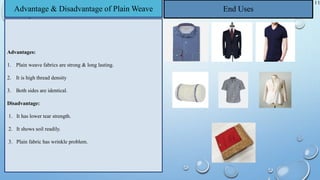
End Uses
11
Advantage & Disadvantage of Plain Weave
Advantages:
1. Plain weave fabrics are strong & long lasting.
2. It is high thread density
3. Both sides are identical.
Disadvantage:
1. It has lower tear strength.
2. It shows soil readily.
3. Plain fabric has wrinkle problem.
12

Presentation on Fabric structure & design & Plain weave

  • 1.
    1 WELCOME TO MYPRESENTATION Presentation on : 1. Introduction to Fabric Structure & Design 2. Plain Weave Dhaka University of Engineering & Technology Department of Textile Engineering Fabric Structur e & Design Presented To: Mr. Shamsuzzaman Sheikh Assistant Professor Department of Textile Engineering Dhaka University of Engineering & Technology, Gazipur-1707 Presented By: Name : Imam Hossain Id : 175054 Year/Semester : 3rd/ 2nd Session : 2019-20 Department : TE 1
  • 2.
    Introduction To FabricStructure & Design Structural designs are essential parts of materials. They are created through manipulation of fabrications, color, or texture. A woven cloth is formed by the interlacement of two sets of threads, namely, warp and weft threads. These threads are interlaced with one another according to the type of weave or design.  According to weave structures woven fabrics divided into two principle category: Fig: Simple structure Fig: compound structure  Identification of warp & weft yarn: Fig: warp & weft yarn Fig: warp & weft yarn Fig: warp & weft yarn  Grain: It is the geometry or position of warp yarns relative to fillings yarns in the fabric. There are two types of grain : Fig: On Grain Fig: Off Grain Fig: Skew & Bow 2
  • 3.
    Some Important Factorsor Terms Fig: Contact Field Fig: Single Interlacing Field Fig: Formula Number 3 Woven Fabric Specification EPI∗PPI Warp Count∗Weft Count * Fabric Width Parts of a Complete Design For a Woven Fabric Fig: Double Interlacing Field
  • 4.
    Curved draft : This draft is applied for fancy weave with large warp repeat unit.  Used to reduce the no. of heald shafts. Classification of Drafting 4 Straight draft: Simplest drafting system Used for twill & satin weave Pointed Draft:  This draft is used when the repeat size is too large  This draft is used to produce fabric with symmetry design. E.G. Zig- zag twill, diamond effect. Skip Draft:  This draft is used in weaving when density of warp threads (EPI) is high.  This draft reduces the friction between the yarns. Broken draft:  This draft can be considered as a modified pointed draft.  Used for producing herringbone twills, diaper design etc. Divided draft :  In this draft, the shaft are divided into two or more groups  The draft is employed for derived waves, double warp weaves, two ply weaves, pile weaves and some others. Grouped draft : This drafts is used for producing check and stripe fabric.  Two sets of stripes are used in two sets of heald shafts. Combined draft :  various methods of drawing in can be combined in one draft for producing a certain type of fabric  It can be chosen if there are some technological or economical reasons.
  • 5.
    Introduction Of PlainWeave Plain weave also called tabby weave, calico weave or taffeta weave is one the most basic of three fundamental types of textile weaves. Here warp & weft threads cross at right angles. Each weft thread crosses the warp threads by going over one, then under the next and so on. The next weft thread goes over the first warp thread then under the second warp thread and so on. Fig: Plain Weave 5 Fig: Plain Fabric Fig: Plain T-shirt 1. Approximately square cloth: 150∗150 40∗40 ∗ 58" 2. Warp Faced cloth: 3.Weft Faced cloth: 32∗148 7∗60 ∗ 57“ Another Classification of Plain Cloth: 1. Balanced cloth: 140∗140 45∗45 ∗ 59" 2.Unbalanced Cloth : a. 150∗150 50∗42 ∗ 58" b. 150∗140 42∗42 ∗ 57" c. 120∗90 20∗16 ∗ 58" 150 ∗ 30 50 ∗ 8 ∗ 56" Plain Weave Derivatives Classification of Plain Cloth:
  • 6.
    Warp Rib: Inthe warp rib, the warp ends float over two or more picks. It shows weft way rib effects. Warp Rib is two types: Rib Weave Rib weave is a variation of plain weave and is created very similarly to a plain weave piece of fabric. The basic construction follows the same pattern of the weft yarns going under and over the warp yarns in the pattern of one under, one over and so on. There are two types of Rib Weave: Weft Rib: In this weave two or more ends weave together as one. It shows warp way rib effects. There are two types of weft rib: 6 Regular Warp Rib: • Here the number of picks in the bundle be same. • The thickness of all ribs are same. • Formula number: Irregular warp rib: The number of weft yarns in the bundle are different. • The thickness of all ribs are not same. • Formula number: Regular Weft Rib • Here the number of warp ends in the bundle same • The thickness of all ribs is same. • Formula number: Irregular Weft Rib • The number of warp yarns in the bundle is different. • The thickness of all ribs is not same • Formula number: Fig: Rib Weave Fig:Warp Rib fabric Fig:Weft Rib fabric
  • 7.
    Hopsack or Basketor Matt Weave The hopsack weave a variation of the plain weave, uses two or more warp and/or two or more weft yarn side by side as one yarn. The interlacing pattern is similar to plain weave, but two or more yarns follow the same parallel path. It is used in dressing cloth, shirting, sail cloth. There area four types of Matt Weave: Regular Matt • It is produced by the combination of regular warp & weft rib. • Formula number: Irregular Matt • It is produced by the combination of irregular warp & weft rib weave. • Formula number: Stitch Matt • Stitch weave is used to avoid looseness of yarn in the fabric. • Formula number: Fancy Matt • It is used for decorative purpose. • Formula number: 7 Fig: Matt Weave
  • 8.
    Difference Between WarpRib & Weft Rib Regular Rib Irregular Rib 1. The number of warp yarns in the bundle is same. 1.The number of warp yarns in the bundle is not same. 2.The thickness of all ribs are same. 2.The thickness of all ribs are not same. 3.Formula number: 3.Formla number: Difference Between Regular & Irregular Rib Warp Rib Weft Rib 1.The rib effect is shown in the weft direction 1.The rib effect is shown in the warp direction 2.Fine yarn used as warp yarn 2.Fine yarn used as weft yarn 3.Warp yarn single & weft yarn bundle yarn 3.Warp yarn bundle & weft yarn single 4.The number of ends are more than the picks 4.The number of picks are more than ends 5.Warp Rib Fabric 5.Weft Rib Fabric: 8
  • 9.
    Difference Between Rib& Matt Weave Rib weave Matt weave 1. It produce rib or cord effect. 1. It is the combination of warp and weft rib. 2. There are two types of Rib weave 2.There are four types of Matt weave 3. Tight structure. 3..Loose structure. 4.It shows less resistant to tearing. 5. It shows greater resistant to tearing. 5. Fabric surface is not so smooth as matt weave. 5. Fabric surface is smooth in matt weave 9 Scopes of Ornamentation in Plain Cloth  By using different types of textile materials like cotton, wool, silk, polyester etc. in the same fabric.  By using different counts for warp and weft yarn respectively.  By using different counts only for warp on and weft yarn in the same fabric.  Fancy slub can be used to ornament plain weave.  By using threads of different color which are combined in check form.  By using two warp beam in different tension.  By using different twisted yarn. Fig:Seer-sucker fabric Fig: Crepon fabric
  • 10.
    Relation Between Design,Draft & Lifting Plan Woven fabric construction is depended on the weave design, its drafting & lifting plan. By the weave design, an designer can directed what will be the interlacement of warp & weft thread in the fabric. According to the design, one can determine how many heald shafts are required to construct that fabric. That is called drafting plan. Again, by drafting plan one can determine the sequence off raising and lowering of the heald shafts. By this, the determination of required loom can be done. 10
  • 11.
    End Uses 11 Advantage &Disadvantage of Plain Weave Advantages: 1. Plain weave fabrics are strong & long lasting. 2. It is high thread density 3. Both sides are identical. Disadvantage: 1. It has lower tear strength. 2. It shows soil readily. 3. Plain fabric has wrinkle problem.
  • 12.