the Bottom line


                  Rotterdam, 6 september 2010
Making decisions
Impact & Effort

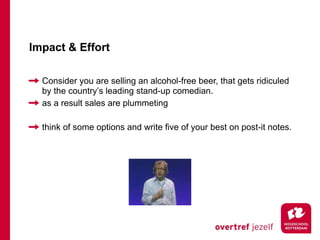
  Consider you are selling an alcohol-free beer, that gets ridiculed
  by the country’s leading stand-up comedian.
  as a result sales are plummeting

  think of some options and write five of your best on post-it notes.
Making decisions

  “Decision making can be regarded as the mental processes
  (cognitive process) resulting in the selection of a course of action
  among several alternatives.” - wikipedia

  the science of decision making:
     CAPM, net value (risk assesment)
     Analytical network process
     decision trees
     etc...
Some vocabulary

  Utility= expected outcome (“attractiveness”) of a decision
  Risk= the probable distribution of outcomes is known
  Uncertainty= the nature of the outcomes is unknown
  Regret= measure of how much better a decisionmaker could
  have done had he known the nature of the outcomes
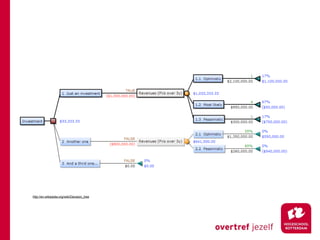
Decisions under risk (decision tree)

  Risk means the probability of the outcomes is known, as are the
  values.

  (IMHO these instances are actually pretty rare in “normal”
  businesses. but the purpose is to illustrate decisions and
  outcomes)
http://en.wikipedia.org/wiki/Decision_tree
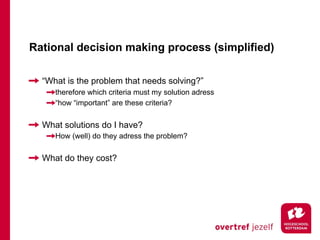
Rational decision making process (simplified)

  “What is the problem that needs solving?”
     therefore which criteria must my solution adress
     “how “important” are these criteria?


  What solutions do I have?
     How (well) do they adress the problem?


  What do they cost?
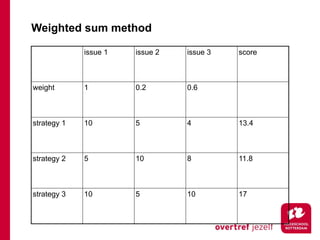
Weighted sum method

             issue 1   issue 2   issue 3   score


weight       1         0.2       0.6


strategy 1   10        5         4         13.4


strategy 2   5         10        8         11.8


strategy 3   10        5         10        17
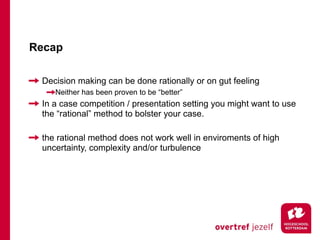
Recap

 Decision making can be done rationally or on gut feeling
    Neither has been proven to be “better”
 In a case competition / presentation setting you might want to use
 the “rational” method to bolster your case.

 the rational method does not work well in enviroments of high
 uncertainty, complexity and/or turbulence
Next week:

  defining the business problem
  making your case

Tbl hc5

  • 1.
    the Bottom line Rotterdam, 6 september 2010
  • 2.
  • 3.
    Impact & Effort Consider you are selling an alcohol-free beer, that gets ridiculed by the country’s leading stand-up comedian. as a result sales are plummeting think of some options and write five of your best on post-it notes.
  • 5.
    Making decisions “Decision making can be regarded as the mental processes (cognitive process) resulting in the selection of a course of action among several alternatives.” - wikipedia the science of decision making: CAPM, net value (risk assesment) Analytical network process decision trees etc...
  • 6.
    Some vocabulary Utility= expected outcome (“attractiveness”) of a decision Risk= the probable distribution of outcomes is known Uncertainty= the nature of the outcomes is unknown Regret= measure of how much better a decisionmaker could have done had he known the nature of the outcomes
  • 7.
    Decisions under risk(decision tree) Risk means the probability of the outcomes is known, as are the values. (IMHO these instances are actually pretty rare in “normal” businesses. but the purpose is to illustrate decisions and outcomes)
  • 8.
  • 9.
    Rational decision makingprocess (simplified) “What is the problem that needs solving?” therefore which criteria must my solution adress “how “important” are these criteria? What solutions do I have? How (well) do they adress the problem? What do they cost?
  • 10.
    Weighted sum method issue 1 issue 2 issue 3 score weight 1 0.2 0.6 strategy 1 10 5 4 13.4 strategy 2 5 10 8 11.8 strategy 3 10 5 10 17
  • 11.
    Recap Decision makingcan be done rationally or on gut feeling Neither has been proven to be “better” In a case competition / presentation setting you might want to use the “rational” method to bolster your case. the rational method does not work well in enviroments of high uncertainty, complexity and/or turbulence
  • 12.
    Next week: defining the business problem making your case

Editor's Notes