Explain the comprehensive hypothetical example
covering all the aspect of salary computation with its
effect on taxability.
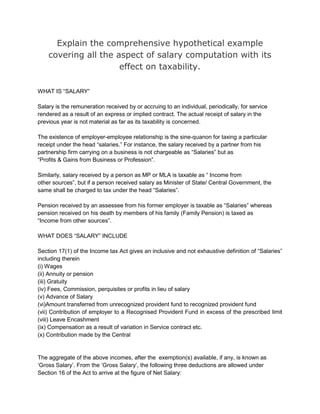
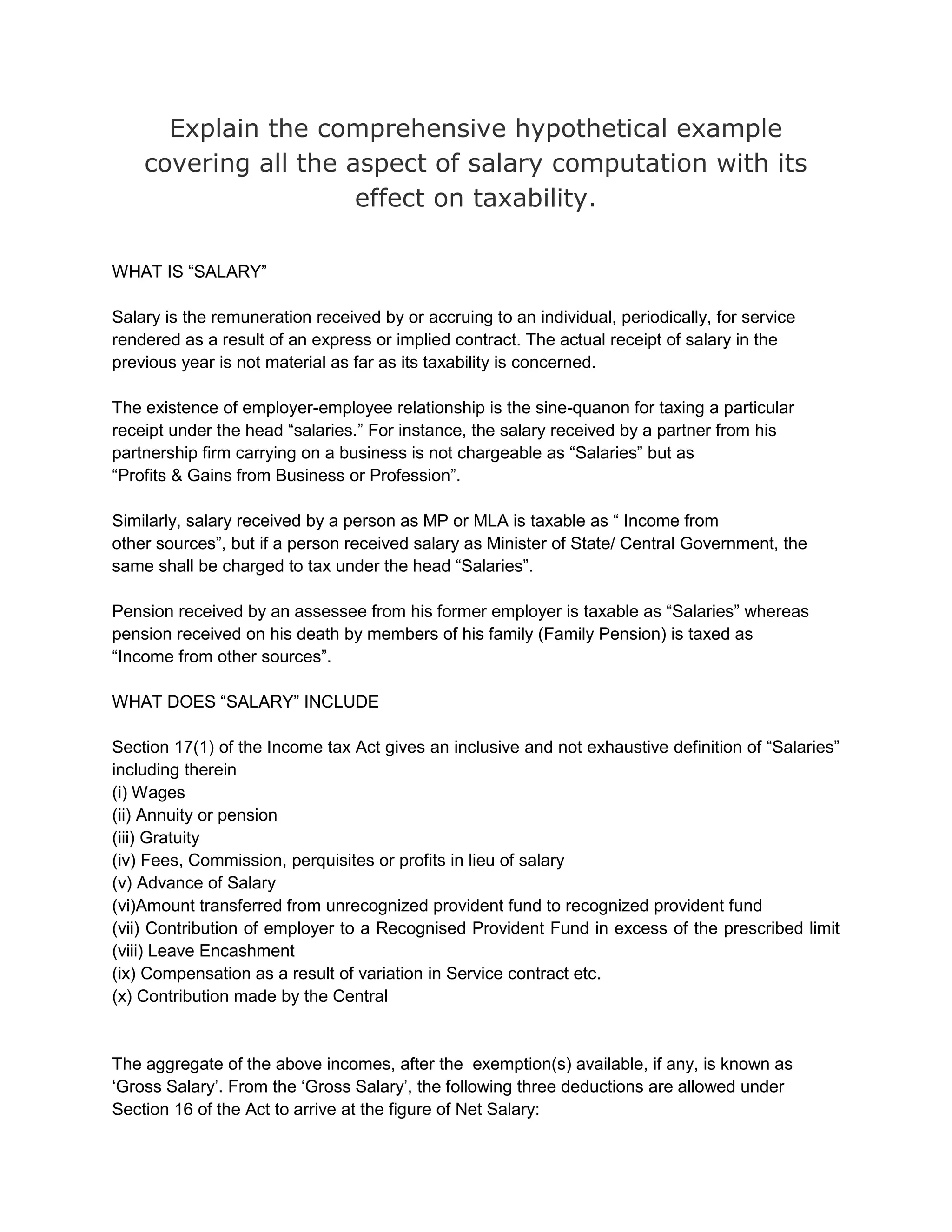
WHAT IS “SALARY”
Salary is the remuneration received by or accruing to an individual, periodically, for service
rendered as a result of an express or implied contract. The actual receipt of salary in the
previous year is not material as far as its taxability is concerned.
The existence of employer-employee relationship is the sine-quanon for taxing a particular
receipt under the head “salaries.” For instance, the salary received by a partner from his
partnership firm carrying on a business is not chargeable as “Salaries” but as
“Profits & Gains from Business or Profession”.
Similarly, salary received by a person as MP or MLA is taxable as “ Income from
other sources”, but if a person received salary as Minister of State/ Central Government, the
same shall be charged to tax under the head “Salaries”.
Pension received by an assessee from his former employer is taxable as “Salaries” whereas
pension received on his death by members of his family (Family Pension) is taxed as
“Income from other sources”.
WHAT DOES “SALARY” INCLUDE
Section 17(1) of the Income tax Act gives an inclusive and not exhaustive definition of “Salaries”
including therein
(i) Wages
(ii) Annuity or pension
(iii) Gratuity
(iv) Fees, Commission, perquisites or profits in lieu of salary
(v) Advance of Salary
(vi)Amount transferred from unrecognized provident fund to recognized provident fund
(vii) Contribution of employer to a Recognised Provident Fund in excess of the prescribed limit
(viii) Leave Encashment
(ix) Compensation as a result of variation in Service contract etc.
(x) Contribution made by the Central

The aggregate of the above incomes, after the exemption(s) available, if any, is known as
„Gross Salary‟. From the „Gross Salary‟, the following three deductions are allowed under
Section 16 of the Act to arrive at the figure of Net Salary:
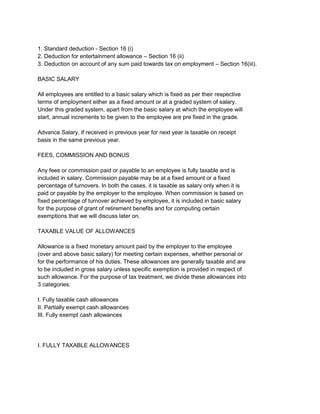
1. Standard deduction - Section 16 (i)
2. Deduction for entertainment allowance – Section 16 (ii)
3. Deduction on account of any sum paid towards tax on employment – Section 16(iii).
BASIC SALARY
All employees are entitled to a basic salary which is fixed as per their respective
terms of employment either as a fixed amount or at a graded system of salary.
Under this graded system, apart from the basic salary at which the employee will
start, annual increments to be given to the employee are pre fixed in the grade.
Advance Salary, if received in previous year for next year is taxable on receipt
basis in the same previous year.
FEES, COMMISSION AND BONUS
Any fees or commission paid or payable to an employee is fully taxable and is
included in salary. Commission payable may be at a fixed amount or a fixed
percentage of turnovers. In both the cases, it is taxable as salary only when it is
paid or payable by the employer to the employee. When commission is based on
fixed percentage of turnover achieved by employee, it is included in basic salary
for the purpose of grant of retirement benefits and for computing certain
exemptions that we will discuss later on.
TAXABLE VALUE OF ALLOWANCES
Allowance is a fixed monetary amount paid by the employer to the employee
(over and above basic salary) for meeting certain expenses, whether personal or
for the performance of his duties. These allowances are generally taxable and are
to be included in gross salary unless specific exemption is provided in respect of
such allowance. For the purpose of tax treatment, we divide these allowances into
3 categories:
I. Fully taxable cash allowances
II. Partially exempt cash allowances
III. Fully exempt cash allowances

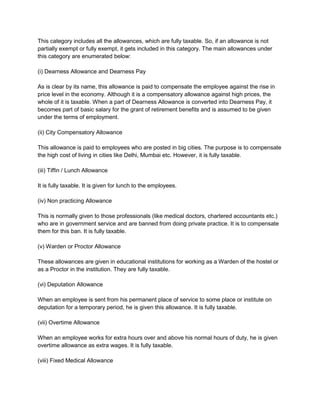
I. FULLY TAXABLE ALLOWANCES
This category includes all the allowances, which are fully taxable. So, if an allowance is not
partially exempt or fully exempt, it gets included in this category. The main allowances under
this category are enumerated below:
(i) Dearness Allowance and Dearness Pay
As is clear by its name, this allowance is paid to compensate the employee against the rise in
price level in the economy. Although it is a compensatory allowance against high prices, the
whole of it is taxable. When a part of Dearness Allowance is converted into Dearness Pay, it
becomes part of basic salary for the grant of retirement benefits and is assumed to be given
under the terms of employment.
(ii) City Compensatory Allowance
This allowance is paid to employees who are posted in big cities. The purpose is to compensate
the high cost of living in cities like Delhi, Mumbai etc. However, it is fully taxable.
(iii) Tiffin / Lunch Allowance
It is fully taxable. It is given for lunch to the employees.
(iv) Non practicing Allowance
This is normally given to those professionals (like medical doctors, chartered accountants etc.)
who are in government service and are banned from doing private practice. It is to compensate
them for this ban. It is fully taxable.
(v) Warden or Proctor Allowance
These allowances are given in educational institutions for working as a Warden of the hostel or
as a Proctor in the institution. They are fully taxable.
(vi) Deputation Allowance
When an employee is sent from his permanent place of service to some place or institute on
deputation for a temporary period, he is given this allowance. It is fully taxable.
(vii) Overtime Allowance
When an employee works for extra hours over and above his normal hours of duty, he is given
overtime allowance as extra wages. It is fully taxable.
(viii) Fixed Medical Allowance
Medical allowance is fully taxable even if some expenditure has actually been incurred for
medical treatment of employee or family.
(ix) Servant Allowance
It is fully taxable whether or not servants have been employed by the employee.
(x) Other allowances
There may be several other allowances like family allowance, project allowance, marriage
allowance, education allowance, and holiday allowance etc. which are not covered under
specifically exempt category, so are fully taxable
PARTIALLY EXEMPT ALLOWANCES
This category includes allowances which are exempt upto certain limit. For certain allowances,
exemption is dependent on amount of allowance spent for the purpose for which it was received
and for other allowances, there is a fixed limit of exemption.
(i) House Rent Allowance (H.R.A.)
An allowance granted to a person by his employer to meet expenditure incurred on payment of
rent in respect of residential accommodation occupied by him is exempt from tax to the extent of
least of the following three amounts:
a) House Rent Allowance actually received by the assessee
b) Excess of rent paid by the assessee over 10% of salary due to him
c) An amount equal to 50% of salary due to assessee (If accommodation is
situated in Mumbai, Kolkata, Delhi, Chennai) „Or‟ an amount equal to 40% of salary (if
accommodation is situated in any other place).
Salary for this purpose includes Basic Salary, Dearness Allowance (if it forms part of salary for
the purpose of retirement benefits), Commission based on fixed percentage of turnover
achieved by the employee.
The exemption of HRA depends upon the following factors:
(1) Basic Salary (2) Rent paid (3) Place of residence (4) HRA received
If an employee is living in his own house and receiving HRA, it will be fully taxable.
(ii) Entertainment Allowance
This allowance is first included in gross salary under allowances and then deduction is given to
only central and state government employees under Section 16 (ii).
(iii) Special Allowances for meeting official expenditure
Certain allowances are given to the employees to meet expenses incurred exclusively in
performance of official duties and hence are exempt to the extent actually incurred for the
purpose for which it is given. These include travelling allowance, daily allowance, conveyance
allowance, helper allowance, research allowance and uniform allowance.
(iv) Special Allowances to meet personal expenses
There are certain allowances given to the employees for specific personal purposes and the
amount of exemption is fixed i.e. not dependent on actual expenditure incurred in this regard.
These allowances include:
a) Children Education Allowance
This allowance is exempt to the extent of Rs.100 per month per child for maximum of 2 children
(grand children are not considered).

b) Children Hostel Allowance
Any allowance granted to an employee to meet the hostel expenditure on his child is exempt to
the extent of Rs.300 per month per child for maximum of 2 children.
c) Transport Allowance
This allowance is generally given to government employees to compensate the cost incurred in
commuting between place of residence and place of work. An amount uptoRs.800 per month
paid is exempt. However, in case of blind and orthopaedically handicapped persons, it is
exempt up to Rs. 1600p.m.
d) Out of station allowance
An allowance granted to an employee working in a transport system to meet his personal
expenses in performance of his duty in the course of running of such transport from one place to
another is exempt upto 70% of such allowance or Rs.6000 per month, whichever is less.

III. FULLY EXEMPT ALLOWANCES
(i) Foreign allowance
This allowance is usually paid by the government to its employees being Indian citizen posted
out of India for rendering services abroad. It is fully exempt from tax.
(ii) Allowance to High Court and Supreme Court Judges of whatever nature are exempt from
tax.
(iii) Allowances from UNO organisation to its employees are fully exempt from tax.

From the following particulars, compute gross salary of Mr Raj for the assessment
year 20012-13. He is employed in Manufacturing industry in Delhi at a monthly salary
of Rs.4000. He is entitled to commission of 1% on sales achieved by him, which
were Rs.10 lakh for the year.
In addition, he received the following allowances from the employer during the
previous year:
1. Dearness Allowance Rs.2000 per month which is granted under terms of
employment and counted for retirement benefits.
2. Bonus Rs.32000
3. House Rent Allowance Rs.1000 per month (Rent paid for house in
Mumbai Rs.1200 per month)
4. Entertainment Allowance Rs.1000 per month
5. Children Education Allowance Rs.500 per month
6. Transport Allowance Rs.1000 per month
7. Medical Allowance Rs.500 per month
8. Servant Allowance Rs.200 per month
9. City Compensatory Allowance Rs.300 per month
10. Research Allowance Rs.500 per month (amount spent on research
Rs.3000)
Solution:
Computation of Income from Salary of Mr. X for the Assessment Year 2006-07
Amount / Rs.
Basic Salary
48,000
Dearness Allowance
24,000
Commission
10,000
Bonus
32,000
House Rent Allowance
(Rs.1000 x 12 – Amount exempt Rs.6200)*
5,800
Entertainment Allowance
12,000
Children Education Allowance
(Rs.500 x 12 – Amount exempt Rs.100 x 2 x 12)
3,600
Transport Allowance
(Rs.1000 x 12 – Amount exempt Rs.800 x 12)
2,400
Medical Allowance (fully taxable)
6,000
Servant Allowance (fully taxable)
2,400
City Compensatory Allowance (fully taxable)
3,600
Research Allowance
(Rs.500 x 12 – Amount exempt Rs.3000)
3,000
Gross Salary:
152,800
* Amount of HRA exempt is least of 3 amounts
a) 50% of Salary (Basic Salary + DA granted under terms of employment +
Commission based on percentage of turnover – Rs.48,000 + Rs.24,000 +
Rs.10,000 = Rs.82,000) = Rs.41,000
b) Actual HRA received : Rs.1000 x 12 = Rs.12,000
c) Rent paid (Rs.1200 x 12) – 10% of Salary (Rs.82,000) Rs.14,400 –
Rs.8,200 = Rs.6,200

Ahuja Girish and Ravi Gupta (2006), Systematic Approach to Income Tax
and
Sales Tax, Bharat Publication, Sahitya Bhawan, Agra
Chandra Mahesh and D.C. Shukla (2006), Income Tax Law and Practice,
Pragati Publication, New Delhi.
Mehrotra H.C. (2006), Income Tax Law and Accounts, Sahitya Bhawan,
Agra.
.Singhania V.K. and Monica Singhania (2006), Students Guide to Income
Tax,
Taxmann Publications, New Delhi.

Salary Taxation Computation

  • 1.
    Explain the comprehensivehypothetical example covering all the aspect of salary computation with its effect on taxability. WHAT IS “SALARY” Salary is the remuneration received by or accruing to an individual, periodically, for service rendered as a result of an express or implied contract. The actual receipt of salary in the previous year is not material as far as its taxability is concerned. The existence of employer-employee relationship is the sine-quanon for taxing a particular receipt under the head “salaries.” For instance, the salary received by a partner from his partnership firm carrying on a business is not chargeable as “Salaries” but as “Profits & Gains from Business or Profession”. Similarly, salary received by a person as MP or MLA is taxable as “ Income from other sources”, but if a person received salary as Minister of State/ Central Government, the same shall be charged to tax under the head “Salaries”. Pension received by an assessee from his former employer is taxable as “Salaries” whereas pension received on his death by members of his family (Family Pension) is taxed as “Income from other sources”. WHAT DOES “SALARY” INCLUDE Section 17(1) of the Income tax Act gives an inclusive and not exhaustive definition of “Salaries” including therein (i) Wages (ii) Annuity or pension (iii) Gratuity (iv) Fees, Commission, perquisites or profits in lieu of salary (v) Advance of Salary (vi)Amount transferred from unrecognized provident fund to recognized provident fund (vii) Contribution of employer to a Recognised Provident Fund in excess of the prescribed limit (viii) Leave Encashment (ix) Compensation as a result of variation in Service contract etc. (x) Contribution made by the Central The aggregate of the above incomes, after the exemption(s) available, if any, is known as „Gross Salary‟. From the „Gross Salary‟, the following three deductions are allowed under Section 16 of the Act to arrive at the figure of Net Salary:
  • 2.
    1. Standard deduction- Section 16 (i) 2. Deduction for entertainment allowance – Section 16 (ii) 3. Deduction on account of any sum paid towards tax on employment – Section 16(iii). BASIC SALARY All employees are entitled to a basic salary which is fixed as per their respective terms of employment either as a fixed amount or at a graded system of salary. Under this graded system, apart from the basic salary at which the employee will start, annual increments to be given to the employee are pre fixed in the grade. Advance Salary, if received in previous year for next year is taxable on receipt basis in the same previous year. FEES, COMMISSION AND BONUS Any fees or commission paid or payable to an employee is fully taxable and is included in salary. Commission payable may be at a fixed amount or a fixed percentage of turnovers. In both the cases, it is taxable as salary only when it is paid or payable by the employer to the employee. When commission is based on fixed percentage of turnover achieved by employee, it is included in basic salary for the purpose of grant of retirement benefits and for computing certain exemptions that we will discuss later on. TAXABLE VALUE OF ALLOWANCES Allowance is a fixed monetary amount paid by the employer to the employee (over and above basic salary) for meeting certain expenses, whether personal or for the performance of his duties. These allowances are generally taxable and are to be included in gross salary unless specific exemption is provided in respect of such allowance. For the purpose of tax treatment, we divide these allowances into 3 categories: I. Fully taxable cash allowances II. Partially exempt cash allowances III. Fully exempt cash allowances I. FULLY TAXABLE ALLOWANCES
  • 3.
    This category includesall the allowances, which are fully taxable. So, if an allowance is not partially exempt or fully exempt, it gets included in this category. The main allowances under this category are enumerated below: (i) Dearness Allowance and Dearness Pay As is clear by its name, this allowance is paid to compensate the employee against the rise in price level in the economy. Although it is a compensatory allowance against high prices, the whole of it is taxable. When a part of Dearness Allowance is converted into Dearness Pay, it becomes part of basic salary for the grant of retirement benefits and is assumed to be given under the terms of employment. (ii) City Compensatory Allowance This allowance is paid to employees who are posted in big cities. The purpose is to compensate the high cost of living in cities like Delhi, Mumbai etc. However, it is fully taxable. (iii) Tiffin / Lunch Allowance It is fully taxable. It is given for lunch to the employees. (iv) Non practicing Allowance This is normally given to those professionals (like medical doctors, chartered accountants etc.) who are in government service and are banned from doing private practice. It is to compensate them for this ban. It is fully taxable. (v) Warden or Proctor Allowance These allowances are given in educational institutions for working as a Warden of the hostel or as a Proctor in the institution. They are fully taxable. (vi) Deputation Allowance When an employee is sent from his permanent place of service to some place or institute on deputation for a temporary period, he is given this allowance. It is fully taxable. (vii) Overtime Allowance When an employee works for extra hours over and above his normal hours of duty, he is given overtime allowance as extra wages. It is fully taxable. (viii) Fixed Medical Allowance
  • 4.
    Medical allowance isfully taxable even if some expenditure has actually been incurred for medical treatment of employee or family. (ix) Servant Allowance It is fully taxable whether or not servants have been employed by the employee. (x) Other allowances There may be several other allowances like family allowance, project allowance, marriage allowance, education allowance, and holiday allowance etc. which are not covered under specifically exempt category, so are fully taxable PARTIALLY EXEMPT ALLOWANCES This category includes allowances which are exempt upto certain limit. For certain allowances, exemption is dependent on amount of allowance spent for the purpose for which it was received and for other allowances, there is a fixed limit of exemption. (i) House Rent Allowance (H.R.A.) An allowance granted to a person by his employer to meet expenditure incurred on payment of rent in respect of residential accommodation occupied by him is exempt from tax to the extent of least of the following three amounts: a) House Rent Allowance actually received by the assessee b) Excess of rent paid by the assessee over 10% of salary due to him c) An amount equal to 50% of salary due to assessee (If accommodation is situated in Mumbai, Kolkata, Delhi, Chennai) „Or‟ an amount equal to 40% of salary (if accommodation is situated in any other place). Salary for this purpose includes Basic Salary, Dearness Allowance (if it forms part of salary for the purpose of retirement benefits), Commission based on fixed percentage of turnover achieved by the employee. The exemption of HRA depends upon the following factors: (1) Basic Salary (2) Rent paid (3) Place of residence (4) HRA received If an employee is living in his own house and receiving HRA, it will be fully taxable. (ii) Entertainment Allowance This allowance is first included in gross salary under allowances and then deduction is given to only central and state government employees under Section 16 (ii).
  • 5.
    (iii) Special Allowancesfor meeting official expenditure Certain allowances are given to the employees to meet expenses incurred exclusively in performance of official duties and hence are exempt to the extent actually incurred for the purpose for which it is given. These include travelling allowance, daily allowance, conveyance allowance, helper allowance, research allowance and uniform allowance. (iv) Special Allowances to meet personal expenses There are certain allowances given to the employees for specific personal purposes and the amount of exemption is fixed i.e. not dependent on actual expenditure incurred in this regard. These allowances include: a) Children Education Allowance This allowance is exempt to the extent of Rs.100 per month per child for maximum of 2 children (grand children are not considered). b) Children Hostel Allowance Any allowance granted to an employee to meet the hostel expenditure on his child is exempt to the extent of Rs.300 per month per child for maximum of 2 children. c) Transport Allowance This allowance is generally given to government employees to compensate the cost incurred in commuting between place of residence and place of work. An amount uptoRs.800 per month paid is exempt. However, in case of blind and orthopaedically handicapped persons, it is exempt up to Rs. 1600p.m. d) Out of station allowance An allowance granted to an employee working in a transport system to meet his personal expenses in performance of his duty in the course of running of such transport from one place to another is exempt upto 70% of such allowance or Rs.6000 per month, whichever is less. III. FULLY EXEMPT ALLOWANCES (i) Foreign allowance This allowance is usually paid by the government to its employees being Indian citizen posted out of India for rendering services abroad. It is fully exempt from tax.
  • 6.
    (ii) Allowance toHigh Court and Supreme Court Judges of whatever nature are exempt from tax. (iii) Allowances from UNO organisation to its employees are fully exempt from tax. From the following particulars, compute gross salary of Mr Raj for the assessment year 20012-13. He is employed in Manufacturing industry in Delhi at a monthly salary of Rs.4000. He is entitled to commission of 1% on sales achieved by him, which were Rs.10 lakh for the year.
  • 7.
    In addition, hereceived the following allowances from the employer during the previous year: 1. Dearness Allowance Rs.2000 per month which is granted under terms of employment and counted for retirement benefits. 2. Bonus Rs.32000 3. House Rent Allowance Rs.1000 per month (Rent paid for house in Mumbai Rs.1200 per month) 4. Entertainment Allowance Rs.1000 per month 5. Children Education Allowance Rs.500 per month 6. Transport Allowance Rs.1000 per month 7. Medical Allowance Rs.500 per month 8. Servant Allowance Rs.200 per month 9. City Compensatory Allowance Rs.300 per month 10. Research Allowance Rs.500 per month (amount spent on research Rs.3000) Solution: Computation of Income from Salary of Mr. X for the Assessment Year 2006-07 Amount / Rs. Basic Salary 48,000 Dearness Allowance 24,000 Commission 10,000 Bonus 32,000 House Rent Allowance (Rs.1000 x 12 – Amount exempt Rs.6200)* 5,800 Entertainment Allowance 12,000 Children Education Allowance (Rs.500 x 12 – Amount exempt Rs.100 x 2 x 12) 3,600 Transport Allowance (Rs.1000 x 12 – Amount exempt Rs.800 x 12) 2,400 Medical Allowance (fully taxable) 6,000 Servant Allowance (fully taxable) 2,400 City Compensatory Allowance (fully taxable) 3,600 Research Allowance (Rs.500 x 12 – Amount exempt Rs.3000) 3,000 Gross Salary: 152,800 * Amount of HRA exempt is least of 3 amounts a) 50% of Salary (Basic Salary + DA granted under terms of employment +
  • 8.
    Commission based onpercentage of turnover – Rs.48,000 + Rs.24,000 + Rs.10,000 = Rs.82,000) = Rs.41,000 b) Actual HRA received : Rs.1000 x 12 = Rs.12,000 c) Rent paid (Rs.1200 x 12) – 10% of Salary (Rs.82,000) Rs.14,400 – Rs.8,200 = Rs.6,200 Ahuja Girish and Ravi Gupta (2006), Systematic Approach to Income Tax and Sales Tax, Bharat Publication, Sahitya Bhawan, Agra Chandra Mahesh and D.C. Shukla (2006), Income Tax Law and Practice, Pragati Publication, New Delhi. Mehrotra H.C. (2006), Income Tax Law and Accounts, Sahitya Bhawan, Agra. .Singhania V.K. and Monica Singhania (2006), Students Guide to Income Tax, Taxmann Publications, New Delhi.