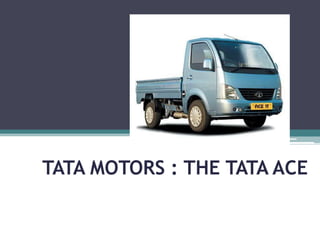
TATA MOTORS : THE TATA ACE
Tata Ace – Basics
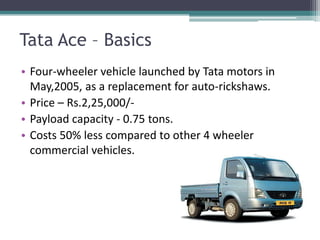
• Four-wheeler vehicle launched by Tata motors in
  May,2005, as a replacement for auto-rickshaws.
• Price – Rs.2,25,000/-
• Payload capacity - 0.75 tons.
• Costs 50% less compared to other 4 wheeler
  commercial vehicles.
Creating Value – Gap Analysis
1. Idea Generation
Current Market Situation
• Demand for larger vehicles due to construction of better highways.
• Demand for a vehicle to service the ‘last mile’.

Gap Analysis
• Large trucks will not be allowed in cities during day time and are unsuitable for
catering rural markets because of high transportation cost and road conditions.
• Three wheelers are not allowed on highways. They do not enhance the social
value of the user.
• Supreme court rule on overloading norms.

Idea Generation
• To target the market gap and launch a small commercial vehicle to connect urban
to rural markets at competitive price of a three wheeler.
2. Product Development
Market Research
• 4000 trucks and three-wheeler operators in rural and urban areas were interviewed
• Customers wanted a 4 wheeler as it was viewed as a higher-status vehicle at low cost
• Creating a vehicle that made the driver look good

Product Development
• Tata motors had to create a 4 wheeler at the price of 3 wheeler to create a paradigm shift
  in the segment of good movement.
• Product to be useful both in rural and urban areas which can be driven in narrow road & 4
  lane highway.
• Should have low maneuverability to get through small by lanes.
• An innovative two cylinder diesel engine concept based on the Indica passenger car’s four-
  cylinder engine.
• Costs to be minimized due to parts sharing with other models, and the performance levels
  to be just right for the vehicle.
• Engine to fix the excessive noise and vibration levels and worked with a supplier to
  develop a rotary fuel-injection pump that could meet emissions standards without
  electronic systems, thereby reducing costs and after-sales service complexity.
3. Target Market
 Customer Market Segmentation:
 • Performance Sensitive – 7%
 • Those interested in status. High Brand image and speed of the vehicle.
 • Willing to pay higher prices for features

 Balanced-Perspective – 25%
 • They are majorly entrepreneurs and want a vehicle that has convience features
   which would improve their quality of life

 ROI sensitive – 55%
 • Those who purchase vehicles based on lowest cost per mile of transport
 • Do not place value on non-monetary purchase considerations

 Acquisition price constraint – 13%
 • Who lack credit and financial needs to purchase an even slightly more expensive
   vehicle
Road Map – Product and Plant
• Establish new assembly plant in North-east India as Pune plant is running at
  100% capacity. This will serve three-fold purpose:
•       a) Capture 75% of untapped market.
•       b) Enter international market like Bangladesh – A country geographically
  closer to       north-east and demographically similar to India.
•       c) Manufacture the new car priced at 1Lakh INR in the new plant.
• Position new variants of Ace which run on CNG in urban areas for intra-city
  transfer of goods.
• Position new variants of Ace which are smaller in size and priced competitively
  against the auto-rickshaws.
• Position a new variant in the passenger vehicle segment and use it for
  transport services.
• Leverage the goodwill generated by Ace to promote the new car which has
  been announced.
Road Map - Transport Service Sector
 • Move into transport service sector(Rural market) to target rented truck
   services. This can be done by leveraging the goodwill generated by Ace
   sales.
 • TATA motors should establish service centers in rural areas and use the
   service centers to offer its Ace mini truck [passenger variant] service like
   pre-paid taxi/ movers business.
 • Existing infrastructure of service network – Dealership.
 • Convert 1S to 2S add transport service to sales
 • We would use existing Tata motors product hence improving the sales of
   other Tata products
 • Would increase the brand value of TATA

 • Future Scope: Once transport network is established and rural areas grow
   FMCG will also add business
Thanks !

Tata ace

  • 1.
    TATA MOTORS :THE TATA ACE
  • 2.
    Tata Ace –Basics • Four-wheeler vehicle launched by Tata motors in May,2005, as a replacement for auto-rickshaws. • Price – Rs.2,25,000/- • Payload capacity - 0.75 tons. • Costs 50% less compared to other 4 wheeler commercial vehicles.
  • 3.
    Creating Value –Gap Analysis
  • 4.
    1. Idea Generation CurrentMarket Situation • Demand for larger vehicles due to construction of better highways. • Demand for a vehicle to service the ‘last mile’. Gap Analysis • Large trucks will not be allowed in cities during day time and are unsuitable for catering rural markets because of high transportation cost and road conditions. • Three wheelers are not allowed on highways. They do not enhance the social value of the user. • Supreme court rule on overloading norms. Idea Generation • To target the market gap and launch a small commercial vehicle to connect urban to rural markets at competitive price of a three wheeler.
  • 5.
    2. Product Development MarketResearch • 4000 trucks and three-wheeler operators in rural and urban areas were interviewed • Customers wanted a 4 wheeler as it was viewed as a higher-status vehicle at low cost • Creating a vehicle that made the driver look good Product Development • Tata motors had to create a 4 wheeler at the price of 3 wheeler to create a paradigm shift in the segment of good movement. • Product to be useful both in rural and urban areas which can be driven in narrow road & 4 lane highway. • Should have low maneuverability to get through small by lanes. • An innovative two cylinder diesel engine concept based on the Indica passenger car’s four- cylinder engine. • Costs to be minimized due to parts sharing with other models, and the performance levels to be just right for the vehicle. • Engine to fix the excessive noise and vibration levels and worked with a supplier to develop a rotary fuel-injection pump that could meet emissions standards without electronic systems, thereby reducing costs and after-sales service complexity.
  • 6.
    3. Target Market Customer Market Segmentation: • Performance Sensitive – 7% • Those interested in status. High Brand image and speed of the vehicle. • Willing to pay higher prices for features Balanced-Perspective – 25% • They are majorly entrepreneurs and want a vehicle that has convience features which would improve their quality of life ROI sensitive – 55% • Those who purchase vehicles based on lowest cost per mile of transport • Do not place value on non-monetary purchase considerations Acquisition price constraint – 13% • Who lack credit and financial needs to purchase an even slightly more expensive vehicle
  • 7.
    Road Map –Product and Plant • Establish new assembly plant in North-east India as Pune plant is running at 100% capacity. This will serve three-fold purpose: • a) Capture 75% of untapped market. • b) Enter international market like Bangladesh – A country geographically closer to north-east and demographically similar to India. • c) Manufacture the new car priced at 1Lakh INR in the new plant. • Position new variants of Ace which run on CNG in urban areas for intra-city transfer of goods. • Position new variants of Ace which are smaller in size and priced competitively against the auto-rickshaws. • Position a new variant in the passenger vehicle segment and use it for transport services. • Leverage the goodwill generated by Ace to promote the new car which has been announced.
  • 8.
    Road Map -Transport Service Sector • Move into transport service sector(Rural market) to target rented truck services. This can be done by leveraging the goodwill generated by Ace sales. • TATA motors should establish service centers in rural areas and use the service centers to offer its Ace mini truck [passenger variant] service like pre-paid taxi/ movers business. • Existing infrastructure of service network – Dealership. • Convert 1S to 2S add transport service to sales • We would use existing Tata motors product hence improving the sales of other Tata products • Would increase the brand value of TATA • Future Scope: Once transport network is established and rural areas grow FMCG will also add business
  • 9.