JABATAN KEJURUTERAAN AWAM DAN STRUKTUR
FAKULTI KEJURUTERAAN DAN ALAM BINA
KKKH 4284 PERANCANGAN BANDAR LESTARI
SEMESTER 2 2013/2014
TASK 6: GLOBAL WARMING
NAME : YONG SIEW FENG
NO. MATRIC : A133075
LECTURER : Prof. Ir. Dr. RIZA ATIQ ABDULLAH BIN O.K. RAHMAT
Dr. MUHAMAD NAZRI BIN BORHAN
Supposed you are living in a coastal city. The city administrator has noticed that the mean
sea level has been rising for the past 50 years. The raising is small but over a long period
of time it may cause problems in the city centre as the level of that part of the city is quite
low. If you are hired as a consultant, write a plan of action on what can be done to reduce
or mitigate the problems.
Your report must include Mitigation and Adaptation measures.
1.0 INTRODUCTION
Current sea level rise is about 3 mm/year worldwide. According to the US National
Oceanic and Atmospheric Administration (NOAA), "this is a significantly larger rate
than the sea-level rise averaged over the last several thousand years", and the rate may be
increasing. This rise in sea levels around the world potentially affects human populations
in coastal and island regions and natural environments like marine ecosystems. Two main
factors contribute to observed sea level rise. The first is thermal expansion: as ocean
water warms, it expands. The second is from the melting of major stores of land ice like
glaciers and ice sheets.Global warming also has an enormous impact with respect to
melting glaciers and ice sheets. Higher global temperatures melt glaciers such as the one
in Greenland, which flow into the oceans, adding to the amount of seawater. A large rise
(on the order of several feet) in global sea levels poses many threats. According to the
U.S. Environmental Protection Agency (EPA), ―such a rise would inundate coastal
wetlands and lowlands, erode beaches, increase the risk of flooding, and increase the
salinity of estuaries, aquifers, and wetlands.‖
Sea level rise is one of several lines of evidence that support the view that the climate has
recently warmed. The global community of climate scientists confirms that it is very
likely human-induced (anthropogenic) warming contributed to the sea level rise observed
in the latter half of the 20th century. So there is necessary for a consultant to identify a
planof action to reduce or mitigate the problems.
2.0 MITIGATION
2.1 Energy Conservation
Energy conservation refers to reducing energy through using less of an energy service.
Energy conservation differs from efficient energy use, which refers to using less energy
for a constant service. For example, driving less is an example of energy conservation.
Driving the same amount with a higher mileage vehicle is an example of energy
efficiency. Energy conservation and efficiency are both energy reduction techniques.
Even though energy conservation reduces energy services, it can result in increased,
environmental quality, national security, and personal financial security. It is at the top of
the sustainable energy hierarchy.
Term energy conservation refers to different methods and processes that have the main
purposein reducing the total amount of energy that is currently being used by industry,
households andvarious other sectors of our society. Energy conservation is important
from many different perspectives. Energy conservation methods are also extremely
important from the environmental point of view because we are still heavily dependent
on fossil fuels, and by reducing our energyneeds we are also reducing the global level of
greenhouse gas emissions that contribute toclimate change and global warming.There are
various ways on which you can contribute to energy conservation.
a. Promoting customer rebates for energy efficiency.
b. Making all municipal buildings energy efficient.
c.Creation of green space and park out of city
d.Planning for the car with odd and even number in alternative days.
e. Not always using your car, insteadchoosing either walking or riding the bike.
There is wide range of energy sources that provide energy needs with minimal impact on
theenvironment through using technologies with high energy-conversion efficient
designs.However, the use of these resources in an environmentally acceptable manner
while providingfor the needs of growing populations and developing economies is a great
challenge. Thefollowing are the main sources of energy:
a.Solar Energy
Solar energy refers to the conversion of the sun’s rays into useful forms of energy, such
as electricity or heat. The amount of solar radiation a location receives depends on a
variety of factors including geographic location, time of day, season, local landscape, and
local weather. Solar energy, radiant light and heat from the sun, is harnessed using a
range of ever-evolving technologies such as solar heating, solar photovoltaics, solar
thermal electricity, solar architecture and artificial photosynthesis.When converted to
thermal (or heat) energy, solar energy can be used to:
Heat water – for use in homes, buildings, or swimming pools.
Heat spaces – inside homes, greenhouses, and other buildings.
Solar energy can also be converted into electricity:
Photovoltaic (PV) or solar cells change sunlight directly into electricity.
Concentrating Solar Power Plants generate electricity by using the heat from solar
thermal collectors to heat a fluid which produces steam. The steam is used to
power a turbine and generate electricity.
b.Wind Energy
Wind is simply air in motion. Winds are created by the sun's uneven heating of the
atmosphere in combination with the irregular surface of the earth and the earth's rotation.
These winds can be "harvested" using wind turbines and used to make electricity. The
force of the wind makes the wind turbine blades spin, and the energy of this motion is
converted into electricity by a generator. Wind turbines, like windmills, are mounted on
atower to capture the most energy. At 100 feet (30 meters) or more aboveground, they
can takeadvantage of the faster and less turbulent wind. Turbines catch the wind's energy
with their propeller-like blades. Wind turbines can convert the energy in the wind into
mechanical power that can be used for a variety of activities like pumping water. Wind
turbines can also use generators to convert wind energy into electricity.Several electricity
providers today use wind plants to supply power to their customers.Wind energy is a free,
renewable resource. Its use does not affect its future supply.
c. Biomass Energy
The term "biomass" refers to raw organic material used to generate a number of energy
resources, including heat, liquid or gaseous fuels, and electricity. Chemical energy stored
in biomass can be converted to heat through combustion (burning). Biomass can be
converted to liquid or gaseous fuels or can be used to generate electricity in the same way
that coal is used. The electricity generated can be sent to energy consumers via electric
transmission systems. These applications can be at a small scale (e.g., to cook or make
hot water in individual buildings) or at a large scale (e.g., to generate ethanol, biodiesel,
biogas, or electricity for general distribution.
d.Hydrokinetic Energy
Hydrokinetic energy is the energy that can be captured from flowing water that occurs in
rivers or ocean currents. This includes ocean wave energy, tidal energy, river in-stream
energy, and ocean current energy.Hydro is also aflexible source of electricity since plants
can be ramped up and down very quickly to adapt tochanging energy demands. However,
damming interrupts the flow of rivers and can harm localecosystems, and building large
dams and reservoirs often involves displacing people andwildlife. Once a hydroelectric
complex is constructed, the project produces no direct waste, andhas a considerably lower
output level of the greenhouse gas carbon dioxide (CO2) than fossilfuel powered energy
plants.
2.2 Transportation
The transportation sector includes the movement of people and goods by cars, trucks,
trains,ships, airplanes, and other vehicles. The majority of greenhouse gas emissions
fromtransportation are CO2 emissions resulting from the combustion of petroleum-based
products,like gasoline, in internal combustion engines. The largest sources of
transportation-relatedgreenhouse gas emissions include passenger cars and light-duty
trucks, including sport utilityvehicles, pickup trucks, and minivans. These sources
account for over half of the emissions fromthe sector. The remainder of greenhouse gas
emissions comes from other modes of transportation, including freight trucks,
commercial aircraft, ships, boats, and trains as well as pipelines and lubricants.Relatively
small amounts of methane (CH4) and nitrous oxide (N2O) are emitted duringfuel
combustion. In addition, a small amount of hydrofluorocarbon (HFC) emissions are
includedin the transportation sector. These emissions result from the use of mobile air
conditioners andrefrigerated transport.Transportation planners should assess and
regularly monitor regionaltransportation system vulnerabilities to climate impacts, design
new transportation projects to beresilient to end-of-century sea-level rise, and prioritize
retrofits for existing infrastructure for assets that are of significant regional economic
value or are irreplaceable, and those that cannot be relocated and would not otherwise be
protected.There are a variety of opportunities to reduce greenhouse gas emissions
associated withtransportation.
2.3 Expand Tree Canopy
Tree canopy (TC) is the layer of leaves, branches, and stems of trees that cover the
ground whenviewed from above. The benefits of trees are widely known. They absorb
CO2, produce clean air and provide shade. However, despite these ecological services,
many cities lack significant tree cover. Impervious layers of concrete and asphalt have
replaced natural ground cover and trees, significantly contributing to warming cities
through the urban heat island effect. We argue in this article that the asphalt network of
roads and parking lots—key elements of gray infrastructure—are prime targets for
garnering the benefits of the urban forest. The Action Plan proposes to maintain tree CO2
uptake at 6.23 million metric tons to ensure that the state can continue to reap the benefits
of urban forestry and proposes two important goals for 2025: increasing canopy cover to
establish a 3% emission offset and reaching 30% canopy coverage in areas with density
greater than 500 people per square mile (Florida Climate Action Plan, 2008). Reaching
these objectives will require the planting of at least 6.7 million trees a year. As a result,
3.5 million short tons of coal, or 76,000 cubic feet of natural gas, totaling $759 million
could be saved (Florida Climate Action Plan, 2008). Beyond carbon removal, urban
forests provide additional benefits. Tree canopy provides many benefits to communities
by improving water quality, saving energy, lowering ambient temperatures, reducing air
pollution, enhancing property values, providing wildlife habitat, facilitating social and
educational opportunities, and providing aesthetic benefits.
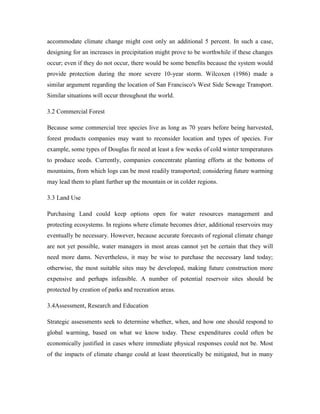
Figure: Canopy roads add shade to the public right of way and contribute to pollution
removal.
3.0 ADAPTION
3.1 Sewer and Drainage Upgrade
Titus et al. (1987) examined the replacement of a century-old street drain in Charleston,
South Carolina (Titus et al. 1987). If designed for the current 5-year storm, such a system
might be insufficient if sea level rises one foot or the severity of the design storm
increases 10 percent, necessitating a completely new system long before the end of the
project's useful life. On the other hand, installing slightly larger pipes sufficient to
accommodate climate change might cost only an additional 5 percent. In such a case,
designing for an increases in precipitation might prove to be worthwhile if these changes
occur; even if they do not occur, there would be some benefits because the system would
provide protection during the more severe 10-year storm. Wilcoxen (1986) made a
similar argument regarding the location of San Francisco's West Side Sewage Transport.
Similar situations will occur throughout the world.
3.2 Commercial Forest
Because some commercial tree species live as long as 70 years before being harvested,
forest products companies may want to reconsider location and types of species. For
example, some types of Douglas fir need at least a few weeks of cold winter temperatures
to produce seeds. Currently, companies concentrate planting efforts at the bottoms of
mountains, from which logs can be most readily transported; considering future warming
may lead them to plant further up the mountain or in colder regions.
3.3 Land Use
Purchasing Land could keep options open for water resources management and
protecting ecosystems. In regions where climate becomes drier, additional reservoirs may
eventually be necessary. However, because accurate forecasts of regional climate change
are not yet possible, water managers in most areas cannot yet be certain that they will
need more dams. Nevertheless, it may be wise to purchase the necessary land today;
otherwise, the most suitable sites may be developed, making future construction more
expensive and perhaps infeasible. A number of potential reservoir sites should be
protected by creation of parks and recreation areas.
3.4Assessment, Research and Education
Strategic assessments seek to determine whether, when, and how one should respond to
global warming, based on what we know today. These expenditures could often be
economically justified in cases where immediate physical responses could not be. Most
of the impacts of climate change could at least theoretically be mitigated, but in many
cases, effective solutions have not yet been developed. Like strategic assessments, the
value of the research is potentially the savings it makes possible.
Efforts to prepare for climate change can only be as enlightened as the people who must
carry them out. Education must be critical component of any effort to address the
greenhouse effect because (1) there will be an increased need for personnel in some
professions, (2) people in other professions will need to routinely consider the
implications of global warming, and (3) an informed citizenry will be necessary for the
public to support the public expenditures and institutional changes that may be required.
4.0 CONCLUSION
Because of the severity of the potential impacts, it is completely appropriate for policy
makers and the public to focus primarily on measures to limit the extent to which
humanity raises the earth`s temperature in the years ahead, an issue outside the domain of
most planners. Nevertheless, past and current emissions suggest that it is too late to
completely prevent a change in climate, so we will have to learn to live with the
consequences. Although planners are sometimes frustrated by the futility of focussing
politicians' attention on events beyond the next election, global warming may be an
opportunity to help them show the voters that they are thinking about the type of world
we pass on to future generations. But whether the politicians lead or follow, they public
will have to decide the type of world we plan to achieve: If something has to give, should
our priority be to maintain current patterns of land and resource use, to avoid tax
increases, or to protect the environment?For communities and governments to
successfully counter the severe impacts of global climate change, mitigation and
adaptation strategies must be intertwined and complementeach other.

Task 6 Global warming

  • 1.
    JABATAN KEJURUTERAAN AWAMDAN STRUKTUR FAKULTI KEJURUTERAAN DAN ALAM BINA KKKH 4284 PERANCANGAN BANDAR LESTARI SEMESTER 2 2013/2014 TASK 6: GLOBAL WARMING NAME : YONG SIEW FENG NO. MATRIC : A133075 LECTURER : Prof. Ir. Dr. RIZA ATIQ ABDULLAH BIN O.K. RAHMAT Dr. MUHAMAD NAZRI BIN BORHAN
  • 2.
    Supposed you areliving in a coastal city. The city administrator has noticed that the mean sea level has been rising for the past 50 years. The raising is small but over a long period of time it may cause problems in the city centre as the level of that part of the city is quite low. If you are hired as a consultant, write a plan of action on what can be done to reduce or mitigate the problems. Your report must include Mitigation and Adaptation measures. 1.0 INTRODUCTION Current sea level rise is about 3 mm/year worldwide. According to the US National Oceanic and Atmospheric Administration (NOAA), "this is a significantly larger rate than the sea-level rise averaged over the last several thousand years", and the rate may be increasing. This rise in sea levels around the world potentially affects human populations in coastal and island regions and natural environments like marine ecosystems. Two main factors contribute to observed sea level rise. The first is thermal expansion: as ocean water warms, it expands. The second is from the melting of major stores of land ice like glaciers and ice sheets.Global warming also has an enormous impact with respect to melting glaciers and ice sheets. Higher global temperatures melt glaciers such as the one in Greenland, which flow into the oceans, adding to the amount of seawater. A large rise (on the order of several feet) in global sea levels poses many threats. According to the U.S. Environmental Protection Agency (EPA), ―such a rise would inundate coastal wetlands and lowlands, erode beaches, increase the risk of flooding, and increase the salinity of estuaries, aquifers, and wetlands.‖ Sea level rise is one of several lines of evidence that support the view that the climate has recently warmed. The global community of climate scientists confirms that it is very likely human-induced (anthropogenic) warming contributed to the sea level rise observed in the latter half of the 20th century. So there is necessary for a consultant to identify a planof action to reduce or mitigate the problems.
  • 3.
    2.0 MITIGATION 2.1 EnergyConservation Energy conservation refers to reducing energy through using less of an energy service. Energy conservation differs from efficient energy use, which refers to using less energy for a constant service. For example, driving less is an example of energy conservation. Driving the same amount with a higher mileage vehicle is an example of energy efficiency. Energy conservation and efficiency are both energy reduction techniques. Even though energy conservation reduces energy services, it can result in increased, environmental quality, national security, and personal financial security. It is at the top of the sustainable energy hierarchy. Term energy conservation refers to different methods and processes that have the main purposein reducing the total amount of energy that is currently being used by industry, households andvarious other sectors of our society. Energy conservation is important from many different perspectives. Energy conservation methods are also extremely important from the environmental point of view because we are still heavily dependent on fossil fuels, and by reducing our energyneeds we are also reducing the global level of greenhouse gas emissions that contribute toclimate change and global warming.There are various ways on which you can contribute to energy conservation. a. Promoting customer rebates for energy efficiency. b. Making all municipal buildings energy efficient. c.Creation of green space and park out of city d.Planning for the car with odd and even number in alternative days. e. Not always using your car, insteadchoosing either walking or riding the bike. There is wide range of energy sources that provide energy needs with minimal impact on theenvironment through using technologies with high energy-conversion efficient designs.However, the use of these resources in an environmentally acceptable manner
  • 4.
    while providingfor theneeds of growing populations and developing economies is a great challenge. Thefollowing are the main sources of energy: a.Solar Energy Solar energy refers to the conversion of the sun’s rays into useful forms of energy, such as electricity or heat. The amount of solar radiation a location receives depends on a variety of factors including geographic location, time of day, season, local landscape, and local weather. Solar energy, radiant light and heat from the sun, is harnessed using a range of ever-evolving technologies such as solar heating, solar photovoltaics, solar thermal electricity, solar architecture and artificial photosynthesis.When converted to thermal (or heat) energy, solar energy can be used to: Heat water – for use in homes, buildings, or swimming pools. Heat spaces – inside homes, greenhouses, and other buildings. Solar energy can also be converted into electricity: Photovoltaic (PV) or solar cells change sunlight directly into electricity. Concentrating Solar Power Plants generate electricity by using the heat from solar thermal collectors to heat a fluid which produces steam. The steam is used to power a turbine and generate electricity. b.Wind Energy Wind is simply air in motion. Winds are created by the sun's uneven heating of the atmosphere in combination with the irregular surface of the earth and the earth's rotation. These winds can be "harvested" using wind turbines and used to make electricity. The force of the wind makes the wind turbine blades spin, and the energy of this motion is converted into electricity by a generator. Wind turbines, like windmills, are mounted on atower to capture the most energy. At 100 feet (30 meters) or more aboveground, they can takeadvantage of the faster and less turbulent wind. Turbines catch the wind's energy with their propeller-like blades. Wind turbines can convert the energy in the wind into mechanical power that can be used for a variety of activities like pumping water. Wind
  • 5.
    turbines can alsouse generators to convert wind energy into electricity.Several electricity providers today use wind plants to supply power to their customers.Wind energy is a free, renewable resource. Its use does not affect its future supply. c. Biomass Energy The term "biomass" refers to raw organic material used to generate a number of energy resources, including heat, liquid or gaseous fuels, and electricity. Chemical energy stored in biomass can be converted to heat through combustion (burning). Biomass can be converted to liquid or gaseous fuels or can be used to generate electricity in the same way that coal is used. The electricity generated can be sent to energy consumers via electric transmission systems. These applications can be at a small scale (e.g., to cook or make hot water in individual buildings) or at a large scale (e.g., to generate ethanol, biodiesel, biogas, or electricity for general distribution. d.Hydrokinetic Energy Hydrokinetic energy is the energy that can be captured from flowing water that occurs in rivers or ocean currents. This includes ocean wave energy, tidal energy, river in-stream energy, and ocean current energy.Hydro is also aflexible source of electricity since plants can be ramped up and down very quickly to adapt tochanging energy demands. However, damming interrupts the flow of rivers and can harm localecosystems, and building large dams and reservoirs often involves displacing people andwildlife. Once a hydroelectric complex is constructed, the project produces no direct waste, andhas a considerably lower output level of the greenhouse gas carbon dioxide (CO2) than fossilfuel powered energy plants. 2.2 Transportation The transportation sector includes the movement of people and goods by cars, trucks, trains,ships, airplanes, and other vehicles. The majority of greenhouse gas emissions fromtransportation are CO2 emissions resulting from the combustion of petroleum-based products,like gasoline, in internal combustion engines. The largest sources of transportation-relatedgreenhouse gas emissions include passenger cars and light-duty
  • 6.
    trucks, including sportutilityvehicles, pickup trucks, and minivans. These sources account for over half of the emissions fromthe sector. The remainder of greenhouse gas emissions comes from other modes of transportation, including freight trucks, commercial aircraft, ships, boats, and trains as well as pipelines and lubricants.Relatively small amounts of methane (CH4) and nitrous oxide (N2O) are emitted duringfuel combustion. In addition, a small amount of hydrofluorocarbon (HFC) emissions are includedin the transportation sector. These emissions result from the use of mobile air conditioners andrefrigerated transport.Transportation planners should assess and regularly monitor regionaltransportation system vulnerabilities to climate impacts, design new transportation projects to beresilient to end-of-century sea-level rise, and prioritize retrofits for existing infrastructure for assets that are of significant regional economic value or are irreplaceable, and those that cannot be relocated and would not otherwise be protected.There are a variety of opportunities to reduce greenhouse gas emissions associated withtransportation. 2.3 Expand Tree Canopy Tree canopy (TC) is the layer of leaves, branches, and stems of trees that cover the ground whenviewed from above. The benefits of trees are widely known. They absorb CO2, produce clean air and provide shade. However, despite these ecological services, many cities lack significant tree cover. Impervious layers of concrete and asphalt have replaced natural ground cover and trees, significantly contributing to warming cities through the urban heat island effect. We argue in this article that the asphalt network of roads and parking lots—key elements of gray infrastructure—are prime targets for garnering the benefits of the urban forest. The Action Plan proposes to maintain tree CO2 uptake at 6.23 million metric tons to ensure that the state can continue to reap the benefits of urban forestry and proposes two important goals for 2025: increasing canopy cover to establish a 3% emission offset and reaching 30% canopy coverage in areas with density greater than 500 people per square mile (Florida Climate Action Plan, 2008). Reaching these objectives will require the planting of at least 6.7 million trees a year. As a result, 3.5 million short tons of coal, or 76,000 cubic feet of natural gas, totaling $759 million could be saved (Florida Climate Action Plan, 2008). Beyond carbon removal, urban
  • 7.
    forests provide additionalbenefits. Tree canopy provides many benefits to communities by improving water quality, saving energy, lowering ambient temperatures, reducing air pollution, enhancing property values, providing wildlife habitat, facilitating social and educational opportunities, and providing aesthetic benefits. Figure: Canopy roads add shade to the public right of way and contribute to pollution removal. 3.0 ADAPTION 3.1 Sewer and Drainage Upgrade Titus et al. (1987) examined the replacement of a century-old street drain in Charleston, South Carolina (Titus et al. 1987). If designed for the current 5-year storm, such a system might be insufficient if sea level rises one foot or the severity of the design storm increases 10 percent, necessitating a completely new system long before the end of the project's useful life. On the other hand, installing slightly larger pipes sufficient to
  • 8.
    accommodate climate changemight cost only an additional 5 percent. In such a case, designing for an increases in precipitation might prove to be worthwhile if these changes occur; even if they do not occur, there would be some benefits because the system would provide protection during the more severe 10-year storm. Wilcoxen (1986) made a similar argument regarding the location of San Francisco's West Side Sewage Transport. Similar situations will occur throughout the world. 3.2 Commercial Forest Because some commercial tree species live as long as 70 years before being harvested, forest products companies may want to reconsider location and types of species. For example, some types of Douglas fir need at least a few weeks of cold winter temperatures to produce seeds. Currently, companies concentrate planting efforts at the bottoms of mountains, from which logs can be most readily transported; considering future warming may lead them to plant further up the mountain or in colder regions. 3.3 Land Use Purchasing Land could keep options open for water resources management and protecting ecosystems. In regions where climate becomes drier, additional reservoirs may eventually be necessary. However, because accurate forecasts of regional climate change are not yet possible, water managers in most areas cannot yet be certain that they will need more dams. Nevertheless, it may be wise to purchase the necessary land today; otherwise, the most suitable sites may be developed, making future construction more expensive and perhaps infeasible. A number of potential reservoir sites should be protected by creation of parks and recreation areas. 3.4Assessment, Research and Education Strategic assessments seek to determine whether, when, and how one should respond to global warming, based on what we know today. These expenditures could often be economically justified in cases where immediate physical responses could not be. Most of the impacts of climate change could at least theoretically be mitigated, but in many
  • 9.
    cases, effective solutionshave not yet been developed. Like strategic assessments, the value of the research is potentially the savings it makes possible. Efforts to prepare for climate change can only be as enlightened as the people who must carry them out. Education must be critical component of any effort to address the greenhouse effect because (1) there will be an increased need for personnel in some professions, (2) people in other professions will need to routinely consider the implications of global warming, and (3) an informed citizenry will be necessary for the public to support the public expenditures and institutional changes that may be required. 4.0 CONCLUSION Because of the severity of the potential impacts, it is completely appropriate for policy makers and the public to focus primarily on measures to limit the extent to which humanity raises the earth`s temperature in the years ahead, an issue outside the domain of most planners. Nevertheless, past and current emissions suggest that it is too late to completely prevent a change in climate, so we will have to learn to live with the consequences. Although planners are sometimes frustrated by the futility of focussing politicians' attention on events beyond the next election, global warming may be an opportunity to help them show the voters that they are thinking about the type of world we pass on to future generations. But whether the politicians lead or follow, they public will have to decide the type of world we plan to achieve: If something has to give, should our priority be to maintain current patterns of land and resource use, to avoid tax increases, or to protect the environment?For communities and governments to successfully counter the severe impacts of global climate change, mitigation and adaptation strategies must be intertwined and complementeach other.