Environment
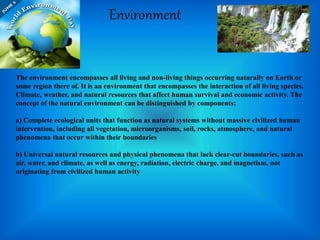
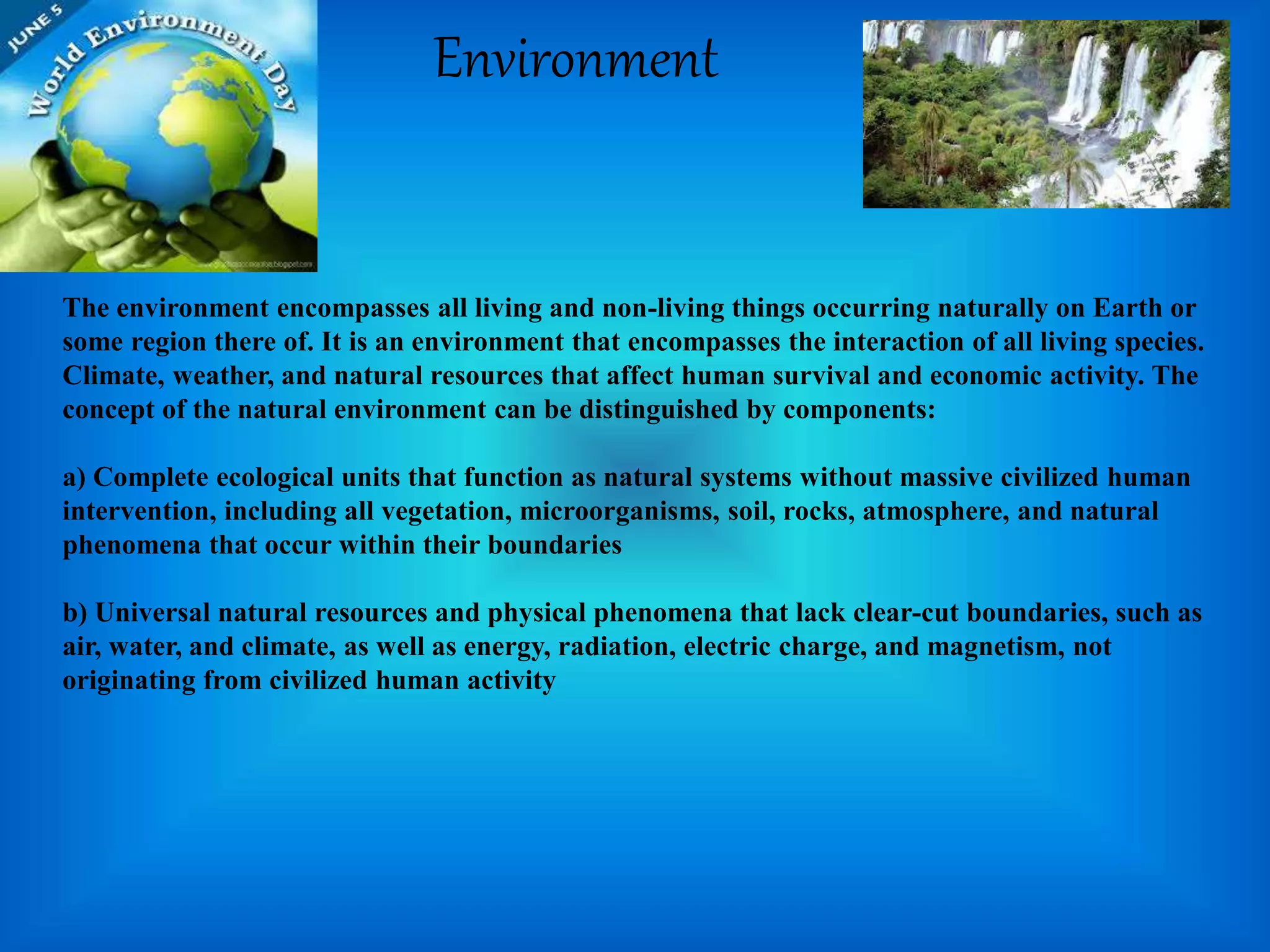
The environment encompasses all living and non-living things occurring naturally on Earth or
some region there of. It is an environment that encompasses the interaction of all living species.
Climate, weather, and natural resources that affect human survival and economic activity. The
concept of the natural environment can be distinguished by components:
a) Complete ecological units that function as natural systems without massive civilized human
intervention, including all vegetation, microorganisms, soil, rocks, atmosphere, and natural
phenomena that occur within their boundaries
b) Universal natural resources and physical phenomena that lack clear-cut boundaries, such as
air, water, and climate, as well as energy, radiation, electric charge, and magnetism, not
originating from civilized human activity
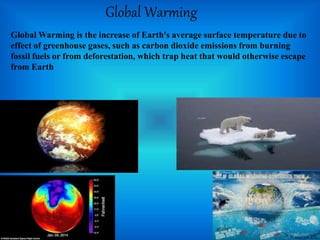
Global Warming
Global Warming is the increase of Earth's average surface temperature due to
effect of greenhouse gases, such as carbon dioxide emissions from burning
fossil fuels or from deforestation, which trap heat that would otherwise escape
from Earth
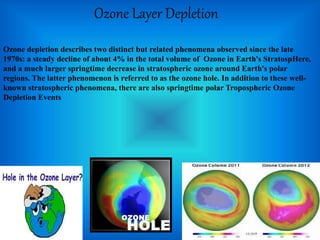
Ozone Layer Depletion
Ozone depletion describes two distinct but related phenomena observed since the late
1970s: a steady decline of about 4% in the total volume of Ozone in Earth's StratospHere,
and a much larger springtime decrease in stratospheric ozone around Earth's polar
regions. The latter phenomenon is referred to as the ozone hole. In addition to these well-
known stratospheric phenomena, there are also springtime polar Tropospheric Ozone
Depletion Events
HOW TO SAVE ENVIRONMENT
SavING ENVIRONMENT is a practice of protecting the
natural environment on individual , organizational or
governmental levels, for the benefit of both the natural
environment and humans. Due to the pressures of
population and technology, the biophysical environment is
being degraded, sometimes permanently. This has been
recognized, and governments have begun placing restraints
on activities that cause environmental degradation. Since
the 1960s, activity of environmental movements has created
awareness of the various environmental issues. There is no
agreement on the extent of the environmental impact of
human activity, and protection measures are occasionally
criticized
Environmental crisIs
The world is facing a very serious environmental crisis. Key environmental problems
include air pollution, the destruction of the ozone layer, vast quantities of toxic waste,
massive levels of soil erosion, the possible exhaustion of key natural resources such as
oil and coal, and the extinction of plants and animals on a scale not seen since the death
of the dinosaurs 60 million years ago. We think that this crisis is likely to have
catastrophic effects in the future. Even today, the negative effects of the crisis are
evident in the form of growing deserts, increased rates of cancer, and the loss of plant
species which could hold out cures for diseases for diseases such as AIDS etc.
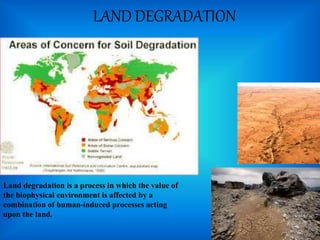
LAND DEGRADATION
Land degradation is a process in which the value of
the biophysical environment is affected by a
combination of human-induced processes acting
upon the land.
REASONS OF LAND DEGRADATION
1. Pollution: Pollution, in whatever form, whether it is air, water, land or noise is harmful for the environment. Air
pollution pollutes the air that we breathe which causes health issues. Water pollution degrades the quality of water
that we use for drinking purposes. Land pollution results in degradation of earth’s surface as a result of human
activities. Noise pollution can cause irreparable damage to our ears when exposed to continuous large sounds like
honking of vehicles on a busy road or machines producing large noise in a factory or a mill
2. Overpopulation: Rapid population growth puts strain on natural resources which results in degradation of our
environment. Mortality rate has gone down due to better medical facilities which has resulted in increased lifespan.
More population simple means more demand for food, clothes and shelter. You need more space to grow food and
provide homes to millions of people. This results in deforestation which is another factor of environmental
degradation.
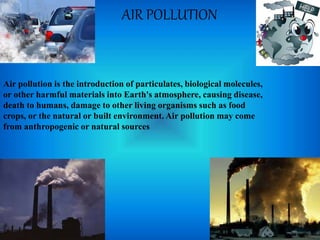
AIR POLLUTION
Air pollution is the introduction of particulates, biological molecules,
or other harmful materials into Earth's atmosphere, causing disease,
death to humans, damage to other living organisms such as food
crops, or the natural or built environment. Air pollution may come
from anthropogenic or natural sources
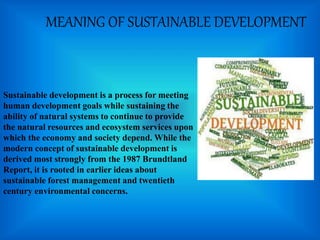
MEANING OF SUSTAINABLE DEVELOPMENT
Sustainable development is a process for meeting
human development goals while sustaining the
ability of natural systems to continue to provide
the natural resources and ecosystem services upon
which the economy and society depend. While the
modern concept of sustainable development is
derived most strongly from the 1987 Brundtland
Report, it is rooted in earlier ideas about
sustainable forest management and twentieth
century environmental concerns.
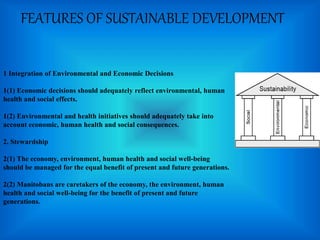
FEATURES OF SUSTAINABLE DEVELOPMENT
1 Integration of Environmental and Economic Decisions
1(1) Economic decisions should adequately reflect environmental, human
health and social effects.
1(2) Environmental and health initiatives should adequately take into
account economic, human health and social consequences.
2. Stewardship
2(1) The economy, environment, human health and social well-being
should be managed for the equal benefit of present and future generations.
2(2) Manitobans are caretakers of the economy, the environment, human
health and social well-being for the benefit of present and future
generations.
STRATEGEIS TO DO SUSTAINABLE
DEVELOPMENT
• The conceptual meaning of sustainable development is not
• to create an obstacle in development process but this concept belongs to how we
utilize our resources so that an inter-relationship can be established among
present and future generation. To attains stainable development many
probable strategies can be useful.
• Input Efficient Technology
• can be reducing the exploitation of resources. So this technology may good for
sustainable development. Via
• Using of Environmental friendly Sources of Energy,
• such as LPG and CNG which are eco-friendly fuel, we can reduce the
greenhouse gases from the earth. Delhi Transport Corporation’s initiative to
CNG Buses in Delhi is the one of the best effort to reduce CO2 and other
harmful gases. Government should pay attention on
• Integrated Rural Development Programes.
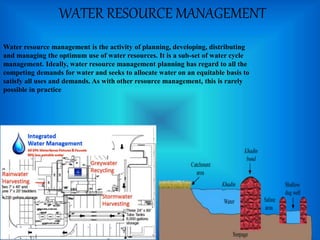
WATER RESOURCE MANAGEMENT
Water resource management is the activity of planning, developing, distributing
and managing the optimum use of water resources. It is a sub-set of water cycle
management. Ideally, water resource management planning has regard to all the
competing demands for water and seeks to allocate water on an equitable basis to
satisfy all uses and demands. As with other resource management, this is rarely
possible in practice
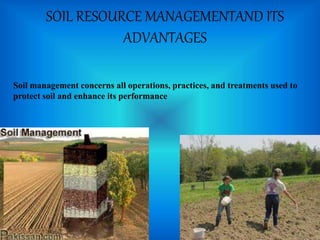
SOIL RESOURCE MANAGEMENTAND ITS
ADVANTAGES
Soil management concerns all operations, practices, and treatments used to
protect soil and enhance its performance

Environment

  • 1.
    Environment The environment encompassesall living and non-living things occurring naturally on Earth or some region there of. It is an environment that encompasses the interaction of all living species. Climate, weather, and natural resources that affect human survival and economic activity. The concept of the natural environment can be distinguished by components: a) Complete ecological units that function as natural systems without massive civilized human intervention, including all vegetation, microorganisms, soil, rocks, atmosphere, and natural phenomena that occur within their boundaries b) Universal natural resources and physical phenomena that lack clear-cut boundaries, such as air, water, and climate, as well as energy, radiation, electric charge, and magnetism, not originating from civilized human activity
  • 2.
    Global Warming Global Warmingis the increase of Earth's average surface temperature due to effect of greenhouse gases, such as carbon dioxide emissions from burning fossil fuels or from deforestation, which trap heat that would otherwise escape from Earth
  • 3.
    Ozone Layer Depletion Ozonedepletion describes two distinct but related phenomena observed since the late 1970s: a steady decline of about 4% in the total volume of Ozone in Earth's StratospHere, and a much larger springtime decrease in stratospheric ozone around Earth's polar regions. The latter phenomenon is referred to as the ozone hole. In addition to these well- known stratospheric phenomena, there are also springtime polar Tropospheric Ozone Depletion Events
  • 4.
    HOW TO SAVEENVIRONMENT SavING ENVIRONMENT is a practice of protecting the natural environment on individual , organizational or governmental levels, for the benefit of both the natural environment and humans. Due to the pressures of population and technology, the biophysical environment is being degraded, sometimes permanently. This has been recognized, and governments have begun placing restraints on activities that cause environmental degradation. Since the 1960s, activity of environmental movements has created awareness of the various environmental issues. There is no agreement on the extent of the environmental impact of human activity, and protection measures are occasionally criticized
  • 5.
    Environmental crisIs The worldis facing a very serious environmental crisis. Key environmental problems include air pollution, the destruction of the ozone layer, vast quantities of toxic waste, massive levels of soil erosion, the possible exhaustion of key natural resources such as oil and coal, and the extinction of plants and animals on a scale not seen since the death of the dinosaurs 60 million years ago. We think that this crisis is likely to have catastrophic effects in the future. Even today, the negative effects of the crisis are evident in the form of growing deserts, increased rates of cancer, and the loss of plant species which could hold out cures for diseases for diseases such as AIDS etc.
  • 6.
    LAND DEGRADATION Land degradationis a process in which the value of the biophysical environment is affected by a combination of human-induced processes acting upon the land.
  • 7.
    REASONS OF LANDDEGRADATION 1. Pollution: Pollution, in whatever form, whether it is air, water, land or noise is harmful for the environment. Air pollution pollutes the air that we breathe which causes health issues. Water pollution degrades the quality of water that we use for drinking purposes. Land pollution results in degradation of earth’s surface as a result of human activities. Noise pollution can cause irreparable damage to our ears when exposed to continuous large sounds like honking of vehicles on a busy road or machines producing large noise in a factory or a mill 2. Overpopulation: Rapid population growth puts strain on natural resources which results in degradation of our environment. Mortality rate has gone down due to better medical facilities which has resulted in increased lifespan. More population simple means more demand for food, clothes and shelter. You need more space to grow food and provide homes to millions of people. This results in deforestation which is another factor of environmental degradation.
  • 8.
    AIR POLLUTION Air pollutionis the introduction of particulates, biological molecules, or other harmful materials into Earth's atmosphere, causing disease, death to humans, damage to other living organisms such as food crops, or the natural or built environment. Air pollution may come from anthropogenic or natural sources
  • 9.
    MEANING OF SUSTAINABLEDEVELOPMENT Sustainable development is a process for meeting human development goals while sustaining the ability of natural systems to continue to provide the natural resources and ecosystem services upon which the economy and society depend. While the modern concept of sustainable development is derived most strongly from the 1987 Brundtland Report, it is rooted in earlier ideas about sustainable forest management and twentieth century environmental concerns.
  • 10.
    FEATURES OF SUSTAINABLEDEVELOPMENT 1 Integration of Environmental and Economic Decisions 1(1) Economic decisions should adequately reflect environmental, human health and social effects. 1(2) Environmental and health initiatives should adequately take into account economic, human health and social consequences. 2. Stewardship 2(1) The economy, environment, human health and social well-being should be managed for the equal benefit of present and future generations. 2(2) Manitobans are caretakers of the economy, the environment, human health and social well-being for the benefit of present and future generations.
  • 11.
    STRATEGEIS TO DOSUSTAINABLE DEVELOPMENT • The conceptual meaning of sustainable development is not • to create an obstacle in development process but this concept belongs to how we utilize our resources so that an inter-relationship can be established among present and future generation. To attains stainable development many probable strategies can be useful. • Input Efficient Technology • can be reducing the exploitation of resources. So this technology may good for sustainable development. Via • Using of Environmental friendly Sources of Energy, • such as LPG and CNG which are eco-friendly fuel, we can reduce the greenhouse gases from the earth. Delhi Transport Corporation’s initiative to CNG Buses in Delhi is the one of the best effort to reduce CO2 and other harmful gases. Government should pay attention on • Integrated Rural Development Programes.
  • 12.
    WATER RESOURCE MANAGEMENT Waterresource management is the activity of planning, developing, distributing and managing the optimum use of water resources. It is a sub-set of water cycle management. Ideally, water resource management planning has regard to all the competing demands for water and seeks to allocate water on an equitable basis to satisfy all uses and demands. As with other resource management, this is rarely possible in practice
  • 13.
    SOIL RESOURCE MANAGEMENTANDITS ADVANTAGES Soil management concerns all operations, practices, and treatments used to protect soil and enhance its performance