Idea Generation
By:
Swara Sawirs
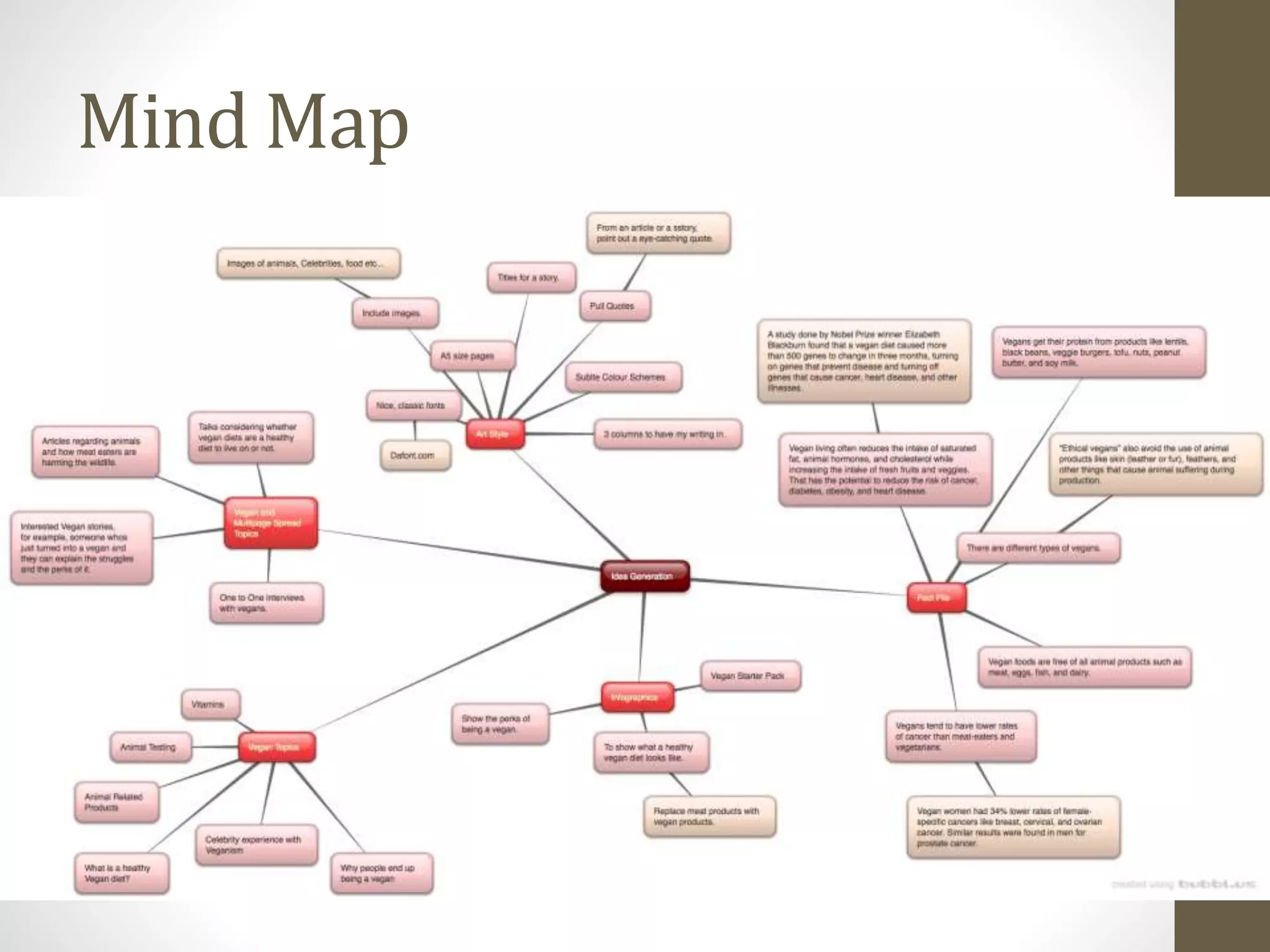
Mind Map
Info graphic/ Why You Should
Be A Vegan!
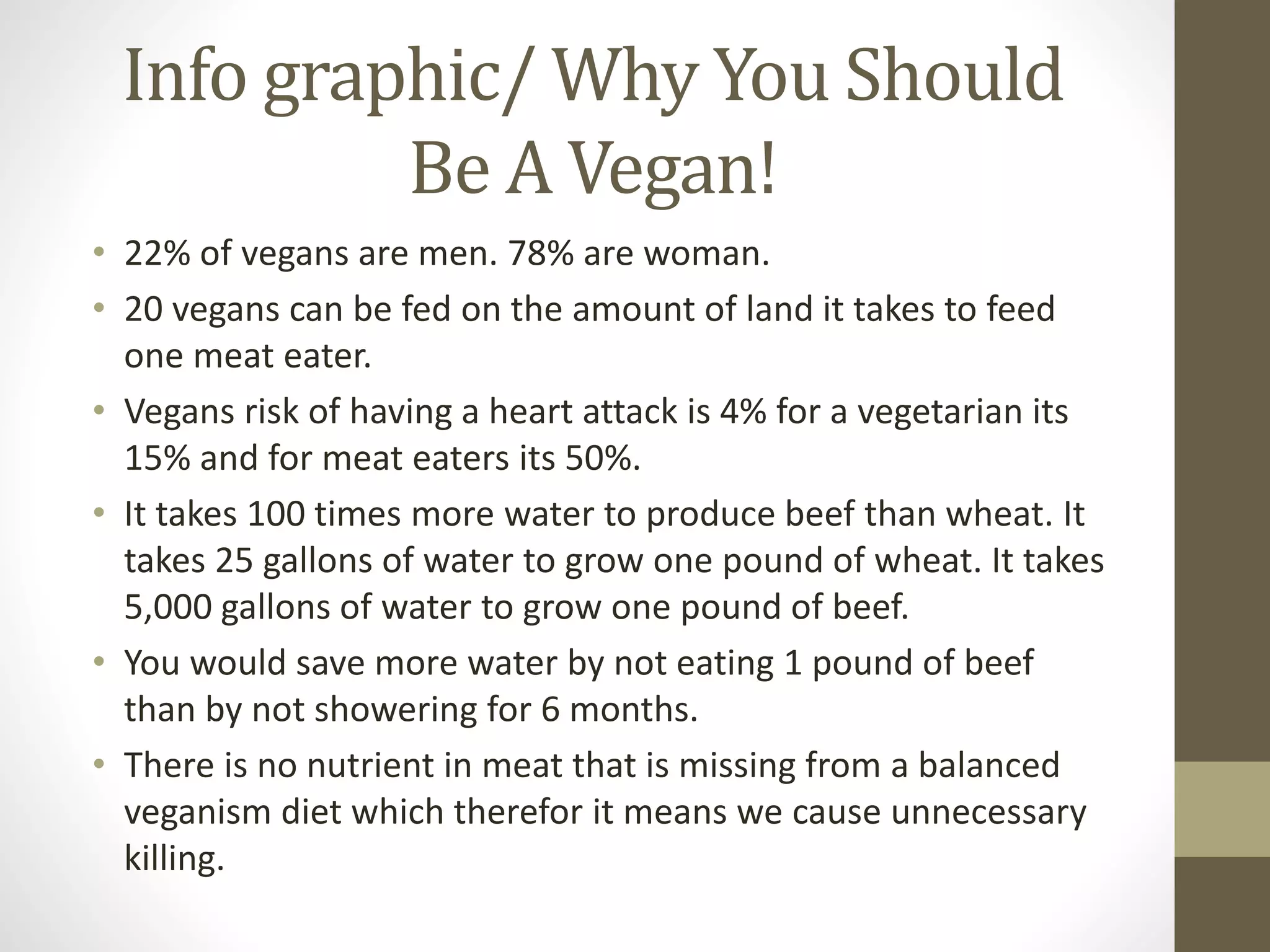
• 22% of vegans are men. 78% are woman.
• 20 vegans can be fed on the amount of land it takes to feed
one meat eater.
• Vegans risk of having a heart attack is 4% for a vegetarian its
15% and for meat eaters its 50%.
• It takes 100 times more water to produce beef than wheat. It
takes 25 gallons of water to grow one pound of wheat. It takes
5,000 gallons of water to grow one pound of beef.
• You would save more water by not eating 1 pound of beef
than by not showering for 6 months.
• There is no nutrient in meat that is missing from a balanced
veganism diet which therefor it means we cause unnecessary
killing.
Info graphic/ Why You Should
Be A Vegan!
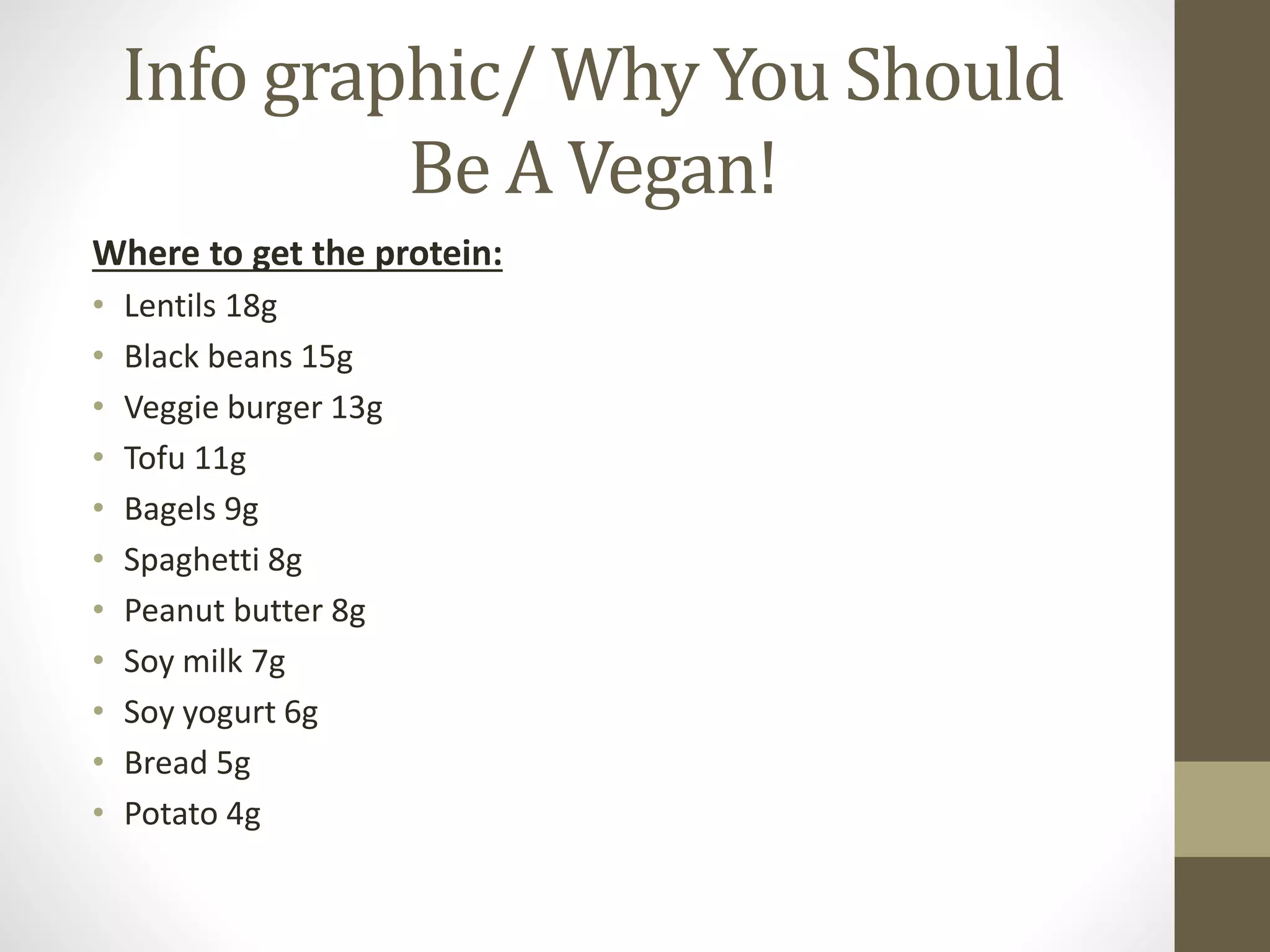
Where to get the protein:
• Lentils 18g
• Black beans 15g
• Veggie burger 13g
• Tofu 11g
• Bagels 9g
• Spaghetti 8g
• Peanut butter 8g
• Soy milk 7g
• Soy yogurt 6g
• Bread 5g
• Potato 4g
Info graphic/ Why You Should
Be A Vegan!
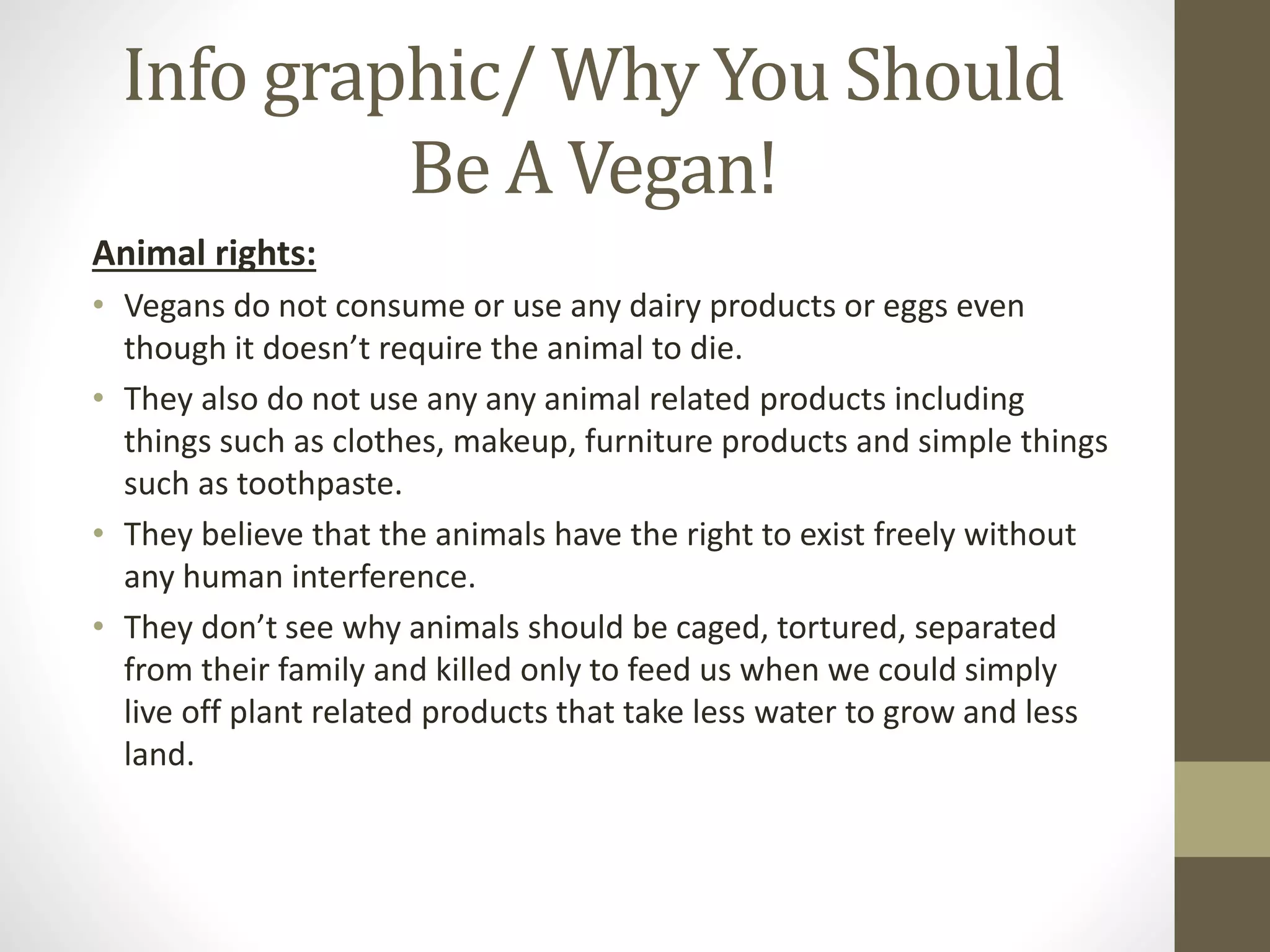
Animal rights:
• Vegans do not consume or use any dairy products or eggs even
though it doesn’t require the animal to die.
• They also do not use any any animal related products including
things such as clothes, makeup, furniture products and simple things
such as toothpaste.
• They believe that the animals have the right to exist freely without
any human interference.
• They don’t see why animals should be caged, tortured, separated
from their family and killed only to feed us when we could simply
live off plant related products that take less water to grow and less
land.
Info graphic/ Why You Should
Be A Vegan!
• Vegans tend to live for 8 years longer.
• Vegans do not eat any animal meat or use any animal related
products.
• Lacto-ovo don’t eat meat but they eat animal produced products
such as eggs.
• Pescatarians do not eat meat but they will eat fish.
• The average cholesterol levels in vegans is 161 whereas in meat
eaters its 230.
• The USA spends over $190 billion dollars in a year in medical costs
towards obesity.
• PETA reports that 2.5 percent of U.S. residents are vegans, while
another 5 percent are vegetarians.
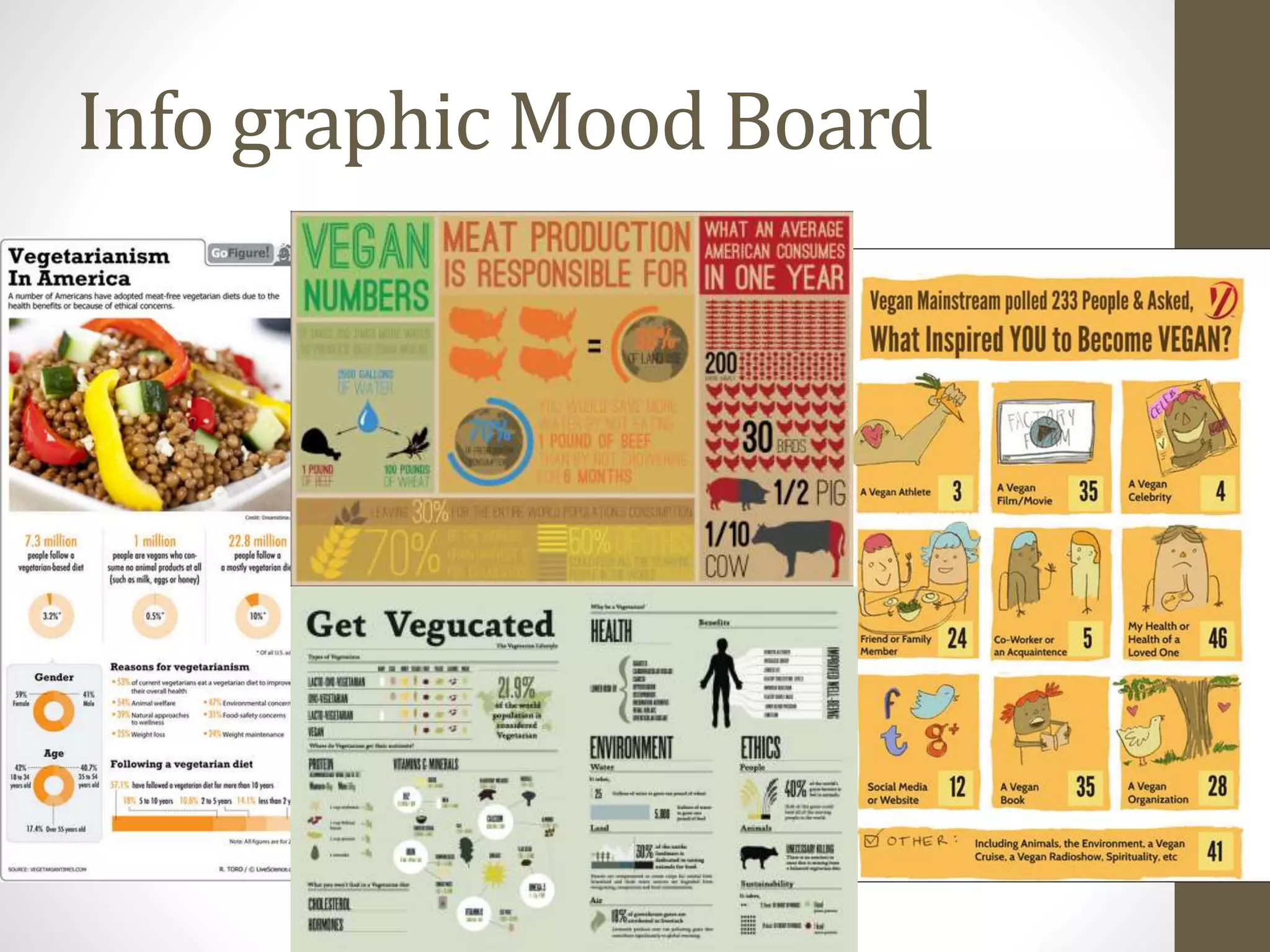
Info graphic Mood Board
Facts
• Meat industry only started in 1946 after the second world war.
• Vegans tend to have lower rates of cancer than meat-eaters and
vegetarians. For example, vegan women had 34% lower rates of female-
specific cancers like breast, cervical, and ovarian cancer.
• Vegan living often reduces the intake of saturated fat, animal hormones,
and cholesterol while increasing the intake of fresh fruits and veggies. That
has the potential to reduce the risk of cancer, diabetes, obesity, and heart
disease. A study done by Nobel Prize winner Elizabeth Blackburn found that
a vegan diet caused more than 500 genes to change in three months,
turning on genes that prevent disease and turning off genes that cause
cancer, heart disease, and other illnesses.
• Vegans don’t consume dairy products like milk and cheese, they intake
calcium with foods like broccoli, bok choy, chinese cabbage, collards, kale,
and calcium-fortified orange juice.
Facts
• “Ethical vegans” also avoid the use of animal products like skin (leather or
fur), feathers, and other things that cause animal suffering during
production.
• Veganism is a way of life that alters diet, clothing, and other decisions with
the goal of ending exploitation of animals.
• Vegans get their protein from products like lentils, black beans, veggie
burgers, tofu, nuts, peanut butter, and soy milk.
• Approximately 5% of the US is vegetarian (close to 16 million people), and
about half of those are vegan — meaning about 7.5 million Americans
abstain from all animal products.
• Most cases of food poisoning (up to 80%), are due to infected meat.
• It takes more than 2,500 gallons of water to produce 1 pound of beef, while
producing 1 pound of tofu only requires 244 gallons of water. By going
vegan, one person can save approximately 219,000 gallons of water a year.
Facts
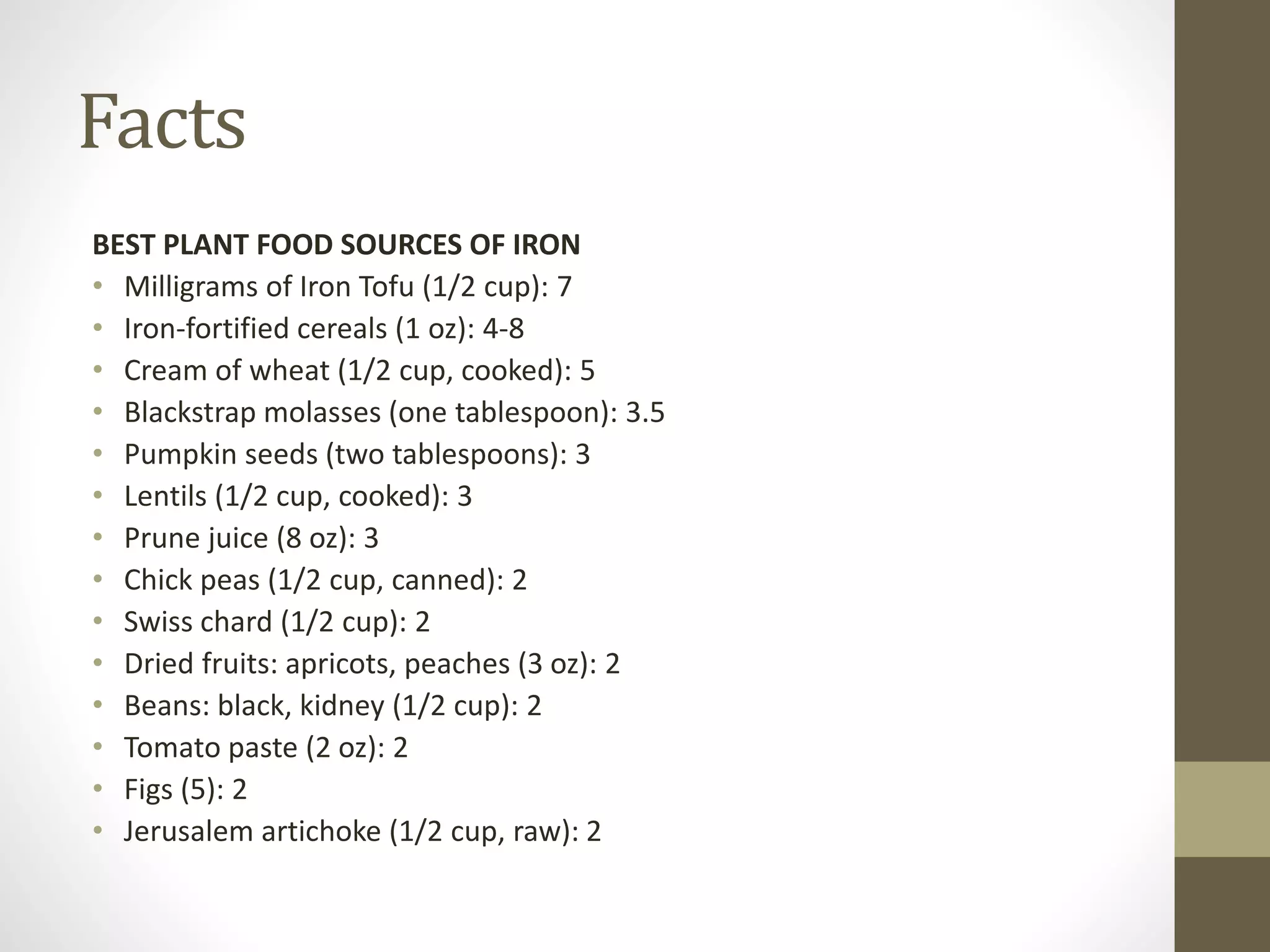
BEST PLANT FOOD SOURCES OF IRON
• Milligrams of Iron Tofu (1/2 cup): 7
• Iron-fortified cereals (1 oz): 4-8
• Cream of wheat (1/2 cup, cooked): 5
• Blackstrap molasses (one tablespoon): 3.5
• Pumpkin seeds (two tablespoons): 3
• Lentils (1/2 cup, cooked): 3
• Prune juice (8 oz): 3
• Chick peas (1/2 cup, canned): 2
• Swiss chard (1/2 cup): 2
• Dried fruits: apricots, peaches (3 oz): 2
• Beans: black, kidney (1/2 cup): 2
• Tomato paste (2 oz): 2
• Figs (5): 2
• Jerusalem artichoke (1/2 cup, raw): 2
Facts
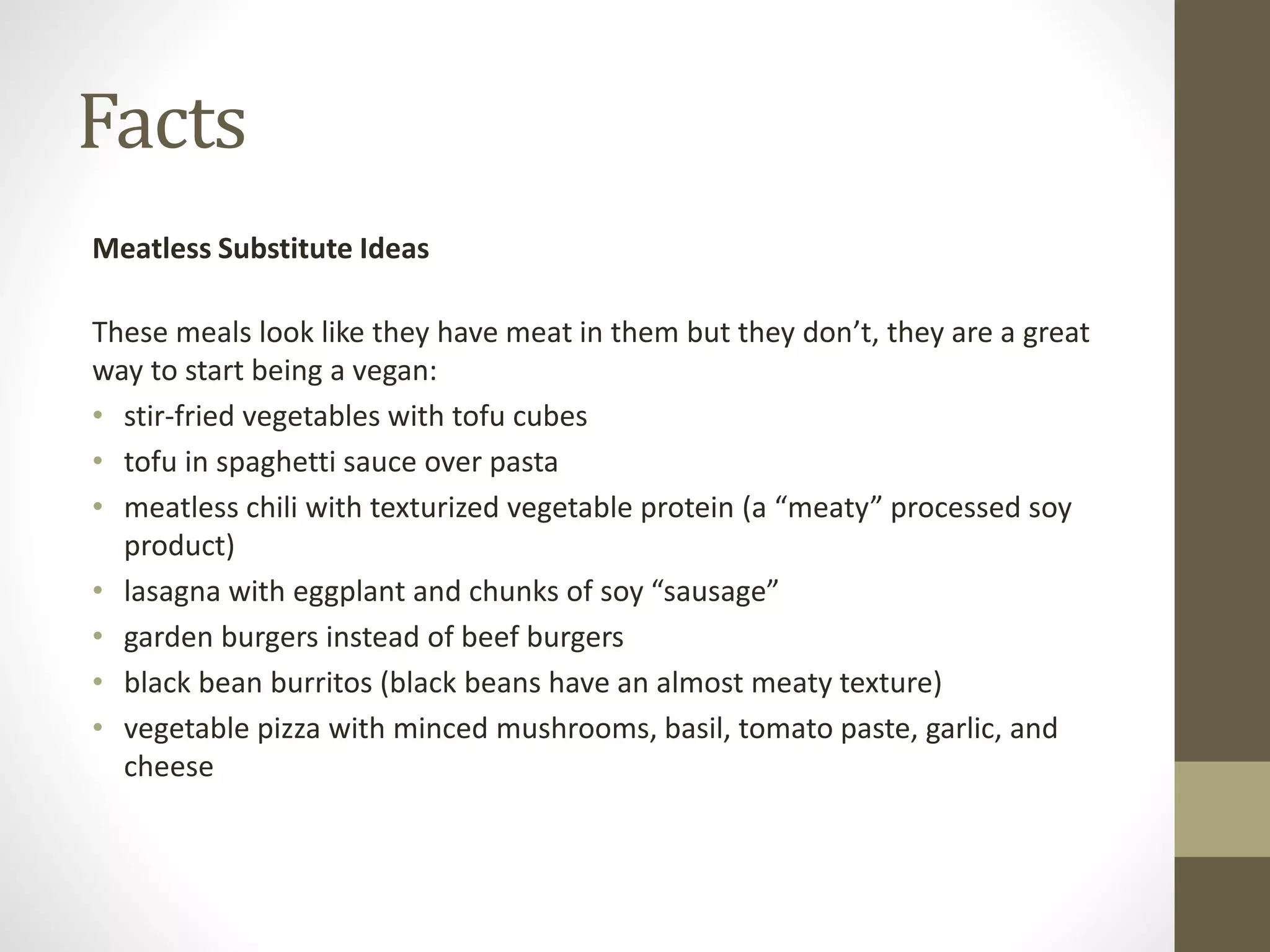
Meatless Substitute Ideas
These meals look like they have meat in them but they don’t, they are a great
way to start being a vegan:
• stir-fried vegetables with tofu cubes
• tofu in spaghetti sauce over pasta
• meatless chili with texturized vegetable protein (a “meaty” processed soy
product)
• lasagna with eggplant and chunks of soy “sausage”
• garden burgers instead of beef burgers
• black bean burritos (black beans have an almost meaty texture)
• vegetable pizza with minced mushrooms, basil, tomato paste, garlic, and
cheese
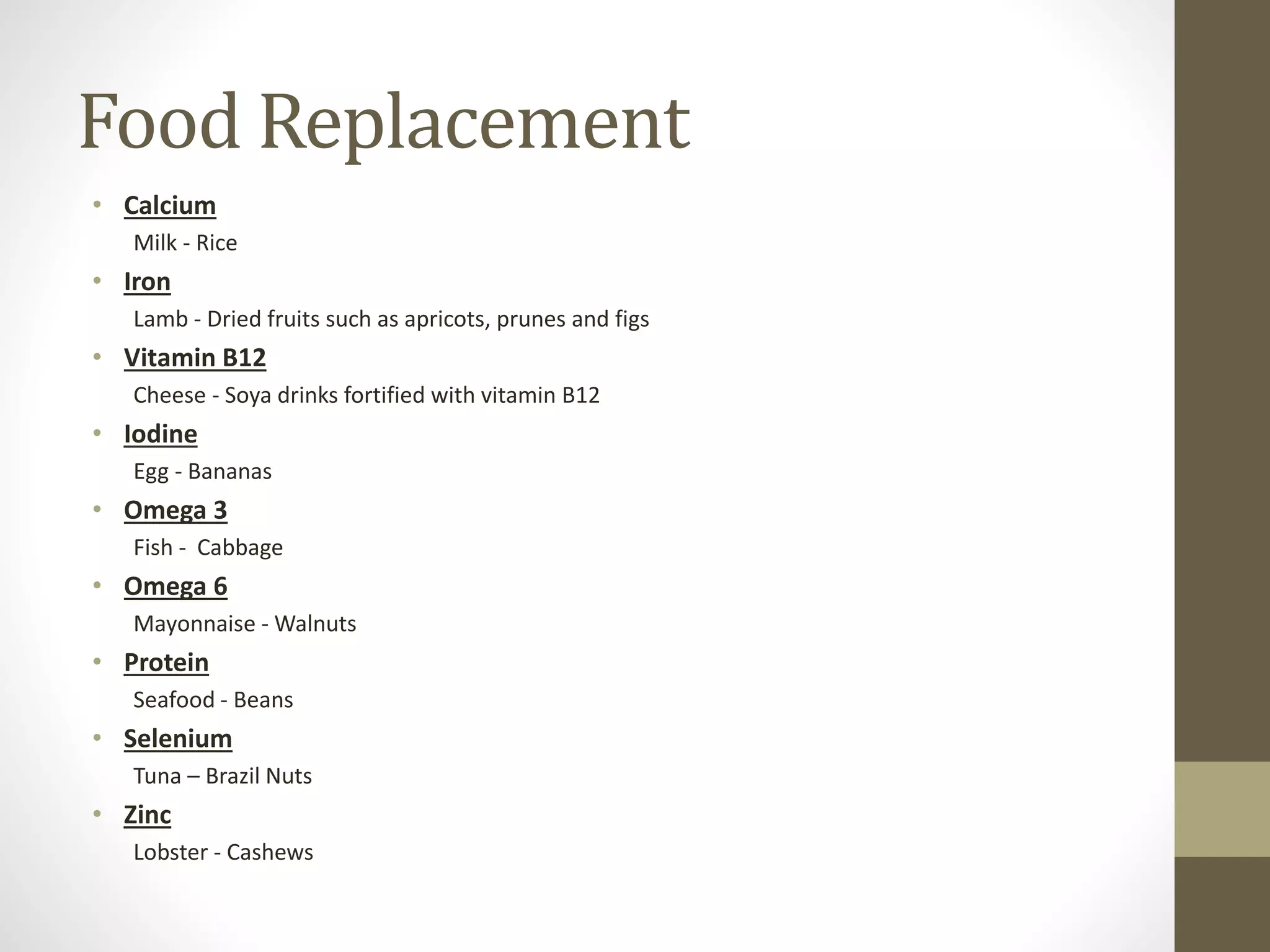
Food Replacement
• Calcium
Milk - Rice
• Iron
Lamb - Dried fruits such as apricots, prunes and figs
• Vitamin B12
Cheese - Soya drinks fortified with vitamin B12
• Iodine
Egg - Bananas
• Omega 3
Fish - Cabbage
• Omega 6
Mayonnaise - Walnuts
• Protein
Seafood - Beans
• Selenium
Tuna – Brazil Nuts
• Zinc
Lobster - Cashews
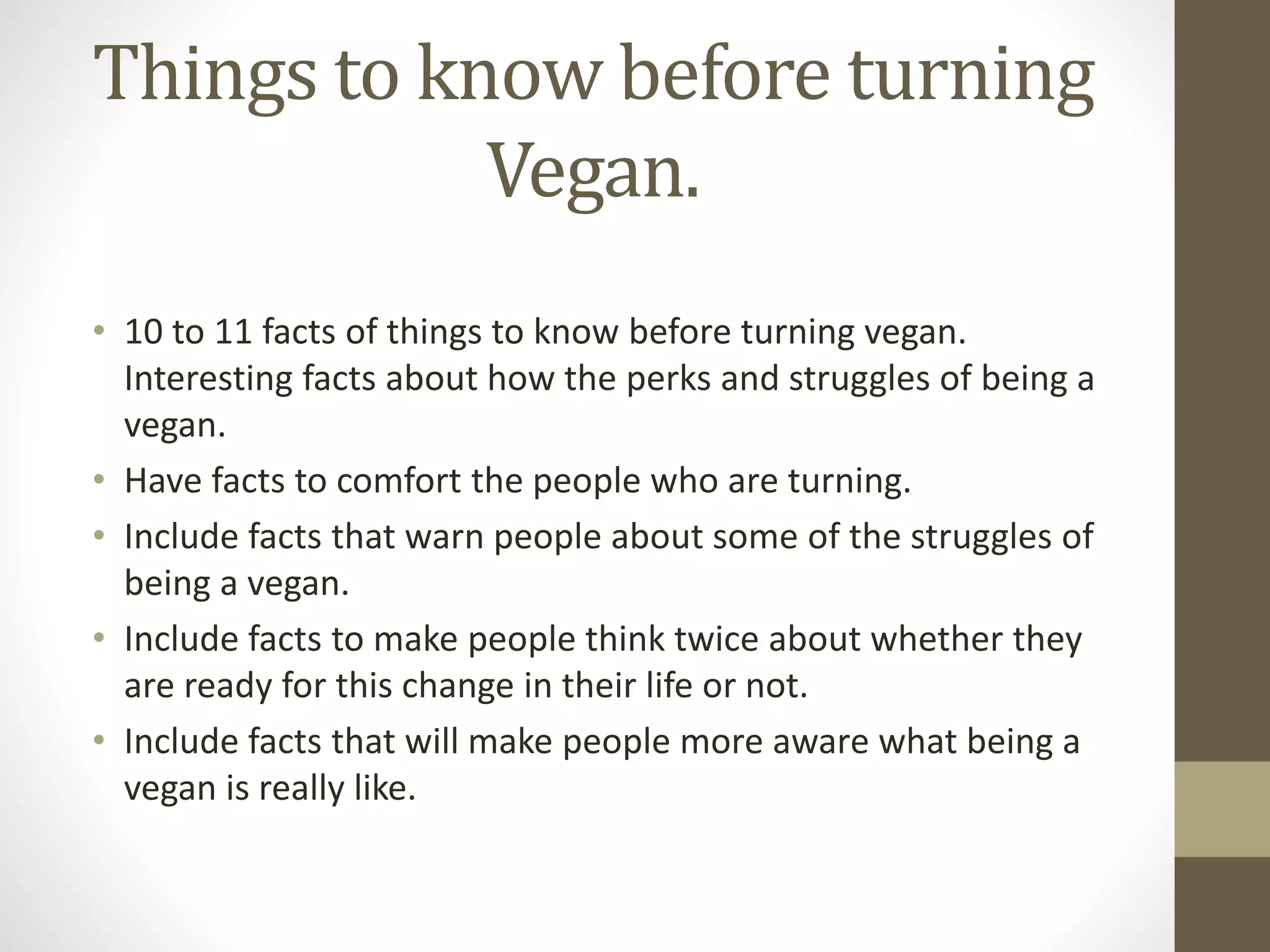
Things to know before turning
Vegan.
• 10 to 11 facts of things to know before turning vegan.
Interesting facts about how the perks and struggles of being a
vegan.
• Have facts to comfort the people who are turning.
• Include facts that warn people about some of the struggles of
being a vegan.
• Include facts to make people think twice about whether they
are ready for this change in their life or not.
• Include facts that will make people more aware what being a
vegan is really like.
Q.1 Youdon’thaveto killanimalsto getdairy
andeggs,so what’swrongwiththose products?
Pull quote:
“Nearly all dairy cows and chickens are sent to
slaughterhouses at less than half their natural life
expectancy.”
Q.2 Where do you get your protein?
Pull Quote:
“So vegans who get enough calories and eat a
healthy diet including a decent variety of foods are
unlikely to be protein deficient.”
Q.3Ifwewereallvegansthentheanimalswouldsoondie
out,soeitherwaytheanimalsdie,sowhat'sthe
difference?
Pull Quote:
“We are killing them to please our taste
buds; which is not natural.”
Q.4 What difference does it make if
one person gives up meat?
Pull Quote:
“if one person didn’t eat all those animals,
imagine how many animal life’s we will be
saving.”
Q.5 Isitsafetofeedchildrenavegetariandiet?
Pull quote:
“Tiny tummies fill up faster on lots of fiber,
but fewer calories.”

Task 5 idea generation

  • 1.
  • 2.
  • 3.
    Info graphic/ WhyYou Should Be A Vegan! • 22% of vegans are men. 78% are woman. • 20 vegans can be fed on the amount of land it takes to feed one meat eater. • Vegans risk of having a heart attack is 4% for a vegetarian its 15% and for meat eaters its 50%. • It takes 100 times more water to produce beef than wheat. It takes 25 gallons of water to grow one pound of wheat. It takes 5,000 gallons of water to grow one pound of beef. • You would save more water by not eating 1 pound of beef than by not showering for 6 months. • There is no nutrient in meat that is missing from a balanced veganism diet which therefor it means we cause unnecessary killing.
  • 4.
    Info graphic/ WhyYou Should Be A Vegan! Where to get the protein: • Lentils 18g • Black beans 15g • Veggie burger 13g • Tofu 11g • Bagels 9g • Spaghetti 8g • Peanut butter 8g • Soy milk 7g • Soy yogurt 6g • Bread 5g • Potato 4g
  • 5.
    Info graphic/ WhyYou Should Be A Vegan! Animal rights: • Vegans do not consume or use any dairy products or eggs even though it doesn’t require the animal to die. • They also do not use any any animal related products including things such as clothes, makeup, furniture products and simple things such as toothpaste. • They believe that the animals have the right to exist freely without any human interference. • They don’t see why animals should be caged, tortured, separated from their family and killed only to feed us when we could simply live off plant related products that take less water to grow and less land.
  • 6.
    Info graphic/ WhyYou Should Be A Vegan! • Vegans tend to live for 8 years longer. • Vegans do not eat any animal meat or use any animal related products. • Lacto-ovo don’t eat meat but they eat animal produced products such as eggs. • Pescatarians do not eat meat but they will eat fish. • The average cholesterol levels in vegans is 161 whereas in meat eaters its 230. • The USA spends over $190 billion dollars in a year in medical costs towards obesity. • PETA reports that 2.5 percent of U.S. residents are vegans, while another 5 percent are vegetarians.
  • 7.
  • 8.
    Facts • Meat industryonly started in 1946 after the second world war. • Vegans tend to have lower rates of cancer than meat-eaters and vegetarians. For example, vegan women had 34% lower rates of female- specific cancers like breast, cervical, and ovarian cancer. • Vegan living often reduces the intake of saturated fat, animal hormones, and cholesterol while increasing the intake of fresh fruits and veggies. That has the potential to reduce the risk of cancer, diabetes, obesity, and heart disease. A study done by Nobel Prize winner Elizabeth Blackburn found that a vegan diet caused more than 500 genes to change in three months, turning on genes that prevent disease and turning off genes that cause cancer, heart disease, and other illnesses. • Vegans don’t consume dairy products like milk and cheese, they intake calcium with foods like broccoli, bok choy, chinese cabbage, collards, kale, and calcium-fortified orange juice.
  • 9.
    Facts • “Ethical vegans”also avoid the use of animal products like skin (leather or fur), feathers, and other things that cause animal suffering during production. • Veganism is a way of life that alters diet, clothing, and other decisions with the goal of ending exploitation of animals. • Vegans get their protein from products like lentils, black beans, veggie burgers, tofu, nuts, peanut butter, and soy milk. • Approximately 5% of the US is vegetarian (close to 16 million people), and about half of those are vegan — meaning about 7.5 million Americans abstain from all animal products. • Most cases of food poisoning (up to 80%), are due to infected meat. • It takes more than 2,500 gallons of water to produce 1 pound of beef, while producing 1 pound of tofu only requires 244 gallons of water. By going vegan, one person can save approximately 219,000 gallons of water a year.
  • 10.
    Facts BEST PLANT FOODSOURCES OF IRON • Milligrams of Iron Tofu (1/2 cup): 7 • Iron-fortified cereals (1 oz): 4-8 • Cream of wheat (1/2 cup, cooked): 5 • Blackstrap molasses (one tablespoon): 3.5 • Pumpkin seeds (two tablespoons): 3 • Lentils (1/2 cup, cooked): 3 • Prune juice (8 oz): 3 • Chick peas (1/2 cup, canned): 2 • Swiss chard (1/2 cup): 2 • Dried fruits: apricots, peaches (3 oz): 2 • Beans: black, kidney (1/2 cup): 2 • Tomato paste (2 oz): 2 • Figs (5): 2 • Jerusalem artichoke (1/2 cup, raw): 2
  • 11.
    Facts Meatless Substitute Ideas Thesemeals look like they have meat in them but they don’t, they are a great way to start being a vegan: • stir-fried vegetables with tofu cubes • tofu in spaghetti sauce over pasta • meatless chili with texturized vegetable protein (a “meaty” processed soy product) • lasagna with eggplant and chunks of soy “sausage” • garden burgers instead of beef burgers • black bean burritos (black beans have an almost meaty texture) • vegetable pizza with minced mushrooms, basil, tomato paste, garlic, and cheese
  • 12.
    Food Replacement • Calcium Milk- Rice • Iron Lamb - Dried fruits such as apricots, prunes and figs • Vitamin B12 Cheese - Soya drinks fortified with vitamin B12 • Iodine Egg - Bananas • Omega 3 Fish - Cabbage • Omega 6 Mayonnaise - Walnuts • Protein Seafood - Beans • Selenium Tuna – Brazil Nuts • Zinc Lobster - Cashews
  • 13.
    Things to knowbefore turning Vegan. • 10 to 11 facts of things to know before turning vegan. Interesting facts about how the perks and struggles of being a vegan. • Have facts to comfort the people who are turning. • Include facts that warn people about some of the struggles of being a vegan. • Include facts to make people think twice about whether they are ready for this change in their life or not. • Include facts that will make people more aware what being a vegan is really like.
  • 14.
    Q.1 Youdon’thaveto killanimalstogetdairy andeggs,so what’swrongwiththose products? Pull quote: “Nearly all dairy cows and chickens are sent to slaughterhouses at less than half their natural life expectancy.”
  • 15.
    Q.2 Where doyou get your protein? Pull Quote: “So vegans who get enough calories and eat a healthy diet including a decent variety of foods are unlikely to be protein deficient.”
  • 16.
  • 17.
    Q.4 What differencedoes it make if one person gives up meat? Pull Quote: “if one person didn’t eat all those animals, imagine how many animal life’s we will be saving.”
  • 18.
    Q.5 Isitsafetofeedchildrenavegetariandiet? Pull quote: “Tinytummies fill up faster on lots of fiber, but fewer calories.”