GeorgiaGregory
Task Two- Detailed analysis of Music Magazine
Indie Magazines
Front cover
Typography
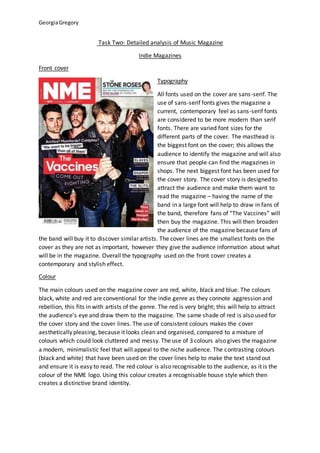
All fonts used on the cover are sans-serif. The
use of sans-serif fonts gives the magazine a
current, contemporary feel as sans-serif fonts
are considered to be more modern than serif
fonts. There are varied font sizes for the
different parts of the cover. The masthead is
the biggest font on the cover; this allows the
audience to identify the magazine and will also
ensure that people can find the magazines in
shops. The next biggest font has been used for
the cover story. The cover story is designed to
attract the audience and make them want to
read the magazine – having the name of the
band in a large font will help to draw in fans of
the band, therefore fans of “The Vaccines” will
then buy the magazine. This will then broaden
the audience of the magazine because fans of
the band will buy it to discover similar artists. The cover lines are the smallest fonts on the
cover as they are not as important, however they give the audience information about what
will be in the magazine. Overall the typography used on the front cover creates a
contemporary and stylish effect.
Colour
The main colours used on the magazine cover are red, white, black and blue. The colours
black, white and red are conventional for the indie genre as they connote aggression and
rebellion, this fits in with artists of the genre. The red is very bright; this will help to attract
the audience’s eye and draw them to the magazine. The same shade of red is also used for
the cover story and the cover lines. The use of consistent colours makes the cover
aesthetically pleasing, because it looks clean and organised, compared to a mixture of
colours which could look cluttered and messy. The use of 3 colours also gives the magazine
a modern, minimalistic feel that will appeal to the niche audience. The contrasting colours
(black and white) that have been used on the cover lines help to make the text stand out
and ensure it is easy to read. The red colour is also recognisable to the audience, as it is the
colour of the NME logo. Using this colour creates a recognisable house style which then
creates a distinctive brand identity.
GeorgiaGregory
Image
There is only one main image on the cover and it is a medium wide shot of a band called
“The Vaccines”. The band members are wearing casual clothes in quite dark colours, which
are associated with the rock genre. They are all wearing very similar clothes which shows a
sense of unity between the band members. They look like a stereotypical rock band due to
the way they are posing, for example the person in the centre is leaning forward and his
hands are in fists – this is quite a violent stance and so it fits with the stereotypical
representation of rock bands. The other members also look very stereotypical, especially
the person on the right hand side as he has very long hair which is normally associated with
the genre. The image has a filter over it which makes it seemgritty and modern. The target
audience of the magazine are similar ages to the people on the front cover and so they may
be able to relate to them – this will then encourage them to read the magazine as they can
identify with the stories and people in the magazine.
Layout
The overall layout of the magazine is mostly very ordered, however the cover story looks
cluttered. The ordered layout of the magazine will appeal to the male audience as it is
stereotypically more male. This also means the cover is easy to read and so they can clearly
see what the magazine is about. The cover story is not as ordered as the rest of the
magazine, however this helps it to stand out against the rest of the magazine, so it ensures
people focus on the cover story. The cluttered cover story is effective as disorder is
associated with rock and so it fits with the band and the genre. This also fits with the image
behind it as they look unorganised.
Route of the eye
All of the key information has been placed along the route of the eye. This means the
audience is guaranteed to see all of the important information as it has been placed
carefully along the route of the eye. The masthead is in the top left hand corner which
GeorgiaGregory
means it is the first thing the audience will see, and so they instantly recognise the magazine
due to the logo. It then follows onto a plug for “The Stone Roses” who are a very well-
known band; the audience will recognise the name and this will entice them to read the
magazine. The route of the eye then goes onto the image of the cover story. The lead singer
has been placed slightly to the right of the centre, this means he takes up more space and is
the main focal point. It then goes straight through the cover story, which is important as it is
the main feature on the magazine. The cover lines in the bottom right hand corner are the
final point on the route of the eye. They show a list of artists that are featured in the
magazine; this will draw in fans of the mentioned bands.
Language
The language used is quite informal, which helps to give the magazine a friendly tone that
will appeal to the audience. There are three rhetorical questions on the cover story,
“Arctics? Mumfords? Coldplay?” that are referring to other well-known bands of the indie
genre. The audience will recognise these names and will be able to identify the genre of the
magazine. There is then a pull quote underneath that says “We want to be bigger than all of
them”. This is a powerful statement that shows that the band are important. The questions
suggest that “The Vaccines” are better than all the previously mentioned bands and so this
implies they are an important band in the indie genre. Underneath the pull quote it says
“Come out fighting”. This fits in with the image above as the lead singer is posing in quite a
violent stance. This theme also fits in with the stereotypical representation of bands of the
rock/indie genre. One of the cover lines also fits with this violent theme as it says “We’re
here to cause a stir”.
Conventions
Overall this is a conventional indie magazine. The colours used are conventional to the
genre and they also help to create a specific house style for the NME magazine that is easily
recognisable. The fonts used are conventional for a modern magazine and they also fit with
the indie genre as they are unique and they stand out. The image is also very conventional
because it’s a typical image of a rock/indie band that you would expect to see in a magazine.
GeorgiaGregory
Contents page
Typography
The fonts on the cover are a
mix of serif and sans-serif. This
creates a contrast between
the more modern and old
fashioned fonts. The use of
contrasting fonts helps to mix
up the contents page and
makes it look more
interesting. There is also a
mixture of bold and plain text
on the cover which helps to
break up the text and make
certain aspects stand out; this
will attract the audience’s
attention and draw them into
the most important parts.
Layout
The layout of the contents
page is organised; this helps
the audience to clearly see
what is going to be featured in
the magazine and where to
find it. This makes the
contents page look masculine because it is organised and simple. This type of layout will
therefore appeal to the target audience as they are predominantly male. The simplistic
layout makes also helps to make the magazine look more sophisticated and modern.
Colour
The main colours that have been used on the contents page are black and white; this makes
the magazine seem classy and modern. The use of minimal colours also helps to add to the
overall simplistic style of the page that makes it easier to understand. Black and red are
quite masculine colours, and so this suits the target audience. Black, white and red are
always used in NME magazines and so this develops their easily recognisable house style.
Images
There are seven images on the contents page and they are all very similar. There are two
images of artists performing on stage; one is Paul Weller, a very famous rock artist that the
audience will instantly recognise. There is a close up of David Bowie, who is also a very
famous artist with a large fan base that will help to draw in the audience. There are then
GeorgiaGregory
four mid shots of other artists, including Miles Kane and A$AP Rocky. These images are all of
well-known artists. They have been placed on the contents page because the audience will
instantly recognise them, and therefore fans of the artists can easily find the pages that they
feature on. It also helps to make the contents page more interesting, as most people
wouldn’t read a list of page numbers – however they can skimthe page and quickly find out
what is featured in the magazine.
Language
The language that has been used on the contents page is quite informal. Most of the text on
this page is pull quotes from the artists featured in the magazine. This gives the audience
some clues about what stories are in the magazine and these also help to draw in the
audience as they are very vague and they leave the reader wanting to find out more. The
artists are also referred to in quite an informal way. This gives the magazine a rather friendly
feel that will appeal to the target audience as they will feel like the magazine is speaking
directly to them. Also, the readers of this magazine will know important artists in the genre
and they will appreciate the way they are being referred to; for example, David Bowie is
referred to as just “Bowie” and Paul Weller is just called “Weller”.
Conventions
Overall, I would say this is a very conventional contents page for magazines of this genre.
The layout ensures it is easy to read, the images will help to make the magazine stand out
and will also make it easier for the audience to skip to their favourite artists without
searching for a page number. The images used are conventional images of indie and rock
artists. The colours used are very effective as they are simple and they also fit in with NME’s
house style, which is important in creating a consistent look that the audience will enjoy
recognising. The font styles are also something I would expect to see on an indie magazine,
therefore they are conventional.
GeorgiaGregory
Double Page Spread
Typography
The main type of font used on the double page spread is serif. This makes the text easier to
read as the individual letters are more distinctive and easier for our brains to read. Serif is a
more old-fashioned font, however it is conventionally used in print media. The kicker is in
the same font and colour as the headline – this links them and helps to develop a continuing
theme over the page. Parts of the pull quote are in bold, this has been done to draw the
audience’s attention to a particular part of the story and it also makes them want to
continue reading as they will want to know the full story. There is also a second kicker
around halfway through the text. This helps to break up the large chunk of text and make it
more interesting for the reader.
Layout
The layout has been structured in an organised way. The left page is taken up completely by
an image of Pete Doherty, this shows he is important. It is conventional for a double page
spread to have one page completely occupied by the artist. The text is in columns which is
also conventional for print media. Having the text in columns makes it easier to read and
also makes it look like there isn’t as much to read – if there was a large chunk of text then
the audience may be deterred. The pull quote has been placed in the middle of the second
page, this breaks up the text and makes the second page look more interesting. The layout
of the text page uses the route of the eye. The audience will see the kicker first, then the
GeorgiaGregory
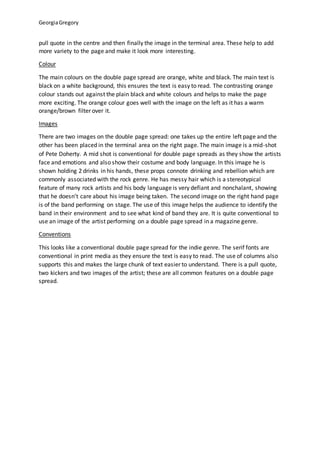
pull quote in the centre and then finally the image in the terminal area. These help to add
more variety to the page and make it look more interesting.
Colour
The main colours on the double page spread are orange, white and black. The main text is
black on a white background, this ensures the text is easy to read. The contrasting orange
colour stands out against the plain black and white colours and helps to make the page
more exciting. The orange colour goes well with the image on the left as it has a warm
orange/brown filter over it.
Images
There are two images on the double page spread: one takes up the entire left page and the
other has been placed in the terminal area on the right page. The main image is a mid-shot
of Pete Doherty. A mid shot is conventional for double page spreads as they show the artists
face and emotions and also show their costume and body language. In this image he is
shown holding 2 drinks in his hands, these props connote drinking and rebellion which are
commonly associated with the rock genre. He has messy hair which is a stereotypical
feature of many rock artists and his body language is very defiant and nonchalant, showing
that he doesn’t care about his image being taken. The second image on the right hand page
is of the band performing on stage. The use of this image helps the audience to identify the
band in their environment and to see what kind of band they are. It is quite conventional to
use an image of the artist performing on a double page spread in a magazine genre.
Conventions
This looks like a conventional double page spread for the indie genre. The serif fonts are
conventional in print media as they ensure the text is easy to read. The use of columns also
supports this and makes the large chunk of text easier to understand. There is a pull quote,
two kickers and two images of the artist; these are all common features on a double page
spread.

Task 2

  • 1.
    GeorgiaGregory Task Two- Detailedanalysis of Music Magazine Indie Magazines Front cover Typography All fonts used on the cover are sans-serif. The use of sans-serif fonts gives the magazine a current, contemporary feel as sans-serif fonts are considered to be more modern than serif fonts. There are varied font sizes for the different parts of the cover. The masthead is the biggest font on the cover; this allows the audience to identify the magazine and will also ensure that people can find the magazines in shops. The next biggest font has been used for the cover story. The cover story is designed to attract the audience and make them want to read the magazine – having the name of the band in a large font will help to draw in fans of the band, therefore fans of “The Vaccines” will then buy the magazine. This will then broaden the audience of the magazine because fans of the band will buy it to discover similar artists. The cover lines are the smallest fonts on the cover as they are not as important, however they give the audience information about what will be in the magazine. Overall the typography used on the front cover creates a contemporary and stylish effect. Colour The main colours used on the magazine cover are red, white, black and blue. The colours black, white and red are conventional for the indie genre as they connote aggression and rebellion, this fits in with artists of the genre. The red is very bright; this will help to attract the audience’s eye and draw them to the magazine. The same shade of red is also used for the cover story and the cover lines. The use of consistent colours makes the cover aesthetically pleasing, because it looks clean and organised, compared to a mixture of colours which could look cluttered and messy. The use of 3 colours also gives the magazine a modern, minimalistic feel that will appeal to the niche audience. The contrasting colours (black and white) that have been used on the cover lines help to make the text stand out and ensure it is easy to read. The red colour is also recognisable to the audience, as it is the colour of the NME logo. Using this colour creates a recognisable house style which then creates a distinctive brand identity.
  • 2.
    GeorgiaGregory Image There is onlyone main image on the cover and it is a medium wide shot of a band called “The Vaccines”. The band members are wearing casual clothes in quite dark colours, which are associated with the rock genre. They are all wearing very similar clothes which shows a sense of unity between the band members. They look like a stereotypical rock band due to the way they are posing, for example the person in the centre is leaning forward and his hands are in fists – this is quite a violent stance and so it fits with the stereotypical representation of rock bands. The other members also look very stereotypical, especially the person on the right hand side as he has very long hair which is normally associated with the genre. The image has a filter over it which makes it seemgritty and modern. The target audience of the magazine are similar ages to the people on the front cover and so they may be able to relate to them – this will then encourage them to read the magazine as they can identify with the stories and people in the magazine. Layout The overall layout of the magazine is mostly very ordered, however the cover story looks cluttered. The ordered layout of the magazine will appeal to the male audience as it is stereotypically more male. This also means the cover is easy to read and so they can clearly see what the magazine is about. The cover story is not as ordered as the rest of the magazine, however this helps it to stand out against the rest of the magazine, so it ensures people focus on the cover story. The cluttered cover story is effective as disorder is associated with rock and so it fits with the band and the genre. This also fits with the image behind it as they look unorganised. Route of the eye All of the key information has been placed along the route of the eye. This means the audience is guaranteed to see all of the important information as it has been placed carefully along the route of the eye. The masthead is in the top left hand corner which
  • 3.
    GeorgiaGregory means it isthe first thing the audience will see, and so they instantly recognise the magazine due to the logo. It then follows onto a plug for “The Stone Roses” who are a very well- known band; the audience will recognise the name and this will entice them to read the magazine. The route of the eye then goes onto the image of the cover story. The lead singer has been placed slightly to the right of the centre, this means he takes up more space and is the main focal point. It then goes straight through the cover story, which is important as it is the main feature on the magazine. The cover lines in the bottom right hand corner are the final point on the route of the eye. They show a list of artists that are featured in the magazine; this will draw in fans of the mentioned bands. Language The language used is quite informal, which helps to give the magazine a friendly tone that will appeal to the audience. There are three rhetorical questions on the cover story, “Arctics? Mumfords? Coldplay?” that are referring to other well-known bands of the indie genre. The audience will recognise these names and will be able to identify the genre of the magazine. There is then a pull quote underneath that says “We want to be bigger than all of them”. This is a powerful statement that shows that the band are important. The questions suggest that “The Vaccines” are better than all the previously mentioned bands and so this implies they are an important band in the indie genre. Underneath the pull quote it says “Come out fighting”. This fits in with the image above as the lead singer is posing in quite a violent stance. This theme also fits in with the stereotypical representation of bands of the rock/indie genre. One of the cover lines also fits with this violent theme as it says “We’re here to cause a stir”. Conventions Overall this is a conventional indie magazine. The colours used are conventional to the genre and they also help to create a specific house style for the NME magazine that is easily recognisable. The fonts used are conventional for a modern magazine and they also fit with the indie genre as they are unique and they stand out. The image is also very conventional because it’s a typical image of a rock/indie band that you would expect to see in a magazine.
  • 4.
    GeorgiaGregory Contents page Typography The fontson the cover are a mix of serif and sans-serif. This creates a contrast between the more modern and old fashioned fonts. The use of contrasting fonts helps to mix up the contents page and makes it look more interesting. There is also a mixture of bold and plain text on the cover which helps to break up the text and make certain aspects stand out; this will attract the audience’s attention and draw them into the most important parts. Layout The layout of the contents page is organised; this helps the audience to clearly see what is going to be featured in the magazine and where to find it. This makes the contents page look masculine because it is organised and simple. This type of layout will therefore appeal to the target audience as they are predominantly male. The simplistic layout makes also helps to make the magazine look more sophisticated and modern. Colour The main colours that have been used on the contents page are black and white; this makes the magazine seem classy and modern. The use of minimal colours also helps to add to the overall simplistic style of the page that makes it easier to understand. Black and red are quite masculine colours, and so this suits the target audience. Black, white and red are always used in NME magazines and so this develops their easily recognisable house style. Images There are seven images on the contents page and they are all very similar. There are two images of artists performing on stage; one is Paul Weller, a very famous rock artist that the audience will instantly recognise. There is a close up of David Bowie, who is also a very famous artist with a large fan base that will help to draw in the audience. There are then
  • 5.
    GeorgiaGregory four mid shotsof other artists, including Miles Kane and A$AP Rocky. These images are all of well-known artists. They have been placed on the contents page because the audience will instantly recognise them, and therefore fans of the artists can easily find the pages that they feature on. It also helps to make the contents page more interesting, as most people wouldn’t read a list of page numbers – however they can skimthe page and quickly find out what is featured in the magazine. Language The language that has been used on the contents page is quite informal. Most of the text on this page is pull quotes from the artists featured in the magazine. This gives the audience some clues about what stories are in the magazine and these also help to draw in the audience as they are very vague and they leave the reader wanting to find out more. The artists are also referred to in quite an informal way. This gives the magazine a rather friendly feel that will appeal to the target audience as they will feel like the magazine is speaking directly to them. Also, the readers of this magazine will know important artists in the genre and they will appreciate the way they are being referred to; for example, David Bowie is referred to as just “Bowie” and Paul Weller is just called “Weller”. Conventions Overall, I would say this is a very conventional contents page for magazines of this genre. The layout ensures it is easy to read, the images will help to make the magazine stand out and will also make it easier for the audience to skip to their favourite artists without searching for a page number. The images used are conventional images of indie and rock artists. The colours used are very effective as they are simple and they also fit in with NME’s house style, which is important in creating a consistent look that the audience will enjoy recognising. The font styles are also something I would expect to see on an indie magazine, therefore they are conventional.
  • 6.
    GeorgiaGregory Double Page Spread Typography Themain type of font used on the double page spread is serif. This makes the text easier to read as the individual letters are more distinctive and easier for our brains to read. Serif is a more old-fashioned font, however it is conventionally used in print media. The kicker is in the same font and colour as the headline – this links them and helps to develop a continuing theme over the page. Parts of the pull quote are in bold, this has been done to draw the audience’s attention to a particular part of the story and it also makes them want to continue reading as they will want to know the full story. There is also a second kicker around halfway through the text. This helps to break up the large chunk of text and make it more interesting for the reader. Layout The layout has been structured in an organised way. The left page is taken up completely by an image of Pete Doherty, this shows he is important. It is conventional for a double page spread to have one page completely occupied by the artist. The text is in columns which is also conventional for print media. Having the text in columns makes it easier to read and also makes it look like there isn’t as much to read – if there was a large chunk of text then the audience may be deterred. The pull quote has been placed in the middle of the second page, this breaks up the text and makes the second page look more interesting. The layout of the text page uses the route of the eye. The audience will see the kicker first, then the
  • 7.
    GeorgiaGregory pull quote inthe centre and then finally the image in the terminal area. These help to add more variety to the page and make it look more interesting. Colour The main colours on the double page spread are orange, white and black. The main text is black on a white background, this ensures the text is easy to read. The contrasting orange colour stands out against the plain black and white colours and helps to make the page more exciting. The orange colour goes well with the image on the left as it has a warm orange/brown filter over it. Images There are two images on the double page spread: one takes up the entire left page and the other has been placed in the terminal area on the right page. The main image is a mid-shot of Pete Doherty. A mid shot is conventional for double page spreads as they show the artists face and emotions and also show their costume and body language. In this image he is shown holding 2 drinks in his hands, these props connote drinking and rebellion which are commonly associated with the rock genre. He has messy hair which is a stereotypical feature of many rock artists and his body language is very defiant and nonchalant, showing that he doesn’t care about his image being taken. The second image on the right hand page is of the band performing on stage. The use of this image helps the audience to identify the band in their environment and to see what kind of band they are. It is quite conventional to use an image of the artist performing on a double page spread in a magazine genre. Conventions This looks like a conventional double page spread for the indie genre. The serif fonts are conventional in print media as they ensure the text is easy to read. The use of columns also supports this and makes the large chunk of text easier to understand. There is a pull quote, two kickers and two images of the artist; these are all common features on a double page spread.