Magazine Analysis
MAGAZINE 1: THE FLY
Introduction

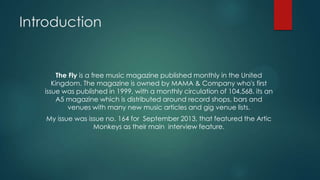
The Fly is a free music magazine published monthly in the United
Kingdom. The magazine is owned by MAMA & Company who's first
issue was published in 1999, with a monthly circulation of 104,568. its an
A5 magazine which is distributed around record shops, bars and
venues with many new music articles and gig venue lists.
My issue was issue no. 164 for September 2013, that featured the Artic
Monkeys as their main interview feature.
Front
cover
The front cover mainly displays a small tonal range
between blacks and whites that makes its main
image and text stand out. As white is associated
with purity and freshness, it can connect with the
magazine because it’s a new issue with new
bands, so the whiteness reflects the newness of
content. This also gives the impression that the
magazine will give an optimistic view on new
bands so will engage an audience to read it.

On the front cover the main image is
displayed beneath the masthead, with no
contact between the two. This also goes for
the main and only cover line situated at the
bottom of the page. The date, issue number
and price of the magazine are displayed
equally in a small font as the strapline of the
front cover, which is not visible until a closer
inspection. A san serif font of some sort is used
for text on the cover and throughout the
magazine, which shows consistency and
house design, and in black, stands out very
well against its white background. The use of
san serif rather than just serif shows the
simplicity of the magazine, that also relates
with the simple image and one cover
line, showing it’s not about the crazy images
or different type of font they use , it’s just
about the new music they want their
audience to listen to.

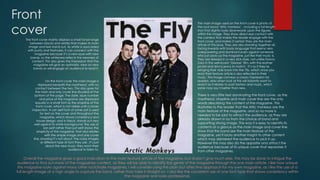
The main image used on the front cover is photo of
the rock band ‘Artic monkeys’ , including a full length
shot that slightly looks downwards upon the figures
within the image. They show direct eye contact with
the camera that makes the reader engage with the
front cover, and makes it certain they are the main
article of this issue. They are also standing together all
facing inwards with body language that seems very
overpowering and dominant even against someone
who just picks up the magazine, just like their music is.
They are dressed in a very slick style, not unlike Danny
Zuko in the well-loved ‘Grease’ film, with the leather
jacket and skinny jeans to match. It’s as if they’re
bringing their style back into the 70s, which once you
read their feature article is also reflected in their
music. This image conveys a classic impression for
readers, who when look at this will instantly want to
read it as it relates to past fashion and music, which
some may say it better than new.

There is very little text dominating the front cover, as the
masthead, strapline and main cover line are the only
words describing the content of the magazine. This
illustrates to the reader that the Artic monkeys are the
main feature of the magazine, and so no more is
needed to be said to attract the audience, as they are
already drawn in by from the choice of band and
supporting strong image. This way it is easy to identify its
contents at a glance as the main image and cover line
show that this band are the main feature of the
magazine, yet it lacks another insight to other content
which may disinterest the audience to pick it up.
However this may also do the opposite and attract the
audience because of its unique cover that separates it
from other magazines.

Overall the magazine gives a good indication to the main feature article of the magazine, but doesn't give much else. This may be done to intrigue the
audience to find out more of the magazines content, as they will be able to identify the genre of the magazine through the one main article. I like how unique
this magazine looks against many other rock/indie magazines. I will consider using this plain but affective approach for my own magazine, as I like the use of a
full length image at a high angle to capture the band, rather than take it straight on. I also like the consistent use of one font type that shows consistency within
the magazine and looks professional.
Contents
page
The contents page covers this
short tonal range as well, yet
swapping the main person in
the image to be the brighter
thing in view. This creates irony
as the person is dressed all in
white, as if to suggest purity, yet
her attitude as an artist is far
from holy. This swap and choice
in colour creates an interesting
range of tones that grabs the
reader’s attention as there I
more reasoning for colour
choice than first expected.
On the contents page they list
the features to a left orientation
and shape it round the main
image. The repeated use of san
serif writing in white not only
stands out against the page,
but gives an equal focus to the
image and the contents of the
magazine.

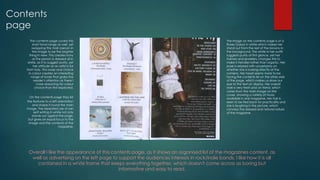
The image on the contents page is of a
Roses Gabor in white which makes her
stand out from the rest of the browns in
the background. The white in her outfit
suggests purity at first glance, yet her
trainers and jewellery changes this to
make it trendier rather than organic. Her
pose is relaxed with uncertainty on
whether she is looking directly at the
camera. Her head seems more to be
facing the contents list on the other side
of the page, which makes us draw our
eye to the text on display. Her overall
style is very fresh and on trend, which
varies from the main image on the
cover, showing a variety of music
available in one magazine. Her hair is
seen to be tied back for practicality and
she is laughing in the picture, which
conveys the relaxed and natural nature
of the magazine.

Overall I like the appearance of this contents page, as it shows an organised list of the magazines content, as
well as advertising on the left page to support the audiences interests in rock/indie bands. I like how it is all
contained in a white frame that keeps everything together, which doesn't come across as boring but
informative and easy to read.
Double page
spread
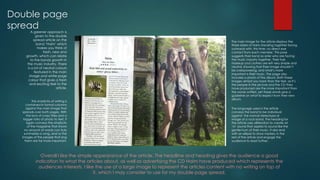
A greener approach is
given to the double
spread article on the
band ‘Haim’ which
makes you think of
fresh, new and
growth, which can relate
to the bands growth in
the music industry. There
is a lot of neutral colours
featured in the main
image and white page
colour that gives a fresh
and exciting feel to the
article.

The simplicity of writing is
contained in formal columns
against the main image that
spreads over both pages. With
the lack of crazy titles and a
bigger ratio of photo to text, it
again conveys the simplicity
of the magazine that shows
no amount of words can truly
summaries a song, and so the
images of the people that sing
them are far more important.

The main image for the article displays the
three sisters of Haim standing together facing
outwards with, this time, no direct eye
contact from each member. This pose
suggests their bond as sister who are facing
the music industry together. Their hair,
makeup and clothes are left very simple and
neutral, showing that their image shouldn’t
be overpowering, and what’s more
important is their music. The page also
includes a photo of the album. Both these
images almost say more than the text, as it’s
the people in the picture and the CD they
have produced are the more important than
the words written, yet these words give a
guideline on what to expect from their new
album.

The language used in the article
conveys the band to be individual
against the normal stereotypical
image of a rock band. The heading for
the article uses alliteration to create an
‘m’ sound that aspires to sound like the
gentle hum of their music. It also end
with an ellipsis to show mystery in the
rest of the article and engage the
audience to read further.

Overall I like the simple appearance of the article. The headline and heading gives the audience a good
indication to what the articles about, as well as advertising the CD Haim have produced which represents the
audiences interests. I like the use of a large image to represent the articles content with no writing on top of
it, which I may consider to use for my double page spread.

Magazine analysis: The Fly

  • 1.
  • 2.
    Introduction The Fly isa free music magazine published monthly in the United Kingdom. The magazine is owned by MAMA & Company who's first issue was published in 1999, with a monthly circulation of 104,568. its an A5 magazine which is distributed around record shops, bars and venues with many new music articles and gig venue lists. My issue was issue no. 164 for September 2013, that featured the Artic Monkeys as their main interview feature.
  • 3.
    Front cover The front covermainly displays a small tonal range between blacks and whites that makes its main image and text stand out. As white is associated with purity and freshness, it can connect with the magazine because it’s a new issue with new bands, so the whiteness reflects the newness of content. This also gives the impression that the magazine will give an optimistic view on new bands so will engage an audience to read it. On the front cover the main image is displayed beneath the masthead, with no contact between the two. This also goes for the main and only cover line situated at the bottom of the page. The date, issue number and price of the magazine are displayed equally in a small font as the strapline of the front cover, which is not visible until a closer inspection. A san serif font of some sort is used for text on the cover and throughout the magazine, which shows consistency and house design, and in black, stands out very well against its white background. The use of san serif rather than just serif shows the simplicity of the magazine, that also relates with the simple image and one cover line, showing it’s not about the crazy images or different type of font they use , it’s just about the new music they want their audience to listen to. The main image used on the front cover is photo of the rock band ‘Artic monkeys’ , including a full length shot that slightly looks downwards upon the figures within the image. They show direct eye contact with the camera that makes the reader engage with the front cover, and makes it certain they are the main article of this issue. They are also standing together all facing inwards with body language that seems very overpowering and dominant even against someone who just picks up the magazine, just like their music is. They are dressed in a very slick style, not unlike Danny Zuko in the well-loved ‘Grease’ film, with the leather jacket and skinny jeans to match. It’s as if they’re bringing their style back into the 70s, which once you read their feature article is also reflected in their music. This image conveys a classic impression for readers, who when look at this will instantly want to read it as it relates to past fashion and music, which some may say it better than new. There is very little text dominating the front cover, as the masthead, strapline and main cover line are the only words describing the content of the magazine. This illustrates to the reader that the Artic monkeys are the main feature of the magazine, and so no more is needed to be said to attract the audience, as they are already drawn in by from the choice of band and supporting strong image. This way it is easy to identify its contents at a glance as the main image and cover line show that this band are the main feature of the magazine, yet it lacks another insight to other content which may disinterest the audience to pick it up. However this may also do the opposite and attract the audience because of its unique cover that separates it from other magazines. Overall the magazine gives a good indication to the main feature article of the magazine, but doesn't give much else. This may be done to intrigue the audience to find out more of the magazines content, as they will be able to identify the genre of the magazine through the one main article. I like how unique this magazine looks against many other rock/indie magazines. I will consider using this plain but affective approach for my own magazine, as I like the use of a full length image at a high angle to capture the band, rather than take it straight on. I also like the consistent use of one font type that shows consistency within the magazine and looks professional.
  • 4.
    Contents page The contents pagecovers this short tonal range as well, yet swapping the main person in the image to be the brighter thing in view. This creates irony as the person is dressed all in white, as if to suggest purity, yet her attitude as an artist is far from holy. This swap and choice in colour creates an interesting range of tones that grabs the reader’s attention as there I more reasoning for colour choice than first expected. On the contents page they list the features to a left orientation and shape it round the main image. The repeated use of san serif writing in white not only stands out against the page, but gives an equal focus to the image and the contents of the magazine. The image on the contents page is of a Roses Gabor in white which makes her stand out from the rest of the browns in the background. The white in her outfit suggests purity at first glance, yet her trainers and jewellery changes this to make it trendier rather than organic. Her pose is relaxed with uncertainty on whether she is looking directly at the camera. Her head seems more to be facing the contents list on the other side of the page, which makes us draw our eye to the text on display. Her overall style is very fresh and on trend, which varies from the main image on the cover, showing a variety of music available in one magazine. Her hair is seen to be tied back for practicality and she is laughing in the picture, which conveys the relaxed and natural nature of the magazine. Overall I like the appearance of this contents page, as it shows an organised list of the magazines content, as well as advertising on the left page to support the audiences interests in rock/indie bands. I like how it is all contained in a white frame that keeps everything together, which doesn't come across as boring but informative and easy to read.
  • 5.
    Double page spread A greenerapproach is given to the double spread article on the band ‘Haim’ which makes you think of fresh, new and growth, which can relate to the bands growth in the music industry. There is a lot of neutral colours featured in the main image and white page colour that gives a fresh and exciting feel to the article. The simplicity of writing is contained in formal columns against the main image that spreads over both pages. With the lack of crazy titles and a bigger ratio of photo to text, it again conveys the simplicity of the magazine that shows no amount of words can truly summaries a song, and so the images of the people that sing them are far more important. The main image for the article displays the three sisters of Haim standing together facing outwards with, this time, no direct eye contact from each member. This pose suggests their bond as sister who are facing the music industry together. Their hair, makeup and clothes are left very simple and neutral, showing that their image shouldn’t be overpowering, and what’s more important is their music. The page also includes a photo of the album. Both these images almost say more than the text, as it’s the people in the picture and the CD they have produced are the more important than the words written, yet these words give a guideline on what to expect from their new album. The language used in the article conveys the band to be individual against the normal stereotypical image of a rock band. The heading for the article uses alliteration to create an ‘m’ sound that aspires to sound like the gentle hum of their music. It also end with an ellipsis to show mystery in the rest of the article and engage the audience to read further. Overall I like the simple appearance of the article. The headline and heading gives the audience a good indication to what the articles about, as well as advertising the CD Haim have produced which represents the audiences interests. I like the use of a large image to represent the articles content with no writing on top of it, which I may consider to use for my double page spread.