CLEOPATRA TRIAL
• A Study to Evaluate Pertuzumab + Trastuzumab + Docetaxel vs.
Placebo + Trastuzumab + Docetaxel in Previously Untreated
HER2-positive Metastatic Breast Cancer (CLEOPATRA)
Dr. GAURAV KUMAR
MD (RADIOTHERAPY)
Study design
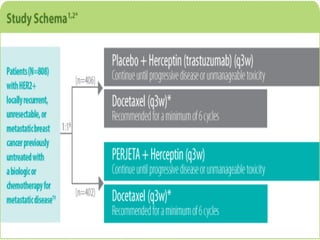
•CLEOPATRA was a multicenter, randomized, double-blind, placebo-controlled phase
III trial
•Primary end point
Progression-free survival (PFS; as assessed by an independent review facility [IRF]),
defined as time from randomization to documented progressive disease as
determined by RECIST, or death.
•Secondary end points
Overall survival (OS)
Objective response rate (ORR)
Duration of response (DoR)
Safety
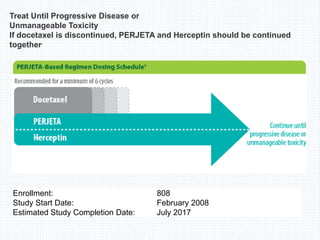
Treat Until Progressive Disease or
Unmanageable Toxicity
If docetaxel is discontinued, PERJETA and Herceptin should be continued
together.
Enrollment: 808
Study Start Date: February 2008
Estimated Study Completion Date: July 2017
Baseline Characteristics2
Placebo + Herceptin +
docetaxel
n=406, n (%)
PERJETA + Herceptin +
docetaxel
n=402, n (%)
Female sex 404 (99.5) 402 (100)
Age — years
Median [range] 54.0 [27-89] 54.0 [22-82]
Race or ethnic group*
Asian 133 (32.8) 128 (31.8)
Black 20 (4.9) 10 (2.5)
White 235 (57.9) 245 (60.9)
Other 18 (4.4) 19 (4.7)
Region
Asia 128 (31.5) 125 (31.1)
Europe 152 (37.4) 154 (38.3)
North America 68 (16.7) 67 (16.7)
South America 58 (14.3) 56 (13.9)
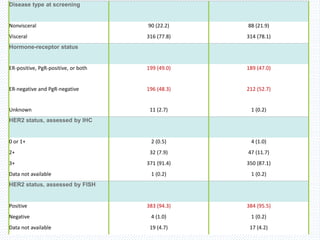
Disease type at screening
Nonvisceral 90 (22.2) 88 (21.9)
Visceral 316 (77.8) 314 (78.1)
Hormone-receptor status
ER-positive, PgR-positive, or both 199 (49.0) 189 (47.0)
ER-negative and PgR-negative 196 (48.3) 212 (52.7)
Unknown 11 (2.7) 1 (0.2)
HER2 status, assessed by IHC
0 or 1+ 2 (0.5) 4 (1.0)
2+ 32 (7.9) 47 (11.7)
3+ 371 (91.4) 350 (87.1)
Data not available 1 (0.2) 1 (0.2)
HER2 status, assessed by FISH
Positive 383 (94.3) 384 (95.5)
Negative 4 (1.0) 1 (0.2)
Data not available 19 (4.7) 17 (4.2)
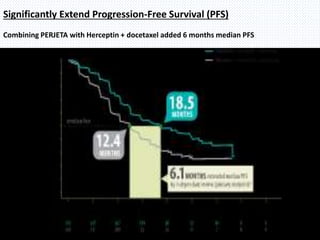
Significantly Extend Progression-Free Survival (PFS)
Combining PERJETA with Herceptin + docetaxel added 6 months median PFS
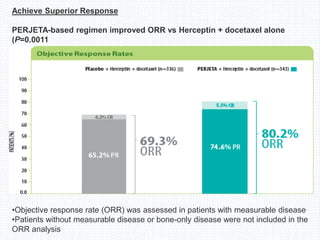
Achieve Superior Response
PERJETA-based regimen improved ORR vs Herceptin + docetaxel alone
(P=0.0011
•Objective response rate (ORR) was assessed in patients with measurable disease.
•Patients without measurable disease or bone-only disease were not included in the
ORR analysis
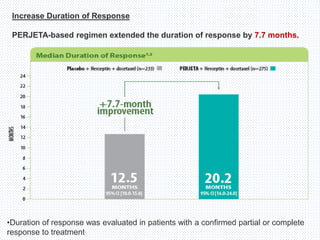
Increase Duration of Response
PERJETA-based regimen extended the duration of response by 7.7 months.
•Duration of response was evaluated in patients with a confirmed partial or complete
response to treatment.
PERJETA demonstrated an OS (overall survival) improvement when
combined with Herceptin + docetaxel at the final analysis.
•At the final analysis, the OS benefit was maintained (HR=0.68, 95% CI: 0.56-
0.84; P=0.0002) and the median was reached in the PERJETA + Herceptin +
docetaxel arm (56.5 months vs 40.8 months in the Herceptin + docetaxel arm).
Improve PFS and OS for patients, including those with visceral metastases
•45% reduced risk of progression or death with PERJETA + Herceptin + docetaxel
•43% reduced risk of death with PERJETA + Herceptin + docetaxel
There was an inability to show OS benefit with PERJETA in patients with
nonvisceral metastases (n=178; HR=1.42; 95% CI: 0.71-2.84)
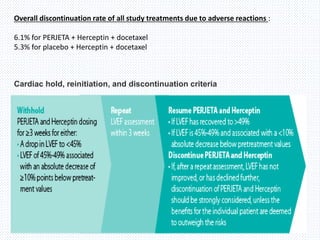
Overall discontinuation rate of all study treatments due to adverse reactions :
6.1% for PERJETA + Herceptin + docetaxel
5.3% for placebo + Herceptin + docetaxel
Cardiac hold, reinitiation, and discontinuation criteria
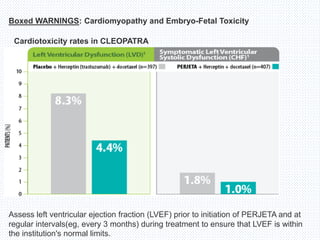
Boxed WARNINGS: Cardiomyopathy and Embryo-Fetal Toxicity
Cardiotoxicity rates in CLEOPATRA
Assess left ventricular ejection fraction (LVEF) prior to initiation of PERJETA and at
regular intervals(eg, every 3 months) during treatment to ensure that LVEF is within
the institution's normal limits.
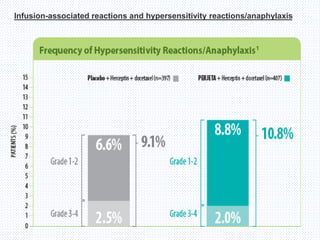
Infusion-associated reactions and hypersensitivity reactions/anaphylaxis
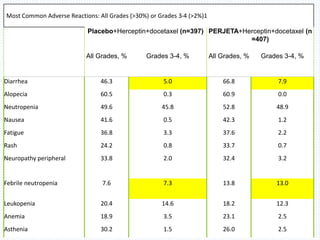
Most Common Adverse Reactions: All Grades (>30%) or Grades 3-4 (>2%)1
Placebo+Herceptin+docetaxel (n=397) PERJETA+Herceptin+docetaxel (n
=407)
All Grades, % Grades 3-4, % All Grades, % Grades 3-4, %
Diarrhea 46.3 5.0 66.8 7.9
Alopecia 60.5 0.3 60.9 0.0
Neutropenia 49.6 45.8 52.8 48.9
Nausea 41.6 0.5 42.3 1.2
Fatigue 36.8 3.3 37.6 2.2
Rash 24.2 0.8 33.7 0.7
Neuropathy peripheral 33.8 2.0 32.4 3.2
Febrile neutropenia 7.6 7.3 13.8 13.0
Leukopenia 20.4 14.6 18.2 12.3
Anemia 18.9 3.5 23.1 2.5
Asthenia 30.2 1.5 26.0 2.5
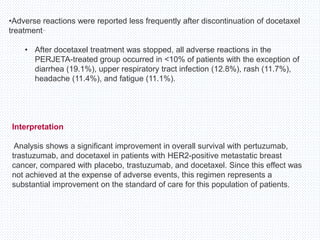
•Adverse reactions were reported less frequently after discontinuation of docetaxel
treatment..
• After docetaxel treatment was stopped, all adverse reactions in the
PERJETA-treated group occurred in <10% of patients with the exception of
diarrhea (19.1%), upper respiratory tract infection (12.8%), rash (11.7%),
headache (11.4%), and fatigue (11.1%).
Interpretation
Analysis shows a significant improvement in overall survival with pertuzumab,
trastuzumab, and docetaxel in patients with HER2-positive metastatic breast
cancer, compared with placebo, trastuzumab, and docetaxel. Since this effect was
not achieved at the expense of adverse events, this regimen represents a
substantial improvement on the standard of care for this population of patients.
COST OF 420mg PERTUZUMAB- $4890
Thank You

Cleopatra trial

  • 1.
    CLEOPATRA TRIAL • AStudy to Evaluate Pertuzumab + Trastuzumab + Docetaxel vs. Placebo + Trastuzumab + Docetaxel in Previously Untreated HER2-positive Metastatic Breast Cancer (CLEOPATRA) Dr. GAURAV KUMAR MD (RADIOTHERAPY)
  • 2.
    Study design •CLEOPATRA wasa multicenter, randomized, double-blind, placebo-controlled phase III trial •Primary end point Progression-free survival (PFS; as assessed by an independent review facility [IRF]), defined as time from randomization to documented progressive disease as determined by RECIST, or death. •Secondary end points Overall survival (OS) Objective response rate (ORR) Duration of response (DoR) Safety
  • 5.
    Treat Until ProgressiveDisease or Unmanageable Toxicity If docetaxel is discontinued, PERJETA and Herceptin should be continued together. Enrollment: 808 Study Start Date: February 2008 Estimated Study Completion Date: July 2017
  • 6.
    Baseline Characteristics2 Placebo +Herceptin + docetaxel n=406, n (%) PERJETA + Herceptin + docetaxel n=402, n (%) Female sex 404 (99.5) 402 (100) Age — years Median [range] 54.0 [27-89] 54.0 [22-82] Race or ethnic group* Asian 133 (32.8) 128 (31.8) Black 20 (4.9) 10 (2.5) White 235 (57.9) 245 (60.9) Other 18 (4.4) 19 (4.7) Region Asia 128 (31.5) 125 (31.1) Europe 152 (37.4) 154 (38.3) North America 68 (16.7) 67 (16.7) South America 58 (14.3) 56 (13.9)
  • 7.
    Disease type atscreening Nonvisceral 90 (22.2) 88 (21.9) Visceral 316 (77.8) 314 (78.1) Hormone-receptor status ER-positive, PgR-positive, or both 199 (49.0) 189 (47.0) ER-negative and PgR-negative 196 (48.3) 212 (52.7) Unknown 11 (2.7) 1 (0.2) HER2 status, assessed by IHC 0 or 1+ 2 (0.5) 4 (1.0) 2+ 32 (7.9) 47 (11.7) 3+ 371 (91.4) 350 (87.1) Data not available 1 (0.2) 1 (0.2) HER2 status, assessed by FISH Positive 383 (94.3) 384 (95.5) Negative 4 (1.0) 1 (0.2) Data not available 19 (4.7) 17 (4.2)
  • 8.
    Significantly Extend Progression-FreeSurvival (PFS) Combining PERJETA with Herceptin + docetaxel added 6 months median PFS
  • 9.
    Achieve Superior Response PERJETA-basedregimen improved ORR vs Herceptin + docetaxel alone (P=0.0011 •Objective response rate (ORR) was assessed in patients with measurable disease. •Patients without measurable disease or bone-only disease were not included in the ORR analysis
  • 10.
    Increase Duration ofResponse PERJETA-based regimen extended the duration of response by 7.7 months. •Duration of response was evaluated in patients with a confirmed partial or complete response to treatment.
  • 11.
    PERJETA demonstrated anOS (overall survival) improvement when combined with Herceptin + docetaxel at the final analysis. •At the final analysis, the OS benefit was maintained (HR=0.68, 95% CI: 0.56- 0.84; P=0.0002) and the median was reached in the PERJETA + Herceptin + docetaxel arm (56.5 months vs 40.8 months in the Herceptin + docetaxel arm). Improve PFS and OS for patients, including those with visceral metastases •45% reduced risk of progression or death with PERJETA + Herceptin + docetaxel •43% reduced risk of death with PERJETA + Herceptin + docetaxel There was an inability to show OS benefit with PERJETA in patients with nonvisceral metastases (n=178; HR=1.42; 95% CI: 0.71-2.84)
  • 12.
    Overall discontinuation rateof all study treatments due to adverse reactions : 6.1% for PERJETA + Herceptin + docetaxel 5.3% for placebo + Herceptin + docetaxel Cardiac hold, reinitiation, and discontinuation criteria
  • 13.
    Boxed WARNINGS: Cardiomyopathyand Embryo-Fetal Toxicity Cardiotoxicity rates in CLEOPATRA Assess left ventricular ejection fraction (LVEF) prior to initiation of PERJETA and at regular intervals(eg, every 3 months) during treatment to ensure that LVEF is within the institution's normal limits.
  • 14.
    Infusion-associated reactions andhypersensitivity reactions/anaphylaxis
  • 15.
    Most Common AdverseReactions: All Grades (>30%) or Grades 3-4 (>2%)1 Placebo+Herceptin+docetaxel (n=397) PERJETA+Herceptin+docetaxel (n =407) All Grades, % Grades 3-4, % All Grades, % Grades 3-4, % Diarrhea 46.3 5.0 66.8 7.9 Alopecia 60.5 0.3 60.9 0.0 Neutropenia 49.6 45.8 52.8 48.9 Nausea 41.6 0.5 42.3 1.2 Fatigue 36.8 3.3 37.6 2.2 Rash 24.2 0.8 33.7 0.7 Neuropathy peripheral 33.8 2.0 32.4 3.2 Febrile neutropenia 7.6 7.3 13.8 13.0 Leukopenia 20.4 14.6 18.2 12.3 Anemia 18.9 3.5 23.1 2.5 Asthenia 30.2 1.5 26.0 2.5
  • 16.
    •Adverse reactions werereported less frequently after discontinuation of docetaxel treatment.. • After docetaxel treatment was stopped, all adverse reactions in the PERJETA-treated group occurred in <10% of patients with the exception of diarrhea (19.1%), upper respiratory tract infection (12.8%), rash (11.7%), headache (11.4%), and fatigue (11.1%). Interpretation Analysis shows a significant improvement in overall survival with pertuzumab, trastuzumab, and docetaxel in patients with HER2-positive metastatic breast cancer, compared with placebo, trastuzumab, and docetaxel. Since this effect was not achieved at the expense of adverse events, this regimen represents a substantial improvement on the standard of care for this population of patients.
  • 18.
    COST OF 420mgPERTUZUMAB- $4890
  • 19.