Taoism
The Great Tao flows everywhere.
It may go left or right
All things depend on it for life.
and it does not turn away from them.
It accomplishes its task, but does not claim
credit for it.
It clothes and feeds all things
but does not claim to be master
over them. Tao Te Ching, chapter 30
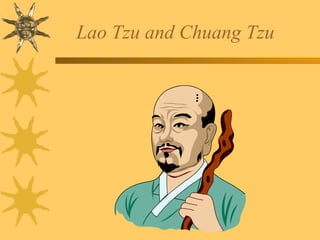
Lao Tzu and Chuang Tzu
Origins of Taoism
The origins are ancient, dating back to the time of Conf
ucius: 551-479.
Taoism’s beginnings are shrouded in mystery.
It is not certain whether the founder of Taoism, Lao
Tzu, ever actually existed.
There are accounts, however legendary, about Lao Tzu
Lao Tzu
Born in 604 B.C. E., his name means “old master.”
He was conceived by a shooting star.
When his mother gave birth to him, he was already
eighty two years old, a wise man with flowing white
hair.
He worked as a government archivist.
Eventually, he became disinchanted with the
corruption of government.
He left his town after taking three days to write down
his words of wisdom, The Tao Te Ching.
The Tao Te Ching
Authored by Lao Tzu, it is Taoism’s foundational text.
It is 81 short chapters, dating back to the 3rd. century,
b.c.e.
It contains many paradoxes and profound teachings on
living in harmony with nature.
Chapter 56 = Echoes of such mystery are heard
repeatedly.
Those who know do not speak; Those who speak do not
know.
Chuang Tzu
Taoism’s second founder seems to have lived from
369 to 286 b.c.e.
The Chuang Tzu, his text, is as important as the Tao
Te Ching but not as well known.
He is known for his humor, profound lessons and
stories.
The central theme of his work is the relativity of
things: “Who is to say, it asks, exactly what is good,
what ought to be done, or even who we are, when
answers to such questions are so dependent on
particular circumstances?
The Philosophy of Tao
Tao is both the ultimate source and principle of order
in the universe.
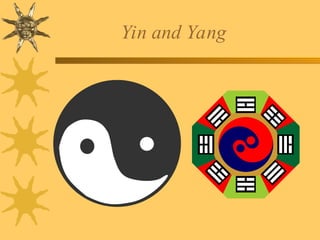
Tao has two components, yin and yang.
Taoism regards moral values as relative and avoids
absolute moral judgments.
Taoism literature says nothing about the afterlife and
depicts death as one of nature’s transformations from
one state to another.
Humans are part of the grand harmony of nature and
to live in accord with the Tao is the only way to thrive.
Yin and Yang
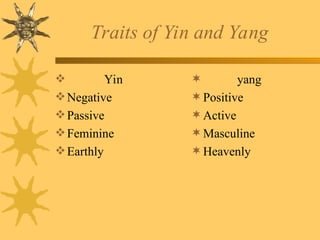
Traits of Yin and Yang
 Yin
Negative
Passive
Feminine
Earthly
 yang
Positive
Active
Masculine
Heavenly
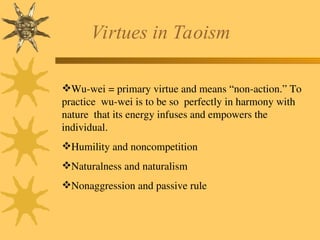
Virtues in Taoism
Wu-wei = primary virtue and means “non-action.” To
practice wu-wei is to be so perfectly in harmony with
nature that its energy infuses and empowers the
individual.
Humility and noncompetition
Naturalness and naturalism
Nonaggression and passive rule

Ryan Taoism education and creative .ppt

  • 1.
    Taoism The Great Taoflows everywhere. It may go left or right All things depend on it for life. and it does not turn away from them. It accomplishes its task, but does not claim credit for it. It clothes and feeds all things but does not claim to be master over them. Tao Te Ching, chapter 30
  • 2.
    Lao Tzu andChuang Tzu
  • 3.
    Origins of Taoism Theorigins are ancient, dating back to the time of Conf ucius: 551-479. Taoism’s beginnings are shrouded in mystery. It is not certain whether the founder of Taoism, Lao Tzu, ever actually existed. There are accounts, however legendary, about Lao Tzu
  • 4.
    Lao Tzu Born in604 B.C. E., his name means “old master.” He was conceived by a shooting star. When his mother gave birth to him, he was already eighty two years old, a wise man with flowing white hair. He worked as a government archivist. Eventually, he became disinchanted with the corruption of government. He left his town after taking three days to write down his words of wisdom, The Tao Te Ching.
  • 5.
    The Tao TeChing Authored by Lao Tzu, it is Taoism’s foundational text. It is 81 short chapters, dating back to the 3rd. century, b.c.e. It contains many paradoxes and profound teachings on living in harmony with nature. Chapter 56 = Echoes of such mystery are heard repeatedly. Those who know do not speak; Those who speak do not know.
  • 6.
    Chuang Tzu Taoism’s secondfounder seems to have lived from 369 to 286 b.c.e. The Chuang Tzu, his text, is as important as the Tao Te Ching but not as well known. He is known for his humor, profound lessons and stories. The central theme of his work is the relativity of things: “Who is to say, it asks, exactly what is good, what ought to be done, or even who we are, when answers to such questions are so dependent on particular circumstances?
  • 7.
    The Philosophy ofTao Tao is both the ultimate source and principle of order in the universe. Tao has two components, yin and yang. Taoism regards moral values as relative and avoids absolute moral judgments. Taoism literature says nothing about the afterlife and depicts death as one of nature’s transformations from one state to another. Humans are part of the grand harmony of nature and to live in accord with the Tao is the only way to thrive.
  • 8.
  • 9.
    Traits of Yinand Yang  Yin Negative Passive Feminine Earthly  yang Positive Active Masculine Heavenly
  • 10.
    Virtues in Taoism Wu-wei= primary virtue and means “non-action.” To practice wu-wei is to be so perfectly in harmony with nature that its energy infuses and empowers the individual. Humility and noncompetition Naturalness and naturalism Nonaggression and passive rule