Performance	
  Stories	
  from	
  Exadata	
  Migra4ons	


                                                                 Tanel	
  Poder	
  

                                                         h>p://blog.tanelpoder.com	
  
                                                            h>p://tech.e2sn.com	
  
                                                           tanel@tanelpoder.com	


Enterprise	
  2.0	
               ©	
  2009-­‐2010	
  
                                                                WWW.E2SN.COM	
  	
  	
     1	


Service	
  Networks	
  	
  	
     www.e2sn.com	
  
Intro:	
  About	
  me	
  
   •  Tanel	
  Põder	
  
                     •  As	
  you	
  already	
  know	
  I’m	
  an	
  Oracle	
  database	
  geek	
  (for	
  last	
  14	
  years)	
  
                     •  Also	
  I	
  did	
  a	
  huge	
  career	
  jump	
  last	
  year	
  and	
  now	
  I’m	
  a	
  CEO	
  of	
  E2SN	
  Ltd.	
  
                                    •  E2SN	
  =	
  Enterprise	
  2.0	
  Service	
  Networks	
  
                                    •  Server	
  &	
  Database	
  ConsolidaXon,	
  VirtualizaXon,	
  Capacity	
  Management,	
  
                                       Performance!	


                     •  I’m	
  co-­‐authoring	
  an	
  “Expert	
  Oracle	
  Exadata”	
  book	
  (with	
  Apress)	
  
                                    •  WriXng	
  the	
  performance,	
  migraXons	
  and	
  consolidaXon	
  chapters…	
  

Enterprise	
  2.0	
               ©	
  2009-­‐2010	
  
                                                                      WWW.E2SN.COM	
  	
  	
                                                         2	


Service	
  Networks	
  	
  	
     www.e2sn.com	
  
About	
  this	
  session	
  

   •  Exadata’s	
  architecture	
  is	
  awesome,	
  no	
  doubt!	
  

   •  However	
  it’s	
  “just”	
  hardware	
  +	
  sodware	
  

   •  It’s	
  also	
  new	
  

   •  It’s	
  also	
  complex	
  (storage	
  cells,	
  RAC,	
  ASM,	
  PX,	
  compression…)	
  

   •  Not	
  very	
  well	
  understood	
  (yet)	
  

   •  I’m	
  offering	
  some	
  of	
  my	
  experiences	
  so	
  far…	
  

Enterprise	
  2.0	
               ©	
  2009-­‐2010	
  
                                                              WWW.E2SN.COM	
  	
  	
          3	


Service	
  Networks	
  	
  	
     www.e2sn.com	
  
Challenge	
  –	
  MigraXng	
  a	
  large	
  DW	
  

   •             A	
  very	
  large	
  telco	
  DW	
  (DB	
  size	
  was	
  close	
  to	
  100	
  TB	
  then)	
  
   •             Already	
  compressed	
  with	
  10g	
  direct	
  load	
  block	
  compression	
  
   •             Raw	
  uncompressed	
  data	
  size	
  ¼	
  Petabytes!	
  	
  
   •             Already	
  heavily	
  parXXoned	
  
   •             No	
  indexes	
  used	
  in	
  source	
  DB	
  

   •  Source	
  plakorm:	
  Oracle	
  10.2	
  –	
  SPARC	
  /	
  Solaris	
  
   •  Target:	
  Exadata	
  v2	
  –	
  Intel	
  /	
  Linux	
  
                                                                                                             New	
  hybrid	
  columnar	
  
                                                                                                             compression	
  is	
  cri%cal,	
  
                                                                                                             otherwise	
  the	
  data	
  
   •  Exadata	
  full	
  rack	
  with	
  15000	
  RPM	
  SAS	
  disks	
                                      wouldn’t	
  fit	
  into	
  a	
  
                     •  100	
  TB	
  raw	
  disk	
  space	
                                                  single	
  rack	
  at	
  all!	
  
                     •  Ader	
  mirroring	
  &	
  overhead	
  -­‐	
  ~30	
  TB	
  real	
  space	
  for	
  data	
  
Enterprise	
  2.0	
               ©	
  2009-­‐2010	
  
                                                                          WWW.E2SN.COM	
  	
  	
                                            4	


Service	
  Networks	
  	
  	
     www.e2sn.com	
  
Challenge	
  –	
  MigraXng	
  a	
  large	
  DW	
  
   •  Which	
  migraXon	
  approach	
  to	
  use	
  (low	
  downXme)?	
  
                     •  Some	
  parXXons	
  known	
  to	
  be	
  read	
  only	
  were	
  (obviously)	
  migrated	
  in	
  
                        advance	


   •  All	
  data	
  had	
  to	
  be	
  compressed	
  with	
  Exadata	
  Hybrid	
  Columnar	
  
      Compression	
  (EHCC)	
  immediately	
  
                     •  In	
  other	
  words,	
  all	
  the	
  data	
  must	
  be	
  sent	
  through	
  compression	
  module	
  
                        during	
  load	
  
                     •  EHCC	
  works	
  only	
  on	
  Exadata,	
  can’t	
  pre-­‐compress	
  data	
  in	
  the	
  source:	
  
                                     •  ORA-­‐64307:	
  hybrid	
  columnar	
  compression	
  is	
  only	
  supported	
  in	
  tablespaces	
  
                                        residing	
  on	
  Exadata	
  storage	


   •  This	
  ruled	
  out	
  all	
  these	
  opXons:	
                                           The	
  DW	
  loads	
  were	
  
                     •            Physical	
  data	
  guard	
                                     done	
  NOLOGGING	
  
                                                                                                  anyway,	
  ruling	
  out	
  the	
  
                     •            Logical	
  data	
  guard	
  
                                                                                                  Streams/Golden	
  Gate	
  	
  
                     •            ASM	
  mirror	
  snapshots	
                                    and	
  other	
  log-­‐mining	
  
                     •            Transportable	
  tablespaces	
                                  based	
  approaches	


Enterprise	
  2.0	
                ©	
  2009-­‐2010	
  
                                                                           WWW.E2SN.COM	
  	
  	
                                               5	


Service	
  Networks	
  	
  	
      www.e2sn.com	
  
Challenge	
  –	
  MigraXng	
  a	
  large	
  DW	
  

   •  Only	
  two	
  reasonable	
  migraXon	
  paths	
  led	
  for	
  large	
  tables:	
  
                     1.  Data	
  Pump	
  
                                    •  Extract	
  data	
  to	
  files	
  
                                    •  Copy	
  files	
  (or	
  share	
  over	
  NFS)	
  	
  
                                    •  Load	
  files	
  into	
  EHCC	
  compressed	
  tables/parXXons	


                     2.  INSERT	
  /*+	
  APPEND	
  */	
  over	
  Database	
  Links	
  
                                    •  No	
  need	
  to	
  dump	
  data	
  to	
  files,	
  copy	
  &	
  read	
  again	
  
                                    •  Less	
  overhead	
  
                                    •  Less	
  complexity	
  managing	
  files	


   •  We	
  chose	
  the	
  INSERT	
  over	
  DBLinks	
  approach	
  
                     •  But…	


Enterprise	
  2.0	
               ©	
  2009-­‐2010	
  
                                                                             WWW.E2SN.COM	
  	
  	
                        6	


Service	
  Networks	
  	
  	
     www.e2sn.com	
  
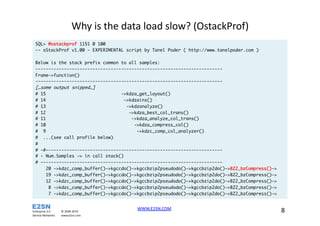
Why	
  is	
  the	
  data	
  load	
  slow?	
  (Snapper)	
  
   --------------------------------------------------------------------------------------------------------	
       SID, USERNAME , TYPE, STATISTIC                                ,         DELTA, HDELTA/SEC,    %TIME	
   --------------------------------------------------------------------------------------------------------	
            1570, SYSTEM                            , STAT, bytes sent via SQL*Net to dblink           ,         536,          17.87,	
            1570, SYSTEM                            , STAT, bytes received via SQL*Net from dblink     ,   113985017,           3.8M,	
            1570, SYSTEM                            , STAT, SQL*Net roundtrips to/from dblink          ,          67,          2.23,	
            1570, SYSTEM                            , TIME, parse time elapsed                         ,         842,       28.07us,           .0%	
            1570, SYSTEM                            , TIME, DB CPU                                     ,    29739479,      991.32ms,         99.1%	
            1570, SYSTEM                            , TIME, sql execute elapsed time                   ,    30031492,              1s,      100.1%	
            1570, SYSTEM                            , TIME, DB time                                    ,    30031492,              1s,      100.1%	
            1570, SYSTEM                            , WAIT, gc current multi block request             ,        3682,      122.73us,            .0%	
            1570, SYSTEM                            , WAIT, gc cr block 3-way                          ,         539,       17.97us,            .0%	
            1570, SYSTEM                            , WAIT, gc current block 3-way                     ,         459,        15.3us,            .0%	
            1570, SYSTEM                            , WAIT, gc current grant 2-way                     ,         209,        6.97us,            .0%	
            1570, SYSTEM                            , WAIT, row cache lock                             ,        2566,       85.53us,            .0%	
            1570, SYSTEM                            , WAIT, SQL*Net message to dblink                  ,          80,         2.67us,           .0%	
            1570, SYSTEM                            , WAIT, SQL*Net message from dblink                ,      263979,          8.8ms,           .9%	
            1570, SYSTEM                            , WAIT, SQL*Net more data from dblink              ,      113617,         3.79ms,           .4%	
            1570, SYSTEM                            , WAIT, kfk: async disk IO                         ,        7562,      252.07us,            .0%	
            1570, SYSTEM                            , WAIT, events in waitclass Other                  ,        5549,      184.97us,            .0%	
   --          End of Stats snap 1, end=2010-06-28 12:09:51, seconds=30	

   -----------------------------------------------------------------------	                                             This	
  load	
  is	
  CPU	
  
   Active% | SQL_ID          | EVENT                     | WAIT_CLASS	                                                  bound	
  because	
  of	
  
   -----------------------------------------------------------------------	
       98% | 0zg4phrzs1s55   | ON CPU                    | ON CPU	
                                                                                                                        compression.	
  Let’s	
  
        2% | 0zg4phrzs1s55   | SQL*Net message from dbli | Network	                                                     use	
  parallel	
  
                                                                                                                        execuTon	
  instead!	
  

Enterprise	
  2.0	
               ©	
  2009-­‐2010	
  
                                                                            WWW.E2SN.COM	
  	
  	
                                                      7	


Service	
  Networks	
  	
  	
     www.e2sn.com	
  
Why	
  is	
  the	
  data	
  load	
  slow?	
  (OstackProf)	
  
   SQL> @ostackprof 1151 0 100	
   -- oStackProf v1.00 - EXPERIMENTAL script by Tanel Poder ( http://www.tanelpoder.com )	

   Below is the stack prefix common to all samples:	
   ------------------------------------------------------------------------	
   Frame->function()	
   ------------------------------------------------------------------------	
   […some output snipped…]	
   # 15                              ->kdza_get_layout()	
   # 14                               ->kdzains()	
   # 13                                ->kdzanalyze()	
   # 12                                 ->kdza_best_col_trans()	
   # 11                                  ->kdza_analyze_col_trans()	
   # 10                                   ->kdza_compress_col()	
   # 9                                     ->kdzc_comp_col_analyzer()	
   # ...(see call profile below)	
   #	
   # -#--------------------------------------------------------------------	
   # - Num.Samples -> in call stack()	
   # ----------------------------------------------------------------------	
        20 ->kdzc_comp_buffer()->kgccdo()->kgccbzip2pseudodo()->kgccbzip2do()->BZ2_bzCompress()->	
        19 ->kdzc_comp_buffer()->kgccdo()->kgccbzip2pseudodo()->kgccbzip2do()->BZ2_bzCompress()->	
        12 ->kdzc_comp_buffer()->kgccdo()->kgccbzip2pseudodo()->kgccbzip2do()->BZ2_bzCompress()->	
         8 ->kdzc_comp_buffer()->kgccdo()->kgccbzip2pseudodo()->kgccbzip2do()->BZ2_bzCompress()->	
         7 ->kdzc_comp_buffer()->kgccdo()->kgccbzip2pseudodo()->kgccbzip2do()->BZ2_bzCompress()->	


Enterprise	
  2.0	
               ©	
  2009-­‐2010	
  
                                                                  WWW.E2SN.COM	
  	
  	
                    8	


Service	
  Networks	
  	
  	
     www.e2sn.com	
  
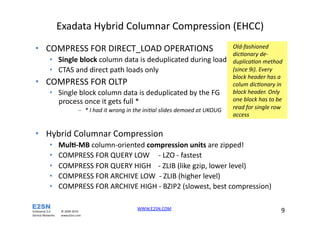
Exadata	
  Hybrid	
  Columnar	
  Compression	
  (EHCC)	
  
   •  COMPRESS	
  FOR	
  DIRECT_LOAD	
  OPERATIONS	
                                                                                               Old-­‐fashioned	
  
                                                                                                                                                   dicTonary	
  de-­‐
                     •  Single	
  block	
  column	
  data	
  is	
  deduplicated	
  during	
  load	
                                                duplicaTon	
  method	
  
                     •  CTAS	
  and	
  direct	
  path	
  loads	
  only	
                                                                           (since	
  9i).	
  Every	
  
                                                                                                                                                   block	
  header	
  has	
  a	
  
   •  COMPRESS	
  FOR	
  OLTP	
                                                                                                                    colum	
  dicTonary	
  in	
  
                     •  Single	
  block	
  column	
  data	
  is	
  deduplicated	
  by	
  the	
  FG	
                                               block	
  header.	
  Only	
  
                        process	
  once	
  it	
  gets	
  full	
  *	
                                                                               one	
  block	
  has	
  to	
  be	
  
                                                   –  *	
  I	
  had	
  it	
  wrong	
  in	
  the	
  iniTal	
  slides	
  demoed	
  at	
  UKOUG	
     read	
  for	
  single	
  row	
  
                                                                                                                                                   access	


   •  Hybrid	
  Columnar	
  Compression	
  
                     •            Mul4-­‐MB	
  column-­‐oriented	
  compression	
  units	
  are	
  zipped!	
  
                     •            COMPRESS	
  FOR	
  QUERY	
  LOW	


  -­‐	
  LZO	
  -­‐	
  fastest	
  
                     •            COMPRESS	
  FOR	
  QUERY	
  HIGH	


  -­‐	
  ZLIB	
  (like	
  gzip,	
  lower	
  level)	
  
                     •            COMPRESS	
  FOR	
  ARCHIVE	
  LOW	
  	
  -­‐	
  ZLIB	
  (higher	
  level)	
  
                     •            COMPRESS	
  FOR	
  ARCHIVE	
  HIGH	
  -­‐	
  BZIP2	
  (slowest,	
  best	
  compression)	


Enterprise	
  2.0	
                ©	
  2009-­‐2010	
  
                                                                                         WWW.E2SN.COM	
  	
  	
                                                                     9	


Service	
  Networks	
  	
  	
      www.e2sn.com	
  
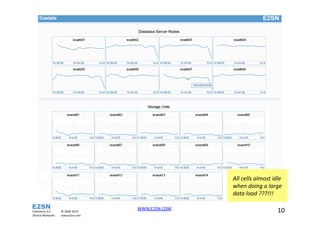
All	
  cells	
  almost	
  idle	
  
                                                                                    when	
  doing	
  a	
  large	
  
                                                                                    data	
  load	
  ???!!!	
  

Enterprise	
  2.0	
               ©	
  2009-­‐2010	
  
                                                         WWW.E2SN.COM	
  	
  	
                                   10	


Service	
  Networks	
  	
  	
     www.e2sn.com	
  
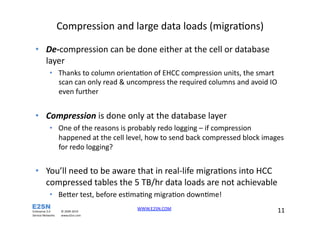
Compression	
  and	
  large	
  data	
  loads	
  (migraXons)	
  

   •  De-­‐compression	
  can	
  be	
  done	
  either	
  at	
  the	
  cell	
  or	
  database	
  
      layer	
  
                     •  Thanks	
  to	
  column	
  orientaXon	
  of	
  EHCC	
  compression	
  units,	
  the	
  smart	
  
                        scan	
  can	
  only	
  read	
  &	
  uncompress	
  the	
  required	
  columns	
  and	
  avoid	
  IO	
  
                        even	
  further	


   •  Compression	
  is	
  done	
  only	
  at	
  the	
  database	
  layer	
  
                     •  One	
  of	
  the	
  reasons	
  is	
  probably	
  redo	
  logging	
  –	
  if	
  compression	
  
                        happened	
  at	
  the	
  cell	
  level,	
  how	
  to	
  send	
  back	
  compressed	
  block	
  images	
  
                        for	
  redo	
  logging?	


   •  You’ll	
  need	
  to	
  be	
  aware	
  that	
  in	
  real-­‐life	
  migraXons	
  into	
  HCC	
  
      compressed	
  tables	
  the	
  5	
  TB/hr	
  data	
  loads	
  are	
  not	
  achievable	
  
                     •  Be>er	
  test,	
  before	
  esXmaXng	
  migraXon	
  downXme!	
  
Enterprise	
  2.0	
               ©	
  2009-­‐2010	
  
                                                             WWW.E2SN.COM	
  	
  	
                                          11	


Service	
  Networks	
  	
  	
     www.e2sn.com	
  
DB	
  Link	
  data	
  transfer	
  

   •  A	
  10	
  Gbit	
  Ethernet	
  adapter	
  was	
  installed	
  into	
  source	
  server	
  
                     •  And	
  a	
  10	
  GbE	
  <-­‐>	
  Infiniband	
  switch	
  
                     •  ~1	
  GB	
  per	
  second	
  transfer	
  capacity?	


   •  INSERT	
  /*+	
  APPEND	
  */	
  SELECT	
  
                     •  Single	
  session	
  
                     •  This	
  gave	
  only	
  ~3-­‐5	
  MB	
  data	
  transfer	
  rate	
  due	
  to	
  compression	
  CPU	
  
                        bo>leneck	


   •  INSERT	
  /*+	
  APPEND	
  PARALLEL	
  …	
  */	
  SELECT	
  …	
  
                     •  Up	
  to	
  256	
  threads	
  (automaXc	
  parallelism)	
  
                     •  SXll	
  only	
  60-­‐70MB/sec	
  network	
  transfer	
  rate	
  over	
  10	
  GbE	
  link	
  ???	


Enterprise	
  2.0	
               ©	
  2009-­‐2010	
  
                                                                 WWW.E2SN.COM	
  	
  	
                                           12	


Service	
  Networks	
  	
  	
     www.e2sn.com	
  
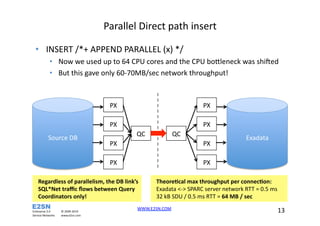
Parallel	
  Direct	
  path	
  insert	
  

   •  INSERT	
  /*+	
  APPEND	
  PARALLEL	
  (x)	
  */	
  
                     •  Now	
  we	
  used	
  up	
  to	
  64	
  CPU	
  cores	
  and	
  the	
  CPU	
  bo>leneck	
  was	
  shided	
  
                     •  But	
  this	
  gave	
  only	
  60-­‐70MB/sec	
  network	
  throughput!	


                                                           PX	
                                             PX	
  

                                                           PX	
                                             PX	
  
                                                                    QC	
                  QC	
  
                   Source	
  DB	
                                                                                                     Exadata	
  
                                                           PX	
                                             PX	
  

                                                           PX	
                                             PX	
  

       Regardless	
  of	
  parallelism,	
  the	
  DB	
  link’s	
                Theore4cal	
  max	
  throughput	
  per	
  connec4on:	
  
       SQL*Net	
  traffic	
  flows	
  between	
  Query	
                           Exadata	
  <-­‐>	
  SPARC	
  server	
  network	
  RTT	
  =	
  0.5	
  ms	
  
       Coordinators	
  only!	
                                                  32	
  kB	
  SDU	
  /	
  0.5	
  ms	
  RTT	
  =	
  64	
  MB	
  /	
  sec	
  

Enterprise	
  2.0	
               ©	
  2009-­‐2010	
  
                                                                    WWW.E2SN.COM	
  	
  	
                                                                13	


Service	
  Networks	
  	
  	
     www.e2sn.com	
  
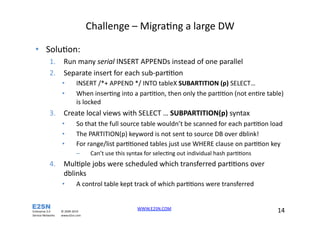
Challenge	
  –	
  MigraXng	
  a	
  large	
  DW	


   •  SoluXon:	
  
                     1.  Run	
  many	
  serial	
  INSERT	
  APPENDs	
  instead	
  of	
  one	
  parallel	
  
                     2.  Separate	
  insert	
  for	
  each	
  sub-­‐parXXon	
  
                                   •            INSERT	
  /*+	
  APPEND	
  */	
  INTO	
  tableX	
  SUBARTITION	
  (p)	
  SELECT…	
  
                                   •            When	
  inserXng	
  into	
  a	
  parXXon,	
  then	
  only	
  the	
  parXXon	
  (not	
  enXre	
  table)	
  
                                                is	
  locked	
  
                     3.  Create	
  local	
  views	
  with	
  SELECT	
  …	
  SUBPARTITION(p)	
  syntax	
  
                                   •            So	
  that	
  the	
  full	
  source	
  table	
  wouldn’t	
  be	
  scanned	
  for	
  each	
  parXXon	
  load	
  
                                   •            The	
  PARTITION(p)	
  keyword	
  is	
  not	
  sent	
  to	
  source	
  DB	
  over	
  dblink!	
  
                                   •            For	
  range/list	
  parXXoned	
  tables	
  just	
  use	
  WHERE	
  clause	
  on	
  parXXon	
  key	
  
                                                –         Can’t	
  use	
  this	
  syntax	
  for	
  selecXng	
  out	
  individual	
  hash	
  parXXons	
  
                     4.  MulXple	
  jobs	
  were	
  scheduled	
  which	
  transferred	
  parXXons	
  over	
  
                         dblinks	
  
                                   •            A	
  control	
  table	
  kept	
  track	
  of	
  which	
  parXXons	
  were	
  transferred	


Enterprise	
  2.0	
               ©	
  2009-­‐2010	
  
                                                                                     WWW.E2SN.COM	
  	
  	
                                                14	


Service	
  Networks	
  	
  	
     www.e2sn.com	
  
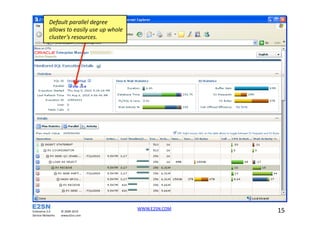
Default	
  parallel	
  degree	
  
                     allows	
  to	
  easily	
  use	
  up	
  whole	
  
                     cluster’s	
  resources.	


Enterprise	
  2.0	
               ©	
  2009-­‐2010	
  
                                                                        WWW.E2SN.COM	
  	
  	
     15	


Service	
  Networks	
  	
  	
     www.e2sn.com	
  
Checking	
  the	
  real	
  parallelism	
  -­‐	
  1	
  

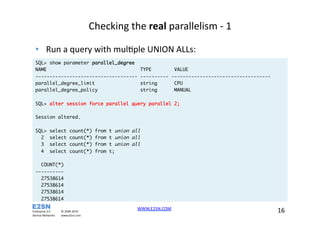
   •  Run	
  a	
  query	
  with	
  mulXple	
  UNION	
  ALLs:	
  
   SQL> show parameter parallel_degree	
   NAME                                                                      TYPE        VALUE	
   ------------------------------------                                      ---------- -----------------------------------	
   parallel_degree_limit                                                     string      CPU	
   parallel_degree_policy                                                    string      MANUAL	

   SQL> alter session force parallel query parallel 2;	

   Session altered.	

   SQL>              select               count(*)         from   t union all	
     2               select               count(*)         from   t union all	
     3               select               count(*)         from   t union all	
     4               select               count(*)         from   t;	

          COUNT(*)	
   ----------	
     27538614	
     27538614	
     27538614	
          27538614	

Enterprise	
  2.0	
               ©	
  2009-­‐2010	
  
                                                                           WWW.E2SN.COM	
  	
  	
                              16	


Service	
  Networks	
  	
  	
     www.e2sn.com	
  
Checking	
  the	
  real	
  parallelism	
  -­‐	
  2	
  

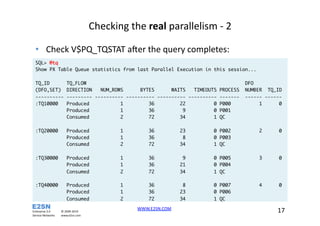
   •  Check	
  V$PQ_TQSTAT	
  ader	
  the	
  query	
  completes:	
  
   SQL> @tq	
   Show PX Table Queue statistics from last Parallel Execution in this session...	

   TQ_ID                               TQ_FLOW                                                         DFO	
   (DFO,SET)                           DIRECTION   NUM_ROWS      BYTES      WAITS   TIMEOUTS PROCESS NUMBER TQ_ID	
   ----------                          --------- ---------- ---------- ---------- ---------- ------- ------ ------	
   :TQ10000                            Produced           1         36         22          0 P000           1    0                           	
                                       Produced           1         36          9          0 P001    	
                                       Consumed           2         72         34          1 QC      	

   :TQ20000                            Produced                     1             36                  23   0 P002       2    0               	
                                       Produced                     1             36                   8   0 P003   	
                                       Consumed                     2             72                  34   1 QC     	

   :TQ30000                            Produced                     1             36                   9   0 P005       3    0               	
                                       Produced                     1             36                  21   0 P004   	
                                       Consumed                     2             72                  34   1 QC     	

   :TQ40000                            Produced                     1             36                   8   0 P007       4    0               	
                                       Produced                     1             36                  23   0 P006   	
                                       Consumed                     2             72                  34   1 QC 	

Enterprise	
  2.0	
               ©	
  2009-­‐2010	
  
                                                                           WWW.E2SN.COM	
  	
  	
                           17	


Service	
  Networks	
  	
  	
     www.e2sn.com	
  
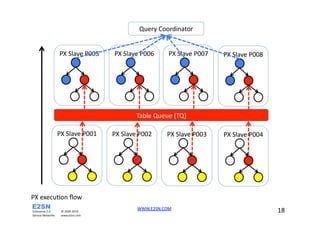
Query	
  Coordinator	


                                   PX	
  Slave	
  P005	
      PX	
  Slave	
  P006	
            PX	
  Slave	
  P007	
     PX	
  Slave	
  P008	


                                                                          Table	
  Queue	
  (TQ)	
  

                                  PX	
  Slave	
  P001	
      PX	
  Slave	
  P002	
            PX	
  Slave	
  P003	
      PX	
  Slave	
  P004	


PX	
  execuXon	
  flow	
  
Enterprise	
  2.0	
                 ©	
  2009-­‐2010	
  
                                                                           WWW.E2SN.COM	
  	
  	
                                                  18	


Service	
  Networks	
  	
  	
       www.e2sn.com	
  
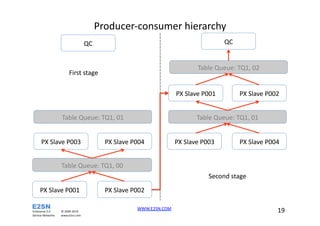
Producer-­‐consumer	
  hierarchy	
  
                                                         QC	
                                                                            QC	


                                                                                                                           Table	
  Queue:	
  TQ1,	
  02	
  
                                         First	
  stage	
  

                                                                                                               PX	
  Slave	
  P001	
              PX	
  Slave	
  P002	


                                  Table	
  Queue:	
  TQ1,	
  01	
                                                          Table	
  Queue:	
  TQ1,	
  01	


           PX	
  Slave	
  P003	
                                  PX	
  Slave	
  P004	
                        PX	
  Slave	
  P003	
              PX	
  Slave	
  P004	


                                  Table	
  Queue:	
  TQ1,	
  00	
  
                                                                                                                                 Second	
  stage	
  
         PX	
  Slave	
  P001	
                                    PX	
  Slave	
  P002	
  

Enterprise	
  2.0	
               ©	
  2009-­‐2010	
  
                                                                                    WWW.E2SN.COM	
  	
  	
                                                             19	


Service	
  Networks	
  	
  	
     www.e2sn.com	
  
Do	
  you	
  need	
  indexes	
  on	
  Exadata	
  or	
  not?	
  

   •  It	
  all	
  depends	
  on	
  whether	
  your	
  workload	
  &	
  physical	
  design	
  is	
  
      right	
  for	
  smart	
  full	
  scanning:	
  

                     1.  How	
  oden	
  and	
  how	
  selecXvely	
  you	
  access	
  data?	
  
                                   •            OLTP	
  databases	
  do	
  need	
  indexes!	
  
                                   •            Also	
  many	
  DWs	
  which	
  are	
  used	
  as	
  reference	
  data	
  lookup	
  warehouse,	
  not	
  
                                                just	
  for	
  bulk	
  reporXng	
  

                     2.  What	
  other	
  IO	
  eliminaXon	
  methods	
  you	
  have	
  in	
  place?	
  
                                   •            In	
  DW	
  &	
  reporXng	
  your	
  database	
  absolutely	
  needs	
  to	
  be	
  parXXoned	
  
                                   •            And	
  the	
  code	
  has	
  to	
  be	
  designed	
  for	
  parXXon	
  pruning	
  
                                   •            Storage	
  indexes	
  will	
  help	
  too	
  (unless	
  you	
  hit	
  a	
  bug),	
  but	
  parXXon	
  pruning	
  
                                                is	
  absolutely	
  needed	


Enterprise	
  2.0	
               ©	
  2009-­‐2010	
  
                                                                                WWW.E2SN.COM	
  	
  	
                                                      20	


Service	
  Networks	
  	
  	
     www.e2sn.com	
  
Exadata	
  Performance	
  An4paVerns	
  -­‐	
  DW	
  
   •  You	
  don’t	
  use	
  direct	
  path	
  full	
  table	
  scans	
  for	
  DW	
  &	
  reporXng	
  
                     •  Direct	
  path	
  reads	
  are	
  needed	
  for	
  smart	
  scan	
  to	
  kick	
  in	
  
                     •  Hash	
  join	
  bloom	
  filter	
  pushdown	
  to	
  storage	
  kicks	
  in	
  with	
  with	
  smart	
  scan	
  
                        only	
  

   •  You	
  sXll	
  rely	
  on	
  bitmap	
  indexes	
  because	
  of	
  past	
  
                     •  Bitmap	
  index-­‐based	
  access	
  ends	
  up	
  with	
  “random”	
  single	
  block	
  reads!	
  
                     •  Smart	
  scan	
  isn’t	
  used	
  with	
  single	
  block	
  reads	
  
                     •  NB!	
  If	
  your	
  schema	
  doesn’t	
  allow	
  good	
  parTTon	
  pruning,	
  then	
  bitmap	
  
                        index	
  access	
  may	
  sTll	
  be	
  the	
  next	
  best	
  opTon	
  for	
  DW	
  
                                    •  It	
  also	
  depends	
  on	
  the	
  nature	
  of	
  your	
  query	
  and	
  selecXviXes	
  of	
  predicates	


   •  You	
  don’t	
  limit	
  the	
  real	
  PX	
  parallelism	
  
                     •  Se€ng	
  parallel	
  degree	
  alone	
  does	
  not	
  limit	
  the	
  real	
  parallelism	
  
                     •  UnXl	
  11.2.0.2	
  the	
  Resource	
  Manager	
  is	
  only	
  way	
  to	
  limit	
  the	
  real	
  
                        paralellism	
  
                     •  parallel_degree_policy	
  =	
  auto	
  is	
  the	
  future	
  (seems	
  to	
  work	
  be>er	
  in	
  
                        11.2.0.2)	
  	
  
Enterprise	
  2.0	
               ©	
  2009-­‐2010	
  
                                                                             WWW.E2SN.COM	
  	
  	
                                                        21	


Service	
  Networks	
  	
  	
     www.e2sn.com	
  
Exadata	
  Performance	
  An4paVerns	
  -­‐	
  OLTP	
  
   •  Every	
  (valid)	
  RAC	
  performance	
  anXpa>ern	
  
                     •            As	
  Exadata	
  is	
  sXll	
  a	
  RAC	
  cluster	
  
                     •            8	
  nodes	
  or	
  2	
  nodes	
  (X2-­‐8)	
  per	
  full	
  rack	
  
                     •            gc	
  buffer	
  busy	
  wait	
  contenXon!	
  
                     •            You	
  should	
  be>er	
  do	
  some	
  workload	
  management	
  to	
  avoid	
  write-­‐write	
  
                                  contenXon	
  across	
  many	
  RAC	
  nodes	


   •  You	
  compress	
  frequently	
  used	
  data	
  with	
  QUERY/ARCHIVE	
  
                     •  Every	
  single	
  block/row	
  read	
  has	
  to	
  uncompress	
  the	
  whole	
  (zipped)	
  
                        compression	
  unit	
  –	
  big	
  overhead	
  when	
  fetching	
  many	
  single	
  rows	
  

   •  You	
  don’t	
  use	
  flash	
  cache	
  
                     •  Without	
  flash	
  cache,	
  Exadata	
  for	
  OLTP	
  workloads	
  is	
  no	
  different	
  from	
  a	
  
                        bunch	
  of	
  Linux	
  pizzaboxes	
  packed	
  into	
  a	
  rack	


Enterprise	
  2.0	
                ©	
  2009-­‐2010	
  
                                                                   WWW.E2SN.COM	
  	
  	
                                       22	


Service	
  Networks	
  	
  	
      www.e2sn.com	
  
Performance	
  bugs	
  and	
  slow	
  smart	
  scan	
  processing?	
  

   •  How	
  to	
  troubleshoot	
  slow	
  smart	
  scan	
  processing?	
  
                     •  Make	
  sure	
  direct	
  path	
  IO	
  is	
  used	
  
                     •  Smart	
  scan	
  is	
  usable	
  only	
  with	
  (serial	
  or	
  parallel)	
  direct	
  path	
  scans	


   •  How	
  to	
  check	
  what’s	
  happening	
  yourself?	
  
                     •  Use	
  a	
  systemaXc	
  approach	
  explained	
  in	
  my	
  arXcle:	
  
                                    •  h>p://tech.e2sn.com/oracle/exadata/performance-­‐troubleshooXng/
                                       exadata-­‐smart-­‐scan-­‐performance	
  
                                    •  Or	
  just	
  google	
  for	
  “troubleshooXng	
  exadata	
  performance”	


Enterprise	
  2.0	
               ©	
  2009-­‐2010	
  
                                                                 WWW.E2SN.COM	
  	
  	
                                                  23	


Service	
  Networks	
  	
  	
     www.e2sn.com	
  
Things	
  affecXng	
  direct	
  path	
  read	
  decisions	
  

   •  Serial	
  execuXon	
  can	
  switch	
  to	
  direct	
  path	
  reads	
  
                     •            Dynamic	
  adapXve	
  direct	
  reads	
  
                     •            _small_table_threshold	
  
                     •            _very_large_table_threshold	
  
                     •            Segment’s	
  cached	
  block	
  count	
  (	
  X$KCBOQH.NUM_BUF	
  )	


   •  Parallel	
  ExecuXon	
  can	
  switch	
  to	
  buffered	
  reads	
  in	
  11.2	
  
                     •  When	
  parallel_degree_policy	
  =	
  AUTO	
  
                     •  Buffered	
  reads	
  =	
  no	
  smart	
  scan	


Enterprise	
  2.0	
                ©	
  2009-­‐2010	
  
                                                                 WWW.E2SN.COM	
  	
  	
                     24	


Service	
  Networks	
  	
  	
      www.e2sn.com	
  
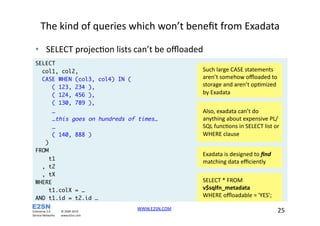
The	
  kind	
  of	
  queries	
  which	
  won’t	
  benefit	
  from	
  Exadata	
  

   •  SELECT	
  projecXon	
  lists	
  can’t	
  be	
  offloaded	
  
   SELECT 	
     col1, col2,	                                                                   Such	
  large	
  CASE	
  statements	
  
     CASE WHEN (col3, col4) IN (	                                                   aren’t	
  somehow	
  offloaded	
  to	
  
         ( 123, 234 ), 	                                                            storage	
  and	
  aren’t	
  opXmized	
  
         ( 124, 456 ),	                                                             by	
  Exadata	
  
         ( 130, 789 ), 	
         …	                                                                         Also,	
  exadata	
  can’t	
  do	
  
         …this goes on hundreds of times…	                                          anything	
  about	
  expensive	
  PL/
         … 	                                                                        SQL	
  funcXons	
  in	
  SELECT	
  list	
  or	
  
         ( 140, 888 )	                                                              WHERE	
  clause	
  
      )	
   FROM	
                                                                                    Exadata	
  is	
  designed	
  to	
  find	
  
       t1	
                                                                                    matching	
  data	
  efficiently	
  
     , t2	
     , tX	
   WHERE	                                                                           SELECT	
  *	
  FROM	
  
       t1.colX = …	                                                                 v$sqlfn_metadata	
  	
  
   AND t1.id = t2.id …	
                                                                                    WHERE	
  offloadable	
  =	
  'YES';	
  

Enterprise	
  2.0	
               ©	
  2009-­‐2010	
  
                                                         WWW.E2SN.COM	
  	
  	
                                                    25	


Service	
  Networks	
  	
  	
     www.e2sn.com	
  
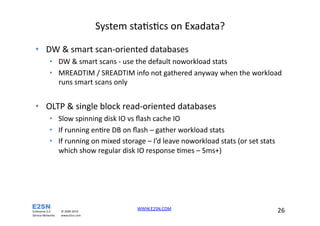
System	
  staXsXcs	
  on	
  Exadata?	
  

   •  DW	
  &	
  smart	
  scan-­‐oriented	
  databases	
  
                     •  DW	
  &	
  smart	
  scans	
  -­‐	
  use	
  the	
  default	
  noworkload	
  stats	
  
                     •  MREADTIM	
  /	
  SREADTIM	
  info	
  not	
  gathered	
  anyway	
  when	
  the	
  workload	
  
                        runs	
  smart	
  scans	
  only	


   •  OLTP	
  &	
  single	
  block	
  read-­‐oriented	
  databases	
  
                     •  Slow	
  spinning	
  disk	
  IO	
  vs	
  flash	
  cache	
  IO	
  
                     •  If	
  running	
  enXre	
  DB	
  on	
  flash	
  –	
  gather	
  workload	
  stats	
  
                     •  If	
  running	
  on	
  mixed	
  storage	
  –	
  I’d	
  leave	
  noworkload	
  stats	
  (or	
  set	
  stats	
  
                        which	
  show	
  regular	
  disk	
  IO	
  response	
  Xmes	
  –	
  5ms+)	


Enterprise	
  2.0	
               ©	
  2009-­‐2010	
  
                                                                     WWW.E2SN.COM	
  	
  	
                                              26	


Service	
  Networks	
  	
  	
     www.e2sn.com	
  
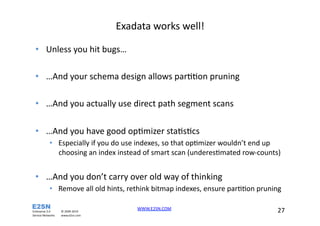
Exadata	
  works	
  well!	
  

   •  Unless	
  you	
  hit	
  bugs…	
  

   •  …And	
  your	
  schema	
  design	
  allows	
  parXXon	
  pruning	
  

   •  …And	
  you	
  actually	
  use	
  direct	
  path	
  segment	
  scans	
  

   •  …And	
  you	
  have	
  good	
  opXmizer	
  staXsXcs	
  
                     •  Especially	
  if	
  you	
  do	
  use	
  indexes,	
  so	
  that	
  opXmizer	
  wouldn’t	
  end	
  up	
  
                        choosing	
  an	
  index	
  instead	
  of	
  smart	
  scan	
  (underesXmated	
  row-­‐counts)	


   •  …And	
  you	
  don’t	
  carry	
  over	
  old	
  way	
  of	
  thinking	
  
                     •  Remove	
  all	
  old	
  hints,	
  rethink	
  bitmap	
  indexes,	
  ensure	
  parXXon	
  pruning	


Enterprise	
  2.0	
               ©	
  2009-­‐2010	
  
                                                               WWW.E2SN.COM	
  	
  	
                                       27	


Service	
  Networks	
  	
  	
     www.e2sn.com	
  
QuesXons?!	


                                                                       Thanks!!!	
  	
  
                                                             tanel@tanelpoder.com	
  
                                                                         ^^^^	
  
                                                               Further	
  quesXons,	
  	
  
                                                         exadata	
  consolidaXon,	
  migraXon,	
  
                                                         troubleshooXng,	
  performance	
  	
  
                                                               &	
  capacity	
  planning	
  

Enterprise	
  2.0	
               ©	
  2009-­‐2010	
  
                                                                    WWW.E2SN.COM	
  	
  	
           28	


Service	
  Networks	
  	
  	
     www.e2sn.com