gluent.com 1
SQL	
  in	
  the	
  Hybrid	
  World
Tanel	
  Poder
a	
  long	
  time	
  computer	
  performance	
  geek
gluent.com 2
Intro:	
  About	
  me
• Tanel	
  Põder
• Oracle	
  Database	
  Performance	
  geek	
  (18+	
  years)
• Exadata	
  Performance	
  geek
• Linux	
  Performance	
  geek
• Hadoop	
  Performance	
  geek
• CEO	
  &	
  co-­‐founder:
Expert	
  Oracle	
  Exadata	
  
book
(2nd edition	
  is	
  out	
  now!)
Instant	
  
promotion
gluent.com 3
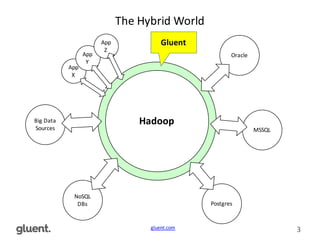
The	
  Hybrid	
  World
GluentHadoop
Gluent
MSSQL
Postgres
NoSQL	
  
DBs
Big	
  Data	
  
Sources
Oracle
App	
  
X
App	
  
Y
App	
  
Z
gluent.com 4
Why	
  this	
  talk?
• Various	
  NoSQL	
  databases	
  and	
  Hadoop	
  projects	
  are	
  very	
  hot!
• Is	
  this	
  stuff	
  for	
  real?
• I’m	
  mainly	
  talking	
  about	
  traditional	
  enterprises
• Not	
  small	
  startups
• Not	
  web/mobile	
  giants
• This	
  is	
  not	
  an	
  academic	
  analysis	
  of	
  data	
  consistency	
  theorems
• A	
  basic	
  reasoning	
  from	
  a	
  database	
  professional’s	
  point	
  of	
  view…
But	
  hey,	
  it’s	
  2016!
gluent.com 5
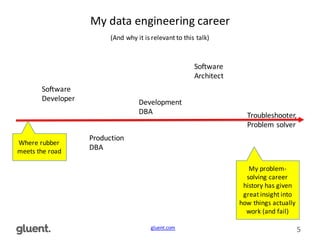
My	
  data	
  engineering	
  career
Software	
  
Developer
Production	
  
DBA
Software	
  
Architect
Development	
  
DBA Troubleshooter,	
  
Problem	
  solver
My	
  problem-­‐
solving	
  career	
  
history	
  has	
  given	
  
great	
  insight	
  into	
  
how	
  things	
  actually	
  
work	
  (and	
  fail)
(And	
  why	
  it	
  is	
  relevant	
  to	
  this	
  talk)
Where	
  rubber	
  
meets	
  the	
  road
gluent.com 6
NoSQL
gluent.com 7
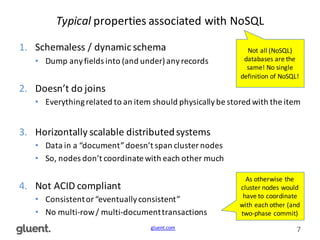
Typical properties	
  associated	
  with	
  NoSQL
1. Schemaless	
  /	
  dynamic	
  schema
• Dump	
  any	
  fields	
  into	
  (and	
  under)	
  any	
  records
2. Doesn’t	
  do	
  joins
• Everything	
  related	
  to	
  an	
  item	
  should	
  physically	
  be	
  stored	
  with	
  the	
  item
3. Horizontally	
  scalable	
  distributed	
  systems
• Data	
  in	
  a	
  “document”	
  doesn’t	
  span	
  cluster	
  nodes
• So,	
  nodes	
  don’t	
  coordinate	
  with	
  each	
  other	
  much
4. Not	
  ACID	
  compliant
• Consistent	
  or	
  “eventually	
  consistent”
• No	
  multi-­‐row	
  /	
  multi-­‐document	
  transactions
Not	
  all	
  (NoSQL)	
  
databases	
  are	
  the	
  
same!	
  No	
  single	
  
definition	
  of	
  NoSQL!
As	
  otherwise	
  the	
  
cluster	
  nodes	
  would	
  
have	
  to	
  coordinate	
  
with	
  each	
  other	
  (and	
  
two-­‐phase	
  commit)
gluent.com 8
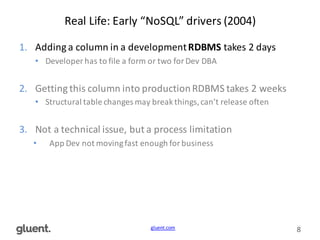
Real	
  Life:	
  Early	
  “NoSQL”	
  drivers	
  (2004)
1. Adding	
  a	
  column	
  in	
  a	
  development	
  RDBMS takes	
  2	
  days
• Developer	
  has	
  to	
  file	
  a	
  form	
  or	
  two	
  for	
  Dev	
  DBA
2. Getting	
  this	
  column	
  into	
  production	
  RDBMS	
  takes	
  2	
  weeks
• Structural	
  table	
  changes	
  may	
  break	
  things,	
  can’t	
  release	
  often
3. Not	
  a	
  technical	
  issue,	
  but	
  a	
  process	
  limitation
• App	
  Dev	
  not	
  moving	
  fast	
  enough	
  for	
  business
gluent.com 9
Real	
  Life:	
  Early	
  “NoSQL”	
  drivers
4. Developers	
  didn’t	
  like	
  the	
  organizational	
  slowness,	
  so:
• Reaction:	
  Using	
  catch-­‐all	
  XML	
  columns	
  and	
  generic	
  entity-­‐attribute-­‐
value	
  designs	
  for	
  “dynamic”	
  data	
  models
• Result:	
  RDBMS	
  Performance	
  problems	
  with	
  real	
  datasets
• Conclusion:	
  “RDBMS	
  are	
  too	
  slow	
  for	
  modern	
  applications”
• Actual	
  reality:	
  You	
  should	
  use	
  relational	
  databases	
  in	
  a	
  relational	
  way
gluent.com 10
“Joins	
  are	
  slow!”
Compared	
  to	
  what?
gluent.com 11
Real	
  Life:	
  Joins	
  are	
  slow!	
  (MySQL	
  edition)
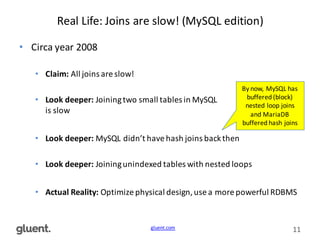
• Circa	
  year	
  2008
• Claim:	
  All	
  joins	
  are	
  slow!
• Look	
  deeper:	
  Joining	
  two	
  small	
  tables	
  in	
  MySQL	
  
is	
  slow
• Look	
  deeper:	
  MySQL	
  didn’t	
  have	
  hash	
  joins	
  back	
  then
• Look	
  deeper:	
  Joining	
  unindexed	
  tables	
  with	
  nested	
  loops
• Actual	
  Reality:	
  Optimize	
  physical	
  design,	
  use	
  a	
  more	
  powerful	
  RDBMS
By	
  now,	
  MySQL	
  has	
  
buffered	
  (block)	
  
nested	
  loop	
  joins	
  
and	
  MariaDB
buffered	
  hash	
  joins
gluent.com 12
Joins	
  are	
  slow!	
  (modern	
  scale-­‐out	
  edition)
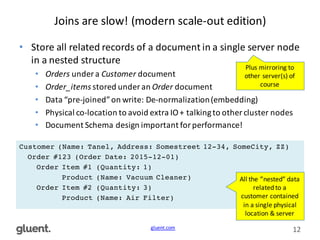
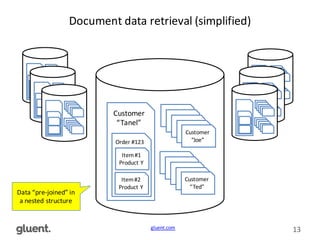
• Store	
  all	
  related	
  records	
  of	
  a	
  document	
  in	
  a	
  single	
  server	
  node	
  
in	
  a	
  nested	
  structure
• Orders under	
  a	
  Customer document
• Order_items stored	
  under	
  an	
  Order document
• Data	
  “pre-­‐joined”	
  on	
  write:	
  De-­‐normalization	
  (embedding)
• Physical	
  co-­‐location	
  to	
  avoid	
  extra	
  IO	
  +	
  talking	
  to	
  other	
  cluster	
  nodes
• Document	
  Schema	
  design	
  important	
  for	
  performance!
Customer (Name: Tanel, Address: Somestreet 12-34, SomeCity, ZZ)
Order #123 (Order Date: 2015-12-01)
Order Item #1 (Quantity: 1)
Product (Name: Vacuum Cleaner)
Order Item #2 (Quantity: 3)
Product (Name: Air Filter)
All	
  the	
  ”nested”	
  data	
  
related	
  to	
  a	
  
customer	
  contained	
  
in	
  a	
  single	
  physical	
  
location	
  &	
  server
Plus	
  mirroring	
  to	
  
other	
  server(s)	
  of	
  
course
gluent.com 13
Document	
  data	
  retrieval	
  (simplified)
Customer
“Tanel”
Order	
  #123
Item	
  #2
Product	
  Y
Customer
“Ted”
Customer
“Joe”
Item	
  #1
Product	
  Y
Data	
  “pre-­‐joined”	
  in	
  
a	
  nested	
  structure
gluent.com 14
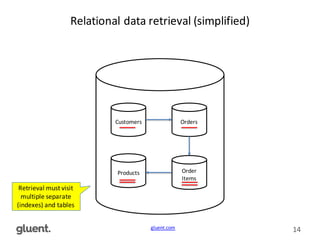
Relational	
  data	
  retrieval	
  (simplified)
Customers Orders
Order	
  
Items
Products
Retrieval	
  must	
  visit	
  
multiple	
  separate	
  
(indexes)	
  and	
  tables
gluent.com 15
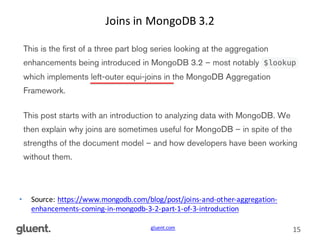
Joins	
  in	
  MongoDB	
  3.2
• Source:	
  https://www.mongodb.com/blog/post/joins-­‐and-­‐other-­‐aggregation-­‐
enhancements-­‐coming-­‐in-­‐mongodb-­‐3-­‐2-­‐part-­‐1-­‐of-­‐3-­‐introduction
gluent.com 16
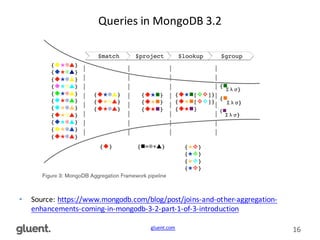
Queries	
  in	
  MongoDB	
  3.2
• Source:	
  https://www.mongodb.com/blog/post/joins-­‐and-­‐other-­‐aggregation-­‐
enhancements-­‐coming-­‐in-­‐mongodb-­‐3-­‐2-­‐part-­‐1-­‐of-­‐3-­‐introduction
gluent.com 17
Filtering	
  in	
  MongoDB	
  3.2
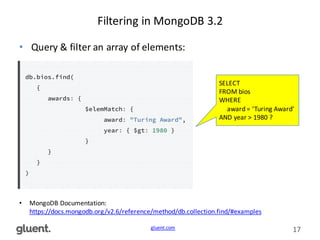
• Query	
  &	
  filter	
  an	
  array	
  of	
  elements:
• MongoDB	
  Documentation:	
  
https://docs.mongodb.org/v2.6/reference/method/db.collection.find/#examples
SELECT
FROM	
  bios
WHERE	
  
award	
  =	
  ‘Turing	
  Award’	
  
AND	
  year	
  >	
  1980	
  ?
gluent.com 18
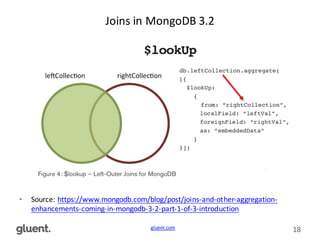
Joins	
  in	
  MongoDB	
  3.2
• Source:	
  https://www.mongodb.com/blog/post/joins-­‐and-­‐other-­‐aggregation-­‐
enhancements-­‐coming-­‐in-­‐mongodb-­‐3-­‐2-­‐part-­‐1-­‐of-­‐3-­‐introduction
gluent.com 19
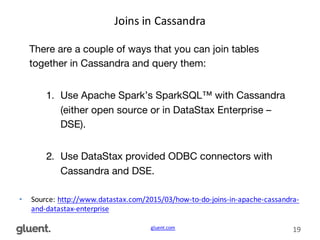
Joins	
  in	
  Cassandra
• Source:	
  http://www.datastax.com/2015/03/how-­‐to-­‐do-­‐joins-­‐in-­‐apache-­‐cassandra-­‐
and-­‐datastax-­‐enterprise
gluent.com 20
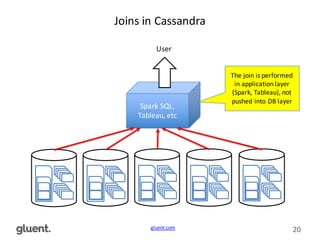
Joins	
  in	
  Cassandra
Spark	
  SQL,	
  
Tableau,	
  etc
The	
  join	
  is	
  performed	
  
in	
  application	
  layer	
  
(Spark,	
  Tableau),	
  not	
  
pushed	
  into	
  DB	
  layer
User
gluent.com 21
Hadoop!
SQL	
  on
gluent.com 22
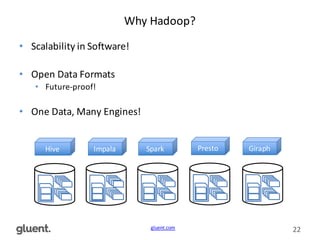
Why	
  Hadoop?
• Scalability	
  in	
  Software!
• Open	
  Data	
  Formats
• Future-­‐proof!
• One	
  Data,	
  Many	
  Engines!
Hive Impala Spark Presto Giraph
gluent.com 23
Scalability	
  vs.	
  Features	
  (Hive	
  example)
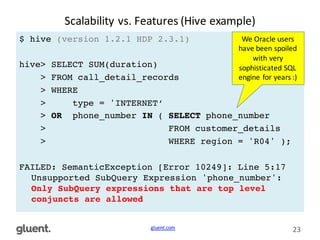
$ hive (version 1.2.1 HDP 2.3.1)
hive> SELECT SUM(duration)
> FROM call_detail_records
> WHERE
> type = 'INTERNET‘
> OR phone_number IN ( SELECT phone_number
> FROM customer_details
> WHERE region = 'R04' );
FAILED: SemanticException [Error 10249]: Line 5:17
Unsupported SubQuery Expression 'phone_number':
Only SubQuery expressions that are top level
conjuncts are allowed
We	
  Oracle	
  users	
  
have	
  been	
  spoiled	
  
with	
  very	
  
sophisticated	
  SQL	
  
engine	
  for	
  years	
  :)
gluent.com 24
Scalability	
  vs.	
  Features	
  (Impala	
  example)
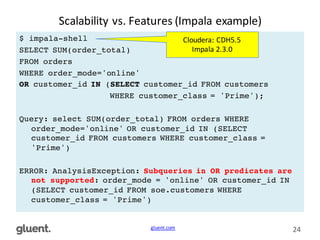
$ impala-shell
SELECT SUM(order_total)
FROM orders
WHERE order_mode='online'
OR customer_id IN (SELECT customer_id FROM customers
WHERE customer_class = 'Prime');
Query: select SUM(order_total) FROM orders WHERE
order_mode='online' OR customer_id IN (SELECT
customer_id FROM customers WHERE customer_class =
'Prime')
ERROR: AnalysisException: Subqueries in OR predicates are
not supported: order_mode = 'online' OR customer_id IN
(SELECT customer_id FROM soe.customers WHERE
customer_class = 'Prime')
Cloudera:	
  CDH5.5	
  
Impala	
  2.3.0
gluent.com 25
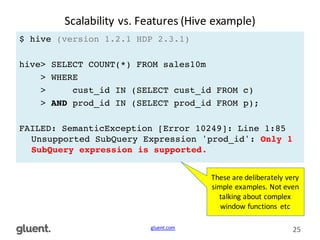
Scalability	
  vs.	
  Features	
  (Hive	
  example)
$ hive (version 1.2.1 HDP 2.3.1)
hive> SELECT COUNT(*) FROM sales10m
> WHERE
> cust_id IN (SELECT cust_id FROM c)
> AND prod_id IN (SELECT prod_id FROM p);
FAILED: SemanticException [Error 10249]: Line 1:85
Unsupported SubQuery Expression 'prod_id': Only 1
SubQuery expression is supported.
These	
  are	
  deliberately	
  very	
  
simple	
  examples.	
  Not	
  even	
  
talking	
  about	
  complex	
  
window	
  functions	
   etc
gluent.com 26
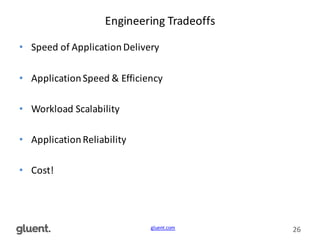
Engineering	
  Tradeoffs
• Speed	
  of	
  Application	
  Delivery
• Application	
  Speed	
  &	
  Efficiency
• Workload	
  Scalability
• Application	
  Reliability
• Cost!
gluent.com 27
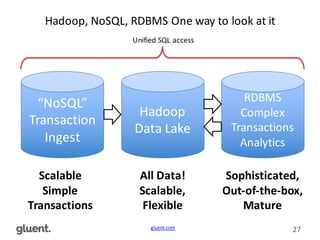
Hadoop,	
  NoSQL,	
  RDBMS	
  One	
  way	
  to	
  look	
  at	
  it
Hadoop
Data	
  Lake
RDBMS
Complex	
  
Transactions
Analytics
All	
  Data!	
  
Scalable,
Flexible
Sophisticated,
Out-­‐of-­‐the-­‐box,
Mature
“NoSQL”	
  
Transaction	
  
Ingest
Scalable	
  
Simple
Transactions
Unified	
  SQL	
  access
gluent.com 28
Thanks!
http://blog.tanelpoder.com
tanel@tanelpoder.com
@tanelpoder
We	
  are	
  hiring	
  developers	
  &	
  data	
  engineers!!!
http://gluent.com