Talent
Management-The
PCMM way
2© 2015 KPMG, an Indian Partnership and a member firm of the KPMG network of independent member firms affiliated with KPMG International Cooperative (“KPMG
International”), a Swiss entity. All rights reserved.
Talent Management
Talent management is the science of using strategic human resource
planning to improve business value and to make it possible for companies
and organizations to reach their goals.
Everything done to recruit, retain, develop, reward and make people
perform forms a part of talent management as well as strategic workforce
planning. A talent-management strategy needs to link to business strategy
to make sense
Talent Management-The PCMM way
Core People
Issues
4© 2015 KPMG, an Indian Partnership and a member firm of the KPMG network of independent member firms affiliated with KPMG International Cooperative (“KPMG
International”), a Swiss entity. All rights reserved.
5© 2015 KPMG, an Indian Partnership and a member firm of the KPMG network of independent member firms affiliated with KPMG International Cooperative (“KPMG
International”), a Swiss entity. All rights reserved.
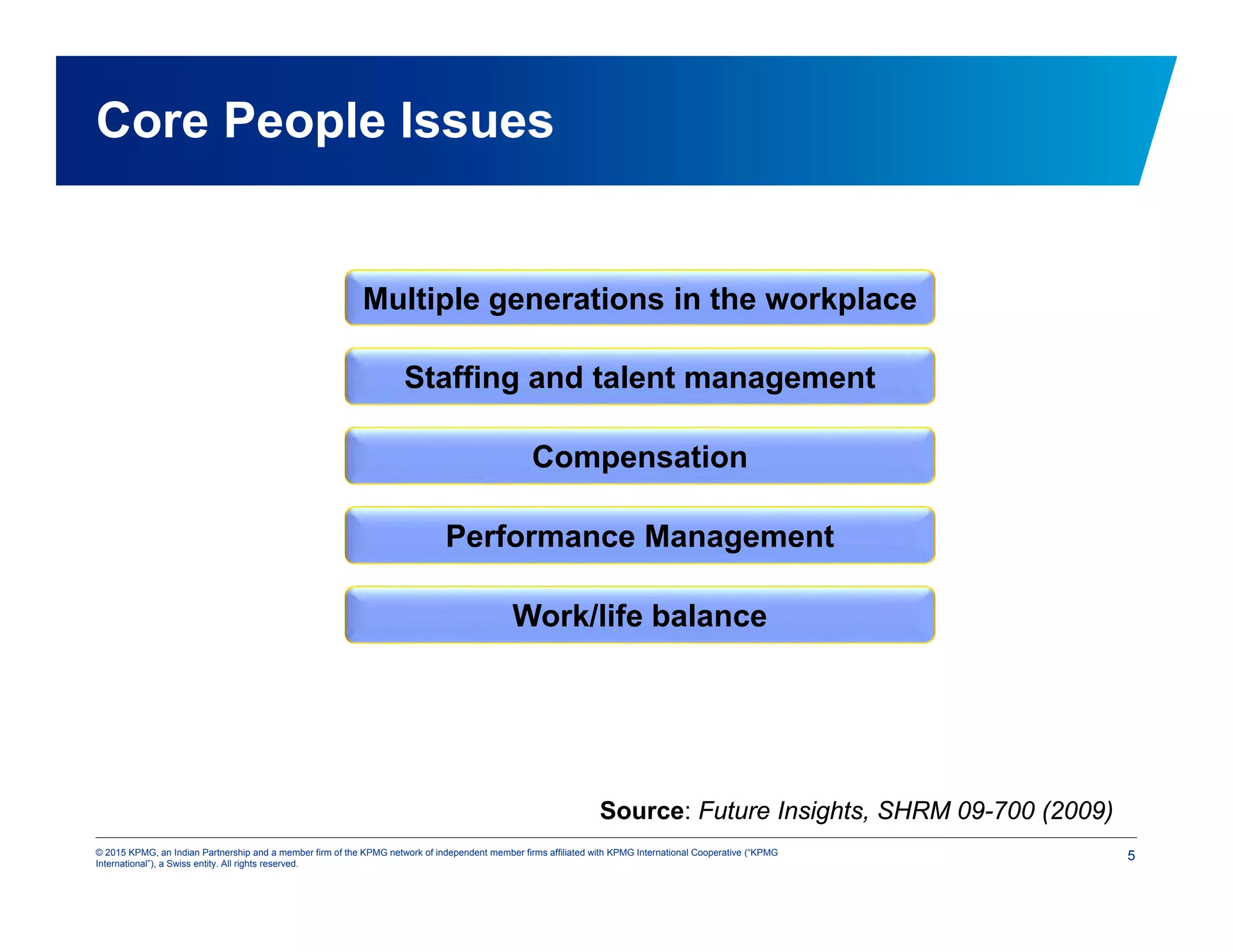
Core People Issues
Staffing and talent management
Compensation
Source: Future Insights, SHRM 09-700 (2009)
Multiple generations in the workplace
Performance Management
Work/life balance
6© 2015 KPMG, an Indian Partnership and a member firm of the KPMG network of independent member firms affiliated with KPMG International Cooperative (“KPMG
International”), a Swiss entity. All rights reserved.
Source: Towers Watson 2014 Global Workforce Study
Engagement Segments
7© 2015 KPMG, an Indian Partnership and a member firm of the KPMG network of independent member firms affiliated with KPMG International Cooperative (“KPMG
International”), a Swiss entity. All rights reserved.
Source: Towers Watson 2014 Global Workforce Study
Top Drivers for Sustainable Engagement
8© 2015 KPMG, an Indian Partnership and a member firm of the KPMG network of independent member firms affiliated with KPMG International Cooperative (“KPMG
International”), a Swiss entity. All rights reserved.
Source: Towers Watson 2014 Global Workforce Study
Attraction and Retention Drivers
9© 2015 KPMG, an Indian Partnership and a member firm of the KPMG network of independent member firms affiliated with KPMG International Cooperative (“KPMG
International”), a Swiss entity. All rights reserved.
10© 2015 KPMG, an Indian Partnership and a member firm of the KPMG network of independent member firms affiliated with KPMG International Cooperative (“KPMG
International”), a Swiss entity. All rights reserved.
Who’s Managing the Organization’s Assets?
“Our greatest asset is our People”
Yet, many organizations leave the management of their
greatest asset, to “managers”, who have limited experience,
skills, or information to be effective managers.
Managers impact
• perception of the organization
— manager represents the company
• retention
— people leave manager first, company second
• performance
• morale
• unit‘s bottom-line
11© 2015 KPMG, an Indian Partnership and a member firm of the KPMG network of independent member firms affiliated with KPMG International Cooperative (“KPMG
International”), a Swiss entity. All rights reserved.
The “Manager”: A People CMM Perspective
A manager
• accepts stewardship of a resource
• provides technical and administrative direction and
control to individual performing tasks
• develops and optimizes the conditions affecting
success
• plans, resources, and controls work within their
responsibility
Many “types” of managers
• senior manager, middle manager line manager, team leader, etc.
12© 2015 KPMG, an Indian Partnership and a member firm of the KPMG network of independent member firms affiliated with KPMG International Cooperative (“KPMG
International”), a Swiss entity. All rights reserved.
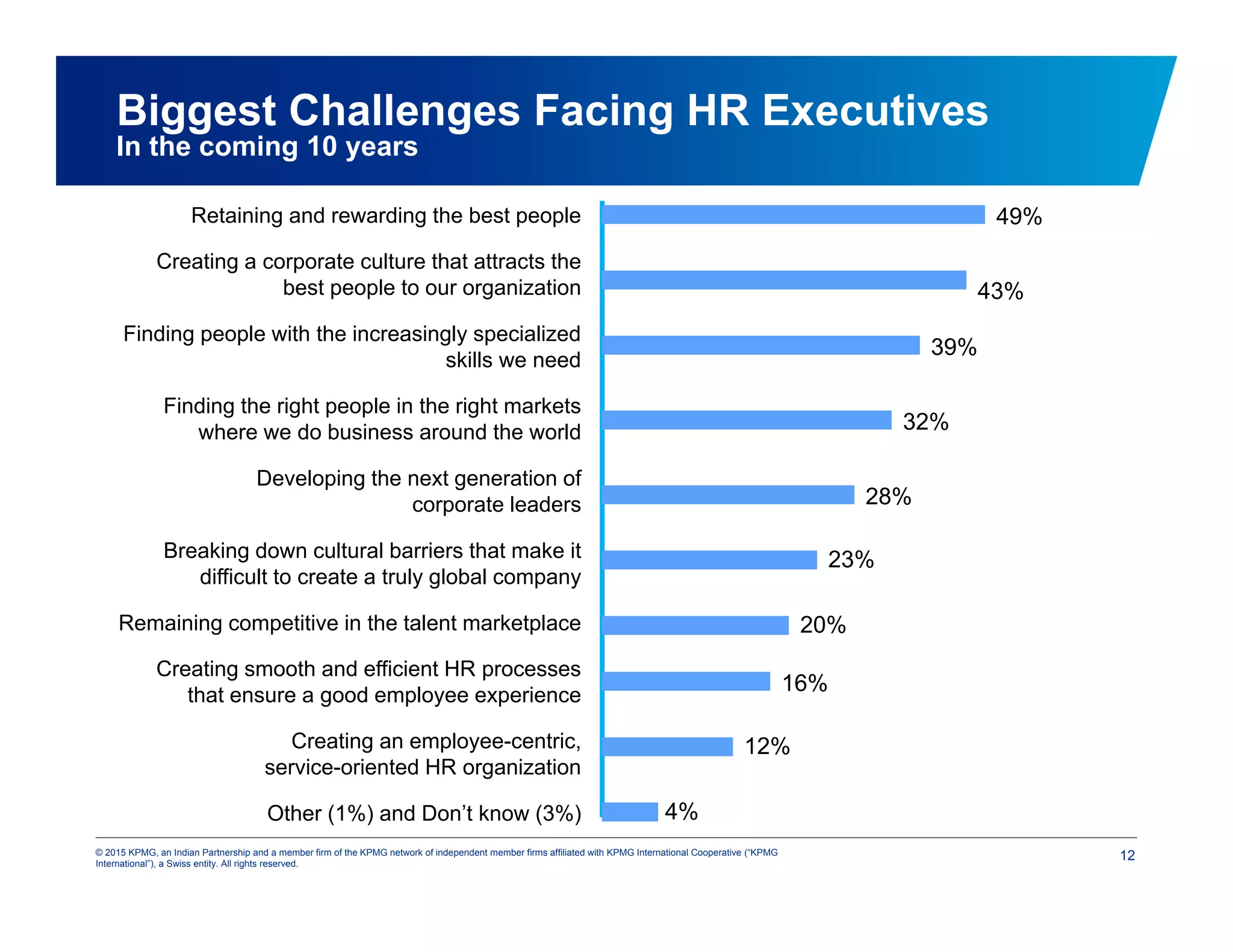
Biggest Challenges Facing HR Executives
In the coming 10 years
49%
43%
Retaining and rewarding the best people
Creating a corporate culture that attracts the
best people to our organization
Finding people with the increasingly specialized
skills we need
Developing the next generation of
corporate leaders
Breaking down cultural barriers that make it
difficult to create a truly global company
Remaining competitive in the talent marketplace
Creating smooth and efficient HR processes
that ensure a good employee experience
Creating an employee-centric,
service-oriented HR organization
Other (1%) and Don’t know (3%)
32%
Finding the right people in the right markets
where we do business around the world
39%
28%
23%
20%
16%
12%
4%
PCMM Maturity
Framework
14© 2015 KPMG, an Indian Partnership and a member firm of the KPMG network of independent member firms affiliated with KPMG International Cooperative (“KPMG
International”), a Swiss entity. All rights reserved.
PCMM Maturity Framework
Humphrey (1989), Paulk et al. (1995),
Cutis et al. (1995)
Managed
practices
Tailored
practices
Measured
and aligned
practices
Continuously
improving
practices
People
management
Competence
management
Team
management
Capability
management
Level 1
Initial
Level 2
Managed
Level 3
Defined
Level 4
Predictable
Level 5
Optimizing
15© 2015 KPMG, an Indian Partnership and a member firm of the KPMG network of independent member firms affiliated with KPMG International Cooperative (“KPMG
International”), a Swiss entity. All rights reserved.
People CMM Architecture
1
Initial
2
Managed
Managers take
responsibility for
managing and
developing their people
Compensation
Training & Development
Performance Management
Staffing
Communication & Co-ordination
Work Environment
3
Defined
Organization develops a
framework of workforce
Competencies required
to accomplish its
business objectives
Participatory Culture
Workgroup Development
Competency-Based Practices
Career Development
Competency Development
Workforce Planning
Competency Analysis
4
Predictable
Capability is managed
quantitatively and the
organization exploits
its opportunities in its
competency framework
Mentoring
Organizational Capability Management
Quantitative Performance Management
Empowered workgroup
Competency-Based Assets
Competency Integration
5
Optimizing
Capability and
performance continually
improved
Continuous Workforce Innovation
Organizational Performance Alignment
Continuous Capability Improvement
Level Focus Key Process Areas
16© 2015 KPMG, an Indian Partnership and a member firm of the KPMG network of independent member firms affiliated with KPMG International Cooperative (“KPMG
International”), a Swiss entity. All rights reserved.
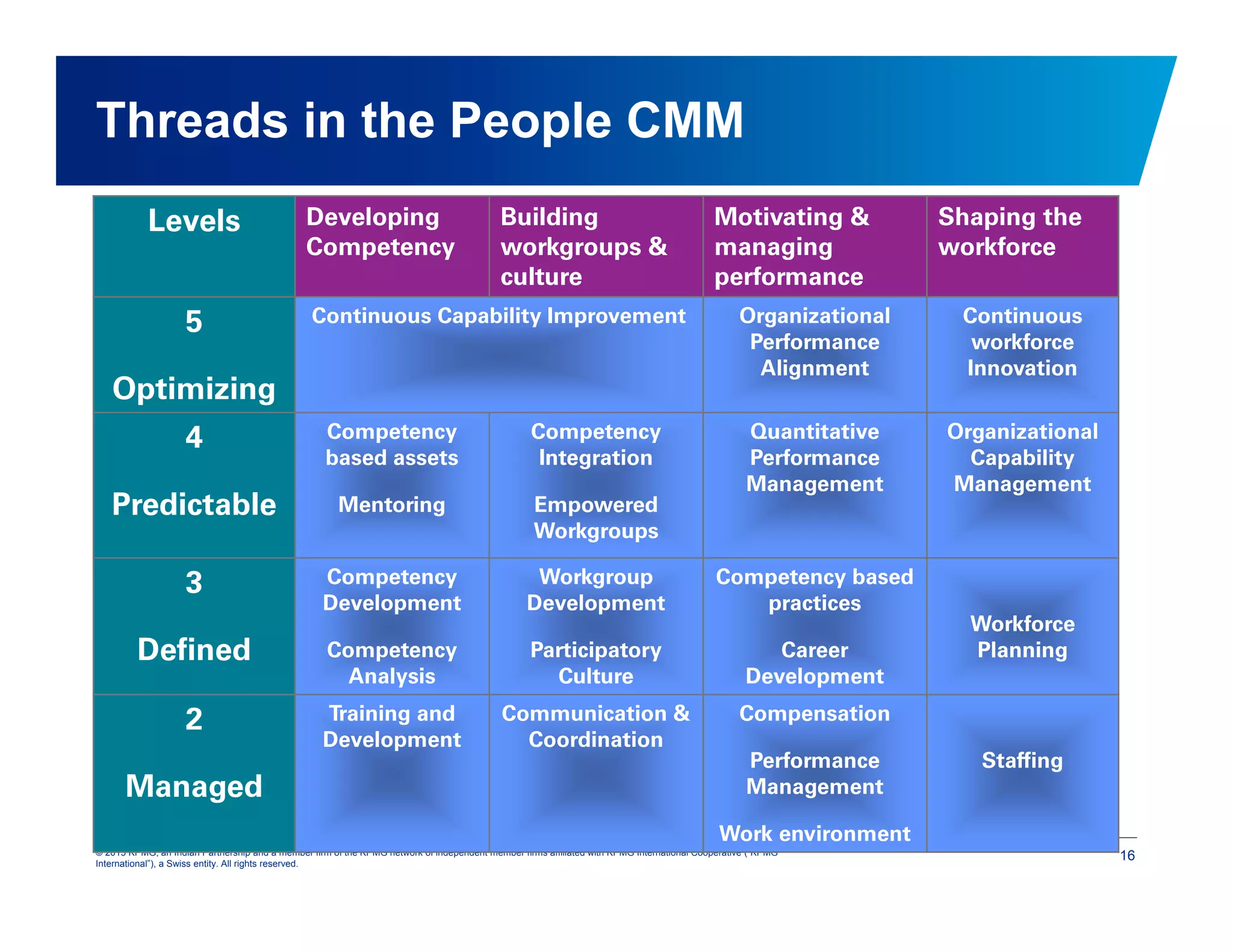
Threads in the People CMM
Levels Developing
Competency
Building
workgroups &
culture
Motivating &
managing
performance
Shaping the
workforce
5
Optimizing
Continuous Capability Improvement Organizational
Performance
Alignment
Continuous
workforce
Innovation
4
Predictable
Competency
based assets
Mentoring
Competency
Integration
Empowered
Workgroups
Quantitative
Performance
Management
Organizational
Capability
Management
3
Defined
Competency
Development
Competency
Analysis
Workgroup
Development
Participatory
Culture
Competency based
practices
Career
Development
Workforce
Planning
2
Managed
Training and
Development
Communication &
Coordination
Compensation
Performance
Management
Work environment
Staffing
17© 2015 KPMG, an Indian Partnership and a member firm of the KPMG network of independent member firms affiliated with KPMG International Cooperative (“KPMG
International”), a Swiss entity. All rights reserved.
18© 2015 KPMG, an Indian Partnership and a member firm of the KPMG network of independent member firms affiliated with KPMG International Cooperative (“KPMG
International”), a Swiss entity. All rights reserved.
Getting Started
20© 2015 KPMG, an Indian Partnership and a member firm of the KPMG network of independent member firms affiliated with KPMG International Cooperative (“KPMG
International”), a Swiss entity. All rights reserved.
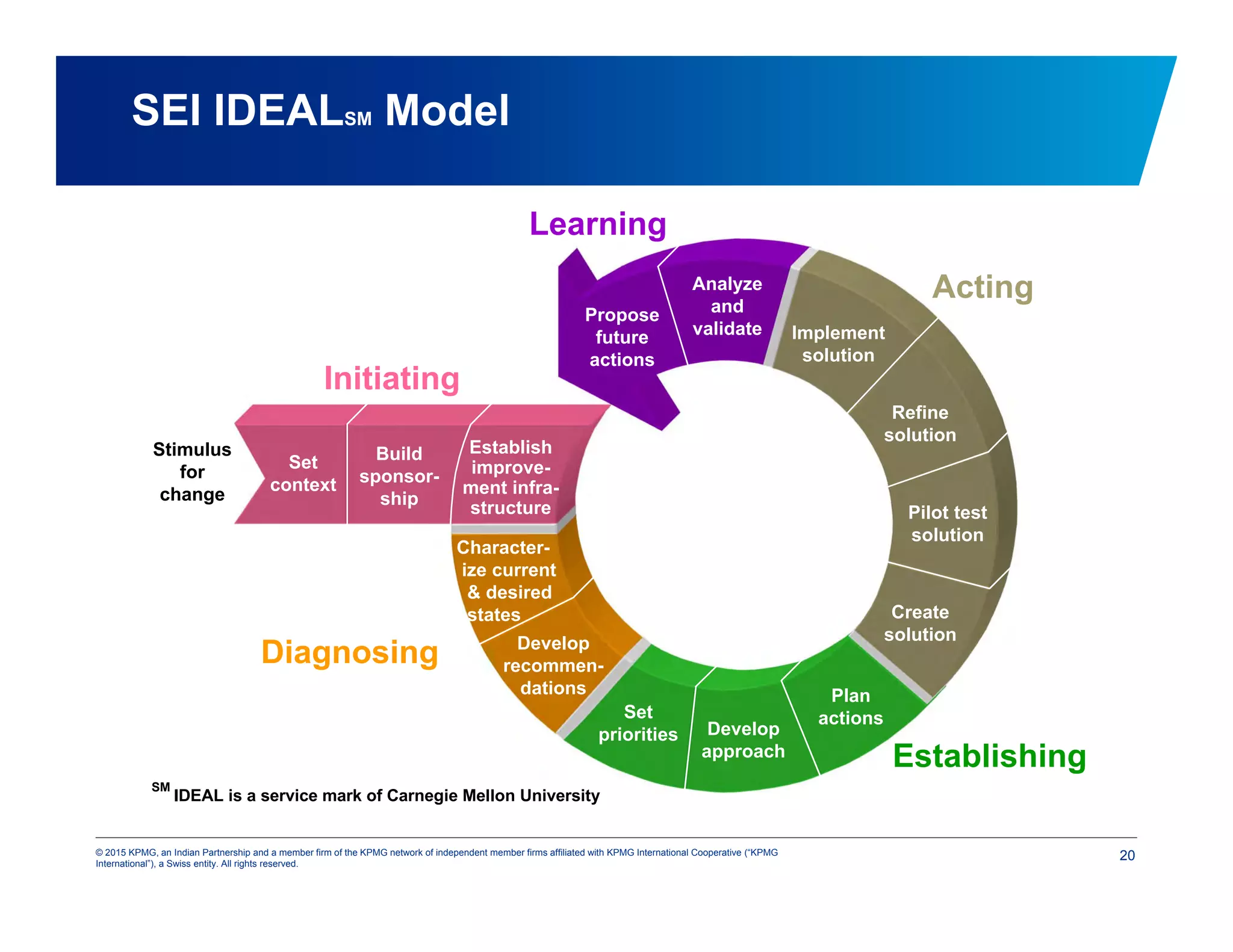
SEI IDEALSM Model
Establish
improve-
ment infra-
structure
Learning
Establishing
Acting
Stimulus
for
change
Set
context
Build
sponsor-
ship
Character-
ize current
& desired
states
Develop
recommen-
dations
Set
priorities Develop
approach
Plan
actions
Create
solution
Pilot test
solution
Refine
solution
Implement
solution
Analyze
and
validate
Propose
future
actions
Diagnosing
Initiating
SM
IDEAL is a service mark of Carnegie Mellon University
A Few
Experiences
22© 2015 KPMG, an Indian Partnership and a member firm of the KPMG network of independent member firms affiliated with KPMG International Cooperative (“KPMG
International”), a Swiss entity. All rights reserved.
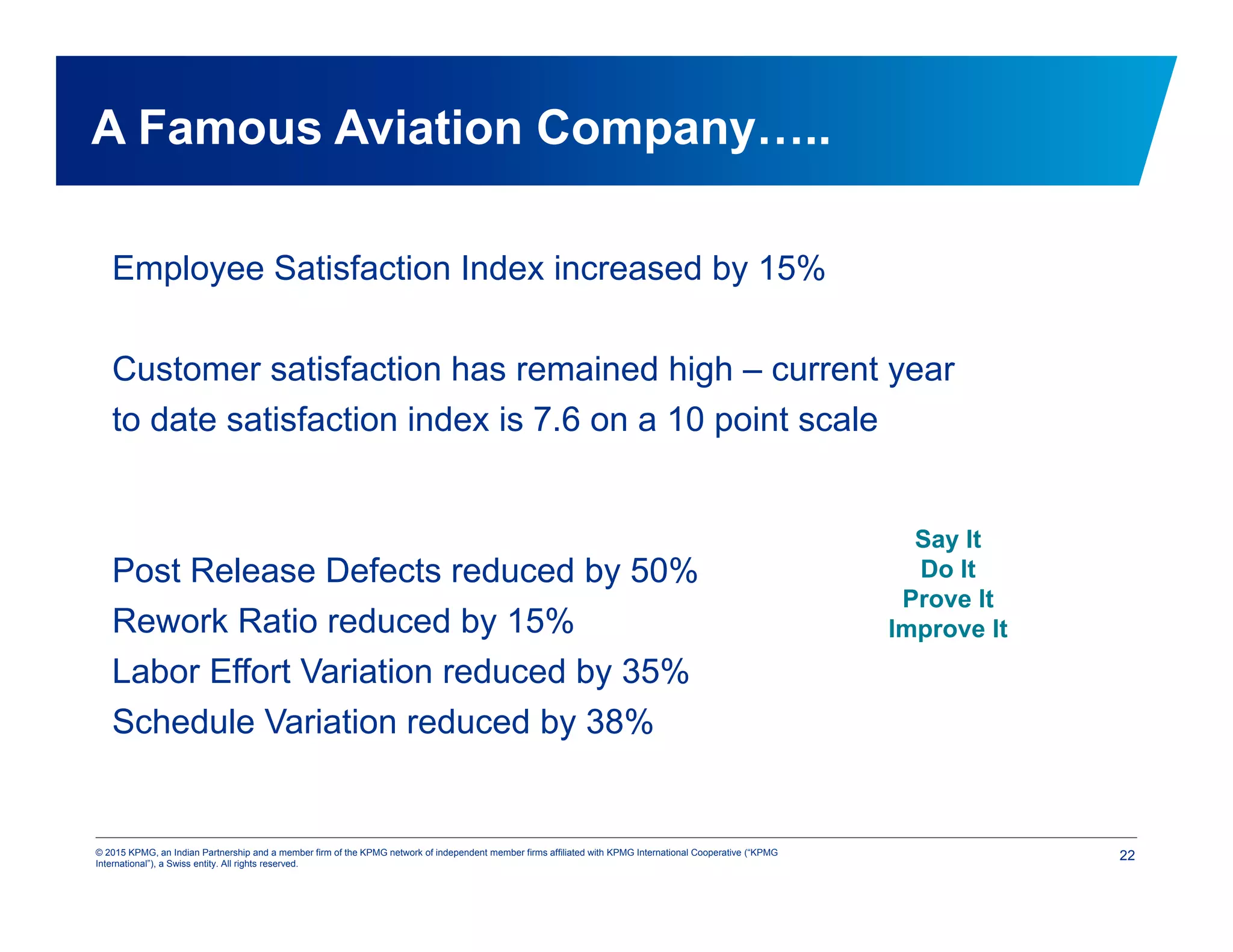
A Famous Aviation Company…..
Employee Satisfaction Index increased by 15%
Customer satisfaction has remained high – current year
to date satisfaction index is 7.6 on a 10 point scale
Post Release Defects reduced by 50%
Rework Ratio reduced by 15%
Labor Effort Variation reduced by 35%
Schedule Variation reduced by 38%
Say It
Do It
Prove It
Improve It
23© 2015 KPMG, an Indian Partnership and a member firm of the KPMG network of independent member firms affiliated with KPMG International Cooperative (“KPMG
International”), a Swiss entity. All rights reserved.
A Renowned Pharma company…
Thorhauge (2000)
Improved communication at all levels :
interrelated goals at all levels
IT tool for documenting goals & formal feedback
High employee satisfaction:
Participation in Employee satisfaction survey significantly increased
Satisfaction index observed to have increased by 45%
Staffing process redesigned:
shorten time-to-offer
improved rate of acceptance
24© 2015 KPMG, an Indian Partnership and a member firm of the KPMG network of independent member firms affiliated with KPMG International Cooperative (“KPMG
International”), a Swiss entity. All rights reserved.
A Reputed IT Organization…
“How we the People CMM to Improve Workforce
Practices”
“After investigating several different ideas, we decided the People CMM was the most
appropriate for our objectives of developing a world-class workforce and organizational
capabilities for IT by strategically shaping our future workforce and influencing our
partners and industry. The People CMM assessment conducted in the third quarter of
every year provides IT with a strategic road map for implementing areas for
improvement.”
Benefits
Clearly defined jobs with skill requirements
Skill gaps filled with job-specific training and nurturing individual accountability
Improved employee job classification and matching
Long-range career planning capability
High Quality communication across
Increased employee satisfaction
25© 2015 KPMG, an Indian Partnership and a member firm of the KPMG network of independent member firms affiliated with KPMG International Cooperative (“KPMG
International”), a Swiss entity. All rights reserved.
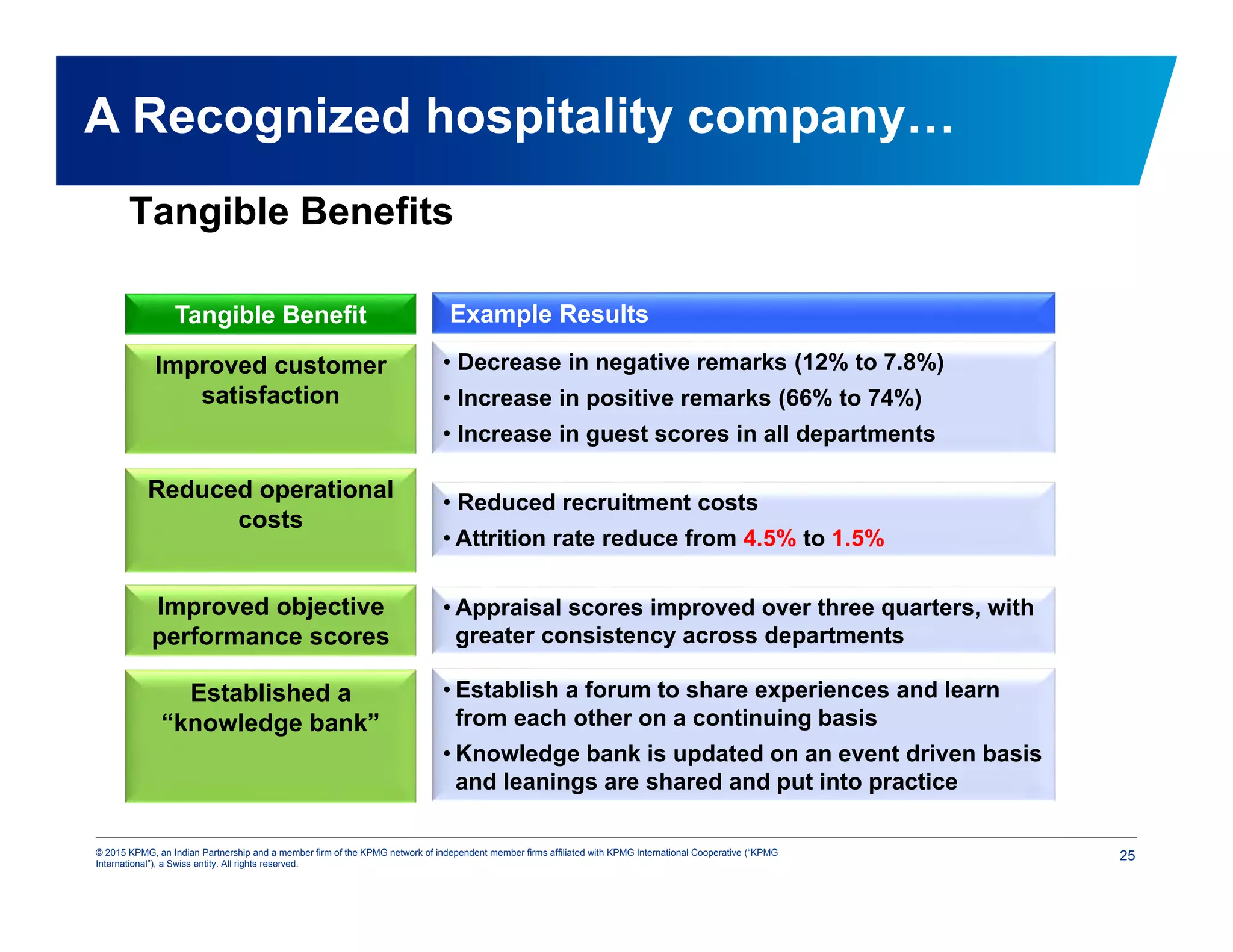
A Recognized hospitality company…
Tangible Benefits
Improved customer
satisfaction
• Decrease in negative remarks (12% to 7.8%)
• Increase in positive remarks (66% to 74%)
• Increase in guest scores in all departments
Reduced operational
costs
• Reduced recruitment costs
• Attrition rate reduce from 4.5% to 1.5%
Improved objective
performance scores
• Appraisal scores improved over three quarters, with
greater consistency across departments
Established a
“knowledge bank”
• Establish a forum to share experiences and learn
from each other on a continuing basis
• Knowledge bank is updated on an event driven basis
and leanings are shared and put into practice
Tangible Benefit Example Results
26© 2015 KPMG, an Indian Partnership and a member firm of the KPMG network of independent member firms affiliated with KPMG International Cooperative (“KPMG
International”), a Swiss entity. All rights reserved.
A Recognized hospitality company…
Intangible Benefits
Employee morale • Fall in attrition rate
• Better feedback on training and orientation activities
Greater cross-level
interaction
• Increase in voluntary participation
• Constructive debates on important issues
Rise in participation • Increase volunteering to committees
• Increase delegation in decision-making processes
Organizational culture
positive and open
• Clarity on unit processes and policies
• Level of interaction during orientation sessions
Intangible Benefit Example Results
27© 2015 KPMG, an Indian Partnership and a member firm of the KPMG network of independent member firms affiliated with KPMG International Cooperative (“KPMG
International”), a Swiss entity. All rights reserved.
The Most Admired & Largest IT Consulting
Company...
Why People CMM?
• Company was experiencing rapid growth and needed to establish a
measurable, repeatable, and predictable employment experience for its people
and processes
• Linking business outcomes to people practices
• The need to increase employee engagement and attract talent
• The need to develop distinctive capabilities
• Reduce risks associated with rapid growth
• To establish a capability development framework
• Increase employee engagement
28© 2015 KPMG, an Indian Partnership and a member firm of the KPMG network of independent member firms affiliated with KPMG International Cooperative (“KPMG
International”), a Swiss entity. All rights reserved.
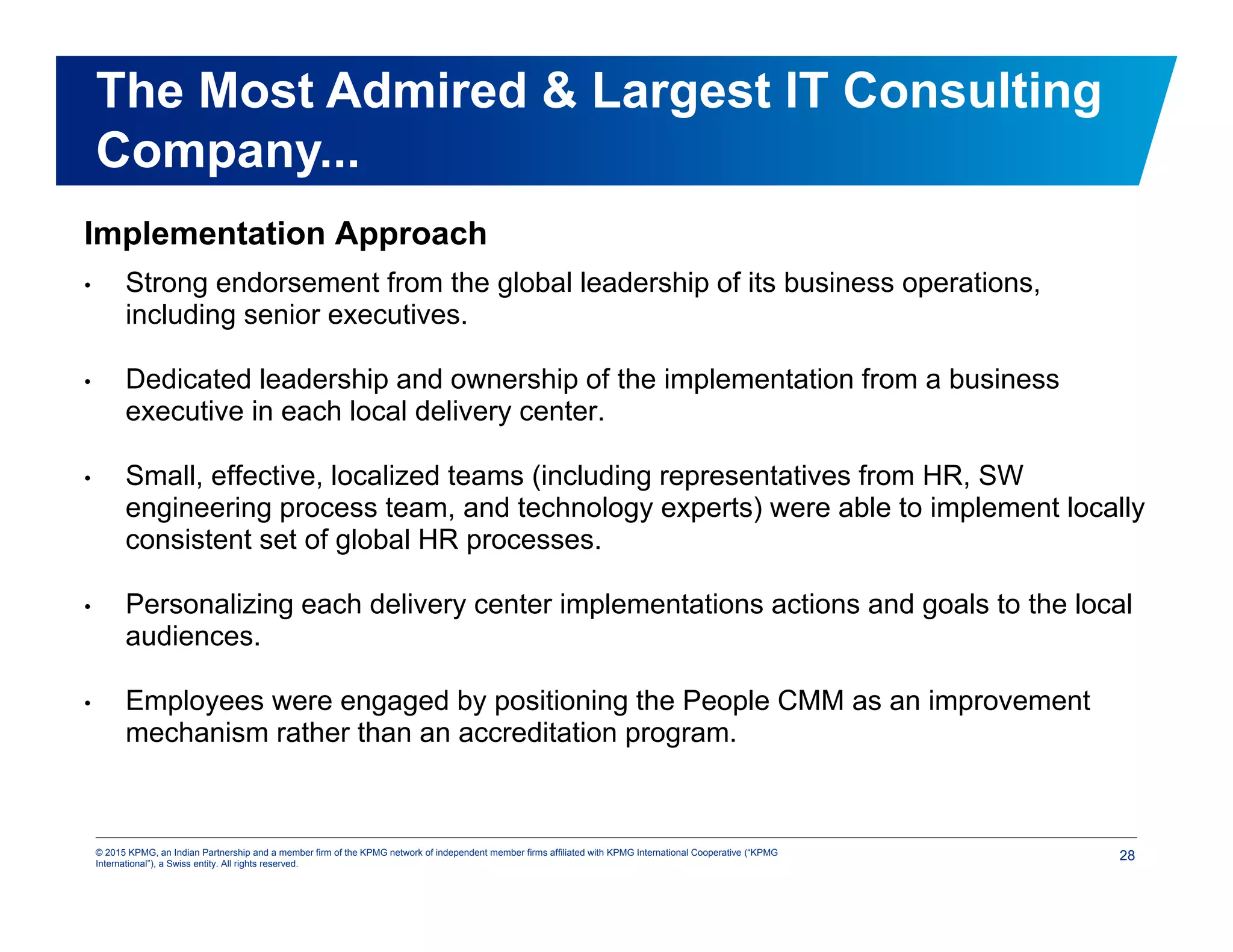
Implementation Approach
• Strong endorsement from the global leadership of its business operations,
including senior executives.
• Dedicated leadership and ownership of the implementation from a business
executive in each local delivery center.
• Small, effective, localized teams (including representatives from HR, SW
engineering process team, and technology experts) were able to implement locally
consistent set of global HR processes.
• Personalizing each delivery center implementations actions and goals to the local
audiences.
• Employees were engaged by positioning the People CMM as an improvement
mechanism rather than an accreditation program.
The Most Admired & Largest IT Consulting
Company...
29© 2015 KPMG, an Indian Partnership and a member firm of the KPMG network of independent member firms affiliated with KPMG International Cooperative (“KPMG
International”), a Swiss entity. All rights reserved.
Outcomes & Achievements
Adoption of the People CMM has helped Company’s delivery centers attain
remarkable achievements in business and workforce objectives including:
• Increased employee moral, satisfaction, and engagement
• Better talent management
• Improved workforce capability to meet business growth
• Improved marketability
• Employee engagement improved by 9%-16% in 2 years earning the company the
“Top Ten Best Employers in multiple countries”
• Significant reduction in Attrition from the range of 30%-35% to 15%-16%
• 20%-25% jump in manpower resource utilization
• Time taken to make new joiners productive reduced by 15%-20%
• Employee satisfaction score improved by 35% with very high participation
The Most Admired & Largest IT Consulting
Company...
© 2015 KPMG India Private Limited, an Indian limited liability company and a member
firm of the KPMG network of independent member firms affiliated with KPMG
International Cooperative (“KPMG International”), a Swiss entity. All rights reserved.
Thank You
Sankaran V
KPMG
Mail: vsankaran@kpmg.com

Talent management - The PCMM way

  • 1.
  • 2.
    2© 2015 KPMG,an Indian Partnership and a member firm of the KPMG network of independent member firms affiliated with KPMG International Cooperative (“KPMG International”), a Swiss entity. All rights reserved. Talent Management Talent management is the science of using strategic human resource planning to improve business value and to make it possible for companies and organizations to reach their goals. Everything done to recruit, retain, develop, reward and make people perform forms a part of talent management as well as strategic workforce planning. A talent-management strategy needs to link to business strategy to make sense Talent Management-The PCMM way
  • 3.
  • 4.
    4© 2015 KPMG,an Indian Partnership and a member firm of the KPMG network of independent member firms affiliated with KPMG International Cooperative (“KPMG International”), a Swiss entity. All rights reserved.
  • 5.
    5© 2015 KPMG,an Indian Partnership and a member firm of the KPMG network of independent member firms affiliated with KPMG International Cooperative (“KPMG International”), a Swiss entity. All rights reserved. Core People Issues Staffing and talent management Compensation Source: Future Insights, SHRM 09-700 (2009) Multiple generations in the workplace Performance Management Work/life balance
  • 6.
    6© 2015 KPMG,an Indian Partnership and a member firm of the KPMG network of independent member firms affiliated with KPMG International Cooperative (“KPMG International”), a Swiss entity. All rights reserved. Source: Towers Watson 2014 Global Workforce Study Engagement Segments
  • 7.
    7© 2015 KPMG,an Indian Partnership and a member firm of the KPMG network of independent member firms affiliated with KPMG International Cooperative (“KPMG International”), a Swiss entity. All rights reserved. Source: Towers Watson 2014 Global Workforce Study Top Drivers for Sustainable Engagement
  • 8.
    8© 2015 KPMG,an Indian Partnership and a member firm of the KPMG network of independent member firms affiliated with KPMG International Cooperative (“KPMG International”), a Swiss entity. All rights reserved. Source: Towers Watson 2014 Global Workforce Study Attraction and Retention Drivers
  • 9.
    9© 2015 KPMG,an Indian Partnership and a member firm of the KPMG network of independent member firms affiliated with KPMG International Cooperative (“KPMG International”), a Swiss entity. All rights reserved.
  • 10.
    10© 2015 KPMG,an Indian Partnership and a member firm of the KPMG network of independent member firms affiliated with KPMG International Cooperative (“KPMG International”), a Swiss entity. All rights reserved. Who’s Managing the Organization’s Assets? “Our greatest asset is our People” Yet, many organizations leave the management of their greatest asset, to “managers”, who have limited experience, skills, or information to be effective managers. Managers impact • perception of the organization — manager represents the company • retention — people leave manager first, company second • performance • morale • unit‘s bottom-line
  • 11.
    11© 2015 KPMG,an Indian Partnership and a member firm of the KPMG network of independent member firms affiliated with KPMG International Cooperative (“KPMG International”), a Swiss entity. All rights reserved. The “Manager”: A People CMM Perspective A manager • accepts stewardship of a resource • provides technical and administrative direction and control to individual performing tasks • develops and optimizes the conditions affecting success • plans, resources, and controls work within their responsibility Many “types” of managers • senior manager, middle manager line manager, team leader, etc.
  • 12.
    12© 2015 KPMG,an Indian Partnership and a member firm of the KPMG network of independent member firms affiliated with KPMG International Cooperative (“KPMG International”), a Swiss entity. All rights reserved. Biggest Challenges Facing HR Executives In the coming 10 years 49% 43% Retaining and rewarding the best people Creating a corporate culture that attracts the best people to our organization Finding people with the increasingly specialized skills we need Developing the next generation of corporate leaders Breaking down cultural barriers that make it difficult to create a truly global company Remaining competitive in the talent marketplace Creating smooth and efficient HR processes that ensure a good employee experience Creating an employee-centric, service-oriented HR organization Other (1%) and Don’t know (3%) 32% Finding the right people in the right markets where we do business around the world 39% 28% 23% 20% 16% 12% 4%
  • 13.
  • 14.
    14© 2015 KPMG,an Indian Partnership and a member firm of the KPMG network of independent member firms affiliated with KPMG International Cooperative (“KPMG International”), a Swiss entity. All rights reserved. PCMM Maturity Framework Humphrey (1989), Paulk et al. (1995), Cutis et al. (1995) Managed practices Tailored practices Measured and aligned practices Continuously improving practices People management Competence management Team management Capability management Level 1 Initial Level 2 Managed Level 3 Defined Level 4 Predictable Level 5 Optimizing
  • 15.
    15© 2015 KPMG,an Indian Partnership and a member firm of the KPMG network of independent member firms affiliated with KPMG International Cooperative (“KPMG International”), a Swiss entity. All rights reserved. People CMM Architecture 1 Initial 2 Managed Managers take responsibility for managing and developing their people Compensation Training & Development Performance Management Staffing Communication & Co-ordination Work Environment 3 Defined Organization develops a framework of workforce Competencies required to accomplish its business objectives Participatory Culture Workgroup Development Competency-Based Practices Career Development Competency Development Workforce Planning Competency Analysis 4 Predictable Capability is managed quantitatively and the organization exploits its opportunities in its competency framework Mentoring Organizational Capability Management Quantitative Performance Management Empowered workgroup Competency-Based Assets Competency Integration 5 Optimizing Capability and performance continually improved Continuous Workforce Innovation Organizational Performance Alignment Continuous Capability Improvement Level Focus Key Process Areas
  • 16.
    16© 2015 KPMG,an Indian Partnership and a member firm of the KPMG network of independent member firms affiliated with KPMG International Cooperative (“KPMG International”), a Swiss entity. All rights reserved. Threads in the People CMM Levels Developing Competency Building workgroups & culture Motivating & managing performance Shaping the workforce 5 Optimizing Continuous Capability Improvement Organizational Performance Alignment Continuous workforce Innovation 4 Predictable Competency based assets Mentoring Competency Integration Empowered Workgroups Quantitative Performance Management Organizational Capability Management 3 Defined Competency Development Competency Analysis Workgroup Development Participatory Culture Competency based practices Career Development Workforce Planning 2 Managed Training and Development Communication & Coordination Compensation Performance Management Work environment Staffing
  • 17.
    17© 2015 KPMG,an Indian Partnership and a member firm of the KPMG network of independent member firms affiliated with KPMG International Cooperative (“KPMG International”), a Swiss entity. All rights reserved.
  • 18.
    18© 2015 KPMG,an Indian Partnership and a member firm of the KPMG network of independent member firms affiliated with KPMG International Cooperative (“KPMG International”), a Swiss entity. All rights reserved.
  • 19.
  • 20.
    20© 2015 KPMG,an Indian Partnership and a member firm of the KPMG network of independent member firms affiliated with KPMG International Cooperative (“KPMG International”), a Swiss entity. All rights reserved. SEI IDEALSM Model Establish improve- ment infra- structure Learning Establishing Acting Stimulus for change Set context Build sponsor- ship Character- ize current & desired states Develop recommen- dations Set priorities Develop approach Plan actions Create solution Pilot test solution Refine solution Implement solution Analyze and validate Propose future actions Diagnosing Initiating SM IDEAL is a service mark of Carnegie Mellon University
  • 21.
  • 22.
    22© 2015 KPMG,an Indian Partnership and a member firm of the KPMG network of independent member firms affiliated with KPMG International Cooperative (“KPMG International”), a Swiss entity. All rights reserved. A Famous Aviation Company….. Employee Satisfaction Index increased by 15% Customer satisfaction has remained high – current year to date satisfaction index is 7.6 on a 10 point scale Post Release Defects reduced by 50% Rework Ratio reduced by 15% Labor Effort Variation reduced by 35% Schedule Variation reduced by 38% Say It Do It Prove It Improve It
  • 23.
    23© 2015 KPMG,an Indian Partnership and a member firm of the KPMG network of independent member firms affiliated with KPMG International Cooperative (“KPMG International”), a Swiss entity. All rights reserved. A Renowned Pharma company… Thorhauge (2000) Improved communication at all levels : interrelated goals at all levels IT tool for documenting goals & formal feedback High employee satisfaction: Participation in Employee satisfaction survey significantly increased Satisfaction index observed to have increased by 45% Staffing process redesigned: shorten time-to-offer improved rate of acceptance
  • 24.
    24© 2015 KPMG,an Indian Partnership and a member firm of the KPMG network of independent member firms affiliated with KPMG International Cooperative (“KPMG International”), a Swiss entity. All rights reserved. A Reputed IT Organization… “How we the People CMM to Improve Workforce Practices” “After investigating several different ideas, we decided the People CMM was the most appropriate for our objectives of developing a world-class workforce and organizational capabilities for IT by strategically shaping our future workforce and influencing our partners and industry. The People CMM assessment conducted in the third quarter of every year provides IT with a strategic road map for implementing areas for improvement.” Benefits Clearly defined jobs with skill requirements Skill gaps filled with job-specific training and nurturing individual accountability Improved employee job classification and matching Long-range career planning capability High Quality communication across Increased employee satisfaction
  • 25.
    25© 2015 KPMG,an Indian Partnership and a member firm of the KPMG network of independent member firms affiliated with KPMG International Cooperative (“KPMG International”), a Swiss entity. All rights reserved. A Recognized hospitality company… Tangible Benefits Improved customer satisfaction • Decrease in negative remarks (12% to 7.8%) • Increase in positive remarks (66% to 74%) • Increase in guest scores in all departments Reduced operational costs • Reduced recruitment costs • Attrition rate reduce from 4.5% to 1.5% Improved objective performance scores • Appraisal scores improved over three quarters, with greater consistency across departments Established a “knowledge bank” • Establish a forum to share experiences and learn from each other on a continuing basis • Knowledge bank is updated on an event driven basis and leanings are shared and put into practice Tangible Benefit Example Results
  • 26.
    26© 2015 KPMG,an Indian Partnership and a member firm of the KPMG network of independent member firms affiliated with KPMG International Cooperative (“KPMG International”), a Swiss entity. All rights reserved. A Recognized hospitality company… Intangible Benefits Employee morale • Fall in attrition rate • Better feedback on training and orientation activities Greater cross-level interaction • Increase in voluntary participation • Constructive debates on important issues Rise in participation • Increase volunteering to committees • Increase delegation in decision-making processes Organizational culture positive and open • Clarity on unit processes and policies • Level of interaction during orientation sessions Intangible Benefit Example Results
  • 27.
    27© 2015 KPMG,an Indian Partnership and a member firm of the KPMG network of independent member firms affiliated with KPMG International Cooperative (“KPMG International”), a Swiss entity. All rights reserved. The Most Admired & Largest IT Consulting Company... Why People CMM? • Company was experiencing rapid growth and needed to establish a measurable, repeatable, and predictable employment experience for its people and processes • Linking business outcomes to people practices • The need to increase employee engagement and attract talent • The need to develop distinctive capabilities • Reduce risks associated with rapid growth • To establish a capability development framework • Increase employee engagement
  • 28.
    28© 2015 KPMG,an Indian Partnership and a member firm of the KPMG network of independent member firms affiliated with KPMG International Cooperative (“KPMG International”), a Swiss entity. All rights reserved. Implementation Approach • Strong endorsement from the global leadership of its business operations, including senior executives. • Dedicated leadership and ownership of the implementation from a business executive in each local delivery center. • Small, effective, localized teams (including representatives from HR, SW engineering process team, and technology experts) were able to implement locally consistent set of global HR processes. • Personalizing each delivery center implementations actions and goals to the local audiences. • Employees were engaged by positioning the People CMM as an improvement mechanism rather than an accreditation program. The Most Admired & Largest IT Consulting Company...
  • 29.
    29© 2015 KPMG,an Indian Partnership and a member firm of the KPMG network of independent member firms affiliated with KPMG International Cooperative (“KPMG International”), a Swiss entity. All rights reserved. Outcomes & Achievements Adoption of the People CMM has helped Company’s delivery centers attain remarkable achievements in business and workforce objectives including: • Increased employee moral, satisfaction, and engagement • Better talent management • Improved workforce capability to meet business growth • Improved marketability • Employee engagement improved by 9%-16% in 2 years earning the company the “Top Ten Best Employers in multiple countries” • Significant reduction in Attrition from the range of 30%-35% to 15%-16% • 20%-25% jump in manpower resource utilization • Time taken to make new joiners productive reduced by 15%-20% • Employee satisfaction score improved by 35% with very high participation The Most Admired & Largest IT Consulting Company...
  • 30.
    © 2015 KPMGIndia Private Limited, an Indian limited liability company and a member firm of the KPMG network of independent member firms affiliated with KPMG International Cooperative (“KPMG International”), a Swiss entity. All rights reserved. Thank You Sankaran V KPMG Mail: vsankaran@kpmg.com